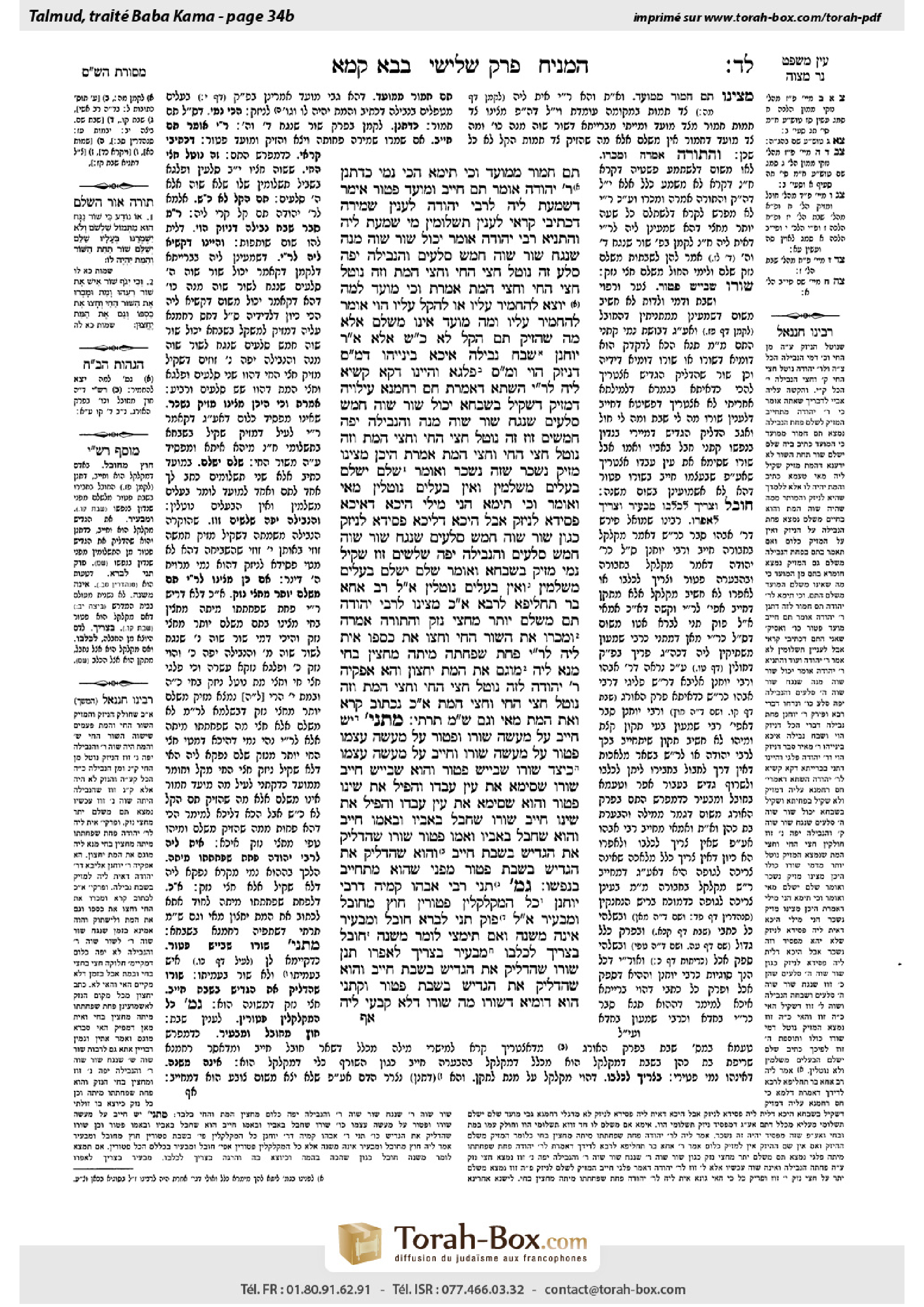
Bava Kamma 34b: Talmud study for Daf Yomi
Study the Talmud for Daf Yomi with scanned pages, Hebrew text, English translations from Sefaria and AI-generated French translations.
Passage selection and English or AI-generated French translation are available where the scan has annotations. Daf Study is independent of Torah-Box and Sefaria.
Browse Bava Kamma · בבא קמא · All tractatesBava Kamma 34b text and translations
This page of Bava Kamma includes the Aramaic text, an English translation and an AI-generated French translation, alongside the scan above.
בבא קמא ל״ד ב · Aramaic and Hebrew text
תָּם חָמוּר מִמּוּעָד!
וְכִי תֵּימָא הָכִי נָמֵי – כְּדִתְנַן, רַבִּי יְהוּדָה אוֹמֵר: תָּם חַיָּיב, וּמוּעָד פָּטוּר; אֵימַר דְּשָׁמְעַתְּ לֵיהּ לְרַבִּי יְהוּדָה – לְעִנְיַן שְׁמִירָה, דִּכְתִיבִי קְרָאֵי; לְעִנְיַן תַּשְׁלוּמִין מִי שָׁמְעַתְּ לֵיהּ?!
וְהָתַנְיָא, רַבִּי יְהוּדָה אוֹמֵר: יָכוֹל שׁוֹר שָׁוֶה מָנֶה שֶׁנָּגַח שׁוֹר שָׁוֶה חָמֵשׁ סְלָעִים, וְהַנְּבֵילָה יָפָה סֶלַע – זֶה נוֹטֵל חֲצִי הַחַי וַחֲצִי הַמֵּת, וְזֶה נוֹטֵל חֲצִי הַחַי וַחֲצִי הַמֵּת?
אָמַרְתָּ: וְכִי מוּעָד לָמָּה יוֹצֵא – לְהַחְמִיר עָלָיו אוֹ לְהָקֵל עָלָיו? הֱוֵי אוֹמֵר לְהַחְמִיר עָלָיו; וּמָה מוּעָד אֵינוֹ מְשַׁלֵּם אֶלָּא מַה שֶּׁהִזִּיק, תָּם הַקַּל לֹא כׇּל שֶׁכֵּן?
אֶלָּא אָמַר רַבִּי יוֹחָנָן: שֶׁבַח נְבֵילָה אִיכָּא בֵּינַיְיהוּ, דְּמָר סָבַר: דְּנִיזָּק הָוֵי, וּמָר סָבַר: פַּלְגָא.
וְהַיְינוּ דְּקָא קַשְׁיָא לֵיהּ לְרַבִּי יְהוּדָה – הַשְׁתָּא דְּאָמְרַתְּ חָס רַחֲמָנָא עִילָּוֵיהּ דְּמַזִּיק, דְּשָׁקֵיל בִּשְׁבָחָא; יָכוֹל שׁוֹר שָׁוֶה חָמֵשׁ סְלָעִים שֶׁנָּגַח שׁוֹר שָׁוֶה מָנֶה, וְהַנְּבֵילָה יָפָה חֲמִשִּׁים זוּז – זֶה נוֹטֵל חֲצִי הַחַי וַחֲצִי הַמֵּת, וְזֶה נוֹטֵל חֲצִי הַחַי וַחֲצִי הַמֵּת?
אָמַרְתָּ: הֵיכָן מָצִינוּ מַזִּיק נִשְׂכָּר, שֶׁזֶּה נִשְׂכָּר? וְאוֹמֵר: ״שַׁלֵּם יְשַׁלֵּם״ – בְּעָלִים מְשַׁלְּמִין, וְאֵין בְּעָלִים נוֹטְלִין.
מַאי ״וְאוֹמֵר״? וְכִי תֵּימָא: הָנֵי מִילֵּי הֵיכָא דְּאִיכָּא פְּסֵידָא לְנִיזָּק; אֲבָל הֵיכָא דְּלֵיכָּא פְּסֵידָא לְנִיזָּק – כְּגוֹן שׁוֹר שָׁוֶה חָמֵשׁ סְלָעִים שֶׁנָּגַח שׁוֹר שָׁוֶה חָמֵשׁ סְלָעִים, וְהַנְּבֵילָה יָפָה שְׁלֹשִׁים זוּז – שָׁקֵיל נָמֵי מַזִּיק בִּשְׁבָחָא;
וְאוֹמֵר: ״שַׁלֵּם יְשַׁלֵּם״ – בְּעָלִים מְשַׁלְּמִין, וְאֵין בְּעָלִים נוֹטְלִין.
אֲמַר לֵיהּ רַב אַחָא בַּר תַּחְלִיפָא לְרָבָא: אִם כֵּן, מָצִינוּ לְרַבִּי יְהוּדָה תָּם מְשַׁלֵּם יוֹתֵר מֵחֲצִי נֶזֶק, וְהַתּוֹרָה אָמְרָה: ״וּמָכְרוּ אֶת הַשּׁוֹר הַחַי וְחָצוּ אֶת כַּסְפּוֹ״!
אִית לֵיהּ לְרַבִּי יְהוּדָה: פְּחָת שֶׁפָּחֲתָה מִיתָה – מַחֲצִין בַּחַי.
מְנָא לֵיהּ? מִ״וְּגַם אֶת הַמֵּת יֶחֱצוּן״?! וְהָא אַפְּקֵיהּ רַבִּי יְהוּדָה לְזֶה נוֹטֵל חֲצִי הַחַי וַחֲצִי הַמֵּת, וְזֶה נוֹטֵל חֲצִי הַחַי וַחֲצִי הַמֵּת!
אִם כֵּן, נִכְתּוֹב קְרָא: ״וְאֶת הַמֵּת״! מַאי ״וְגַם״? שְׁמַע מִינַּהּ תַּרְתֵּי.
מַתְנִי׳ יֵשׁ חַיָּיב עַל מַעֲשֵׂה שׁוֹרוֹ וּפָטוּר עַל מַעֲשֵׂה עַצְמוֹ, פָּטוּר עַל מַעֲשֵׂה שׁוֹרוֹ וְחַיָּיב עַל מַעֲשֵׂה עַצְמוֹ.
כֵּיצַד? שׁוֹרוֹ שֶׁבִּיֵּישׁ – פָּטוּר, וְהוּא שֶׁבִּיֵּישׁ – חַיָּיב. שׁוֹרוֹ שֶׁסִּימֵּא אֶת עֵין עַבְדּוֹ וְהִפִּיל אֶת שִׁינּוֹ – פָּטוּר, וְהוּא שֶׁסִּימֵּא אֶת עֵין עַבְדּוֹ וְהִפִּיל אֶת שִׁינּוֹ – חַיָּיב.
שׁוֹרוֹ שֶׁחָבַל בְּאָבִיו וּבְאִמּוֹ – חַיָּיב, וְהוּא שֶׁחָבַל בְּאָבִיו וְאִמּוֹ – פָּטוּר. שׁוֹרוֹ שֶׁהִדְלִיק אֶת הַגָּדִישׁ בְּשַׁבָּת – חַיָּיב, וְהוּא שֶׁהִדְלִיק אֶת הַגָּדִישׁ בְּשַׁבָּת – פָּטוּר, מִפְּנֵי שֶׁהוּא מִתְחַיֵּיב בְּנַפְשׁוֹ.
גְּמָ׳ תָּנֵי רַבִּי אֲבָהוּ קַמֵּיהּ דְּרַבִּי יוֹחָנָן: כׇּל הַמְקַלְקְלִין פְּטוּרִין, חוּץ מֵחוֹבֵל וּמַבְעִיר. אֲמַר לֵיהּ: פּוֹק תָּנֵי לְבָרָא! חוֹבֵל וּמַבְעִיר אֵינָהּ מִשְׁנָה. וְאִם תִּימְצֵי לוֹמַר מִשְׁנָה; חוֹבֵל – בְּצָרִיךְ לְכַלְבּוֹ, מַבְעִיר – בְּצָרִיךְ לְאֶפְרוֹ.
תְּנַן: שׁוֹרוֹ שֶׁהִדְלִיק אֶת הַגָּדִישׁ בְּשַׁבָּת – חַיָּיב, וְהוּא שֶׁהִדְלִיק אֶת הַגָּדִישׁ בְּשַׁבָּת – פָּטוּר. וְקָתָנֵי הוּא דּוּמְיָא דְשׁוֹרוֹ – מָה שׁוֹרוֹ דְּלָא קָבָעֵי לֵיהּ,
Bava Kamma 34b · English translation
a case where the halakha with regard to an innocuous ox that causes damage is more stringent than with regard to a forewarned ox, since according to all opinions, in a case where a forewarned ox kills another ox, the carcass belongs exclusively to the injured party, and he sustains any subsequent decrease in its value.
And if you would say that indeed, Rabbi Yehuda holds that the halakha with regard to an innocuous ox is more stringent than with regard to a forewarned ox, as we learned in a mishna that Rabbi Yehuda says: If a bailee did not safeguard an ox properly, and it escaped and caused damage, if it was an innocuous ox he is liable, and if it was a forewarned ox he is exempt (45b), that mishna cannot serve as proof for the issue under discussion. Say that you heard Rabbi Yehuda express this opinion, that the halakha with regard to an innocuous ox is more stringent, with regard to the halakhot of safeguarding, as verses are written in the Torah from which this halakha is derived. But with regard to compensation, did you ever hear him express this opinion?
On the contrary; but isn’t it taught in a baraita that Rabbi Yehuda says: One might have thought that in the case of an ox worth one hundred dinars that gored an ox worth five sela, i.e., twenty dinars, and the carcass is worth one sela, i.e., four dinars, the halakha is that this party takes half the living ox and half the dead ox, and that party takes half the living ox and half the dead ox. Accordingly, the injured party receives fifty-two dinars in value, which is much more than his ox was worth before it was killed.
Instead, continues Rabbi Yehuda, you should say: For what purpose is the case of a forewarned ox singled out by the halakha? Is it to render it more stringent than the case of an innocuous ox, or to render it more lenient? Clearly, you must say that it is to render it more stringent. And therefore, if in the case of a forewarned ox, its owner pays only the value of what he damaged and no more, in the case of an innocuous ox, which is more lenient, all the more so is it not clear that the owner is not liable to pay more than the value of the damage? Evidently, Rabbi Yehuda does not allow for liability in the case of an innocuous ox to be more stringent than in the case of a forewarned ox.
Rather, Rava’s explanation, that Rabbi Meir and Rabbi Yehuda disagree with regard to a case where the carcass depreciated in value, should be rejected. Instead, their dispute should be explained according to what Rabbi Yoḥanan said, i.e., that the practical difference between them is with regard to the appreciation of the carcass in value after the ox’s death; as one Sage, Rabbi Meir, holds that the entire increased value of the carcass belongs to the injured party, since the owner of the belligerent ox has no share in the carcass, and one Sage, Rabbi Yehuda, holds that half of the increased value belongs to the injured party and half goes to the one liable for the damage.
And this explains what was difficult for Rabbi Yehuda in another baraita. Now that you say that the Merciful One has mercy on the one liable for damage, as he takes a share of the increased value of the carcass, can it be that in the case of an ox worth five sela, i.e., twenty dinars, that gored an ox worth one hundred dinars, and the carcass is worth fifty dinars, this party takes half the live ox and half the dead ox, and that party takes half the live ox and half the dead ox? Accordingly, the owner of the belligerent ox receives thirty-five dinars in value, which is more than his ox was worth.
Rather, you should say: Where do we find a case where the one liable for damage gains from the damage, comparable to this case, where this owner of the belligerent ox gains, receiving more than the value of his ox? Clearly there is no such case, as one who is liable for damage does not gain from it. And in addition, it says: “He shall pay” (Exodus 21:36), indicating that the owner of the belligerent ox pays, and the owner does not take more than the amount his animal was worth at the time of the damage.
The Gemara asks: For what reason was it necessary to add the claim: And it says: “He shall pay”? The Gemara answers: Lest you say that this matter, that the one liable for damage does not gain, applies specifically where there is a loss sustained by the injured party, as in this case, where the decrease in the ox’s value is fifty dinars, and if the carcass is shared by the liable party, the injured party receives only thirty-five dinars, thereby sustaining a loss. But in a case where there is no loss sustained by the injured party, for example, the case of an ox worth five sela, i.e., twenty dinars, that gored another ox worth five sela, and the carcass appreciated in value and is now worth thirty dinars, more than the ox was worth when it was alive, in this case the one liable for damage also takes a share of the increased value, since the injured party ends up not having sustained any financial loss, as he receives a share of ten dinars in the belligerent ox and another fifteen in the carcass, gaining five dinars over the value of his ox.
It is to counter this claim that Rabbi Yehuda adds: And it says: “He shall pay,” indicating that the owner of the belligerent ox pays, and the owner does not take more than the amount his animal was worth at the time of the damage.
§ With regard to Rabbi Yehuda’s opinion that the two owners split the value of both the belligerent ox and the dead ox between them, Rav Aḥa bar Taḥalifa said to Rava: If so, we find that according to Rabbi Yehuda, when an innocuous ox gores an ox that is worth less than it, its owner pays more than half the damage. But the Torah stated: “Then they shall sell the live ox, and divide its monetary value” (Exodus 21:35).
Rava answered him: Rabbi Yehuda also holds that only the diminished value of the dead ox that was diminished by its death is compensated for by dividing the live ox between the two parties. The liable party never pays more than half the damage.
The Gemara asks: From where does Rabbi Yehuda derive this halakha? Is it from the verse: “And the carcass they shall also divide” (Exodus 21:35), from which Rabbi Meir derived it? But didn’t Rabbi Yehuda already derive from this verse that this party takes the value of half the live ox and half the dead ox, and that party takes the value of half the live ox and half the dead ox?
The Gemara answers: If so, if that is the only halakha indicated by this clause, let the verse simply write: And the carcass they shall divide. What is the reason that the word “also” is added? It is added so that one may conclude two conclusions from the clause: That the carcass is also divided between the two parties, and that the liable party is never required to pay more than half the damage.
MISHNA: There are cases where one is liable for an act of damage caused by his ox, but exempt from liability for the same action if he performed it himself. Conversely, there are also cases where one is exempt from liability for the action of his ox, but liable for his own action.
How so? If his ox caused a person humilation, he is exempt from paying compensation, but if he himself humiliated another, he is liable. Similarly, if his ox blinded the eye of his slave or knocked out his slave’s tooth, he is exempt from having to emancipate the slave for this mutilation. But if he himself blinded his slave’s eye or knocked out his tooth, he is liable to emancipate him, as stated in the Torah (Exodus 21:26–27).
By contrast, if his ox injured the owner’s father or his mother, he is liable to pay damages, but if he himself injured his father or his mother, he is exempt from paying compensation. Similarly, if his ox set fire to a haystack on Shabbat, he is liable to pay damages. But if he himself set fire to a haystack on Shabbat, he is exempt from paying damages. He is exempt from payment in these cases due to the fact that he is liable to receive the death penalty for injuring his father or mother or for desecrating Shabbat.
GEMARA: Rabbi Abbahu taught the following baraita before Rabbi Yoḥanan: Anyone who performs labor destructively on Shabbat is exempt, except for one who injures another or kindles a fire. Rabbi Yoḥanan said to him: Go out and teach it outside; this baraita is not fit for discussion in the study hall. The opinion that deems one liable for injuring another or kindling a fire on Shabbat is not a mishna and should be ignored. And if you say that it is a mishna, one who injures another would be liable only in a case where he requires the blood to give to his dog, and one who kindles a fire would be liable only in a case where he requires its ashes. In these cases, the act is not purely destructive but has some constructive purpose.
We learned in the mishna: If his ox set fire to a haystack on Shabbat, he is liable. But if he himself set fire to a haystack on Shabbat, he is exempt. And the mishna is presumably teaching a case where he set the fire in a scenario that is similar to the case where his ox did so. Just as in the case where his ox set the fire it clearly does not need the ashes, as an ox does not act with such intentions,
Bava Kamma 34b · Traduction française (IA)
un cas où la halakha concernant un taureau inoffensif qui cause des dommages est plus exigeante que celle concernant un taureau averti, car selon toutes les opinions, dans un cas où un taureau averti tue un autre taureau, la dépouille appartient exclusivement à la partie blessée, et elle subit toute diminution ultérieure de sa valeur.
Et si vous dites que, en effet, Rabbi Yéhuda considère que la halakha concernant un taureau inoffensif est plus exigeante que celle concernant un taureau averti, comme nous l'avons appris dans une mitsva que Rabbi Yéhuda dit : Si un dépositaire n'a pas gardé un taureau correctement et qu'il s'est échappé et a causé des dommages, si c'était un taureau inoffensif, il est responsable, et si c'était un taureau averti, il est exempt (45b), cette mitsva ne peut pas servir de preuve pour le sujet en discussion. Dites que vous avez entendu Rabbi Yéhuda exprimer cet avis, que la halakha concernant un taureau inoffensif est plus exigeante, concernant les halakhot de garde, comme des versets sont écrits dans la Torah d'où cette halakha est tirée. Mais concernant la compensation, avez-vous jamais entendu qu'il exprime cet avis ?
Au contraire ; mais n'est-ce pas enseigné dans une baraïta que Rabbi Yéhuda dit : On pourrait penser que dans le cas d'un taureau valant cent dinars qui a écorné un taureau valant cinq sela, c'est-à-dire vingt dinars, et que la dépouille vaut un sela, c'est-à-dire quatre dinars, la halakha est que cette partie prend la moitié du taureau vivant et la moitié du taureau mort, et que cette autre partie prend la moitié du taureau vivant et la moitié du taureau mort. Ainsi, la partie blessée reçoit cinquante-deux dinars de valeur, ce qui est bien plus que la valeur de son taureau avant qu'il ne soit tué.
Au contraire, continue Rabbi Yéhuda, vous devriez dire : Pour quelle raison la halakha distingue spécifiquement le cas d'un taureau averti ? Est-ce pour le rendre plus exigeant que celui d'un taureau inoffensif, ou pour le rendre plus clément ? Évidemment, vous devez dire qu'il est pour le rendre plus exigeant. Et donc, si, dans le cas d'un taureau averti, son propriétaire paie seulement la valeur des dommages et pas plus, dans le cas d'un taureau inoffensif, qui est plus clément, tout autant que cela n'est pas clair que le propriétaire ne soit pas tenu de payer plus que la valeur des dommages ? Évidemment, Rabbi Yéhuda ne permet pas que la responsabilité dans le cas d'un taureau inoffensif soit plus exigeante que dans le cas d'un taureau averti.
Plutôt, l'explication de Rava, que Rabbi Meïr et Rabbi Yéhuda divergent concernant un cas où la dépouille a perdu en valeur, devrait être rejetée. Plutôt, leur débat devrait être expliqué selon ce que Rabbi Yochanan a dit, c'est-à-dire que la différence pratique entre eux concerne l'appréciation de la dépouille après la mort du taureau ; comme un Sage, Rabbi Meïr, considère que toute la valeur augmentée de la dépouille appartient à la partie blessée, puisque le propriétaire du taureau agressif n'a pas de part dans la dépouille, et un autre Sage, Rabbi Yéhuda, considère que la moitié de la valeur augmentée appartient à la partie blessée et la moitié va au responsable des dommages.
Et cela explique ce qui était difficile pour Rabbi Yéhuda dans une autre baraïta. Maintenant que vous dites que l'Éternel a miséricorde sur celui qui est responsable des dommages, comme il prend une part de la valeur augmentée de la dépouille, peut-il être que dans le cas d'un taureau valant cinq sela, c'est-à-dire vingt dinars, qui a écorné un taureau valant cent dinars, et la dépouille vaut cinquante dinars, cette partie prend la moitié du taureau vivant et la moitié du taureau mort, et cette autre partie prend la moitié du taureau vivant et la moitié du taureau mort ? Ainsi, le propriétaire du taureau agressif reçoit trente-cinq dinars de valeur, ce qui est plus que la valeur de son taureau.
Plutôt, vous devriez dire : Où trouvons-nous un cas où celui qui est responsable des dommages gagne de ce dommage, comparable à ce cas, où ce propriétaire du taureau agressif gagne, recevant plus que la valeur de son taureau ? Évidemment, il n'y a pas de tel cas, puisque celui qui est responsable des dommages ne gagne pas de ce fait. Et en outre, il est dit : « Il paiera » (Exode 21:36), indiquant que le propriétaire du taureau agressif paie, et le propriétaire ne prend pas plus que la somme que son animal valait au moment du dommage.
La Guemara demande : Pour quelle raison a-t-on besoin d'ajouter la déclaration : « Il paiera » ? La Guemara répond : Pour éviter que l'on dise que cette affaire, selon laquelle celui qui est responsable des dommages ne gagne pas, s'applique spécifiquement dans un cas où la partie blessée subit une perte, comme dans ce cas-ci, où la diminution de la valeur du taureau est de cinquante dinars, et si la dépouille est partagée par la partie responsable, la partie blessée reçoit seulement trente-cinq dinars, subissant ainsi une perte. Mais dans un cas où il n'y a pas de perte subie par la partie blessée, par exemple, le cas d'un taureau valant cinq sela, c'est-à-dire vingt dinars, qui a écorné un autre taureau valant cinq sela, et la dépouille a augmenté en valeur et vaut maintenant trente dinars, plus que le taureau vivant, dans ce cas, la partie responsable des dommages prend aussi une part de la valeur augmentée, puisque la partie blessée finit par ne pas avoir subi de perte financière, comme il reçoit une part de dix dinars du taureau agressif et quinze dinars de la dépouille, gagnant cinq dinars sur la valeur de son taureau.
C'est pour contredire cette affirmation que Rabbi Yéhuda ajoute : « Il paiera », indiquant que le propriétaire du taureau agressif paie, et le propriétaire ne prend pas plus que la somme que son animal valait au moment du dommage.
§ Concernant l'opinion de Rabbi Yéhuda que les deux propriétaires partagent la valeur des deux taureaux, le vivant et le mort, Rav Acha bar Tachalifa a dit à Rava : Si c'est ainsi, nous trouvons selon Rabbi Yéhuda que lorsque un taureau inoffensif écorné un taureau moins cher, son propriétaire paie plus que la moitié des dommages. Mais la Torah a dit : « Alors ils vendront le taureau vivant, et ils partageront sa valeur monétaire » (Exode 21:35).
Rava lui a répondu : Rabbi Yéhuda considère également que seule la valeur diminuée du taureau mort, diminuée par sa mort, est compensée en partageant le taureau vivant entre les deux parties. Le responsable ne paie jamais plus que la moitié des dommages.
La Guemara pose la question : D'où le maître Yéhuda dérive-t-il cette halakha ? D'après la parole : « Et ils partageront aussi le cadavre » (Exode 21:35), d'après laquelle le maître Méir a tiré cette conclusion ? Mais n'avait-il pas déjà tiré de cette parole que ce parti prend la valeur de la moitié de l'ox vivant et de la moitié de l'ox mort, et que l'autre parti prend la valeur de la moitié de l'ox vivant et de la moitié de l'ox mort ?
La Guemara répond : Si c'est ainsi, si cette seule halakha est indiquée par cette clause, la parole pourrait simplement écrire : Et ils partageront le cadavre. Pourquoi l'adverbe « aussi » est-il ajouté ? C'est pour permettre de conclure deux conclusions à partir de cette clause : que le cadavre est aussi partagé entre les deux parties, et que la partie responsable n'est jamais tenue de payer plus que la moitié du préjudice.
MICHNA : Il y a des cas où l'on est responsable d'un acte de dommage causé par son bœuf, mais exempt de responsabilité pour la même action s'il l'a accomplie lui-même. À l'inverse, il y a aussi des cas où l'on est exempt de responsabilité pour l'action de son bœuf, mais responsable pour son propre acte.
Comment cela ? Si son bœuf a humilié une personne, il est exempt de payer une compensation, mais si c'est lui-même qui a humilié une autre personne, il est responsable. De même, si son bœuf a aveuglé l'œil de son serviteur ou a arraché un dents à son serviteur, il est exempt de devoir l'émanciper pour cette mutilation. Mais si c'est lui-même qui a aveuglé l'œil de son serviteur ou qui a arraché un dents à son serviteur, il est responsable d'émanciper ce dernier, comme il est dit dans la Torah (Exode 21:26–27).
À l'inverse, si son bœuf a blessé le père ou la mère de son propriétaire, il est responsable de payer des dommages, mais si c'est lui-même qui a blessé son père ou sa mère, il est exempt de payer une compensation. De même, si son bœuf a mis le feu à un tas de foin le sabbat, il est responsable de payer des dommages. Mais si c'est lui-même qui a mis le feu à un tas de foin le sabbat, il est exempt de payer des dommages. Il est exempt de payer dans ces cas-là en raison du fait qu'il est responsable de recevoir la peine de mort pour avoir blessé son père ou sa mère ou pour avoir profané le sabbat.
GUEMARA : Rabbi Abbahu a enseigné la suivante baraïta avant Rabbi Yoḥanan : Quiconque accomplit un travail destructeur le sabbat est exempt, sauf celui qui blesse un autre ou allume un feu. Rabbi Yoḥanan lui a dit : Sortez et enseignez cela à l'extérieur ; cette baraïta n'est pas adaptée à la discussion dans la salle de study. L'opinion qui considère que l'on est responsable de blesser un autre ou d'allumer un feu le sabbat n'est pas une mitsva et doit être ignorée. Et si vous dites qu'il s'agit d'une mitsva, celui qui blesse un autre serait responsable uniquement dans un cas où il a besoin du sang pour donner à son chien, et celui qui allume un feu serait responsable uniquement dans un cas où il a besoin de ses cendres. Dans ces cas, l'acte n'est pas purement destructeur mais a un but constructif.
Nous avons appris dans la Michna : Si son bœuf a mis le feu à un tas de foin le sabbat, il est responsable. Mais si c'est lui-même qui a mis le feu à un tas de foin le sabbat, il est exempt. Et la Michna est probablement enseignée dans un cas où il a allumé le feu dans un contexte similaire à celui où son bœuf l'a fait. Tout comme dans le cas où son bœuf a allumé le feu, il est clair qu'il n'a pas besoin des cendres, car un bœuf ne fait pas d'actes avec de tels intentions,
Traduction française générée par IA à partir de l’édition anglaise de Sefaria. Vérifie toujours un passage avec le texte source.
Text from Sefaria: William Davidson Edition - Vocalized Aramaic (CC BY NC); William Davidson Edition - English (CC BY NC).