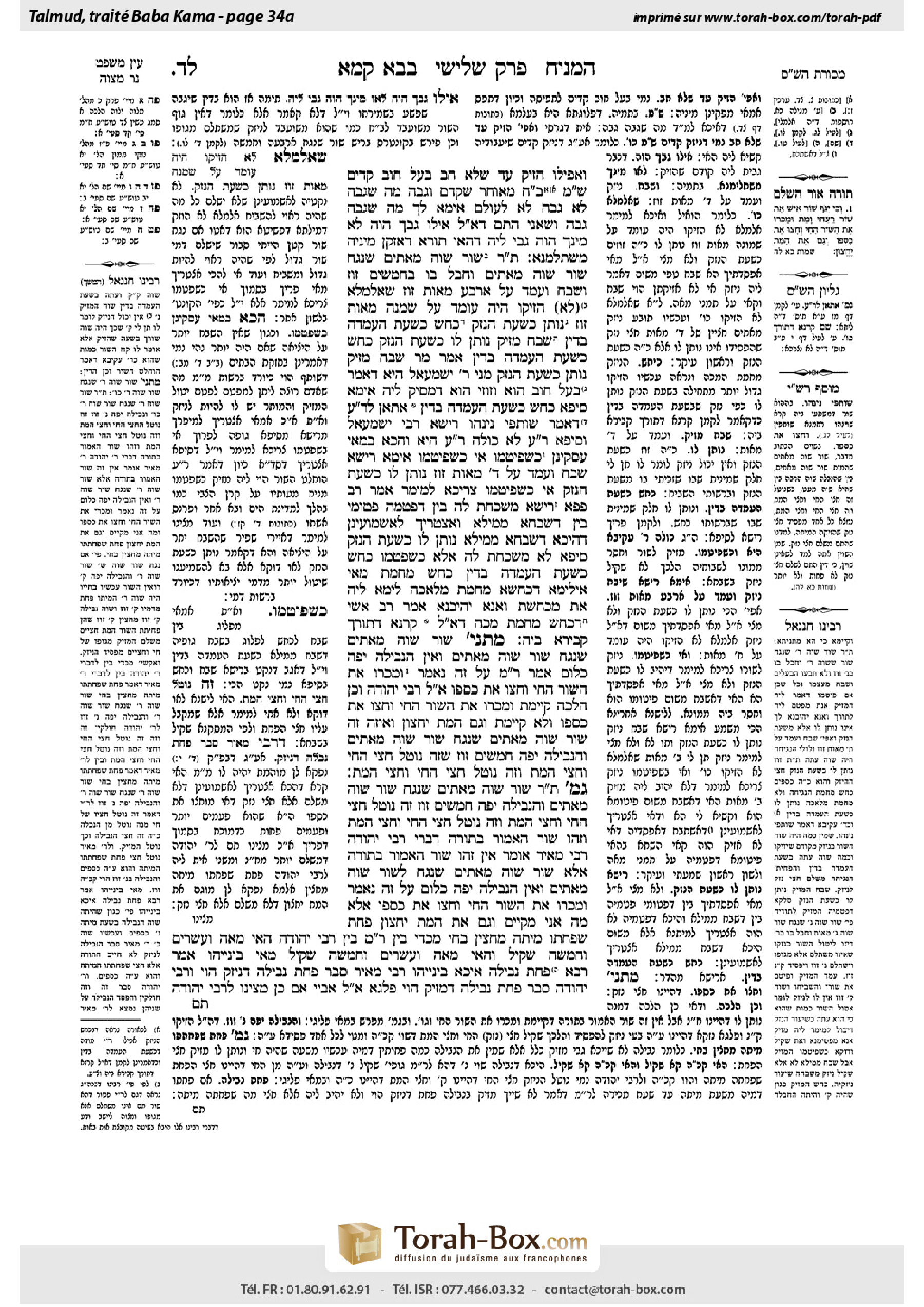
Bava Kamma 34a: Talmud study for Daf Yomi
Study the Talmud for Daf Yomi with scanned pages, Hebrew text, English translations from Sefaria and AI-generated French translations.
Passage selection and English or AI-generated French translation are available where the scan has annotations. Daf Study is independent of Torah-Box and Sefaria.
Browse Bava Kamma · בבא קמא · All tractatesBava Kamma 34a text and translations
This page of Bava Kamma includes the Aramaic text, an English translation and an AI-generated French translation, alongside the scan above.
בבא קמא ל״ד א · Aramaic and Hebrew text
וַאֲפִילּוּ הִזִּיק עַד שֶׁלֹּא חָב – בַּעַל חוֹב קְדֵים! שְׁמַע מִינַּהּ, בַּעַל חוֹב מְאוּחָר שֶׁקָּדַם וְגָבָה – מַה שֶּׁגָּבָה לֹא גָּבָה?!
לָא, לְעוֹלָם אֵימָא לָךְ: מַה שֶּׁגָּבָה גָּבָה; וְשָׁאנֵי הָתָם, דַּאֲמַר לֵיהּ: אִילּוּ גַּבָּךְ הֲוָה – לָא מִינָּךְ (הֲוָה) גְּבַי לֵיהּ? דְּהַאי תּוֹרָא דְּאַזְּקַן, מִינֵּיהּ מִשְׁתַּלֵּמְנָא.
תָּנוּ רַבָּנַן: שׁוֹר שָׁוֶה מָאתַיִם שֶׁנָּגַח שׁוֹר שָׁוֶה מָאתַיִם, וְחָבַל בּוֹ בַּחֲמִשִּׁים זוּז, וְשָׁבַח וְעָמַד עַל אַרְבַּע מֵאוֹת זוּז – שֶׁאִלְמָלֵא לֹא הִזִּיקוֹ הָיָה עוֹמֵד עַל שְׁמֹנֶה מֵאוֹת זוּז; נוֹתֵן כִּשְׁעַת הַנֶּזֶק.
כָּחַשׁ – כִּשְׁעַת הַעֲמָדָה בַּדִּין.
שָׁבַח מַזִּיק – נוֹתֵן לוֹ כִּשְׁעַת הַנֶּזֶק. כָּחַשׁ – כִּשְׁעַת הַעֲמָדָה בַּדִּין.
אָמַר מָר: שָׁבַח מַזִּיק – נוֹתֵן כִּשְׁעַת הַנֶּזֶק. מַנִּי – רַבִּי יִשְׁמָעֵאל הִיא, דְּאָמַר: בַּעַל חוֹב הוּא, וְזוּזֵי הוּא דְּמַסֵּיק לֵיהּ;
אֵימָא סֵיפָא: כָּחַשׁ – כִּשְׁעַת הַעֲמָדָה בַּדִּין. אֲתָאן לְרַבִּי עֲקִיבָא, דְּאָמַר: שׁוּתָּפֵי נִינְהוּ! רֵישָׁא רַבִּי יִשְׁמָעֵאל וְסֵיפָא רַבִּי עֲקִיבָא?!
לָא, כּוּלַּהּ רַבִּי עֲקִיבָא הִיא; וְהָכָא בְּמַאי עָסְקִינַן – כְּשֶׁפִּיטְּמוֹ.
אִי כְּשֶׁפִּיטְּמוֹ, אֵימָא רֵישָׁא: שָׁבַח וְעָמַד עַל אַרְבַּע מֵאוֹת זוּז – נוֹתֵן לוֹ כִּשְׁעַת הַנֶּזֶק. אִי כְּשֶׁפִּיטְּמו,ֹ צְרִיכָא לְמֵימַר?!
אָמַר רַב פָּפָּא: רֵישָׁא – מַשְׁכַּחַתְּ לַהּ בֵּין דְּפַטְּמַהּ פַּטּוֹמֵי בֵּין דִּשְׁבַחָא מִמֵּילָא, וְאִצְטְרִיךְ לְאַשְׁמוֹעִינַן דְּהֵיכָא דִּשְׁבַחָא מִמֵּילָא – נוֹתֵן לוֹ כִּשְׁעַת הַנֶּזֶק. סֵיפָא – לָא מַשְׁכַּחַתְּ לַהּ אֶלָּא כְּשֶׁפִּטְּמוֹ.
כָּחַשׁ – כִּשְׁעַת הַעֲמָדָה בַּדִּין. כָּחַשׁ מֵחֲמַת מַאי? אִילֵימָא דְּכָחֲשָׁה מֵחֲמַת מְלָאכָה, לֵימָא לֵיהּ: אַתְּ מַכְחֲשַׁתְּ, וַאֲנָא יָהֵיבְנָא?!
אָמַר רַב אָשֵׁי: דִּכְחַשׁ מֵחֲמַת מַכָּה, דַּאֲמַר לֵיהּ: קַרְנָא דְּתוֹרָךְ קְבִירָא בֵּיהּ.
מַתְנִי׳ שׁוֹר שָׁוֶה מָאתַיִם שֶׁנָּגַח שׁוֹר שָׁוֶה מָאתַיִם, וְאֵין הַנְּבֵילָה יָפָה כְּלוּם – אָמַר רַבִּי מֵאִיר, עַל זֶה נֶאֱמַר: ״וּמָכְרוּ אֶת הַשּׁוֹר הַחַי וְחָצוּ אֶת כַּסְפּוֹ״.
אָמַר לוֹ רַבִּי יְהוּדָה: וְכֵן הֲלָכָה; קִיַּימְתָּ ״וּמָכְרוּ אֶת הַשּׁוֹר הַחַי וְחָצוּ אֶת כַּסְפּוֹ״, וְלֹא קִיַּימְתָּ ״וְגַם הַמֵּת יֶחֱצוּן״! וְאֵיזֶה? זֶה שׁוֹר שָׁוֶה מָאתַיִם שֶׁנָּגַח שׁוֹר שָׁוֶה מָאתַיִם, וְהַנְּבֵילָה יָפָה חֲמִשִּׁים זוּז; שֶׁזֶּה נוֹטֵל חֲצִי הַחַי וַחֲצִי הַמֵּת, וְזֶה נוֹטֵל חֲצִי הַחַי וַחֲצִי הַמֵּת.
גְּמָ׳ תָּנוּ רַבָּנַן: שׁוֹר שָׁוֶה מָאתַיִם שֶׁנָּגַח שׁוֹר שָׁוֶה מָאתַיִם, וְהַנְּבֵילָה יָפָה חֲמִשִּׁים זוּז – זֶה נוֹטֵל חֲצִי הַחַי וַחֲצִי הַמֵּת, וְזֶה נוֹטֵל חֲצִי הַחַי וַחֲצִי הַמֵּת, וְזֶהוּ שׁוֹר הָאָמוּר בַּתּוֹרָה; דִּבְרֵי רַבִּי יְהוּדָה.
רַבִּי מֵאִיר אוֹמֵר: אֵין זֶהוּ שׁוֹר הָאָמוּר בַּתּוֹרָה, אֶלָּא שׁוֹר שָׁוֶה מָאתַיִם שֶׁנָּגַח לְשׁוֹר שָׁוֶה מָאתַיִם, וְאֵין הַנְּבֵילָה יָפָה כְּלוּם, עַל זֶה נֶאֱמַר: ״וּמָכְרוּ אֶת הַשּׁוֹר הַחַי וְחָצוּ אֶת כַּסְפּוֹ״. אֶלָּא מָה אֲנִי מְקַיֵּים ״וְגַם אֶת הַמֵּת יֶחֱצוּן״? פְּחָת שֶׁפְּחָתַתּוּ מִיתָה – מַחֲצִין בַּחַי.
מִכְּדֵי בֵּין רַבִּי מֵאִיר בֵּין רַבִּי יְהוּדָה – הַאי מֵאָה וְעֶשְׂרִים וַחֲמִשָּׁה שָׁקֵיל, וְהַאי מֵאָה וְעֶשְׂרִים וַחֲמִשָּׁה שָׁקֵיל; מַאי בֵּינַיְיהוּ?
אָמַר רָבָא: פְּחַת נְבֵילָה אִיכָּא בֵּינַיְיהוּ. רַבִּי מֵאִיר סָבַר: פְּחַת נְבֵילָה – דְּנִיזָּק הָוֵי, וְרַבִּי יְהוּדָה סָבַר: פְּחַת נְבֵילָה – דְּמַזִּיק הָוֵי פַּלְגָא.
אֲמַר לֵיהּ אַבָּיֵי: אִם כֵּן, מָצִינוּ לְרַבִּי יְהוּדָה
Bava Kamma 34a · English translation
Moreover, even if the ox caused damage before he owed them, nevertheless the creditor came first and seized what he rightfully deserved. Should one conclude from the baraita that if a later creditor collected a debt before an earlier creditor, his collection is not valid and payment should instead be given to the earlier creditor?
The Gemara answers: No; actually, I could say to you that the collection of the later creditor is valid, and there, in the case where a creditor seized the belligerent ox, it is different, as the injured party can say to the creditor who seized the ox: If the ox was in your possession, would I not have collected it from you? The reason I would take it is that I am paid from this ox that caused me damage. Therefore, the creditor cannot collect the ox, even if the debt preceded the damage.
§ The Sages taught: With regard to an innocuous ox worth two hundred dinars that gored another ox worth two hundred dinars and injured it, reducing its value by fifty dinars [zuz], and the injured ox subsequently appreciated in value, and its value stood at four hundred dinars, while if the belligerent ox had not injured it, its value would have now stood at eight hundred dinars, in this case the owner of the belligerent ox gives him only twenty-five dinars, which is half the value of the damage according to its value at the time the injury occurred.
If the injured ox depreciated in value and its worth is now less than at the time it was injured, the damage is evaluated according to the ox’s worth at the time of standing trial. In other words, the owner of the belligerent ox must pay the difference between its value before it was injured and its current value.
If the ox that caused the injury, from which the owner of the injured ox collects damages, appreciated in value, its owner gives the injured party a share of the ox according to its value at the time of the injury. If it depreciated in value, the owner gives him a share according to its value at the time of standing trial.
The Gemara asks: The Master said in the first clause of the second half of the baraita that if the ox that caused the damage appreciated in value, its owner gives the injured party a share according to the ox’s value at the time of the injury. In accordance with whose opinion is this ruling? It is apparently in accordance with the opinion of Rabbi Yishmael, who says that the injured party is considered a creditor, and it is money that he is claiming from him, as he has no share of ownership in the belligerent ox.
The Gemara states a difficulty with this explanation: Say the latter clause of the second half of the baraita: If the belligerent ox depreciated in value, the owner gives the injured party a share according to its value at the time of standing trial. Here we arrive at the opinion of Rabbi Akiva, who says that the owners of the two oxen are partners, i.e., the injured party has a share of ownership in the belligerent ox. How can it be that the first clause is in accordance with Rabbi Yishmael’s opinion, and the latter clause follows the opinion of Rabbi Akiva?
The Gemara answers: No, it is all in accordance with the opinion of Rabbi Akiva that they are partners, and here, in the case where the belligerent ox appreciated in value, we are dealing with a case where the reason it appreciated is that its owner fattened it. Though the injured party has a share of ownership in the ox, he has no share in the appreciation in value, and his share is therefore calculated according to its value at the time of the injury.
The Gemara asks: If it is a case where the owner fattened it, say the first clause of the first half of the baraita, stated with regard to the injured ox: If it appreciated in value, and its value stood at four hundred dinars, the owner of the belligerent ox gives him compensation according to its value at the time of the injury. If this is referring to a case where its owner fattened it, need it be said that the owner of the belligerent ox is not exempt from compensation?
Rav Pappa said: You find the halakha stated in the first clause of the first half of the baraita to be true whether he fattened it or whether it appreciated in value by itself. And the tanna found it necessary to mention this halakha to teach us that even in a case where the ox appreciated in value by itself, the owner of the belligerent ox gives him compensation according to its value at the time of the injury and not at the time of the trial. By contrast, you find the halakha stated in the latter clause of the second half of the baraita, with regard to a case where the belligerent ox appreciated in value, only where its owner fattened it.
It is stated in the latter clause of the first half of the baraita that if the injured ox depreciated in value, it is evaluated according to its worth at the time of standing trial. The Gemara asks: Due to what did it depreciate in value? If we say that the ox depreciated in value due to labor for which it was used, let the liable party say to him: You reduced its value and I should therefore give you extra compensation?
Rav Ashi said: It is a case where it depreciated in value due to the continuous effect of the wound, as the injured party can say to him: The horn of your ox is buried in it, i.e., it is still losing value due to the wound.
MISHNA: With regard to an innocuous ox worth two hundred dinars that gored another ox worth two hundred, and the carcass is worth nothing, Rabbi Meir said: It is about this type of case that it is stated: “Then they shall sell the live ox, and divide its monetary value” (Exodus 21:35).
Rabbi Yehuda said to him: And that is the halakha, yet your interpretation of the verse is incorrect. You have upheld the clause: “Then they shall sell the live ox and divide its monetary value,” which fits your interpretation of the case. But you have not upheld the latter clause of the verse: “And the dead they shall also divide,” since in the case you mentioned the carcass is worthless. Rather, to which case is the verse referring? It is the case of an ox worth two hundred dinars that gored another ox worth two hundred dinars, and the carcass is worth fifty dinars. In this case, this party takes half the value of the living ox, one hundred dinars, and half the value of the dead ox, twenty-five dinars; and that party also takes half the value of the living ox and half the value of the dead ox.
GEMARA: The Sages taught: With regard to an ox worth two hundred dinars that gored an ox worth two hundred dinars, and the carcass is worth fifty dinars, this party takes half the value of the living ox and half the value of the dead ox, and that party also takes half the value of the living ox and half the value of the dead ox, and this is the case of the belligerent ox stated in the Torah. This is the statement of Rabbi Yehuda.
Rabbi Meir says: This is not the case of the ox stated in the Torah. Rather, it is the case of an ox worth two hundred dinars that gored an ox worth two hundred dinars, and the carcass is worth nothing. It is about this case that it is stated in the verse: “Then they shall sell the live ox, and divide its monetary value.” Rather, how do I realize the meaning of “And the dead they shall also divide”? This clause means that the diminished value of the dead ox that was diminished by its death is compensated for by dividing the value of the live ox between the two parties, while its owner does not receive a share in the carcass of the dead ox.
The Gemara asks: Now, both Rabbi Meir and Rabbi Yehuda hold that in the case described by Rabbi Yehuda, where the carcass is worth fifty, this party takes one hundred and twenty-five, and that party takes one hundred and twenty-five. Rabbi Meir holds that the injured party keeps the carcass, worth fifty, and receives another seventy-five dinars, half the value of the damage, from the proceeds of the sale of the belligerent ox. Its owner is thereby left with one hundred and twenty-five dinars out of the two hundred that it is worth. Rabbi Yehuda maintains that the value of both oxen is split between the two parties, leaving each with one hundred and twenty-five. If so, what is the difference between the two tanna’im? Why does it matter in which manner the compensation is calculated?
Rava said: There is a practical difference between them with regard to the diminishing value of the carcass. If the carcass depreciates in value between the ox’s death and the time it is sold, Rabbi Meir holds that the diminishing value of the carcass is sustained by the injured party. The one liable for the damage is not responsible for any depreciation in value that occurs after the loss caused by the attack has been evaluated. And Rabbi Yehuda holds that half of the diminishing value of the carcass is sustained by the one liable for damage, since he receives half of the dead ox.
Abaye said to Rava: If so, we have found, according to Rabbi Yehuda,
Bava Kamma 34a · Traduction française (IA)
De plus, même si l'ox a causé des dommages avant qu'il ne doive cela, néanmoins le créancier est venu en premier et a pris ce à quoi il avait droit. Devrait-on conclure de la baraïta que si un créancier ultérieur récupère un créance avant un créancier antérieur, sa récupération n'est pas valable et le paiement devrait être donné plutôt au créancier antérieur ?
La Guemara répond : Non ; en réalité, je pourrais te dire que la récupération du créancier ultérieur est valable, et là, dans le cas où un créancier s'empare de l'ox belliqueux, c'est différent, car la partie blessée peut dire au créancier qui s'est emparé de l'ox : Si l'ox était en ton possession, ne l'aurais-je pas récupéré de toi ? La raison pour laquelle je le récupère est que je suis payé par cet ox qui m'a causé des dommages. Ainsi, le créancier ne peut récupérer l'ox, même si la dette a précédé le dommage.
§ Les Sages enseignent : En ce qui concerne un ox inoffensif valant deux cents dinars qui a blessé un autre ox valant deux cents dinars, réduisant sa valeur de cinquante dinars, et que l'ox blessé a ensuite augmenté en valeur, et sa valeur est de quatre cents dinars, tandis que, si l'ox belliqueux ne l'avait pas blessé, sa valeur serait maintenant de huit cents dinars, dans ce cas, l'propriétaire de l'ox belliqueux lui donne seulement vingt-cinq dinars, soit la moitié de la valeur du dommage selon sa valeur au moment de l'incident.
Si l'ox blessé a diminué en valeur et sa valeur est maintenant inférieure à celle qu'il avait au moment de l'incident, le dommage est évalué selon la valeur de l'ox au moment du procès. En d'autres termes, l'owner de l'ox belliqueux doit payer la différence entre sa valeur avant l'incident et sa valeur actuelle.
Si l'ox qui a causé le dommage, duquel l'owner de l'ox blessé récupère les dommages, a augmenté en valeur, son owner donne à la partie blessée une part de l'ox selon sa valeur au moment de l'incident. Si l'ox a diminué en valeur, le propriétaire lui donne une part selon sa valeur au moment du procès.
La Guemara pose une question : Le Maître a dit dans la première clause de la deuxième moitié de la baraïta que si l'ox qui a causé le dommage a augmenté en valeur, son propriétaire donne à la partie blessée une part de l'ox selon sa valeur au moment de l'incident. Selon quel avis est-ce que cette décision est prise ? Il semble que ce soit selon l'avis de Rabbi Yishmael, qui dit que la partie blessée est considérée comme un créancier, et qu'il réclame de lui de l'argent, car il n'a pas de part de propriété dans l'ox belliqueux.
La Guemara énonce une difficulté avec cette explication : Dis la dernière clause de la deuxième moitié de la baraïta : Si l'ox belliqueux a diminué en valeur, le propriétaire donne à la partie blessée une part selon sa valeur au moment du procès. Ici, nous arrivons à l'avis de Rabbi Akiva, qui dit que les propriétaires des deux ox sont associés, c'est-à-dire que la partie blessée a une part de propriété dans l'ox belliqueux. Comment peut-il être que la première clause soit selon l'avis de Rabbi Yishmael et que la dernière clause suive celui de Rabbi Akiva ?
La Guemara répond : Non, tout est selon l'avis de Rabbi Akiva, selon lequel ils sont associés, et ici, dans le cas où l'ox belliqueux a augmenté en valeur, nous sommes en présence d'un cas où la raison de cette augmentation est que son propriétaire l'a nourri. Bien que la partie blessée ait une part de propriété dans l'ox, elle n'a pas de part dans l'augmentation de valeur, et sa part est donc calculée selon sa valeur au moment de l'incident.
La Guemara pose une question : Si c'est un cas où le propriétaire l'a nourri, dis la première clause de la première moitié de la baraïta, concernant l'ox blessé : Si sa valeur est de quatre cents dinars, le propriétaire de l'ox belliqueux lui donne une compensation selon sa valeur au moment de l'incident. Si cela fait référence à un cas où son propriétaire l'a nourri, pourquoi dire que le propriétaire de l'ox belliqueux n'est pas exempt de compensation ?
Rav Pappa dit : Tu trouves la halakha énoncée dans la première clause de la première moitié de la baraïta à être vraie, qu'il ait nourri l'ox ou qu'il ait augmenté en valeur par lui-même. Et le tanna a jugé nécessaire de mentionner cette halakha pour nous enseigner que même dans un cas où l'ox a augmenté en valeur par lui-même, le propriétaire de l'ox belliqueux donne une compensation selon sa valeur au moment de l'incident et non au moment du procès. À l'inverse, tu trouves la halakha énoncée dans la dernière clause de la deuxième moitié de la baraïta, concernant un cas où l'ox belliqueux a augmenté en valeur, uniquement lorsque son propriétaire l'a nourri.
Il est dit dans la dernière clause de la première moitié de la baraïta que si l'ox blessé a diminué en valeur, il est évalué selon sa valeur au moment du procès. La Guemara pose une question : Pourquoi a-t-il diminué en valeur ? Si nous disons qu'il a diminué en valeur en raison d'un travail pour lequel il a été utilisé, que la partie responsable dise à lui : Tu as réduit sa valeur et je devrais donc te donner une compensation supplémentaire ?
Rav Ashi dit : C'est un cas où il a diminué en valeur en raison de l'effet continu de la blessure, car la partie blessée peut dire à lui : Le cor de ton ox est enfoui en lui, c'est-à-dire qu'il continue à perdre de la valeur en raison de la blessure.
MICHNA : En ce qui concerne un boeuf inoffensif valant deux cents dinars qui a blessé un autre boeuf valant deux cents, et dont la carcasse est sans valeur, Rabbi Meir dit : C'est à propos de ce type de cas que cela est dit : « Puis ils vendront le boeuf vivant, et partageront sa valeur monétaire » (Exode 21:35).
Rabbi Yéhuda a dit à lui : C’est la halakha, mais votre interprétation de la parole est incorrecte. Vous avez maintenu la clause : « Alors ils vendront l’ox vivant et partageront sa valeur monétaire », ce qui correspond à votre interprétation du cas. Mais vous n’avez pas maintenu la seconde clause de la parole : « Et les morts ils les partageront aussi », car dans le cas que vous avez mentionné, le cadavre est sans valeur. Plutôt, à quel cas la parole fait-elle référence ? C’est le cas d’un ox valant deux cents dinars qui a blessé un autre ox valant deux cents dinars, et le cadavre vaut cinquante dinars. Dans ce cas, cette partie prend la moitié de la valeur de l’ox vivant, cent dinars, et la moitié de la valeur de l’ox mort, vingt-cinq dinars ; et cette autre partie prend également la moitié de la valeur de l’ox vivant et la moitié de la valeur de l’ox mort.
GUEMARA : Les Sages ont enseigné : En ce qui concerne un ox valant deux cents dinars qui a blessé un ox valant deux cents dinars, et le cadavre vaut cinquante dinars, cette partie prend la moitié de la valeur de l’ox vivant et la moitié de la valeur de l’ox mort, et cette autre partie prend également la moitié de la valeur de l’ox vivant et la moitié de la valeur de l’ox mort, et c’est le cas de l’ox belliqueux mentionné dans la Torah. C’est la déclaration de Rabbi Yéhuda.
Rabbi Méir dit : Ce n’est pas le cas de l’ox mentionné dans la Torah. Plutôt, c’est le cas d’un ox valant deux cents dinars qui a blessé un ox valant deux cents dinars, et le cadavre est sans valeur. C’est à ce cas que la parole : « Alors ils vendront l’ox vivant, et partageront sa valeur monétaire » fait référence. Plutôt, comment puis-je comprendre la clause : « Et les morts ils les partageront aussi » ? Cette clause signifie que la diminution de valeur du cadavre, diminuée par sa mort, est compensée en partageant la valeur de l’ox vivant entre les deux parties, tandis que son propriétaire ne reçoit pas sa part du cadavre de l’ox mort.
La Guemara demande : Maintenant, Rabbi Méir et Rabbi Yéhuda considèrent tous les deux que dans le cas décrit par Rabbi Yéhuda, où le cadavre vaut cinquante, cette partie reçoit cent vingt-cinq, et celle-ci reçoit cent vingt-cinq. Rabbi Méir considère que la partie blessée garde le cadavre, valant cinquante, et reçoit un autre soixante-quinze dinars, la moitié de la valeur du préjudice, des recettes de la vente de l’ox belliqueux. Son propriétaire est ainsi laissé avec cent vingt-cinq dinars sur les deux cents que l’ox valait. Rabbi Yéhuda maintient que la valeur des deux ox est partagée entre les deux parties, laissant chacun avec cent vingt-cinq. Si tel est le cas, quelle est la différence entre les deux tanna’im ? Pourquoi cela importe-t-il dans quelle mesure la compensation est calculée ?
Rava a dit : Il y a une différence pratique entre eux concernant la diminution de valeur du cadavre. Si le cadavre se déprécie en valeur entre la mort de l’ox et le moment où il est vendu, Rabbi Méir considère que la diminution de valeur du cadavre est supportée par la partie blessée. Celui responsable du préjudice n’est pas responsable de toute dépréciation de valeur qui survient après que le préjudice causé par l’attaque ait été évalué. Et Rabbi Yéhuda considère que la moitié de la diminution de valeur du cadavre est supportée par celui responsable du préjudice, car il reçoit la moitié de l’ox mort.
Abaye a dit à Rava : Si c’est ainsi, nous avons trouvé, selon Rabbi Yéhuda,
Traduction française générée par IA à partir de l’édition anglaise de Sefaria. Vérifie toujours un passage avec le texte source.
Text from Sefaria: William Davidson Edition - Vocalized Aramaic (CC BY NC); William Davidson Edition - English (CC BY NC).