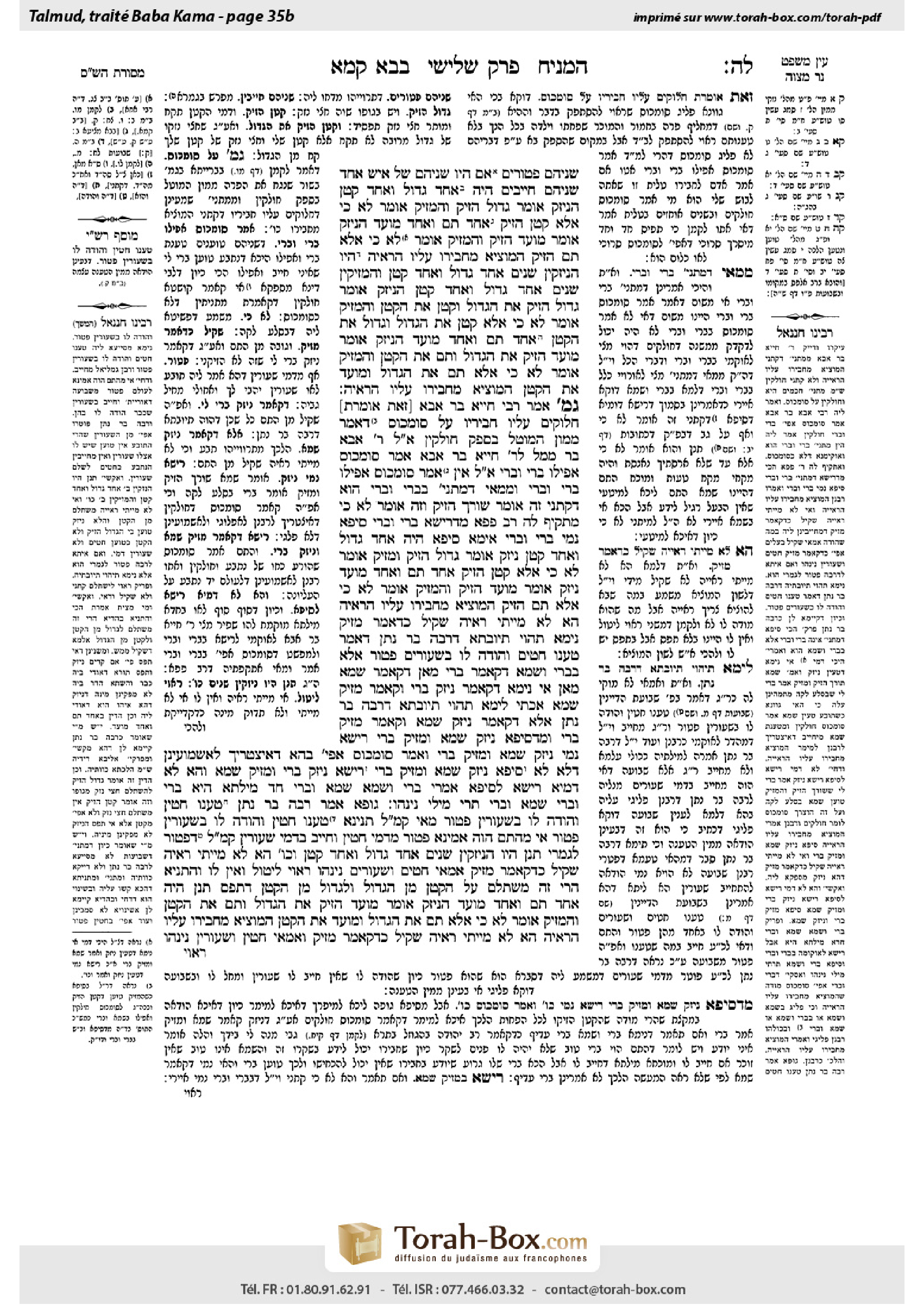
Bava Kamma 35b: Talmud study for Daf Yomi
Study the Talmud for Daf Yomi with scanned pages, Hebrew text, English translations from Sefaria and AI-generated French translations.
Passage selection and English or AI-generated French translation are available where the scan has annotations. Daf Study is independent of Torah-Box and Sefaria.
Browse Bava Kamma · בבא קמא · All tractatesBava Kamma 35b text and translations
This page of Bava Kamma includes the Aramaic text, an English translation and an AI-generated French translation, alongside the scan above.
בבא קמא ל״ה ב · Aramaic and Hebrew text
שְׁנֵיהֶם פְּטוּרִים. אִם הָיוּ שְׁנֵיהֶם שֶׁל אִישׁ אֶחָד – שְׁנֵיהֶם חַיָּיבִים.
הָיָה אֶחָד גָּדוֹל וְאֶחָד קָטָן, הַנִּיזָּק אוֹמֵר: ״גָּדוֹל הִזִּיק״, וְהַמַּזִּיק אוֹמֵר: ״לֹא כִי, אֶלָּא קָטָן הִזִּיק״; אֶחָד תָּם וְאֶחָד מוּעָד, הַנִּיזָּק אוֹמֵר: ״מוּעָד הִזִּיק״, וְהַמַּזִּיק אוֹמֵר: ״לֹא כִי, אֶלָּא תָּם הִזִּיק״ – הַמּוֹצִיא מֵחֲבֵירוֹ עָלָיו הָרְאָיָה.
הָיוּ הַנִּיזָּקִין שְׁנַיִם – אֶחָד גָּדוֹל וְאֶחָד קָטָן, וְהַמַּזִּיקִין שְׁנַיִם – אֶחָד גָּדוֹל וְאֶחָד קָטָן; הַנִּיזָּק אוֹמֵר: ״גָּדוֹל הִזִּיק אֶת הַגָּדוֹל, וְקָטָן אֶת הַקָּטָן״, וְהַמַּזִּיק אוֹמֵר: ״לֹא כִי, אֶלָּא קָטָן אֶת הַגָּדוֹל, וְגָדוֹל אֶת הַקָּטָן״; אֶחָד תָּם וְאֶחָד מוּעָד, הַנִּיזָּק אוֹמֵר: ״מוּעָד הִזִּיק אֶת הַגָּדוֹל, וְתָם אֶת הַקָּטָן״, וְהַמַּזִּיק אוֹמֵר: ״לֹא כִי, אֶלָּא תָּם אֶת הַגָּדוֹל, וּמוּעָד אֶת הַקָּטָן״ – הַמּוֹצִיא מֵחֲבֵירוֹ עָלָיו הָרְאָיָה.
גְּמָ׳ אָמַר רַבִּי חִיָּיא בַּר אַבָּא: [זֹאת אוֹמֶרֶת] חֲלוּקִים עָלָיו חֲבֵירָיו עַל סוֹמְכוֹס, דְּאָמַר: מָמוֹן הַמּוּטָּל בְּסָפֵק – חוֹלְקִין.
אֲמַר לֵיהּ רַבִּי אַבָּא בַּר מֶמֶל לְרַבִּי חִיָּיא בַּר אַבָּא: אָמַר סוֹמְכוֹס אֲפִילּוּ בָּרִי וּבָרִי? אֲמַר לֵיהּ: אִין, אָמַר סוֹמְכוֹס אֲפִילּוּ בָּרִי וּבָרִי.
וּמִמַּאי דְּמַתְנִיתִין בְּבָרִי וּבָרִי הוּא? דְּקָתָנֵי: זֶה אוֹמֵר שׁוֹרְךָ הִזִּיק, וְזֶה אוֹמֵר לֹא כִי.
מַתְקֵיף לַהּ רַב פָּפָּא: מִדְּרֵישָׁא בָּרִי וּבָרִי – סֵיפָא נָמֵי בָּרִי וּבָרִי;
אֵימָא סֵיפָא: הָיָה אֶחָד גָּדוֹל וְאֶחָד קָטָן, נִיזָּק אוֹמֵר: ״גָּדוֹל הִזִּיק״, וּמַזִּיק אוֹמֵר: ״לֹא כִי, אֶלָּא קָטָן הִזִּיק״; אֶחָד תָּם וְאֶחָד מוּעָד, נִיזָּק אוֹמֵר: ״מוּעָד הִזִּיק״, וְהַמַּזִּיק אוֹמֵר: ״לֹא כִי, אֶלָּא תָּם הִזִּיק״ – הַמּוֹצִיא מֵחֲבֵירוֹ עָלָיו הָרְאָיָה;
הָא לָא מַיְיתֵי רְאָיָה – שָׁקֵיל כִּדְאָמַר מַזִּיק; נֵימָא תִּהְוֵי תְּיוּבְתָּא דְּרַבָּה בַּר נָתָן – דְּאָמַר: טְעָנוֹ חִטִּים וְהוֹדָה לוֹ בִּשְׂעוֹרִים – פָּטוּר?
אֶלָּא בְּבָרִי וְשֶׁמָּא.
דְּקָאָמַר בָּרִי מַאן, דְּקָאָמַר שֶׁמָּא מַאן? אִי נֵימָא דְּקָאָמַר נִיזָּק בָּרִי וְקָאָמַר מַזִּיק שֶׁמָּא, אַכַּתִּי לֵימָא תִּהְוֵי תְּיוּבְתָּא דְּרַבָּה בַּר נָתָן!
אֶלָּא דְּקָאָמַר נִיזָּק שֶׁמָּא, וְקָאָמַר מַזִּיק בָּרִי.
וּמִדְּסֵיפָא נִיזָּק שֶׁמָּא וּמַזִּיק בָּרִי, רֵישָׁא נָמֵי נִיזָּק שֶׁמָּא וּמַזִּיק בָּרִי;
וְאָמַר סוֹמְכוֹס אֲפִילּוּ בְּהָא – דְּאִיצְטְרִיךְ לְאַשְׁמוֹעִינַן דְּלָא?!
לָא; סֵיפָא נִיזָּק שֶׁמָּא וּמַזִּיק בָּרִי, רֵישָׁא נִיזָּק בָּרִי וּמַזִּיק שֶׁמָּא.
וְהָא לָא דָּמְיָא רֵישָׁא לְסֵיפָא!
אָמְרִי: בָּרִי וְשֶׁמָּא, שֶׁמָּא וּבָרִי – חַד מִילְּתָא הִיא; בָּרִי וּבָרִי, שֶׁמָּא וּבָרִי – תְּרֵי מִילֵּי נִינְהוּ.
גּוּפָא – אָמַר רַבָּה בַּר נָתָן: טְעָנוֹ חִטִּין וְהוֹדָה לוֹ בִּשְׂעוֹרִין – פָּטוּר. מַאי קָא מַשְׁמַע לַן? תְּנֵינָא: טְעָנוֹ חִטִּין וְהוֹדָה לוֹ בִּשְׂעוֹרִין – פָּטוּר!
אִי מֵהָתָם, הֲוָה אָמֵינָא: פָּטוּר מִדְּמֵי חִטִּין, וְחַיָּיב בִּדְמֵי שְׂעוֹרִין. קָא מַשְׁמַע לַן דְּפָטוּר לִגְמָרֵי.
תְּנַן: הָיוּ הַנִּיזָּקִין שְׁנַיִם – אֶחָד גָּדוֹל וְאֶחָד קָטָן וְכוּ׳. הָא לָא מַיְיתֵי רְאָיָה – שָׁקֵיל כִּדְקָאָמַר מַזִּיק; אַמַּאי? חִטִּים וּשְׂעוֹרִים נִינְהוּ!
רָאוּי לִיטּוֹל – וְאֵין לוֹ.
וְהָתַנְיָא: הֲרֵי זֶה מִשְׁתַּלֵּם עַל הַקָּטָן מִן הַגָּדוֹל, וְלַגָּדוֹל מִן הַקָּטָן!
דִּתְפַס.
תְּנַן: הָיָה אֶחָד תָּם וְאֶחָד מוּעָד, הַנִּיזָּק אוֹמֵר: ״מוּעָד הִזִּיק אֶת הַגָּדוֹל, וְתָם אֶת הַקָּטָן״, וְהַמַּזִּיק אוֹמֵר: ״לֹא כִי, אֶלָּא תָּם אֶת הַגָּדוֹל, וּמוּעָד אֶת הַקָּטָן״ – הַמּוֹצִיא מֵחֲבֵירוֹ עָלָיו הָרְאָיָה. הָא לָא מַיְיתֵי רְאָיָה – שָׁקֵיל כִּדְקָאָמַר מַזִּיק; וְאַמַּאי? חִטִּין וּשְׂעוֹרִין נִינְהוּ!
Bava Kamma 35b · English translation
the two of them are exempt, since each of them rejects the claim of the injured party that his ox caused the injury. If both oxen belonged to one person, both are liable, as will be explained in the Gemara.
If the pursuing oxen both belonged to one person, and were both innocuous, so that restitution is paid exclusively from proceeds of the sale of the belligerent ox, and one was large and the other one small, in this case, if the injured party says that the large ox caused the damage, and he is therefore entitled to receive restitution for half the damage from the value of the large ox, but the one liable for damage says: No; rather, the small ox caused the damage, and half of its value is not sufficient to cover half the damage; or, similarly, in a case where one ox is innocuous and one is forewarned, and the injured party says: The forewarned ox caused the damage, and the injured party is therefore eligible to receive full damages, but the one liable for damage says: No; rather, the innocuous ox caused the damage, in which case he is liable to pay only half the damage; in both of the above cases, the principle is that the burden of proof rests upon the claimant.
If the injured animals were two oxen, one large and the other one small, and the ones that caused the damage were also two oxen, one large and one small, and the injured party says: The large one injured the large one and the small one injured the small one, and the one liable for damage says: No; rather, the small one injured the large one, in which case, if half the value of the belligerent ox does not cover half the damage, he is not required to pay more, and the large one injured the small one; or, similarly, if one of the belligerent oxen was innocuous and one forewarned, and the injured party says: The forewarned ox injured the large one, and the innocuous ox injured the small one, and the one liable for damage says: No; rather, the innocuous ox injured the large one and the forewarned ox injured the small one; here too, the burden of proof rests upon the claimant.
GEMARA: The mishna rules that in a case where there is uncertainty with regard to whether it was the pursuing ox that caused the injury to the other ox, the burden of proof rests upon the claimant. Rabbi Ḥiyya bar Abba says: That is to say that the colleagues of Sumakhos, who says that property of uncertain ownership is divided, disagree with his opinion.
Rabbi Abba bar Memel said to Rabbi Ḥiyya bar Abba: Does Sumakhos state this principle even in the case of a certain claim and a certain claim, i.e., where both parties maintain the certainty of their claims, as appears to be the case in the mishna? Rabbi Ḥiyya bar Abba said to him: Yes, Sumakhos says this even in a case of a certain claim and a certain claim.
The Gemara asks: And from where is it inferred that the mishna is referring to a case of a certain claim and a certain claim? As it teaches that this one, the owner of the injured ox, says: Your ox injured my ox, and that one, the owner of the pursuing ox, says: No, rather etc., indicating that both make their claims with certainty.
Rav Pappa objects to this interpretation of the case: From the suggestion that the case in the first clause of the mishna is one where there is a certain claim and a certain claim, it may be inferred that the latter clause, the subsequent clause in the mishna, also is referring to a case where there is a certain claim and a certain claim.
If so, say the latter clause: If one was large and the other one small, and the injured party says that the large ox caused the damage, and the one liable for damage says: No; rather, the small ox caused the damage; or if one ox is innocuous and one is forewarned, and the injured party says: The forewarned ox caused the damage, but the one liable for damage says: No; rather, the innocuous ox caused the damage, the burden of proof rests upon the claimant.
This indicates that if he does not bring proof, he takes compensation according to what the one liable for damage says. If it is a case where both parties maintain certainty of their claims, let us say that this mishna is a conclusive refutation of the statement of Rabba bar Natan, who says that if one claims that another owes him wheat, which he claims he deposited with him, and the other concedes that he owes him barley, which is less expensive than wheat, he is exempt from any payment, since he did not admit to what was claimed, and what he did admit was not claimed. Similarly, here, the injured party claims that it was the large ox that injured his ox, and the defendant admits that his small ox caused the injury, but not the large ox. His admission does not correspond to the claim. Yet, he is apparently liable to pay according to his admission, contrary to the ruling of Rabba bar Natan.
Rather, this clause must be referring to a case where there is a certain claim and an uncertain claim, i.e., one party maintains certainty of his claim, while the other merely states his claim as a possibility.
The Gemara asks: Who is the one who states a certain claim, and who is the one who states an uncertain claim? If we say that it is the injured party who states with a certain claim that the large ox caused the injury, and it is the one liable for damage who states an uncertain claim that it was the small one, let us still say that the mishna is a conclusive refutation of the opinion of Rabba bar Natan, since the defendant does not admit to the claim of the injured party, and nevertheless he is liable to pay compensation from the small one.
Rather, it must be a case where the injured party states an uncertain claim that it was the large ox that caused the injury, and the one liable for damage states a certain claim that it was the small one. Since the claimant does not contradict the defendant’s admission, the latter is liable to pay the amount that he admitted he owes.
The Gemara notes: And from the fact that the latter clause of the mishna is referring to a case where the injured party states an uncertain claim and the one liable for damage states a certain claim, it may be inferred that the first clause is also referring to a case where the injured party states an uncertain claim that it was the defendant’s ox that injured his ox, and the one liable for damage states a certain claim that it was injured by a stone. It is not referring to a case of two certain claims as inferred above.
The Gemara asks: And does Sumakhos state his ruling that the disputed property is divided between the two parties even with regard to this case, where the claimant states an uncertain claim, so that it was necessary for the mishna to teach us that according to the other Rabbis it is not divided? Certainly Sumakhos would concede that in this case the burden of proof rests upon the claimant.
The Gemara answers: No; although the latter clause is referring to a case where the injured party states an uncertain claim and the one liable for damage states a certain claim, the first clause is referring to a case where the injured party states a certain claim and the one liable for damage states an uncertain claim. It is with regard to this case that the Rabbis disagree with the opinion of Sumakhos that the property is divided.
The Gemara questions this interpretation: But according to this interpretation, the first clause is not similar to the last clause. Why not explain the first clause as referring to a case of two certain claims?
The Sages said in response: A case of a certain claim and an uncertain claim, and a case of an uncertain claim and a certain claim, are one matter. Therefore, the two clauses are congruent. By contrast, a case of a certain claim and a certain claim, and a case of an uncertain claim and a certain claim, are two matters. Therefore, the first clause of the mishna cannot be referring to a case of two certain claims.
§ The Gemara returns to discuss the matter itself that was mentioned above. Rabba bar Natan says: If one claims that another owes him wheat, and the other concedes that he owes him barley, the latter is exempt from payment. The Gemara asks: What novel element is this teaching us? We already learned it in a mishna: If one claims that another owes him wheat, and the other concedes that he owes him barley, he is exempt (Shevuot 38b).
The Gemara answers: If it had been taught only from there, I would say the mishna means that he is exempt from payment of the value of the wheat but liable to pay the value of the barley, which he conceded that he owes. Therefore, Rabba bar Natan teaches us that the mishna means that he is completely exempt, even from paying for the barley.
The Gemara raises an objection to this statement: We learned in the mishna here that if the injured animals were two oxen, one large and the other one small, and the ones that caused the damage were also two oxen, one large and one small, and the injured party claims that the large one injured the large one, and the small one injured the small one, and the liable party claims that the small one injured the large one, and the large one injured the small one, the burden of proof rests upon the claimant. This indicates that if the injured party does not bring proof for his claim, he takes compensation according to what the one liable for damage says. According to Rabba bar Natan’s statement, why does he receive compensation at all? The case is parallel to the case of wheat and barley, and the defendant should be entirely exempt.
The Gemara answers: The mishna does not indicate that the injured party receives compensation, rather, that it is fitting for him to take compensation. But in practice he does not receive any compensation.
The Gemara asks: But isn’t it taught in a baraita that the injured party receives payment for his small ox from the liable party’s large ox, and for his large ox from the liable party’s small ox? Evidently he does receive payment.
The Gemara answers: The baraita is referring to a case where the injured party seized the defendant’s ox, in which case the court allows it to remain in his possession, since his taking it was appropriate, although the court cannot compel the defendant to pay him ab initio.
The Gemara raises an objection to Rabba bar Natan’s statement from the last clause of the mishna as well: We learned in the mishna that if one of the belligerent oxen was innocuous and the other one was forewarned, and the injured party says: The forewarned ox injured the large one and the innocuous ox injured the small one, and the one liable for damage says: No; rather, the innocuous ox injured the large one and the forewarned ox injured the small one, in this case, the burden of proof rests upon the claimant. This indicates that if he does not bring proof for his claim, he takes compensation according to what the one liable for damage says. Why does he receive compensation at all? The case is parallel to the case of wheat and barley.
Bava Kamma 35b · Traduction française (IA)
les deux sont exemptés, car chacun des deux rejette la revendication de la partie blessée selon laquelle son bœuf avait causé l'injure. Si les deux bœufs appartenaient à la même personne, les deux sont responsables, comme il sera expliqué dans la Guemara.
Si les deux bœufs poursuivants appartenaient à la même personne et étaient tous deux sans danger, de sorte que la réparation est payée exclusivement à partir des revenus de la vente du bœuf agresseur, et si l'un était grand et l'autre petit, dans ce cas, si la partie blessée affirme que c'est le grand bœuf qui avait causé l'injure, et qu'il est donc dû à lui une réparation pour la moitié de l'injure à partir de la valeur du grand bœuf, mais celui qui est responsable de l'injure dit : Non, c'est le petit bœuf qui avait causé l'injure, et la moitié de sa valeur n'est pas suffisante pour couvrir la moitié de l'injure ; ou, de manière similaire, dans un cas où l'un des bœufs est sans danger et l'autre averti, et la partie blessée affirme que c'est le bœuf averti qui avait causé l'injure, et la partie blessée est donc éligible à recevoir l'intégralité de l'injure, mais celui qui est responsable de l'injure dit : Non, c'est le bœuf sans danger qui avait causé l'injure, dans ce cas, il est tenu de payer seulement la moitié de l'injure ; dans les deux cas mentionnés ci-dessus, le principe est que la charge de la preuve repose sur le plaignant.
Si les animaux blessés étaient deux bœufs, l'un grand et l'autre petit, et les bœufs qui avaient causé l'injure étaient également deux bœufs, l'un grand et l'autre petit, et la partie blessée affirme : Le grand a blessé le grand et le petit a blessé le petit, et celui qui est responsable de l'injure affirme : Non, c'est le petit qui a blessé le grand, dans ce cas, si la moitié de la valeur du bœuf agresseur n'est pas suffisante pour couvrir la moitié de l'injure, il n'est pas tenu de payer davantage, et le grand a blessé le petit ; ou, de manière similaire, si l'un des bœufs agresseurs était sans danger et l'autre averti, et la partie blessée affirme : Le bœuf averti a blessé le grand et le bœuf sans danger a blessé le petit, et celui qui est responsable de l'injure affirme : Non, c'est le bœuf sans danger qui a blessé le grand et le bœuf averti qui a blessé le petit ; dans ce cas également, la charge de la preuve repose sur le plaignant.
GUEMARA : La Michna règle que dans un cas où il y a incertitude quant à savoir si c'est le bœuf poursuivant qui a causé l'injure au bœuf, la charge de la preuve repose sur le plaignant. Rabbi Ḥiyya bar Abba dit : Cela signifie que les collègues de Sumakhos, qui affirme que les biens dont l'ownership est incertaine sont partagés, sont en désaccord avec son opinion.
Rabbi Abba bar Memel a dit à Rabbi Ḥiyya bar Abba : Sumakhos affirme-t-il ce principe même dans le cas d'une revendication certaine et d'une revendication certaine, c'est-à-dire où les deux parties maintiennent la certitude de leurs revendications, comme semble être le cas dans la Michna ? Rabbi Ḥiyya bar Abba a répondu à lui : Oui, Sumakhos affirme cela même dans le cas d'une revendication certaine et d'une revendication certaine.
La Guemara pose la question : Et d'où infère-t-on que la Michna fait référence à un cas de revendication certaine et de revendication certaine ? Comme il enseigne que celui-ci, l'propriétaire du bœuf blessé, dit : Votre bœuf a blessé mon bœuf, et celui-là, l'propriétaire du bœuf poursuivant, dit : Non, plutôt etc., indiquant que les deux font leurs revendications avec certitude.
Rav Pappa s'oppose à cette interprétation du cas : À partir de la suggestion que le cas dans la première clause de la Michna est un cas où il y a une revendication certaine et une revendication certaine, on peut en déduire que la clause ultérieure, la clause suivante de la Michna, fait également référence à un cas où il y a une revendication certaine et une revendication certaine.
Si c'est le cas, disent les dernières clauses : Si l'un était grand et l'autre petit, et la partie blessée affirme que c'est le grand bœuf qui avait causé l'injure, et celui qui est responsable de l'injure affirme : Non, plutôt c'est le petit bœuf qui avait causé l'injure ; ou si l'un des bœufs agresseurs était sans danger et l'autre averti, et la partie blessée affirme que c'est le bœuf averti qui avait causé l'injure, mais celui qui est responsable de l'injure affirme : Non, plutôt c'est le bœuf sans danger qui avait causé l'injure, la charge de la preuve repose sur le plaignant.
Cela indique que si l'on ne présente pas de preuve, la réparation est déterminée selon ce que l'individu responsable du dommage affirme. Si c'est un cas où les deux parties maintiennent la certitude de leurs revendications, disons que cette Michna est une réfutation définitive de l'opinion de Rabba bar Natan, qui affirme que si l'un affirme que l'autre lui doit du blé, qu'il affirme avoir déposé avec lui, et l'autre admet qu'il lui doit du froment, qui est moins cher que le blé, il est exempt de tout paiement, car il n'a pas admis ce qui était revendiqué, et ce qu'il a admis n'était pas revendiqué. De manière similaire, ici, la partie blessée affirme que c'est le grand bœuf qui a blessé son bœuf, et l'individu responsable du dommage admet que c'est le petit bœuf qui a causé l'injure, mais pas le grand bœuf. Son admission ne correspond pas à la revendication. Cependant, il est apparemment tenu de payer selon son admission, contrairement à la décision de Rabba bar Natan.
Plutôt, cette clause doit faire référence à un cas où il y a une revendication certaine et une revendication incertaine, c'est-à-dire une partie maintient la certitude de sa revendication, tandis que l'autre affirme simplement sa revendication comme une possibilité.
La Guemara pose la question : Qui est celui qui affirme une revendication certaine, et qui est celui qui affirme une revendication incertaine ? Si nous disons que c'est la partie blessée qui affirme avec une revendication certaine que c'est le grand bœuf qui avait causé l'injure, et c'est celui qui est responsable de l'injure qui affirme une revendication incertaine que c'était le petit bœuf, disons tout de même que la Michna est une réfutation définitive de l'opinion de Rabba bar Natan, car le défendeur ne reconnaît pas la revendication de la partie blessée, et pourtant il est tenu de payer la réparation à partir du petit bœuf.
Plutôt, il s'agit d'un cas où la partie blessée affirme une revendication incertaine selon laquelle c'est le grand bœuf qui a causé l'injure, et celui qui est responsable de l'injure affirme une revendication certaine selon laquelle c'était le petit bœuf. Puisque le plaignant ne contredit pas l'admission du défendeur, le dernier est tenu de payer la somme qu'il a admis de devoir.
La Guemara note : Et du fait que la clause ultérieure de la mitsna fait référence à un cas où la partie blessée formule une revendication incertaine et la partie responsable affirme une revendication certaine, on peut en déduire que la première clause fait également référence à un cas où la partie blessée formule une revendication incertaine selon laquelle c’est l’ox de l’accusé qui a blessé son ox, et la partie responsable affirme une revendication certaine selon laquelle l’ox a été blessé par une pierre. Il ne s’agit pas d’un cas de deux revendications certaines, comme on l’a inféré ci-dessus.
La Guemara demande : Et Sumakhos affirme-t-il son opinion selon laquelle la propriété en litige est partagée entre les deux parties même dans ce cas, où la partie revendicatrice formule une revendication incertaine, de sorte qu’il aurait été nécessaire que la mitsna nous apprenne que selon les autres Rabbins, la propriété n’est pas partagée ? Certainement Sumakhos reconnaîtrait qu’en ce cas la charge de la preuve incombe à la partie revendicatrice.
La Guemara répond : Non ; bien que la clause ultérieure fasse référence à un cas où la partie blessée formule une revendication incertaine et la partie responsable affirme une revendication certaine, la première clause fait référence à un cas où la partie blessée formule une revendication certaine et la partie responsable affirme une revendication incertaine. C’est à propos de ce cas que les Rabbins s’opposent à l’opinion de Sumakhos selon laquelle la propriété est partagée.
La Guemara questionne cette interprétation : Mais selon cette interprétation, la première clause n’est pas semblable à la dernière clause. Pourquoi ne pas expliquer la première clause comme faisant référence à un cas de deux revendications certaines ?
Les Sages répondent : Un cas de revendication certaine et d’une revendication incertaine, et un cas de revendication incertaine et d’une revendication certaine, sont une seule et même affaire. Ainsi, les deux clauses sont congruentes. En revanche, un cas de revendication certaine et d’une revendication certaine, et un cas de revendication incertaine et d’une revendication certaine, sont deux affaires distinctes. Ainsi, la première clause de la mitsna ne peut pas faire référence à un cas de deux revendications certaines.
§ La Guemara retourne à discuter de la question mentionnée ci-dessus. Rabba bar Natan dit : Si l’un affirme que l’autre lui doit du blé, et l’autre reconnaît qu’il lui doit du froment, le second est exempt de paiement. La Guemara demande : Quel élément nouveau cette enseignement nous apprend-il ? Nous avons déjà appris cela dans une mitsna : Si l’un affirme que l’autre lui doit du blé, et l’autre reconnaît qu’il lui doit du froment, il est exempt (Shevuot 38b).
La Guemara répond : Si cela avait été enseigné uniquement là, je dirais que la mitsna signifie qu’il est exempt de payer la valeur du blé, mais qu’il est tenu de payer la valeur du froment qu’il a reconnu devoir. Ainsi, Rabba bar Natan nous apprend que la mitsna signifie qu’il est totalement exempt, même de payer le froment.
La Guemara soulève une objection contre cette déclaration : Nous avons appris dans la mitsna ici que si les animaux blessés étaient deux bœufs, l’un grand et l’autre petit, et les bœufs responsables étaient également deux bœufs, l’un grand et l’autre petit, et la partie blessée affirme que le grand a blessé le grand et le petit a blessé le petit, et la partie responsable affirme que le petit a blessé le grand et le grand a blessé le petit, la charge de la preuve incombe à la partie revendicatrice. Cela indique que si la partie blessée ne présente pas de preuve pour sa revendication, il reçoit une compensation selon ce que la partie responsable affirme. Selon la déclaration de Rabba bar Natan, pourquoi reçoit-il une compensation ? Ce cas est parallèle au cas du blé et du froment, et le défendeur devrait être totalement exempt.
La Guemara répond : La mitsna ne signifie pas que la partie blessée reçoit une compensation, mais qu’il est approprié qu’il en reçoive. Cependant, en pratique, il ne reçoit aucune compensation.
La Guemara demande : Mais n’est-il pas enseigné dans une baraïta que la partie blessée reçoit une compensation pour son petit bœuf du bœuf de l’accusé, et pour son grand bœuf du petit bœuf de l’accusé ? Évidemment, il reçoit une compensation.
La Guemara répond : La baraïta fait référence à un cas où la partie blessée a saisi le bœuf de l’accusé, dans lequel cas la cour permet qu’il reste en son possession, car son acte était approprié, bien que la cour ne puisse pas obliger l’accusé à lui payer dès le début.
La Guemara soulève une objection contre la déclaration de Rabba bar Natan à partir de la dernière clause de la mitsva également : Nous avons appris dans la mitsva que si l’un des bœufs en conflit était inoffensif et l’autre avait été averti, et la partie blessée affirme : Le bœuf averti a blessé le grand et le bœuf inoffensif a blessé le petit, et la partie responsable affirme : Non, plutôt le bœuf inoffensif a blessé le grand et le bœuf averti a blessé le petit, dans ce cas, la charge de la preuve incombe à la partie revendicatrice. Cela indique que si elle ne présente pas de preuve pour sa revendication, elle reçoit une compensation selon ce que la partie responsable affirme. Pourquoi reçoit-elle une compensation ? Ce cas est parallèle au cas du blé et du froment.
Traduction française générée par IA à partir de l’édition anglaise de Sefaria. Vérifie toujours un passage avec le texte source.
Text from Sefaria: William Davidson Edition - Vocalized Aramaic (CC BY NC); William Davidson Edition - English (CC BY NC).