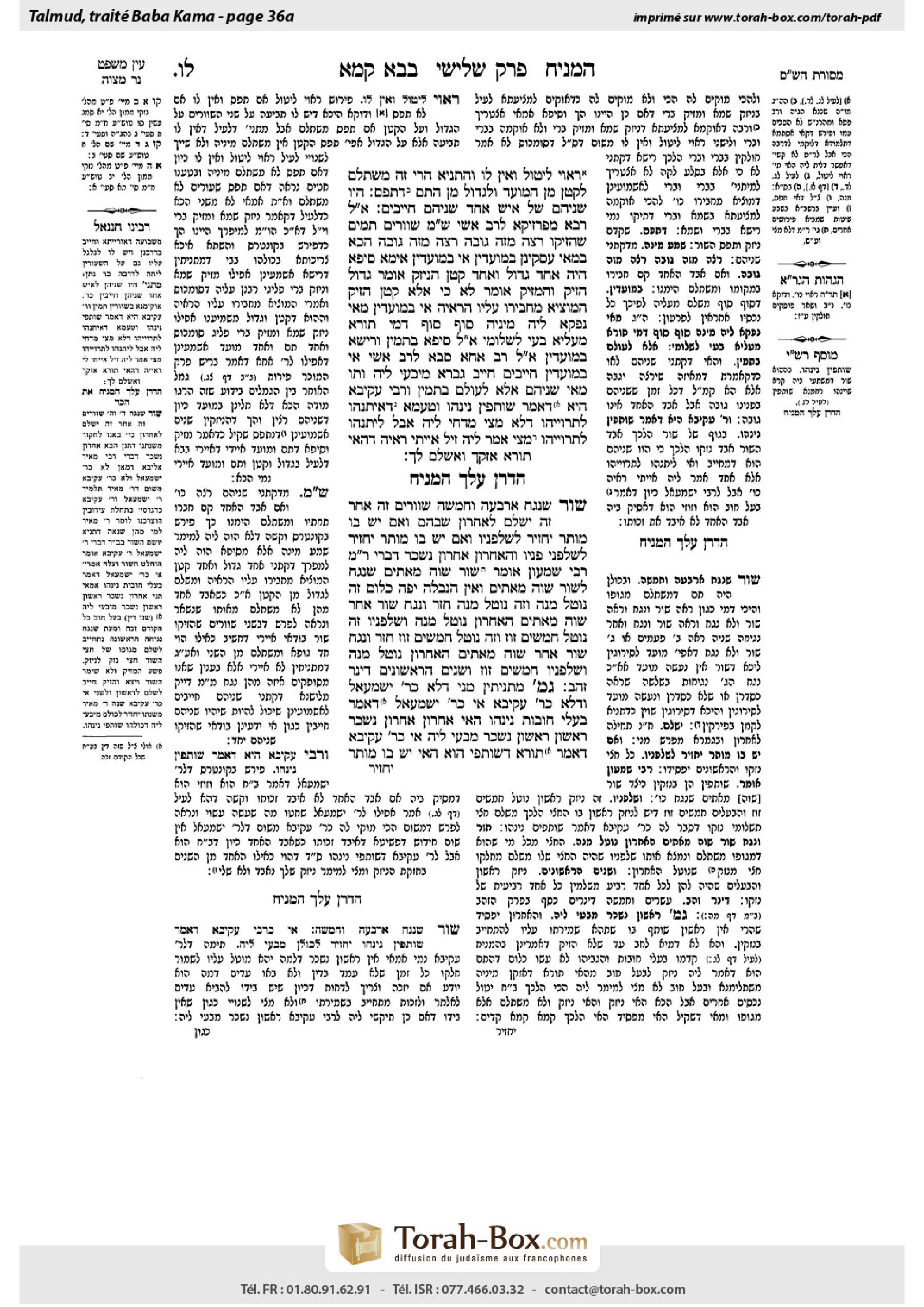
Bava Kamma 36a: Talmud study for Daf Yomi
Study the Talmud for Daf Yomi with scanned pages, Hebrew text, English translations from Sefaria and AI-generated French translations.
Passage selection and English or AI-generated French translation are available where the scan has annotations. Daf Study is independent of Torah-Box and Sefaria.
Browse Bava Kamma · בבא קמא · All tractatesBava Kamma 36a text and translations
This page of Bava Kamma includes the Aramaic text, an English translation and an AI-generated French translation, alongside the scan above.
בבא קמא ל״ו א · Aramaic and Hebrew text
רָאוּי לִיטּוֹל, וְאֵין לוֹ. וְהָתַנְיָא: הֲרֵי זֶה מִשְׁתַּלֵּם לַקָּטָן מִן הַמּוּעָד, וְלַגָּדוֹל מִן הַתָּם! דִּתְפַס.
הָיוּ שְׁנֵיהֶם שֶׁל אִישׁ אֶחָד – שְׁנֵיהֶם חַיָּיבִים. אֲמַר לֵיהּ רָבָא מִפַּרְזִיקָא לְרַב אָשֵׁי: שְׁמַע מִינַּהּ, שְׁוָורִים תַּמִּים שֶׁהִזִּיקוּ – רָצָה מִזֶּה גּוֹבֶה, רָצָה מִזֶּה גּוֹבֶה.
הָכָא בְּמַאי עָסְקִינַן – בְּמוּעָדִין.
אִי בְּמוּעָדִין, אֵימָא סֵיפָא: הָיָה אֶחָד גָּדוֹל וְאֶחָד קָטָן, הַנִּיזָּק אוֹמֵר: ״גָּדוֹל הִזִּיק״, וְהַמַּזִּיק אוֹמֵר: ״לֹא כִי, אֶלָּא קָטָן הִזִּיק״ – הַמּוֹצִיא מֵחֲבֵירוֹ עָלָיו הָרְאָיָה. אִי בְּמוּעָדִין, מַאי נָפְקָא לֵיהּ מִינֵּיהּ? סוֹף סוֹף, דְּמֵי תּוֹרָא מְעַלְּיָא בָּעֵי לְשַׁלּוֹמֵי!
אֲמַר לֵיהּ: סֵיפָא בְּתַמִּין, וְרֵישָׁא בְּמוּעָדִין.
אֲמַר לֵיהּ רַב אַחָא סָבָא לְרַב אָשֵׁי: אִי בְּמוּעָדִין, ״חַיָּיבִים״?! ״חַיָּיב גַּבְרָא״ מִיבְּעֵי לֵיהּ! וְתוּ, מַאי ״שְׁנֵיהֶם״?
אֶלָּא לְעוֹלָם בְּתַמִּין; וְרַבִּי עֲקִיבָא הִיא, דְּאָמַר: שׁוּתָּפִין נִינְהוּ; וְטַעְמָא דְּאִיתַנְהוּ לְתַרְוַיְיהוּ – דְּלָא מָצֵי מְדַחֵי לֵיהּ, אֲבָל לֵיתַנְהוּ לְתַרְוַיְיהוּ – מָצֵי אֲמַר לֵיהּ: זִיל אַיְיתִי רְאָיָה דְּהַאי תּוֹרָא אַזְּקָךְ, וַאֲשַׁלֵּם לָךְ.
הֲדַרַן עֲלָךְ הַמַּנִּיחַ
מַתְנִי׳ שׁוֹר שֶׁנָּגַח אַרְבָּעָה וַחֲמִשָּׁה שְׁוָורִים זֶה אַחַר זֶה – יְשַׁלֵּם לָאַחֲרוֹן שֶׁבָּהֶם, וְאִם יֵשׁ בּוֹ מוֹתָר – יַחֲזִיר לְשֶׁלְּפָנָיו, וְאִם יֵשׁ בּוֹ מוֹתָר – יַחֲזִיר לְשֶׁלִּפְנֵי פָנָיו, וְהָאַחֲרוֹן אַחֲרוֹן נִשְׂכָּר; דִּבְרֵי רַבִּי מֵאִיר.
רַבִּי שִׁמְעוֹן אוֹמֵר: שׁוֹר שָׁוֶה מָאתַיִם שֶׁנָּגַח לְשׁוֹר שָׁוֶה מָאתַיִם, וְאֵין הַנְּבֵלָה יָפָה כְּלוּם – זֶה נוֹטֵל מָנֶה, וְזֶה נוֹטֵל מָנֶה.
חָזַר וְנָגַח שׁוֹר אַחֵר שָׁוֶה מָאתַיִם – הָאַחֲרוֹן נוֹטֵל מָנֶה; וְשֶׁלְּפָנָיו – זֶה נוֹטֵל חֲמִשִּׁים זוּז, וְזֶה נוֹטֵל חֲמִשִּׁים זוּז.
חָזַר וְנָגַח שׁוֹר אַחֵר שָׁוֶה מָאתַיִם – הָאַחֲרוֹן נוֹטֵל מָנֶה, וְשֶׁלְּפָנָיו חֲמִשִּׁים זוּז, וּשְׁנַיִם הָרִאשׁוֹנִים – דִּינַר זָהָב.
גְּמָ׳ מַתְנִיתִין מַנִּי? דְּלָא כְּרַבִּי יִשְׁמָעֵאל, וּדְלָא כְּרַבִּי עֲקִיבָא!
אִי כְּרַבִּי יִשְׁמָעֵאל דְּאָמַר בַּעֲלֵי חוֹבוֹת נִינְהוּ, הַאי ״אַחֲרוֹן אַחֲרוֹן נִשְׂכָּר״?! ״רִאשׁוֹן רִאשׁוֹן נִשְׂכָּר״ מִבְּעֵי לֵיהּ! אִי כְּרַבִּי עֲקִיבָא דְּאָמַר תּוֹרָא דְשׁוּתָּפֵי הוּא, הַאי ״יֵשׁ בּוֹ מוֹתָר –
Bava Kamma 36a · English translation
The Gemara answers: The mishna does not indicate that the injured party receives compensation. Rather, it indicates that it is fitting for him to take compensation, but in practice he does not receive any compensation. The Gemara asks: But isn’t it taught in a baraita that he receives payment for his small ox from the liable party’s forewarned ox, and for his large ox from the liable party’s innocuous ox? Evidently he does receive payment. The Gemara answers: This baraita is also referring to a case where the injured party seized the defendant’s ox, in which case the court allows it to remain in his possession. The court cannot compel the defendant to pay him ab initio.
§ The mishna teaches: In a case where an ox was injured by one of two oxen that were pursuing it, if both oxen belonged to one person, both are liable. Rava of Parzika said to Rav Ashi: Should one learn from the fact that both are liable that in a case of innocuous oxen that caused damage, if the injured party wishes, he can collect damages from the proceeds from the sale of this ox, and if he wishes, he can collect from the sale of that ox?
Rav Ashi rejected this inference: With what are we dealing here? We are dealing with forewarned oxen, in which case the injured party does not collect damages exclusively from the belligerent ox but rather from any of its owner’s property. Therefore, he can collect from either ox as compensation.
Rava of Parzika replied: If the mishna is referring to forewarned oxen, say the latter clause of the mishna: If one of the belligerent oxen was large and the other one was small, and the injured party says that the large ox caused the damage, but the one liable for damage says: No; rather, the small ox caused the damage, the burden of proof rests upon the claimant. If this is referring to forewarned oxen, what difference does it make to him which one caused the injury? Ultimately, the liable party is required to pay the value of a full ox in any case.
Rav Ashi said to him: The latter clause of the mishna is referring to innocuous oxen, and the first clause is referring to forewarned oxen.
Rav Aḥa the Elder said to Rav Ashi: If it is referring to a case of forewarned oxen, where compensation is not collected specifically from the belligerent ox, why does the mishna state: They are liable, in the plural form? It should have stated: The man is liable. And furthermore, what is the word both in the statement: Both are liable, referring to?
Rather, the first clause of the mishna is actually referring to innocuous oxen, and it is the opinion of Rabbi Akiva, who says that the injured party and the liable party are partners, as they share ownership of the belligerent ox. And therefore, the reason that the owner of the belligerent oxen is liable is that the two of them are available, so he cannot dismiss the injured party by claiming that this ox is not the one that caused the injury. But if the two of them are not available, e.g., if one died or was lost, he can say to the injured party: Go bring proof that it was this ox that caused you damage, and I will pay you compensation.
MISHNA: With regard to an innocuous ox that gored four or five other oxen one after the other, its owner shall pay the owner of the last one of them half of the damages from the proceeds of the sale of the belligerent ox; and if there is surplus value left in his ox after he pays that owner, he shall return it to the owner of the previous ox that was gored; and if there is still surplus value left in his ox after he pays that owner, he shall return it to the one prior to the previous one. The principle is that the owner of the latest of the oxen gored in succession gains. This is the statement of Rabbi Meir.
Rabbi Shimon says that the division of the compensation is as follows: With regard to an innocuous ox worth two hundred dinars that gored an ox worth two hundred dinars, thereby killing it, and the carcass is worthless, the injured party takes one hundred dinars, i.e., half the cost of the damage, from the proceeds of the sale of the belligerent ox, and the owner of the belligerent ox takes the remaining one hundred dinars.
If the ox, after goring the first ox but before compensation had been paid, again gored another ox worth two hundred dinars, and the carcass is worthless, the owner of the last ox that was gored takes one hundred dinars, and with regard to payment for the previous goring, the owner of this ox that was gored takes fifty dinars, which is half the remaining value of the belligerent ox after one hundred dinars were paid to the last injured party, and the owner of that belligerent ox takes the remaining fifty dinars.
If the ox, after goring the first two oxen but before compensation had been paid, again gored another ox worth two hundred dinars, and the carcass is worthless, the last injured party takes one hundred dinars, the previous one takes fifty dinars, and the first two, i.e., the first injured party and the owner of the belligerent ox, divide the remainder, each receiving one gold dinar, which is worth twenty-five silver dinars.
GEMARA: Whose opinion is expressed in the mishna? Apparently the mishna is neither in accordance with the opinion of Rabbi Yishmael, nor in accordance with the opinion of Rabbi Akiva (see 33a).
The Gemara explains: If the mishna had been in accordance with the opinion of Rabbi Yishmael, who says that the owners of the gored oxen are considered creditors of the owner of the belligerent ox, then instead of stating this halakha that the owner of the latest of the oxen gored in succession gains, the mishna should have stated that the owner of the earliest of the oxen gored in succession gains, since the creditor to whom the ox is initially liened collects first. And if the mishna had been in accordance with the opinion of Rabbi Akiva, who says that the belligerent ox belongs to its owner and to the injured party, who are considered partners in the ownership of the ox, then instead of stating this ruling that if there is surplus value remaining in the ox after he pays that owner
Bava Kamma 36a · Traduction française (IA)
Le Guemara répond : La Michna ne précise pas que la partie blessée reçoit une compensation. Elle indique plutôt qu'il est approprié qu'il prenne une compensation, mais en pratique, il ne reçoit aucune compensation. Le Guemara demande : Mais n'est-il pas enseigné dans une baraïta qu'il reçoit une compensation pour son petit taureau du taureau du responsable averti, et pour son grand taureau du taureau innocent du responsable ? Évidemment, il reçoit une compensation. Le Guemara répond : Cette baraïta fait référence également à un cas où la partie blessée a saisi le taureau du défendeur, dans ce cas, le tribunal permet qu'il reste en son possession. Le tribunal ne peut pas obliger le défendeur à lui payer dès le début.
§ La Michna enseigne : Dans un cas où un taureau a été blessé par l'un des deux taureaux qui le poursuivaient, si les deux taureaux appartenaient à la même personne, les deux sont responsables. Rava de Parzika dit à Rav Ashi : Doit-on apprendre de ce que les deux sont responsables que dans un cas de taureaux innocents qui ont causé des dommages, si la partie blessée le souhaite, il peut réclamer des dommages à partir des revenus de la vente de ce taureau, et si il le souhaite, il peut réclamer à partir de la vente de celui-ci ?
Rav Ashi rejette cette déduction : Avec quels taureaux sommes-nous en train de parler ? Nous parlons de taureaux avertis, dans lesquels cas la partie blessée ne réclame pas exclusivement des dommages à partir du taureau belliqueux, mais plutôt à partir de toute la propriété de son propriétaire. Ainsi, il peut réclamer à partir de n'importe quel taureau comme compensation.
Rava de Parzika répondit : Si la Michna fait référence à des taureaux avertis, disons la seconde partie de la Michna : Si l'un des taureaux belliqueux était grand et l'autre petit, et la partie blessée affirme que c'est le taureau grand qui a causé les dommages, mais celui responsable des dommages affirme : Non ; c'est plutôt le taureau petit qui a causé les dommages, la charge de la preuve repose sur le plaignant. Si cela fait référence à des taureaux avertis, à quoi cela sert-il de savoir quel taureau a causé la blessure ? Finalement, la partie responsable est tenue de payer la valeur d'un taureau entier dans tous les cas.
Rav Ashi dit à lui : La seconde partie de la Michna fait référence aux taureaux innocents, et la première partie fait référence aux taureaux avertis.
Rav Acha le Vieux dit à Rav Ashi : Si cela fait référence à un cas de taureaux avertis, où la compensation n'est pas réclamée spécifiquement à partir du taureau belliqueux, pourquoi la Michna dit-elle : Ils sont responsables, au pluriel ? Elle aurait dû dire : L'homme est responsable. Et de plus, à quoi fait référence le mot « les deux » dans l'affirmation : Les deux sont responsables ?
Plutôt, la première partie de la Michna fait en réalité référence à des taureaux innocents, et c'est l'opinion de Rabbi Akiva, qui dit que la partie blessée et la partie responsable sont associés, car ils partagent la propriété du taureau belliqueux. Et donc, la raison pour laquelle l'owner du taureau belliqueux est responsable est que les deux d'entre eux sont disponibles, donc il ne peut pas rejeter la partie blessée en affirmant que ce taureau n'est pas celui qui a causé les dommages. Mais si les deux d'entre eux ne sont pas disponibles, par exemple si l'un est mort ou perdu, il peut dire à la partie blessée : Apporte-moi la preuve que c'est ce taureau qui t'a causé des dommages, et je te paierai la compensation.
MICHNA : Concernant un taureau innocent qui a renversé quatre ou cinq autres taureaux les uns après les autres, son propriétaire doit payer au propriétaire du dernier d'entre eux la moitié des dommages à partir des revenus de la vente du taureau belliqueux ; et si il reste une valeur résiduelle dans son taureau après avoir payé ce propriétaire, il doit la rendre au propriétaire du taureau renversé précédemment ; et si il reste encore une valeur résiduelle dans son taureau après avoir payé ce propriétaire, il doit la rendre au précédent de celui-ci. Le principe est que le propriétaire du dernier taureau renversé en succession gagne. C'est l'opinion de Rabbi Meir.
Rabbi Shimon dit que la répartition de la compensation est la suivante : Concernant un taureau innocent valant deux cents dinars qui a renversé un taureau valant deux cents dinars, le tuant, et le cadavre est sans valeur, la partie blessée prend cent dinars, c'est-à-dire la moitié du coût des dommages, à partir des revenus de la vente du taureau belliqueux, et le propriétaire du taureau belliqueux prend les cent dinars restants.
Si le taureau, après avoir renversé le premier taureau mais avant que la compensation n'ait été payée, renverse à nouveau un autre taureau valant deux cents dinars, et le cadavre est sans valeur, le propriétaire du dernier taureau renversé prend cent dinars, et concernant le paiement pour la précédente renversement, le propriétaire de ce taureau renversé prend cinquante dinars, qui est la moitié de la valeur restante du taureau belliqueux après que cent dinars aient été payés à la dernière partie blessée, et le propriétaire de ce taureau belliqueux prend les cinquante dinars restants.
Si le taureau, après avoir renversé les deux premiers taureaux mais avant que la compensation n'ait été payée, renverse à nouveau un autre taureau valant deux cents dinars, et le cadavre est sans valeur, le dernier propriétaire blessé prend cent dinars, le précédent prend cinquante dinars, et les deux premiers, c'est-à-dire la première partie blessée et le propriétaire du taureau belliqueux, divisent le reste, chacun recevant un dinar d'or, qui vaut vingt-cinq dinars d'argent.
GUEMARA : Quelle opinion exprime la Michna ? Apparemment, la Michna ne correspond ni à l'opinion de Rabbi Yishmael, ni à l'opinion de Rabbi Akiva (voir 33a).
La Guemara explique : Si la Michna avait été en conformité avec l'opinion du Rabbi Yishmael, qui affirme que les propriétaires des bœufs qui ont attaqué sont considérés comme des créanciers du propriétaire du bœuf belliqueux, alors au lieu de formuler cette halakha selon laquelle le propriétaire du bœuf qui a attaqué en dernier dans la succession obtient gain, la Michna aurait dû affirmer que le propriétaire du bœuf qui a attaqué en premier dans la succession obtient gain, car le créancier auquel le bœuf est initialement lié récupère en premier. Et si la Michna avait été en conformité avec l'opinion du Rabbi Akiva, qui affirme que le bœuf belliqueux appartient à son propriétaire et à la partie blessée, qui sont considérés comme partenaires dans la propriété du bœuf, alors au lieu de formuler cette décision selon laquelle, en cas de valeur résiduelle restant dans le bœuf après qu'il ait payé à ce propriétaire
Traduction française générée par IA à partir de l’édition anglaise de Sefaria. Vérifie toujours un passage avec le texte source.
Text from Sefaria: William Davidson Edition - Vocalized Aramaic (CC BY NC); William Davidson Edition - English (CC BY NC).