Bava Kamma 41a: Talmud study for Daf Yomi
Study the Talmud for Daf Yomi with scanned pages, Hebrew text, English translations from Sefaria and AI-generated French translations.
Passage selection and English or AI-generated French translation are available where the scan has annotations. Daf Study is independent of Torah-Box and Sefaria.
Browse Bava Kamma · בבא קמא · All tractatesBava Kamma 41a text and translations
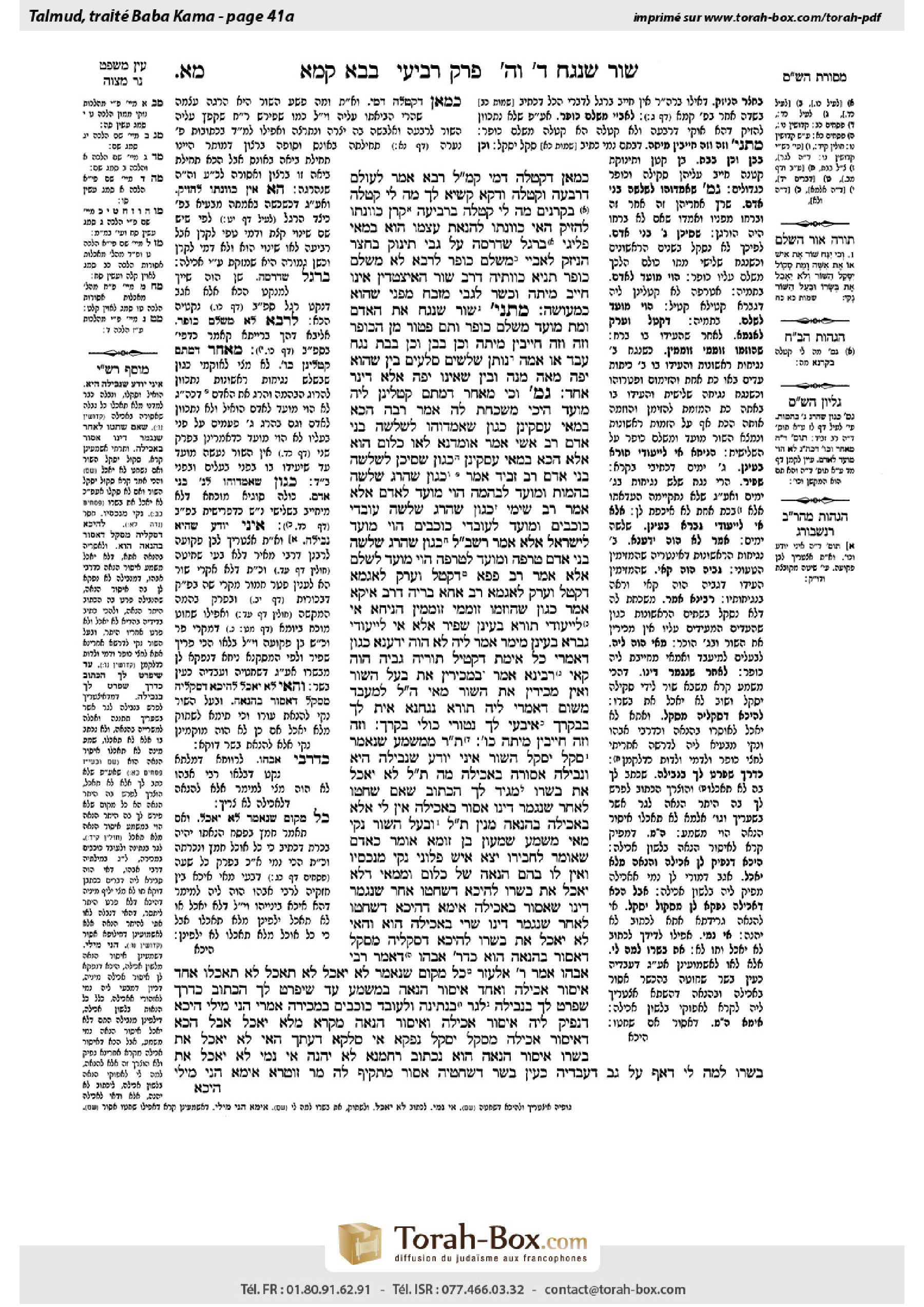
This page of Bava Kamma includes the Aramaic text, an English translation and an AI-generated French translation, alongside the scan above.
בבא קמא מ״א א · Aramaic and Hebrew text
כְּמַאן דְּקַטְלַהּ דָּמֵי, קָא מַשְׁמַע לַן.
רָבָא אָמַר: לְעוֹלָם דְּרַבְעַהּ וְקַטְלַהּ; וּדְקָא קַשְׁיָא לָךְ: מָה לִי קַטְלַהּ בְּקַרְנַיִם, מָה לִי קַטְלַהּ בִּרְבִיעָה – קֶרֶן כַּוּוֹנָתוֹ לְהַזִּיק, הַאי כַּוּוֹנָתוֹ לַהֲנָאַת עַצְמוֹ הוּא.
בְּמַאי פְּלִיגִי? בְּרֶגֶל שֶׁדָּרְסָה עַל גַּבֵּי תִּינוֹק בַּחֲצַר הַנִּיזָּק; לְאַבָּיֵי – מְשַׁלֵּם כּוֹפֶר, לְרָבָא – לָא מְשַׁלֵּם כּוֹפֶר.
תַּנְיָא כְּווֹתֵיהּ דְּרַב: שׁוֹר הָאִיצְטָדִין – אֵינוֹ חַיָּיב מִיתָה, וְכָשֵׁר לְגַבֵּי מִזְבֵּחַ; מִפְּנֵי שֶׁהוּא כִּמְעוּשֶּׂה.
מַתְנִי׳ שׁוֹר שֶׁנָּגַח אֶת הָאָדָם, וּמֵת – מוּעָד מְשַׁלֵּם כּוֹפֶר, וְתָם פָּטוּר מִן הַכּוֹפֶר. וְזֶה וְזֶה חַיָּיבִין מִיתָה. וְכֵן בַּבֵּן, וְכֵן בַּבַּת. נָגַח עֶבֶד אוֹ אָמָה – נוֹתֵן שְׁלֹשִׁים סְלָעִים; בֵּין שֶׁהוּא יָפֶה מֵאָה מָנֶה, וּבֵין שֶׁאֵינוֹ יָפֶה אֶלָּא דִּינָר אֶחָד.
גְּמָ׳ וְכִי מֵאַחַר דְּמִתָּם קָטְלִינַן לֵיהּ, מוּעָד הֵיכִי מַשְׁכַּחַתְּ לַהּ?
אָמַר רַבָּה: הָכָא בְּמַאי עָסְקִינַן – כְּגוֹן שֶׁאֲמָדוּהוּ לִשְׁלֹשָׁה בְּנֵי אָדָם.
רַב אָשֵׁי אָמַר: אוּמְדָּנָא לָאו כְּלוּם הוּא. אֶלָּא הָכָא בְּמַאי עָסְקִינַן – כְּגוֹן שֶׁסִּיכֵּן לִשְׁלֹשָׁה בְּנֵי אָדָם.
רַב זְבִיד אָמַר: כְּגוֹן שֶׁהָרַג שָׁלֹשׁה בְּהֵמוֹת.
וּמוּעָד לִבְהֵמָה הָוֵי מוּעָד לְאָדָם? אֶלָּא אָמַר רַב שִׁימִי: כְּגוֹן שֶׁהָרַג שְׁלֹשָׁה גּוֹיִם.
וּמוּעָד לְגוֹיִם הָוֵי מוּעָד לְיִשְׂרָאֵל? אֶלָּא אָמַר רַבִּי שִׁמְעוֹן בֶּן לָקִישׁ: כְּגוֹן שֶׁהָרַג שְׁלֹשָׁה בְּנֵי אָדָם טְרֵפָה.
וּמוּעָד לִטְרֵפָה הָוֵי מוּעָד לְשָׁלֵם? אֶלָּא אָמַר רַב פָּפָּא: דִּקְטַל וַעֲרַק לְאַגְמָא, דִּקְטַל וַעֲרַק לְאַגְמָא.
רַב אַחָא בְּרֵיהּ דְּרַב אִיקָא אָמַר: כְּגוֹן שֶׁהוּזְמוּ זוֹמְמֵי זוֹמְמִין.
הָנִיחָא אִי לְיַיעוֹדֵי תּוֹרָא בָּעֵינַן – שַׁפִּיר. אֶלָּא אִי לְיַיעוֹדֵי גַּבְרָא בָּעֵינַן, מֵימַר אֲמַר לֵיהּ: לָא הֲוָה יָדַעְנָא! כְּגוֹן דְּאָמְרִי: כֹּל אֵימַת דְּקָטֵיל תּוֹרֵיהּ, גַּבֵּיהּ הֲוָה קָאֵי.
רָבִינָא אָמַר: בְּמַכִּירִין אֶת בַּעַל הַשּׁוֹר, וְאֵין מַכִּירִין אֶת הַשּׁוֹר.
מַאי הֲוָה לֵיהּ לְמֶעְבַּד? מִשּׁוּם דְּאָמְרִי לֵיהּ: תּוֹרָא נַגְחָנָא אִית לָךְ בְּבַקְרָךְ, אִיבְּעִי לָךְ נַטּוֹרֵי כּוּלֵּי בַּקְרָךְ.
וְזֶה וָזֶה חַיָּיבִין מִיתָה כּוּ׳. תָּנוּ רַבָּנַן: מִמַּשְׁמַע שֶׁנֶּאֱמַר ״סָקֹל יִסָּקֵל הַשּׁוֹר״ – אֵינִי יוֹדֵעַ שֶׁנְּבֵילָה הִיא, וּנְבֵילָה אֲסוּרָה בַּאֲכִילָה? מָה תַּלְמוּד לוֹמַר ״לֹא יֵאָכֵל אֶת בְּשָׂרוֹ״? מַגִּיד לְךָ הַכָּתוּב, שֶׁאִם שְׁחָטוֹ לְאַחַר שֶׁנִּגְמַר דִּינוֹ – אָסוּר בַּאֲכִילָה.
אֵין לִי אֶלָּא בַּאֲכִילָה, בַּהֲנָאָה מִנַּיִן? תַּלְמוּד לוֹמַר: ״וּבַעַל הַשּׁוֹר נָקִי״.
מַאי מַשְׁמַע? שִׁמְעוֹן בֶּן זוֹמָא אוֹמֵר, כְּאָדָם שֶׁאוֹמֵר לַחֲבֵירוֹ: ״יָצָא אִישׁ פְּלוֹנִי נָקִי מִנְּכָסָיו, וְאֵין לוֹ בָּהֶם הֲנָאָה שֶׁל כְּלוּם״.
וּמִמַּאי דְּ״לֹא יֵאָכֵל אֶת בְּשָׂרוֹ״ – לְהֵיכָא דִּשְׁחָטוֹ אַחַר שֶׁנִּגְמַר דִּינוֹ, שֶׁאָסוּר בַּאֲכִילָה? אֵימָא דְּהֵיכָא דִּשְׁחָטוֹ לְאַחַר שֶׁנִּגְמַר דִּינוֹ – שְׁרֵי בַּאֲכִילָה הוּא; וְהַאי ״לֹא יֵאָכֵל אֶת בְּשָׂרוֹ״ – לְהֵיכָא דְּסַקְלֵיהּ מִסְקָל, דְּאָסוּר בַּהֲנָאָה הוּא – כִּדְרַבִּי אֲבָהוּ,
דְּאָמַר רַבִּי אֲבָהוּ אָמַר רַבִּי אֶלְעָזָר: כׇּל מָקוֹם שֶׁנֶּאֱמַר ״לֹא יֹאכַל״; ״לֹא תֹאכַל״; ״לֹא תֹאכְלוּ״ – אֶחָד אִיסּוּר אֲכִילָה וְאֶחָד אִיסּוּר הֲנָאָה בַּמַּשְׁמָע,
עַד שֶׁיִּפְרֹט לְךָ הַכָּתוּב כְּדֶרֶךְ שֶׁפָּרַט לְךָ בִּנְבֵילָה – לַגֵּר בִּנְתִינָה, וְלַנׇּכְרִי בִּמְכִירָה!
אָמְרִי: הָנֵי מִילֵּי הֵיכָא דְּנָפֵיק לֵיהּ אִיסּוּר אֲכִילָה וְאִיסּוּר הֲנָאָה מִקְּרָא – מִ״לֹּא יֹאכַל״; אֲבָל הָכָא, דְּאִיסּוּר אֲכִילָה מִ״סָּקֹל יִסָּקֵל״ נָפְקָא, אִי סָלְקָא דַעְתָּךְ הַאי ״לֹא יֵאָכֵל אֶת בְּשָׂרוֹ״ אִיסּוּר הֲנָאָה הוּא, נִכְתּוֹב רַחֲמָנָא: ״לֹא יֵהָנֶה״, אִי נָמֵי ״לֹא יֵאָכֵל״; ״אֶת בְּשָׂרוֹ״ לְמָה לִי? דְּאַף עַל גַּב דְּעַבְדֵיהּ כְּעֵין בָּשָׂר, דְּשַׁחְטֵיהּ – אָסוּר.
מַתְקֵיף לַהּ מָר זוּטְרָא: אֵימָא הָנֵי מִילֵּי
Bava Kamma 41a · English translation
that the ox should be considered like one that killed her, as it was the reason for her execution, and therefore its owner should be liable to pay a ransom, the baraita teaches us that this is not the case.
Rava said: Actually, it is a case where the animal engaged in bestiality with her and killed her in the process. And as for the difficulty you pose: What is the difference to me whether it killed her with its horns, and what is the difference to me whether it killed her through bestiality, the answer is that in that case of an animal killing with its horn, its intention is to cause injury, whereas in this case of killing through bestiality its intention is to achieve its own pleasure.
The Gemara asks: With regard to what other case would Abaye and Rava disagree? They disagree with regard to a case where an ox trampled a child with its foot, killing it, in the courtyard of the injured party. According to Abaye, the owner pays the ransom, as he holds that ransom is paid even if the animal’s objective was not to cause injury or death. According to Rava, he does not pay the ransom.
It is taught in a baraita in accordance with the opinion of Rav: A stadium ox that killed a person is not liable to be put to death and is fit to be sacrificed as an offering on the altar, because it is as though it was compelled to behave in this manner.
MISHNA: With regard to an ox that gored a person and the person died, if the ox was forewarned its owner pays ransom, but if it was innocuous he is exempt from paying the ransom. And both this forewarned ox and that innocuous ox are liable to be put to death for killing a person. And the same halakha applies in a case where the animal killed a boy and the same applies in a case where it killed a girl. If the ox gored and killed a Canaanite slave or a Canaanite maidservant, its owner gives the victim’s master thirty sela, whether he was a slave worth one hundred maneh, i.e., one hundred silver dinars, or worth only one dinar.
GEMARA: The Gemara asks: But since we kill the ox for killing a person when it is still considered innocuous, how can you find a case of a forewarned ox killing a person?
Rabba said: Here we are dealing with a case where in three instances of attacking people, the court assessed that had the people not escaped, the ox would certainly have killed them. Therefore, despite the fact that the ox did not kill anyone, it now has the status of a forewarned ox.
Rav Ashi said: Such an assessment is not worth anything. Since the ox did not actually kill them, it is not rendered forewarned even if it intended to kill. Rather, here we are dealing with a case where it endangered the lives of three people by goring them, and they all died only after the third goring. Therefore, the ox had not been put to death.
Rav Zevid said: The mishna is discussing a case where it killed three animals, which is sufficient to render the ox forewarned but for which it is not put to death.
The Gemara asks: But is an animal that is forewarned with regard to animals considered forewarned with regard to people as well? Certainly it is not. Rather, Rav Shimi said: The mishna is discussing a case where it killed three gentiles, for which the animal is not put to death.
The Gemara asks: But is an animal that is forewarned with regard to gentiles considered forewarned with regard to Jews as well? Rather, Rabbi Shimon ben Lakish said: The mishna is discussing a case where it killed three people who had wounds that would have caused them to die within twelve months [tereifa]. Since they were on the verge of dying anyway, the ox is not put to death for killing them. Nevertheless, it is rendered forewarned with regard to its future goring and killing of people.
The Gemara asks: But is an animal that is forewarned with regard to a tereifa considered forewarned with regard to an intact person, i.e., one who is not a tereifa? Rather, Rav Pappa said: The mishna is discussing a case where it killed a person and fled to the marsh, then killed again and fled to the marsh, and then killed again and fled to the marsh, so the court was not able kill it before it had killed three times, rendering it forewarned.
Rav Aḥa, son of Rav Ika, said: The mishna is discussing a case where the witnesses who had rendered the witnesses who testified to the three incidents of goring as conspiring witnesses, resulting in the animal not being put to death, were themselves subsequently proven to be conspiring witnesses by other witnesses. Consequently, the testimonies of the witnesses who testified about the incidents of goring were reinstated, rendering the ox forewarned.
The Gemara asks: This explanation works out well if it is assumed that the purpose of testifying to the ox’s goring is because we wish to establish the ox as forewarned; once the testimony concerning the incidents of goring is reinstated, it is established that the ox gored three times. But if we wish to warn the man who owns the ox by testifying that the animal gored, he could say to the judge, after it is established that his ox was forewarned: I did not know that my ox was forewarned, since the witnesses had previously been rendered conspiring witnesses. The Gemara answers: This is a case where the witnesses say: Each time his ox killed a person he was standing by it, so that he cannot claim ignorance.
Ravina said: The mishna is discussing a case where the witnesses recognized the owner of the ox but did not recognize the ox itself. Therefore, with regard to the first incidents of goring, they testified that it was his ox that gored, but they did not testify with regard to the ox itself. That is why the ox was not put to death. Only afterward did they realize that this was the ox that had gored three times previously.
The Gemara asks: If so, why is the ox rendered forewarned? What could the owner have done to prevent it from goring again, as he did not know which of his oxen had gored? The Gemara answers that it is rendered forewarned because the court effectively said to him: You have a habitually goring ox in your herd, so you must safeguard your entire herd.
§ The mishna teaches: And both this forewarned ox and that innocuous ox are liable to be put to death. The Sages taught: We learn by inference from that which is stated with regard to an ox that killed a person: “And if an ox gores a man or a woman, that they die, the ox shall be stoned, and its flesh shall not be eaten; but the owner of the ox shall be clear” (Exodus 21:28). Don’t I know from this verse that the stoning makes it an unslaughtered animal carcass, and it is prohibited to eat an unslaughtered animal carcass? What is the meaning when the verse states: “Its flesh shall not be eaten”? The verse is telling you that even if one slaughtered the ox after its verdict had been reached but before it was stoned, it is still prohibited to eat it.
I have derived only that one is prohibited to eat it; from where is it derived that one is prohibited from deriving benefit from the ox as well? The verse states: “But the owner of the ox shall be clear.”
The Gemara asks: What is the inference? How is this halakha derived from the statement that the owner shall be clear? Shimon ben Zoma says: This is like a person who says to his friend: So-and-so was left clear of his property, and has no benefit from it at all. Similarly, “but the owner of the ox shall be clear” means that he may not derive benefit from the ox.
The Gemara asks: And from where is it known that this phrase: “Its flesh shall not be eaten,” serves to teach a halakha with regard to a case where he slaughtered the ox after its verdict was reached, but before it was stoned, and is teaching that one is prohibited to eat it? Why not say that it is permitted to eat the ox if he slaughtered it after its verdict had been reached. And this phrase: “Its flesh shall not be eaten,” serves to teach a halakha with regard to a case where they had already stoned it, but not to teach a prohibition against eating it, as that is already known due to the fact that it was stoned. Rather, it serves to prohibit deriving benefit from the ox, and that would be in accordance with the statement of Rabbi Abbahu.
As Rabbi Abbahu says that Rabbi Elazar says that wherever it is stated: “It shall not be eaten”; or “you,” singular, “shall not eat”; or “you,” plural, “shall not eat”; both a prohibition against eating and a prohibition against deriving benefit are indicated. This is so unless the verse specifies for you that one may derive benefit, in the manner that it specified for you with regard to an animal carcass, from which the verse explicitly permits one to derive benefit.
The Gemara continues: This is so unless the verse specifies for you that one may derive benefit, in the manner that it specified for you with regard to an animal carcass, from which the verse explicitly permits one to derive benefit, as it states: “You may sell it to a foreigner” (Deuteronomy 14:21). Accordingly, it is permitted to transfer an unslaughtered animal carcass to a ger toshav, i.e., a gentile who resides in Eretz Yisrael and observes the seven Noahide mitzvot, through giving it to him as a gift, and to any other gentile through selling it to him. Apparently, without this explicit permission, it would be prohibited to derive any benefit from a carcass, due to the prohibition: “You shall not eat.” Here, too, with regard to the ox that is stoned, the phrase: “Its flesh shall not be eaten,” may serve to teach that one may not derive benefit from the stoned ox.
The Sages said in response: That statement applies where both the prohibition of eating and the prohibition of deriving benefit are derived from a verse using an expression such as: “It shall not be eaten.” But here, where the prohibition of eating is derived from the statement: “The ox shall be stoned,” if it enters your mind that this expression: “Its flesh shall not be eaten,” is stated only in reference to the prohibition of deriving benefit, let the Merciful One write explicitly: Benefit shall not be derived from it. Alternatively, let the verse simply state: “It shall not be eaten”; why do I require the specific term: “Its flesh”? Clearly, the intention of the verse is to teach that even if he has rendered it like kosher flesh by properly slaughtering it after the verdict, one is still prohibited to eat it.
Mar Zutra objects to this: Say that this statement applies
Bava Kamma 41a · Traduction française (IA)
que l'ox soit considéré comme celui qui a tué elle, car c'était la raison de son exécution, et donc son propriétaire devrait être tenu responsable de payer une rançon, la baraïta nous apprend que ce n'est pas le cas.
Rava a dit : En réalité, il s'agit d'un cas où l'animal a eu des relations avec elle et l'a tuée en cours de route. Et quant à la difficulté que vous élevez : Quelle différence fait-il pour moi que l'animal l'ait tuée avec ses cornes, et quelle différence fait-il pour moi que l'animal l'ait tuée par bestialité, la réponse est que dans le cas d'un animal tuant avec ses cornes, son intention est de causer un préjudice, tandis que dans ce cas de tuer par bestialité, son intention est d'atteindre son propre plaisir.
Le Guemara pose la question : À propos de quel autre cas Abaye et Rava s'opposent-ils ? Ils s'opposent à propos d'un cas où un taureau a écrasé un enfant avec son pied, le tuant, dans la cour du propriétaire blessé. Selon Abaye, le propriétaire paie la rançon, car il considère que la rançon est payée même si l'objectif de l'animal n'était pas de causer un préjudice ou une mort. Selon Rava, il ne paie pas la rançon.
Il est enseigné dans une baraïta selon l'opinion de Rav : Un taureau de stade qui a tué une personne n'est pas tenu responsable de la mort et est digne d'être sacrifié comme offrande sur l'autel, car il est comme s'il avait été contraint à agir ainsi.
MICHNA : Concernant un taureau qui a renversé une personne et que celle-ci est morte, si le taureau avait été averti, son propriétaire paie la rançon, mais s'il était inoffensif, il est exempt de payer la rançon. Et à la fois ce taureau averti et ce taureau inoffensif sont tenus responsables de la mort d'une personne. Et la même halakha s'applique dans le cas où l'animal a tué un garçon et la même s'applique dans le cas où il a tué une fille. Si le taureau a renversé et tué un esclave cananéen ou une servante cananéenne, son propriétaire verse à l'homme de la victime trente sela, qu'il soit un esclave valant cent maneh, c'est-à-dire cent dinars d'argent, ou valant seulement un dinar.
GUEMARA : Le Guemara pose la question : Mais puisque nous tuons le taureau pour avoir tué une personne même s'il est encore considéré comme inoffensif, comment pouvez-vous trouver un cas d'un taureau averti tuant une personne ?
Rabba a dit : Nous sommes en présence d'un cas où, dans trois cas d'attaques, le tribunal a estimé que, si les personnes n'avaient pas fui, le taureau aurait certainement tué. Par conséquent, malgré le fait que le taureau n'a pas tué personne, il est désormais considéré comme un taureau averti.
Rav Ashi a dit : Une telle évaluation n'a aucune valeur. Puisque le taureau n'a pas effectivement tué, il n'est pas considéré comme averti même s'il avait l'intention de le faire. En réalité, nous sommes en présence d'un cas où il a mis en danger la vie de trois personnes en les taillant en pièces, et ils sont tous morts seulement après la troisième attaque. Par conséquent, le taureau n'a pas été tué.
Rav Zevid a dit : La mishna discute d'un cas où il a tué trois animaux, ce qui est suffisant pour que le taureau soit considéré comme averti, mais pour lequel il n'est pas tué.
Le Guemara pose la question : Mais un animal averti concernant les animaux est-il considéré comme averti concernant les humains également ? Cela n'est certainement pas le cas. En réalité, Rav Shimi a dit : La Michna discute d'un cas où il a tué trois non-Juifs, pour lesquels l'animal n'est pas tué.
Le Guemara pose la question : Mais un animal averti concernant les non-Juifs est-il considéré comme averti concernant les Juifs également ? En réalité, Rabbi Shimon ben Lakish a dit : La Michna discute d'un cas où il a tué trois personnes qui étaient déjà mourantes, c'est-à-dire qui mourraient dans les douze mois [tereifa]. Puisque ces personnes étaient sur le point de mourir de toute façon, le taureau n'est pas tué pour avoir tué. Cependant, il est considéré comme averti concernant ses futurs renversements et tueries.
Le Guemara pose la question : Mais un animal averti concernant un tereifa est-il considéré comme averti concernant une personne intacte, c'est-à-dire une personne non tereifa ? En réalité, Rav Pappa a dit : La Michna discute d'un cas où il a tué une personne et s'est enfui vers la marais, puis a tué à nouveau et s'est enfui vers la marais, puis a tué à nouveau et s'est enfui vers la marais, de sorte que le tribunal n'a pas pu le tuer avant qu'il n'ait tué trois fois, le rendant averti.
Rav Aḥa, fils de Rav Ika, a dit : La Michna discute d'un cas où les témoins qui avaient témoigné que les trois incidents de renversement étaient dus à des témoins conjurés, entraînant que l'animal ne soit pas tué, ont ensuite été prouvés être des témoins conjurés par d'autres témoins. Par conséquent, les témoignages des témoins qui avaient témoigné sur les incidents de renversement ont été rétablis, rendant l'ox averti.
Le Guemara pose la question : Cette explication fonctionne bien si on suppose que le but de témoigner sur le renversement de l'ox est de l'établir comme averti ; une fois que les témoignages concernant les incidents de renversement sont rétablis, il est établi que l'ox a renversé trois fois. Mais si on veut avertir l'homme qui possède l'ox en témoignant qu'il a renversé, il pourrait dire au juge, après qu'il est établi que son ox était averti : Je ne savais pas que mon ox était averti, puisque les témoins avaient été rendus témoins conjurés auparavant. Le Guemara répond : C'est un cas où les témoins disent : Chaque fois que son ox a tué une personne, il était présent à côté de lui, de sorte qu'il ne peut pas prétendre à l'ignorance.
Ravina a dit : La Michna discute d'un cas où les témoins ont reconnu le propriétaire du taureau mais n'ont pas reconnu le taureau lui-même. Par conséquent, concernant les premiers incidents de renversement, ils ont témoigné qu'il s'agissait de son taureau qui avait renversé, mais ils n'ont pas témoigné concernant le taureau lui-même. C'est pourquoi le taureau n'a pas été tué. Seulement après cela, ils ont réalisé que c'était le taureau qui avait renversé trois fois précédemment.
Le Guemara pose la question : Si c'est ainsi, pourquoi l'ox est-il rendu prévenu ? Quel était le fait que l'propriétaire aurait pu faire pour l'empêcher de tuer à nouveau, puisqu'il ne savait pas quel des oxes de son troupeau avait tué ? Le Guemara répond que l'ox est rendu prévenu parce que le tribunal a effectivement dit à lui : Vous avez un ox qui attaque fréquemment dans votre troupeau, donc vous devez garder votre troupeau en sécurité.
§ La mitsna enseigne : Et cet ox prévenu ainsi que cet ox innocent sont tenus responsables de la mort. Les Sages enseignent : Nous apprenons par déduction à partir de ce qui est dit concernant un ox qui a tué un homme ou une femme : « Et si un ox attaque un homme ou une femme, qu'ils meurent, l'ox sera lapidé, et sa chair ne sera pas mangée ; mais l'propriétaire de l'ox sera pur » (Exode 21:28). Ne sais-je pas de cette verset que la lapidation rend l'animal un cadavre non sacrifié, et il est interdit de manger un cadavre non sacrifié ? Quelle est la signification lorsque le verset dit : « Sa chair ne sera pas mangée » ? Le verset vous dit que même si l'on a sacrifié l'ox après que la sentence ait été rendue mais avant qu'il ne soit lapidé, il est encore interdit de le manger.
J'ai déduit seulement que l'on est interdit de le manger ; d'où est-il déduit que l'on est interdit de tirer un bénéfice de l'ox ? Le verset dit : « Mais l'propriétaire de l'ox sera pur. »
Le Guemara pose la question : Quelle est l'inférence ? Comment cette halakha est-elle déduite à partir de l'affirmation que l'owner sera pur ? Shimon ben Zoma dit : C'est comme un homme qui dit à son ami : Tel est resté pur de ses biens et n'en tire aucun bénéfice. De même, « mais l'owner de l'ox sera pur » signifie qu'il ne peut pas tirer de bénéfice de l'ox.
Le Guemara pose la question : Et d'où sait-on que cette phrase : « Sa chair ne sera pas mangée », sert à enseigner une halakha concernant un cas où l'on a tué l'ox après que la sentence ait été rendue mais avant qu'il ne soit lapidé, et enseigne que l'on est interdit de le manger ? Pourquoi ne pas dire qu'il est permis de manger l'ox si l'on a tué l'ox après que la sentence ait été rendue. Et cette phrase : « Sa chair ne sera pas mangée », sert à enseigner une halakha concernant un cas où ils l'ont déjà lapidé, mais pas à enseigner une interdiction de le manger, car cela est déjà connu du fait qu'il a été lapidé. Plutôt, elle sert à interdire de tirer un bénéfice de l'ox, et cela correspond à l'affirmation de Rabbi Abbahu.
Comme Rabbi Abbahu dit que Rabbi Elazar dit que partout où il est dit : « Il ne sera pas mangé » ; ou « toi, singulier, ne mangeras pas » ; ou « vous, pluriel, ne mangerez pas » ; à la fois une interdiction de manger et une interdiction de tirer un bénéfice sont indiquées. C'est ainsi sauf si le verset spécifie que l'on peut tirer un bénéfice, dans le sens où il spécifie concernant un cadavre d'animal, duquel le verset autorise explicitement à tirer un bénéfice.
Le Guemara continue : C'est ainsi, sauf si le verset spécifie que l'on peut tirer un bénéfice, dans le sens où il spécifie concernant un cadavre d'animal, duquel le verset autorise explicitement à tirer un bénéfice, comme il dit : « Tu peux le vendre à un étranger » (Deutéronome 14:21). Ainsi, il est permis de transférer un cadavre d'animal non sacrifié à un ger toshav, c'est-à-dire un non-Juif résidant en Eretz Yisrael et observant les sept mitsvot de Noé, en lui donnant en cadeau, et à tout autre non-Juif en le vendant à lui. Apparemment, sans cette autorisation explicite, il serait interdit de tirer un bénéfice de tout cadavre, en raison de l'interdiction : « Tu ne mangeras pas. » Ici aussi, concernant l'ox lapidé, la phrase : « Sa chair ne sera pas mangée », peut servir à enseigner que l'on ne peut pas tirer un bénéfice de l'ox lapidé.
Les Sages répondent en disant : Cette déclaration s'applique là où à la fois l'interdiction de manger et l'interdiction de tirer un bénéfice sont déduites d'un verset utilisant une expression telle que : « Il ne sera pas mangé ». Mais ici, où l'interdiction de manger est déduite de l'affirmation : « L'ox sera lapidé », si vous pensez que cette expression : « Sa chair ne sera pas mangée » est mentionnée uniquement en référence à l'interdiction de tirer un bénéfice, faites explicitement écrire par le Très Miséricordieux : « On ne tirera pas de bénéfice de lui ». Alternativement, faites simplement dire : « Il ne sera pas mangé » ; pourquoi ai-je besoin du terme spécifique : « Sa chair » ? Évidemment, l'intention du verset est d'enseigner que même s'il a été rendu comme chair kasher en sacrifiant correctement après la sentence, l'on est encore interdit de le manger.
Mar Zutra s'oppose à cela en disant : Dites que cette déclaration s'applique
Traduction française générée par IA à partir de l’édition anglaise de Sefaria. Vérifie toujours un passage avec le texte source.
Text from Sefaria: William Davidson Edition - Vocalized Aramaic (CC BY NC); William Davidson Edition - English (CC BY NC).