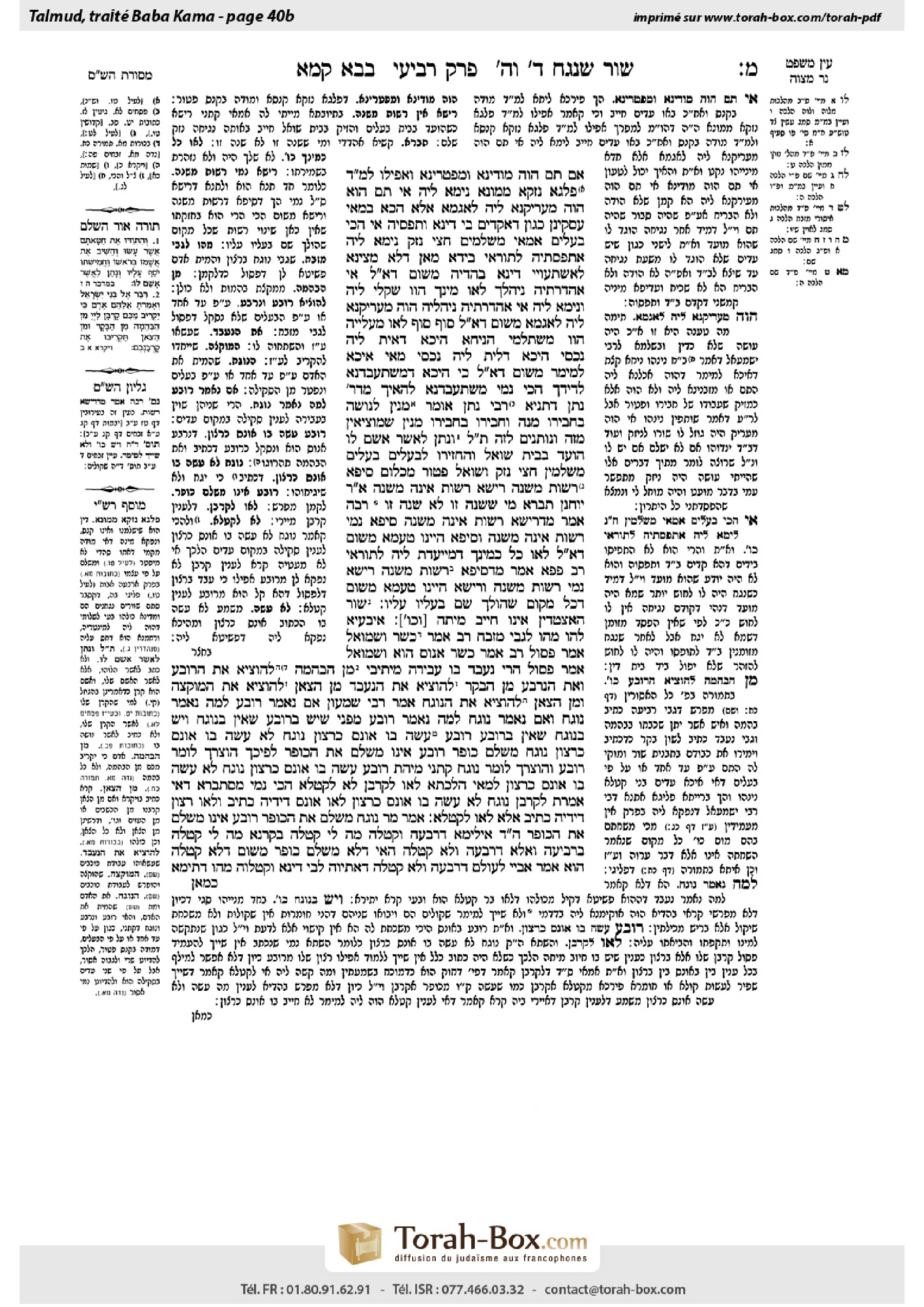
Bava Kamma 40b: Talmud study for Daf Yomi
Study the Talmud for Daf Yomi with scanned pages, Hebrew text, English translations from Sefaria and AI-generated French translations.
Passage selection and English or AI-generated French translation are available where the scan has annotations. Daf Study is independent of Torah-Box and Sefaria.
Browse Bava Kamma · בבא קמא · All tractatesBava Kamma 40b text and translations
This page of Bava Kamma includes the Aramaic text, an English translation and an AI-generated French translation, alongside the scan above.
בבא קמא מ׳ ב · Aramaic and Hebrew text
אִם תָּם – הֲוָה מוֹדֵינָא, וּמִפְּטַרְינָא!
וַאֲפִילּוּ לְמַאן דְּאָמַר פַּלְגָא נִזְקָא מָמוֹנָא, נֵימָא לֵיהּ: אִי תָּם הוּא – הֲוָה מַעֲרֵיקְנָא לֵיהּ לְאַגְמָא!
אֶלָּא הָכָא בְּמַאי עָסְקִינַן – כְּגוֹן דְּאַקְדֵּים בֵּי דִינָא, וְתַפְסֵיהּ.
אִי הָכִי, בְּעָלִים אַמַּאי מְשַׁלְּמִים חֲצִי נֶזֶק? נֵימָא לֵיהּ: אַתְפַּסְתֵּיהּ לְתוֹרַאי – בִּידָא [דְּ]מַאן דְּלָא מָצֵינָא לְאִשְׁתַּעוֹיֵי דִּינָא בַּהֲדֵיהּ! מִשּׁוּם דְּאָמַר לֵיהּ: אִי אַהְדַּרְתֵּיהּ נִיהֲלָךְ, לָאו מִינָּךְ הֲווֹ שָׁקְלִי לֵיהּ?!
וְנֵימָא לֵיהּ: אִי אַהְדַּרְתֵּיהּ נִיהֲלִי, הֲוָה מַעֲרֵיקְנָא לֵיהּ לְאַגְמָא! מִשּׁוּם דְּאָמַר לֵיהּ: סוֹף סוֹף, לָאו מֵעֲלִיָּיה הֲווֹ מִשְׁתַּלְּמִי?!
הָנִיחָא הֵיכָא דְּאִית לֵיהּ נִכְסֵי, הֵיכָא דְּלֵית לֵיהּ נִכְסֵי מַאי אִיכָּא לְמֵימַר?
מִשּׁוּם דְּאָמַר לֵיהּ: כִּי הֵיכָא דְּמִשְׁתַּעְבַּדְנָא לְדִידָךְ, הָכִי נָמֵי מִשְׁתַּעְבַּדְנָא לְהַאיְךְ – מִדְּרַבִּי נָתָן.
דְּתַנְיָא, רַבִּי נָתָן אוֹמֵר: מִנַּיִן לַנּוֹשֶׁה בַּחֲבֵירוֹ מָנֶה, וַחֲבֵירוֹ בַּחֲבֵירוֹ – מִנַּיִן שֶׁמּוֹצִיאִין מִזֶּה, וְנוֹתְנִים לָזֶה? תַּלְמוּד לוֹמַר: ״וְנָתַן לַאֲשֶׁר אָשַׁם לוֹ״.
הוּעַד בְּבֵית שׁוֹאֵל, וְהֶחְזִירוֹ לַבְּעָלִים – בְּעָלִים מְשַׁלְּמִין חֲצִי נֶזֶק, וְשׁוֹאֵל פָּטוּר מִכְּלוּם.
סֵיפָא – רְשׁוּת מְשַׁנָּה, רֵישָׁא – רְשׁוּת אֵינָהּ מְשַׁנָּה!
אָמַר רַבִּי יוֹחָנָן: תִּבְרַהּ; מִי שֶׁשָּׁנָה זוֹ לֹא שָׁנָה זוֹ.
רַבָּה אָמַר: מִדְּרֵישָׁא רְשׁוּת אֵינָהּ מְשַׁנָּה, סֵיפָא נָמֵי רְשׁוּת אֵינָהּ מְשַׁנָּה. וְסֵיפָא הַיְינוּ טַעְמָא – מִשּׁוּם דְּאָמַר לֵיהּ: לָאו כֹּל כְּמִינָךְ דִּמְיַיעֲדַתְּ לֵיהּ לְתוֹרַאי.
רַב פָּפָּא אָמַר: מִדְּסֵיפָא רְשׁוּת מְשַׁנָּה, רֵישָׁא נָמֵי רְשׁוּת מְשַׁנָּה; וְרֵישָׁא הַיְינוּ טַעְמָא – מִשּׁוּם דְּכׇל מָקוֹם שֶׁהוֹלֵךְ, שֵׁם בְּעָלָיו עָלָיו.
שׁוֹר הָאִצְטָדִין אֵינוֹ חַיָּיב מִיתָה. אִיבַּעְיָא לְהוּ: מַהוּ לְגַבֵּי מִזְבֵּחַ?
רַב אָמַר: כָּשֵׁר, וּשְׁמוּאֵל אָמַר: פָּסוּל. רַב אָמַר כָּשֵׁר – אָנוּס הוּא. וּשְׁמוּאֵל אָמַר פָּסוּל – הֲרֵי נֶעֶבְדָ[ה] בּוֹ עֲבֵירָה.
מֵיתִיבִי: ״מִן הַבְּהֵמָה״ – לְהוֹצִיא אֶת הָרוֹבֵעַ וְאֶת הַנִּרְבָּע. ״מִן הַבָּקָר״ – לְהוֹצִיא אֶת הַנֶּעֱבָד. ״מִן הַצֹּאן״ – לְהוֹצִיא אֶת הַמּוּקְצֶה. ״וּמִן הַצֹּאן״ – לְהוֹצִיא אֶת הַנּוֹגֵחַ.
אָמַר רַבִּי שִׁמְעוֹן: אִם נֶאֱמַר רוֹבֵעַ – לָמָּה נֶאֱמַר נוֹגֵחַ? וְאִם נֶאֱמַר נוֹגֵחַ – לָמָּה נֶאֱמַר רוֹבֵעַ?
מִפְּנֵי שֶׁיֵּשׁ בָּרוֹבֵעַ שֶׁאֵין בַּנּוֹגֵחַ, וְיֵשׁ בַּנּוֹגֵחַ שֶׁאֵין בָּרוֹבֵעַ.
רוֹבֵעַ – עָשָׂה בּוֹ אוֹנֶס כְּרָצוֹן, נוֹגֵחַ – לֹא עָשָׂה בּוֹ אוֹנֶס כְּרָצוֹן. נוֹגֵחַ – מְשַׁלֵּם כּוֹפֶר, רוֹבֵעַ – אֵינוֹ מְשַׁלֵּם אֶת הַכּוֹפֶר. לְפִיכָךְ הוּצְרַךְ לוֹמַר רוֹבֵעַ, וְהוּצְרַךְ לוֹמַר נוֹגֵחַ.
קָתָנֵי מִיהַת, רוֹבֵעַ – עָשָׂה בּוֹ אוֹנֶס כְּרָצוֹן, נוֹגֵחַ – לֹא עָשָׂה בּוֹ אוֹנֶס כְּרָצוֹן. לְמַאי הִלְכְתָא? לָאו לְקׇרְבָּן?
לָא, לִקְטָלָא.
הָכִי נָמֵי מִסְתַּבְּרָא; דְּאִי אָמְרַתְּ לְקׇרְבָּן, ״נוֹגֵחַ לֹא עָשָׂה בּוֹ אוֹנֶס כְּרָצוֹן״?! לָאו אוֹנֶס דִּידֵיהּ כְּתִיב, וְלָאו רָצוֹן דִּידֵיהּ כְּתִיב! אֶלָּא לָאו לִקְטָלָא?
אָמַר מָר: נוֹגֵחַ – מְשַׁלֵּם אֶת הַכּוֹפֶר, רוֹבֵעַ – אֵינוֹ מְשַׁלֵּם אֶת הַכּוֹפֶר. הֵיכִי דָמֵי? אִילֵּימָא דְּרַבְעַהּ וְקַטְלַהּ – מָה לִי קַטְלַהּ בְּקַרְנָא, מָה לִי קַטְלַהּ בִּרְבִיעָה?
וְאֶלָּא דְּרַבְעַהּ וְלָא קַטְלַהּ? הַאי דְּלָא מְשַׁלֵּם כּוֹפֶר – מִשּׁוּם דְּלָא קַטְלַהּ הוּא!
אָמַר אַבָּיֵי: לְעוֹלָם דְּרַבְעַהּ וְלָא קַטְלַהּ, דְּאַתְיוּהָ לְבֵי דִינָא וְקַטְלוּהָ; מַהוּ דְּתֵימָא
Bava Kamma 40b · English translation
If the ox was innocuous, I would have admitted my liability and would thereby have been exempt. A fine is imposed only as result of the testimony of two witnesses; if the offender admits his liability, no fine is imposed. Therefore, since the liability to pay half the cost of the damage for the act of an innocuous ox is a fine, the borrower could have rendered himself exempt from liability through admission.
And even according to the one who says that payment of half the damage is considered monetary restitution, not a fine, and therefore his admission would not have rendered himself exempt from liability, let the borrower say to him: If the ox was innocuous, I would have smuggled it out to the marsh [agma] so that the injured party would not find it in my possession. He would then be unable to collect damages from me, since he can collect payment only from the proceeds of the sale of the ox. By contrast, compensation for damage caused by a forewarned ox can be collected from all of the owner’s property, and the borrower had no way of rendering himself exempt from liability. Therefore, it is unclear why the borrower is liable to pay half the cost of the damage.
The Gemara answers: Rather, here we are dealing with a case where the court seized the ox first, before the borrower had the chance to admit his liability or to smuggle the ox to the marsh. Therefore, the borrower cannot claim that he would have been able to render himself exempt from liability.
The Gemara asks: If so, why does the owner pay half the cost of the damage? Let him say to the borrower: You let my ox be seized by the court, with whom I cannot engage in litigation in an attempt to reach a compromise; the court collects full payment, and you are responsible for this situation. Therefore, you should pay the entire amount. The Gemara answers that the owner is liable to pay because the borrower can say to him: If I would have returned it to you, would the court not have taken it from you?
The Gemara asks: But if that is the case, let the owner say to him in response: If you would have returned it to me I would have smuggled it to the marsh, and the court would not have been able to seize it. The Gemara answers: The owner cannot say this, because the borrower can say to him: Ultimately, would the injured party not then have received payment from your superior-quality property, as is the halakha in the case of a forewarned ox, where the compensation paid is not only from the proceeds of the sale of the belligerent ox?
The Gemara comments: This explanation works out well in a case where the owner has other property from which compensation can be collected, besides the ox. But where he does not have other property, what is there to say? In that case, the borrower has in fact caused him loss.
The Gemara answers: The reason the borrower is exempt is because he can say to the owner: Just as I am indebted to you, to return your ox to you, so too, I am indebted to that injured party to whom you owe compensation. This is due to the ruling of Rabbi Natan.
As it is taught in a baraita that Rabbi Natan says: From where is it derived that if one is owed one hundred dinars by another, and the other person, i.e., the debtor, is owed one hundred dinars by another person, the court appropriates payment from that latter debtor and gives the money directly to this first creditor, without going through the middleman, who is both the first debtor and the second creditor? The verse states, with regard to returning stolen property: “And he gives it to the one with regard to whom he is guilty” (Numbers 5:7), indicating that there is a situation where the liable party pays a third party to whom his creditor owes money in turn.
It is stated at the end of the baraita cited earlier (40a): If the ox was rendered forewarned in the house of the borrower, and the borrower then returned it to the owner and it subsequently gored, the owner pays half the cost of the damage and the borrower is exempt from paying any compensation.
The Gemara asks: The last clause of that baraita indicates that a change of custody changes the status of the ox; if it was rendered forewarned while in the borrower’s possession and was then returned to its owner, the owner pays only half the cost of the damage for any subsequent damage it might cause, as it is no longer considered forewarned. By contrast, the first clause of the same baraita, which teaches that the ox retains its status as forewarned even after being borrowed, indicates that a change of custody does not change the status of the ox.
Rabbi Yoḥanan said: This baraita is disjointed [tavra]. The tanna who taught this clause did not teach that clause.
Rabba said: From the fact that the first clause follows the opinion that a change of custody does not change the status of the ox, it is inferred that the last clause also follows the opinion that a change of custody does not change its status. And this is the reason that in the last clause the ox reverts to its status of innocuousness: It is because the owner can say to the borrower: It is not in your power to render my ox forewarned, as I did not give it to you with that intention and it was your negligence that caused the change in its status. Therefore, the owner is not liable to pay additional compensation that results from the status the ox acquired under the custody of the borrower.
Rav Pappa said: From the fact that the last clause follows the opinion that a change of custody changes the status of the ox, it is inferred that the first clause also follows the opinion that a change of custody changes its status. And this is the reason that in the first clause the ox is considered forewarned even when in the custody of the borrower: It is because wherever it goes, the name of its owner is upon it. Since it was rendered forewarned under its owner’s custody, with whom it remains identified, it is not considered to have undergone a change of custody.
§ The mishna teaches that a stadium ox is not liable to be put to death, since it was trained to gore. A dilemma was raised before the Sages: If an ox kills a person it may not be brought as an offering, even if it is not put to death. If a stadium ox kills a person, what is the halakha with regard to sacrificing it on the altar?
Rav says that it is fit to be brought as an offering, and Shmuel says that it is disqualified. Rav says that the ox is fit because it acted due to circumstances beyond its control, as goring is what it was trained to do; and Shmuel says that it is disqualified as, in any event, a transgression was committed through it.
The Gemara raises an objection from a baraita that interprets the verse: “You shall bring your offering from the cattle, even from the herd or from the flock” (Leviticus 1:2). The phrase “from the cattle” is mentioned to exclude an animal that engaged in bestiality and an animal that was the object of bestiality from eligibility to be brought as an offering. The phrase “from the herd” is mentioned to exclude an animal that had been worshipped as a god. “From the flock” is mentioned to exclude an animal that had been set aside for idol worship. The additional conjunction “or,” in the phrase “or from the flock” is mentioned to exclude an animal that gores a person, killing him.
The baraita continues: Rabbi Shimon said: If it is stated that an animal that engaged in bestiality is disqualified from being brought as an offering, why is it stated that an animal that gores is disqualified? And if it is stated that an animal that gores is disqualified, why is it stated that an animal that engaged in bestiality is disqualified?
He explains: It is because there is a stringency pertaining to an animal that engaged in bestiality that does not pertain to one that gores, and, conversely, there is a stringency pertaining to an animal that gores that does not pertain to an animal that engaged in bestiality.
He clarifies: With regard to an animal that engaged in bestiality, the Torah renders a case where it is a victim of circumstances beyond its control like a case where it acted willfully, as it is disqualified in either case. By contrast, with regard to an animal that gores, the Torah does not render a case where it is a victim of circumstances beyond its control like a case where it acted willfully. Conversely, with regard to an animal that gores, its owner pays the ransom; whereas the owner of an animal that engaged in bestiality does not pay a ransom. Therefore, the Torah had to state that an animal that engaged in bestiality is disqualified and had to state that an animal that gores is disqualified.
The Gemara explains the objection: In any event, the baraita teaches that with regard to an animal that engaged in bestiality, the Torah renders a case where it is a victim of circumstances beyond its control like a case where it acted willfully. By contrast, with regard to an animal that gores, the Torah does not render a case where it is a victim of circumstances beyond its control like a case where it acted willfully. With regard to what halakha is this stated? Is it not with regard to the animal’s eligibility to be brought as an offering? Accordingly, a stadium ox, which is considered a victim of circumstances beyond its control, is fit to be brought as an offering, contrary to Shmuel’s opinion.
The Gemara answers: No, it is with regard to the animal being put to death, i.e., the ox is not killed if it is a victim of circumstances beyond its control.
So too, it is reasonable, as if you say that the ruling of the baraita is with regard to the animal’s eligibility to be brought as an offering, how can the baraita state the following: By contrast, with regard to an animal that gores, the Torah does not render a case where it is a victim of circumstances beyond its control like a case where it acted willfully. Neither are circumstances beyond its control written in that context, nor is its willingness written; the issue is not mentioned in the Torah at all. Rather, is the ruling of the baraita not stated with regard to the animal being put to death, where this distinction is indicated in the Torah? The mishna interprets the phrase: “And if an ox gores” (Exodus 21:28), as indicating that the ox is not put to death in a case where it is induced to gore; therefore, this distinction is mentioned in the Torah with regard to the animal being put to death. Accordingly, the baraita does not address the topic of dispute between Rav and Shmuel.
§ The Master said in the same baraita: With regard to an animal that gores, its owner pays the ransom, whereas the owner of an animal that engaged in bestiality does not pay a ransom. What are the circumstances under which the owner of an animal that engaged in bestiality is not liable to pay the ransom? If we say that it is when the animal engaged in bestiality with a woman and killed her in the process, what is the difference to me whether it killed her with its horn, and what is the difference to me whether it killed her through bestiality?
And rather, if the baraita is referring to a case where the animal engaged in bestiality with her but did not kill her, in that case, this halakha that he does not pay a ransom is simply due to the fact that it did not kill her, so paying ransom is irrelevant; it is not a feature associated with the halakhot of an animal that engaged in bestiality.
Abaye said: Actually, it is referring to a case where the animal engaged in bestiality with her but did not kill her, and it is still noteworthy that its owner is not liable to pay ransom, as the woman was brought to court, and they executed her for her transgression. Lest you say
Bava Kamma 40b · Traduction française (IA)
Si l'ox était innocent, j'aurais admis ma responsabilité et ainsi aurais été exempt. Une amende est imposée uniquement en raison du témoignage de deux témoins ; si l'offensé admet sa responsabilité, aucune amende n'est imposée. Par conséquent, puisque la responsabilité de payer la moitié du coût des dommages pour l'acte d'un ox innocent est une amende, le prêteur aurait pu se rendre exempt de responsabilité par son admission.
Et même selon celui qui affirme que le paiement de la moitié des dommages est considéré comme une restitution monétaire, et non une amende, et par conséquent son admission ne l'aurait pas rendu exempt de responsabilité, disons au prêteur : Si l'ox était innocent, j'aurais caché l'ox dans la marais afin que la partie blessée ne le trouve pas en mon possession. Il ne pourrait alors pas réclamer des dommages contre moi, car il peut réclamer le paiement uniquement à partir des revenus de la vente de l'ox. En revanche, la compensation des dommages causés par un ox averti peut être réclamée à partir de toute la propriété de l'propriétaire, et le prêteur n'avait aucun moyen de se rendre exempt de responsabilité. Par conséquent, il est incertain pourquoi le prêteur est tenu de payer la moitié du coût des dommages.
La Guemara répond : En réalité, nous sommes en présence d'un cas où l'ox a été d'abord saisi par le tribunal, avant que le prêteur n'ait eu l'occasion d'admettre sa responsabilité ou de cacher l'ox dans la marais. Par conséquent, le prêteur ne peut pas affirmer qu'il aurait pu se rendre exempt de responsabilité.
La Guemara pose la question : Si c'est ainsi, pourquoi l'propriétaire paie-t-il la moitié du coût des dommages ? Disons au prêteur : Tu as laissé mon bœuf être saisi par le tribunal, avec qui je ne peux pas engager une procédure pour tenter d'atteindre un compromis ; le tribunal réclame le paiement complet, et tu es responsable de cette situation. Par conséquent, tu devrais payer l'intégralité de la somme. La Guemara répond que l'propriétaire est tenu de payer car le prêteur peut lui dire : Si j'avais rendu l'âne à toi, le tribunal ne l'aurait-il pas retiré de toi ?
La Guemara pose la question : Mais si c'est le cas, disons à l'propriétaire en réponse : Si tu avais rendu l'âne à moi, je l'aurais caché dans la marais, et le tribunal n'aurait pas pu le saisir. La Guemara répond : L'propriétaire ne peut pas dire cela, car le prêteur peut lui dire : Finalement, ne recevrait-il pas la partie blessée alors des biens de meilleure qualité de toi, comme c'est la halakha dans le cas d'un âne averti, où la compensation payée ne provient pas uniquement des revenus de la vente de l'âne belliqueux ?
La Guemara commente : Cette explication fonctionne bien dans le cas où l'propriétaire possède d'autres biens à partir desquels la compensation peut être réclamée, en dehors de l'âne. Mais dans le cas où il n'a pas d'autres biens, que dire ? Dans ce cas, le prêteur a en effet causé à l'propriétaire un préjudice.
La Guemara répond : La raison pour laquelle le prêteur est exempt est qu'il peut dire à l'propriétaire : Tout comme je suis dû à toi, rendre ton bœuf à toi, ainsi je suis dû à cette partie blessée à laquelle tu dois une compensation. Cela est dû à la décision du Rabbi Natan.
Comme il est enseigné dans une baraïta que Rabbi Natan dit : D'où est tiré le fait que si l'un est dû à un autre une centaine de drachmes, et que l'autre, c'est-à-dire le débiteur, est dû à un autre une centaine de drachmes, le tribunal réclame le paiement de ce dernier débiteur et le donne directement à ce premier créancier, sans passer par le milieu, qui est à la fois le premier débiteur et le second créancier ? La Sainte Écriture dit, concernant la restitution d'un objet volé : « Et il le donne à celui à qui il est coupable » (Lévitique 5:7), indiquant qu'il existe un cas où la partie coupable paie un tiers à qui son créancier doit de l'argent à son tour.
Il est dit à la fin de la baraïta citée précédemment (40a) : Si l'âne a été rendu averti dans la maison du prêteur, et que le prêteur a ensuite rendu l'âne à son propriétaire et qu'il a ensuite blessé, le propriétaire paie la moitié du coût des dommages et le prêteur est exempt de payer toute compensation.
La Guemara pose la question : La dernière clause de cette baraïta indique que le changement de possession change le statut de l'âne ; si l'âne avait été rendu averti pendant la possession du prêteur et avait ensuite été rendu à son propriétaire, le propriétaire paie seulement la moitié du coût des dommages pour tout dommage ultérieur qu'il pourrait causer, car il n'est plus considéré comme averti. En revanche, la première clause de la même baraïta, qui enseigne que l'âne conserve son statut d'avertissement même après avoir été emprunté, indique que le changement de possession ne change pas le statut de l'âne.
Rabbi Yoḥanan a dit : Cette baraïta est disjointe [tavra]. Le tanna qui a enseigné cette clause n'a pas enseigné cette clause.
Rabba a dit : D'après le fait que la première clause suit l'opinion que le changement de possession ne change pas le statut de l'âne, il est inféré que la dernière clause suit également l'opinion que le changement de possession ne change pas son statut. Et c'est la raison pour laquelle, dans la dernière clause, l'âne reprend son statut d'innocence : C'est parce que l'propriétaire peut dire au prêteur : Ce n'est pas en ton pouvoir de rendre mon âne averti, car je ne t'ai pas donné l'âne avec cette intention et c'est ta négligence qui a causé le changement de statut. Par conséquent, l'propriétaire n'est pas tenu de payer une compensation supplémentaire résultant du statut que l'âne a acquis sous la possession du prêteur.
Rav Pappa a dit : D'après le fait que la dernière clause suit l'opinion selon laquelle un changement de garde change le statut de l'ox, on infère que la première clause suit également l'opinion selon laquelle un changement de garde change son statut. Et c'est la raison pour laquelle, dans la première clause, l'ox est considéré comme averti même lorsqu'il est en garde chez le prêteur : c'est parce que partout où il va, le nom de son propriétaire est sur lui. Puisque l'ox a été rendu averti sous la garde de son propriétaire, avec lequel il reste identifié, il n'est pas considéré comme ayant subi un changement de garde.
§ La mitsva enseigne que l'ox de stade n'est pas tenu de mourir, car il a été dressé à attaquer. Un dilemme a été soulevé devant les Sages : Si un ox tue une personne, il ne peut pas être offert en sacrifice, même s'il n'est pas tué. Si un ox de stade tue une personne, quelle est la halakha concernant le sacrifice de cet ox sur l'autel ?
Rav dit qu'il est digne d'être offert en sacrifice, et Shmuel dit qu'il est disqualifié. Rav dit que l'ox est digne d'être offert en sacrifice car il a agi en raison de circonstances hors de son contrôle, car l'attaque est ce à quoi il a été dressé ; et Shmuel dit qu'il est disqualifié, car, en tout cas, un péché a été commis à travers lui.
Le Guemara soulève une objection tirée d'une baraïta qui interprète la parole : « Vous apporterez votre holocauste des bêtes, même du troupeau ou de la bergerie » (Lévitique 1:2). La phrase « des bêtes » est mentionnée pour exclure un animal qui a eu des relations avec un animal et un animal qui a été l'objet de telles relations de l'éligibilité à être offert en sacrifice. La phrase « du troupeau » est mentionnée pour exclure un animal qui a été adoré comme un dieu. « De la bergerie » est mentionnée pour exclure un animal qui a été mis de côté pour l'idolâtrie. L'union supplémentaire « ou », dans la phrase « ou de la bergerie », est mentionnée pour exclure un animal qui attaque une personne, le tuant.
La baraïta continue : Rabbi Shimon a dit : Si on dit qu'un animal qui a eu des relations avec un animal est disqualifié pour être offert en sacrifice, pourquoi dit-on qu'un animal qui attaque est disqualifié ? Et si on dit qu'un animal qui attaque est disqualifié, pourquoi dit-on qu'un animal qui a eu des relations avec un animal est disqualifié ?
Il explique : C'est parce qu'il y a une stricte exigence concernant un animal qui a eu des relations avec un animal qui ne s'applique pas à un animal qui attaque, et inversement, il y a une stricte exigence concernant un animal qui attaque qui ne s'applique pas à un animal qui a eu des relations avec un animal.
Il clarifie : Concernant un animal qui a commis un acte bestial, la Torah rend un cas où il est victime de circonstances hors de son contrôle comme un cas où il agit volontairement, car il est disqualifié dans les deux cas. À l'inverse, concernant un animal qui attaque, la Torah ne rend pas un cas où il est victime de circonstances hors de son contrôle comme un cas où il agit volontairement. À l'inverse, concernant un animal qui attaque, son propriétaire paie le rançon ; alors que le propriétaire d'un animal qui a commis un acte bestial ne paie pas de rançon. Par conséquent, la Torah a dû dire qu'un animal qui a commis un acte bestial est disqualifié et a dû dire qu'un animal qui attaque est disqualifié.
Le Guemara explique l'objection : En tout cas, la baraïta enseigne que concernant un animal qui a commis un acte bestial, la Torah rend un cas où il est victime de circonstances hors de son contrôle comme un cas où il agit volontairement. À l'inverse, concernant un animal qui attaque, la Torah ne rend pas un cas où il est victime de circonstances hors de son contrôle comme un cas où il agit volontairement. Concernant quelle halakha est-ce dit ? N'est-ce pas concernant l'éligibilité de l'animal à être offert en sacrifice ? Ainsi, un bœuf de stade, qui est considéré comme victime de circonstances hors de son contrôle, est digne d'être offert en sacrifice, contrairement à l'opinion de Shmuel.
Le Guemara répond : Non, c'est concernant la mise à mort de l'animal, c'est-à-dire que l'ox n'est pas tué s'il est victime de circonstances hors de son contrôle.
De même, il est raisonnable, car si vous dites que la décision de la baraïta est concernant l'éligibilité de l'animal à être offert en sacrifice, comment la baraïta peut-elle dire que : À l'inverse, concernant un animal qui attaque, la Torah ne rend pas un cas où il est victime de circonstances hors de son contrôle comme un cas où il agit volontairement. Ni les circonstances hors de son contrôle ne sont écrites dans ce contexte, ni la volonté n'est mentionnée ; l'issue n'est pas mentionnée du tout dans la Torah. Plutôt, est-ce que la décision de la baraïta n'est pas mentionnée concernant la mort de l'animal, où cette distinction est indiquée dans la Torah ? La mitsva interprète la parole : « Et si un ox attaque » (Exode 21:28), comme indiquant que l'ox n'est pas tué dans le cas où il est induit à attaquer ; donc cette distinction est mentionnée dans la Torah concernant la mort de l'animal. Ainsi, la baraïta ne traite pas la question de débat entre Rav et Shmuel.
§ Le Maître a dit dans la même baraïta : Concernant un animal qui attaque, son propriétaire paie le rançon, alors que le propriétaire d'un animal qui a eu des relations avec un animal ne paie pas de rançon. Quelles sont les circonstances dans lesquelles le propriétaire d'un animal qui a eu des relations avec un animal n'est pas tenu de payer le rançon ? Si on dit que c'est lorsque l'animal a eu des relations avec une femme et l'a tuée, quelle est la différence pour moi que l'animal l'ait tuée avec son corne, et quelle est la différence pour moi que l'animal l'ait tuée par bestialité ?
Et plutôt, si la baraïta fait référence à un cas où l'animal a eu des relations avec elle mais n'a pas tué, dans ce cas, cette halakha selon laquelle il ne paie pas de rançon est simplement due au fait qu'il n'a pas tué, donc le paiement du rançon est sans importance ; il n'est pas un attribut associé aux halakhot d'un animal qui a eu des relations avec un animal.
Abaye a dit : En réalité, il s'agit d'un cas où l'animal a eu des relations avec elle mais ne l'a pas tuée, et il est encore remarquable que son propriétaire ne soit pas tenu de payer une rançon, car la femme a été conduite devant le tribunal et on a exécuté sa transgression. De peur que l'on dise
Traduction française générée par IA à partir de l’édition anglaise de Sefaria. Vérifie toujours un passage avec le texte source.
Text from Sefaria: William Davidson Edition - Vocalized Aramaic (CC BY NC); William Davidson Edition - English (CC BY NC).