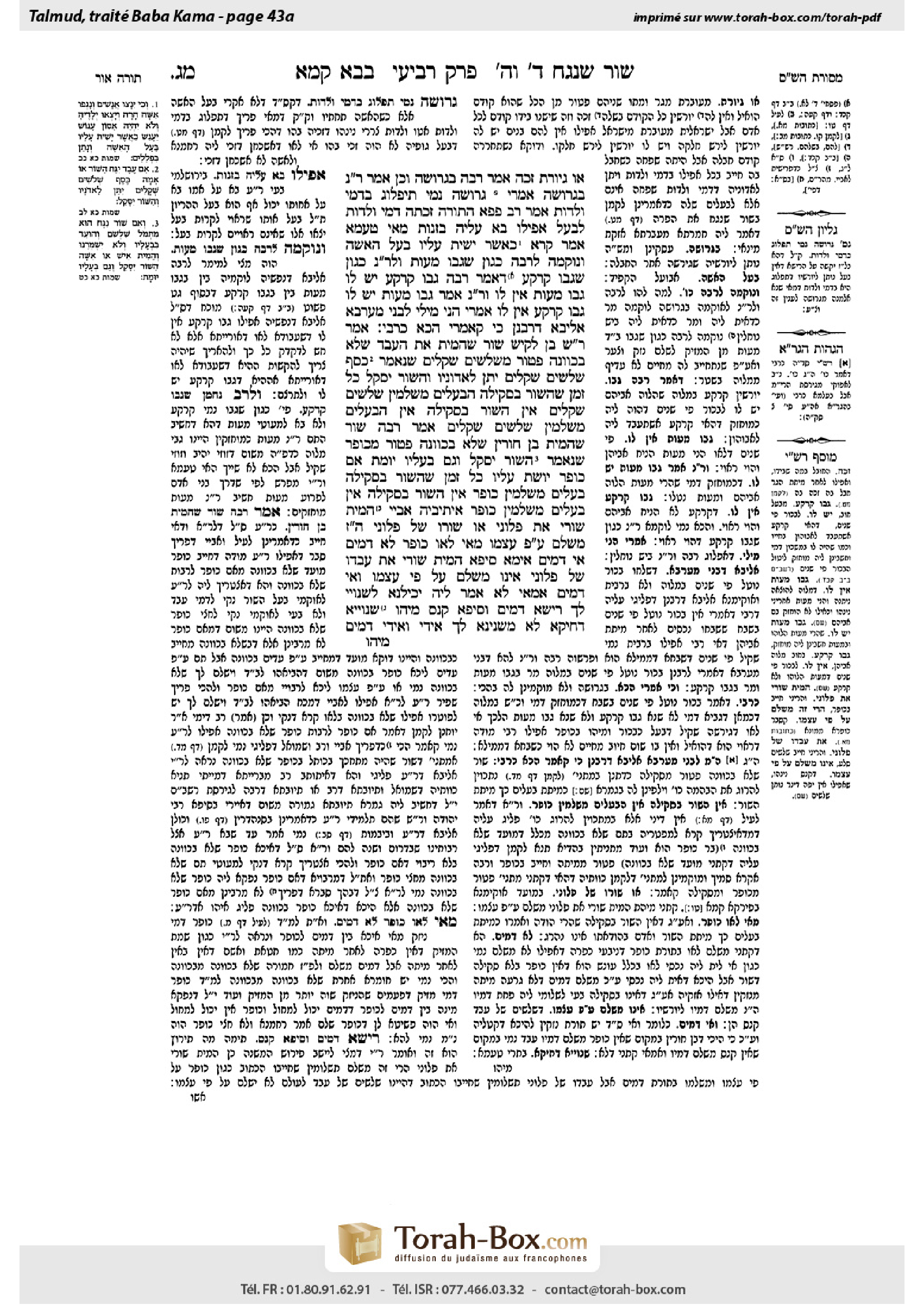
Bava Kamma 43a: Talmud study for Daf Yomi
Study the Talmud for Daf Yomi with scanned pages, Hebrew text, English translations from Sefaria and AI-generated French translations.
Passage selection and English or AI-generated French translation are available where the scan has annotations. Daf Study is independent of Torah-Box and Sefaria.
Browse Bava Kamma · בבא קמא · All tractatesBava Kamma 43a text and translations
This page of Bava Kamma includes the Aramaic text, an English translation and an AI-generated French translation, alongside the scan above.
בבא קמא מ״ג א · Aramaic and Hebrew text
אוֹ גִיּוֹרֶת – זָכָה!
אָמַר רַבָּה: בִּגְרוּשָׁה. וְכֵן אָמַר רַב נַחְמָן: בִּגְרוּשָׁה.
אָמְרִי: גְּרוּשָׁה נָמֵי תִּיפְלוֹג בִּדְמֵי וְלָדוֹת!
אָמַר רַב פָּפָּא: הַתּוֹרָה זִכְּתָה דְּמֵי וְלָדוֹת לַבַּעַל, אֲפִילּוּ בָּא עָלֶיהָ בִּזְנוּת. מַאי טַעְמָא? אָמַר קְרָא ״כַּאֲשֶׁר יָשִׁית עָלָיו בַּעַל הָאִשָּׁה״.
וְנוֹקְמַהּ לְרַבָּה כְּגוֹן שֶׁגָּבוּ מָעוֹת, וּלְרַב נַחְמָן כְּגוֹן שֶׁגָּבוּ קַרְקַע!
דְּאָמַר רַבָּה: גָּבוּ קַרְקַע – יֵשׁ לוֹ, גָּבוּ מָעוֹת – אֵין לוֹ. וְרַב נַחְמָן אָמַר: גָּבוּ מָעוֹת – יֵשׁ לוֹ, גָּבוּ קַרְקַע – אֵין לוֹ.
הָנֵי מִילֵּי לִבְנֵי מַעְרְבָא – אַלִּיבָּא דְּרַבָּנַן;
כִּי קָאָמְרִי הָכָא – כְּרַבִּי.
אָמַר רַבִּי שִׁמְעוֹן בֶּן לָקִישׁ: שׁוֹר שֶׁהֵמִית אֶת הָעֶבֶד שֶׁלֹּא בְּכַוָּונָה – פָּטוּר מִשְּׁלֹשִׁים שְׁקָלִים, שֶׁנֶּאֱמַר: ״כֶּסֶף שְׁלֹשִׁים שְׁקָלִים יִתֵּן לַאדֹנָיו, וְהַשּׁוֹר יִסָּקֵל״ – כׇּל זְמַן שֶׁהַשּׁוֹר בִּסְקִילָה, הַבְּעָלִים מְשַׁלְּמִין שְׁלֹשִׁים שְׁקָלִים; אֵין הַשּׁוֹר בִּסְקִילָה, אֵין הַבְּעָלִים מְשַׁלְּמִין שְׁלֹשִׁים שְׁקָלִים.
אָמַר רַבָּה: שׁוֹר שֶׁהֵמִית בֶּן חוֹרִין שֶׁלֹּא בְּכַוָּונָה – פָּטוּר מִכּוֹפֶר, שֶׁנֶּאֱמַר: ״הַשּׁוֹר יִסָּקֵל, וְגַם בְּעָלָיו יוּמָת. אִם כֹּפֶר יוּשַׁת עָלָיו״ – כׇּל זְמַן שֶׁהַשּׁוֹר בִּסְקִילָה – בְּעָלִים מְשַׁלְּמִין כּוֹפֶר, אֵין הַשּׁוֹר בִּסְקִילָה – אֵין בְּעָלִים מְשַׁלְּמִין כּוֹפֶר.
אֵיתִיבֵיהּ אַבָּיֵי: ״הֵמִית שׁוֹרִי אֶת פְּלוֹנִי״, אוֹ ״שׁוֹרוֹ שֶׁל פְּלוֹנִי״ – הֲרֵי זֶה מְשַׁלֵּם עַל פִּי עַצְמוֹ. מַאי, לָאו כּוֹפֶר?
לָא, דָּמִים.
אִי דָּמִים, אֵימָא סֵיפָא: ״הֵמִית שׁוֹרִי אֶת עַבְדּוֹ שֶׁל פְּלוֹנִי״ – אֵינוֹ מְשַׁלֵּם עַל פִּי עַצְמוֹ. וְאִי דָּמִים, אַמַּאי לָא?
אֲמַר לֵיהּ, יָכֵילְנָא לְשַׁנּוֹיֵי לָךְ: רֵישָׁא דָּמִים, וְסֵיפָא קְנָס; מִיהוּ שִׁנּוּיָיא דְחִיקָא לָא מְשַׁנֵּינָא לָךְ. אִידֵּי וְאִידֵּי דָּמִים.
Bava Kamma 43a · English translation
and subsequently married a Canaanite slave who had also been emancipated, and became pregnant from him, or if she was a convert who became pregnant from a male convert, and both the husband and wife died without heirs, the assailant gains by not having to pay, since there are no heirs. In any event, it is explicitly stated in the baraita that the beneficiary of the compensation due to her, including that which she would have received during her lifetime, is not her husband but rather her heirs.
Rabba said: This baraita relates to a divorcée; since they got divorced, the husband does not inherit from her. Likewise, Rav Naḥman said: The baraita relates to a divorcée.
The Sages said in response: If she is a divorcée, she should also share in the compensation for the miscarried offspring. Why should her ex-husband receive the full payment?
Rav Pappa said: The Torah awarded the payment of compensation for miscarried offspring to the husband, even if he is not actually her legal husband but rather engaged in licentious sexual intercourse with her. Although he has no rights to her property, the damages for the miscarried offspring belong to him alone, as he is the father of the offspring. What is the reason? The verse states: “As the husband [ba’al] of the woman shall impose upon him” (Exodus 21:22), indicating that damages are not collected by the woman, but by the man who engaged in intercourse [ba’al] with her, impregnating her. Therefore, if they got divorced, the ex-husband receives the payment.
The Gemara asks: Why do Rabba and Rav Naḥman explain this baraita as referring to a divorcée? They could have answered, in accordance with their own opinions elsewhere (Bava Batra 124b), that it is referring to payments that are not considered to have been in the woman’s possession during her lifetime, but rather are considered property due to the woman, which her husband does not inherit. Let us establish this baraita, according to Rabba, as referring to a case where they collected money for the damage and pain, and according to Rav Naḥman, where they collected land.
As with regard to the right of a firstborn to receive a double portion of the inheritance of his father, he receives a double portion only of the property possessed by his father, not of the property due to him. In a case where money was owed to the father, Rabba says: If the heirs collected the debt from land, the firstborn has the right to a double portion, since it is considered property that was already in the father’s possession. If they collected money, he does not have a double portion, as it is considered property due to the father. And Rav Naḥman says: If they collected money, he has a double portion, and if they collected land, he does not have a double portion.
The Gemara answers: That statement applies according to the residents of the West, i.e., Eretz Yisrael, in accordance with the opinion of the Rabbis, who limit the rights of a firstborn to his father’s property to the extent that they hold he does not receive a double portion of any appreciation in the property occurring after his father’s death.
By contrast, when they state that this baraita here relates to a divorcée, it is in accordance with the opinion of Rabbi Yehuda HaNasi that the firstborn receives a double portion even in the appreciation of the property occurring after the father’s death. According to this opinion, clearly everything due to the father is considered to be in his possession, whether he receives his compensation in money or in land. The same applies to a husband, who inherits the rights to inherit compensation for damage and pain inflicted on his wife. That is why Rabba and Rav Naḥman had to interpret this baraita as relating to a divorcée.
§ Rabbi Shimon ben Lakish says: With regard to an ox that killed a Canaanite slave unintentionally, the owner is exempt from paying the fine of thirty shekels, as it is stated: “He shall give to their master thirty shekels of silver, and the ox shall be stoned” (Exodus 21:32). It is derived from the verse that the liability to pay thirty shekels is dependent on the stoning of the ox; whenever the ox is liable to be killed by stoning, the owner pays thirty shekels as compensation for the damage. If the ox is not liable to be killed by stoning, e.g., if it killed unintentionally, the owner does not pay thirty shekels.
Similarly, Rabba says: With regard to an ox that killed a freeman unintentionally, its owner is exempt from paying ransom; as it is stated: “The ox shall be stoned, and its owner also shall be put to death. If a ransom is laid on him” (Exodus 21:29–30). This indicates that whenever the ox is liable to be killed by stoning the owner pays ransom; and if the ox is not liable to be killed by stoning the owner does not pay ransom.
Abaye raised an objection to Rabba’s statement from a mishna: If a person admits: My ox killed so-and-so, or: My ox killed the ox of so-and-so, this owner pays based on his own admission (Ketubot 41a). This cannot be referring to the payment of a fine, as a person who admits his responsibility for an act incurring a fine is exempt from paying the fine. Clearly, it must be referring to a payment for which one can render himself liable through admission. What, is it not referring to the payment of ransom? If so, this proves that payment of ransom is not dependent on whether the ox is liable to be killed by stoning, as the ox cannot be killed based on its owner’s admission alone.
The Gemara answers: No, it is referring to payment of the monetary value of the victim. Although he is not liable to pay ransom, as the ox is not killed, nevertheless, since by his own admission his ox caused damage, he is liable to pay damages.
Abaye challenged this answer: If it is referring to the value of the victim, say the latter clause of that mishna: If a person admits: My ox killed the Canaanite slave of so-and-so, he does not pay based on his own admission. And if, as you claim, the mishna is referring to the value of the victim, not to the thirty-shekel fine, why should he not pay?
Rabba said to Abaye: I could have answered you by saying that the former clause, which discusses an ox killing a freeman, is referring to the value of the victim, and the latter clause, which relates to an ox that gored a slave, is referring to payment of the thirty-shekel fine. But I will not answer you with a forced answer. Instead, I will answer as follows: Both this clause and that clause refer to the value of the victim;
Bava Kamma 43a · Traduction française (IA)
et ensuite épousa une servante cananéenne qui avait également été affranchie, et tomba enceinte de lui, ou si elle était une convertie qui tomba enceinte d'un homme converti, et que les deux époux moururent sans héritiers, l'agresseur gagne à ne pas avoir à payer, car il n'y a pas d'héritiers. En tout cas, il est explicitement mentionné dans la baraïta que le bénéficiaire de la compensation due à elle, y compris celle qu'elle aurait reçue pendant sa vie, n'est pas son mari mais plutôt ses héritiers.
Rabba dit : cette baraïta concerne une femme divorcée ; puisqu'ils se sont séparés, le mari ne hérite pas d'elle. De même, Rav Naḥman dit : la baraïta concerne une femme divorcée.
Les Sages répondirent : si elle est une femme divorcée, elle devrait aussi bénéficier de la compensation pour les fœtus abortés. Pourquoi l'ex-mari devrait-il recevoir la totalité du paiement ?
Rav Pappa dit : la Torah attribue le paiement de la compensation pour les fœtus abortés au mari, même s'il n'est pas réellement son mari légal mais plutôt qu'il a eu des relations sexuelles licencieuses avec elle. Bien qu'il n'ait aucun droit sur ses biens, les dommages pour les fœtus abortés lui appartiennent seul, car il est le père des fœtus. Pourquoi ? Parce que la Parashia dit : « Comme le mari [ba’al] de la femme, il imposera sur lui » (Exode 21:22), indiquant que les dommages ne sont pas réclamés par la femme, mais par l'homme qui a eu des relations sexuelles [ba’al] avec elle, la concevant. Ainsi, si ils se sont séparés, l'ex-mari reçoit le paiement.
La Guemara pose la question : pourquoi Rabba et Rav Naḥman expliquent-ils cette baraïta comme concernant une femme divorcée ? Ils auraient pu répondre, conformément à leurs propres opinions ailleurs (Bava Batra 124b), qu'il s'agit de paiements qui ne sont pas considérés comme appartenant à la femme pendant sa vie, mais plutôt comme des biens dus à la femme, que son mari ne hérite pas. Établisons cette baraïta, selon Rabba, dans un cas où ils ont collecté de l'argent pour les dommages et la douleur, et selon Rav Naḥman, dans un cas où ils ont collecté une terre.
Concernant le droit du premier-né de recevoir une double part de l'héritage de son père, il reçoit une double part uniquement de la propriété possédée par son père, pas de la propriété due à lui. Dans un cas où une somme d'argent était due au père, Rabba dit : si les héritiers ont récupéré la dette à partir de la terre, le premier-né a le droit à une double part, car cela est considéré comme une propriété déjà en possession du père. Si ils ont récupéré de l'argent, il n'a pas de double part, car cela est considéré comme une propriété due au père. Et Rav Naḥman dit : si ils ont récupéré de l'argent, il a une double part, et si ils ont récupéré la terre, il n'a pas de double part.
La Guemara répond : cette déclaration s'applique aux habitants de l'Ouest, c'est-à-dire Eretz Yisrael, conformément à l'opinion des Rabbins, qui limitent le droit du premier-né à la propriété de son père à la mesure où ils considèrent qu'il ne reçoit pas une double part de toute augmentation de la propriété survenue après la mort de son père.
Par contraste, lorsqu'ils disent que cette baraïta ici concerne une femme divorcée, c'est selon l'opinion de Rabbi Yehuda HaNasi que le premier-né reçoit une double part même pour l'augmentation de la propriété survenue après la mort de son père. Selon cette opinion, clairement tout ce qui est dû au père est considéré comme étant en sa possession, qu'il reçoive sa réparation en argent ou en terre. De même, cela s'applique à un mari, qui hérite des droits d'héritage de la réparation des dommages et de la douleur infligés à sa femme. C'est pourquoi Rabba et Rav Naḥman ont dû interpréter cette baraïta comme concernant une femme divorcée.
Rabbi Shimon ben Lakish dit : concernant un bœuf qui a tué un serviteur cananéen de manière non intentionnelle, le propriétaire est exempt de payer la somme de trente sicles, car il est dit : « Il donnera à leur maître trente sicles d'argent, et le bœuf sera lapidé » (Exode 21:32). Cela est tiré de la Parashia indiquant que la responsabilité de payer trente sicles dépend de la lapidation du bœuf ; chaque fois que le bœuf est tenu responsable d'être lapidé, le propriétaire paie trente sicles comme compensation pour le dommage. Si le bœuf n'est pas tenu responsable d'être lapidé, par exemple s'il a tué de manière non intentionnelle, le propriétaire ne paie pas trente sicles.
De même, Rabba dit : concernant un bœuf qui a tué un homme libre de manière non intentionnelle, son propriétaire est exempt de payer la rançon ; car il est dit : « Le bœuf sera lapidé, et son propriétaire sera également mis à mort. Si une rançon est mise sur lui » (Exode 21:29–30). Cela indique que chaque fois que le bœuf est tenu responsable d'être lapidé, le propriétaire paie la rançon ; et si le bœuf n'est pas tenu responsable d'être lapidé, le propriétaire ne paie pas la rançon.
Abaye souleva une objection contre l'affirmation de Rabba, en citant une mitsna : Si une personne admet : Mon bœuf a tué tel ou tel, ou : Mon bœuf a tué le bœuf de tel ou tel, ce propriétaire paie en fonction de son propre aveu (Ketubot 41a). Cela ne peut pas concerner le paiement d'une amende, car une personne qui admet sa responsabilité pour un acte entraînant une amende est exemptée de payer l'amende. Évidemment, cela doit concerner un paiement pour lequel on peut rendre une personne responsable par l'aveu. Qu'est-ce que cela ne concerne pas le paiement de la rançon ? Si c'est le cas, cela prouve que le paiement de la rançon n'est pas dépendant de savoir si le bœuf est tenu responsable d'être lapidé, car le bœuf ne peut être lapidé en fonction de l'aveu de son propriétaire seul.
La Guemara répond : Non, cela concerne le paiement de la valeur du victime. Bien qu'il ne soit pas tenu responsable de payer la rançon, car le bœuf n'est pas lapidé, néanmoins, puisqu'il admet lui-même que son bœuf a causé un dommage, il est tenu responsable de payer des dommages.
Abaye a relevé ce point : Si cela fait référence à la valeur de la victime, dites la seconde partie de cette mitsna : Si une personne admet : Mon bœuf a tué l'esclave cananéen de tel ou tel, il ne paie pas selon son propre aveu. Et si, comme vous le soutenez, la mitsna fait référence à la valeur de la victime et non à la somme de trente sicles, pourquoi ne devrait-il pas payer ?
Rabba a répondu à Abaye : Je pouvais vous répondre en disant que la première partie, qui parle d'un bœuf qui tue un homme libre, fait référence à la valeur de la victime, et la seconde partie, qui concerne un bœuf qui a renversé un esclave, fait référence au paiement de trente sicles. Mais je ne répondrai pas avec une réponse forcée. Au contraire, je répondrai comme suit : Ces deux parties font référence à la valeur de la victime ;
Traduction française générée par IA à partir de l’édition anglaise de Sefaria. Vérifie toujours un passage avec le texte source.
Text from Sefaria: William Davidson Edition - Vocalized Aramaic (CC BY NC); William Davidson Edition - English (CC BY NC).