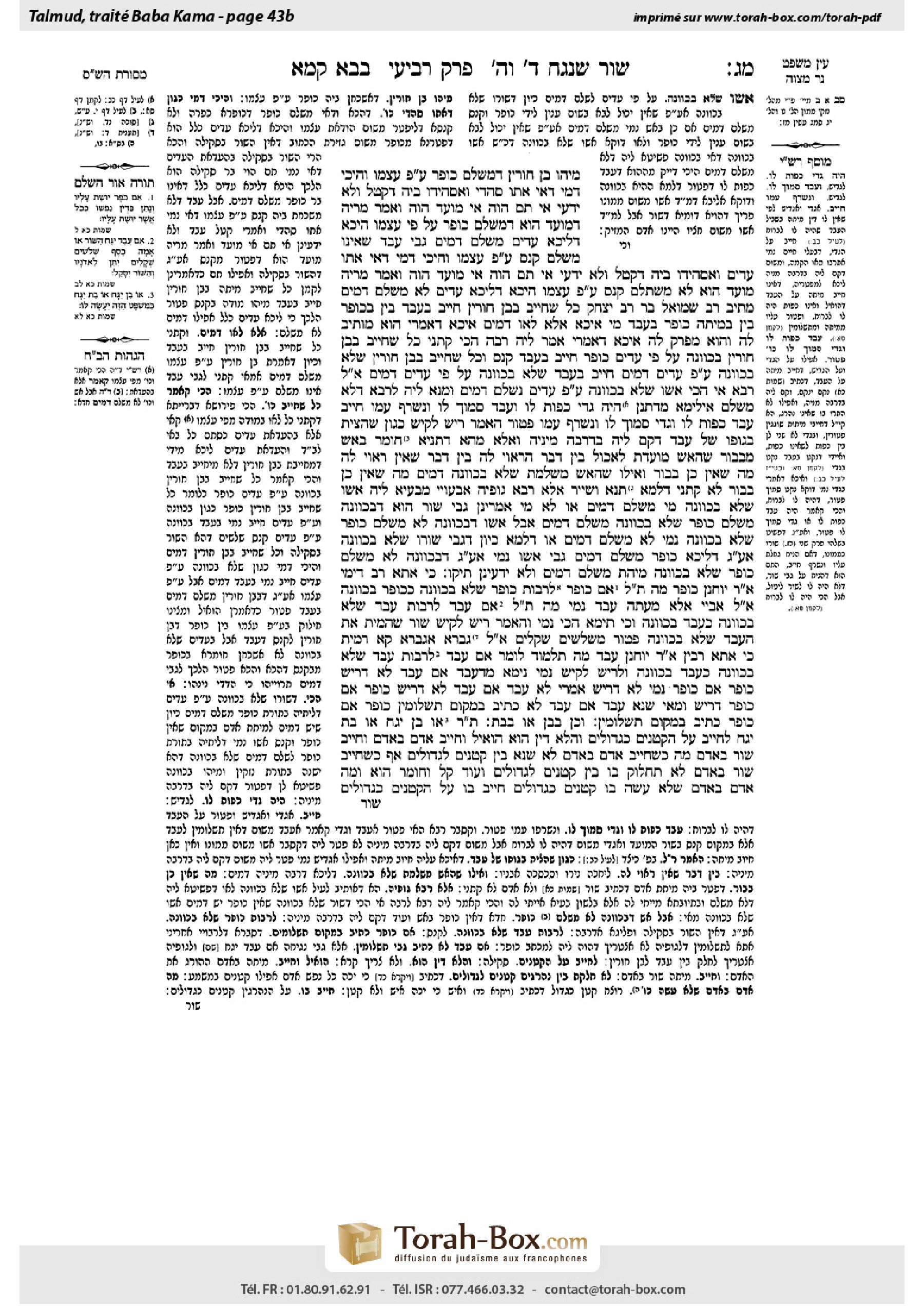
Bava Kamma 43b: Talmud study for Daf Yomi
Study the Talmud for Daf Yomi with scanned pages, Hebrew text, English translations from Sefaria and AI-generated French translations.
Passage selection and English or AI-generated French translation are available where the scan has annotations. Daf Study is independent of Torah-Box and Sefaria.
Browse Bava Kamma · בבא קמא · All tractatesBava Kamma 43b text and translations
This page of Bava Kamma includes the Aramaic text, an English translation and an AI-generated French translation, alongside the scan above.
בבא קמא מ״ג ב · Aramaic and Hebrew text
מִיהוּ, בֶּן חוֹרִין דִּמְשַׁלֵּם כּוֹפֶר עַל פִּי עַצְמוֹ – וְהֵיכִי דָּמֵי? דְּאִי אֲתוֹ סָהֲדֵי וְאַסְהִידוּ בֵּיהּ דִּקְטַל, וְלָא יָדְעִי אִי תָּם הֲוָה אִי מוּעָד הֲוָה, וַאֲמַר מָרֵיהּ דְּמוּעָד הוּא, דִּמְשַׁלֵּם כּוֹפֶר עַל פִּי עַצְמוֹ – הֵיכָא דְּלֵיכָּא עֵדִים, מְשַׁלֵּם דָּמִים;
גַּבֵּי עֶבֶד, שֶׁאֵינוֹ מְשַׁלֵּם קְנָס עַל פִּי עַצְמוֹ – וְהֵיכִי דָּמֵי? דְּאִי אֲתוֹ עֵדִים וְאַסְהִידוּ בֵּיהּ דִּקְטַל, וְלָא יָדְעִי אִי תָּם הֲוָה אִי מוּעָד הֲוָה, וַאֲמַר מָרֵיהּ מוּעָד הוּא – לָא מִשְׁתַּלַּם קְנָס עַל פִּי עַצְמוֹ. הֵיכָא דְּלֵיכָּא עֵדִים – לָא מְשַׁלֵּם דָּמִים.
מֵתִיב רַב שְׁמוּאֵל בַּר רַב יִצְחָק: כֹּל שֶׁחַיָּיב בְּבֶן חוֹרִין – חַיָּיב בְּעֶבֶד, בֵּין בְּכוֹפֶר בֵּין בְּמִיתָה.
כּוֹפֶר בְּעֶבֶד מִי אִיכָּא?! אֶלָּא לָאו דָּמִים?
אִיכָּא דְּאָמְרִי: הוּא מוֹתֵיב לַהּ וְהוּא מְפָרֵק לַהּ, אִיכָּא דְאָמְרִי: אֲמַר לֵיהּ רַבָּה – הָכִי קָתָנֵי: כֹּל שֶׁחַיָּיב בְּבֶן חוֹרִין בְּכַוָּונָה עַל פִּי עֵדִים, כּוֹפֶר – חַיָּיב בְּעֶבֶד קְנָס. וְכֹל שֶׁחַיָּיב בְּבֶן חוֹרִין שֶׁלֹּא בְּכַוָּונָה עַל פִּי עֵדִים, דָּמִים – חַיָּיב בְּעֶבֶד שֶׁלֹּא בְּכַוָּונָה עַל פִּי עֵדִים, דָּמִים.
אֲמַר לֵיהּ רָבָא: אִי הָכִי, אִשּׁוֹ שֶׁלֹּא בְּכַוָּונָה עַל פִּי עֵדִים – נְשַׁלֵּם דָּמִים!
וּמְנָא לֵיהּ לְרָבָא דְּלָא מְשַׁלֵּם?
אִילֵּימָא מִדִּתְנַן: הָיָה גְּדִי כָּפוּת לוֹ, וְעֶבֶד סָמוּךְ לוֹ וְנִשְׂרַף עִמּוֹ – חַיָּיב. עֶבֶד כָּפוּת לוֹ, וּגְדִי סָמוּךְ לוֹ וְנִשְׂרַף עִמּוֹ – פָּטוּר.
הָאָמַר רֵישׁ לָקִישׁ: כְּגוֹן שֶׁהִצִּית בְּגוּפוֹ שֶׁל עֶבֶד, דְּקָם לֵיהּ בִּדְרַבָּה מִינֵּיהּ!
וְאֶלָּא מֵהָא דְּתַנְיָא: חוֹמֶר בְּאֵשׁ מִבְּבוֹר – שֶׁהָאֵשׁ מוּעֶדֶת לֶאֱכוֹל בֵּין דָּבָר הָרָאוּי לָהּ בֵּין דָּבָר שֶׁאֵין רָאוּי לָהּ, מַה שֶּׁאֵין כֵּן בְּבוֹר. וְאִילּוּ שֶׁהָאֵשׁ מְשַׁלֶּמֶת שֶׁלֹּא בְּכַוָּונָה דָּמִים – מַה שֶּׁאֵין כֵּן בְּבוֹר, לָא קָתָנֵי!
דִּלְמָא תְּנָא וְשַׁיַּיר?
אֶלָּא רָבָא גּוּפֵיהּ אִבְּעוֹיֵי מִבַּעְיָא לֵיהּ: אִשּׁוֹ שֶׁלֹּא בְּכַוָּונָה – מִי מְשַׁלֵּם דָּמִים, אוֹ לָא?
מִי אָמְרִינַן: גַּבֵּי שׁוֹר הוּא דִּבְכַוָּונָה מְשַׁלֵּם כּוֹפֶר – שֶׁלֹּא בְּכַוָּונָה מְשַׁלֵּם דָּמִים; אֲבָל אִשּׁוֹ, דִּבְכַוָּונָה לָא מְשַׁלֵּם כּוֹפֶר – שֶׁלֹּא בְּכַוָּונָה נָמֵי לָא מְשַׁלֵּם דָּמִים; אוֹ דִלְמָא, כֵּיוָן דְּגַבֵּי שׁוֹרוֹ שֶׁלֹּא בְּכַוָּונָה – אַף עַל גַּב דְּלֵיכָּא כּוֹפֶר, מְשַׁלֵּם דָּמִים; גַּבֵּי אִשּׁוֹ נָמֵי, אַף עַל גַּב דִּבְכַוָּונָה לָא מְשַׁלֵּם כּוֹפֶר, שֶׁלֹּא בְּכַוָּונָה מִיהַת מְשַׁלֵּם דָּמִים?
וְלָא יָדְעִינַן, תֵּיקוּ.
כִּי אֲתָא רַב דִּימִי, אָמַר רַבִּי יוֹחָנָן: ״כֹּפֶר״; מָה תַּלְמוּד לוֹמַר ״אִם כֹּפֶר״? לְרַבּוֹת כּוֹפֶר שֶׁלֹּא בְּכַוָּונָה – כְּכוֹפֶר בְּכַוָּונָה.
אֲמַר לֵיהּ אַבָּיֵי: אֶלָּא מֵעַתָּה, עֶבֶד נָמֵי – מָה תַּלְמוּד לוֹמַר ״אִם עֶבֶד״? לְרַבּוֹת עֶבֶד שֶׁלֹּא בְּכַוָּונָה – כְּעֶבֶד בְּכַוָּונָה! וְכִי תֵּימָא הָכִי נָמֵי, וְהָאָמַר רֵישׁ לָקִישׁ: שׁוֹר שֶׁהֵמִית אֶת הָעֶבֶד שֶׁלֹּא בְּכַוָּונָה – פָּטוּר מִשְּׁלֹשִׁים שְׁקָלִים!
אֲמַר לֵיהּ: גַּבְרָא אַגַּבְרָא קָא רָמֵית?!
כִּי אֲתָא רָבִין, אָמַר רַבִּי יוֹחָנָן: ״עֶבֶד״; מָה תַּלְמוּד לוֹמַר ״אִם עֶבֶד״? לְרַבּוֹת עֶבֶד שֶׁלֹּא בְּכַוָּונָה – כְּעֶבֶד בְּכַוָּונָה.
וּלְרֵישׁ לָקִישׁ נָמֵי, נֵימָא: מִדְּ״עֶבֶד״ – ״אִם עֶבֶד״ לָא דָּרֵישׁ, ״כֹּפֶר״ – ״אִם כֹּפֶר״ נָמֵי לָא דָּרֵישׁ!
אָמְרִי: לָא; ״עֶבֶד״ – ״אִם עֶבֶד״ לָא דָּרֵישׁ, ״כֹּפֶר״ – ״אִם כֹּפֶר״ דָּרֵישׁ.
וּמַאי שְׁנָא? ״עֶבֶד״ – ״אִם עֶבֶד״ לָא כְּתִיב בִּמְקוֹם תַּשְׁלוּמִין, ״כֹּפֶר״ – ״אִם כֹּפֶר״ כְּתִיב בִּמְקוֹם תַּשְׁלוּמִין.
וְכֵן בְּבֵן אוֹ בְּבַת. תָּנוּ רַבָּנַן: ״אוֹ בֵן יִגָּח אוֹ בַת יִגָּח״ – לְחַיֵּיב עַל הַקְּטַנִּים כַּגְּדוֹלִים.
וַהֲלֹא דִּין הוּא – הוֹאִיל וְחִיֵּיב אָדָם בְּאָדָם, וְחִיֵּיב שׁוֹר בְּאָדָם; מָה כְּשֶׁחִיֵּיב אָדָם בְּאָדָם – לָא שְׁנָא בֵּין קְטַנִּים לִגְדוֹלִים, אַף כְּשֶׁחִיֵּיב שׁוֹר בְּאָדָם – לֹא תַּחְלוֹק בּוֹ בֵּין קְטַנִּים לִגְדוֹלִים!
וְעוֹד, קַל וָחוֹמֶר הוּא: וּמָה אָדָם בְּאָדָם – שֶׁלֹּא עָשָׂה בּוֹ קְטַנִּים כִּגְדוֹלִים, חִיֵּיב בּוֹ עַל הַקְּטַנִּים כִּגְדוֹלִים;
Bava Kamma 43b · English translation
but there is a distinction between the two cases. With regard to an ox killing a freeman, there is a scenario where the owner pays ransom based on his own admission. And what are the circumstances? If witnesses came and testified that the ox killed a freeman and is therefore liable to be killed by stoning, but they did not know whether it was innocuous or if it was forewarned, and its owner said that it was forewarned. In this case, the owner pays ransom based on his own admission, since the ox is liable to be killed, and the ransom is for atonement and does not constitute a fine. Therefore, even where there are no witnesses, and the ox is therefore not liable to be killed by stoning for killing a person, nevertheless, the owner at least pays the monetary value of the victim based on his admission.
By contrast, with regard to an ox killing a slave, there is a scenario where one does not pay the fine of thirty shekels based on his own admission. And what are the circumstances where one would be liable to pay this fine due to his own admission? If witnesses came and testified that the ox killed a slave, but they did not know whether it was innocuous or if it was forewarned, and its owner said that it was forewarned. In this case, even though the ox is liable to be killed, the owner does not pay the fine based on his own admission, due to the principle that one does not pay a fine based on his own admission. Therefore, in a case where there are no witnesses, he does not even pay the value of the victim based on his own admission.
Rav Shmuel bar Rav Yitzḥak raises an objection from a baraita that states a principle: In any scenario where a person is liable for his ox killing a freeman, he is liable for his ox killing a Canaanite slave, whether with regard to liability to pay ransom or with regard to the ox being put to death.
The wording of the baraita is unclear: Is there a ransom to be paid in the case of a slave? Ransom is paid only for the killing of a freeman. Rather, is it not referring to payment of the value of the victim? This poses a difficulty for Rabba’s opinion that one is not liable to pay the value of the victim for admitting to his ox’s killing of a slave.
There are those who say that he, Rav Shmuel bar Rav Yitzḥak, raised the objection and he resolved it, and there are those who say it was Rabba who said to him in response, that this is what the baraita is teaching: In any scenario where a person is liable to pay ransom for his ox killing a freeman, e.g., where it gored intentionally based on the testimony of witnesses, he is liable to pay a fine for his ox killing a slave. And in any scenario where one is liable to pay the value of the victim for his ox killing a freeman, e.g., where it gored unintentionally based on the testimony of witnesses, for a slave too, one is liable to pay the value, namely, where it gored unintentionally based on the testimony of witnesses. Accordingly, one does not pay the value of a slave based on his own admission, although he does pay the value of a freeman if he admits that his ox killed him.
Rava said to Rabba: If that is so, that one is liable to pay the value of the victim in cases where he is exempt from paying ransom, then if a person burns another to death unintentionally with his fire, and the proof is based on the testimony of witnesses, he should, likewise, at least pay the value of the victim.
The Gemara asks: And from where does Rava know that he does not pay the value of the victim if he started the fire unintentionally?
If we say that it is from what we learned in a mishna (61b): If one ignites a heap of grain and there was a goat bound to an item adjacent to it, and there was also a slave adjacent to it but not bound, and they were burned together with the heap of grain, he is liable to pay for the heap of grain and for the goat. If the slave was bound to it in such a way that he was unable to flee from the fire, and the goat was adjacent to it, and they were burned with it, he is exempt from liability. Apparently, there is no liability even if he unintentionally burned the slave to death.
The Gemara comments: If this is Rava’s source, there is no proof from here. Didn’t Reish Lakish say that the mishna is referring to a case where he ignited the body of the slave directly, in which case he is exempt from paying damages because he receives the greater punishment of them? Since he is liable to receive court-imposed capital punishment for killing the slave, he is not liable to pay damages. Therefore, this does not serve as proof that one is not liable to pay the value of a fire victim.
And if Rava’s proof is rather from that which is taught in a baraita (10a): The stringency that applies to Fire as opposed to Pit is that the one responsible for Fire is considered forewarned with regard to its consuming both something that is fitting for it and something that is not fitting for it, i.e., both flammable and non-flammable items. This is not so with regard to Pit, as damages are not paid for everything that can be damaged by a pit. But the baraita does not teach: That with regard to Fire, one is liable to pay the value of the victim even if the fire was ignited unintentionally. This is not so with regard to Pit. This would seem to support Rava’s opinion that one is not liable to pay the value of an unintentional victim of fire.
The Gemara comments: If this is Rava’s source, there is no proof from here. Perhaps the baraita taught one distinction and omitted another; it simply did not enumerate all the differences.
Rather, Rava’s statement should not be understood as an objection to Rabba’s opinion, as Rava himself had a dilemma with regard to the matter: If a person burns another to death unintentionally with his fire, does he pay the value of the victim or not?
The Gemara elaborates on the question: Do we say that it is specifically with regard to death caused by one’s ox, where if it was done intentionally he pays ransom and where it was done unintentionally he pays the victim’s monetary value instead; but with regard to death caused by his fire, where even if it was done intentionally he does not pay ransom, if it was done unintentionally he does not pay the value either? Or perhaps, since with regard to the case where his ox gored unintentionally, although there is no liability to pay ransom, nevertheless, he at least pays the value of the victim. One should say that with regard to his fire too, even though in a case where it was done intentionally he does not pay ransom, when it was done unintentionally, he should pay the value in any event.
The Gemara concludes: And we do not know the solution to this dilemma, which shall stand unresolved.
§ With regard to Rabba’s statement that for an ox that killed a person unintentionally one is exempt from paying ransom, the Gemara relates that when Rav Dimi came from Eretz Yisrael, he reported that Rabbi Yoḥanan says: It would have been sufficient for the verse to state: “A ransom is laid on him.” What is the meaning when the verse states: “If a ransom is laid on him” (Exodus 21:30)? It is to include liability to pay ransom in a case where the ox killed unintentionally, just as one is liable to pay ransom when it killed intentionally, in contrast to Rabba’s opinion.
Abaye said to Rav Dimi: If Rabbi Yoḥanan’s interpretation is so, it should be implemented with regard to the fine for a Canaanite slave as well, and it would have been sufficient for the verse to state: The ox gores a slave or a maidservant, he shall give to their master thirty shekels of silver. What is the meaning when the verse states: “If the ox gores a slave” (Exodus 21:32)? It is to include liability in a case where the ox killed a Canaanite slave unintentionally, just as when it killed a slave intentionally. And if you would say that indeed this is the halakha, but doesn’t Reish Lakish say that for an ox that killed a slave unintentionally its owner is exempt from paying the thirty shekels?
Rav Dimi said to Abaye: Are you setting the statement of one man against the statement of another man? It could be that although Reish Lakish maintains that he is exempt, Rabbi Yoḥanan holds that he is liable.
When Ravin came from Eretz Yisrael, he confirmed that this is the opinion of Rabbi Yoḥanan, as he says that it would have been sufficient for the verse to state: “The ox gores a slave.” What is the meaning when the verse states: “If the ox gores a slave”? It is to include liability in a case where the ox killed a slave unintentionally, just as when it killed a slave intentionally.
The Gemara suggests: And according to Reish Lakish, let us say similarly that from the fact that he does not interpret the difference between the terms “a slave” and “if a slave” to derive an additional halakha, it may be inferred that he does not interpret the difference between the terms “a ransom” and “if a ransom” either, and holds that ransom is not paid if the incident was unintentional.
The Sages said: No, that is not a valid comparison. Although Reish Lakish does not interpret the difference between the terms “a slave” and “if a slave,” he does interpret the difference between the terms “a ransom” and “if a ransom.”
And what is different between the two verses? The terms “a slave” and “if a slave” are not written where the liability for payment is stated, but rather in the presentation of the case: “If the ox gores a slave.” Therefore, the use of the word “if” is warranted. By contrast, the terms “a ransom” and “if a ransom” are written where the liability for payment is stated, where it would have been sufficient for the verse to state: “A ransom is laid on him.” Therefore, the superfluous word “if” lends itself to interpretation to include liability to pay ransom even in a case where the killing was unintentional.
§ The mishna teaches: And the same halakha applies in a case where the ox killed a boy or in a case where it killed a girl. The Sages taught: The verse states: “Whether it has gored a son or has gored a daughter” (Exodus 21:31), to deem the owner liable for the death of minors just as for adults.
The baraita asks: And could this not be derived through logical inference? Since the Torah renders a person liable to receive court-imposed capital punishment for killing another person, and, similarly, renders an ox liable to be killed for killing a person, it should be derived that just as when the Torah renders a person liable for killing a person the Torah makes no distinction between killing minors and killing adults, so too, when it renders an ox liable to be killed for killing a person, do not differentiate with regard to it between minors and adults.
And furthermore, it could be inferred a fortiori: If in the case of a person killing a person the Torah does not render minors entirely like adults with regard to this act, inasmuch as minors are exempt from liability for killing, but nevertheless it renders a person liable for killing minors as well as adults,
Bava Kamma 43b · Traduction française (IA)
mais il y a une distinction entre les deux cas. En ce qui concerne un bœuf qui tue un homme libre, il existe un cas où l'propriétaire paie une rançon en vertu de son propre aveu. Et quels sont les circonstances ? Si des témoins sont venus témoigner que le bœuf a tué un homme libre et est donc réputé coupable de lapidation, mais s'ils ne savaient pas s'il était inoffensif ou s'il avait été averti, et que son propriétaire a dit qu'il avait été averti. Dans ce cas, l'propriétaire paie une rançon en vertu de son propre aveu, car le bœuf est réputé coupable de lapidation, et la rançon est pour l'at-onnement et ne constitue pas une amende. Ainsi, même dans le cas où il n'y a pas de témoins, et que le bœuf n'est donc pas réputé coupable de lapidation pour avoir tué une personne, néanmoins, l'propriétaire paie au moins la valeur de la victime en vertu de son propre aveu.
Par contraste, en ce qui concerne un bœuf qui tue un esclave, il existe un cas où l'on ne paie pas l'amende de trente sicles en vertu de son propre aveu. Et quels sont les circonstances où l'on serait réputé coupable de payer cette amende en vertu de son propre aveu ? Si des témoins sont venus témoigner que le bœuf a tué un esclave, mais s'ils ne savaient pas s'il était inoffensif ou s'il avait été averti, et que son propriétaire a dit qu'il avait été averti. Dans ce cas, même si le bœuf est réputé coupable de lapidation, l'propriétaire ne paie pas l'amende en vertu de son propre aveu, en raison du principe selon lequel l'on ne paie pas une amende en vertu de son propre aveu. Ainsi, dans un cas où il n'y a pas de témoins, il ne paie même pas la valeur de la victime en vertu de son propre aveu.
Rav Shmuel bar Rav Yitzḥak émet un objection contre une baraïta qui énonce un principe : Dans tout cas où une personne est réputée coupable de la mort de son bœuf d'un homme libre, elle est réputée coupable de la mort de son bœuf d'un esclave juif, qu'il s'agisse de la rançon ou de la lapidation du bœuf.
La formulation de la baraïta est ambiguë : y a-t-il une rançon à payer dans le cas d'un esclave ? La rançon est payée uniquement pour la mort d'un homme libre. Plutôt, n'est-ce pas une référence au paiement de la valeur de la victime ? Cela pose un problème pour l'opinion de Rabba qui affirme que l'on n'est pas réputé coupable de payer la valeur de la victime en vertu de son propre aveu pour la mort d'un esclave.
Certains disent que c'est Rav Shmuel bar Rav Yitzḥak qui a émis l'objection et l'a résolue, et d'autres disent que c'est Rabba qui a répondu à lui, en disant que c'est ce que la baraïta enseigne : Dans tout cas où une personne est réputée coupable de payer une rançon pour la mort de son bœuf d'un homme libre, par exemple, lorsqu'il a attaqué intentionnellement en vertu des témoignages, elle est réputée coupable de payer une amende pour la mort de son bœuf d'un esclave. Et dans tout cas où l'on est réputé coupable de payer la valeur de la victime pour la mort de son bœuf d'un homme libre, par exemple, lorsqu'il a attaqué accidentellement en vertu des témoignages, pour un esclave également, l'on est réputé coupable de payer la valeur, c'est-à-dire lorsqu'il a attaqué accidentellement en vertu des témoignages. Ainsi, l'on ne paie pas la valeur d'un esclave en vertu de son propre aveu, bien que l'on paie la valeur d'un homme libre si l'propriétaire admet que son bœuf l'a tué.
Rava dit à Rabba : Si c'est ainsi, c'est-à-dire que l'on est réputé coupable de payer la valeur de la victime dans les cas où l'on est exempt de payer une rançon, alors si une personne brûle accidentellement une autre à mort avec son feu, et la preuve est basée sur les témoignages, il devrait, de même, au moins payer la valeur de la victime.
La Guemara demande : Et d'où Rava connaît-il qu'il ne paie pas la valeur de la victime si l'on a accidentellement allumé le feu ?
Si nous disons que c'est ce que nous avons appris dans une mitsva (61b) : Si l'on allume un tas de blé et qu'il y avait un bouc attaché à un objet adjacent à ce tas, et qu'il y avait aussi un esclave adjacent à ce tas mais non attaché, et qu'ils ont été brûlés ensemble avec le tas de blé, il est réputé coupable de payer pour le tas de blé et pour le bouc. Si l'esclave était attaché de telle sorte qu'il ne pouvait pas fuir du feu, et que le bouc était adjacent à ce tas, et qu'ils ont été brûlés avec ce tas, il est exempt de responsabilité. Apparemment, il n'y a pas de responsabilité même s'il a accidentellement brûlé l'esclave à mort.
La Guemara commente : Si c'est la source de Rava, il n'y a pas de preuve ici. N'a-t-il pas dit Reish Lakish que la mitsva fait référence à un cas où l'on a allumé directement le corps de l'esclave, dans lequel cas il est exempt de dommages car il reçoit la punition plus grave de leur part ? Puisqu'il est réputé coupable de recevoir la peine de mort imposée par la cour pour avoir tué l'esclave, il n'est pas réputé coupable de payer des dommages. Ainsi, cela ne sert pas de preuve que l'on n'est pas réputé coupable de payer la valeur d'une victime brûlée accidentellement.
Et si la preuve de Rava provient plutôt de ce qui est enseigné dans une baraïta (10a) : La stricte qui s'applique au feu par rapport au trou est que la personne responsable du feu est considérée comme avertie concernant sa consommation à la fois d'une chose qui lui convient et d'une chose qui ne lui convient pas, c'est-à-dire à la fois des objets inflammables et non inflammables. Cela n'est pas le cas concernant le trou, car les dommages ne sont pas payés pour tout ce qui peut être endommagé par un trou. Mais la baraïta ne dit pas que, concernant le feu, l'on est réputé coupable de payer la valeur de la victime même si le feu a été allumé accidentellement. Cela n'est pas le cas concernant le trou. Cela semble soutenir l'opinion de Rava que l'on n'est pas réputé coupable de payer la valeur d'une victime accidentellement brûlée par le feu.
La Guemara commente : Si c'est la source de Rava, il n'y a pas de preuve ici. Peut-être que la baraïta a enseigné une distinction et a omis une autre ; elle n'a simplement pas énuméré toutes les différences.
Plutôt, la déclaration de Rava ne devrait pas être comprise comme une objection contre l'opinion de Rabba, car Rava lui-même avait un dilemme concernant la question : Si une personne brûle accidentellement une autre à mort avec son feu, paie-t-il la valeur de la victime ou non ?
La Guemara développe la question : Disons-nous que c’est spécifiquement concernant la mort causée par l’ox de quelqu’un, où si cela a été fait intentionnellement, il paie une rançon, et où si cela a été fait accidentellement, il paie la valeur monétaire de la victime ; mais concernant la mort causée par son feu, où même si cela a été fait intentionnellement, il ne paie pas de rançon, et si cela a été fait accidentellement, il ne paie pas non plus la valeur ? Ou peut-être, puisque dans le cas où l’ox a blessé accidentellement, bien qu’il n’y ait pas de responsabilité à payer une rançon, il paie tout de même la valeur de la victime. On devrait dire que concernant son feu aussi, même si dans le cas où cela a été fait intentionnellement, il ne paie pas de rançon, lorsqu’il a été fait accidentellement, il devrait payer la valeur en tout cas.
La Guemara conclut : Et nous ne savons pas la solution à ce dilemme, qui restera sans réponse.
§ Concernant la déclaration de Rabba selon laquelle, pour un ox qui a tué une personne accidentellement, on est exempt de payer une rançon, la Guemara rapporte que lorsqu’Rav Dimi est venu d’Eretz Yisrael, il a rapporté que Rabbi Yoḥanan dit : Il aurait suffi que la versette stipule : « Une rançon est imposée à lui. » Quel est le sens lorsque la versette stipule : « Si une rançon est imposée à lui » (Exode 21:30) ? C’est pour inclure la responsabilité de payer une rançon dans le cas où l’ox a tué accidentellement, tout comme l’on est responsable de payer une rançon lorsqu’il a tué intentionnellement, contrairement à l’opinion de Rabba.
Abaye dit à Rav Dimi : Si l’interprétation de Rabbi Yoḥanan est ainsi, elle devrait être appliquée également concernant la peine pour un esclave cananéen, et il aurait suffi que la versette stipule : « L’ox blesse un esclave ou une servante, il devra donner à leur maître trente sicloirs d’argent. » Quel est le sens lorsque la versette stipule : « Si l’ox blesse un esclave » (Exode 21:32) ? C’est pour inclure la responsabilité dans le cas où l’ox a tué un esclave cananéen accidentellement, tout comme lorsqu’il l’a tué intentionnellement. Et si vous dites que c’est effectivement la halakha, mais ne dit-on pas que Reish Lakish affirme que pour un ox qui a tué un esclave accidentellement, son propriétaire est exempt de payer les trente sicloirs ?
Rav Dimi dit à Abaye : Vous opposez-vous la déclaration d’un homme à celle d’un autre ? Il pourrait être que bien que Reish Lakish maintienne qu’il est exempt, Rabbi Yoḥanan considère qu’il est responsable.
Lorsque Rabin est venu d’Eretz Yisrael, il a confirmé que c’est l’opinion de Rabbi Yoḥanan, car il dit que la versette aurait suffi à stipuler : « L’ox blesse un esclave. » Quel est le sens lorsque la versette stipule : « Si l’ox blesse un esclave » ? C’est pour inclure la responsabilité dans le cas où l’ox a tué un esclave accidentellement, tout comme lorsqu’il l’a tué intentionnellement.
La Guemara suggère : Et selon Reish Lakish, disons de même que du fait qu’il ne dérive pas une halakha supplémentaire de la différence entre les termes « un esclave » et « si un esclave », on peut en déduire qu’il ne dérive pas non plus la différence entre les termes « une rançon » et « si une rançon », et qu’il considère que la rançon n’est pas payée si l’incident a été involontaire.
Les Sages dirent : Non, cela n’est pas une comparaison valable. Bien que Reish Lakish ne dérive pas la différence entre les termes « un esclave » et « si un esclave », il dérive la différence entre les termes « une rançon » et « si une rançon ».
Et quelle est la différence entre ces deux versets ? Les termes « un esclave » et « si un esclave » ne sont pas écrits là où la responsabilité de paiement est mentionnée, mais plutôt dans la présentation du cas : « Si l’ox blesse un esclave. » Par conséquent, l’usage du mot « si » est justifié. En revanche, les termes « une rançon » et « si une rançon » sont écrits là où la responsabilité de paiement est mentionnée, où il aurait suffi que la versette stipule : « Une rançon est imposée à lui. » Par conséquent, le mot superflu « si » permet une interprétation pour inclure la responsabilité de payer une rançon même dans le cas où la mort a été involontaire.
§ La mitsva enseigne : Et la même halakha s’applique dans le cas où l’ox a tué un garçon ou dans le cas où il a tué une fille. Les Sages enseignent : La versette stipule : « Qu’il ait blessé un fils ou qu’il ait blessé une fille » (Exode 21:31), afin de considérer l’propriétaire responsable de la mort des mineurs tout comme pour les adultes.
La baraïta pose la question : Et cela ne pourrait-il pas être déduit par une déduction logique ? Puisque la Torah rend une personne responsable de recevoir une peine de mort imposée par le tribunal pour avoir tué une autre personne, et de même rend un ox responsable d’être tué pour avoir tué une personne, il devrait être déduit que tout comme lorsque la Torah rend une personne responsable de tuer une personne, elle ne fait pas de distinction entre tuer des mineurs et tuer des adultes, de même lorsque elle rend un ox responsable d’être tué pour avoir tué une personne, elle ne fait pas de distinction entre les mineurs et les adultes.
Et de plus, cela pourrait être déduit par une déduction a fortiori : Si, dans le cas d’une personne qui tue une personne, la Torah ne rend les mineurs entièrement comme les adultes concernant cet acte, en raison de l’exonération des mineurs de responsabilité, mais toutefois elle rend une personne responsable de tuer des mineurs comme des adultes,
Traduction française générée par IA à partir de l’édition anglaise de Sefaria. Vérifie toujours un passage avec le texte source.
Text from Sefaria: William Davidson Edition - Vocalized Aramaic (CC BY NC); William Davidson Edition - English (CC BY NC).