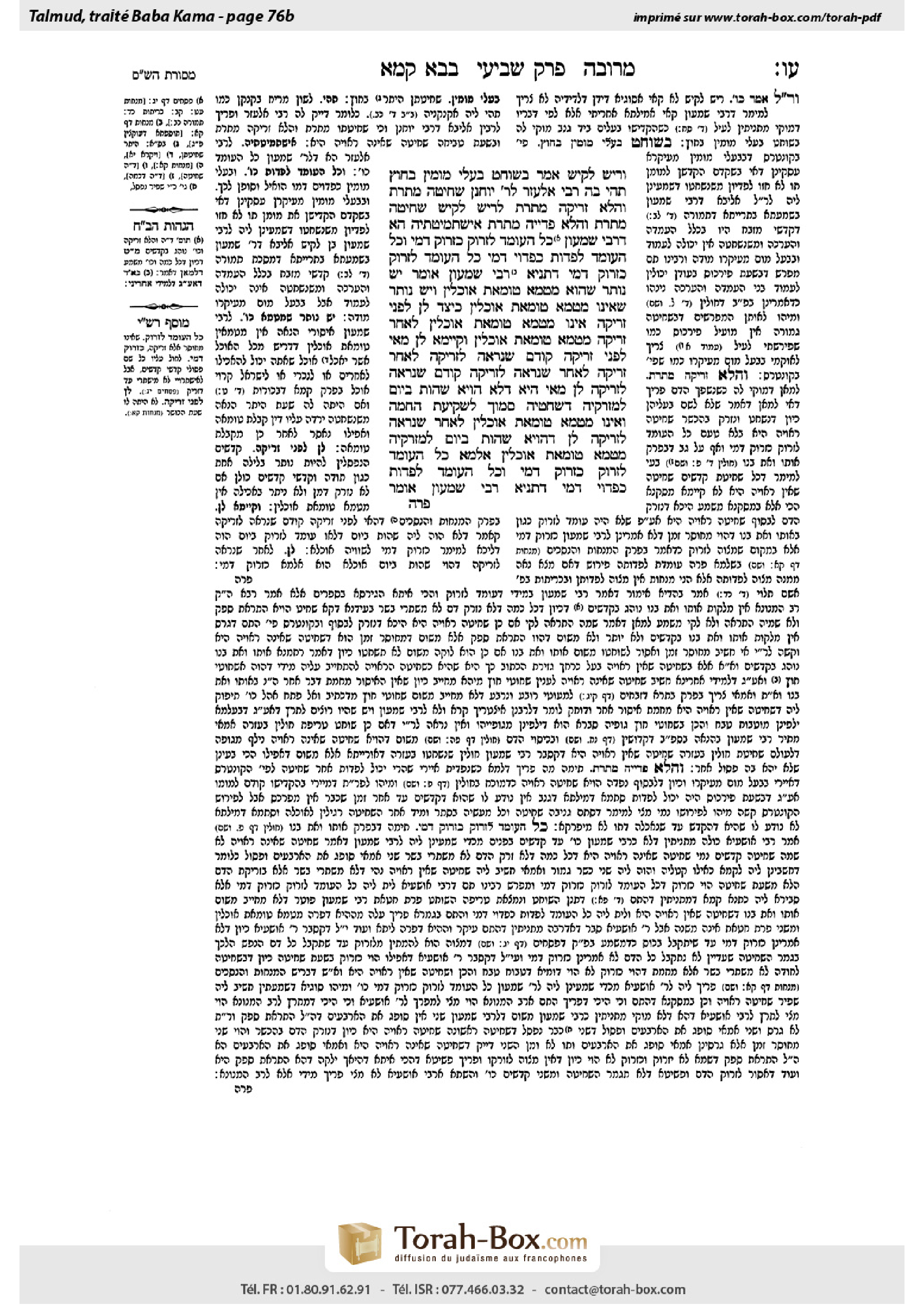
Bava Kamma 76b: Talmud study for Daf Yomi
Study the Talmud for Daf Yomi with scanned pages, Hebrew text, English translations from Sefaria and AI-generated French translations.
Passage selection and English or AI-generated French translation are available where the scan has annotations. Daf Study is independent of Torah-Box and Sefaria.
Browse Bava Kamma · בבא קמא · All tractatesBava Kamma 76b text and translations
This page of Bava Kamma includes the Aramaic text, an English translation and an AI-generated French translation, alongside the scan above.
בבא קמא ע״ו ב · Aramaic and Hebrew text
וְרֵישׁ לָקִישׁ אָמַר: בְּשׁוֹחֵט בַּעֲלֵי מוּמִין בַּחוּץ.
תָּהֵי בַּהּ רַבִּי אֶלְעָזָר: לְרַבִּי יוֹחָנָן – שְׁחִיטָה מַתֶּרֶת?! וַהֲלֹא זְרִיקָה מַתֶּרֶת!
לְרֵישׁ לָקִישׁ – שְׁחִיטָה מַתֶּרֶת?! וַהֲלֹא פְּדִיָּיה מַתֶּרֶת!
אִישְׁתְּמִיטְתֵּיהּ הָא דְּרַבִּי שִׁמְעוֹן: כׇּל הָעוֹמֵד לִזְרוֹק – כְּזָרוּק דָּמֵי, וְכׇל הָעוֹמֵד לִפְדּוֹת – כְּפָדוּי דָּמֵי.
כׇּל הָעוֹמֵד לִזְרוֹק כְּזָרוּק דָּמֵי – דְּתַנְיָא, רַבִּי שִׁמְעוֹן אוֹמֵר: יֵשׁ נוֹתָר שֶׁהוּא מְטַמֵּא טוּמְאַת אוֹכָלִין, וְיֵשׁ נוֹתָר שֶׁאֵינוֹ מְטַמֵּא טוּמְאַת אוֹכָלִין.
כֵּיצַד? לָן לִפְנֵי זְרִיקָה – אֵינוֹ מְטַמֵּא טוּמְאַת אוֹכָלִין. לְאַחַר זְרִיקָה – מְטַמֵּא טוּמְאַת אוֹכָלִין.
וְקַיְימָא לַן: מַאי ״לִפְנֵי זְרִיקָה״ – קוֹדֶם שֶׁנִּרְאָה לִזְרִיקָה. ״לְאַחַר זְרִיקָה״ – לְאַחַר שֶׁנִּרְאָה לִזְרִיקָה.
קוֹדֶם שֶׁנִּרְאָה לִזְרִיקָה לָן – מַאי הִיא? דְּלָא הָוְיָא שְׁהוּת בַּיּוֹם לְמִזְרְקֵיהּ, דְּשַׁחְטֵיהּ סָמוּךְ לִשְׁקִיעַת הַחַמָּה – וְאֵינוֹ מְטַמֵּא טוּמְאַת אוֹכָלִין.
לְאַחַר שֶׁנִּרְאָה לִזְרִיקָה לָן, דַּהֲוַיא שְׁהוּת בַּיּוֹם לְמִזְרְקֵיהּ – מְטַמֵּא טוּמְאַת אוֹכָלִין. אַלְמָא כָּל הָעוֹמֵד לִזְרוֹק – כְּזָרוּק דָּמֵי,
וְכׇל הָעוֹמֵד לִפְדּוֹת – כְּפָדוּי דָּמֵי. דְּתַנְיָא, רַבִּי שִׁמְעוֹן אוֹמֵר:
Bava Kamma 76b · English translation
And Reish Lakish says yet another explanation as to why the principal has not been returned to the owner: This is referring to a case where the thief slaughters blemished animals outside the Temple. A blemished animal may be slaughtered outside the Temple and its meat may be eaten, provided that it is redeemed with money.
Rabbi Elazar wondered about this discussion: According to the explanations attributed to Rabbi Yoḥanan, which are based on the assumption that this is referring to slaughtering a sacrificial animal inside the Temple, is it the slaughtering of the animal that renders it permitted for consumption? But isn’t it the sprinkling of the blood that renders it permitted? It is prohibited to eat sacrificial meat immediately after the slaughter; only after the sprinkling of the blood is it permitted to consume the meat. As the slaughter itself does not render the animal’s meat permitted, there should be no liability to pay the fourfold or fivefold payment.
Rabbi Elazar continues: And according to the explanation of Reish Lakish, who states that the case is referring to the slaughter of a consecrated blemished animal outside the Temple, is it the slaughtering of the animal that renders it permitted for consumption? But isn’t it the redemption of the animal that renders it permitted? Since the thief slaughtered a sacrificial animal, it is prohibited to eat its meat until its sanctity is removed by redeeming it with money. Once again, the slaughter itself does not render the meat permitted, and here too, there should be no liability to pay the fourfold or fivefold payment.
The Gemara comments: Apparently, this following statement of Rabbi Shimon escaped Rabbi Elazar, who asked these questions. Rabbi Shimon holds that any blood that is ready to be sprinkled is considered as though it had already been sprinkled, and likewise, any animal that is ready to be redeemed is considered as if it had already been redeemed.
The Gemara proves that Rabbi Shimon maintains these two opinions. Rabbi Shimon holds that any blood that is ready to be sprinkled is considered as though it had already been sprinkled, as it is taught in a baraita that Rabbi Shimon says: There are cases involving leftover sacrificial meat after the time allotted for its consumption [notar], in which the meat is susceptible to contracting ritual impurity of food, and there are cases of leftover sacrificial meat in which the meat is not susceptible to contracting ritual impurity of food.
How so? If sacrificial meat was disqualified due to the fact that it remained overnight, i.e., after the allotted time for that offering, before the sprinkling of its blood, it is not susceptible to contracting ritual impurity of food, as it was never fit for consumption. According to Rabbi Shimon, for an item to be susceptible to contracting ritual impurity of food it must have been permitted for consumption or benefit, either at present or at some point in the past. Sacrificial meat may not be consumed before the sprinkling of its blood, nor may it be consumed if it had been left over after a specific period of time, in most cases overnight. If it was disqualified by being left overnight before its blood had been sprinkled, there was never a time when the meat was permitted. By contrast, if the meat was disqualified by being left over after the sprinkling of the blood, it is susceptible to contracting ritual impurity of food, as it was permitted for consumption at some point after the sprinkling of the blood.
And we maintain, as a result of a discussion recorded in tractate Menaḥot (101b): What is the meaning of: Before the sprinkling of the blood? It means before the blood became fit for sprinkling. And what is meant by: After the sprinkling of the blood? This means after the blood became fit for sprinkling, i.e., immediately subsequent to the slaughter.
The Gemara elaborates: What is the case in which the meat remained overnight before the blood became fit for sprinkling? Since the blood is fit for sprinkling almost immediately after the animal’s slaughter, how is it possible for the meat to become notar before that stage? The Gemara answers: This is referring to a case where there was not enough time in the day to sprinkle the blood, as he slaughtered the offering immediately prior to sunset. The blood was never fit for sprinkling, as the act of sprinkling must be performed before sunset. And in this case the meat is not susceptible to contracting ritual impurity of food, as there was never a time when it was permitted for consumption.
What is the case where the meat remained overnight after the blood became fit for sprinkling? It was when there was enough time remaining in the day after the slaughter to sprinkle the blood, and therefore the meat is susceptible to contracting ritual impurity of food. The Gemara states its conclusion: Evidently, Rabbi Shimon maintains that any blood that is ready to be sprinkled is considered as though it had already been sprinkled.
And Rabbi Shimon holds that any animal that is ready to be redeemed is considered as though it is already redeemed, as it is taught in a baraita that Rabbi Shimon says:
Bava Kamma 76b · Traduction française (IA)
Et Reish Lakish dit une autre explication sur le fait que le principal n'a pas été rendu à l'owner : cela fait référence à un cas où le voleur tue des animaux blemis en dehors du Temple. Un animal blemi peut être tué en dehors du Temple et sa viande peut être mangée, à condition qu'il soit racheté avec de l'argent.
Rabbi Elazar s'est interrogé sur cette discussion : selon les explications attribuées à Rabbi Yoḥanan, qui supposent que cela fait référence à la mise à mort d'un animal sacré à l'intérieur du Temple, est-ce que c'est la mise à mort de l'animal qui rend la viande permise à la consommation ? Mais n'est-ce pas la dispersion du sang qui rend la viande permise ? Il est interdit de manger la viande sacrée immédiatement après la mise à mort ; seule après la dispersion du sang est-elle permise à la consommation. Comme la mise à mort elle-même ne rend pas la viande permise, il ne devrait pas y avoir de responsabilité de payer le quadruple ou le quintuple.
Rabbi Elazar continue : et selon l'explication de Reish Lakish, qui affirme que le cas fait référence à la mise à mort d'un animal blemi consacré en dehors du Temple, est-ce que c'est la mise à mort de l'animal qui rend la viande permise à la consommation ? Mais n'est-ce pas le rachat de l'animal qui rend la viande permise ? Puisque le voleur a tué un animal sacré, il est interdit de manger sa viande jusqu'à ce que sa sanctité soit retirée par son rachat avec de l'argent. À nouveau, la mise à mort elle-même ne rend pas la viande permise, et ici aussi, il ne devrait pas y avoir de responsabilité de payer le quadruple ou le quintuple.
Le Guemara commente : Apparemment, cette déclaration suivante de Rabbi Shimon a échappé à Rabbi Elazar, qui a posé ces questions. Rabbi Shimon affirme que tout sang prêt à être sprinklé est considéré comme s'il avait déjà été sprinklé, de même que tout animal prêt à être racheté est considéré comme s'il avait déjà été racheté.
Le Guemara démontre que Rabbi Shimon maintient ces deux opinions. Rabbi Shimon affirme que tout sang prêt à être sprinklé est considéré comme s'il avait déjà été sprinklé, comme il est enseigné dans une baraïta que Rabbi Shimon dit : Il y a des cas concernant de la viande sacrée restante après la période allouée à sa consommation [notar], dans lesquels la viande est susceptible de contracter une impureté rituelle alimentaire, et il y a des cas de viande sacrée restante dans lesquels la viande n'est pas susceptible de contracter une impureté rituelle alimentaire.
Comment cela ? Si la viande sacrée a été disqualifiée en raison du fait qu'elle a resté toute la nuit, c'est-à-dire après la période allouée à cette offrande, avant la dispersion de son sang, elle n'est pas susceptible de contracter une impureté rituelle alimentaire, car elle n'était jamais propre à la consommation. Selon Rabbi Shimon, pour qu'un objet soit susceptible de contracter une impureté rituelle alimentaire, il doit avoir été permis à la consommation ou à l'utilité, soit à l'heure actuelle, soit à un moment passé. La viande sacrée ne peut pas être consommée avant la dispersion de son sang, ni ne peut être consommée si elle a été restée après une période spécifique, la plupart du temps toute la nuit. Si elle a été disqualifiée en raison de son séjour toute la nuit avant que son sang ne soit dispersé, il n'y a jamais eu un moment où la viande était permise. À l'inverse, si la viande a été disqualifiée en raison de son séjour après la dispersion du sang, elle est susceptible de contracter une impureté rituelle alimentaire, car elle était permise à la consommation à un moment donné après la dispersion du sang.
Et nous maintenons, en conséquence d'une discussion rapportée dans le tractat Menaḥot (101b) : Quelle est la signification de : Avant la dispersion du sang ? Cela signifie avant que le sang ne soit propre à la dispersion. Et quelle est la signification de : Après la dispersion du sang ? Cela signifie après que le sang ait été propre à la dispersion, c'est-à-dire immédiatement après la mise à mort.
Le Guemara développe : Quel est le cas où la viande a resté toute la nuit avant que le sang ne soit propre à la dispersion ? Puisque le sang est propre à la dispersion presque immédiatement après la mise à mort de l'animal, comment est-il possible que la viande devienne notar avant cette étape ? Le Guemara répond : cela fait référence à un cas où il n'y avait pas assez de temps dans la journée pour disperser le sang, car il a tué l'offrande juste avant le coucher du soleil. Le sang n'était jamais propre à la dispersion, car l'acte de dispersion doit être effectué avant le coucher du soleil. Et dans ce cas, la viande n'est pas susceptible de contracter une impureté rituelle alimentaire, car il n'y a jamais eu un moment où elle était permise à la consommation.
Quel est le cas où la viande a resté toute la nuit après que le sang fut propre à la dispersion ? C'était le cas où il y avait suffisamment de temps restant dans la journée après la mise à mort pour disperser le sang, et donc la viande est susceptible de contracter une impureté rituelle alimentaire. Le Guemara énonce sa conclusion : Apparemment, Rabbi Shimon maintient que tout sang prêt à être dispersé est considéré comme s'il avait déjà été dispersé.
Et Rabbi Shimon affirme que tout animal prêt à être racheté est considéré comme s'il était déjà racheté, comme il est enseigné dans une baraïta que Rabbi Shimon dit :
Traduction française générée par IA à partir de l’édition anglaise de Sefaria. Vérifie toujours un passage avec le texte source.
Text from Sefaria: William Davidson Edition - Vocalized Aramaic (CC BY NC); William Davidson Edition - English (CC BY NC).