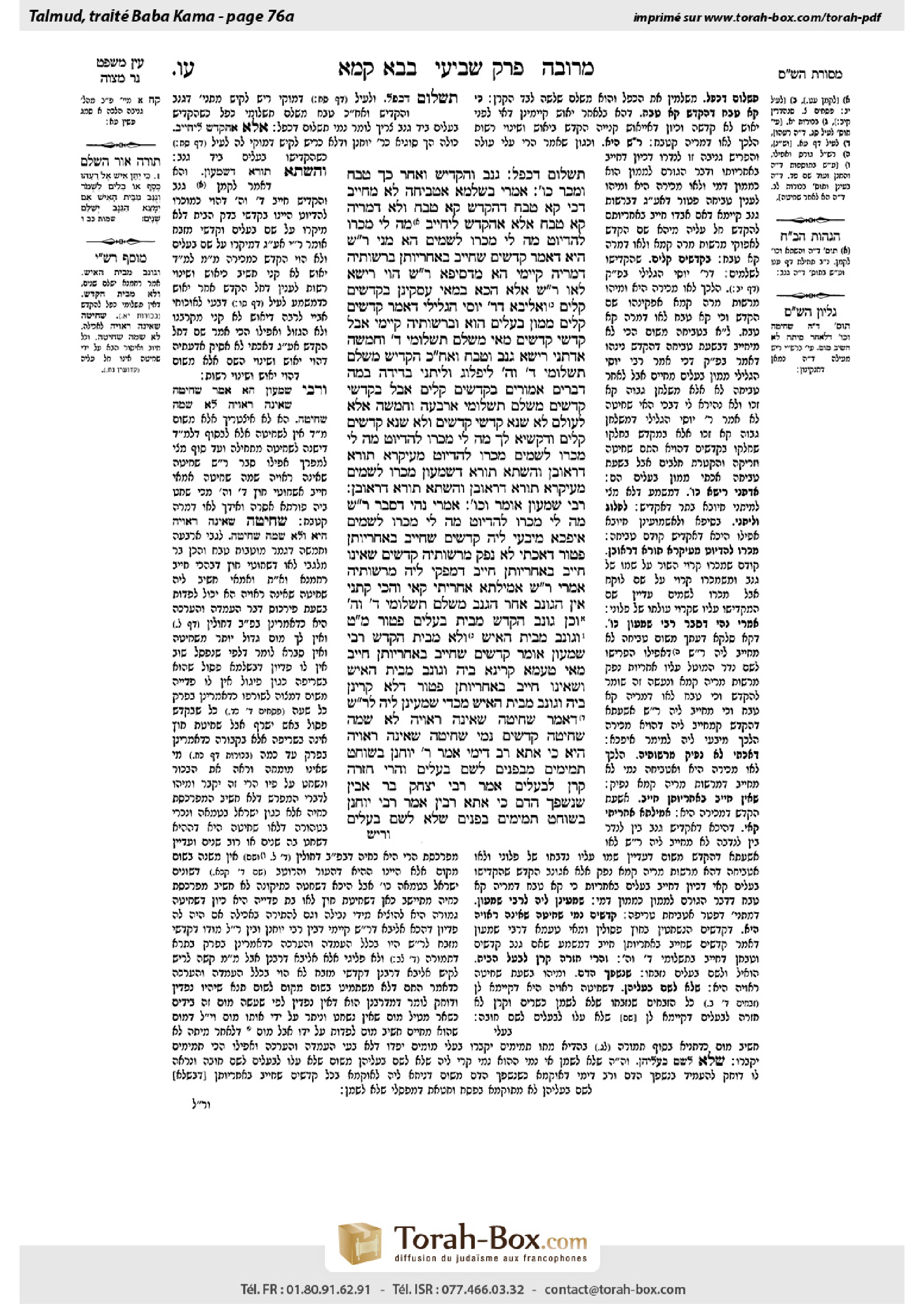
Bava Kamma 76a: Talmud study for Daf Yomi
Study the Talmud for Daf Yomi with scanned pages, Hebrew text, English translations from Sefaria and AI-generated French translations.
Passage selection and English or AI-generated French translation are available where the scan has annotations. Daf Study is independent of Torah-Box and Sefaria.
Browse Bava Kamma · בבא קמא · All tractatesBava Kamma 76a text and translations
This page of Bava Kamma includes the Aramaic text, an English translation and an AI-generated French translation, alongside the scan above.
בבא קמא ע״ו א · Aramaic and Hebrew text
תַּשְׁלוּם דְּכֵפֶל.
גָּנַב וְהִקְדִּישׁ וְאַחַר כָּךְ טָבַח וּמָכַר כּוּ׳. אָמְרִי: בִּשְׁלָמָא אַטְּבִיחָה לָא מִחַיַּיב, דְּכִי קָא טָבַח – דְּהֶקְדֵּשׁ קָא טָבַח, וְלָא דְּמָרֵיהּ קָא טָבַח;
אֶלָּא אַהֶקְדֵּשׁ – לִיחַיַּיב! מָה לִי מְכָרוֹ לְהֶדְיוֹט, מָה לִי מְכָרוֹ לַשָּׁמַיִם?
הָא מַנִּי – רַבִּי שִׁמְעוֹן הִיא, דְּאָמַר: קֳדָשִׁים שֶׁחַיָּיב בְּאַחְרָיוּתָן – בִּרְשׁוּתֵיהּ דְּמָרֵיהּ קָיְימִי.
הָא מִדְּסֵיפָא רַבִּי שִׁמְעוֹן הָוֵי, רֵישָׁא לָאו רַבִּי שִׁמְעוֹן!
אֶלָּא הָכָא בְּמַאי עָסְקִינַן – בְּקָדָשִׁים קַלִּים, וְאַלִּיבָּא דְּרַבִּי יוֹסֵי הַגְּלִילִי, דְּאָמַר: קָדָשִׁים קַלִּים – מָמוֹן בְּעָלִים הוּא, וּבִרְשׁוּתֵיהּ קָיְימִי.
אֲבָל קׇדְשֵׁי קָדָשִׁים מַאי, מְשַׁלֵּם תַּשְׁלוּמֵי אַרְבָּעָה וַחֲמִשָּׁה?! אַדְּתָנֵי רֵישָׁא: גָּנַב וְטָבַח וְאַחַר כָּךְ הִקְדִּישׁ – מְשַׁלֵּם תַּשְׁלוּמֵי אַרְבָּעָה וַחֲמִשָּׁה; לִיפְלוֹג וְלִיתְנֵי בְּדִידַהּ:
בַּמֶּה דְּבָרִים אֲמוּרִים – בְּקָדָשִׁים קַלִּים, אֲבָל בְּקׇדְשֵׁי קֳדָשִׁים – מְשַׁלֵּם תַּשְׁלוּמֵי אַרְבָּעָה וַחֲמִשָּׁה!
אֶלָּא לְעוֹלָם – לָא שְׁנָא קׇדְשֵׁי קָדָשִׁים, וְלָא שְׁנָא קָדָשִׁים קַלִּים; וּדְקַשְׁיָא לָךְ: מָה לִי מְכָרוֹ לְהֶדְיוֹט מָה לִי מְכָרוֹ לַשָּׁמַיִם; מְכָרוֹ לְהֶדְיוֹט – מֵעִיקָּרָא תּוֹרָא דִרְאוּבֵן, וְהַשְׁתָּא תּוֹרָא דְשִׁמְעוֹן. מְכָרוֹ לַשָּׁמַיִם – מֵעִיקָּרָא תּוֹרָא דִרְאוּבֵן, וְהַשְׁתָּא תּוֹרָא דִרְאוּבֵן.
רַבִּי שִׁמְעוֹן אוֹמֵר וְכוּ׳. אָמְרִי, נְהִי דְּסָבַר רַבִּי שִׁמְעוֹן: מָה לִי מְכָרוֹ לְהֶדְיוֹט מָה לִי מְכָרוֹ לַשָּׁמַיִם; אִיפְּכָא מִיבְּעֵי לֵיהּ:
קֳדָשִׁים שֶׁחַיָּיב בְּאַחְרָיוּתָן – פָּטוּר, דְּאַכַּתִּי לָא נְפַק מֵרְשׁוּתֵיהּ;
קֳדָשִׁים שֶׁאֵינוֹ חַיָּיב בְּאַחְרָיוּתָן – חַיָּיב, דְּמַפְּקִי לֵיהּ מֵרְשׁוּתֵיהּ!
אָמְרִי: רַבִּי שִׁמְעוֹן – אַמִּילְּתָא אַחֲרִיתִי קָאֵי,
וְהָכִי קָתָנֵי: אֵין הַגּוֹנֵב אַחַר הַגַּנָּב מְשַׁלֵּם תַּשְׁלוּמֵי אַרְבָּעָה וַחֲמִשָּׁה, וְכֵן גּוֹנֵב הֶקְדֵּשׁ מִבֵּית בְּעָלִים – פָּטוּר.
מַאי טַעְמָא? ״וְגֻנַּב מִבֵּית הָאִישׁ״ – וְלֹא מִבֵּית הֶקְדֵּשׁ.
רַבִּי שִׁמְעוֹן אוֹמֵר: קֳדָשִׁים שֶׁחַיָּיב בְּאַחְרָיוּתָן – חַיָּיב. מַאי טַעְמָא? קָרֵינָא בֵּיהּ: ״וְגֻנַּב מִבֵּית הָאִישׁ״. וְשֶׁאֵינוֹ חַיָּיב בְּאַחְרָיוּתָן – פָּטוּר, דְּלָא קָרֵינַן בֵּיהּ: ״וְגֻנַּב מִבֵּית הָאִישׁ״.
מִכְּדִי שָׁמְעִינַן לֵיהּ לְרַבִּי שִׁמְעוֹן דְּאָמַר: שְׁחִיטָה שֶׁאֵינָהּ רְאוּיָה – לֹא שְׁמָהּ שְׁחִיטָה; קֳדָשִׁים נָמֵי שְׁחִיטָה שֶׁאֵינָהּ רְאוּיָה הִיא!
כִּי אֲתָא רַב דִּימִי אָמַר רַבִּי יוֹחָנָן: בְּשׁוֹחֵט תְּמִימִים מִבִּפְנִים לְשֵׁם בְּעָלִים.
וַהֲרֵי חָזְרָה קֶרֶן לַבְּעָלִים! אָמַר רַבִּי יִצְחָק בַּר אָבִין: שֶׁנִּשְׁפַּךְ הַדָּם.
כִּי אֲתָא רָבִין אָמַר רַבִּי יוֹחָנָן: בְּשׁוֹחֵט תְּמִימִים בִּפְנִים שֶׁלֹּא לְשֵׁם בְּעָלִים.
Bava Kamma 76a · English translation
the payment of the extra part of the double payment, i.e., the amount that exceeds the principal.
§ The mishna teaches: If one stole an animal and subsequently he consecrated it as an offering, and afterward he slaughtered or sold it, the thief pays the double payment but he does not pay the fourfold or fivefold payment. The Sages say: Granted, he is not liable to pay the fourfold or fivefold payment for the slaughter of the animal, as when he slaughtered it, he slaughtered an animal belonging to the Temple treasury, and he did not slaughter the animal belonging to its owner.
But let him be liable to pay the fourfold or fivefold payment for having consecrated the animal in the first place, as what difference is it to me if he sold the animal to an ordinary person, and what difference is it to me if he sold it to Heaven by consecrating it? Consecration should be considered tantamount to a sale, as in either case ownership of the animal is transferred to another party.
The Gemara answers: In accordance with whose opinion is this mishna taught? It is in accordance with the opinion of Rabbi Shimon, who says that sacrificial animals for which the owner bears financial responsibility to replace with another animal if one of the original animals is lost or dies are considered to be in the possession of their owner (see 74b). The mishna is referring a case where the thief consecrated the animal in such a manner that he is obligated to replace it if it is lost or damaged before being sacrificed. One consequence of this potential financial loss is that the animal is considered to be in the thief’s possession even after he consecrated it. Therefore, the animal’s consecration is not tantamount to a sale to another party.
The Gemara rejects this answer: But from the fact that the latter clause of the mishna is in accordance with the opinion of Rabbi Shimon, it follows that the first clause of the mishna, which is stated before his opinion is introduced, is not in accordance with the opinion of Rabbi Shimon.
Rather, with what are we dealing here in the mishna? We are dealing with a case where the thief consecrated the animal as an offering of lesser sanctity, and the mishna is in accordance with the opinion of Rabbi Yosei HaGelili, who says that an offering of lesser sanctity is the property of its putative owner, and is considered in his possession. Therefore, its consecration is not tantamount to a sale to another party.
The Gemara rejects this answer as well: But what would be the halakha had the thief consecrated the animal as an offering of the most sacred order? Would he have to pay the fourfold or fivefold payment? If so, rather than teaching the following in the earlier clause of the mishna (70a), in the case that stands in opposition to this one: If he stole an animal and slaughtered it and afterward he consecrated it, he must pay the fourfold or fivefold payment, let the tanna distinguish and teach the opposing halakha within the same category itself.
The Gemara elaborates: The tanna could have taught: In what case is this statement, that the thief is exempt if he consecrated the stolen animal and then slaughtered or sold it, said? It is said only if he consecrated the animal as an offering of lesser sanctity; but if he consecrated it as an offering of the most sacred order he pays the fourfold or fivefold payment, as the consecration itself would be tantamount to a sale to another party.
Rather, the Gemara states that actually there is no difference whether the thief consecrates the animal as an offering of the most sacred order and there is no difference whether he consecrates it as an offering of lesser sanctity. And as for the matter that presented a difficulty for you, namely: What difference is it to me if he sold the animal to an ordinary person and what difference is it to me if he sold it to Heaven by consecration, one can answer as follows: If someone, e.g., Reuven, sold an ox to an ordinary person, e.g., Shimon, at the outset it was Reuven’s ox and now, after the sale, it is Shimon’s ox. By contrast, if he sold it to Heaven, i.e., he consecrated it as an offering, it is not considered to have been transferred into the possession of another party, as at the outset it was Reuven’s ox and now, after consecration, it is still Reuven’s ox.
§ The mishna teaches: Rabbi Shimon says: In the case of sacrificial animals for which the owner bears financial responsibility to replace with another animal if one of the original animals that one stole is lost or dies, the thief is obligated to pay the fourfold or fivefold payment if he slaughters one of the animals. If it is a sacrificial animal for which the owner bears no financial responsibility, the thief is exempt from the fourfold or fivefold payment. At this stage the Gemara assumes that Rabbi Shimon requires the fourfold or fivefold payment as a fine for the act of consecration itself rather than for the act of slaughtering the animal. The Gemara says: Although Rabbi Shimon holds that there is a logic of: What difference is it to me if he sold the animal to an ordinary person and what difference is it to me if he sold it to Heaven via consecration, nevertheless, he should have said the opposite.
The Gemara elaborates: He should have said that if they are sacrificial animals for which one bears financial responsibility, the thief is exempt from paying the fourfold or fivefold payment. In other words, if the thief stole a non-sacred animal and subsequently consecrated it as an offering in such a manner that he bears responsibility to replace it, he should be exempt from the fourfold or fivefold payment for the act of consecration. The reason is that the animal has not yet left his possession, and therefore this act of consecration should not be considered a sale.
By contrast, if they are sacrificial animals for which one does not bear financial responsibility, the thief should be liable to pay the fourfold or fivefold payment. If the thief stole a non-sacred animal and then consecrated it as an offering in such a way that he does not bear responsibility to replace it, he should be liable to pay the fourfold or fivefold payment for the act of consecration, as he has thereby removed the animal from his possession.
The Sages say in response: Rabbi Shimon is not discussing the issue of whether the consecration of an animal is tantamount to its sale. Rather, he is referring to a different matter, one that is not explicitly mentioned in the mishna.
And this is what the mishna is teaching: One who steals an animal after a thief has already stolen it, i.e., he steals it from the thief, does not pay the double payment, and if he slaughtered or sold the animal he does not pay the fourfold or fivefold payment. And similarly, one who steals consecrated property from the house of its owner is exempt from the double payment, and if it was a sacrificial animal and the thief slaughtered or sold it, he is exempt from the fourfold or fivefold payment.
What is the reason for this last ruling? The reason is as it is written: “If a man gives his neighbor money or vessels to safeguard and it was stolen from the house of the man, if the thief shall be found he shall pay double” (Exodus 22:6). The phrase “from the house of the man” indicates that a thief is obligated to pay the double payment only when they are stolen from a person, but not if the item in question was stolen out of the house of the Temple treasury.
Rabbi Shimon says: If the stolen items were sacrificial animals for which the owner bears financial responsibility, the thief who steals them is liable to pay the double payment, as well as the fourfold or fivefold payment if he slaughters or sells them. What is the reason for this? Since the owner must replace the animals, one applies to this case the phrase “and it was stolen from the house of the man.” But if the stolen animals are those for which the owner does not bear financial responsibility, the thief is exempt from the double payment and from the fourfold and fivefold payment, as one does not apply to this case the phrase “and it was stolen from the house of the man.”
Now, we have heard elsewhere concerning Rabbi Shimon that he said: An act of slaughter that is not fit for accomplishing its full ritual purpose is not considered an act of slaughter at all. And if the thief slaughtered the sacrificial animal he stole, this is also an act of slaughter that is not fit for accomplishing its full ritual purpose, as it does not render the animal’s meat fit for consumption, in light of the halakha that it is prohibited to eat a sacrificial animal slaughtered outside the Temple.
When Rav Dimi came from Eretz Yisrael, he said that Rabbi Yoḥanan says: This is referring to a case where the thief slaughters the animal, unblemished, inside the Temple, for the sake of its owner. In this case, its meat may be eaten.
The Gemara asks: But by slaughtering and sacrificing the sacrificial animal on behalf of the owner, it is as though the principal, i.e., the animal itself, has been returned to the owner, and the fourfold or fivefold payment should no longer apply. The owner had designated the animal as his offering, and it was in fact used for that purpose. Rabbi Yitzḥak bar Avin said in response: This is referring to a situation where the animal’s blood was spilled before it could be sprinkled on the altar. Consequently, the owner did not achieve atonement through this offering, which is why it is not considered as though the animal has been returned to the owner.
When Ravin came from Eretz Yisrael, he cited a different version of this answer, and said that Rabbi Yoḥanan says: This is referring to a case where the thief slaughters the animal, unblemished, inside the Temple, but not for the sake of its owner. The halakha in this case is that the animal’s meat may be eaten but the owner has not fulfilled his obligation with this offering. In such a case, the slaughter of the animal does render its meat fit for consumption. Yet, it is not considered as though the animal has been returned to the owner.
Bava Kamma 76a · Traduction française (IA)
le paiement de la partie supplémentaire du double paiement, c'est-à-dire la somme qui excède le principal.
§ La Michna enseigne : Si l'on vole un animal et ensuite il le consacre comme un sacrifice, et ensuite il le sacrifie ou le vend, le voleur paie le double paiement mais il ne paie pas le quadruple ou le quintuple paiement. Les Sages disent : C'est vrai, il n'est pas tenu responsable du quadruple ou du quintuple paiement pour la sacrifice de l'animal, car lorsqu'il le sacrifia, il sacrifia un animal appartenant au trésor du Temple, et il n'a pas sacrifié l'animal appartenant à son propriétaire.
Mais il devrait être tenu responsable du quadruple ou du quintuple paiement pour avoir d'abord consacré l'animal comme un sacrifice, car quelle différence y a-t-il pour moi si il le vendit à un homme ordinaire, et quelle différence y a-t-il pour moi si il le vendit à Dieu en le consacrant ? La consécration devrait être considérée comme équivalente à une vente, car dans les deux cas, la propriété de l'animal est transférée à une autre partie.
Le Guemara répond : Selon l'opinion de qui est-ce que cette Michna est enseignée ? C'est selon l'opinion de Rabbi Shimon, qui dit que les animaux sacrés pour lesquels l'owner est tenu financièrement responsable de les remplacer si l'un des animaux originaux est perdu ou meurt sont considérés comme appartenant à leur propriétaire (voir 74b). La Michna fait référence à un cas où le voleur a consacré l'animal de telle manière qu'il est tenu responsable de le remplacer si l'animal est perdu ou endommagé avant d'être sacrifié. Une conséquence de cette perte financière potentielle est que l'animal est considéré comme appartenant au voleur même après sa consécration. Par conséquent, la consécration n'est pas équivalente à une vente à une autre partie.
Le Guemara rejette cette réponse : Mais du fait que la clause ultérieure de la Michna est selon l'opinion de Rabbi Shimon, il en découle que la clause initiale de la Michna, qui est énoncée avant que son opinion ne soit introduite, n'est pas selon l'opinion de Rabbi Shimon.
Plutôt, avec quoi sommes-nous en train de traiter dans la Michna ? Nous traitons d'un cas où le voleur a consacré l'animal comme un sacrifice de moindre sanctité, et la Michna est selon l'opinion de Rabbi Yosei HaGelili, qui dit qu'un sacrifice de moindre sanctité est la propriété de son propriétaire prétendu et est considéré comme étant en sa possession. Par conséquent, sa consécration n'est pas équivalente à une vente à une autre partie.
Le Guemara rejette cette réponse également : Mais que serait la halakha si le voleur avait consacré l'animal comme un sacrifice de la plus haute sanctité ? Devrait-il payer le quadruple ou le quintuple ? Si c'est le cas, plutôt que d'enseigner ce qui suit dans la clause antérieure de la Michna (70a), dans le cas qui s'oppose à celui-ci : Si l'on vole un animal et le sacrifie et ensuite il le consacre, il doit payer le quadruple ou le quintuple, laissez le tanna distinguer et enseigner la halakha opposée dans la même catégorie elle-même.
Le Guemara développe : Le tanna aurait pu enseigner : Dans quel cas cette déclaration, selon laquelle le voleur est exempt si il a consacré l'animal volé et ensuite l'a sacrifié ou vendu, est-elle dite ? Elle est dite uniquement si il a consacré l'animal comme un sacrifice de moindre sanctité ; mais si il l'a consacré comme un sacrifice de la plus haute sanctité, il devrait payer le quadruple ou le quintuple, car la consécration elle-même serait équivalente à une vente à une autre partie.
Plutôt, le Guemara affirme que, en réalité, il n'y a pas de différence si le voleur consacre l'animal comme un sacrifice de la plus haute sanctité et il n'y a pas de différence si il le consacre comme un sacrifice de moindre sanctité. Et concernant la question qui vous posait un problème, à savoir : Quelle différence y a-t-il pour moi si il vendit l'animal à un homme ordinaire et quelle différence y a-t-il pour moi si il le vendit à Dieu en le consacrant, on peut répondre comme suit : Si quelqu'un, par exemple, Réouven, vend un bœuf à un homme ordinaire, par exemple, Shimon, au départ c'était le bœuf de Réouven et maintenant, après la vente, c'est le bœuf de Shimon. En revanche, si il le vendit à Dieu, c'est-à-dire il le consacra comme un sacrifice, il n'est pas considéré comme ayant été transféré dans la possession d'une autre partie, car au départ c'était le bœuf de Réouven et maintenant, après la consécration, c'est toujours le bœuf de Réouven.
§ La Michna enseigne : Rabbi Shimon dit : Dans le cas des animaux sacrés pour lesquels l'propriétaire est tenu financièrement responsable de les remplacer si l'un des animaux originaux que l'on a volé est perdu ou meurt, le voleur est tenu de payer le quadruple ou le quintuple paiement s'il sacrifie l'un des animaux. Si c'est un animal sacré pour lequel l'propriétaire ne porte pas de responsabilité financière, le voleur est exempt du quadruple ou du quintuple paiement. À cette étape, le Guemara suppose que Rabbi Shimon exige le quadruple ou le quintuple paiement comme une amende pour l'acte de consécration lui-même plutôt que pour l'acte de sacrifier l'animal. Le Guemara dit : Bien que Rabbi Shimon maintienne qu'il y a une logique de : Quelle différence y a-t-il pour moi si il vendit l'animal à un homme ordinaire et quelle différence y a-t-il pour moi si il le vendit à Dieu via la consécration, néanmoins, il aurait dû dire l'opposé.
Le Guemara développe : Il aurait dû dire que si ce sont des animaux sacrés pour lesquels l'on porte une responsabilité financière, le voleur est exempt de payer le quadruple ou le quintuple paiement. En d'autres termes, si le voleur a volé un animal non sacré et ensuite l'a consacré comme un sacrifice de telle manière qu'il porte une responsabilité financière, il devrait être exempt du quadruple ou du quintuple paiement pour l'acte de consécration. La raison est que l'animal n'a pas encore quitté sa possession, et par conséquent, cet acte de consécration ne devrait pas être considéré comme une vente.
Par contre, si ce sont des animaux sacrés pour lesquels on ne porte pas la responsabilité financière, le voleur devrait être tenu responsable de payer une réparation quadruple ou quintuple. Si le voleur a volé un animal non sacré et a ensuite consacré cet animal en tant qu'offrande de manière à ce qu'il ne porte pas la responsabilité de le remplacer, il devrait être tenu responsable de payer une réparation quadruple ou quintuple pour l'acte de consécration, car il a ainsi retiré l'animal de son possession.
Les Sages disent en réponse : Rabbi Shimon ne discute pas la question de savoir si la consécration d'un animal équivaut à une vente. Il fait référence à une autre question, celle qui n'est pas explicitement mentionnée dans la mitsna.
Et c'est ce que la mitsna enseigne : celui qui vole un animal après qu'un voleur ait déjà volé un animal, c'est-à-dire qu'il le vole au voleur, ne paie pas la réparation double, et s'il a tué ou vendu l'animal, il ne paie pas la réparation quadruple ou quintuple. De même, celui qui vole des biens consacrés à partir de la maison de leur propriétaire est exempt de la réparation double, et si c'était un animal sacré et que le voleur l'a tué ou vendu, il est exempt de la réparation quadruple ou quintuple.
Quelle est la raison de cette dernière décision ? La raison est telle que cela est écrit : « Si un homme donne à son voisin de l'argent ou des objets pour les garder et qu'ils ont été volés de la maison de l'homme, si le voleur est trouvé, il devra payer double » (Exode 22:6). La phrase « de la maison de l'homme » indique que le voleur est tenu de payer la réparation double uniquement lorsqu'ils ont été volés d'une personne, mais pas si l'objet en question a été volé hors de la maison du trésor du Temple.
Rabbi Shimon dit : Si les objets volés sont des animaux sacrés pour lesquels le propriétaire porte la responsabilité financière, le voleur qui les vole est tenu responsable de payer la réparation double, ainsi que la réparation quadruple ou quintuple s'il les tue ou les vend. Quelle est la raison de cela ? Puisque le propriétaire doit remplacer les animaux, on applique à ce cas la phrase « et ils ont été volés de la maison de l'homme ». Mais si les animaux volés sont ceux pour lesquels le propriétaire ne porte pas la responsabilité financière, le voleur est exempt de la réparation double et de la réparation quadruple et quintuple, car on ne s'applique pas à ce cas la phrase « et ils ont été volés de la maison de l'homme ».
Maintenant, nous avons entendu ailleurs concernant Rabbi Shimon qu'il a dit : Un acte de sacrifice qui n'est pas adapté à accomplir son but rituel complet n'est pas considéré comme un acte de sacrifice. Et si le voleur a tué un animal sacré qu'il avait volé, c'est aussi un acte de sacrifice qui n'est pas adapté à accomplir son but rituel complet, car cela ne rend pas la viande de l'animal propre à la consommation, en raison de la halakha qui interdit de manger un animal sacré tué en dehors du Temple.
Quand Rav Dimi est venu d'Eretz Yisrael, il a dit que Rabbi Yoḥanan dit : Cela fait référence à un cas où le voleur tue l'animal, non blemishé, à l'intérieur du Temple, à l'intention de son propriétaire. Dans ce cas, sa viande peut être mangée.
La Guemara pose la question : Mais en tuant et en sacrifiant l'animal sacré au nom du propriétaire, cela équivaut à ce que l'animal lui-même ait été rendu au propriétaire, et la réparation quadruple ou quintuple ne devrait plus s'appliquer. Le propriétaire avait désigné l'animal comme son offrande, et il a effectivement été utilisé à cet effet. Rabbi Yitzḥak bar Avin a répondu en ce sens : Cela fait référence à un cas où le sang de l'animal a été versé avant qu'il ne puisse être versé sur l'autel. Ainsi, le propriétaire n'a pas obtenu la rédemption par cette offrande, ce qui explique pourquoi il n'est pas considéré comme si l'animal avait été rendu au propriétaire.
Quand Ravin est venu d'Eretz Yisrael, il a cité une autre version de cette réponse et a dit que Rabbi Yoḥanan dit : Cela fait référence à un cas où le voleur tue l'animal, non blemishé, à l'intérieur du Temple, mais pas à l'intention de son propriétaire. La halakha dans ce cas est que la viande de l'animal peut être mangée, mais que le propriétaire n'a pas accompli son obligation avec cette offrande. Dans ce cas, la mise à mort de l'animal rend sa viande propre à la consommation. Cependant, cela n'est pas considéré comme si l'animal avait été rendu au propriétaire.
Traduction française générée par IA à partir de l’édition anglaise de Sefaria. Vérifie toujours un passage avec le texte source.
Text from Sefaria: William Davidson Edition - Vocalized Aramaic (CC BY NC); William Davidson Edition - English (CC BY NC).