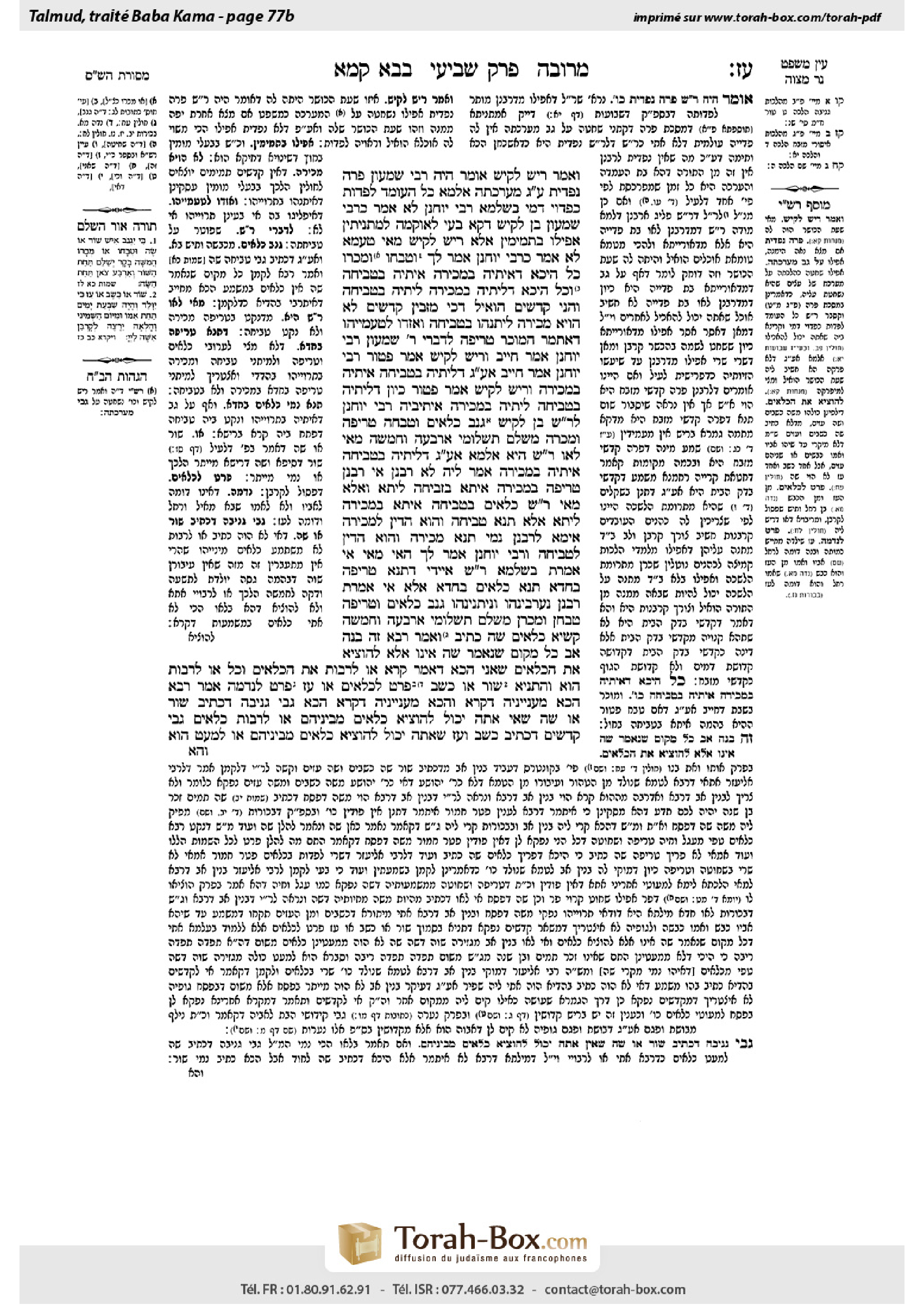
Bava Kamma 77b: Talmud study for Daf Yomi
Study the Talmud for Daf Yomi with scanned pages, Hebrew text, English translations from Sefaria and AI-generated French translations.
Passage selection and English or AI-generated French translation are available where the scan has annotations. Daf Study is independent of Torah-Box and Sefaria.
Browse Bava Kamma · בבא קמא · All tractatesBava Kamma 77b text and translations
This page of Bava Kamma includes the Aramaic text, an English translation and an AI-generated French translation, alongside the scan above.
בבא קמא ע״ז ב · Aramaic and Hebrew text
וְאָמַר רֵישׁ לָקִישׁ, אוֹמֵר הָיָה רַבִּי שִׁמְעוֹן: פָּרָה נִפְדֵּית עַל גַּבֵּי מַעֲרַכְתָּהּ. אַלְמָא כׇּל הָעוֹמֵד לִפְדּוֹת – כְּפָדוּי דָּמֵי.
בִּשְׁלָמָא רַבִּי יוֹחָנָן לָא אָמַר כְּרַבִּי שִׁמְעוֹן בֶּן לָקִישׁ – דְּקָא בָּעֵי לְאוֹקֹמַהּ לְמַתְנִיתִין אֲפִילּוּ בִּתְמִימִין. אֶלָּא רֵישׁ לָקִישׁ – מַאי טַעְמָא לָא אָמַר כְּרַבִּי יוֹחָנָן?
אָמַר לָךְ: ״וּטְבָחוֹ וּמְכָרוֹ״ – כֹּל הֵיכָא דְּאִיתֵיהּ בִּמְכִירָה אִיתֵיהּ בִּטְבִיחָה, וְכֹל הֵיכָא דְּלֵיתֵיהּ בִּמְכִירָה לֵיתֵיהּ בִּטְבִיחָה. וְהָנֵי קֳדָשִׁים – הוֹאִיל דְּכִי מְזַבֵּין קֳדָשִׁים לָא הָוְיָא מְכִירָה, לֵיתַנְהוּ בִּטְבִיחָה.
וְאָזְדוּ לְטַעְמַיְיהוּ – דְּאִתְּמַר: הַמּוֹכֵר טְרֵיפָה לְדִבְרֵי רַבִּי שִׁמְעוֹן – רַבִּי יוֹחָנָן אָמַר: חַיָּיב, וְרֵישׁ לָקִישׁ אָמַר: פָּטוּר.
רַבִּי יוֹחָנָן אָמַר חַיָּיב – אַף עַל גַּב דְּלֵיתֵיהּ בִּטְבִיחָה, אִיתֵיהּ בִּמְכִירָה. וְרֵישׁ לָקִישׁ אָמַר פָּטוּר – כֵּיוָן דְּלֵיתֵיהּ בִּטְבִיחָה, לֵיתֵיהּ בִּמְכִירָה.
אֵיתִיבֵיהּ רַבִּי יוֹחָנָן לְרַבִּי שִׁמְעוֹן בֶּן לָקִישׁ: גָּנַב כִּלְאַיִם וּטְבָחָהּ, טְרֵיפָה וּמְכָרָהּ – מְשַׁלֵּם תַּשְׁלוּמֵי אַרְבָּעָה וַחֲמִשָּׁה. מַאי, לָאו רַבִּי שִׁמְעוֹן הִיא? אַלְמָא אַף עַל גַּב דְּלֵיתֵיהּ בִּטְבִיחָה – אִיתֵיהּ בִּמְכִירָה!
אֲמַר לֵיהּ: לָא; רַבָּנַן.
אִי רַבָּנַן, טְרֵיפָה בִּמְכִירָה אִיתַהּ – בִּזְבִיחָה לֵיתַהּ?!
וְאֶלָּא מַאי, רַבִּי שִׁמְעוֹן?! כִּלְאַיִם בִּטְבִיחָה אִיתַהּ, בִּמְכִירָה לֵיתַהּ?!
אֶלָּא תְּנָא טְבִיחָה – וְהוּא הַדִּין לִמְכִירָה; אֵימָא לְרַבָּנַן נָמֵי, תְּנָא מְכִירָה – וְהוּא הַדִּין לִטְבִיחָה.
וְרַבִּי יוֹחָנָן אָמַר לָךְ: הַאי מַאי? אִי אָמְרַתְּ בִּשְׁלָמָא רַבִּי שִׁמְעוֹן, אַיְּידֵי דִּתְנָא טְרֵיפָה בַּחֲדָא – תְּנָא כִּלְאַיִם בַּחֲדָא.
אֶלָּא אִי אָמְרַתְּ רַבָּנַן, נְעָרְבִינְהוּ וְנִיתְנִינְהוּ: גָּנַב כִּלְאַיִם וּטְרֵיפָה, טְבָחָן וּמְכָרָן – מְשַׁלֵּם תַּשְׁלוּמֵי אַרְבָּעָה וַחֲמִשָּׁה! קַשְׁיָא.
כִּלְאַיִם – ״שֶׂה״ כְּתִיב; וְאָמַר רָבָא: זֶה בָּנָה אָב – כׇּל מָקוֹם שֶׁנֶּאֱמַר ״שֶׂה״, אֵינוֹ אֶלָּא לְהוֹצִיא אֶת הַכִּלְאַיִם!
שָׁאנֵי הָכָא, דְּאָמַר קְרָא: ״אוֹ״ – לְרַבּוֹת אֶת הַכִּלְאַיִם.
וְכׇל ״אוֹ״ לְרַבּוֹת הוּא? וְהָתַנְיָא: ״שׁוֹר אוֹ כֶשֶׂב״ – פְּרָט לְכִלְאַיִם, ״אוֹ עֵז״ – פְּרָט לְנִדְמֶה!
אָמַר רָבָא: הָכָא מֵעִנְיָינֵיהּ דִּקְרָא, וְהָכָא מֵעִנְיָינֵיהּ דִּקְרָא. הָכָא גַּבֵּי גְּנֵיבָה, דִּכְתִיב: ״שׁוֹר אוֹ שֶׂה״, שֶׁאִי אַתָּה יָכוֹל לְהוֹצִיא כִּלְאַיִם מִבֵּינֵיהֶם – ״אוֹ״ לְרַבּוֹת כִּלְאַיִם. גַּבֵּי קֳדָשִׁים, דִּכְתִיב: ״כֶּשֶׂב וָעֵז״, שֶׁאַתָּה יָכוֹל לְהוֹצִיא כִּלְאַיִם מִבֵּינֵיהֶם – ״אוֹ״ לְמַעֵט הוּא.
Bava Kamma 77b · English translation
And Reish Lakish says, in explanation of Rabbi Shimon’s statement: Rabbi Shimon would say that the red heifer can be redeemed with money even when it has already been slaughtered upon its pyre, i.e., for the sake of purification. For this reason Rabbi Shimon claimed that the meat had a time when it was fit for consumption, as it can be rendered permitted for consumption through redemption. The Gemara states its conclusion: Evidently, Rabbi Shimon holds that any animal that is ready to be redeemed is considered as though it has already been redeemed.
The Gemara discusses the relative merits of the answers provided by Rabbi Yoḥanan and Reish Lakish: Granted, Rabbi Yoḥanan did not state an answer in accordance with that of Rabbi Shimon ben Lakish, i.e., Reish Lakish, that the mishna is referring to a blemished animal, because he wants to interpret the mishna as dealing with all kinds of sacrificial animals, even with unblemished ones. But what is the reason that Reish Lakish did not state an answer in accordance with that of Rabbi Yoḥanan?
Reish Lakish could have said to you that the verse states: “If a man steals an ox or a sheep, and slaughters it or sells it” (Exodus 21:37). This verse compares slaughtering to selling, thereby indicating that anywhere that the fourfold or fivefold payment is applicable for the sale of a particular animal it is likewise applicable for its slaughter, and anywhere that the fourfold or fivefold payment is not applicable for the sale of an animal it is not applicable for its slaughter either. And with regard to this case of sacrificial animals, since when one sells sacrificial animals it is not a valid sale, and no fourfold or fivefold payment is incurred, so too, there is no fourfold or fivefold payment for their slaughter.
And these two Sages follow their own lines of reasoning. As it was stated: According to the statement of Rabbi Shimon that an act of slaughter that is not fit for accomplishing its full ritual purpose is not considered an act of slaughter at all and does not entail liability to pay the fourfold or fivefold payment, in the case of a thief who sells a stolen animal with a wound that will cause it to die within twelve months [tereifa], Rabbi Yoḥanan says: The thief is liable to pay the fourfold or fivefold payment if he sells the animal rather than slaughters it. And Reish Lakish says: He is exempt.
The Gemara elaborates: Rabbi Yoḥanan says that he is liable, as even though the fourfold or fivefold payment is not applicable for the slaughter of a tereifa according to the opinion of Rabbi Shimon, as its meat may not be eaten, nevertheless, it is applicable for its sale. And Reish Lakish says that the thief is exempt, as, since the fourfold or fivefold payment is not applicable for the slaughter of a tereifa according to Rabbi Shimon, it is not applicable for its sale either.
Rabbi Yoḥanan raised an objection to the opinion of Rabbi Shimon ben Lakish from the following baraita: If one stole an animal of diverse kinds, e.g., a sheep-goat hybrid, and slaughtered it, or if he stole a tereifa and sold it, he pays the fourfold or fivefold payment. What, is it not correct to say that this baraita, which mentions the case of selling a stolen tereifa but not slaughtering it, is in accordance with the opinion of Rabbi Shimon? Apparently, according to Rabbi Shimon, even though the fourfold or fivefold payment is not applicable for the slaughter of a tereifa, it is nevertheless applicable for its sale.
Reish Lakish said to Rabbi Yoḥanan in response: No; this baraita is not taught in accordance with the opinion of Rabbi Shimon. Rather, it follows the opinion of the Rabbis, who disagree with Rabbi Shimon and maintain that a thief is liable for the fourfold or fivefold payment for slaughtering an animal even if the act of slaughter does not render its meat fit for consumption, as in the case of a tereifa.
The Gemara asks: If the baraita reflects the opinion of the Rabbis, why does it mention the sale of a tereifa but not its slaughter? According to the opinion of the Rabbis, is the fourfold or fivefold payment applicable for the sale of a tereifa while it is not applicable for its slaughter? This is certainly not the case.
The Gemara responds with a counter-question: Rather, what would you say, that the baraita reflects the opinion of Rabbi Shimon? The same difficulty could be raised in the case of diverse kinds, as the baraita mentions the animal’s slaughter but not its sale: Is the fourfold or fivefold payment applicable for the slaughter of an animal of diverse kinds, while it is not applicable for its sale? There is certainly no difference between slaughtering and selling in this case.
Rather, one cannot make such inferences from the baraita, as it teaches liability with regard to the slaughter of diverse kinds, and the same is true with regard to its sale. If so, one can say the same for the opinion of the Rabbis as well: The baraita teaches liability with regard to the sale of a tereifa, and the same is true with regard to its slaughter. Once the baraita is interpreted in accordance with the opinion of the Rabbis and not that of Rabbi Shimon, it has no bearing on the dispute between Rabbi Yoḥanan and Reish Lakish.
And Rabbi Yoḥanan could say to you: What is this comparison? Granted, if you say that the baraita reflects the opinion of Rabbi Shimon, and that is why it referred specifically to the sale of a tereifa, the baraita can be explained: Since it necessarily taught the case of tereifa in only one manner, that of selling, it maintained the same style of presentation and taught the case of diverse kinds in only one manner, that of slaughtering.
But if you say that the baraita is in accordance with the opinion of the Rabbis, there is no reason for it to present just one scenario in either case. Rather, let the baraita combine them and teach them in a single sentence: If one stole an animal of diverse kinds or a tereifa and then slaughtered or sold either one of them, he pays the fourfold or fivefold payment. The Gemara concludes: This is difficult according to the opinion of Reish Lakish.
§ The baraita teaches that a thief is liable to pay the fourfold or fivefold payment in the case of an animal of diverse kinds. The Gemara asks: It is written in the Torah: “If a man steals an ox or a sheep [seh]” (Exodus 21:37), and Rava says, concerning the verse: “These are the animals that you may eat: The ox, the seh of a sheep, and the seh of a goat” (Deuteronomy 14:4), that this verse establishes a paradigm for other cases: Wherever the word seh is stated in the Torah, it serves to exclude only an animal of diverse kinds. The Hebrew word seh denotes either a sheep or a goat. A hybrid, which is neither a sheep nor a goat, does not qualify as a seh. Why, then, is the fourfold or fivefold payment applicable to one who stole this kind of animal?
The Gemara answers: It is different here, in the case of the fourfold or fivefold payment, as the verse states “or” (Exodus 21:37), a term that could have been avoided, as explained earlier (67b). This extra word serves to include an animal of diverse kinds, i.e., the sheep-goat hybrid.
The Gemara asks: And does every instance of the word “or” serve to include diverse kinds? But isn’t it taught in a baraita: It is written: “When a bull or a sheep or a goat is born, it shall be seven days under its mother and from the eighth day onward it may be accepted as a fire-offering to the Lord” (Leviticus 22:27). The phrase “a bull or a sheep” serves to exclude diverse kinds, i.e., an animal of diverse kinds may not be brought as an offering. The phrase “or a goat” serves to exclude an animal that resembles another, i.e., a sheep that is the offspring of two sheep but that looks like a goat, or vice versa.
Rava said in response: The derivation from the word “or” depends on the verse in question. Here, it is interpreted based on the context of the verse, and there, it is also interpreted based on the context of the verse. Here, with regard to theft, the reason the word “or” serves as an inclusion is that it is written: “An ox or a sheep,” which are two animals from which you cannot produce diverse kinds, as they cannot procreate together, and therefore the word “or” serves to include an animal of diverse kinds. By contrast, with regard to sacrificial animals, the reason the word “or” serves as an exclusion is that it is written “sheep” and “goat,” which are two animals from which you can produce diverse kinds. Consequently, the word “or” serves to exclude diverse kinds.
Bava Kamma 77b · Traduction française (IA)
Et Reish Lakish dit, en expliquant la déclaration de Rabbi Shimon : Rabbi Shimon disait que la vache rouge peut être rachetée avec de l'argent même après qu'elle ait été sacrifiée sur son bûcher, c'est-à-dire pour l'usage de la purification. C'est pourquoi Rabbi Shimon affirmait que la viande avait un moment où elle était propre à la consommation, car elle peut être rendue permise à la consommation par le rachat. La Guemara énonce sa conclusion : Évidemment, Rabbi Shimon considère qu'un animal prêt à être racheté est considéré comme s'il avait déjà été racheté.
La Guemara discute des mérites relatifs des réponses fournies par Rabbi Yoḥanan et Reish Lakish : Admettons que Rabbi Yoḥanan n'a pas formulé une réponse conformément à celle de Rabbi Shimon ben Lakish, c'est-à-dire Reish Lakish, qui affirme que la mitsva fait référence à un animal blemi, car il veut interpréter la mitsva comme concernant tous les types d'animaux sacrés, même les animaux non blemis. Mais quelle est la raison pour laquelle Reish Lakish n'a pas formulé une réponse conformément à celle de Rabbi Yoḥanan ?
Reish Lakish aurait pu dire à vous que la Parashah dit : « Si un homme vole un bœuf ou une brebis, et le tue ou le vend », (Exode 21:37). Cette Parashah compare la mise à mort à la vente, indiquant ainsi que partout où le paiement quadruple ou quintuple est applicable pour la vente d'un animal donné, il l'est également pour sa mise à mort, et partout où le paiement quadruple ou quintuple n'est pas applicable pour la vente d'un animal, il ne l'est pas non plus pour sa mise à mort. Et concernant ce cas d'animaux sacrés, puisque la vente d'animaux sacrés n'est pas une vente valide et qu'aucun paiement quadruple ou quintuple n'est imposé, de même, il n'y a pas de paiement quadruple ou quintuple pour leur mise à mort.
Et ces deux Sages suivent leurs propres raisonnements. Comme il a été dit : Selon la déclaration de Rabbi Shimon, une mise à mort qui n'est pas adaptée à accomplir pleinement son but rituel n'est pas considérée comme une mise à mort et ne génère pas de responsabilité de paiement quadruple ou quintuple. Dans le cas d'un voleur qui vend un animal volé avec une blessure qui le fera mourir dans les douze mois [tereifa], Rabbi Yoḥanan dit : Le voleur est responsable du paiement quadruple ou quintuple s'il vend l'animal plutôt que de le tuer. Et Reish Lakish dit : Il est exempt.
La Guemara développe : Rabbi Yoḥanan dit qu'il est responsable, car même si le paiement quadruple ou quintuple n'est pas applicable pour la mise à mort d'un tereifa selon l'opinion de Rabbi Shimon, car sa viande ne peut pas être mangée, il est applicable pour sa vente. Et Reish Lakish dit qu'il est exempt, car, puisque le paiement quadruple ou quintuple n'est pas applicable pour la mise à mort d'un tereifa selon Rabbi Shimon, il ne l'est pas non plus pour sa vente.
Rabbi Yoḥanan a soulevé une objection contre l'opinion de Rabbi Shimon ben Lakish à partir de la suivante baraïta : Si l'on a volé un animal de diverses espèces, par exemple un mouton-chèvre hybride, et l'on l'a sacrifié, ou si l'on a volé un tereifa et l'on l'a vendu, on paie le paiement quadruple ou quintuple. Qu'est-ce que cela ne signifie pas que ce baraïta, qui mentionne le cas de la vente d'un tereifa mais pas de sa mise à mort, est conforme à l'opinion de Rabbi Shimon ? Apparemment, selon Rabbi Shimon, même si le paiement quadruple ou quintuple n'est pas applicable pour la mise à mort d'un tereifa, il est applicable pour sa vente.
Reish Lakish a répondu à Rabbi Yoḥanan en disant : Non ; ce baraïta n'est pas enseigné selon l'opinion de Rabbi Shimon. Plutôt, il suit l'opinion des Rabbins, qui s'opposent à Rabbi Shimon et maintiennent que le voleur est tenu responsable du paiement quadruple ou quintuple pour la mise à mort d'un animal même si l'acte de mise à mort ne rend pas sa viande propre à la consommation, comme dans le cas d'un tereifa.
La Guemara pose une question : Si le baraïta reflète l'opinion des Rabbins, pourquoi mentionne-t-il la vente d'un tereifa mais pas sa mise à mort ? Selon l'opinion des Rabbins, le paiement quadruple ou quintuple est-il applicable pour la vente d'un tereifa alors qu'il ne l'est pas pour sa mise à mort ? Cela n'est certainement pas le cas.
La Guemara répond avec une contre-question : Plutôt, que diriez-vous, que le baraïta reflète l'opinion de Rabbi Shimon ? La même difficulté pourrait être soulevée dans le cas d'animaux de diverses espèces, car le baraïta mentionne la mise à mort de l'animal mais pas sa vente : Le paiement quadruple ou quintuple est-il applicable pour la mise à mort d'un animal de diverses espèces, alors qu'il ne l'est pas pour sa vente ? Il n'y a certainement pas de différence entre la mise à mort et la vente dans ce cas.
Plutôt, on ne peut pas en tirer de telles conclusions à partir du baraïta, car il enseigne la responsabilité concernant la mise à mort d'animaux de diverses espèces, et c'est également le cas pour leur vente. Si tel est le cas, on pourrait dire la même chose pour l'opinion des Rabbins : le baraïta enseigne la responsabilité concernant la vente d'un tereifa, et c'est également le cas pour sa mise à mort. Une fois que le baraïta est interprété selon l'opinion des Rabbins et non celle de Rabbi Shimon, il n'a plus de pertinence dans le débat entre Rabbi Yoḥanan et Reish Lakish.
Et Rabbi Yoḥanan pourrait dire à vous : Quel est ce parallèle ? Admettons que vous disiez que le baraïta reflète l'opinion de Rabbi Shimon, et que c'est pourquoi il mentionne spécifiquement la vente d'un tereifa, le baraïta peut être expliqué : puisqu'il a nécessairement enseigné le cas du tereifa d'une seule manière, à savoir la vente, il a maintenu le même style de présentation et a enseigné le cas d'animaux de diverses espèces d'une seule manière, à savoir la mise à mort.
Mais si vous dites que la baraïta suit l'opinion des Sages, il n'y a pas de raison qu'elle présente un seul cas dans chaque cas. Plutôt, la baraïta devrait les combiner et enseigner tout cela dans une seule phrase : Si l'on a volé un animal de diverses espèces ou un animal mort, et ensuite a tué ou vendu l'un d'eux, il paie la réparation quadruple ou quintuple. La Guemara conclut : Cela est difficile selon l'opinion de Réish Lakish.
§ La baraïta enseigne que le voleur est tenu de payer la réparation quadruple ou quintuple dans le cas d'un animal de diverses espèces. La Guemara pose la question : Il est écrit dans la Torah : « Si un homme vole un bœuf ou une brebis [seh] » (Exode 21:37), et Rava dit, concernant la verset : « Ces sont les animaux que vous pouvez manger : le bœuf, la brebis d'une chèvre, et la brebis d'une chèvre » (Deutéronome 14:4), que ce verset établit un modèle pour d'autres cas : partout que le mot « seh » est utilisé dans la Torah, il sert à exclure uniquement un animal de diverses espèces. Le mot hébreu « seh » désigne soit une brebis soit une chèvre. Un hybride, qui n'est ni une brebis ni une chèvre, ne peut pas être considéré comme un « seh ». Pourquoi, alors, la réparation quadruple ou quintuple s'applique-t-elle à celui qui a volé ce genre d'animal ?
La Guemara répond : C'est différent ici, dans le cas de la réparation quadruple ou quintuple, car le verset dit « ou » (Exode 21:37), un mot qui aurait pu être évité, comme expliqué précédemment (67b). Ce mot supplémentaire sert à inclure un animal de diverses espèces, c'est-à-dire le hybride brebis-chèvre.
La Guemara pose la question : Et chaque occurrence du mot « ou » sert-elle à inclure des animaux de différentes espèces ? Mais n'est-il pas enseigné dans une baraïta : Il est écrit : « Lorsqu'un taureau, une brebis ou une chèvre est né, il doit rester sept jours auprès de sa mère et à partir du huitième jour, il peut être accepté comme offrande de feu à l'Éternel » (Lévitique 22:27). La phrase « un taureau ou une brebis » sert à exclure les animaux de différentes espèces, c'est-à-dire qu'un animal de différentes espèces ne peut pas être offert en sacrifice. La phrase « ou une chèvre » sert à exclure un animal ressemblant à un autre, c'est-à-dire une brebis qui est l'enfant de deux brebis mais qui ressemble à une chèvre, ou inversement.
Rava répondit en réponse : La dérivation du mot « ou » dépend du verset en question. Ici, elle est interprétée selon le contexte du verset, et là, elle est également interprétée selon le contexte du verset. Ici, concernant le vol, la raison pour laquelle le mot « ou » sert d'inclusion est que le verset dit : « un taureau ou une brebis », deux animaux dont on ne peut pas produire des animaux de différentes espèces, car ils ne peuvent pas se reproduire ensemble, et donc le mot « ou » sert à inclure un animal de différentes espèces. À l'inverse, concernant les animaux sacrés, la raison pour laquelle le mot « ou » sert d'exclusion est que le verset dit « brebis » et « chèvre », deux animaux dont on peut produire des animaux de différentes espèces. Ainsi, le mot « ou » sert à exclure les animaux de différentes espèces.
Traduction française générée par IA à partir de l’édition anglaise de Sefaria. Vérifie toujours un passage avec le texte source.
Text from Sefaria: William Davidson Edition - Vocalized Aramaic (CC BY NC); William Davidson Edition - English (CC BY NC).