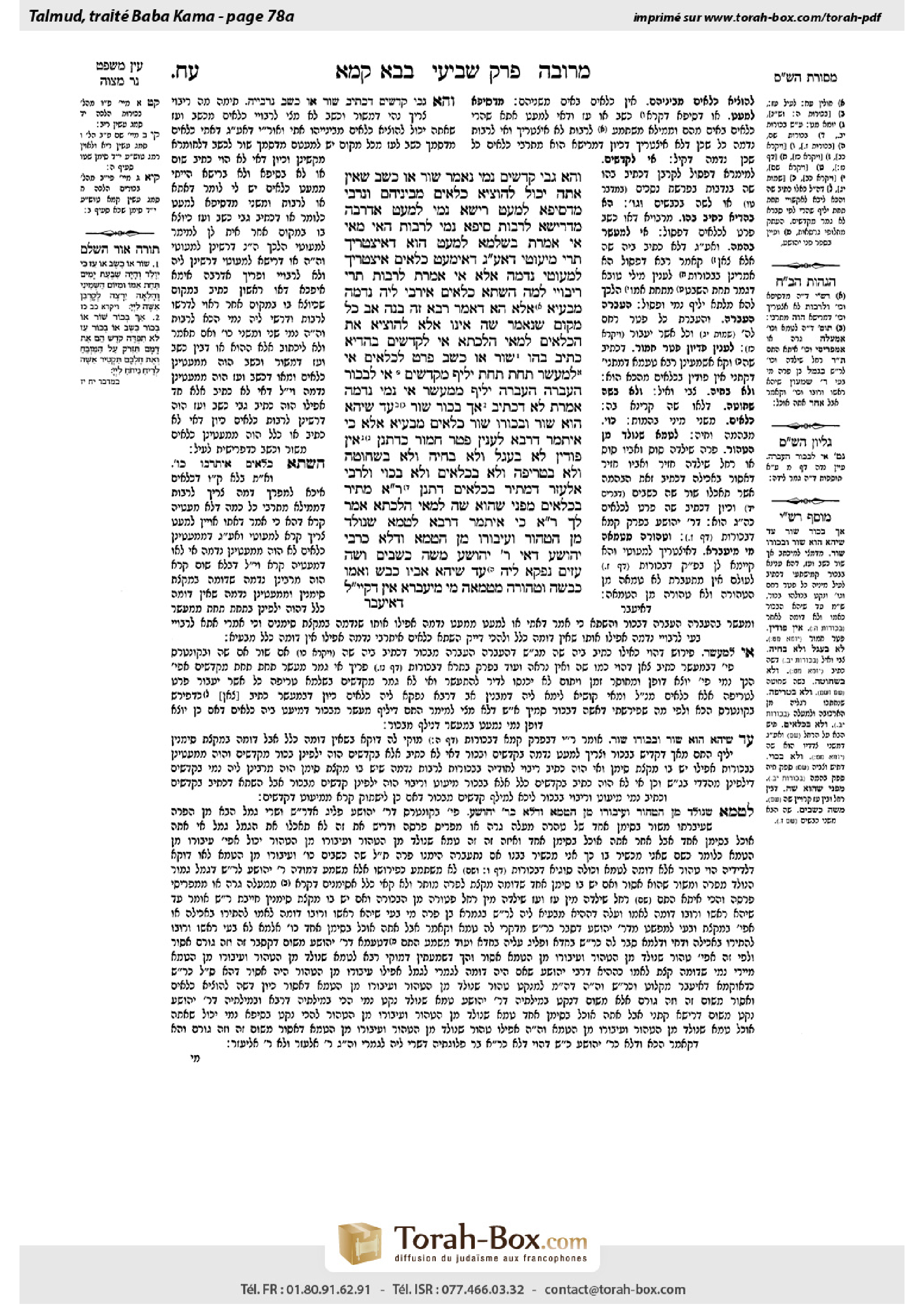
Bava Kamma 78a: Talmud study for Daf Yomi
Study the Talmud for Daf Yomi with scanned pages, Hebrew text, English translations from Sefaria and AI-generated French translations.
Passage selection and English or AI-generated French translation are available where the scan has annotations. Daf Study is independent of Torah-Box and Sefaria.
Browse Bava Kamma · בבא קמא · All tractatesBava Kamma 78a text and translations
This page of Bava Kamma includes the Aramaic text, an English translation and an AI-generated French translation, alongside the scan above.
בבא קמא ע״ח א · Aramaic and Hebrew text
הָא גַּבֵּי קֳדָשִׁים נָמֵי נֶאֱמַר: ״שׁוֹר אוֹ כֶשֶׂב״ – שֶׁאֵין אַתָּה יָכוֹל לְהוֹצִיא כִּלְאַיִם מִבֵּינֵיהֶם, וּנְרַבֵּי! מִדְּסֵיפָא לְמַעֵט, רֵישָׁא נָמֵי לְמַעֵט. אַדְּרַבָּה; מִדְּרֵישָׁא לְרַבּוֹת, סֵיפָא נָמֵי לְרַבּוֹת!
הַאי מַאי? אִי אָמְרַתְּ בִּשְׁלָמָא לְמַעֵט – הוּא דְּאִיצְטְרִיךְ תְּרֵי מִיעוּטֵי; דְּאַף עַל גַּב דְּאִימַּעַט כִּלְאַיִם, אִיצְטְרִיךְ לְמַעוֹטֵי נִדְמֶה. אֶלָּא אִי אָמְרַתְּ לְרַבּוֹת – תְּרֵי רִיבּוּיֵי לְמָה? הַשְׁתָּא כִּלְאַיִם אִירַבִּי לֵיהּ, נִדְמֶה מִבַּעְיָא?!
אֶלָּא הָא דְּאָמַר רָבָא: זֶה בָּנָה אָב – כׇּל מָקוֹם שֶׁנֶּאֱמַר ״שֶׂה״, אֵינוֹ אֶלָּא לְהוֹצִיא אֶת הַכִּלְאַיִם; לְמַאי הִלְכְתָא? אִי לְקָדָשִׁים, בְּהֶדְיָא כְּתִיב בְּהוּ ״שׁוֹר אוֹ כֶשֶׂב״ – פְּרָט לְכִלְאַיִם!
אִי לְמַעֲשֵׂר, ״תַּחַת״–״תַּחַת״ יָלֵיף, מִקֳּדָשִׁים!
אִי לִבְכוֹר, ״הַעֲבָרָה״–״הַעֲבָרָה״ יָלֵיף, מִמַּעֲשֵׂר!
אִי נָמֵי, נִדְמֶה אָמְרַתְּ לָא – דִּכְתִיב: ״אַךְ בְּכוֹר שׁוֹר״ – עַד שֶׁיְּהֵא הוּא שׁוֹר וּבְכוֹרוֹ שׁוֹר; כִּלְאַיִם מִבַּעְיָא?
אֶלָּא כִּי אִיתְּמַר דְּרָבָא – לְעִנְיַן פֶּטֶר חֲמוֹר. כְּדִתְנַן: אֵין פּוֹדִין לֹא בְּעֵגֶל וְלֹא בְּחַיָּה וְלֹא בִּשְׁחוּטָה וְלֹא בִּטְרֵיפָה וְלֹא בְּכִלְאַיִם וְלֹא בְּכוֹי.
וּלְרַבִּי אֶלְעָזָר דְּמַתִּיר בְּכִלְאַיִם – דִּתְנַן: רַבִּי אֶלְעָזָר מַתִּיר בְּכִלְאַיִם מִפְּנֵי שֶׁהוּא שֶׂה, לְמַאי הִלְכְתָא?
אָמַר לָךְ רַבִּי אֶלְעָזָר: כִּי אִיתְּמַר דְּרָבָא – לְטָמֵא שֶׁנּוֹלַד מִן הַטָּהוֹר וְעִיבּוּרוֹ מִן הַטָּמֵא, וּדְלָא כְּרַבִּי יְהוֹשֻׁעַ; דְּאִי רַבִּי יְהוֹשֻׁעַ, מִ״שֵּׂה כְשָׂבִים וְשֵׂה עִזִּים״ נָפְקָא לֵיהּ – עַד שֶׁיְּהֵא אָבִיו כֶּבֶשׂ וְאִמּוֹ כִּבְשָׂה.
וּטְהוֹרָה מִטְּמֵאָה מִי מִיעַבְּרָא?! אִין; דְּקַיְימָא לַן
Bava Kamma 78a · English translation
The Gemara asks: But with regard to sacrificial animals it is also stated in the first part of the verse: “A bull or a sheep” (Leviticus 22:27), which are two animals from which you cannot produce diverse kinds. And accordingly, let us include an animal of diverse kinds as being fit for sacrifice on the altar on that account. The Gemara answers: From the fact that the latter clause of the verse: “Or a goat,” serves to exclude a type of animal from being fit for sacrifice on the altar, it may be inferred that the first clause: “A bull or a sheep,” also serves to exclude a type of animal from being fit for sacrifice on the altar. The Gemara asks: On the contrary, one could equally argue that from the fact that the first clause of the verse serves to include a type of animal as being fit for sacrifice on the altar, the latter clause also serves to include a type of animal as being fit for sacrifice on the altar.
The Gemara rejects this argument: What is this comparison? Granted, if you say that both expressions serve to exclude types of animals from being fit for sacrifice on the altar, this is why two exclusions were necessary: One exclusion is referring to diverse kinds and the other is referring to an animal that resembles another species, as even though an animal of diverse kinds is excluded, it was still necessary to exclude an animal that resembles another. But if you say that both phrases serve to include types of animals as being fit for sacrifice on the altar, why are two inclusions required? Now that an animal of diverse kinds has been included, in the first inclusion, is it necessary to say that an animal that resembles another is also included? There is more justification for including an animal that resembles another, whose parentage is entirely of one species, than for including an animal of diverse kinds.
The Gemara has established that when the Torah uses the word seh (Exodus 21:37) in the context of theft it does not serve to exclude animals of diverse kinds. The Gemara asks: If so, what is meant by this statement that Rava says with regard to the verse: “The ox, the seh of a sheep, and the seh of a goat” (Deuteronomy 14:4), that this establishes a paradigm for other cases, teaching that wherever the word seh is stated in the Torah, it serves to exclude only an animal of diverse kinds. With regard to what halakha did Rava state this principle? If this principle is referring to the halakha concerning sacrificial animals, it is written explicitly with regard to them: “A bull or a sheep” (Leviticus 22:27), which, as taught in the aforementioned baraita, serves to exclude diverse kinds.
If this principle is referring to the halakha concerning animal tithe, concerning which it is written: “And all the tithe of the herd or the flock [tzon], any one that passes under the rod, the tenth shall be sacred unto the Lord” (Leviticus 27:32), this principle is not necessary either. The reason is that the exclusion of diverse kinds can be derived by means of a verbal analogy from the term “under” in this verse, and the word “under” in a verse that deals with sacrificial animals: “When a bull, or a sheep, or a goat is born, it shall be seven days under its mother” (Leviticus 22:27). This verbal analogy, from which many halakhot of animal tithe are derived, indicates that diverse kinds are not subject to animal tithe, just as they cannot be used for an offering.
If this principle is referring to firstborn animals, concerning which it is written: “However, the firstborn among animals, which is born as a firstling to the Lord, no man shall sanctify it; whether it be ox or seh, it is the Lord’s” (Leviticus 27:26), it is not necessary in that context either. The reason is that this can be derived by a verbal analogy between the term passing, in the verse: “And you shall cause to pass to the Lord all that open the womb” (Exodus 13:12), and the same term passing, from a verse concerning animal tithe: “And all the tithe of the herd or the flock, any one that passes under the rod, the tenth shall be sacred unto the Lord” (Leviticus 27:32). This verbal analogy teaches that if the firstborn of a ewe or a she-goat is an animal of diverse kinds it is not considered a firstborn with regard to the halakhot of firstborn animals, which means that Rava’s principle is not necessary here.
Alternatively, you must say that an animal that resembles another is not subject to the halakhot of a firstborn, as it is written: “But the firstborn of a bull, or the firstborn of a sheep, or the firstborn of a goat, you shall not redeem; they are holy” (Numbers 18:17). This indicates that the halakhot of the firstborn are not applicable unless the fathering animal is a bull and its firstborn is also a bull. This excludes an animal that resembles another species, rather than its father. Once it is established that an animal that resembles another is not subject to the halakhot of a firstborn, is it necessary for the Torah to state the same with regard to diverse kinds? Since it is evident that firstborn status does not apply to diverse kinds, Rava’s principle is not required here either.
Rather, Rava’s principle was stated with regard to the redemption of a firstborn donkey, concerning which it is written: “And every firstborn of a donkey you shall redeem with a seh” (Exodus 13:13), as we learned in a mishna (Bekhorot 12a): One may not redeem a firstborn donkey neither with a calf, nor with a non-domesticated animal, nor with a slaughtered animal, nor with a tereifa animal, nor with diverse kinds, i.e., a sheep-goat hybrid, nor with a koy. Rava’s principle is referring to the source for the prohibition against using an animal of diverse kinds for the redemption of a firstborn donkey.
The Gemara asks: But what about according to the opinion of Rabbi Elazar, who disagrees with this ruling and permits the use of an animal of diverse kinds for the redemption of a firstborn donkey? As we learned in the same mishna: Rabbi Elazar permits diverse kinds for use in the redemption of a firstborn donkey because it is considered a seh. Accordingly, with regard to what halakha is Rava’s principle relevant?
Rabbi Elazar could have said to you: Rava’s principle was stated with regard to a non-kosher animal that was born from a kosher mother, whose impregnation was from a non-kosher animal. Rava is saying that this animal is not kosher. And this is not in accordance with the opinion of Rabbi Yehoshua, as, if it were in accordance with the opinion of Rabbi Yehoshua, although he would agree with this halakha, he derives this halakha (see Bekhorot 7a) from the phrase: “The seh of sheep [kevasim], and the seh of goats [izzim]” (Deuteronomy 14:4). The plural forms “kevasim” and “izzim” indicate that a lamb is not kosher unless both its father is a sheep and its mother is a ewe, and the same halakha applies to a kid.
The Gemara asks with regard to the case under discussion: But can a kosher animal become impregnated by a non-kosher animal in the first place? Is it even possible for this to occur? Why did Rabbi Yehoshua and Rava have to find a biblical source to deem this offspring as non-kosher? The Gemara answers: Yes, it is possible. As we maintain elsewhere (Bekhorot 7a)
Bava Kamma 78a · Traduction française (IA)
La Guemara pose la question : Mais concernant les animaux sacrifiés, il est également dit dans la première partie de la phrase : « Un taureau ou une brebis » (Lévitique 22:27), qui sont deux animaux dont on ne peut pas produire des espèces différentes. Et ainsi, permettons qu'un animal d'espèce différente soit considéré comme propre à l'offrande sur l'autel à cause de cela. La Guemara répond : D'après le fait que la seconde partie de la phrase : « Ou un bouc », sert à exclure un type d'animal de la propreté à l'offrande sur l'autel, on peut en déduire que la première partie : « Un taureau ou une brebis », sert également à exclure un type d'animal de la propreté à l'offrande sur l'autel. La Guemara pose la question : Au contraire, on pourrait aussi bien argumenter que d'après le fait que la première partie de la phrase sert à inclure un type d'animal comme propre à l'offrande sur l'autel, la seconde partie sert également à inclure un type d'animal comme propre à l'offrande sur l'autel.
La Guemara rejette cet argument : Quel est ce parallèle ? Bien que, si l'on dit que les deux expressions servent à exclure des types d'animaux de la propreté à l'offrande sur l'autel, c'est pourquoi deux exclusions étaient nécessaires : une exclusion concerne les espèces différentes et l'autre concerne un animal ressemblant à une autre espèce, car même si un animal d'espèce différente est exclu, il était nécessaire d'exclure un animal ressemblant à une autre espèce. Mais si l'on dit que les deux phrases servent à inclure des types d'animaux comme propres à l'offrande sur l'autel, pourquoi deux inclusions sont-elles nécessaires ? Maintenant que l'animal d'espèce différente a été inclus dans la première inclusion, est-il nécessaire de dire que l'animal ressemblant à une autre espèce est également inclus ? Il y a plus de justification pour inclure un animal ressemblant à une autre espèce, dont la parenté est entièrement d'une espèce, que pour inclure un animal d'espèce différente.
La Guemara a établi que lorsque la Torah utilise le mot « seh » (Ex 21:37) dans le contexte du vol, cela ne sert pas à exclure les animaux d'espèce différente. La Guemara pose la question : Si c'est ainsi, à quoi fait référence cette déclaration que Rava fait concernant la phrase : « L'ox, le seh de la brebis, et le seh du bouc » (Dt 14:4), qui établit un modèle pour d'autres cas, enseignant que partout où le mot « seh » est mentionné dans la Torah, il sert à exclure uniquement un animal d'espèce différente. Concernant quelle halakha Rava a-t-il formulé ce principe ? Si ce principe concerne la halakha concernant les animaux sacrés, il est écrit explicitement concernant eux : « Un taureau ou une brebis » (Lévitique 22:27), qui, comme enseigné dans la baraïta mentionnée précédemment, sert à exclure les espèces différentes.
Si ce principe concerne la halakha concernant l'offrande de dîme, concernant laquelle il est écrit : « Et toute l'offrande du troupeau ou de la basse-cour [tzon], toute bête qui passe sous le bâton, le dixième sera consacré au Seigneur » (Lévitique 27:32), ce principe n'est pas nécessaire non plus. La raison est que l'exclusion des espèces différentes peut être déduite par analogie verbale du terme « sous » dans cette phrase et du mot « sous » dans une phrase concernant les animaux sacrés : « Quand un taureau, ou une brebis, ou un bouc est né, il sera sept jours sous sa mère » (Lévitique 22:27). Cette analogie verbale, à partir de laquelle sont déduits nombreux halakhot concernant l'offrande de dîme, indique que les espèces différentes ne sont pas soumises à l'offrande de dîme, tout comme elles ne peuvent pas être utilisées pour une offrande.
Si ce principe concerne les premiers-nés, concernant lesquels il est écrit : « Cependant, le premier-né des animaux, qui est né comme premier-né au Seigneur, aucun homme ne doit le sanctifier ; qu'il soit un taureau ou une chèvre, c'est au Seigneur » (Lévitique 27:26), il n'est pas nécessaire non plus dans ce contexte. La raison est que cela peut être déduit par analogie verbale entre le terme « passer », dans la phrase : « Et tu feras passer au Seigneur tout ce qui ouvre le ventre » (Ex 13:12), et le même terme « passer », dans une phrase concernant l'offrande de dîme : « Et toute l'offrande du troupeau ou de la basse-cour, toute bête qui passe sous le bâton, le dixième sera consacré au Seigneur » (Lévitique 27:32). Cette analogie verbale enseigne que si le premier-né d'une brebis ou d'une chèvre est un animal d'espèce différente, il n'est pas considéré comme un premier-né concernant les halakhot des premiers-nés, ce qui signifie que le principe de Rava n'est pas nécessaire ici.
Autrement, vous devez dire qu'un animal ressemblant à un autre n'est pas soumis aux halakhot des premiers-nés, car il est écrit : « Mais le premier-né d'un taureau, ou le premier-né d'une brebis, ou le premier-né d'un bouc, tu ne dois pas racheter ; ils sont saints » (Nb 18:17). Cela indique que les halakhot des premiers-nés ne s'appliquent pas à moins que l'animal père soit un taureau et son premier-né soit également un taureau. Cela exclut un animal ressemblant à une autre espèce, plutôt que son père. Une fois établi que l'animal ressemblant à une autre espèce n'est pas soumis aux halakhot des premiers-nés, est-il nécessaire que la Torah énonce la même chose concernant les espèces différentes ? Puisque cela est évident que le statut de premier-né ne s'applique pas aux espèces différentes, le principe de Rava n'est pas nécessaire ici non plus.
Au contraire, le principe de Rava a été formulé concernant le rachat du premier-né d'une ânesse, concernant lequel il est écrit : « Et tout premier-né d'une ânesse, tu le rachèteras avec un seh » (Exode 13:13), comme nous l'avons appris dans une mitsva (Bekhorot 12a) : On ne peut pas racheter un premier-né d'une ânesse ni avec un veau, ni avec un animal sauvage, ni avec un animal tué, ni avec un animal téréf, ni avec des espèces différentes, c'est-à-dire un mélange brebis-bouc, ni avec un koy. Le principe de Rava fait référence à la source de l'interdiction d'utiliser un animal d'espèce différente pour le rachat d'un premier-né d'une ânesse.
La Guemara pose la question : Mais qu'en est-il selon l'opinion de Rabbi Eléazar, qui s'oppose à cette décision et permet l'utilisation d'un animal d'espèce différente pour le rachat d'un premier-né d'une ânesse ? Comme nous l'avons appris dans la même mitsva : Rabbi Eléazar permet les espèces différentes pour l'utilisation dans le rachat d'un premier-né d'une ânesse car il est considéré comme un seh. Ainsi, concernant quelle halakha le principe de Rava est-il pertinent ?
Rabbi Elazar aurait pu dire à l'audience : Le principe de Rava a été énoncé concernant un animal non-kosher né d'une mère kosher, dont la conception provient d'un animal non-kosher. Rava affirme que cet animal n'est pas kosher. Et cela ne correspond pas à l'opinion de Rabbi Yéhoshua, car, si cela correspondait à son opinion, bien qu'il accepterait cette halakha, il en déduirait celle-ci (comme dans Bekhorot 7a) à partir de la phrase : « Le seh des brebis [kevasim], et le seh des chèvres [izzim] » (Deutéronome 14:4). Les formes plurales « kevasim » et « izzim » indiquent que l'agneau n'est pas kosher à moins que son père soit une brebis et sa mère une agnelle, et la même halakha s'applique à un petit chèvre.
Le Guemara pose la question concernant le cas en discussion : Mais peut un animal kosher être impregné par un animal non-kosher en premier lieu ? Est-il même possible que cela se produise ? Pourquoi Rabbi Yéhoshua et Rava ont-ils dû trouver une source biblique pour déclarer cet enfant non-kosher ? Le Guemara répond : Oui, cela est possible. Comme nous le maintenons ailleurs (Bekhorot 7a).
Traduction française générée par IA à partir de l’édition anglaise de Sefaria. Vérifie toujours un passage avec le texte source.
Text from Sefaria: William Davidson Edition - Vocalized Aramaic (CC BY NC); William Davidson Edition - English (CC BY NC).