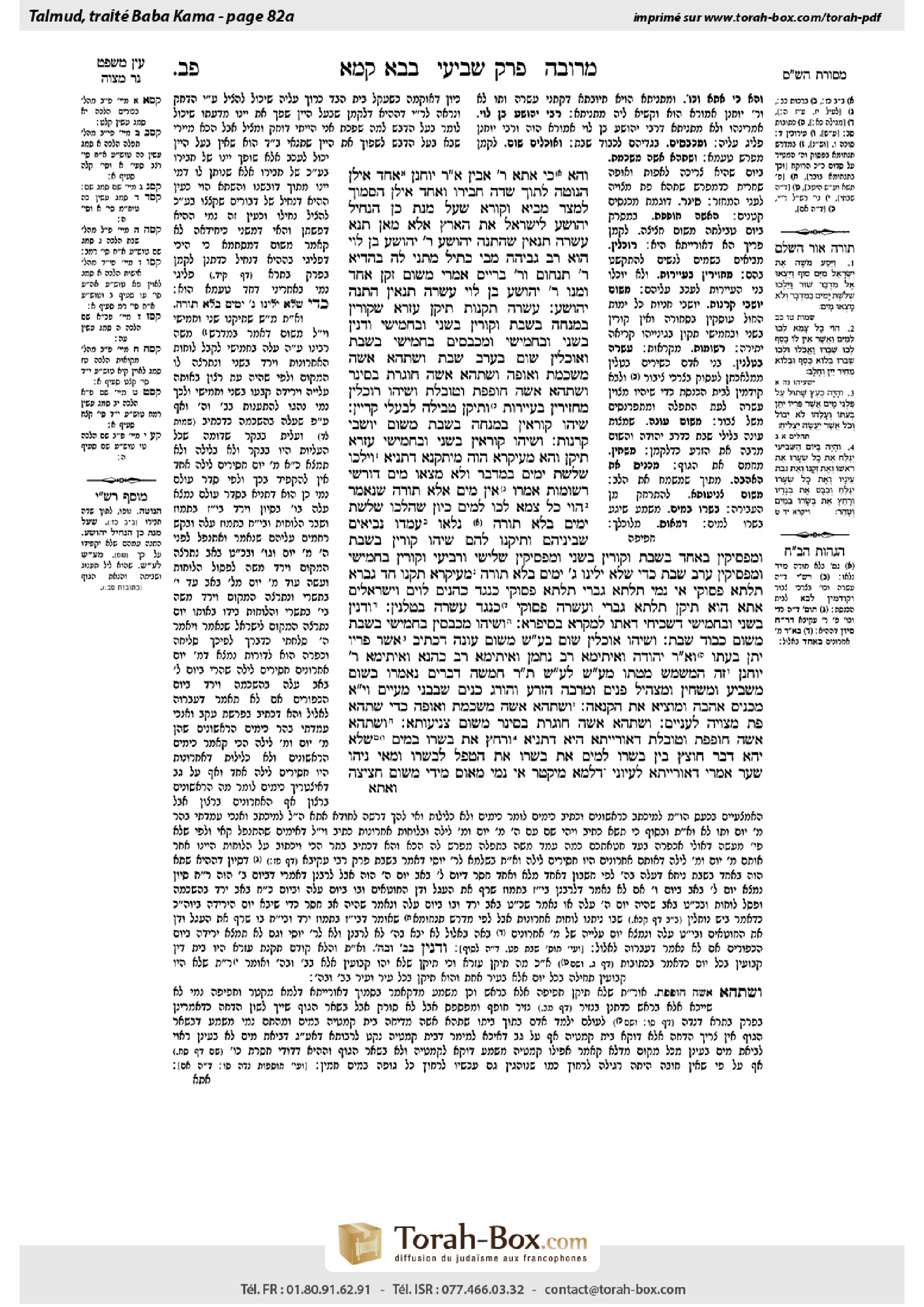
Bava Kamma 82a: Talmud study for Daf Yomi
Study the Talmud for Daf Yomi with scanned pages, Hebrew text, English translations from Sefaria and AI-generated French translations.
Passage selection and English or AI-generated French translation are available where the scan has annotations. Daf Study is independent of Torah-Box and Sefaria.
Browse Bava Kamma · בבא קמא · All tractatesBava Kamma 82a text and translations
This page of Bava Kamma includes the Aramaic text, an English translation and an AI-generated French translation, alongside the scan above.
בבא קמא פ״ב א · Aramaic and Hebrew text
וְהָא כִּי אֲתָא רַבִּי אָבִין אָמַר רַבִּי יוֹחָנָן: אֶחָד אִילָן הַנּוֹטֶה לְתוֹךְ שְׂדֵה חֲבֵירוֹ, וְאֶחָד אִילָן הַסָּמוּךְ לַמֶּצֶר – מֵבִיא וְקוֹרֵא, שֶׁעַל מְנָת כֵּן הִנְחִיל יְהוֹשֻׁעַ לְיִשְׂרָאֵל אֶת הָאָרֶץ!
אֶלָּא מַאן תָּנָא עֲשָׂרָה תְּנָאִין שֶׁהִתְנָה יְהוֹשֻׁעַ – רַבִּי יְהוֹשֻׁעַ בֶּן לֵוִי הוּא. רַב גְּבִיהָה מִבֵּי כְתִיל מַתְנֵי לַהּ בְּהֶדְיָא: רַבִּי תַּנְחוּם וְרַבִּי בִּרְיָיס אָמְרִי מִשּׁוּם זָקֵן אֶחָד, וּמַנּוּ – רַבִּי יְהוֹשֻׁעַ בֶּן לֵוִי; עֲשָׂרָה תְּנָאִין הִתְנָה יְהוֹשֻׁעַ.
עֲשָׂרָה תַּקָּנוֹת תִּיקֵּן עֶזְרָא: שֶׁקּוֹרִין בַּמִּנְחָה בַּשַּׁבָּת; וְקוֹרִין בְּשֵׁנִי וּבַחֲמִישִׁי; וְדָנִין בְּשֵׁנִי וּבַחֲמִישִׁי; וּמְכַבְּסִים בַּחֲמִישִׁי בַּשַּׁבָּת; וְאוֹכְלִין שׁוּם בְּעֶרֶב שַׁבָּת; וְשֶׁתְּהֵא אִשָּׁה מַשְׁכֶּמֶת וְאוֹפָה; וְשֶׁתְּהֵא אִשָּׁה חוֹגֶרֶת בְּסִינָר; וְשֶׁתְּהֵא אִשָּׁה חוֹפֶפֶת וְטוֹבֶלֶת; וְשֶׁיְּהוּ רוֹכְלִין מַחֲזִירִין בָּעֲיָירוֹת; וְתִיקֵּן טְבִילָה לְבַעֲלֵי קְרָיִין.
שֶׁיְּהוּ קוֹרְאִין בַּמִּנְחָה בַּשַּׁבָּת – מִשּׁוּם יוֹשְׁבֵי קְרָנוֹת.
וְשֶׁיְּהוּ קוֹרְאִין בְּשֵׁנִי וּבַחֲמִישִׁי – עֶזְרָא תִּיקֵּן?! וְהָא מֵעִיקָּרָא הֲוָה מִיתַּקְנָא! דְּתַנְיָא: ״וַיֵּלְכוּ שְׁלֹשֶׁת יָמִים בַּמִּדְבָּר וְלֹא מָצְאוּ מָיִם״ – דּוֹרְשֵׁי רְשׁוּמוֹת אָמְרוּ: אֵין מַיִם אֶלָּא תּוֹרָה, שֶׁנֶּאֱמַר: ״הוֹי כׇּל צָמֵא לְכוּ לַמַּיִם״.
כֵּיוָן שֶׁהָלְכוּ שְׁלֹשֶׁת יָמִים בְּלֹא תּוֹרָה, נִלְאוּ, עָמְדוּ נְבִיאִים שֶׁבֵּינֵיהֶם וְתִיקְּנוּ לָהֶם שֶׁיְּהוּ קוֹרִין בַּשַּׁבָּת, וּמַפְסִיקִין בְּאֶחָד בַּשַּׁבָּת, וְקוֹרִין בְּשֵׁנִי, וּמַפְסִיקִין שְׁלִישִׁי וּרְבִיעִי, וְקוֹרִין בַּחֲמִישִׁי, וּמַפְסִיקִין עֶרֶב שַׁבָּת, כְּדֵי שֶׁלֹּא יָלִינוּ שְׁלֹשָׁה יָמִים בְּלֹא תּוֹרָה.
מֵעִיקָּרָא תִּקְּנוּ חַד גַּבְרָא – תְּלָתָא פְּסוּקֵי, אִי נָמֵי תְּלָתָא גַּבְרֵי – תְּלָתָא פְּסוּקֵי, כְּנֶגֶד כֹּהֲנִים לְוִיִּם וְיִשְׂרְאֵלִים; אֲתָא הוּא, תַּיקֵּן תְּלָתָא גַּבְרֵי וְעַשְׂרָה פְּסוּקֵי, כְּנֶגֶד עֲשָׂרָה בַּטְלָנִין.
וְדָנִין בְּשֵׁנִי וּבַחֲמִישִׁי – דִּשְׁכִיחִי, דְּאָתוּ לְמִקְרֵא בְּסִיפְרָא.
וְשֶׁיְּהוּ מְכַבְּסִין בַּחֲמִישִׁי בַּשַּׁבָּת – מִשּׁוּם כְּבוֹד שַׁבָּת.
וְשֶׁיְּהוּ אוֹכְלִין שׁוּם בְּעֶרֶב שַׁבָּת – מִשּׁוּם עוֹנָה; דִּכְתִיב: ״אֲשֶׁר פִּרְיוֹ יִתֵּן בְּעִתּוֹ״, וְאָמַר רַבִּי יְהוּדָה, וְאִיתֵּימָא רַב נַחְמָן, וְאִיתֵּימָא רַב כָּהֲנָא, וְאִיתֵּימָא רַבִּי יוֹחָנָן: זֶה הַמְשַׁמֵּשׁ מִטָּתוֹ מֵעֶרֶב שַׁבָּת לְעֶרֶב שַׁבָּת.
תָּנוּ רַבָּנַן, חֲמִשָּׁה דְּבָרִים נֶאֶמְרוּ בַּשּׁוּם: מַשְׂבִּיעַ, וּמַשְׁחִין, וּמַצְהִיל פָּנִים, וּמַרְבֶּה הַזֶּרַע, וְהוֹרֵג כִּנִּים שֶׁבִּבְנֵי מֵעַיִים. וְיֵשׁ אוֹמְרִים: מַכְנִיס אַהֲבָה וּמוֹצִיא אֶת הַקִּנְאָה.
וְשֶׁתְּהֵא אִשָּׁה מַשְׁכֶּמֶת וְאוֹפָה – כְּדֵי שֶׁתְּהֵא פַּת מְצוּיָה לַעֲנִיִּים.
וְשֶׁתְּהֵא אִשָּׁה חוֹגֶרֶת בְּסִינָר – מִשּׁוּם צְנִיעוּתָא.
וְשֶׁתְּהֵא אִשָּׁה חוֹפֶפֶת וְטוֹבֶלֶת – דְּאוֹרָיְיתָא הִיא!
דְּתַנְיָא: ״וְרָחַץ אֶת בְּשָׂרוֹ בַּמַּיִם״ – שֶׁלֹּא יְהֵא דָּבָר חוֹצֵץ בֵּין בְּשָׂרוֹ לַמַּיִם. ״אֶת בְּשָׂרוֹ״ – אֶת הַטָּפֵל לִבְשָׂרוֹ, וּמַאי נִיהוּ – שֵׂעָר!
אָמְרִי: דְּאוֹרָיְיתָא – לְעַיּוֹנֵי דִּלְמָא מִיקְּטַר, אִי נָמֵי מְאַוַּס מִידֵּי, מִשּׁוּם חֲצִיצָה;
Bava Kamma 82a · English translation
The Gemara further questions the number of Joshua’s stipulations: But when Rabbi Avin came from Eretz Yisrael he said that Rabbi Yoḥanan says: With regard to both a tree that leans into the field of another and a tree that is close to a boundary with another field, the owner of the tree brings the first fruits of the tree and recites the accompanying declaration, as described in Deuteronomy 26:5–10, as it was on this condition that Joshua apportioned Eretz Yisrael to the Jewish people. This is an additional stipulation by Joshua, which means that there are more than ten.
The Gemara answers: Rather, who is the one who taught the baraita that deals with the ten conditions that Joshua stipulated? It is Rabbi Yehoshua ben Levi, an amora. Therefore, Rabbi Yoḥanan, another amora, can disagree with it. Rav Geviha from Bei Katil teaches this explicitly in his version of the baraita: Rabbi Tanḥum and Rabbi Berayes say in the name of a certain elder, and who is that elder? It is Rabbi Yehoshua ben Levi: Joshua stipulated ten conditions.
§ The Sages taught that Ezra the Scribe instituted ten ordinances: He instituted that communities read the Torah on Shabbat in the afternoon; and they also read the Torah on every Monday and Thursday; and the courts convene and judge every Monday and Thursday; and one does laundry on Thursday; and one eats garlic on Shabbat eve. And Ezra further instituted that a woman should rise early and bake bread on those days when she wants to bake; and that a woman should don a breechcloth; and that a woman should first comb her hair and only then immerse in a ritual bath after being ritually impure; and that peddlers of cosmetics and perfumes should travel around through all the towns. And Ezra further instituted the requirement of immersion for those who experienced a seminal emission.
The Gemara analyzes these ordinances, the first of which is that communities shall read the Torah on Shabbat afternoon. This Gemara explains that this ordinance was instituted due to those who sit idly on street corners, who do not attend the synagogue during the week.
The Gemara discusses the second of Ezra’s ordinances: And that they should read the Torah on every Monday and Thursday. The Gemara asks: Did Ezra institute this practice? But it was instituted from the beginning, i.e., long before his time. As it is taught in a baraita with regard to the verse: “And Moses led Israel onward from the Red Sea, and they went out into the wilderness of Shur; and they went three days in the wilderness, and found no water” (Exodus 15:22). Those who interpret verses metaphorically said that water here is referring to nothing other than Torah, as it is stated metaphorically, concerning those who desire wisdom: “Ho, everyone who thirsts, come for water” (Isaiah 55:1).
The baraita continues: The verse means that since the Jews traveled for three days without hearing any Torah they became weary, and therefore the prophets among them arose and instituted for them that they should read from the Torah each Shabbat, and pause on Sunday, and read again on Monday, and pause on Tuesday and Wednesday, and read again on Thursday, and pause on Shabbat eve, so they would not tarry three days without hearing the Torah. Evidently this practice predates Ezra.
The Gemara answers: Initially they instituted that one man read three verses; or alternatively, that three men read three verses. Either way, the number three corresponds to the three types of Jews: Priests, Levites, and Israelites. Ezra later came and instituted that three men always read, and that ten verses altogether be read by them, corresponding to the ten idlers in a city, i.e., the ten men who are paid to spend their time dealing with synagogue and communal matters.
The next ordinance of Ezra is: And the courts convene and judge every Monday and Thursday. The Gemara explains that the reason for this ordinance is that many people are found in a city on these days, as they come from the countryside for the reading of the holy book, the Torah, which is performed on Mondays and Thursdays, as stated above.
The baraita teaches: And that one should do laundry on Thursday. This was instituted due to the need to have clean garments in deference to Shabbat.
The Gemara explains the next listed ordinance: And that one should eat garlic Shabbat eve. This is due to the fact that garlic enhances sexual potency, and Friday night is an appropriate time for conjugal relations. As it is written concerning the righteous: “And he shall be like a tree planted by streams of water, who brings forth his fruit in his season” (Psalms 1:3); and Rabbi Yehuda says, and some say it was Rav Naḥman, and some say it was Rav Kahana, and some say it was Rabbi Yoḥanan who said: This is referring to one who engages in sexual intercourse every Shabbat eve.
The Sages taught in a baraita that five matters were stated with regard to garlic: It satisfies; it warms the body; it causes one’s countenance to shine; it increases one’s sperm, and it kills lice that are in the intestines. And some say that it also instills love into those who eat it and removes jealousy from them.
The next ordinance is: And that a woman should rise early and bake bread on those days when she bakes. This Gemara explains that this was instituted so that bread should be available for poor people, who go begging for bread in the mornings.
The baraita further teaches: And that a woman should don a breechcloth [sinar]. This ordinance was instituted due to reasons of modesty.
The baraita adds: And that a woman should first comb her hair and only then immerse in a ritual bath. This is to ensure that there is no dirt or other substance in the hair that would invalidate the immersion. The Gemara questions this: This is required by Torah law, Ezra did not institute this.
As it is taught in a baraita, concerning a verse that discusses one who must undergo ritual immersion: “And he shall bathe his flesh [et besaro] in water” (Leviticus 14:9). This verse teaches that no substance should interpose between his flesh and the water. When the verse states this in the expanded form of “et his flesh,” using the term “et,” this teaches that the water must come into contact even with that which is subordinate to his flesh. And what is that? It is one’s hair. Accordingly, the Torah itself states that there may not be any interposing substance in the hair at the time of immersion. What, then, did Ezra add?
The Sages say in response: By Torah law one is required to inspect his or her hair before immersion, as perhaps some hairs are knotted together, preventing contact with water at that spot, or perhaps there is some repulsive substance in his hair. One must perform this inspection because these would constitute an interposition.
Bava Kamma 82a · Traduction française (IA)
La Guemara pose une autre question sur le nombre des stipulations de Josué : Mais lorsque le Rabbi Avin est revenu d’Eretz Yisrael, il a dit que Rabbi Yoḥanan dit : Concernant à la fois un arbre qui penche sur la propriété d’un autre et un arbre proche d’une limite entre deux champs, l’propriétaire de l’arbre apporte les premiers fruits de l’arbre et récite la déclaration accompagnante, comme décrit dans Deutéronome 26 : 5–10, car c’est sur cette condition que Josué a divisé Eretz Yisrael au peuple juif. C’est une autre stipulation de Josué, ce qui signifie qu’il y a plus de dix.
La Guemara répond : Plutôt, qui est celui qui a enseigné la baraïta concernant les dix conditions stipulées par Josué ? C’est Rabbi Yéhoshua ben Levi, un amora. Par conséquent, Rabbi Yoḥanan, un autre amora, peut avoir un avis différent. Rav Geviha de Bei Katil enseigne cela explicitement dans sa version de la baraïta : Rabbi Tanḥum et Rabbi Berayes disent en nom d’un certain vieillard, et qui est ce vieillard ? C’est Rabbi Yéhoshua ben Levi : Josué a stipulé dix conditions.
§ Les Sages ont enseigné que Ezra le Scribe a institué dix ordonnances : Il a institué que les communautés lisent la Torah le soir du Shabbat ; et elles lisent également la Torah chaque lundi et chaque jeudi ; et les tribunaux se réunissent et jugent chaque lundi et chaque jeudi ; et l’on fait le linge le jeudi ; et l’on mange de l’ail le soir du Shabbat. Et Ezra a encore institué que la femme doive se lever tôt et faire du pain les jours où elle veut le faire ; et que la femme doive porter un sinal ; et que la femme doive d’abord se coiffer et seulement ensuite se baigner rituellement après avoir été impure ; et que les vendeurs de cosmétiques et de parfums doivent parcourir toutes les villes. Et Ezra a encore institué la nécessité de bain rituel pour ceux qui ont eu une émission sémencière.
La Guemara analyse ces ordonnances, la première étant que les communautés liront la Torah à l’après-midi du Shabbat. Cette Guemara explique que cette ordonnance a été instituée en raison de ceux qui s’assoient inutilement aux coins des rues, qui ne fréquentent pas la synagogue durant la semaine.
La Guemara discute de la deuxième ordonnance d’Ezra : Et qu’ils liront la Torah chaque lundi et chaque jeudi. La Guemara pose la question : Ezra a-t-il institué cette pratique ? Mais elle a été instituée depuis longtemps, c’est-à-dire bien avant sa période. Comme il est enseigné dans une baraïta concernant la verset : « Et Moïse mena Israël hors du Sinaï, et ils sortirent dans le désert de Sur ; et ils marchèrent trois jours dans le désert, et ne trouvèrent point d’eau » (Exode 15 : 22). Ceux qui interprètent les versets métaphoriquement dirent que l’eau ici ne désigne rien d’autre que la Torah, comme il est dit métaphoriquement, concernant ceux qui désirent la sagesse : « Ho, tout celui qui a soif, viens prendre de l’eau » (Yachout 55 : 1).
La baraïta continue : Le verset signifie que puisque les Juifs marchèrent trois jours sans entendre de Torah, ils se fatiguèrent, et donc les prophètes parmi eux se levèrent et instituèrent pour eux que l’on lise de la Torah chaque Shabbat, et qu’on s’arrête le dimanche, et qu’on lise à nouveau le lundi, et qu’on s’arrête le mardi et le mercredi, et qu’on lise à nouveau le jeudi, et qu’on s’arrête le soir du Shabbat, afin qu’ils ne passent pas trois jours sans entendre la Torah. Évidemment cette pratique précède Ezra.
La Guemara répond : Initialement, ils instituèrent que l’un seul lisait trois versets ; ou bien que trois hommes lisaient trois versets. Quel que soit le cas, le nombre trois correspond aux trois types de Juifs : les prêtres, les lévites et les Israélites. Ezra vint ensuite et institua que trois hommes lisaient toujours, et que dix versets ensemble soient lus par eux, correspondant aux dix oisifs d’une ville, c’est-à-dire les dix hommes qui sont payés pour passer leur temps à s’occuper des affaires de la synagogue et de la communauté.
L’ordonnance suivante d’Ezra est : Et les tribunaux se réunissent et jugent chaque lundi et chaque jeudi. La Guemara explique que la raison de cette ordonnance est que beaucoup de personnes sont trouvées dans une ville ces jours-là, car ils viennent des campagnes pour la lecture du livre saint, la Torah, qui est effectuée le lundi et le jeudi, comme mentionné ci-dessus.
La baraïta enseigne : Et qu’on fasse le linge le jeudi. Cela a été institué en raison du besoin d’avoir des vêtements propres en vue du Shabbat.
La Guemara explique l’ordonnance suivante : Et qu’on mange de l’ail le soir du Shabbat. Cela est dû au fait que l’ail améliore la force sexuelle, et que la nuit du vendredi est un moment approprié pour les relations conjugales. Comme il est écrit concernant les justes : « Et il sera comme un arbre planté près des rivières de l’eau, qui produit ses fruits à son temps » (Psaumes 1 : 3) ; et Rabbi Yéhuda dit, et certains disent que c’est Rav Naḥman, et d’autres disent que c’est Rav Kahana, et d’autres disent que c’est Rabbi Yoḥanan qui a dit : Cela fait référence à celui qui engage en relations conjugales chaque soir du Shabbat.
Les Sages ont enseigné dans une baraïta que cinq choses furent dites concernant l’ail : il rassasie ; il réchauffe le corps ; il fait briller le visage ; il augmente le sperme, et il tue les poux qui sont dans les intestins. Et certains disent qu’il instille l’amour chez ceux qui le mangent et qu’il enlève la jalousie de leurs cœurs.
L’ordonnance suivante est : Et que la femme doive se lever tôt et faire du pain les jours où elle fait du pain. Cette Guemara explique que cela a été institué afin que du pain soit disponible pour les pauvres, qui mendient du pain le matin.
La baraïta enseigne de plus : Et que la femme doive porter un sinal. Cette ordonnance a été instituée en raison de raisons de modestie.
La baraïta ajoute : Et que la femme doive d’abord se coiffer et seulement ensuite se baigner rituellement. Cela est pour s’assurer qu’il n’y ait pas de saleté ou d’autre substance dans les cheveux qui pourrait invalider le bain rituel. La Guemara pose une question : Cela est requis par la loi divine, Ezra n’a pas institué cela.
Comme il est enseigné dans une baraïta, concernant un verset qui parle d'une personne qui doit subir une immersion rituelle : « Et il baignera sa chair [et besaro] dans l'eau » (Lévitique 14,9). Ce verset enseigne que rien ne doit interposer entre sa chair et l'eau. Lorsque le verset mentionne cela sous la forme développée de « et sa chair », en utilisant le terme « et », cela enseigne que l'eau doit entrer en contact même avec ce qui est subordonné à sa chair. Et qu'est-ce que cela ? C'est ses cheveux. Ainsi, la Torah elle-même indique qu'il ne doit pas y avoir de substance interposante dans les cheveux lors de l'immersion. Et alors, qu'a ajouté Ezra ?
Les Sages répondent en disant : Selon la loi talmudique, on est tenu d'inspecter ses cheveux avant l'immersion, car peut-être certains cheveux sont noués ensemble, empêchant le contact avec l'eau à cet endroit, ou peut-être il y a quelque chose de répugnant dans ses cheveux. On doit effectuer cette inspection car ces éléments constitueraient une interposition.
Traduction française générée par IA à partir de l’édition anglaise de Sefaria. Vérifie toujours un passage avec le texte source.
Text from Sefaria: William Davidson Edition - Vocalized Aramaic (CC BY NC); William Davidson Edition - English (CC BY NC).