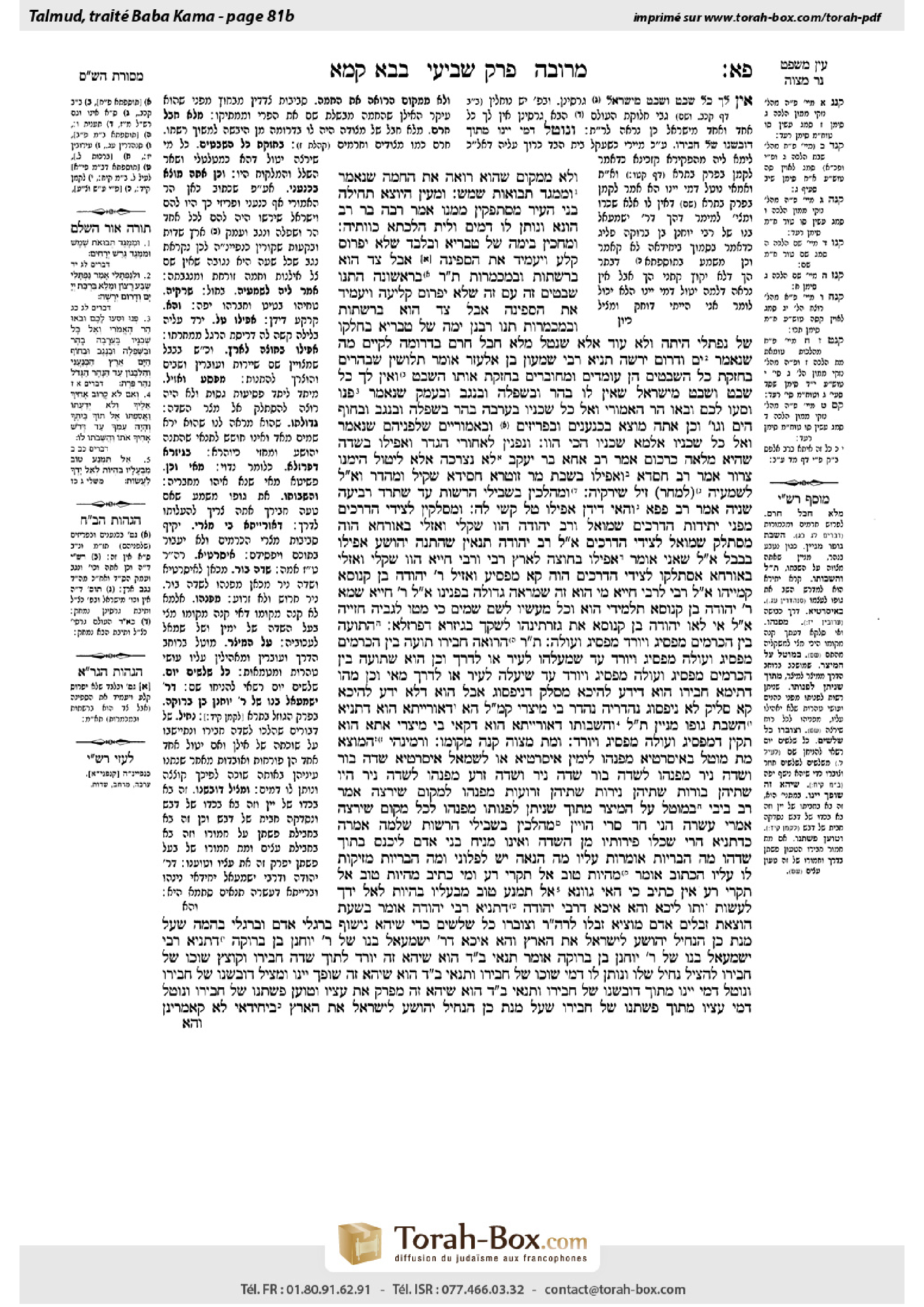
Bava Kamma 81b: Talmud study for Daf Yomi
Study the Talmud for Daf Yomi with scanned pages, Hebrew text, English translations from Sefaria and AI-generated French translations.
Passage selection and English or AI-generated French translation are available where the scan has annotations. Daf Study is independent of Torah-Box and Sefaria.
Browse Bava Kamma · בבא קמא · All tractatesBava Kamma 81b text and translations
This page of Bava Kamma includes the Aramaic text, an English translation and an AI-generated French translation, alongside the scan above.
בבא קמא פ״א ב · Aramaic and Hebrew text
וְלֹא מִמְּקוֹם שֶׁהוּא רוֹאֶה אֶת הַחַמָּה; שֶׁנֶּאֱמַר: ״וּמִמֶּגֶד תְּבוּאֹת שָׁמֶשׁ״.
וּמַעְיָן הַיּוֹצֵא תְּחִילָּה – בְּנֵי הָעִיר מִסְתַּפְּקִין מִמֶּנּוּ. אָמַר רַבָּה בַּר רַב הוּנָא: וְנוֹתֵן לוֹ דָּמִים. וְלֵית הִלְכְתָא כְּווֹתֵיהּ.
וּמְחַכִּין בְּיַמָּהּ שֶׁל טְבֶרְיָא, וּבִלְבַד שֶׁלֹּא יִפְרוֹס קֶלַע וְיַעֲמִיד אֶת הַסְּפִינָה – אֲבָל צָד הוּא בִּרְשָׁתוֹת וּבְמִכְמָרוֹת. תָּנוּ רַבָּנַן: בָּרִאשׁוֹנָה הִתְנוּ שְׁבָטִים זֶה עִם זֶה שֶׁלֹּא יִפְרוֹס קְלִיעָה וְיַעֲמִיד אֶת הַסְּפִינָה, אֲבָל צָד הוּא בִּרְשָׁתוֹת וּבְמִכְמָרוֹת.
תָּנוּ רַבָּנַן: יַמָּהּ שֶׁל טְבֶרְיָא – בְּחֶלְקוֹ שֶׁל נַפְתָּלִי הָיְתָה. וְלֹא עוֹד, אֶלָּא שֶׁנָּטַל מְלֹא חֶבֶל חֵרֶם בִּדְרוֹמָהּ, לְקַיֵּים מַה שֶּׁנֶּאֱמַר ״יָם וְדָרוֹם יְרָשָׁה״.
תַּנְיָא, רַבִּי שִׁמְעוֹן בֶּן אֶלְעָזָר אוֹמֵר: תְּלוּשִׁין שֶׁבֶּהָרִים – בְּחֶזְקַת כׇּל הַשְּׁבָטִים הֵן עוֹמְדִים, וּמְחוּבָּרִים – בְּחֶזְקַת אוֹתוֹ הַשֵּׁבֶט.
וְאֵין לְךָ כׇּל שֵׁבֶט וְשֵׁבֶט מִיִּשְׂרָאֵל שֶׁאֵין לוֹ בָּהָר וּבַשְּׁפֵלָה וּבַנֶּגֶב וּבָעֵמֶק, שֶׁנֶּאֱמַר: ״פְּנוּ וּסְעוּ לָכֶם וּבֹאוּ הַר הָאֱמוֹרִי וְאֶל כׇּל שְׁכֵנָיו; בָּעֲרָבָה, בָהָר, בַּשְּׁפֵלָה וּבַנֶּגֶב וּבְחוֹף הַיָּם וְגוֹ׳. וְכֵן אַתָּה מוֹצֵא בַּכְּנַעֲנִים וּבַפְּרִיזִּים וּבָאֱמוֹרִיִּים שֶׁלִּפְנֵיהֶם, שֶׁנֶּאֱמַר: ״וְאֶל כׇּל שְׁכֵנָיו״ – אַלְמָא שְׁכֵנָיו הָכִי הָווּ.
וְנִפְנִין לַאֲחוֹרֵי הַגָּדֵר, וַאֲפִילּוּ בְּשָׂדֶה שֶׁהִיא מְלֵאָה כַּרְכּוֹם. אָמַר רַב אַחָא בַּר יַעֲקֹב: לֹא נִצְרְכָה אֶלָּא לִיטּוֹל הֵימֶנּוּ צְרוֹר. אָמַר רַב חִסְדָּא: וַאֲפִילּוּ בְּשַׁבָּת. מָר זוּטְרָא חֲסִידָא שָׁקֵיל וּמַהְדַּר, וַאֲמַר לֵיהּ לְשַׁמָּעֵיהּ (לִמְחַר): זִיל שִׁירְקֵיהּ.
וּמְהַלְּכִין בִּשְׁבִילֵי הָרְשׁוּת, עַד שֶׁתֵּרֵד רְבִיעָה שְׁנִיָּה. אָמַר רַב פָּפָּא: וְהַאי דִּידַן – אֲפִילּוּ טַל קָשֵׁי לֵהּ.
וּמְסַלְּקִין לְצִידֵּי הַדְּרָכִים, מִפְּנֵי יְתֵידוֹת הַדְּרָכִים. שְׁמוּאֵל וְרַב יְהוּדָה הֲווֹ שָׁקְלִי וְאָזְלִי בְּאוֹרְחָא, הֲוָה מִסְתַּלַּק שְׁמוּאֵל לְצִידֵּי הַדְּרָכִים. אֲמַר לֵיהּ רַב יְהוּדָה: תְּנָאִין שֶׁהִתְנָה יְהוֹשֻׁעַ, אֲפִילּוּ בְּבָבֶל?! אֲמַר לֵיהּ: שֶׁאֲנִי אוֹמֵר, אֲפִילּוּ בְּחוּצָה לָאָרֶץ.
רַבִּי וְרַבִּי חִיָּיא הֲווֹ שָׁקְלִי וְאָזְלִי בְּאוֹרְחָא, אִסְתַּלַּקוּ לְצִידֵּי הַדְּרָכִים. הֲוָה קָא מְפַסַּיע וְאָזֵיל רַבִּי יְהוּדָה בֶּן (קְנוֹסָא) [נְקוֹסָא] קַמַּיְיהוּ, אֲמַר לֵיהּ רַבִּי לְרַבִּי חִיָּיא: מִי הוּא זֶה שֶׁמַּרְאֶה גְּדוּלָּה בְּפָנֵינוּ?
אֲמַר לֵיהּ רַבִּי חִיָּיא: שֶׁמָּא רַבִּי יְהוּדָה בֶּן (קְנוֹסָא) [נְקוֹסָא] תַּלְמִידִי הוּא, וְכׇל מַעֲשָׂיו לְשֵׁם שָׁמַיִם. כִּי מְטוֹ לְגַבֵּיהּ, חַזְיֵיהּ. אֲמַר לֵיהּ: אִי לָאו יְהוּדָה בֶּן (קְנוֹסָא) [נְקוֹסָא] אַתְּ, גְּזַרְתִּינְהוּ לְשָׁקָךְ בְּגִיזְרָא דְפַרְזְלָא.
הַתּוֹעֶה בֵּין הַכְּרָמִים, מְפַסֵּיג וְיוֹרֵד מְפַסֵּיג וְעוֹלֶה. תָּנוּ רַבָּנַן: הָרוֹאֶה חֲבֵירוֹ תּוֹעֶה בֵּין הַכְּרָמִים, מְפַסֵּיג וְעוֹלֶה מְפַסֵּיג וְיוֹרֵד, עַד שֶׁמַּעֲלֵהוּ לָעִיר אוֹ לַדֶּרֶךְ. וְכֵן הוּא שֶׁתּוֹעֶה בֵּין הַכְּרָמִים, מְפַסֵּיג וְעוֹלֶה מְפַסֵּיג וְיוֹרֵד עַד שֶׁיַּעֲלֶה לָעִיר אוֹ לַדֶּרֶךְ.
מַאי ״וְכֵן״? מַהוּ דְּתֵימָא, חֲבֵירוֹ הוּא דְּיָדַע לְהֵיכָא מְסַלֵּק – דְּנִיפְסוֹג; אֲבָל הוּא, דְּלָא יֵדַע לְהֵיכָא קָא סָלֵיק – לָא נִיפְסוֹג, נַהְדְּרֵיהּ (נֶהְדַּר) [מִהְדָּר] בֵּי מִיצְרֵי; קָא מַשְׁמַע לַן.
הָא דְּאוֹרָיְיתָא הוּא, דְּתַנְיָא: הֲשָׁבַת גּוּפוֹ מִנַּיִין? תַּלְמוּד לוֹמַר: ״וַהֲשֵׁבוֹתוֹ״!
דְּאוֹרָיְיתָא הוּא דְּקָאֵי בֵּי מִיצְרֵי, אֲתָא הוּא תַּקֵּין דִּמְפַסֵּיג וְעוֹלֶה מְפַסֵּיג וְיוֹרֵד.
וּמֵת מִצְוָה קָנָה מְקוֹמוֹ. וּרְמִינְהִי: הַמּוֹצֵא מֵת מוּטָל בְּאִיסְרַטְיָא, מְפַנֵּהוּ לִימִין אִיסְרַטְיָא אוֹ לִשְׂמֹאל אִיסְרַטְיָא. שְׂדֵה בוּר וּשְׂדֵה נִיר – מְפַנֵּהוּ לִשְׂדֵה בוּר.
שְׂדֵה נִיר וּשְׂדֵה זֶרַע – מְפַנֵּהוּ לִשְׂדֵה נִיר. הָיוּ שְׁתֵּיהֶן בּוּרוֹת; שְׁתֵּיהֶן נִירוֹת; שְׁתֵּיהֶן זְרוּעוֹת – מְפַנֵּהוּ לְמָקוֹם שֶׁיִּרְצֶה!
אָמַר רַב בִּיבִי: בְּמוּטָּל עַל הַמֵּיצַר; מִתּוֹךְ שֶׁנִּיתָּן לְפַנּוֹתוֹ, מְפַנֵּהוּ לְכׇל מָקוֹם שֶׁיִּרְצֶה.
אָמְרִי: עֲשָׂרָה?! הָנֵי חַד סְרֵי הָוְיָין! מְהַלְּכִין בִּשְׁבִילֵי הָרְשׁוּת – שְׁלֹמֹה אַמְרַהּ.
כִּדְתַנְיָא: הֲרֵי שֶׁכָּלוּ פֵּירוֹתָיו מִן הַשָּׂדֶה, וְאֵינוֹ מַנִּיחַ בְּנֵי אָדָם לִיכָּנֵס בְּתוֹךְ שָׂדֵהוּ – מָה הַבְּרִיּוֹת אוֹמְרוֹת עָלָיו? מָה הֲנָאָה יֵשׁ לִפְלוֹנִי, וּמָה הַבְּרִיּוֹת מַזִּיקוֹת לוֹ? עָלָיו הַכָּתוּב אוֹמֵר: ״מִהְיוֹת טוֹב אַל תִּקָּרֵי רָע״. וּמִי כְּתִיב: ״מִהְיוֹת טוֹב אַל תִּקָּרֵי רָע״? אִין, כְּתִיב כִּי הַאי גַוְונָא: ״אַל תִּמְנַע טוֹב מִבְּעָלָיו, בִּהְיוֹת לְאֵל יָדְךָ לַעֲשׂוֹת״.
וְתוּ לֵיכָּא? וְהָא אִיכָּא דְּרַבִּי יְהוּדָה – דְּתַנְיָא, רַבִּי יְהוּדָה אוֹמֵר: בִּשְׁעַת הוֹצָאַת זְבָלִים, אָדָם מוֹצִיא זִבְלוֹ לִרְשׁוּת הָרַבִּים, וְצוֹבְרוֹ כׇּל שְׁלֹשִׁים; כְּדֵי שֶׁיְּהֵא נִישּׁוֹף בְּרַגְלֵי אָדָם וּבְרַגְלֵי בְהֵמָה. שֶׁעַל מְנָת כֵּן הִנְחִיל יְהוֹשֻׁעַ לְיִשְׂרָאֵל אֶת הָאָרֶץ!
וְהָא אִיכָּא דְּרַבִּי יִשְׁמָעֵאל בְּנוֹ שֶׁל רַבִּי יוֹחָנָן בֶּן בְּרוֹקָה – דְּתַנְיָא, רַבִּי יִשְׁמָעֵאל בְּנוֹ שֶׁל רַבִּי יוֹחָנָן בֶּן בְּרוֹקָה אוֹמֵר: תְּנַאי בֵּית דִּין הוּא שֶׁיְּהֵא זֶה יוֹרֵד לְתוֹךְ שְׂדֵה חֲבֵירוֹ וְקוֹצֵץ שׂוֹכוֹ שֶׁל חֲבֵירוֹ לְהַצִּיל נְחִיל שֶׁלּוֹ, וְנוֹתֵן לוֹ דְּמֵי שׂוֹכוֹ שֶׁל חֲבֵירוֹ;
וּתְנַאי בֵּית דִּין הוּא שֶׁיְּהֵא זֶה שׁוֹפֵךְ יֵינוֹ וּמַצִּיל דּוּבְשָׁנוֹ שֶׁל חֲבֵירוֹ, וְנוֹטֵל דְּמֵי יֵינוֹ מִתּוֹךְ דּוּבְשָׁנוֹ שֶׁל חֲבֵירוֹ; וּתְנַאי בֵּית דִּין הוּא שֶׁיְּהֵא זֶה מְפָרֵק אֶת עֵצָיו וְטוֹעֵן פִּשְׁתָּנוֹ שֶׁל חֲבֵירוֹ, וְנוֹטֵל דְּמֵי עֵצָיו מִתּוֹךְ פִּשְׁתָּנוֹ שֶׁל חֲבֵירוֹ; שֶׁעַל מְנָת כֵּן הִנְחִיל יְהוֹשֻׁעַ לְיִשְׂרָאֵל אֶת הָאָרֶץ!
בִּיחִידָאֵי לָא קָאָמְרִינַן.
Bava Kamma 81b · English translation
but not from a place that faces the sun, where the fruits grow copiously, as it is stated: “And for the precious things of the fruits of the sun” (Deuteronomy 33:14).
The baraita further states: And the people of the city shall have the right to take supplies of water from a spring on private property, even from a spring that emerges for the first time. Rabba bar Rav Huna says: And although one may draw water from that spring, he must give money to reimburse the owner of the property. The Gemara concludes: But the halakha is not in accordance with his opinion, as the water may be taken without payment.
The next of Joshua’s conditions is: And that they shall have the right to fish in the Sea of Tiberias, provided that the fisherman does not build an underwater fence to catch fish, thereby causing an impediment to boats. The Gemara comments: But one may fish with nets and with traps. The Sages taught in a baraita: Initially, the tribes stipulated with each other that one may not build an underwater fence to catch fish, thereby causing an impediment to boats, but one may fish with nets and with traps.
The Sages taught in a baraita: The Sea of Tiberias was located in the portion of the tribe of Naphtali. Moreover, the tribe of Naphtali received in addition a small stretch of land equal to the full length of the rope of a fish trap. This stretch of land was located to the south of the sea, where the members of this tribe could spread out their fishing nets, to fulfill that which is stated: “And of Naphtali he said: O Naphtali, satisfied with favor, and full with the blessing of the Lord; possess the sea and the south” (Deuteronomy 33:23).
It is taught in a baraita: Rabbi Shimon ben Elazar says: Detached items that are found in the mountains at the time of conquest are considered to be in the possession of all the tribes equally, as spoils of war; but that which is attached, e.g., trees, are considered to be in the sole possession of that tribe that would receive the land where the tree was found.
The baraita adds: And you do not have a single tribe of Israel that did not have in its portion at least some land in the mountains, and some in the lowland, and some in the countryside, and some in the valley, as it is stated: “Turn and take your journey, and go to the hill-country of the Amorites and to all their neighbors, in the Arabah, in the hill-country, and in the lowland, and in the countryside, and by the seashore” (Deuteronomy 1:7). And you find similarly with regard to the Canaanites and Perizzites and Amorites who inhabited the land before the Jews, as it stated in the above verse: “The Amorites and to all their neighbors.” Apparently, the Amorites and their neighbors all had this variety of types of land in their respective territories.
§ The Gemara discusses the next of Joshua’s conditions: And people shall have the right to relieve themselves outdoors behind a fence, even in a field that is full of saffron. Rav Aḥa bar Ya’akov said: It goes without saying that one may relieve himself when necessary; this stipulation is necessary only to permit the one relieving himself to take a stone out of a wall in the field with which to clean himself. Rav Ḥisda said: And it is permitted to remove a stone from a wall for this purpose even on Shabbat. Mar Zutra the Pious would take a stone in this manner on Shabbat and replace it in the wall, and say to his attendant after Shabbat: Go and plaster it over, so that it would fit securely back in the wall.
The baraita further states: And they shall have the right to walk in permitted paths, i.e., those paths that cut through a private field, throughout the summer until the second rainfall, when crops begin to sprout. Rav Pappa said: And with regard to these fields that we have in Babylonia, even dew that settled the previous night is bad for them. Even after a night of dew, the field is sufficiently moistened that trampling on it will cause damage, and therefore this condition does not apply if there was dew the previous night.
The next item on the list of conditions is: And they shall have the right to veer off to the sides of the roads onto private property because of hard protrusions of the road. The Gemara relates: Shmuel and Rav Yehuda, who lived in Babylonia, were once walking along the road, and Shmuel veered off to the sides of the road onto private property. Rav Yehuda said to him: Do the conditions that Joshua stipulated apply even in Babylonia? Shmuel said to him: Indeed so, as I say that they apply even outside of Eretz Yisrael.
Rabbi Yehuda HaNasi and Rabbi Ḥiyya were once walking along the road, and they veered off to the sides of the road. Rabbi Yehuda ben Kanosa was taking broad steps on the road, to avoid the protrusions without going off to the side of the road, while walking in front of them. Rabbi Yehuda HaNasi said to Rabbi Ḥiyya: Who is this man who is showing off his supposed greatness in our presence? By acting more stringently than required by halakha, he is displaying insolence.
Rabbi Ḥiyya said to Rabbi Yehuda HaNasi: Perhaps it is my student Rabbi Yehuda ben Kanosa. And if so, all of his actions are undertaken for the sake of Heaven; he is not acting out of haughtiness. When they reached him and Rabbi Yehuda HaNasi saw him, he said to him: If you were not Yehuda ben Kanosa I would have cut off your legs with iron shears, i.e., I would have excommunicated you for your impudence.
The baraita further teaches: And one who becomes lost among the vineyards shall have the right to cut down [mefaseig] branches and enter an area of the vineyard, or cut down branches and exit an area of the vineyard, until he finds his way back to the road. The Sages taught in a baraita that this stipulation extends further: With regard to one who sees another person lost among the vineyards, he may cut down branches and enter an area of the vineyard, or cut down branches and exit an area of the vineyard until he reaches him and brings him back up to the city or to the road. And similarly, if he himself is the one who is lost among the vineyards, he may cut down branches and enter an area of the vineyard, or cut down branches and exit an area of the vineyard until he comes back up to the city or to the road.
The Gemara asks a question with regard to this baraita: What is the point of the clause that begins with: And similarly? It is obvious that a lost individual himself has the same right to cut down branches as one who assists him to find his way out. The Gemara answers: That is taught lest you say that it is only another person who is permitted to cut down branches, as, having seen the lost party, he knows exactly where he is going to rescue the other and help him leave the vineyard, and that is why he may cut down branches; but with regard to the lost person himself, who does not know where he is going, one might have said that he may not cut down branches but must go all the way back to the boundary of the vineyard. The baraita therefore teaches us that one who is lost may cut down branches in his quest to find his own way to the nearby town or road.
The Gemara asks a further question: Why was it necessary for Joshua to stipulate that one may find his way out in this manner? After all, this halakha applies by Torah law. When one is lost, whoever can assist in helping him find his way must do so by Torah law, as it is taught in a baraita: There is a mitzva to return lost items to their owner. From where is it derived that the requirement applies even to returning his body, i.e., helping a lost person find his way? The verse states: “And you shall restore it to him” (Deuteronomy 22:2), which can also be translated as: And you shall restore himself to him. If this is required by Torah law, why did Joshua stipulate a condition to this effect?
The Gemara answers: By Torah law one is required only to walk in a roundabout path along the boundaries, without damaging another’s vines by cutting off branches. Joshua came and instituted the stipulation that one may go even further and cut off branches and ascend or cut off branches and descend, thereby leaving through the most direct route.
The Gemara addresses the last stipulation in the baraita: And that a corpse with no one to bury it [met mitzva] acquires its place and is buried where it was found. The Gemara raises a contradiction from a baraita: One who finds a corpse laid out on a main street [isratya] evacuates it for burial either to the right of the street or to the left of the street, but it may not be buried under the main street itself. If one can move the corpse either to a fallow field or to a plowed field, he evacuates it to the fallow field.
If the choice is between a plowed field and a sown field, he evacuates it to the plowed field. If both fields were fallow, or if both were plowed, or if both were sown, he evacuates it to any side where he wishes to move it. According to this baraita, a met mitzva is not necessarily buried where it is found. It may be moved elsewhere.
Rav Beivai said: The ruling of this baraita is stated with regard to a corpse laid out on the pathway. Were the corpse buried there, it would prohibit passage by priests. Since permission was already granted to evacuate it from there, one may evacuate it to any place he wishes. If, however, the corpse was in a field, it would be prohibited to move it.
§ The Gemara returns to the opening statement of the baraita, that Joshua stipulated ten conditions. The Gemara says: Are there really only ten? These conditions enumerated in the baraita are actually eleven. The Gemara answers: The condition that one may walk in permitted paths that cut through a private field in the summer was not instituted by Joshua; rather, King Solomon said it.
As it is taught in a baraita: If one’s produce was completely harvested from the field, but he does not allow people to enter into his field to shorten their route, what do people say about him? They say: What benefit does so-and-so have by denying entry into his field? And what harm are people causing him by traversing his field? Concerning him, the verse says: Do not be called wicked by refraining from being good. The Gemara asks: Is it really written: Do not be called wicked by refraining from being good? There is no such verse in the Bible. The Gemara answers: Yes, an idea like this is found in the Bible, albeit in a slightly different form, as it is written like this: “Withhold not good from him to whom it is due, when it is in the power of your hand to do it” (Proverbs 3:27).
The Gemara further questions the statement of the baraita that Joshua instituted ten stipulations: And is there nothing more that Joshua instituted? But there is also the stipulation mentioned by Rabbi Yehuda. As it is taught in a baraita: Rabbi Yehuda says: During the time of manure removal, a person may remove his manure from his property into the public thoroughfare and pile it up there for a full thirty days, so that it should be trodden by the feet of people and by the feet of animals, thereby improving its quality, as it was on this condition that Joshua apportioned Eretz Yisrael to the Jewish people.
The Gemara continues this line of questioning: And furthermore, there are the stipulations mentioned by Rabbi Yishmael, son of Rabbi Yoḥanan ben Beroka, as it is taught in a baraita: Rabbi Yishmael, son of Rabbi Yoḥanan ben Beroka, says: It is a stipulation of the court, i.e., it is an automatic right even when not explicitly granted, that this owner of a bee colony may enter the field of another and chop off the other’s branch in order to save his bee colony, and afterward he gives him the value of the other’s severed branch. That is, if a beekeeper finds that one of his colonies has relocated to a tree in a neighboring field, he may bring it back to his own property together with the branch, provided that he later reimburses the owner of the tree.
The baraita continues: And it is also a stipulation of the court that this bearer of wine pours out his wine from his barrel and uses the barrel to save another’s spilling honey, which is more valuable than the wine, and then he takes the value of his wine from the saved honey of the other, as reimbursement. And it is likewise a stipulation of the court that this owner of wood unloads his wood from his donkey and loads another’s flax, which is more valuable than wood, if the load of flax is stranded on the road due to a mishap, and later he takes the value of his wood from the saved flax of that other individual. Once again, the reason is that it was on this condition that Joshua apportioned Eretz Yisrael to the Jewish people.
The Gemara explains why the stipulations mentioned by Rabbi Yehuda and Rabbi Yishmael are omitted by the earlier baraita: In the baraita, we are not speaking of individual opinions, but only of those that are accepted by all the Sages.
Bava Kamma 81b · Traduction française (IA)
mais pas d'un lieu qui fait face au soleil, où les fruits poussent abondamment, car il est dit : « Et pour les précieux fruits du soleil » (Deutéronome 33:14).
La baraïta ajoute encore : Les habitants de la ville ont le droit de puiser de l'eau d'une source sur une propriété privée, même d'une source qui sort pour la première fois. Rabba bar Rav Huna dit : Et bien qu'on puisse tirer de l'eau de cette source, on doit donner de l'argent pour compenser l'propriétaire de la propriété. La Guemara conclut : Mais la halakha ne suit pas son avis, car l'eau peut être prise sans paiement.
La prochaine condition de Josué est : Et ils auront le droit de pêcher dans la mer de Tibériade, à condition que le pêcheur ne construise pas un filet sous l'eau pour attraper des poissons, ce qui causerait un obstacle aux bateaux. La Guemara commente : Mais on peut pêcher avec des filets et avec des pièges. Les Sages ont enseigné dans une baraïta : D'abord, les tribus se sont stipulé mutuellement qu'on ne pouvait pas construire un filet sous l'eau pour attraper des poissons, ce qui causerait un obstacle aux bateaux, mais on pouvait pêcher avec des filets et avec des pièges.
Les Sages ont enseigné dans une baraïta : La mer de Tibériade était située dans la portion de la tribu de Naphthali. De plus, la tribu de Naphthali a reçu en outre une petite bande de terre égale à la longueur complète du filet de pêche. Cette bande de terre était située au sud de la mer, là où les membres de cette tribu pouvaient étendre leurs filets de pêche, pour accomplir ce qui est dit : « Et de Naphthali il dit : O Naphthali, satisfait de la bonté, et plein de la bénédiction du Seigneur ; possède la mer et le sud » (Deutéronome 33:23).
Il est enseigné dans une baraïta : Rabbi Shim'on ben Elazar dit : Les objets détachés trouvés dans les montagnes lors de la conquête sont considérés comme appartenant à tous les tribus de manière égale, comme des butins de guerre ; mais ce qui est attaché, par exemple les arbres, est considéré comme appartenant exclusivement à la tribu qui recevait la terre où l'arbre était trouvé.
La baraïta ajoute : Et vous ne trouvez pas une seule tribu d'Israël qui n'ait eu dans sa portion au moins une partie de terre dans les montagnes, une partie dans la plaine, une partie dans la campagne, et une partie dans la vallée, car il est dit : « Tournez-vous et prenez votre chemin, et allez vers la montagne des Amorites et vers tous ses voisins, dans la plaine, dans la montagne, et dans la plaine, et dans la campagne, et près de la mer » (Deutéronome 1:7). Et vous trouvez de même concernant les Cananéens et les Perizzites et les Amorites qui habitaient la terre avant les Juifs, car il est dit dans la verset ci-dessus : « Les Amorites et vers tous leurs voisins ». Apparemment, les Amorites et leurs voisins avaient tous cette variété de types de terre dans leurs territoires respectifs.
§ La Guemara discute de la prochaine condition de Josué : Et les gens auront le droit de s'arrêter en plein air derrière un mur, même dans un champ rempli de safran. Rav Acha bar Ya'akov dit : Il va sans dire qu'on peut s'arrêter quand on en a besoin ; cette stipulation est nécessaire uniquement pour permettre à celui qui s'arrête de prendre une pierre d'un mur dans le champ avec laquelle il se nettoie. Rav Hizda dit : Et il est permis de retirer une pierre d'un mur à cet effet même le sabbat. Mar Zutra le Pieux prenait une pierre de cette manière le sabbat et la remplaçait dans le mur, et disait à son serviteur après le sabbat : Va et recouvre-la, afin qu'elle s'insère bien dans le mur.
La baraïta ajoute encore : Et ils auront le droit de marcher sur les chemins permis, c'est-à-dire ceux qui traversent un champ privé, tout au long de l'été jusqu'au deuxième orage, lorsque les cultures commencent à pousser. Rav Pappa dit : Et concernant ces champs que nous avons en Babylonie, même la rosée qui s'est formée la veille est nuisible pour eux. Même après une nuit de rosée, le champ est suffisamment humide pour que la piétinement cause des dégâts, et par conséquent cette condition ne s'applique pas si la veille il y avait eu de la rosée.
La prochaine condition sur la liste des conditions est : Et ils auront le droit de dévier vers les côtés des routes sur une propriété privée en raison des bosses prononcées de la route. La Guemara rapporte : Shmuel et Rav Yehuda, qui vivaient en Babylonie, étaient un jour en train de marcher sur la route, et Shmuel dévia vers les côtés de la route sur une propriété privée. Rav Yehuda dit à lui : Les conditions que Josué stipula s'appliquent-elles même en Babylonie ? Shmuel dit à lui : En effet, car je dis qu'elles s'appliquent même en dehors de la Terre d'Israël.
Rabbi Yehuda HaNasi et Rabbi Ḥiyya étaient un jour en train de marcher sur la route, et ils s'écartèrent vers les côtés de la route. Rabbi Yehuda ben Kanosa marchait en grand pas sur la route, pour éviter les obstacles sans s'écarter vers les côtés de la route, tout en marchant devant eux. Rabbi Yehuda HaNasi dit à Rabbi Ḥiyya : Qui est cet homme qui montre sa grandeur devant nous ? En agissant plus strictement que ce qui est requis par la halakha, il manifeste de l'arrogance.
Rabbi Ḥiyya dit à Rabbi Yehuda HaNasi : Peut-être est-ce mon élève Rabbi Yehuda ben Kanosa. Et si c'est le cas, toutes ses actions sont entreprises pour le Ciel ; il n'agit pas par vanité. Lorsqu'ils arrivèrent à lui et que Rabbi Yehuda HaNasi le vit, il dit à lui : Si tu n'étais pas Yehuda ben Kanosa, je t'aurais excommunié pour ta impudeur.
La baraïta enseigne de plus : Celui qui se perd dans les vignobles a le droit de couper des branches et d'entrer dans une partie du vignoble, ou de couper des branches et de sortir d'une partie du vignoble, jusqu'à ce qu'il retrouve le chemin. Les Sages enseignent dans une baraïta que cette disposition s'étend davantage : concernant celui qui voit une autre personne se perdre dans les vignobles, il peut couper des branches et entrer dans une partie du vignoble, ou couper des branches et sortir d'une partie du vignoble jusqu'à ce qu'il le rejoigne et le ramène jusqu'à la ville ou jusqu'au chemin. De même, si c'est lui-même qui se perd dans les vignobles, il peut couper des branches et entrer dans une partie du vignoble, ou couper des branches et sortir d'une partie du vignoble jusqu'à ce qu'il revienne jusqu'à la ville ou jusqu'au chemin.
Le Guemara pose une question concernant cette baraïta : À quoi sert la clause qui commence par « De même » ? Il est évident que la personne perdue a le même droit de couper des branches que celui qui l'aide à retrouver le chemin. Le Guemara répond : Cela est enseigné afin que l'on ne dise pas que seul l'autre personne est autorisée à couper des branches, car, ayant vu la personne perdue, il sait exactement où il doit la ramener et l'aider à sortir du vignoble, et c'est pourquoi il peut couper des branches ; mais concernant la personne perdue elle-même, qui ne sait pas où elle va, on aurait pu dire qu'elle ne peut pas couper des branches mais doit retourner jusqu'à la limite du vignoble. La baraïta enseigne donc que celui qui est perdu peut couper des branches dans sa quête de retrouver le chemin vers la ville ou le chemin.
Le Guemara pose une autre question : Pourquoi a-t-il été nécessaire que Josué stipule que l'on peut trouver son chemin ainsi ? Après tout, cette halakha s'applique selon la loi juive. Lorsqu'une personne est perdue, celui qui peut l'aider à retrouver le chemin doit le faire selon la loi juive, comme il est enseigné dans une baraïta : Il y a une mitsva de rendre un objet perdu à son propriétaire. D'où est tiré le fait que cette exigence s'applique même à la restitution de son corps, c'est-à-dire à l'aide à une personne perdue pour retrouver le chemin ? La Sainte Écriture dit : « Et tu le rendras à lui » (Deutéronome 22:2), ce qui peut aussi être traduit par : « Et tu le rendras à lui-même. » Si cela est exigé selon la loi juive, pourquoi Josué a-t-il stipulé une condition à cet égard ?
Le Guemara répond : Selon la loi juive, on est tenu seulement de marcher sur un chemin détourné le long des limites, sans endommager les vignes d'autrui en coupant des branches. Josué est venu et a institué la stipulation selon laquelle l'on peut aller même plus loin et couper des branches pour monter ou descendre, en laissant le chemin le plus direct.
Le Guemara aborde la dernière stipulation de la baraïta : Et un cadavre sans personne pour le faire enterrer [met mitsva] acquiert sa place et est enterré là où il a été trouvé. Le Guemara soulève une contradiction à partir d'une baraïta : Celui qui trouve un cadavre étendu sur une route principale [isratya] l'évacue pour l'enterrement soit à droite de la route, soit à gauche de la route, mais il ne peut pas être enterré sous la route principale elle-même. Si l'on peut déplacer le cadavre soit dans un champ inoccupé, soit dans un champ cultivé, on l'évacue dans le champ inoccupé.
Si le choix est entre un champ cultivé et un champ semé, on l'évacue dans le champ cultivé. Si les deux champs étaient en friche, ou si les deux étaient cultivés, ou si les deux étaient semés, on l'évacue vers n'importe quel côté où l'on souhaite le déplacer. Selon cette baraïta, un met mitsva n'est pas nécessairement enterré là où il a été trouvé. Il peut être déplacé ailleurs.
Rav Beivai dit : La décision de cette baraïta est formulée concernant un cadavre étendu sur le chemin. Si le cadavre était enterré là, il interdirait le passage aux prêtres. Puisque l'autorisation a déjà été donnée pour l'évacuer d'ici, l'on peut l'évacuer vers n'importe quel endroit souhaité. Cependant, si le cadavre était dans un champ, il serait interdit de le déplacer.
§ Le Guemara revient à l'énoncé initial de la baraïta, que Josué stipula dix conditions. Le Guemara dit : Y a-t-il vraiment seulement dix ? Ces conditions énumérées dans la baraïta sont en réalité onze. Le Guemara répond : La condition selon laquelle l'on peut marcher sur des chemins autorisés qui traversent un champ privé en été n'a pas été instituée par Josué ; plutôt, le roi Salomon l'a dit.
Comme il est enseigné dans une baraïta : Si les récoltes d'une personne ont été entièrement récoltées du champ, mais qu'il ne permet pas aux gens d'entrer dans son champ pour raccourcir leur chemin, que disent les gens à son sujet ? Ils disent : Quel bénéfice a-t-il à refuser l'entrée dans son champ ? Et quel préjudice les gens causent-ils à lui en traversant son champ ? Concernant lui, la Sainte Écriture dit : Ne sois pas appelé méchant en évitant de faire le bien. Le Guemara pose la question : Est-ce vraiment écrit : Ne sois pas appelé méchant en évitant de faire le bien ? Il n'y a pas de telle verset dans la Bible. Le Guemara répond : Oui, une idée semblable est trouvée dans la Bible, bien qu'un peu différente, comme il est écrit ainsi : « Ne retiens pas le bien qui est dû à quelqu'un, lorsque tu as la puissance de le faire » (Proverbes 3:27).
Le Guemara pose une autre question concernant l'énoncé de la baraïta que Josué institua dix stipulations : Et n'y a-t-il pas autre chose que Josué institua ? Mais il y a aussi la stipulation mentionnée par Rabbi Yehuda. Comme il est enseigné dans une baraïta : Rabbi Yehuda dit : Pendant la période de ramassage des déjections, une personne peut ramasser ses déjections de sa propriété et les empiler dans la voie publique pendant trente jours, afin qu'elles soient foulées par les pieds des gens et par les pieds des animaux, améliorant ainsi leur qualité, comme c'était sur cette condition que Josué a partagé la Terre d'Israël entre le peuple juif.
La Guemara poursuit cette ligne de raisonnement : Et de plus, il y a les stipulations mentionnées par Rabbi Yishmael, fils de Rabbi Yoḥanan ben Beroka, comme il est enseigné dans une baraïta : Rabbi Yishmael, fils de Rabbi Yoḥanan ben Beroka, dit : C’est une stipulation du tribunal, c’est-à-dire un droit automatique même lorsqu’il n’est pas explicitement accordé, que cet propriétaire d’une colonie d’abeilles puisse entrer dans le champ d’un autre et couper la branche de l’autre afin de sauver sa colonie d’abeilles, et ensuite il lui donne la valeur de la branche coupée. C’est-à-dire que si un apiculteur découvre que l’une de ses colonies s’est réfugiée sur un arbre dans un champ voisin, il peut l’apporter à son propre domaine avec la branche, à condition qu’il répare ensuite au propriétaire de l’arbre la valeur de la branche coupée.
La baraïta poursuit : Et c’est aussi une stipulation du tribunal que ce porteur de vin verse son vin de son tonneau et utilise le tonneau pour sauver l’écoulement du miel de l’autre, qui est plus précieux que le vin, et ensuite il prend la valeur de son vin à partir du miel sauvé de l’autre. Et c’est également une stipulation du tribunal que ce propriétaire de bois décharge son bois de son âne et charge le lin de l’autre, qui est plus précieux que le bois, si la charge de lin est coincée sur la route en raison d’un accident, et ensuite il prend la valeur de son bois à partir du lin sauvé de l’autre individu. À nouveau, la raison est que c’est sur cette condition que Josué a divisé la Terre d’Israël aux Juifs.
La Guemara explique pourquoi les stipulations mentionnées par Rabbi Yehuda et Rabbi Yishmael sont omises par la baraïta précédente : Dans la baraïta, nous ne parlons pas des opinions individuelles, mais uniquement de celles acceptées par tous les Sages.
Traduction française générée par IA à partir de l’édition anglaise de Sefaria. Vérifie toujours un passage avec le texte source.
Text from Sefaria: William Davidson Edition - Vocalized Aramaic (CC BY NC); William Davidson Edition - English (CC BY NC).