Bava Kamma 83a: Talmud study for Daf Yomi
Study the Talmud for Daf Yomi with scanned pages, Hebrew text, English translations from Sefaria and AI-generated French translations.
Passage selection and English or AI-generated French translation are available where the scan has annotations. Daf Study is independent of Torah-Box and Sefaria.
Browse Bava Kamma · בבא קמא · All tractatesBava Kamma 83a text and translations
This page of Bava Kamma includes the Aramaic text, an English translation and an AI-generated French translation, alongside the scan above.
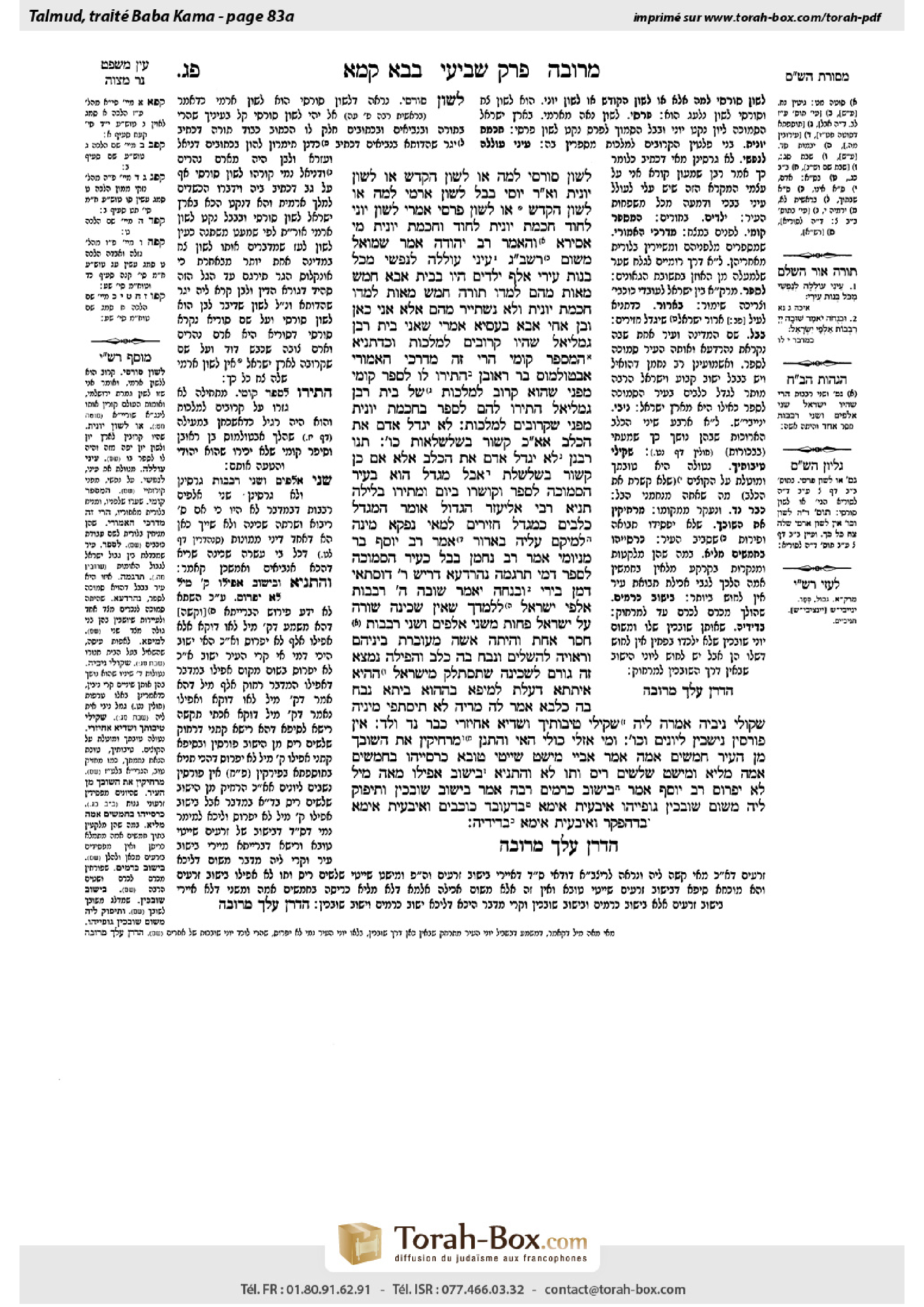
בבא קמא פ״ג א · Aramaic and Hebrew text
לָשׁוֹן סוּרְסִי לָמָּה? אוֹ לְשׁוֹן הַקֹּדֶשׁ, אוֹ לָשׁוֹן יְוָנִית! וְאָמַר רַבִּי יוֹסֵי: [בְּ]בָבֶל – לְשׁוֹן אֲרַמִּי לָמָּה? אוֹ לְשׁוֹן הַקֹּדֶשׁ, אוֹ לָשׁוֹן פָּרְסִי! אָמְרִי: לָשׁוֹן יְוָנִי לְחוּד, חׇכְמַת יְוָנִית לְחוּד.
וְחׇכְמַת יְוָנִית מִי אֲסִירָא?! וְהָאָמַר רַב יְהוּדָה אָמַר שְׁמוּאֵל מִשּׁוּם רַבָּן שִׁמְעוֹן בֶּן גַּמְלִיאֵל: ״עֵינִי עוֹלְלָה לְנַפְשִׁי מִכֹּל בְּנוֹת עִירִי״ – אֶלֶף יְלָדִים הָיוּ בְּבֵית אַבָּא; חֲמֵשׁ מֵאוֹת מֵהֶם לָמְדוּ תּוֹרָה, חֲמֵשׁ מֵאוֹת לָמְדוּ חׇכְמַת יְוָנִית; וְלֹא נִשְׁתַּיֵּיר מֵהֶם אֶלָּא אֲנִי – כָּאן, וּבֶן אֲחִי אַבָּא – בְּעַסְיָא!
אָמְרִי: שָׁאנֵי בֵּית רַבָּן גַּמְלִיאֵל, שֶׁהָיוּ קְרוֹבִים לַמַּלְכוּת. וְכִדְתַנְיָא: הַמְסַפֵּר קוֹמֵי – הֲרֵי זֶה מִדַּרְכֵי הָאֱמוֹרִי. אַבְטוּלְמוֹס בַּר רְאוּבֵן הִתִּירוּ לוֹ לְסַפֵּר קוֹמֵי, מִפְּנֵי שֶׁהוּא קָרוֹב לַמַּלְכוּת. שֶׁל בֵּית רַבָּן גַּמְלִיאֵל הִתִּירוּ לָהֶם לְסַפֵּר בְּחׇכְמַת יְוָנִית, מִפְּנֵי שֶׁקְּרוֹבִים לַמַּלְכוּת.
לֹא יְגַדֵּל אָדָם אֶת הַכֶּלֶב אֶלָּא אִם כֵּן קָשׁוּר בְּשַׁלְשְׁלָאוֹת כּוּ׳. תָּנוּ רַבָּנַן: לֹא יְגַדֵּל אָדָם אֶת הַכֶּלֶב – אֶלָּא אִם כֵּן קָשׁוּר בְּשַׁלְשֶׁלֶת. אֲבָל מְגַדֵּל הוּא בָּעִיר הַסְּמוּכָה לַסְּפָר, וְקוֹשְׁרוֹ בַּיּוֹם וּמַתִּירוֹ בַּלַּיְלָה.
תַּנְיָא רַבִּי אֱלִיעֶזֶר הַגָּדוֹל אוֹמֵר: הַמְגַדֵּל כְּלָבִים – כִּמְגַדֵּל חֲזִירִים. לְמַאי נָפְקָא מִינַּהּ? לְמֵיקַם עֲלֵיהּ בְּאָרוּר.
אָמַר רַב יוֹסֵף בַּר מִנְיוֹמֵי אָמַר רַב נַחְמָן: בָּבֶל – כְּעִיר הַסְּמוּכָה לַסְּפָר דָּמֵי. תַּרְגְּמַהּ: נְהַרְדְּעָא.
דָּרֵישׁ רַבִּי דּוֹסְתַּאי דְּמִן בֵּירֵי: ״וּבְנֻחֹה יֹאמַר שׁוּבָה ה׳ רִבְבוֹת אַלְפֵי יִשְׂרָאֵל״ – לְלַמֶּדְךָ, שֶׁאֵין שְׁכִינָה שׁוֹרָה עַל יִשְׂרָאֵל פָּחוֹת מִשְּׁנֵי אֲלָפִים וּשְׁנֵי רְבָבוֹת. חָסֵר אַחַת, וְהָיְתָה אִשָּׁה מְעוּבֶּרֶת בֵּינֵיהֶם וּרְאוּיָה לְהַשְׁלִים, וְנָבַח בָּהּ כֶּלֶב וְהִפִּילָה, נִמְצָא זֶה גּוֹרֵם לַשְּׁכִינָה שֶׁתִּסְתַּלֵּק מִיִּשְׂרָאֵל.
הָהִיא אִיתְּתָא דְּעַלַּת לְמֵיפָא בְּהָהוּא בֵּיתָא, נְבַח בַּהּ כַּלְבָּא. אֲמַר לַהּ מָרֵיהּ: לָא תִּיסְתְּפַי מִינֵּיהּ, שְׁקִילִי נִיבֵיהּ. אֲמַרָה לֵיהּ: שְׁקִילָה טֵיבוּתָיךְ וְשַׁדְיָא אַחִיזְרֵי, כְּבָר נָד וָלָד.
אֵין פּוֹרְסִין נִישְׁבִּין לְיוֹנִים וְכוּ׳. וּמִי אָזְלִי כּוּלֵּי הַאי? וְהָתְנַן: מַרְחִיקִין אֶת הַשּׁוֹבָךְ מִן הָעִיר חֲמִשִּׁים אַמָּה! אָמַר אַבָּיֵי: מֵישָׁט שָׁיְיטִי טוּבָא, כַּרְסַיְיהוּ בַּחֲמִשִּׁים אַמָּה מַלְיָא.
וּמֵישָׁט שְׁלֹשִׁים רִיס וְתוּ לָא? וְהָתַנְיָא: בַּיִּשּׁוּב – אֲפִילּוּ מֵאָה מִיל לֹא יִפְרוֹס! רַב יוֹסֵף אָמַר: בְּיִשּׁוּב כְּרָמִים. רַבָּה אָמַר: בְּיִשּׁוּב שׁוֹבָכִין.
וְתִיפּוֹק לֵיהּ מִשּׁוּם שׁוֹבָכִין גּוּפַיְיהוּ! אִיבָּעֵית אֵימָא: בִּדְגוֹי, וְאִיבָּעֵית אֵימָא: בִּדְהֶפְקֵר, וְאִיבָּעֵית אֵימָא: בְּדִידֵיהּ.
הֲדַרַן עֲלָךְ מְרוּבָּה
Bava Kamma 83a · English translation
why would one speak the Syriac [Sursi] language? One should speak either the sacred tongue, Hebrew, or the Greek language. And Rabbi Yosei said similarly: In Babylonia, why would one speak the Aramaic language? One should speak either the sacred tongue or the Persian language. At any rate, Rabbi Yehuda HaNasi’s statement indicates that there is nothing wrong with learning and speaking Greek. The Sages say in response: The Greek language is discrete, and Greek wisdom is discrete. In other words, these are two separate issues; only Greek wisdom is prohibited, not the Greek language.
The Gemara further pursues this line of inquiry: And is Greek wisdom itself actually prohibited? But doesn’t Rav Yehuda say that Shmuel says in the name of Rabban Shimon ben Gamliel: It is written: “My eye affected my soul, because of all the daughters of my city” (Lamentations 3:51). Rabban Shimon ben Gamliel applied this verse to a personal tragedy: There were a thousand children in the household of my father, Rabban Gamliel; five hundred of them studied the Torah, and five hundred of them studied Greek wisdom. All of them were killed by the Romans; and the only ones that remain of them are I, who is here, and the son of my father’s brother, who is in Asia Minor [Asya]. Rabban Shimon ben Gamliel’s statement indicates that it is permitted to study Greek wisdom.
The Sages say in response: The household of Rabban Gamliel is different, as they held close ties with the government. Since knowledge of Greek wisdom was crucial for the members of this family, the Sages exempted them from the general decree, as it is taught in a baraita: With regard to one who cuts his hair in the fashion of komi, a certain haircut favored by the Romans, this is considered one of the ways of the Amorites, i.e., a gentile practice prohibited by the Torah (Leviticus 18:3). Despite this, the Sages permitted Avtolmos bar Reuven to cut his hair in the fashion of komi, because he had close ties with the government. Likewise, they permitted the members of the household of Rabban Gamliel to discuss matters of Greek wisdom, because they had close ties with the government.
§ The mishna teaches: A person may not raise a dog unless it is tied with chains. The Sages taught in a baraita: A person may not raise a dog unless it is tied with a chain. But he may raise a dog in a city that is close to the border of the country, and in that case he should tie it during the day but may release it at night.
It is taught in a baraita that Rabbi Eliezer the Great says: One who raises dogs is like one who raises pigs. The Gemara asks: What is the practical significance of this statement? Since both are prohibited, what is the point of this comparison? The Gemara answers: The significance is with regard to determining when one is liable to be cursed for it. Rabbi Eliezer is saying that the same curse meted out to one who raises pigs also applies to one who raises dogs.
Rav Yosef bar Minyumi says that Rav Naḥman says: Babylonia is considered like a city close to the border, and therefore it is permitted to raise dogs there. The Gemara qualifies this statement, and in this context, Babylonia is interpreted as referring only to Neharde’a, a city that was close to the border.
With regard to raising dogs, Rabbi Dostai from Biri expounded: It is written in connection to the Ark of the Covenant: “And when it rested, he said: Return, O Lord, to the myriads of the thousands of Israel” (Numbers 10:36). This verse serves to teach you that the Divine Presence does not rest upon the Jewish people if they number fewer than two thousand and two myriads, where one myriad is equal to ten thousand. The plural form of “myriads” and “thousands” indicates at least two of each. If they are lacking one individual from this total, and there was a pregnant woman among them, who was fit to complete the number by giving birth, and a dog barked at her and she miscarried as a result of the fright, this owner of the dog is found to have caused the Divine Presence to depart from the Jewish people.
There was a certain woman who entered a certain building to bake. A dog barked at her. Its owner said to her: Do not be afraid of it; its canine teeth have been removed. She said to him: It is too late for your reassurances. Take your favors and throw them on the thorns! I have felt that the baby has already moved from its place in the womb and will not be born alive.
§ The mishna teaches: One may spread out traps for pigeons only if this was performed at a distance of at least thirty ris, which is eight thousand cubits, from any settled area, to ensure that privately owned pigeons are not caught in the traps. The Gemara asks: And do pigeons really travel that far from their established places? But didn’t we learn in a mishna (Bava Batra 23a): One must distance a dovecote fifty cubits from the city, so that the pigeons that settle in the cotes do not eat the crops that grow in the gardens of the city. This shows that the range of a pigeon is only fifty cubits, whereas four mil is eight thousand cubits. Abaye said: Pigeons fly much more than fifty cubits away from their cotes, but their stomachs become full from the food they find within fifty cubits, and therefore they do not eat any more beyond that range.
The Gemara asks: And with regard to flying, is their range only thirty ris and no more? But isn’t it taught in a baraita: In a settled area, one may not spread out a trap for pigeons even at a distance of one hundred mil from the settlement? This indicates that a privately owned pigeon might be trapped even one hundred mil away from a settled area. Why, then, does the mishna permit trapping beyond four mil? Rav Yosef said: The baraita is not talking about an ordinary city but about a settled area where vineyards are grown. Since the pigeons rest in the vineyards as they travel, they are able to traverse great distances. Rabba stated a different answer: The baraita is dealing with a settled area where there are many dovecotes in which they can rest from their flight.
The Gemara asks: If there are many dovecotes along the way, let the tanna derive the prohibition against setting pigeon traps due to the dovecotes themselves. Since the mishna teaches that it is prohibited to trap pigeons within four mil of privately owned dovecotes, it should be irrelevant that there is a city one hundred mil away. The Gemara answers: If you wish, say that the baraita is dealing with dovecotes that belong to a gentile, and the prohibition against trapping pigeons from private dovecotes applies only to birds owned by Jews. Or if you wish, say that the baraita is dealing with abandoned dovecotes that are ownerless. Or if you wish, say that it is referring to dovecotes that are his, i.e., they belong to the same individual who is setting the pigeon trap.
Bava Kamma 83a · Traduction française (IA)
Pourquoi parlerait-on la langue syrienne [Sursi] ? On devrait parler soit la langue sacrée, le hébreu, soit la langue grecque. Rabbi Yosei a dit de même : En Babylone, pourquoi parlerait-on la langue araméenne ? On devrait parler soit la langue sacrée soit la langue perse. En tout cas, la déclaration de Rabbi Yehuda HaNasi indique que rien ne vaut à interdire d'apprendre et de parler la langue grecque. Les Sages répondent en disant : La langue grecque est discrète et la sagesse grecque est discrète. Autrement dit, ces sont deux questions distinctes ; seule la sagesse grecque est interdite, pas la langue grecque.
La Guemara poursuit davantage cette ligne d'enquête : La sagesse grecque elle-même est-elle réellement interdite ? Mais ne dit pas Rav Yehuda que Shmuel dit en nom de Rabban Shimon ben Gamliel : « Mon œil a affecté mon âme, à cause de toutes les filles de ma ville » (Lamentations 3:51). Rabban Shimon ben Gamliel applique cette verset à une tragédie personnelle : Il y avait mille enfants dans la maison de mon père, Rabban Gamliel ; cinq cents d'entre eux étudiaient la Torah, et cinq cents d'entre eux étudiaient la sagesse grecque. Tous ont été tués par les Romains ; et les seuls qui restent d'entre eux sont moi, qui est ici, et le fils du frère de mon père, qui est en Asie Mineure [Asya]. La déclaration de Rabban Shimon ben Gamliel indique que l'étude de la sagesse grecque est permise.
Les Sages répondent : La maison de Rabban Gamliel est différente, car elle entretenait des liens étroits avec le gouvernement. Puisque la connaissance de la sagesse grecque était cruciale pour les membres de cette famille, les Sages ont exempté cette famille de la déclaration générale, comme il est enseigné dans une baraïta : Concernant celui qui coupe ses cheveux dans le style komi, un certain type de coiffure favorisé par les Romains, cela est considéré comme l'une des manières des Amorites, c'est-à-dire une pratique païenne interdite par la Torah (Lévitique 18:3). Malgré cela, les Sages ont permis à Avtolmos bar Reuven de couper ses cheveux dans le style komi, car il entretenait des liens étroits avec le gouvernement. De même, ils ont permis aux membres de la maison de Rabban Gamliel d'aborder des questions de sagesse grecque, car ils entretenaient des liens étroits avec le gouvernement.
§ La mitsva enseigne : Une personne ne doit pas dresser un chien à moins qu'il ne soit lié avec une chaîne. Les Sages ont enseigné dans une baraïta : Une personne ne doit pas dresser un chien à moins qu'il ne soit lié avec une chaîne. Mais il peut dresser un chien dans une ville proche de la frontière du pays, et dans ce cas il doit le lier pendant la journée mais peut le libérer la nuit.
Il est enseigné dans une baraïta que Rabbi Eliezer le Grand dit : Celui qui dresse des chiens est comme celui qui dresse des porcs. La Guemara pose la question : Quel est le sens pratique de cette déclaration ? Puisque les deux sont interdits, à quoi sert cette comparaison ? La Guemara répond : Le sens est concernant la détermination du moment où l'on est tenu de être maudit pour cela. Rabbi Eliezer dit que la même malédiction infligée à celui qui dresse des porcs s'applique également à celui qui dresse des chiens.
Rav Yosef bar Minyumi dit que Rav Naḥman dit : Babylone est considérée comme une ville proche de la frontière, et par conséquent il est permis de dresser des chiens là-bas. La Guemara précise cette déclaration, et dans ce contexte, Babylone est interprétée comme désignant uniquement Neharde’a, une ville proche de la frontière.
Concernant la dressure des chiens, Rabbi Dostai de Biri a expliqué : Il est écrit en lien avec l'Arca du Pacte : « Et quand il reposa, il dit : Reviens, ô Seigneur, vers les myriades des milliers d'Israël » (Nm 10:36). Ce verset sert à t'enseigner que la Présence Divine ne repose pas sur le peuple juif s'ils sont moins de deux mille et deux myriades, où un myriade est égal à dix mille. La forme plurielle de « myriades » et « milliers » indique au moins deux de chaque. Si l'un manque à ce total, et qu'il y avait une femme enceinte parmi eux, qui était capable de compléter le nombre en donnant naissance, et qu'un chien a hurlé à elle et qu'elle a eu un avortement à cause de la frayeur, ce propriétaire du chien est trouvé avoir causé la Présence Divine à quitter le peuple juif.
Il y avait une certaine femme qui entra dans un certain bâtiment pour cuire. Un chien a hurlé à elle. Son propriétaire lui a dit : Ne t'inquiète pas de lui ; ses dents canines ont été retirées. Elle lui a répondu : C'est trop tard pour tes rassurances. Prends tes faveurs et jette-les sur les épines ! J'ai senti que l'enfant a déjà bougé de sa place dans le ventre et ne sera pas né vivant.
§ La mitsva enseigne : On peut étendre des pièges pour des pigeons uniquement si cela a été fait à une distance d'au moins trente ris, ce qui correspond à huit mille coudées, d'une zone habité, afin d'assurer que les pigeons privés ne soient pas capturés dans les pièges. La Guemara pose la question : Et les pigeons voyage-t-ils vraiment aussi loin de leurs lieux habituels ? Mais n'avons-nous pas appris dans une mitsva (Bava Batra 23a) : On doit distancer un colombier de cinquante coudées de la ville, afin que les pigeons qui s'installent dans les colombiers ne mangent pas les cultures qui poussent dans les jardins de la ville. Cela montre que la portée d'un pigeon n'est que cinquante coudées, alors que quatre mil est huit mille coudées. Abaye a dit : Les pigeons volent bien plus de cinquante coudées loin de leurs colombiers, mais leurs estomacs se remplissent de la nourriture qu'ils trouvent à cinquante coudées, et par conséquent ils ne mangent plus au-delà de cette portée.
La Guemara pose la question : Et concernant le vol, leur portée n'est que trente ris et pas plus ? Mais n'est-il pas enseigné dans une baraïta : Dans une zone habité, on ne peut pas étendre un piège pour des pigeons même à une distance d'un cent mil de la zone habité ? Cela indique qu'un pigeon privé pourrait être capturé même un cent mil loin d'une zone habité. Pourquoi, alors, la mitsva permet-elle de capturer au-delà de quatre mil ? Rav Yosef a dit : La baraïta ne parle pas d'une ville ordinaire mais d'une zone habité où des vignobles sont cultivés. Puisque les pigeons reposent dans les vignobles lors de leur voyage, ils sont capables de parcourir de grandes distances. Rabba a donné une autre réponse : La baraïta traite d'une zone habité où il y a beaucoup de colombiers où ils peuvent se reposer de leur vol.
Le Guemara pose la question : Si des colombiers sont présents le long du chemin, pourquoi le tanna n'aurait-il pas déduit la prohibition contre l'installation de pièges à pigeons à partir des colombiers eux-mêmes ? Puisque la Michna enseigne que c'est interdit de piéger des pigeons à quatre mil de colombiers privés, il ne devrait pas être pertinent que l'on trouve une ville à cent mil de distance. Le Guemara répond : Si tu le souhaites, dis que la baraïta traite de colombiers appartenant à un non-Juif, et que la prohibition contre le piégeage des pigeons provenant de colombiers privés s'applique uniquement aux oiseaux appartenant aux Juifs. Ou si tu le souhaites, dis que la baraïta traite de colombiers abandonnés et sans propriétaire. Ou si tu le souhaites, dis qu'il s'agit de colombiers qui sont à lui, c'est-à-dire qui appartiennent à la même personne qui installe le piège à pigeons.
Traduction française générée par IA à partir de l’édition anglaise de Sefaria. Vérifie toujours un passage avec le texte source.
Text from Sefaria: William Davidson Edition - Vocalized Aramaic (CC BY NC); William Davidson Edition - English (CC BY NC).