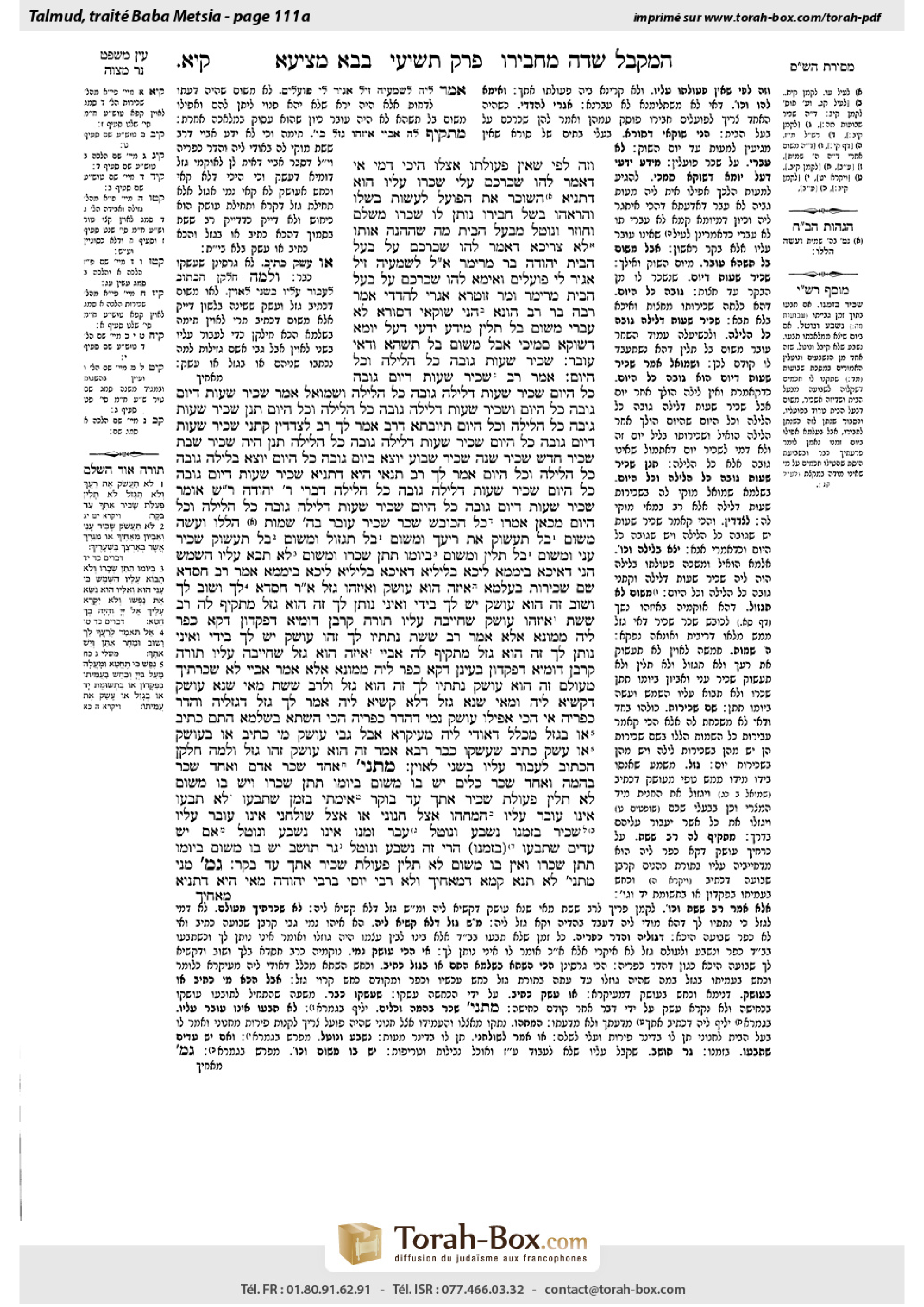
Bava Metzia 111a: Talmud study for Daf Yomi
Study the Talmud for Daf Yomi with scanned pages, Hebrew text, English translations from Sefaria and AI-generated French translations.
Passage selection and English or AI-generated French translation are available where the scan has annotations. Daf Study is independent of Torah-Box and Sefaria.
Browse Bava Metzia · בבא מציעא · All tractatesBava Metzia 111a text and translations
This page of Bava Metzia includes the Aramaic text, an English translation and an AI-generated French translation, alongside the scan above.
בבא מציעא קי״א א · Aramaic and Hebrew text
וְזֶה, לְפִי שֶׁאֵין פְּעוּלָּתוֹ אֶצְלוֹ. הֵיכִי דָמֵי? אִי דַּאֲמַר לְהוּ שְׂכַרְכֶם עָלַי – שְׂכָרוֹ עָלָיו הוּא, דְּתַנְיָא: הַשּׂוֹכֵר אֶת הַפּוֹעֵל לַעֲשׂוֹת בְּשֶׁלּוֹ וְהֶרְאָהוּ בְּשֶׁל חֲבֵירוֹ – נוֹתֵן לוֹ שְׂכָרוֹ מִשָּׁלֵם, וְחוֹזֵר וְנוֹטֵל מִבַּעַל הַבַּיִת מַה שֶּׁהֶהֱנָה אוֹתוֹ!
לָא צְרִיכָא, דַּאֲמַר לְהוּ: שְׂכַרְכֶם עַל בַּעַל הַבַּיִת.
יְהוּדָה בַּר מָרִימָר אֲמַר לֵיהּ לְשַׁמָּעֵיהּ: זִיל אֱגוֹר לִי פּוֹעֲלִים, וְאֵימָא לְהוּ: שְׂכַרְכֶם עַל בַּעַל הַבַּיִת, מָרִימָר וּמַר זוּטְרָא אָגְרִי לַהֲדָדֵי.
אָמַר רַבָּה בַּר רַב הוּנָא: הָנֵי שׁוּקָאֵי דְּסוּרָא לָא עָבְרִי מִשּׁוּם ״בַּל תָּלִין״, מִידָּע יָדְעִי דְּעַל יוֹמָא דְשׁוּקָא סְמִיכִי, אֲבָל מִשּׁוּם ״בַּל תְּשַׁהֶא״ וַדַּאי עוֹבֵר.
שְׂכִיר שָׁעוֹת גּוֹבֶה כׇּל הַלַּיְלָה וְכׇל הַיּוֹם. אָמַר רַב: שְׂכִיר שָׁעוֹת דְּיוֹם – גּוֹבֶה כׇּל הַיּוֹם, שְׂכִיר שָׁעוֹת דְּלַיְלָה – גּוֹבֶה כׇּל הַלַּיְלָה. וּשְׁמוּאֵל אָמַר: שְׂכִיר שָׁעוֹת דְּיוֹם – גּוֹבֶה כׇּל הַיּוֹם, וּשְׂכִיר שָׁעוֹת דְּלַיְלָה – גּוֹבֶה כׇּל הַלַּיְלָה וְכׇל הַיּוֹם.
תְּנַן: שְׂכִיר שָׁעוֹת גּוֹבֶה כׇּל הַלַּיְלָה וְכׇל הַיּוֹם, תְּיוּבְתָּא דְּרַב! אָמַר לְךָ רַב: לִצְדָדִין קָתָנֵי. שְׂכִיר שָׁעוֹת דְּיוֹם – גּוֹבֶה כׇּל הַיּוֹם, שְׂכִיר שָׁעוֹת דְּלַיְלָה – גּוֹבֶה כׇּל הַלַּיְלָה.
תְּנַן: הָיָה שְׂכִיר שַׁבָּת, שְׂכִיר חֹדֶשׁ, שְׂכִיר שָׁנָה, שְׂכִיר שָׁבוּעַ, יוֹצֵא בַּיּוֹם – גּוֹבֶה כׇּל הַיּוֹם. יוֹצֵא בַּלַּיְלָה – גּוֹבֶה כׇּל הַלַּיְלָה וְכׇל הַיּוֹם.
אָמַר לְךָ רַב: תַּנָּאֵי הִיא, דְּתַנְיָא: שְׂכִיר שָׁעוֹת דְּיוֹם – גּוֹבֶה כׇּל הַיּוֹם, שְׂכִיר שָׁעוֹת דְּלַיְלָה – גּוֹבֶה כׇּל הַלַּיְלָה, דִּבְרֵי רַבִּי יְהוּדָה. רַבִּי שִׁמְעוֹן אוֹמֵר: שְׂכִיר שָׁעוֹת דְּיוֹם – גּוֹבֶה כׇּל הַיּוֹם, שְׂכִיר שָׁעוֹת דְּלַיְלָה – גּוֹבֶה כׇּל הַלַּיְלָה וְכׇל הַיּוֹם.
מִכָּאן אָמְרוּ: כׇּל הַכּוֹבֵשׁ שְׂכַר שָׂכִיר, עוֹבֵר בַּחֲמִשָּׁה שֵׁמוֹת הַלָּלוּ וַעֲשֵׂה. מִשּׁוּם ״בַּל תַּעֲשֹׁק אֶת רֵעֲךָ״, וּמִשּׁוּם ״בַּל תִּגְזֹל״, וּמִשּׁוּם ״בַּל תַּעֲשֹׁק שָׂכִיר עָנִי״, וּמִשּׁוּם ״בַּל תָּלִין״, וּמִשּׁוּם ״בְּיוֹמוֹ תִּתֵּן שְׂכָרוֹ״, וּמִשּׁוּם ״לֹא תָבֹא עָלָיו הַשֶּׁמֶשׁ״.
הָנֵי דְּאִיכָּא בִּימָמָא – לֵיכָּא בְּלֵילְיָא, דְּאִיכָּא בְּלֵילְיָא – לֵיכָּא בִּימָמָא? אָמַר רַב חִסְדָּא: שֵׁם שְׂכִירוּת בְּעָלְמָא.
אֵיזֶה הוּא עוֹשֶׁק וְאֵיזֶהוּ גָּזֵל? אָמַר רַב חִסְדָּא: ״לֵךְ וָשׁוּב״, ״לֵךְ וָשׁוּב״ – זֶה הוּא עוֹשֶׁק. ״יֵשׁ לְךָ בְּיָדִי וְאֵינִי נוֹתֵן לְךָ״ – זֶה הוּא גָּזֵל.
מַתְקֵיף לַהּ רַב שֵׁשֶׁת: אֵיזֶהוּ עוֹשֶׁק שֶׁחִיְּיבָה עָלָיו תּוֹרָה קׇרְבָּן – דּוּמְיָא דְּפִקָּדוֹן, דְּקָא כָפַר לֵיהּ מָמוֹנָא! אֶלָּא אָמַר רַב שֵׁשֶׁת: ״נְתַתִּיו לָךְ״ – זֶהוּ עוֹשֶׁק, ״יֵשׁ לְךָ בְּיָדִי וְאֵינִי נוֹתֵן לָךְ״ – זֶה הוּא גָּזֵל.
מַתְקֵיף לַהּ אַבָּיֵי: אֵיזֶה הוּא גָּזֵל שֶׁחִיְּיבָה עָלָיו תּוֹרָה קׇרְבָּן, דּוּמְיָא דְּפִקָּדוֹן בָּעֵינַן, דְּקָא כָפַר לֵיהּ מָמוֹנָא! אֶלָּא אָמַר אַבָּיֵי: ״לֹא שְׂכַרְתִּיךָ מֵעוֹלָם״ – זֶה הוּא עוֹשֶׁק, ״נְתַתִּיו לָךְ״ – זֶה הוּא גָּזֵל.
וּלְרַב שֵׁשֶׁת, מַאי שְׁנָא עוֹשֶׁק דְּקַשְׁיָא לֵיהּ, וּמַאי שְׁנָא גָּזֵל דְּלָא קַשְׁיָא לֵיהּ? אָמַר לָךְ: גָּזֵל – דְּגַזְלֵיהּ וַהֲדַר כַּפְרֵיהּ.
אִי הָכִי, אֲפִילּוּ עוֹשֶׁק נָמֵי דַּהֲדַר כַּפְרֵיהּ! הָכִי הַשְׁתָּא: בִּשְׁלָמָא הָתָם כְּתִיב: ״אוֹ בְגָזֵל״ – מִכְּלָל דְּאוֹדִי לֵיהּ מֵעִיקָּרָא. אֲבָל גַּבֵּי עוֹשֶׁק מִי כְּתִיב ״אוֹ בְעוֹשֶׁק״? ״אוֹ עָשַׁק״ כְּתִיב, שֶׁעֲשָׁקוֹ כְּבָר.
רָבָא אָמַר: זֶה הוּא עוֹשֶׁק זֶהוּ גָּזֵל. וְלָמָּה חִלְּקָן הַכָּתוּב – לַעֲבוֹר עָלָיו בִּשְׁנֵי לָאוִין.
מַתְנִי׳ אֶחָד שְׂכַר אָדָם וְאֶחָד שְׂכַר בְּהֵמָה וְאֶחָד שְׂכַר כֵּלִים – יֵשׁ בּוֹ מִשּׁוּם ״בְּיוֹמוֹ תִּתֵּן שְׂכָרוֹ״, וְיֵשׁ בּוֹ מִשּׁוּם ״לֹא תָלִין פְּעֻלַּת שָׂכִיר אִתְּךָ עַד בֹּקֶר״. אֵימָתַי – בִּזְמַן שֶׁתְּבָעוֹ. לֹא תְּבָעוֹ – אֵינוֹ עוֹבֵר עָלָיו. הִמְחָהוּ אֵצֶל חֶנְוָנִי אוֹ אֵצֶל שׁוּלְחָנִי – אֵינוֹ עוֹבֵר עָלָיו.
שָׂכִיר בִּזְמַנּוֹ – נִשְׁבָּע וְנוֹטֵל. עָבַר זְמַנּוֹ – אֵינוֹ נִשְׁבָּע וְנוֹטֵל. אִם יֵשׁ עֵדִים שֶׁתְּבָעוֹ בִּזְמַנּוֹ – הֲרֵי זֶה נִשְׁבָּע וְנוֹטֵל.
גֵּר תּוֹשָׁב יֵשׁ בּוֹ מִשּׁוּם ״בְּיוֹמוֹ תִּתֵּן שְׂכָרוֹ״, וְאֵין בּוֹ מִשּׁוּם ״לֹא תָלִין פְּעוּלַּת שָׂכִיר אִתְּךָ עַד בֹּקֶר״.
גְּמָ׳ מַנִּי מַתְנִיתִין? לָא תַּנָּא קַמָּא דְּ״מֵאַחֶיךָ״, וְלָא רַבִּי יוֹסֵי בְּרַבִּי יְהוּדָה. מַאי הִיא, דְּתַנְיָא:
Bava Metzia 111a · English translation
And that one, the middleman, is exempt because his work is not performed for him. The Gemara asks: What are the circumstances of this case? If the middleman said to them: Your wages are incumbent upon me, his wages are indeed upon him, as the one who hired the workers bears full responsibility. As it is taught in a baraita: With regard to one who hires a laborer to perform work in his own field, and the employer inadvertently showed the laborer a field belonging to another in which he should work, the employer must give the laborer his full wages; and in addition, the employer goes back and takes from the owner of the field in which he worked the value of the benefit that owner received from the laborer. The employer is entitled to claim from the owner of the field the profit that owner gained from the work, but not the entire wages of the laborer. This indicates that one who says: Your wage is incumbent upon me, is responsible for the arrangement.
The Gemara explains: No, it is necessary to state this halakha where the middleman said to them: The obligation to pay your wages is incumbent upon the employer, in which case they share responsibility for the payment and neither violates the prohibition.
The Gemara relates: Yehuda bar Mareimar would say to his attendant: Go hire workers for me and say to them: Your wages are upon the employer. Yehuda bar Mareimar instructed the attendant to do this in order to avoid violating the prohibition of delaying payment of wages. Mareimar and Mar Zutra would hire workers for each other for the same reason.
Rabba bar Rav Huna said: Those marketplace workers of Sura do not violate the prohibition by Torah law of delaying payment of wages, in the event that they do not pay their employees immediately. This is because everyone knows that they rely on the market day to earn their money, and the employees are aware that they will not be paid on the same day that they worked. But he certainly violates the prohibition by rabbinic law of: Do not delay, if he withholds payment any later than the market day.
§ The mishna teaches that an hourly laborer collects his wages all night and all day. Rav says: An hourly laborer who worked by day collects his wages all that day, while an hourly laborer who worked by night collects his wages all that night. And Shmuel says: An hourly laborer who worked by day indeed collects his wages all that day, but an hourly laborer by night collects his wages all that night and all the following day.
We learned in the mishna: An hourly laborer collects his wages all night and all day. This is apparently a conclusive refutation of Rav. The Gemara answers: Rav could have said to you that he teaches the mishna disjunctively in the following manner: An hourly laborer by day collects his wages all day, while an hourly laborer by night collects his wages all night.
We learned in the mishna: If he was a weekly laborer, a monthly laborer, a yearly laborer, or a laborer for a Sabbatical cycle of seven years, if he left upon the completion of his work in the day, he collects his wages all day; if he left at night, he collects his wages all night and all day. This indicates that one who finishes his work at night can be paid throughout the following day as well.
The Gemara replies: Rav could have said to you that it is a dispute between tanna’im, as it is taught in a baraita: An hourly laborer by day collects his wages all day, while an hourly laborer by night collects his wages all night; this is the statement of Rabbi Yehuda. Rabbi Shimon says: An hourly laborer by day collects his wages all day, while an hourly laborer by night collects his wages all night and all day.
The baraita continues. From here the Sages stated: Anyone who withholds the wages of a hired laborer violates these five negative prohibitions and one positive mitzva. He violates the prohibition of: “Do not oppress your neighbor” (Leviticus 19:13), and the prohibition of: “Do not steal” (Leviticus 19:13), and the prohibition of: “You should not oppress a hired laborer who is poor” (Deuteronomy 24:14), and the prohibition of delaying payment of wages (Leviticus 19:13), and he has not fulfilled the positive mitzva of: “On the same day you shall give him his wages” (Deuteronomy 24:15), and he has violated the prohibition of: “The sun shall not set upon him” (Deuteronomy 24:15).
The Gemara asks: But these five prohibitions do not all take effect at the same time, since those that are applicable by day are not in effect by night, while those that are applicable by night are not relevant by day. How can he be in violation of them all? Rav Ḥisda said: It means merely that the general concept of withholding the wages of a hired laborer includes all these prohibitions and one positive mitzva.
§ The Gemara asks: What is defined as oppression and what is defined as stealing, and what is the difference between them? Rav Ḥisda said: If he told him: Go and return, go and return (see Proverbs 3:28), avoiding paying him while saying that he will pay him at some point, this is oppression. If he says to him: You have money owed to you in my possession but I will not give it to you, this is stealing.
Rav Sheshet objects to this from a baraita: What is the type of oppression for which the Torah obligated him to bring an offering? It is similar to the case of one who had been entrusted with money as a deposit, where he then denies that he accepted it, thereby keeping the money. This contradicts Rav Ḥisda’s claim that oppression is referring to one who admits that he owes him. Rather, Rav Sheshet said that the difference is as follows: If he said to him: I gave it to you, this is defined as oppression. If he tells him: You have money owed to you in my possession but I am not giving it to you, this is defined as stealing.
Abaye objects to this: What is the type of stealing for which the Torah obligated him to bring an offering? We require it to be similar to the case of one who had been entrusted with money as a deposit, where he then denies that he accepted it, thereby keeping the money. That is unlike the example of stealing given by Rav Ḥisda and Rav Sheshet, where the party withholding the money concedes that he owes it. Rather, Abaye said: If he said to him: I never hired you, this is oppression; if he claimed: I gave it to you, this is stealing.
The Gemara asks: And according to Rav Sheshet, what is different about oppression that he raised a difficulty against Rav Ḥisda concerning it, and what is different about stealing that he did not raise a difficulty, although Abaye’s question was similar to his. The Gemara explains: Rav Sheshet could have said to you: Stealing means that he first stole from him by stating that he will not give him the money, and later denied owing it.
The Gemara challenges: If so, then even with regard to oppression as well, the case can be that he first conceded that he owes the wages and then later denied it. Why does Rav Sheshet say that the case must be where the employer said to the laborer: I gave it to you? The Gemara responds: How can these cases be compared? Granted, there it is written: “And if he deals falsely with his neighbor in a matter of deposit, or of pledge, or of robbery” (Leviticus 5:21), which by inference indicates that he admitted to him at the outset. But with regard to oppression is it written: Or by oppression? It is written: “Or he oppressed,” which does not refer back to his previous denial but is referring to the actual sin, indicating that he had already oppressed him.
Rava said: There is no need for such an artificial distinction, as oppression is the same as stealing, and no practical difference exists between the two categories. And why, then, did the verse divide them into two categories? It did this so that he will violate two prohibitions, stealing and oppression.
MISHNA: Whether referring to a person’s wages that he receives or the renting of an animal or the renting of utensils, are all subject to the prohibition of: “On the same day you shall give him his wages” (Deuteronomy 24:15), and are subject to the prohibition of: “The wages of a hired laborer shall not remain with you all night until the morning” (Leviticus 19:13). When does he transgress these prohibitions? He transgresses them when the one owed the money claimed the payment from him. If he did not claim his payment from him the other does not transgress the prohibitions. If the one who owes the money transferred his payment by leaving instructions with a storekeeper or with a money changer to pay him, he does not transgress the prohibitions.
The mishna discusses other related halakhot: If a hired laborer requests payment at the proper time and the employer claims he already paid him, the laborer takes an oath that he did not receive his wages and then takes the wages from the employer. If the time had passed, he does not take an oath and take the wages. If there are witnesses who testify that he claimed the money from him at the proper time, he takes an oath and takes the money.
One who hires a gentile who resides in Eretz Yisrael and observes the seven Noahide mitzvot [ger toshav] is subject to the prohibition of: “On the same day you shall give him his wages,” but is not subject to the negative mitzva of: “The wages of a hired laborer shall not remain with you all night until the morning.”
GEMARA: The Gemara asks: Whose opinion is expressed in the mishna? It is not that of the first tanna of the baraita, who interprets the phrase: “From your brothers” (Deuteronomy 24:14), and it is not Rabbi Yosei, son of Rabbi Yehuda. The Gemara clarifies: What is this baraita that is referred to here? The Gemara explains: As it is taught in a baraita:
Bava Metzia 111a · Traduction française (IA)
Et celui-là, le tiers, est exempt, car son travail n'est pas accompli pour lui. La Guemara pose la question : Quelles sont les circonstances de ce cas ? Si le tiers dit à eux : Vos salaires sont à moi, ses salaires sont effectivement à lui, car celui qui a engagé les travailleurs assume pleinement la responsabilité. Comme il est enseigné dans une baraïta : En ce qui concerne celui qui engage un ouvrier pour accomplir un travail dans son propre champ, et que l'employeur, par négligence, montre à l'ouvrier un champ appartenant à un autre où il devrait travailler, l'employeur doit payer à l'ouvrier ses salaires complets ; et en outre, l'employeur revient et récupère de l'propriétaire du champ où il a travaillé la valeur du bénéfice que l'propriétaire a tiré de l'ouvrier. L'employeur a le droit de réclamer à l'propriétaire du champ le profit que l'propriétaire a gagné du travail, mais pas les salaires complets de l'ouvrier. Cela montre que celui qui dit : Vos salaires sont à moi, est responsable de l'arrangement.
La Guemara explique : Non, il est nécessaire d'énoncer cette halakha dans le cas où le tiers dit à eux : L'obligation de payer vos salaires incombe à l'employeur, dans ce cas ils partagent la responsabilité du paiement et aucun ne viole la prohibition.
La Guemara rapporte : Yéhouda bar Méréimar disait à son serviteur : Va'engager des travailleurs pour moi et dis-leur : Vos salaires sont à l'employeur. Yéhouda bar Méréimar instruisait le serviteur à faire cela afin d'éviter de violer la prohibition de retarder le paiement des salaires. Méréimar et Mar Zutra engageaient des travailleurs l'un pour l'autre pour la même raison.
Rabba bar Rav Huna dit : Ceux qui travaillent au marché de Sura ne violent pas la prohibition de retarder le paiement des salaires selon la Torah, en cas où ils ne paient leurs employés immédiatement. Cela est dû au fait que tout le monde sait qu'ils comptent sur la journée du marché pour gagner leur argent, et les employés savent qu'ils ne seront pas payés le même jour où ils ont travaillé. Mais il viole certainement la prohibition selon la loi rabbinique de : Ne retarde pas, s'il retarde le paiement plus tard que la journée du marché.
§ La mitsna enseigne que l'ouvrier horaire récolte ses salaires toute la nuit et toute la journée. Rav dit : L'ouvrier horaire qui a travaillé de jour récolte ses salaires toute la journée, tandis que l'ouvrier horaire qui a travaillé de nuit récolte ses salaires toute la nuit. Et Shmuel dit : L'ouvrier horaire qui a travaillé de jour récolte effectivement ses salaires toute la journée, mais l'ouvrier horaire de nuit récolte ses salaires toute la nuit et toute la journée suivante.
Nous avons appris dans la mitsna : L'ouvrier horaire récolte ses salaires toute la nuit et toute la journée. Cela semble être une réfutation concluante de Rav. La Guemara répond : Rav aurait pu dire que la mitsna est enseignée de manière disjunctive de la manière suivante : L'ouvrier horaire de jour récolte ses salaires toute la journée, tandis que l'ouvrier horaire de nuit récolte ses salaires toute la nuit.
Nous avons appris dans la Michna : Si c'était un ouvrier hebdomadaire, un ouvrier mensuel, un ouvrier annuel, ou un ouvrier pour un cycle de sept ans de Sabbat, et s'il est parti à la fin de son travail en journée, il récolte ses salaires toute la journée ; s'il est parti la nuit, il récolte ses salaires toute la nuit et toute la journée. Cela montre que celui qui termine son travail la nuit peut être payé toute la journée suivante également.
La Guemara répond : Rav aurait pu dire que c'est un débat entre les tannaïm, comme il est enseigné dans une baraïta : L'ouvrier horaire de jour récolte ses salaires toute la journée, tandis que l'ouvrier horaire de nuit récolte ses salaires toute la nuit ; c'est la déclaration de Rabbi Yéhuda. Rabbi Shimon dit : L'ouvrier horaire de jour récolte ses salaires toute la journée, tandis que l'ouvrier horaire de nuit récolte ses salaires toute la nuit et toute la journée.
La baraïta continue. D'ici, les Sages ont déclaré : Celui qui retient les salaires d'un ouvrier engagé viole ces cinq prohibitions négatives et une positive mitsva. Il viole la prohibition de : « Ne opprimez pas votre prochain » (Lévitique 19:13), et la prohibition de : « Ne vollez pas » (Lévitique 19:13), et la prohibition de : « Vous ne devriez pas opprimer un ouvrier engagé qui est pauvre » (Deutéronome 24:14), et la prohibition de retarder le paiement des salaires (Lévitique 19:13), et il n'a pas accompli la positive mitsva de : « Sur la même journée, vous lui donnerez ses salaires » (Deutéronome 24:15), et il a violé la prohibition de : « Le soleil ne doit pas se coucher sur lui » (Deutéronome 24:15).
La Guemara pose la question : Mais ces cinq prohibitions ne s'appliquent pas toutes en même temps, car celles applicables en journée ne s'appliquent pas en nuit, tandis que celles applicables en nuit ne s'appliquent pas en journée. Comment peut-il enfreindre toutes ces prohibitions ? Rav Ḥisda dit : Cela signifie simplement que le concept général de retenir les salaires d'un ouvrier engagé inclut toutes ces prohibitions et une positive mitsva.
§ La Guemara pose la question : Qu'est-ce qui est défini comme oppression et qu'est-ce qui est défini comme vol, et quelle est la différence entre eux ? Rav Ḥisda dit : Si on dit à lui : Va' retourner, va' retourner (voir Lévitique 19:18), évitant de le payer tout en disant qu'on le paiera un jour, c'est de l'oppression. Si on dit à lui : Tu as de l'argent dû à toi chez moi mais je ne te le donne pas, c'est du vol.
Rav Sheshet s'oppose à cela à partir d'une baraïta : Quel est le type d'oppression pour lequel la Torah a imposé de présenter un sacrifice ? C'est semblable au cas d'une personne qui a été confiée de l'argent en dépôt, où il nie ensuite avoir accepté cet argent, en conservant ainsi l'argent. Cela contredit la déclaration de Rav Ḥisda selon laquelle l'oppression fait référence à celui qui admet d'endettement. Plutôt, Rav Sheshet dit que la différence est la suivante : Si on dit à lui : Je t'ai donné, c'est défini comme oppression. Si on dit à lui : Tu as de l'argent dû à toi chez moi mais je ne te le donne pas, c'est défini comme vol.
Abaye s'oppose à cela : Quel est le type de vol pour lequel la Torah l'a obligé de présenter un sacrifice ? Nous exigeons qu'il soit similaire au cas d'une personne qui avait été confiée de l'argent en tant que dépôt, où il nie ensuite avoir accepté cet argent, en conservant ainsi l'argent. Cela diffère de l'exemple de vol donné par Rav Ḥisda et Rav Sheshet, où la personne qui retient l'argent reconnaît qu'elle lui doit de l'argent. Plutôt, Abaye dit : Si il dit à lui : Je ne t'ai jamais employé, c'est de l'oppression ; si il affirme : J'ai donné l'argent à toi, c'est du vol.
Le Guemara pose la question : Et selon Rav Sheshet, en quoi l'oppression est-elle différente, qu'il a soulevé un doute contre Rav Ḥisda à ce sujet, et en quoi le vol est-il différent, qu'il n'a pas soulevé de doute, bien que la question d'Abaye fût similaire à la sienne. Le Guemara explique : Rav Sheshet aurait pu dire à vous : Le vol signifie qu'il a d'abord volé à lui en affirmant qu'il ne lui donnerait pas l'argent, puis a nié devoir l'argent.
Le Guemara soulève un défi : Si c'est ainsi, alors même concernant l'oppression, le cas peut être celui où il a d'abord reconnu devoir les salaires, puis a nié plus tard. Pourquoi Rav Sheshet dit-il que le cas doit être celui où l'employeur dit au travailleur : J'ai donné l'argent à toi ? Le Guemara répond : Comment peuvent ces cas être comparés ? En effet, il est écrit : « Et s'il trompe son voisin dans une affaire de dépôt, ou de caution, ou de vol » (Lévitique 5:21), ce qui par inférence indique qu'il a reconnu à l'avance. Mais concernant l'oppression, il est écrit : « Ou par oppression ? » Il est écrit : « Ou il a opprimé », ce qui ne fait pas référence à son précédent déni, mais désigne la véritable transgression, indiquant qu'il avait déjà opprimé.
Rava dit : Il n'y a pas besoin d'une telle distinction artificielle, car l'oppression est la même que le vol, et il n'y a pas de différence pratique entre les deux catégories. Et pourquoi, alors, la Parashah les a-t-elle divisés en deux catégories ? Elle l'a fait afin qu'il viole deux prohibitions, le vol et l'oppression.
MICHNA : Qu'il s'agisse des salaires d'une personne qu'il reçoit, ou de la location d'un animal ou d'ustensiles, tout est soumis à la prohibition : « Et le même jour tu lui donneras ses salaires » (Dn 24:15), et à la prohibition : « Les salaires d'un ouvrier engagé ne doivent pas rester avec toi toute la nuit jusqu'au matin » (Lévitique 19:13). À quel moment transgresse-t-on ces prohibitions ? On les transgresse lorsque celui qui doit l'argent réclame le paiement à celui qui lui doit. Si celui qui doit l'argent n'a pas réclamé le paiement à celui qui lui doit, celui-ci ne transgresse pas les prohibitions. Si celui qui doit l'argent transfère le paiement en laissant des instructions à un marchand ou à un changeur pour lui payer, il ne transgresse pas les prohibitions.
La mishna discute d'autres halakhot connexes : Si un ouvrier demandait le paiement à l'heure appropriée et l'employeur affirmait avoir déjà payé, l'ouvrier prend un serment qu'il n'a pas reçu ses salaires et puis prend les salaires de l'employeur. Si le temps était passé, il ne prend pas de serment et ne prend pas les salaires. Si des témoins témoignent qu'il a réclamé l'argent à l'heure appropriée, il prend un serment et prend l'argent.
Celui qui engage un non-Juif résidant en Eretz Yisrael et observant les sept commandements de Noé [ger toshav] est soumis à la prohibition : « Sur le même jour, tu lui donneras ses salaires », mais n'est pas soumis à la prohibitions négative : « Les salaires d'un ouvrier engagé ne doivent pas rester avec toi toute la nuit jusqu'au matin ».
GUEMARA : Le Guemara pose la question : Quel est l'opinion exprimée dans la mishna ? Ce n'est pas celle du premier tanna du baraïta, qui interprète la phrase : « De vos frères » (Lévitique 24:14), et ce n'est pas celle de Rabbi Yosei, fils de Rabbi Yehuda. Le Guemara clarifie : Quel est ce baraïta dont on parle ici ? Le Guemara explique : Comme il est enseigné dans un baraïta :
Traduction française générée par IA à partir de l’édition anglaise de Sefaria. Vérifie toujours un passage avec le texte source.
Text from Sefaria: William Davidson Edition - Vocalized Aramaic (CC BY NC); William Davidson Edition - English (CC BY NC).