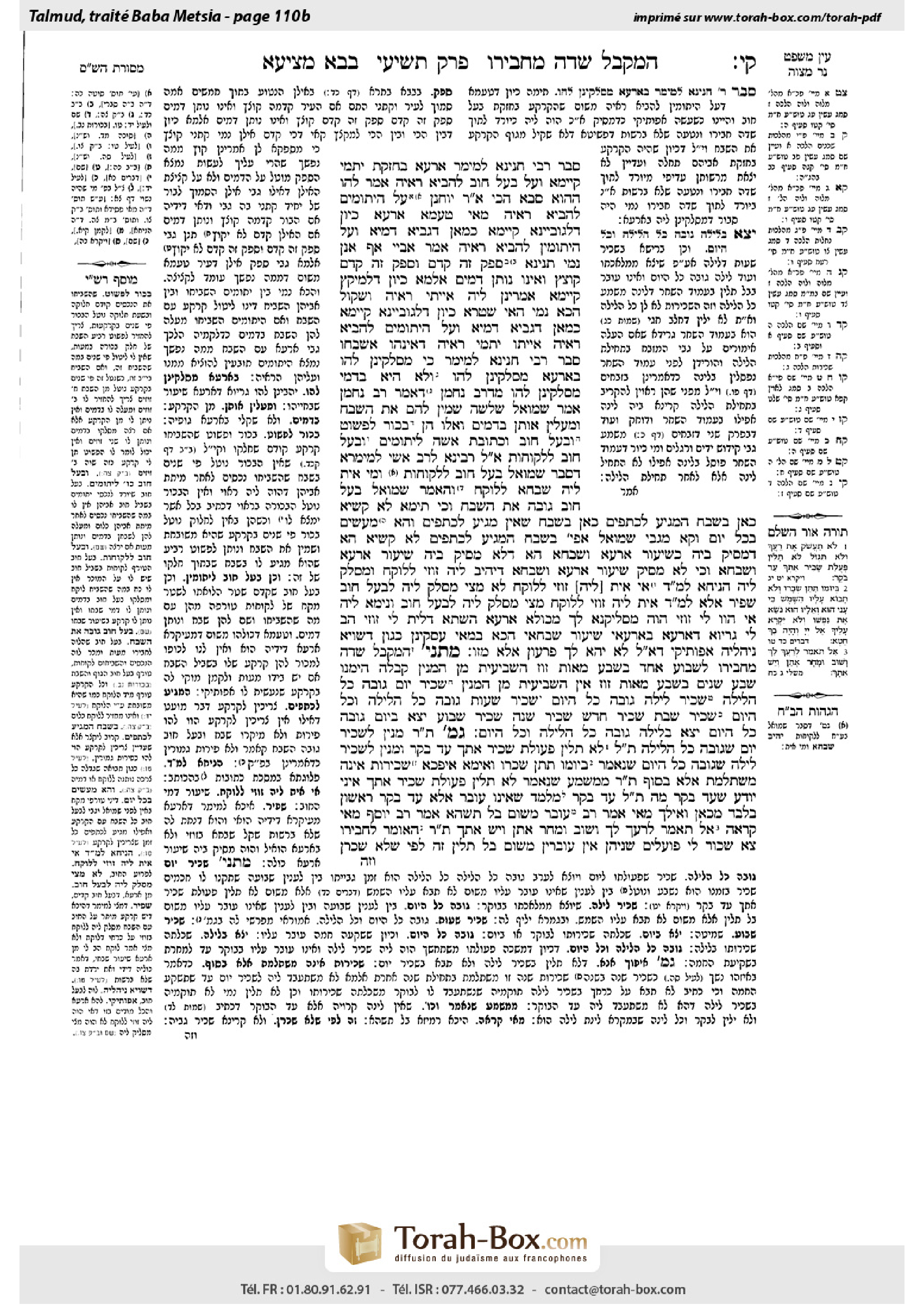
Bava Metzia 110b: Talmud study for Daf Yomi
Study the Talmud for Daf Yomi with scanned pages, Hebrew text, English translations from Sefaria and AI-generated French translations.
Passage selection and English or AI-generated French translation are available where the scan has annotations. Daf Study is independent of Torah-Box and Sefaria.
Browse Bava Metzia · בבא מציעא · All tractatesBava Metzia 110b text and translations
This page of Bava Metzia includes the Aramaic text, an English translation and an AI-generated French translation, alongside the scan above.
בבא מציעא ק״י ב · Aramaic and Hebrew text
סָבַר רַבִּי חֲנִינָא לְמֵימַר: אַרְעָא בְּחֶזְקַת יַתְמֵי קָיְימָא, וְעַל בַּעַל חוֹב לְהָבִיא רְאָיָה. אֲמַר לְהוּ הַהוּא סָבָא, הָכִי אָמַר רַבִּי יוֹחָנָן: עַל הַיְּתוֹמִים לְהָבִיא רְאָיָה. מַאי טַעְמָא? אַרְעָא, כֵּיוָן דִּלְגוּבְיָינָא קָיְימָא – כְּמַאן דְּגַבְיָא דָּמְיָא, וְעַל הַיְּתוֹמִין לְהָבִיא רְאָיָה.
אָמַר אַבָּיֵי, אַף אֲנַן נָמֵי תְּנֵינָא: סָפֵק זֶה קָדַם וְסָפֵק זֶה קָדַם – קוֹצֵץ וְאֵינוֹ נוֹתֵן דָּמִים.
אַלְמָא כֵּיוָן דִּלְמִיקָּץ קָיְימָא, אָמְרִינַן לֵיהּ: אַיְיתִי רְאָיָה וּשְׁקוֹל. הָכִי נָמֵי, הַאי שְׁטָרָא כֵּיוָן דִּלְגוּבְיָינָא קָיְימָא – כְּמַאן דְּגַבְיָא דָּמְיָא, וְעַל הַיְּתוֹמִים לְהָבִיא רְאָיָה.
אַיְיתוֹ יַתְמֵי רְאָיָה דְּאִינְהוּ אַשְׁבַּחוּ, סָבַר רַבִּי חֲנִינָא לְמֵימַר: כִּי מְסַלְּקִינַן לְהוּ – בְּאַרְעָא מְסַלְּקִינַן לְהוּ.
וְלָא הִיא, בִּדְמֵי מְסַלְּקִינַן לְהוּ, מִדְּרַב נַחְמָן. דְּאָמַר רַב נַחְמָן אָמַר שְׁמוּאֵל: שְׁלֹשָׁה שָׁמִין לָהֶם אֶת הַשֶּׁבַח, וּמַעֲלִין אוֹתָן בְּדָמִים, וְאֵלּוּ הֵן: בְּכוֹר לְפָשׁוּט,
וּבַעַל חוֹב וּכְתוּבַּת אִשָּׁה לִיתוֹמִים, וּבַעַל חוֹב לְלָקוֹחוֹת.
אֲמַר לֵיהּ רָבִינָא לְרַב אָשֵׁי: לְמֵימְרָא דְּסָבַר שְׁמוּאֵל בַּעַל חוֹב לְלָקוֹחוֹת? וּמַאי אִית לֵיהּ שְׁבָחָא לְלוֹקֵחַ? וְהָאָמַר שְׁמוּאֵל בַּעַל חוֹב גּוֹבֶה אֶת הַשֶּׁבַח! וְכִי תֵּימָא, לָא קַשְׁיָא: כָּאן – בְּשֶׁבַח הַמַּגִּיעַ לִכְתֵפַיִם, כָּאן – בְּשֶׁבַח שֶׁאֵין מַגִּיעַ לַכְּתֵפַיִם. וְהָא מַעֲשִׂים בְּכׇל יוֹם, וְקָא מַגְבֵּי שְׁמוּאֵל אֲפִילּוּ בְּשֶׁבַח הַמַּגִּיעַ לִכְתֵפַיִם!
לָא קַשְׁיָא: הָא דְּמַסֵּיק בֵּיהּ כְּשִׁיעוּר אַרְעָא וּשְׁבָחָא, הָא דְּלָא מַסֵּיק בֵּיהּ שִׁיעוּר אַרְעָא וּשְׁבָחָא.
וְכִי לָא מַסֵּיק שִׁיעוּר אַרְעָא וּשְׁבָחָא, דְּיָהֵיב לֵיהּ זוּזֵי לְלוֹקֵחַ וּמְסַלֵּק לֵיהּ, הָנִיחָא לְמַאן דְּאָמַר: אִי אִית לֵיהּ זוּזֵי לְלוֹקֵחַ לָא מָצֵי מְסַלֵּק לֵיהּ לְבַעַל חוֹב – שַׁפִּיר. אֶלָּא לְמַאן דְּאָמַר: אִית לֵיהּ זוּזֵי לְלוֹקֵחַ מָצֵי מְסַלֵּק לֵיהּ לְבַעַל חוֹב, וְנֵימָא לֵיהּ: אִי הֲווֹ לִי זוּזֵי – הֲוָה מְסַלֵּיקְנָא לָךְ מִכּוּלַּאּ אַרְעָא, הַשְׁתָּא דְּלֵית לִי זוּזֵי – הַב לִי גְּרִיוָא דְּאַרְעָא בְּאַרְעַאי שִׁיעוּר שְׁבָחַאי!
הָכָא בְּמַאי עָסְקִינַן – כְּגוֹן דְּשַׁוְּיַאּ נִיהֲלֵיהּ אַפּוֹתֵיקֵי, דַּאֲמַר לֵיהּ: לֹא יְהֵא לְךָ פֵּרָעוֹן אֶלָּא מִזּוֹ.
מַתְנִי׳ הַמְקַבֵּל שָׂדֶה מֵחֲבֵירוֹ לְשָׁבוּעַ אֶחָד בִּשְׁבַע מֵאוֹת זוּז, הַשְּׁבִיעִית מִן הַמִּנְיָן. קִבְּלָהּ הֵימֶנּוּ שֶׁבַע שָׁנִים בִּשְׁבַע מֵאוֹת זוּז – אֵין הַשְּׁבִיעִית מִן הַמִּנְיָן.
שְׂכִיר יוֹם – גּוֹבֶה כׇּל הַלַּיְלָה. שְׂכִיר לַיְלָה – גּוֹבֶה כׇּל הַיּוֹם. שְׂכִיר שָׁעוֹת – גּוֹבֶה כׇּל הַלַּיְלָה וְכׇל הַיּוֹם. שְׂכִיר שַׁבָּת, שְׂכִיר חֹדֶשׁ, שְׂכִיר שָׁנָה, שְׂכִיר שָׁבוּעַ, יָצָא בַּיּוֹם – גּוֹבֶה כׇּל הַיּוֹם, יָצָא בַּלַּיְלָה – גּוֹבֶה כׇּל הַלַּיְלָה וְכׇל הַיּוֹם.
גְּמָ׳ תָּנוּ רַבָּנַן: מִנַּיִן לִשְׂכִיר יוֹם שֶׁגּוֹבֶה כׇּל הַלַּיְלָה? תַּלְמוּד לוֹמַר: ״לֹא תָלִין פְּעֻלַּת שָׂכִיר אִתְּךָ עַד בֹּקֶר״. וּמִנַּיִן לִשְׂכִיר לַיְלָה שֶׁגּוֹבֶה כׇּל הַיּוֹם – שֶׁנֶּאֱמַר: ״בְּיוֹמוֹ תִתֵּן שְׂכָרוֹ״.
וְאֵימָא אִיפְּכָא! שְׂכִירוּת אֵינָהּ מִשְׁתַּלֶּמֶת אֶלָּא בַּסּוֹף.
תָּנוּ רַבָּנַן: מִמַּשְׁמַע שֶׁנֶּאֱמַר ״לֹא תָלִין פְּעֻלַּת שָׂכִיר אִתְּךָ״, אֵינִי יוֹדֵעַ שֶׁ״עַד בֹּקֶר״? מָה תַּלְמוּד לוֹמַר ״עַד בֹּקֶר״ – מְלַמֵּד שֶׁאֵינוֹ עוֹבֵר אֶלָּא עַד בֹּקֶר רִאשׁוֹן בִּלְבַד.
מִכָּאן וְאֵילָךְ, מַאי? אָמַר רַב: עוֹבֵר מִשּׁוּם ״בַּל תְּשַׁהֶא״. אָמַר רַב יוֹסֵף: מַאי קְרָאָה – ״אַל תֹּאמַר לְרֵעֲךָ לֵךְ וָשׁוּב וּמָחָר אֶתֵּן וְיֵשׁ אִתָּךְ״.
תָּנוּ רַבָּנַן: הָאוֹמֵר לַחֲבֵירוֹ צֵא שְׂכוֹר לִי פּוֹעֲלִים – שְׁנֵיהֶן אֵין עוֹבְרִין מִשּׁוּם ״בַּל תָּלִין״. זֶה, לְפִי שֶׁלֹּא שְׂכָרָן,
Bava Metzia 110b · English translation
Rabbi Ḥanina thought to say that the land remains in the orphans’ possession, as they are currently in control of it, and therefore the responsibility falls upon the creditor to bring proof. A certain elder said to them: This is what Rabbi Yoḥanan says: The responsibility falls upon the orphans to bring proof. What is the reason for this? Since this land stands ready for collection, it is considered as though it has already been collected and is in the creditor’s possession. Consequently, the responsibility falls upon the orphans to bring proof.
Abaye said: We learn a similar halakha in the mishna (Bava Batra 24b) as well, with regard to a tree planted adjacent to a city. Such a tree must be chopped down in any event, regardless of what preceded what. If the city preceded the tree, the owner is not entitled to compensation, but if the tree was there first, he receives payment for the tree. If it is uncertain whether this one was first or that one was first, the owner of the tree cuts it down and the people of the city do not give money to the owner.
Apparently, since this tree is standing to be chopped down, as it is chopped down regardless of whether it or the town was there first, we say to the owner of the tree: You must bring proof to support your claim that the tree was there before the town and only then you may take its value, although the tree is currently in his possession and has not yet been cut down. So too, with regard to this document recording the lien on the land, since it is ready for collection, it is considered as though it has been collected and the responsibility falls upon the orphans to bring proof.
In the case where the orphans brought proof that they indeed enhanced the land, Rabbi Ḥanina thought to say: When we remove them, we remove them by giving them part of the land equivalent to the value of their enhancement.
The Gemara comments: But that is not so, as we remove them by paying them with money, as derived from a statement of Rav Naḥman. As Rav Naḥman says that Shmuel says: In three cases the court appraises the enhanced value for the parties involved in enhancing a field, and they are paid in money rather than by being given a portion of the property. And these are they: The first is a firstborn son who makes payment to an ordinary, i.e., non-firstborn, son. This is a case where two sons, one firstborn and the other not, inherit a field from their father. Before it is divided, they both work and enhance the field. When the time comes to divide the field, the firstborn son, who receives a double portion, must pay his brother for the enhancement that the latter contributed to the former’s portion. This payment is given in money rather than land.
And the second case is that of payment taken by a creditor or the payment of a marriage contract by someone who is obligated to reimburse orphans, i.e., a creditor or widow who collects land from the orphans of the deceased debtor or husband, respectively. He or she must pay the orphans for any enhancements they made after their father’s death. This payment is also given in money rather than land. And the third case is that of a creditor who is obligated to purchasers, i.e., a creditor who collects the debt from lands that were sold by the debtor. He pays money to the purchaser for the enhancements generated by the purchaser but does not pay him in land.
Ravina said to Rav Ashi: Is this to say that Shmuel maintains that a creditor must pay the value of the enhancement to the buyers? And what type of enhancement is there that is given to a buyer according to Shmuel? But doesn’t Shmuel say: A creditor collects even the enhancement, not only the land itself? And if you would say that this is not difficult, as here it is referring to enhancement that is so great that it reaches the shoulders, meaning it is large enough to be carried away on porters’ shoulders, whereas there it is referring to enhancement that does not reach the shoulders, that is still difficult. But aren’t there incidents every day where Shmuel would collect everything on behalf of a creditor, even enhancement that reaches the shoulders?
The Gemara responds: It is not difficult; this is referring to a case where the debtor owed him the amount of the value of the land and the enhancement combined, and therefore the creditor does not leave the buyers with anything, whereas that involves a case where he did not owe him the amount of the value of the land and the enhancement. Since he has taken more than the sum to which he is entitled, he pays the buyers for the improvement.
The Gemara asks: And if he did not owe him the amount of the value of the land and the enhancement, it was stated that the creditor gives the buyer money and removes him. This works out well according to the one who says that even if the buyer has money he cannot remove the creditor by paying him his debt in cash, as the creditor has the right to claim land. According to this opinion, it works well. But according to the one who says that if the buyer has money he may remove the creditor by paying him cash and keep the land for himself, let him say to him as follows: If I had money prepared I would remove you from the entire land; now that I do not have money equal to the value of the entire land, since you must repay me for the enhancement, at least give me a plot of earth in my land corresponding to the amount of the value of my enhancement.
The Gemara responds: Here we are dealing with a case where the debtor set aside this land as designated repayment [apoteiki] for the creditor, as he said to him: You shall be able to collect from only this land, but no other. Consequently, the creditor wants to take the entire land, as his lien applies only to this field, and if it turns out that he has other claims he will be unable to collect them from elsewhere.
MISHNA: In the case of one who receives a field from another to cultivate for one Sabbatical cycle of seven years culminating with the Sabbatical Year for seven hundred dinars, the Sabbatical Year is included in the tally, despite the fact that he is unable to work the land during that year. If he received it from him to cultivate for seven years for seven hundred dinars, the Sabbatical Year is not included in the number, and he may keep the field for an additional year to take the place of the Sabbatical Year, during which he could not work the land.
The tanna addresses a different issue, the halakha of the payment of workers. A day laborer collects his wages from his employer all night following his work shift. A night laborer collects his wages all the following day, while an hourly laborer collects his wages all night and all day. With regard to a weekly laborer, a monthly laborer, a yearly laborer, or a laborer for a Sabbatical cycle of seven years, if he left upon the completion of his work in the day, he collects his wages all day; if he left at night, he collects his wages all night and all day.
GEMARA: The Sages taught: From where is it derived concerning a day laborer that he collects his wages all night? The verse states: “The wages of a hired laborer shall not remain with you all night until the morning” (Leviticus 19:13). This indicates that he must pay him by the morning, and he has therefore not transgressed the prohibition of delaying the payment of wages until that time. And from where is it derived concerning a night laborer that he collects his wages all day? As it is stated: “On the same day you shall give him his wages” (Deuteronomy 24:15).
The Gemara asks: But why not say the opposite, i.e., that a night laborer may be paid all night, while a day laborer receives his wages all day? The Gemara responds: The obligation to pay a person’s wage is incurred only at the end of the period for which he was hired.
The Sages taught: From the indication of that which is stated in the verse: “The wages of a hired laborer shall not remain with you all night [lo talin],” do I not know that this means: “Until the morning,” as this is the meaning of: “Remain with you all night [talin]”? Why must the verse state: “Until the morning”? It teaches that he transgresses the prohibition of withholding payment only until the first morning alone, but does not transgress this prohibition another time for any further delay.
The Gemara asks: From that point forward, what is the halakha? Rav said: Although one no longer transgresses the prohibition of delaying payment of wages, one violates the prohibition of: Do not delay, by delaying his wages. Rav Yosef said: What is the verse from which it is derived? “Do not say to your neighbor: Go and come again, and tomorrow I will give, when you have it with you” (Proverbs 3:28).
The Sages taught: Concerning one who says to another: Go out and hire workers for me, both of them do not violate the prohibition of delaying payment of wages if they fail to pay immediately. This one, the employer, is exempt because he did not hire them himself, and strictly speaking they are not his hired workers.
Bava Metzia 110b · Traduction française (IA)
Rabbi Ḥanina pensait dire que la terre demeure dans la possession des orphelins, puisqu'ils sont actuellement maîtres d'elle, et donc la responsabilité incombe au créancier de fournir une preuve. Un vieil homme dit à eux : C'est ce que Rabbi Yoḥanan dit : La responsabilité incombe aux orphelins de fournir une preuve. Pourquoi est-ce ainsi ? Parce que cette terre est prête à être réclamée, on la considère comme si elle avait déjà été réclamée et était en possession du créancier. Ainsi, la responsabilité incombe aux orphelins de fournir une preuve.
Abaye dit : Nous apprenons une halakha semblable dans la mishna (Bava Batra 24b) également, concernant un arbre planté à proximité d'une ville. Cet arbre doit être abattu de toute façon, indépendamment de l'ordre des événements. Si la ville a précédé l'arbre, le propriétaire n'a pas droit à une compensation, mais si l'arbre était là en premier, il reçoit une rémunération pour l'arbre. Si l'on ne sait pas si c'est l'arbre ou la ville qui a été le premier, le propriétaire de l'arbre abat l'arbre et les habitants de la ville ne donnent pas d'argent au propriétaire.
Apparemment, puisque cet arbre est prêt à être abattu, puisqu'il est abattu indépendamment de savoir si c'est l'arbre ou la ville qui était là en premier, nous disons au propriétaire de l'arbre : Vous devez fournir une preuve pour soutenir votre revendication que l'arbre était là avant la ville et seulement alors vous pouvez réclamer sa valeur, bien que l'arbre soit actuellement en votre possession et n'ait pas encore été abattu. De même, concernant ce document qui enregistre le droit de réclamation sur la terre, puisque ce dernier est prêt à être réclamé, on le considère comme s'il avait déjà été réclamé et la responsabilité incombe aux orphelins de fournir une preuve.
Dans le cas où les orphelins ont apporté une preuve qu'ils ont amélioré la terre, Rabbi Ḥanina pensait dire : Lorsque nous les expulsons, nous les expulsons en leur donnant une part de la terre équivalente à la valeur de leur amélioration.
La Guemara commente : Mais cela n'est pas ainsi, car nous les expulsons en leur payant en argent, comme déduit d'une déclaration de Rav Naḥman. Comme Rav Naḥman dit que Shmuel dit : Dans trois cas, la cour évalue la valeur améliorée pour les parties impliquées dans l'amélioration d'un champ, et ils sont payés en argent plutôt qu'en portion de propriété. Et ces trois cas sont : le premier est un fils aîné qui paie un frère ordinaire, c'est-à-dire non aîné. C'est le cas où deux fils, l'un aîné et l'autre non, héritent d'un champ de leur père. Avant la division, ils travaillent tous les deux et améliorent le champ. Lorsque vient le temps de diviser le champ, le fils aîné, qui reçoit une double portion, doit payer à son frère pour l'amélioration que ce dernier a contribué à sa portion. Ce paiement est donné en argent plutôt que en terre.
Et le deuxième cas est celui de la réclamation d'un créancier ou le paiement d'un contrat de mariage par une personne obligée de réparer les orphelins, c'est-à-dire un créancier ou une veuve qui réclame la terre des orphelins du débiteur décédé ou du mari respectivement. Il ou elle doit payer aux orphelins pour toute amélioration qu'ils ont réalisée après la mort de leur père. Ce paiement est également donné en argent plutôt que en terre. Et le troisième cas est celui d'un créancier obligé aux acheteurs, c'est-à-dire un créancier qui réclame la dette des terres vendues par le débiteur. Il paie en argent aux acheteurs pour les améliorations générées par l'acheteur mais ne paie pas en terre.
Ravina dit à Rav Ashi : Est-ce que cela signifie que Shmuel maintient que le créancier doit payer la valeur de l'amélioration aux acheteurs ? Et quel type d'amélioration y a-t-il selon Shmuel qui est donnée à un acheteur ? Mais ne dit pas Shmuel : Le créancier réclame même l'amélioration, pas seulement la terre elle-même ? Et si vous dites que cela n'est pas difficile, comme ici il s'agit d'une amélioration si grande qu'elle atteint les épaules, c'est-à-dire suffisamment grande pour être portée sur les épaules des porteurs, alors que là il s'agit d'une amélioration qui n'atteint pas les épaules, c'est-à-dire qui est encore difficile. Mais n'y a-t-il pas des cas quotidiens où Shmuel réclamait tout au nom du créancier, même l'amélioration qui atteint les épaules ?
La Guemara répond : Ce n'est pas difficile ; il s'agit d'un cas où le débiteur devait à l'individu la valeur de la terre et de l'amélioration combinées, et donc le créancier ne laisse pas les acheteurs avec quoi que ce soit, tandis que cela concerne un cas où il ne devait pas la valeur de la terre et de l'amélioration. Puisqu'il a pris plus que ce à quoi il avait droit, il paie aux acheteurs pour l'amélioration.
La Guemara pose la question : Et s'il ne devait pas la valeur de la terre et de l'amélioration, il a été dit que le créancier donne de l'argent à l'acheteur et l'éloigne. Cela fonctionne bien selon celui qui dit que même si l'acheteur a de l'argent, il ne peut pas éloigner le créancier en lui payant sa dette en espèces, car le créancier a le droit de réclamer la terre. Selon cet avis, cela fonctionne bien. Mais selon celui qui dit que si l'acheteur a de l'argent, il peut éloigner le créancier en lui payant en espèces et garder la terre pour lui, dis-lui comme suit : Si j'avais de l'argent préparé, je t'aurais éloigné de toute la terre ; maintenant que je n'ai pas d'argent équivalent à la valeur de toute la terre, puisque tu dois me réparer pour l'amélioration, au moins donne-moi une parcelle de terre dans ma terre correspondant à la valeur de mon amélioration.
La Guemara répond : Ici, nous sommes en présence d'un cas où le débiteur a désigné cette terre comme rétribution [apoteiki] pour le créancier, car il a dit à lui : Tu dois pouvoir réclamer uniquement de cette terre, pas d'une autre. Ainsi, le créancier veut prendre toute la terre, car son droit de réclamation s'applique uniquement à ce champ, et s'il découvre qu'il a d'autres revendications, il sera incapable de les réclamer ailleurs.
MICHNA : Dans le cas d'une personne qui reçoit un champ d'une autre pour le cultiver pendant un cycle de sept ans, culminant avec l'année sabbatique, pour sept cents dinars, l'année sabbatique est comptée dans le délai, malgré le fait qu'il ne puisse pas travailler la terre durant cette année. Si l'on a reçu ce champ pour le cultiver pendant sept ans pour sept cents dinars, l'année sabbatique n'est pas comptée dans le délai, et l'on peut conserver le champ pendant une année supplémentaire pour remplacer l'année sabbatique, durant laquelle on ne pouvait pas travailler la terre.
Le tanna aborde une question différente, celle de la halakha concernant le paiement des ouvriers. Un ouvrier de jour reçoit ses salaires de son employeur toute la nuit après la fin de son service. Un ouvrier de nuit reçoit ses salaires toute la journée suivante, tandis qu'un ouvrier horaire reçoit ses salaires toute la nuit et toute la journée. En ce qui concerne un ouvrier hebdomadaire, un ouvrier mensuel, un ouvrier annuel ou un ouvrier pour un cycle de sept ans de Sabbat, si il quitte à la fin de son service de jour, il reçoit ses salaires toute la journée ; si il quitte la nuit, il reçoit ses salaires toute la nuit et toute la journée.
GUEMARA : Les Sages ont enseigné : D'où tire-t-on que l'ouvrier de jour reçoit ses salaires toute la nuit ? La Parashah dit : « Les salaires d'un ouvrier engagé ne doivent pas rester avec toi toute la nuit jusqu'au matin » (Lévitique 19:13). Cela indique qu'il doit être payé au matin, et qu'il n'a donc pas transgressé l'interdiction de retarder le paiement des salaires jusqu'à ce moment. Et d'où tire-t-on que l'ouvrier de nuit reçoit ses salaires toute la journée ? Comme il est dit : « Le même jour, tu lui donneras ses salaires » (Dn 24:15).
La Guemara pose la question : Pourquoi ne pas dire l'inverse, c'est-à-dire que l'ouvrier de nuit peut être payé toute la nuit, tandis que l'ouvrier de jour reçoit ses salaires toute la journée ? La Guemara répond : L'obligation de payer les salaires d'une personne est engagée uniquement à la fin de la période pour laquelle il a été engagé.
Les Sages ont enseigné : D'après l'indication de ce qui est dit dans la Parashah : « Les salaires d'un ouvrier engagé ne doivent pas rester avec toi toute la nuit [lo talin] », ne tire-t-on pas que cela signifie : « Jusqu'au matin », comme c'est la signification de : « Restent avec toi toute la nuit [talin] » ? Pourquoi la Parashah dit-elle : « Jusqu'au matin » ? Elle enseigne que l'on transgresse l'interdiction de retenir les salaires uniquement jusqu'au premier matin, mais qu'on ne transgresse pas cette interdiction une autre fois pour tout retard supplémentaire.
La Guemara pose la question : À partir de ce moment, quelle est la halakha ? Rav a dit : Bien que l'on ne transgresse plus l'interdiction de retarder le paiement des salaires, l'on viole l'interdiction de : Ne retarde pas, en retardant ses salaires. Rav Yosef a dit : De quelle Parashah tire-t-on cela ? « Ne dis pas à ton voisin : Va et reviens, et demain je te donnerai, quand tu as avec toi » (Proverbes 3:28).
Les Sages ont enseigné : Concernant celui qui dit à un autre : Sortez et embauchez des ouvriers pour moi, les deux ne commettent pas l'infraction de retarder le paiement des salaires s'ils ne paient pas immédiatement. Celui-ci, l'employeur, est exempt car il n'a pas lui-même embauché les ouvriers, et strictement parlant, ils ne sont pas ses ouvriers engagés.
Traduction française générée par IA à partir de l’édition anglaise de Sefaria. Vérifie toujours un passage avec le texte source.
Text from Sefaria: William Davidson Edition - Vocalized Aramaic (CC BY NC); William Davidson Edition - English (CC BY NC).