Bava Metzia 112a: Talmud study for Daf Yomi
Study the Talmud for Daf Yomi with scanned pages, Hebrew text, English translations from Sefaria and AI-generated French translations.
Passage selection and English or AI-generated French translation are available where the scan has annotations. Daf Study is independent of Torah-Box and Sefaria.
Browse Bava Metzia · בבא מציעא · All tractatesBava Metzia 112a text and translations
This page of Bava Metzia includes the Aramaic text, an English translation and an AI-generated French translation, alongside the scan above.
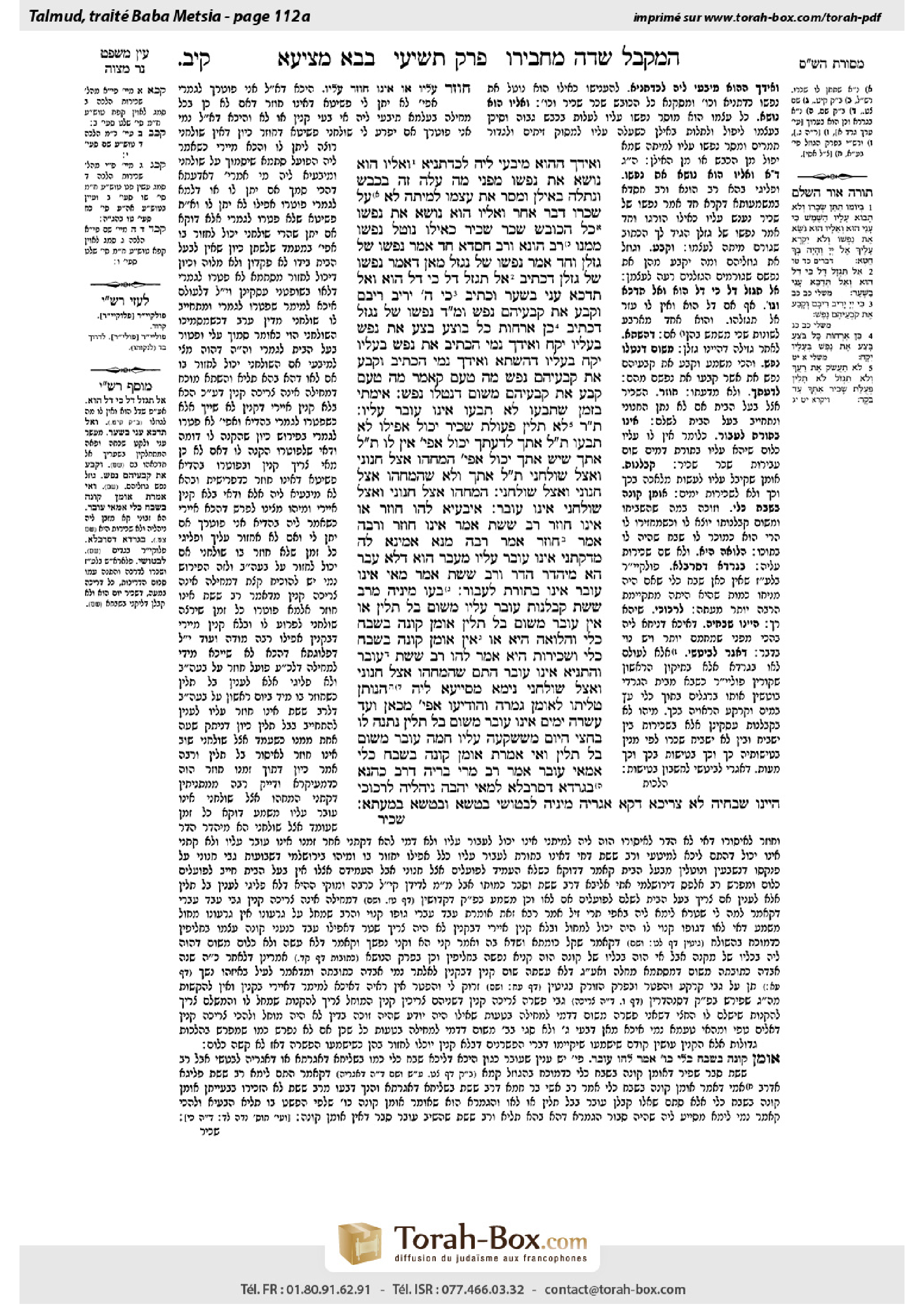
בבא מציעא קי״ב א · Aramaic and Hebrew text
וְאִידַּךְ: הַהוּא מִיבְּעֵי לֵיהּ לְכִדְתַנְיָא: ״וְאֵלָיו הוּא נֹשֵׂא אֶת נַפְשׁוֹ״, מִפְּנֵי מָה עָלָה זֶה בַּכֶּבֶשׁ וְנִתְלָה בָּאִילָן וּמָסַר אֶת עַצְמוֹ לְמִיתָה – לֹא עַל שְׂכָרוֹ?
דָּבָר אַחֵר: ״וְאֵלָיו הוּא נֹשֵׂא אֶת נַפְשׁוֹ״, כָּל הַכּוֹבֵשׁ שְׂכַר שָׂכִיר – כְּאִילּוּ נוֹטֵל נַפְשׁוֹ מִמֶּנּוּ. רַב הוּנָא וְרַב חִסְדָּא, חַד אָמַר: נַפְשׁוֹ שֶׁל גַּזְלָן, וְחַד אָמַר: נַפְשׁוֹ שֶׁל נִגְזָל.
מַאן דְּאָמַר נַפְשׁוֹ שֶׁל גַּזְלָן, דִּכְתִיב: ״אַל תִּגְזׇל דַּל כִּי דַל הוּא וְאַל תְּדַכֵּא עָנִי בַשָּׁעַר״, וּכְתִיב: ״כִּי ה׳ יָרִיב רִיבָם וְקָבַע אֶת קֹבְעֵיהֶם נָפֶשׁ״. וּמַאן דְּאָמַר נַפְשׁוֹ שֶׁל נִגְזָל, דִּכְתִיב: ״כֵּן אׇרְחוֹת כׇּל בּוֹצֵעַ בָּצַע אֶת נֶפֶשׁ בְּעָלָיו יִקָּח״.
וְאִידַּךְ נָמֵי, הָכְתִיב ״אֶת נֶפֶשׁ בְּעָלָיו יִקָּח״! בְּעָלָיו דְּהַשְׁתָּא. וְאִידַּךְ נָמֵי, הָכְתִיב: ״וְקָבַע אֶת קֹבְעֵיהֶם נָפֶשׁ״! מָה טַעַם קָאָמַר: מָה טַעַם ״קָבַע אֶת קֹבְעֵיהֶם״ – מִשּׁוּם דְּנָטְלוּ נָפֶשׁ.
אֵימָתַי – בִּזְמַן שֶׁתְּבָעוֹ, לֹא תְּבָעוֹ – אֵינוֹ עוֹבֵר עָלָיו. תָּנוּ רַבָּנַן: ״לֹא תָלִין פְּעֻלַּת שָׂכִיר״ יָכוֹל אֲפִילּוּ לֹא תְּבָעוֹ – תַּלְמוּד לוֹמַר: ״אִתְּךָ״, לְדַעְתְּךָ.
יָכוֹל אֲפִילּוּ אֵין לוֹ – תַּלְמוּד לוֹמַר: ״אִתְּךָ״. שֶׁיֵּשׁ אִתְּךָ. יָכוֹל אֲפִילּוּ הִמְחָהוּ אֵצֶל חֶנְוָנִי וְאֵצֶל שׁוּלְחָנִי, תַּלְמוּד לוֹמַר: ״אִתְּךָ״ וְלֹא שֶׁהִמְחָהוּ אֵצֶל חֶנְוָנִי וְאֵצֶל שׁוּלְחָנִי.
הִמְחָהוּ אֵצֶל חֶנְוָנִי וְאֵצֶל שׁוּלְחָנִי – אֵינוֹ עוֹבֵר. אִיבַּעְיָא לְהוּ: חוֹזֵר, אוֹ אֵינוֹ חוֹזֵר? רַב שֵׁשֶׁת אָמַר: אֵינוֹ חוֹזֵר, וְרַבָּה אָמַר: חוֹזֵר.
אָמַר רַבָּה: מְנָא אָמֵינָא לַהּ – מִדְּקָתָנֵי: אֵינוֹ עוֹבֵר עָלָיו, מִעְבָּר הוּא דְּלָא עָבַר, הָא מִיהְדָּר הָדַר. וְרַב שֵׁשֶׁת אָמַר: מַאי אֵינוֹ עוֹבֵר – אֵינוֹ בְּתוֹרַת לַעֲבוֹר.
בְּעוֹ מִינֵּיהּ מֵרַב שֵׁשֶׁת: קַבְּלָנוּת, עוֹבֵר עָלָיו מִשּׁוּם ״בַּל תָּלִין״, אוֹ אֵין עוֹבֵר מִשּׁוּם ״בַּל תָּלִין״?
אוּמָּן קוֹנֶה בִּשְׁבַח כְּלִי, וְהַלְוָאָה הִיא? אוֹ אֵין אוּמָּן קוֹנֶה בִּשְׁבַח כְּלִי, וּשְׂכִירוּת הִיא?
אֲמַר לְהוּ רַב שֵׁשֶׁת: עוֹבֵר! וְהָתַנְיָא: אֵינוֹ עוֹבֵר! הָתָם שֶׁהִמְחָהוּ אֵצֶל חֶנְוָנִי וְאֵצֶל שׁוּלְחָנִי.
נֵימָא מְסַיְּיעָא לֵיהּ: הַנּוֹתֵן טַלִּיתוֹ לְאוּמָּן, גְּמָרָהּ וְהוֹדִיעוֹ, אֲפִילּוּ מִכָּאן וְעַד עֲשָׂרָה יָמִים, אֵינוֹ עוֹבֵר מִשּׁוּם ״בַּל תָּלִין״. נְתָנָהּ לוֹ בַּחֲצִי הַיּוֹם – מִשֶּׁשָּׁקְעָה עָלָיו חַמָּה עוֹבֵר מִשּׁוּם ״בַּל תָּלִין״.
וְאִי אָמְרַתְּ אוּמָּן קוֹנֶה בִּשְׁבַח כְּלִי – אַמַּאי עוֹבֵר?
אָמַר רַב מָרִי בְּרֵיהּ דְּרַב כָּהֲנָא: בִּגְרָדָא דְּסַרְבָּלָא. לְמַאי יַהֲבֵהּ נִיהֲלֵיהּ – לְרַכּוֹכֵי, הַיְינוּ שְׁבָחֵיהּ.
לָא צְרִיכָא, דְּקָא אַגְרֵיהּ (מִינֵּיהּ) לְבַטּוֹשֵׁי בִּטְשָׁא וּבִטְשָׁא בְּמָעֲתָא.
Bava Metzia 112a · English translation
The Gemara asks: And what does the other Sage, the second tanna, derive from this verse? The Gemara responds: That verse is necessary for that which is taught in a baraita: The expression “for he sets his soul upon it” explains why one must be so precise when paying a laborer his wages: For what reason did this laborer ascend on a tall ramp or suspend himself from a tree and risk death to himself? Was it not for his wages? How, then, can his employer delay his payment?
Alternatively, the words “for he sets his soul upon it” teach that concerning one who withholds the wages of a hired laborer, it is as though he takes his soul from him. Rav Huna and Rav Ḥisda disagreed over the meaning of this statement. One says it is referring to the soul of the robber, meaning that one who steals from a hired laborer by delaying payment of his wages causes Heaven to remove his own soul, and one says that he takes the soul of the robbery victim, meaning that one who steals from a hired worker causes the death of the worker.
The Gemara cites proof for these two opinions. The one who says it is referring to the soul of the robber bases his opinion on a verse, as it is written: “Do not rob from the weak because he is weak, nor crush the poor in the gate” (Proverbs 22:22), and it is written immediately afterward: “For the Lord will plead their cause, and spoil the soul of those who spoil them” (Proverbs 22:23). This indicates that God will take the soul of one who steals from a poor person. And the one who says it is referring to the soul of the robbery victim bases his opinion on a verse, as it is written: “So are the ways of everyone who is greedy for gain; it takes away the life of its owners” (Proverbs 1:19). A robber is considered as if he removed the very soul of his victim.
The Gemara asks: And according to the other Sage too, isn’t it written: “It takes away the life of its owners”? How does he interpret this verse? The Gemara answers: This is referring to its current owner, i.e., the robber, who took the money and now owns it. The Gemara asks: And according to the other Sage too, isn’t it written: “And spoil the soul of those who spoil them”? How does he interpret this verse? The Gemara answers: This verse employs the style known as: What is the reason, as follows: What is the reason that God will spoil those who spoil them? Because they took someone’s soul, for which He will exact retribution.
§ The mishna teaches: When does he transgress these prohibitions? He transgresses them when the one owed the money claimed the payment from him. If he did not claim his payment from him, the other does not transgress the prohibitions. The Sages taught: With regard to the verse: “The wages of a hired laborer shall not remain with you all night until the morning” (Leviticus 19:13), one might have thought that he should be liable even if the laborer did not claim his wages from him. The verse states “with you,” meaning the prohibition is not transgressed unless it is with your knowledge and consent that you have not paid him. But if he did not even request his wages yet, the prohibition has not been violated.
Furthermore, one might have thought that the employer is liable even if he does not have the money to pay him. Therefore, the verse states “with you,” indicating that there is money with you. One might have thought that even if the employer transferred his payment to a storekeeper or to a money changer, he still violates the prohibition of delaying payment of wages. Therefore, the verse states “with you,” indicating that it applies only if the payment is your obligation, but not if he transferred it to a storekeeper or to a money changer, as then the payment of the laborer’s wages is no longer his responsibility.
§ The mishna teaches: If the one who owes the money transferred his payment by leaving instructions with a storekeeper or with a money changer to pay him, he does not transgress the prohibitions. A dilemma was raised before the Sages: If the storekeeper or money changer neglected to pay the wages, may the laborer return to the employer and claim his money from him, or may he not return, as the storekeeper or money changer is now his exclusive address for complaints? Rav Sheshet says he may not return, and Rabba says he may return.
Rabba said: From where do I state my opinion? From the fact that the mishna teaches: He does not transgress the prohibition, from which it may be inferred: He does not transgress the prohibition, but the laborer may still return to him to collect his wages. And Rav Sheshet said: What is the meaning of the ruling that he does not transgress the prohibition? It means that he is not included in the category of transgressing, as his transfer of the payment exempts him from all responsibility.
§ The Sages inquired of Rav Sheshet: If the laborer worked as a contractor, who is paid for a completed job rather than by the hour, does the employer violate the prohibition of delaying payment of wages or does he not violate the prohibition of delaying payment of wages?
The resolution to this inquiry depends on how a craftsman’s wages are classified. Does a craftsman, who is a type of contractor, acquire ownership rights through enhancement of the vessel? This would mean that the craftsman is considered to have acquired the vessel through his work, which enhances its value, and it remains in his possession until he returns it to the owners, who are then considered to have purchased the enhanced item from him. And accordingly, his payment is akin to a loan in that it will not be subject to the prohibition of delaying the payment of wages. Or perhaps a craftsman does not acquire ownership rights through enhancement of the vessel,and the obligation of the owner to pay him is similar to the obligation to pay wages to any laborer, in which case the money is classified as a wage, and is subject to the prohibition of delaying wages.
Rav Sheshet said to them: He does violate the prohibition. They asked Rav Sheshet: But isn’t it taught in a baraita that a contractor does not violate the prohibition? Rav Sheshet replied: There it is referring to a case where he transferred the wages to a storekeeper or to a money changer.
The Gemara suggests: Let us say that the following baraita supports the opinion of Rav Sheshet: With regard to one who gave his garment to a craftsman, and the craftsman concluded the work and notified the owner that the work was complete, even if the owner delays paying the craftsman from now until ten days henceforth, he does not violate the prohibition of delaying the payment of wages. If the craftsman gave the garment to him at midday, then once the sun has set and the owner has not paid him, the owner does violate the prohibition of delaying the payment of wages.
The Gemara concludes: And if it enters your mind to say that a craftsman acquires ownership rights through the enhancement of the vessel, why does the owner violate the prohibition of delaying the payment of wages? It is as if the craftsman acquired the garment, and the payment is considered to be a purchase of the garment by the owner, rather than a wage.
Rav Mari, son of Rav Kahana, said: There is no proof from here, as the baraita is stating the halakha with regard to the laundering of a thick garment, where there is no enhancement of the garment. Therefore, the craftsman does not acquire it. The Gemara asks: Ultimately, to what end did the owner of the garment give it to the craftsman? He gave it to him in order to soften it. Once he has softened it, that is its enhancement, and the craftsman has therefore acquired it.
The Gemara responds: No, it is necessary to teach this halakha in a case where the owner hired the craftsman for treading, i.e., to forcefully tread on the garment in water until it softens, with the owner paying the craftsman a ma’a coin for each tread. Accordingly, this is considered hired labor, where the craftsman is paid based on the amount of times he performed an action, and not contractual labor, where he is paid based on the outcome, in this case, a softened garment, and the prohibition of delaying payment of wages does apply to this case.
Bava Metzia 112a · Traduction française (IA)
Le Guemara pose la question : Et qu'entend le deuxième tanna, le sage suivant, par cette versette ? Le Guemara répond : Cette versette est nécessaire pour ce qui est enseigné dans une baraïta : L'expression « car il met son âme sur cela » explique pourquoi l'on doit être si précis lors du paiement des salaires à un ouvrier : Pour quelle raison cet ouvrier est-il monté sur une rampe élevée ou s'est-il suspendu d'un arbre et a-t-il risqué sa vie ? N'était-ce pas pour ses salaires ? Comment, alors, son employeur peut-il retarder son paiement ?
D'une autre manière, les mots « car il met son âme sur cela » enseignent que concernant celui qui retient les salaires d'un ouvrier engagé, c'est comme s'il prenait son âme. Rav Huna et Rav Ḥisda étaient en désaccord sur la signification de cette déclaration. L'un dit qu'il s'agit de l'âme du voleur, c'est-à-dire que celui qui vole à un ouvrier en retardant le paiement de ses salaires cause que le Ciel retire son propre âme, et l'autre dit qu'il prend l'âme de la victime du vol, c'est-à-dire que celui qui vole à un ouvrier cause la mort de l'ouvrier.
Le Guemara cite une preuve pour ces deux opinions. Celui qui dit qu'il s'agit de l'âme du voleur s'appuie sur une versette, comme il est écrit : « Ne volez pas de l'impuissant, car il est impuissant, ni ne déshonorez le pauvre à la porte » (Proverbes 22:22), et il est écrit immédiatement après : « Car l'Éternel défendra leur cause, et ôtera l'âme de ceux qui les oppriment » (Proverbes 22:23). Cela indique que Dieu ôtera l'âme de celui qui vole à un pauvre. Et celui qui dit qu'il s'agit de l'âme de la victime du vol s'appuie sur une versette, comme il est écrit : « Ainsi sont les voies de tous ceux qui sont avides de gain ; il ôte la vie de ses propriétaires » (Proverbes 1:19). Le voleur est considéré comme s'il avait ôté l'âme même de sa victime.
Le Guemara pose la question : Et selon l'autre sage également, n'est-il pas écrit : « Il ôte la vie de ses propriétaires » ? Comment interprète-t-il cette versette ? Le Guemara répond : Cela fait référence à son propriétaire actuel, c'est-à-dire le voleur, qui a pris l'argent et qui le possède maintenant. Le Guemara pose la question : Et selon l'autre sage également, n'est-il pas écrit : « Et ôtera l'âme de ceux qui l'oppriment » ? Comment interprète-t-il cette versette ? Le Guemara répond : Cette versette utilise un style connu comme suit : Quel est le motif, comme suit : Quel est le motif que Dieu ôtera ceux qui l'oppriment ? Parce qu'ils ont pris l'âme de quelqu'un, pour laquelle Il exigera une rétribution.
§ La mitsna enseigne : Quand transgresse-t-il ces prohibitions ? Il transgresse lorsqu'il est demandé le paiement par celui qui est dû. Si celui qui est dû n'a pas demandé son paiement, l'autre ne transgresse pas les prohibitions. Les Sages enseignent : Concernant la versette : « Les salaires d'un ouvrier engagé ne doivent pas rester avec toi toute la nuit jusqu'au matin » (Lévitique 19:13), on pourrait penser qu'il est responsable même si l'ouvrier n'a pas réclamé ses salaires. La versette dit « avec toi », ce qui signifie que la prohibition n'est pas transgressée à moins que ce ne soit avec votre connaissance et votre accord que vous n'ayez pas payé. Mais si même la demande n'a pas été faite, la prohibition n'a pas été violée.
De plus, on pourrait penser que l'employeur est responsable même s'il n'a pas l'argent pour payer. Par conséquent, la versette dit « avec toi », indiquant qu'il y a de l'argent avec vous. On pourrait penser également que même si l'employeur a transféré le paiement à un marchand ou à un changeur, il enfreint toujours la prohibition de retarder le paiement des salaires. Par conséquent, la versette dit « avec toi », indiquant qu'il s'applique uniquement si le paiement est votre obligation, mais pas si l'employeur a transféré le paiement à un marchand ou à un changeur, car alors le paiement des salaires de l'ouvrier n'est plus sa responsabilité.
§ La mitsna enseigne : Si celui qui doit l'argent a transféré son paiement en laissant des instructions à un marchand ou à un changeur pour le payer, il ne transgresse pas les prohibitions. Un dilemme a été soulevé devant les Sages : Si le marchand ou le changeur a négligé de payer les salaires, peut l'ouvrier revenir à l'employeur pour réclamer son argent, ou ne peut-il pas revenir, le marchand ou le changeur étant désormais son seul point de contact pour les plaintes ? Rav Sheshet dit qu'il ne peut pas revenir, et Rabba dit qu'il peut revenir.
Rabba dit : D'où tire-je mon opinion ? De ce que la mitsna enseigne : Il ne transgresse pas la prohibition, d'où on peut en déduire : Il ne transgresse pas la prohibition, mais l'ouvrier peut toujours revenir à lui pour récupérer ses salaires. Et Rav Sheshet dit : Quelle est la signification de la décision selon laquelle il ne transgresse pas la prohibition ? Cela signifie qu'il n'est pas inclus dans la catégorie de ceux qui transgressent, car son transfert du paiement l'exempte de toute responsabilité.
§ Les Sages ont interrogé Rav Sheshet : Si l'ouvrier a travaillé comme un entrepreneur, qui est rémunéré pour un travail accompli plutôt que par l'heure, l'employeur enfreint-il la prohibition de retarder le paiement des salaires ou non ?
La résolution de cette interrogation dépend de la manière dont les salaires d'un artisan sont classés. L'artisan, qui est un type d'entrepreneur, acquiert-il des droits de propriété par l'amélioration du vaisseau ? Cela signifierait que l'artisan est considéré comme ayant acquis le vaisseau par son travail, qui l'a amélioré, et il reste en son possession jusqu'à ce qu'il le rende aux propriétaires, qui sont alors considérés comme ayant acheté l'objet amélioré de lui. Ainsi, son paiement est semblable à un prêt, et n'est pas soumis à la prohibition de retarder le paiement des salaires. Ou peut-être que l'artisan n'acquiert pas de droits de propriété par l'amélioration du vaisseau, et l'obligation du propriétaire de le payer est similaire à l'obligation de payer les salaires à tout ouvrier, dans ce cas le paiement est classé comme un salaire et est soumis à la prohibition de retarder le paiement des salaires.
Rav Sheshet dit à ceux-ci : Il viole la prohibition. Ils demandèrent à Rav Sheshet : Mais n’est-il pas enseigné dans une baraïta que le contractant ne viole pas la prohibition ? Rav Sheshet répondit : Là, il s’agit d’un cas où il a transféré les salaires à un marchand ou à un changeur.
La Guemara suggère : Disons que la baraïta suivante soutient l’opinion de Rav Sheshet : Concernant celui qui a donné son vêtement à un artisan, et l’artisan a terminé le travail et a informé le propriétaire que le travail était achevé, même si le propriétaire retarde le paiement à l’artisan depuis maintenant jusqu’à dix jours, il ne viole pas la prohibition de retarder le paiement des salaires. Si l’artisan a donné le vêtement à l’heure de midi, alors une fois que le soleil est couché et que le propriétaire n’a pas payé, le propriétaire viole la prohibition de retarder le paiement des salaires.
La Guemara conclut : Et si vous pensez que l’artisan acquiert des droits de propriété par l’amélioration du vêtement, pourquoi le propriétaire viole-t-il la prohibition de retarder le paiement des salaires ? C’est comme si l’artisan avait acquis le vêtement, et le paiement est considéré comme un achat du vêtement par le propriétaire, plutôt qu’un salaire.
Rav Mari, fils de Rav Kahana, dit : Il n’y a pas de preuve ici, car la baraïta énonce la halakha concernant le lavage d’un vêtement épais, où il n’y a pas d’amélioration du vêtement. Par conséquent, l’artisan ne l’acquiert pas. La Guemara demande : Finalement, à quel fin le propriétaire du vêtement a-t-il donné ce dernier à l’artisan ? Il l’a donné pour le ramollir. Une fois qu’il l’a ramoli, c’est son amélioration, et l’artisan a donc acquis le vêtement.
La Guemara répond : Non, il faut enseigner cette halakha dans un cas où le propriétaire a engagé l’artisan pour treader, c’est-à-dire pour tasser le vêtement dans l’eau jusqu’à ce qu’il soit ramolli, avec le propriétaire payant à l’artisan une monnaie de ma’a pour chaque tressage. Ainsi, cela est considéré comme un travail salarié, où l’artisan est payé selon le nombre de fois qu’il a effectué une action, et non un travail contractuel, où il est payé selon le résultat, à savoir un vêtement ramolli, et la prohibition de retarder le paiement des salaires s’applique à ce cas.
Traduction française générée par IA à partir de l’édition anglaise de Sefaria. Vérifie toujours un passage avec le texte source.
Text from Sefaria: William Davidson Edition - Vocalized Aramaic (CC BY NC); William Davidson Edition - English (CC BY NC).