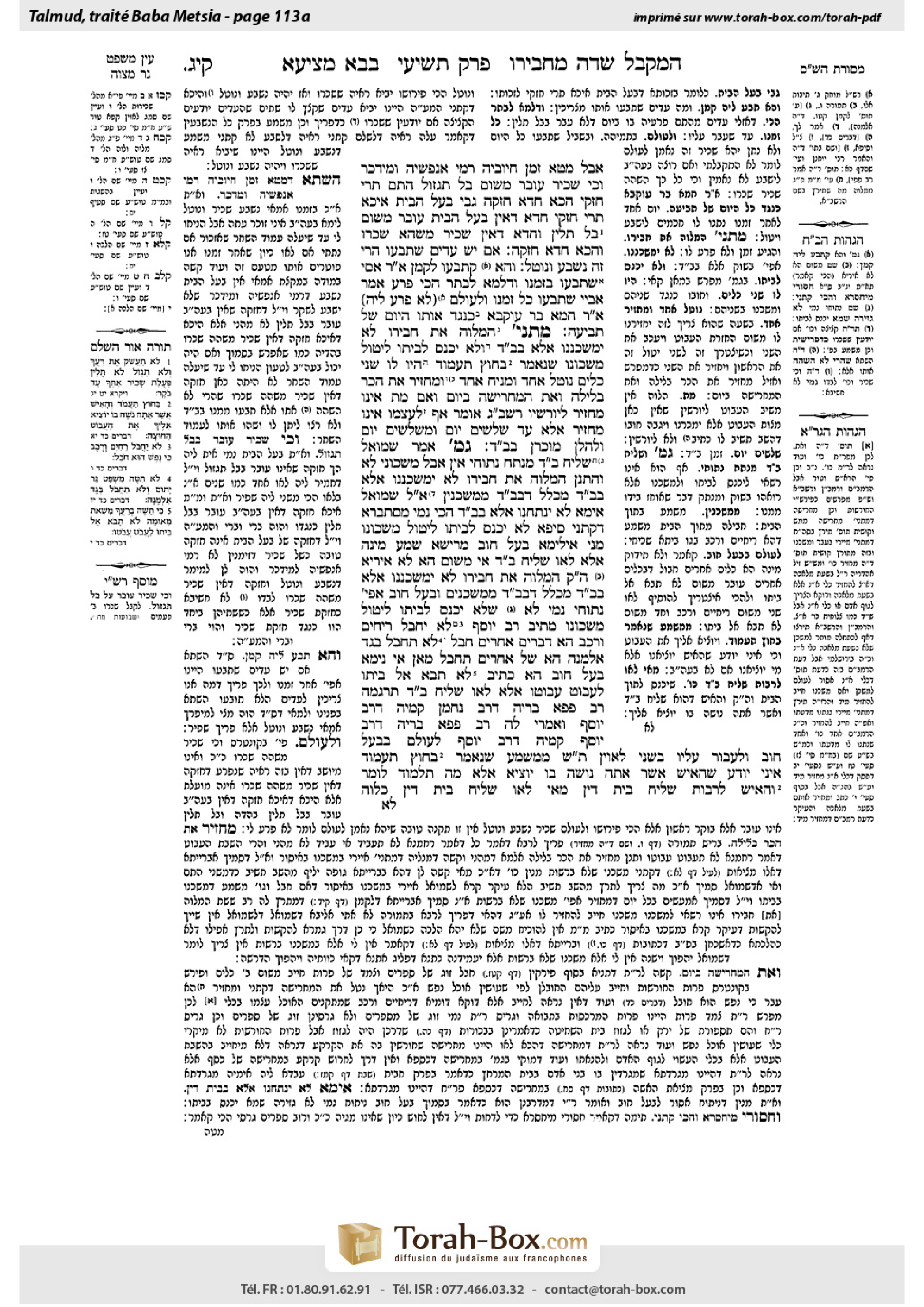
Bava Metzia 113a: Talmud study for Daf Yomi
Study the Talmud for Daf Yomi with scanned pages, Hebrew text, English translations from Sefaria and AI-generated French translations.
Passage selection and English or AI-generated French translation are available where the scan has annotations. Daf Study is independent of Torah-Box and Sefaria.
Browse Bava Metzia · בבא מציעא · All tractatesBava Metzia 113a text and translations
This page of Bava Metzia includes the Aramaic text, an English translation and an AI-generated French translation, alongside the scan above.
בבא מציעא קי״ג א · Aramaic and Hebrew text
אֲבָל מְטָא זְמַן חִיּוּבֵיהּ – רָמֵי אַנַּפְשֵׁיהּ וּמִידְּכַר.
וְכִי שָׂכִיר עוֹבֵר מִשּׁוּם ״בַּל תִּגְזֹל״? הָתָם תְּרֵי חֲזָקֵי, הָכָא חֲדָא חֲזָקָה. גַּבֵּי בַּעַל הַבַּיִת אִיכָּא תְּרֵי חֲזָקֵי: חֲדָא דְּאֵין בַּעַל הַבַּיִת עוֹבֵר מִשּׁוּם ״בַּל תָּלִין״, וַחֲדָא דְּאֵין שָׂכִיר מְשַׁהֶא שְׂכָרוֹ. וְהָכָא חֲדָא חֲזָקָה.
אִם יֵשׁ עֵדִים שֶׁתְּבָעוֹ – הֲרֵי זֶה נִשְׁבָּע וְנוֹטֵל. וְהָא (קָתָבְעוֹ לְקַמַּן) [קָא תָבַע לֵיהּ קַמַּן]? אָמַר רַבִּי אַסִּי: שֶׁתְּבָעוֹ בִּזְמַנּוֹ. וְדִלְמָא לְבָתַר הָכִי פְּרַע? אָמַר אַבָּיֵי: שֶׁתְּבָעוֹ כָּל זְמַנּוֹ.
וּלְעוֹלָם לָא פָּרַע לֵיהּ?! אָמַר רַב חָמָא בַּר עוּקְבָא: כְּנֶגֶד אוֹתוֹ הַיּוֹם שֶׁל תְּבִיעָה.
מַתְנִי׳ הַמַּלְוֶה אֶת חֲבֵירוֹ – לֹא יְמַשְׁכְּנֶנּוּ אֶלָּא בְּבֵית דִּין. וְלֹא יִכָּנֵס לְבֵיתוֹ לִיטּוֹל מַשְׁכּוֹנוֹ, שֶׁנֶּאֱמַר: ״בַּחוּץ תַּעֲמֹד״. הָיוּ לוֹ שְׁנֵי כֵלִים – נוֹטֵל אֶחָד וּמַנִּיחַ אֶחָד.
וּמַחְזִיר אֶת הַכַּר בַּלַּיְלָה וְאֶת הַמַּחְרֵישָׁה בַּיּוֹם. וְאִם מֵת – אֵינוֹ מַחְזִיר לְיוֹרְשָׁיו. רַבָּן שִׁמְעוֹן בֶּן גַּמְלִיאֵל אוֹמֵר: אַף לְעַצְמוֹ אֵינוֹ מַחְזִיר אֶלָּא עַד שְׁלֹשִׁים יוֹם, וּמִשְּׁלֹשִׁים יוֹם וּלְהַלָּן מוֹכְרָן בְּבֵית דִּין.
גְּמָ׳ אָמַר שְׁמוּאֵל: שְׁלִיחַ בֵּית דִּין מְנַתַּח נַתּוֹחֵי – אִין, אֲבָל מַשְׁכּוֹנֵי – לָא. וְהָתְנַן: הַמַּלְוֶה אֶת חֲבֵירוֹ לֹא יְמַשְׁכְּנֶנּוּ אֶלָּא בְּבֵית דִּין, מִכְּלָל דִּבְבֵית דִּין מְמַשְׁכְּנִין!
אָמַר לָךְ שְׁמוּאֵל: אֵימָא, לֹא יְנַתְּחֶנּוּ אֶלָּא בְּבֵית דִּין. הָכִי נָמֵי מִסְתַּבְּרָא, דְּקָתָנֵי סֵיפָא: לֹא יִכָּנֵס לְבֵיתוֹ לִיטּוֹל מַשְׁכּוֹנוֹ. מַנִּי? אִילֵּימָא בַּעַל חוֹב – מֵרֵישָׁא שָׁמְעַתְּ מִינַּהּ! אֶלָּא לָאו, שְׁלִיחַ בֵּית דִּין!
אִי מִשּׁוּם הָא – לָא אִירְיָא. הָכִי קָאָמַר: הַמַּלְוֶה אֶת חֲבֵירוֹ לֹא יְמַשְׁכְּנֶנּוּ אֶלָּא בְּבֵית דִּין, מִכְּלָל דִּבְבֵית דִּין מְמַשְׁכְּנִים, וּבַעַל חוֹב אֲפִילּוּ נַתּוֹחֵי נָמֵי לָא, שֶׁלֹּא יִכָּנֵס לְבֵיתוֹ לִיטּוֹל מַשְׁכּוֹנוֹ.
מֵתִיב רַב יוֹסֵף: ״לָא יַחֲבֹל רֵיחַיִם וָרָכֶב״, הָא דְּבָרִים אֲחֵרִים – חֲבֹל. ״לֹא תַחֲבֹל בֶּגֶד אַלְמָנָה״, הָא שֶׁל אֲחֵרִים – תַּחְבֹּל, מַאן? אִי נֵימָא בַּעַל חוֹב, הָא כְּתִיב: ״לֹא תָבֹא אֶל בֵּיתוֹ לַעֲבֹט עֲבֹטוֹ״, אֶלָּא לָאו שְׁלִיחַ בֵּית דִּין!
תַּרְגְּמַהּ רַב פָּפָּא בְּרֵיהּ דְּרַב נַחְמָן קַמֵּיהּ דְּרַב יוֹסֵף, וְאָמְרִי לַהּ רַב פָּפָּא בְּרֵיהּ דְּרַב יוֹסֵף קַמֵּיהּ דְּרַב יוֹסֵף: לְעוֹלָם בְּבַעַל חוֹב, וְלַעֲבוֹר עָלָיו בִּשְׁנֵי לָאוִין.
תָּא שְׁמַע: מִמַּשְׁמַע שֶׁנֶּאֱמַר ״בַּחוּץ תַּעֲמֹד״ אֵינִי יוֹדֵעַ שֶׁ״הָאִישׁ אֲשֶׁר אַתָּה נוֹשֶׁה בוֹ יוֹצִיא״! אֶלָּא מָה תַּלְמוּד לוֹמַר ״וְהָאִישׁ״ – לְרַבּוֹת שְׁלִיחַ בֵּית דִּין. מַאי לָאו: שְׁלִיחַ בֵּית דִּין כְּלֹוֶה?
Bava Metzia 113a · English translation
but when the time of his obligation to pay arrives, he applies himself and remembers all the details, so as not to violate the prohibition of delaying payment of the laborer’s wages.
The Gemara asks: Why would one rely upon the presumption that the employer would not transgress? But is the hired laborer suspected of violating the prohibition of stealing? The Gemara replies: There, concerning the credibility of an employer, there are two presumptions, whereas here, concerning the credibility of a laborer, there is only one presumption. The Gemara explains: Concerning the credibility of an employer there are the following two presumptions: One is that the employer does not violate the prohibition of delaying payment of wages, and the other one is that a hired laborer does not delay the request for his wages. But here, concerning the credibility of the laborer, there is only one presumption, i.e., that the laborer does not violate the prohibition of stealing.
The mishna teaches: If there are witnesses who testify that he claimed the money from him, he takes an oath and receives the money. The Gemara asks: But what need is there for witnesses that he lodged a claim, when he is claiming it from him in front of us? Rabbi Asi said: The tanna is referring to witnesses that testified that he claimed it from him at its proper time. The Gemara challenges: Even if the laborer claimed the money at the proper time, perhaps the employer paid him afterward. Abaye said: The witnesses testify that he claimed it from him the entire time, i.e., from the time he completed his labor until the end of that day.
The Gemara continues: And is it always assumed that the employer did not pay the laborer? Why does the fact that he claimed his money at the proper time mean that his claim against his employer is always accepted? Rav Ḥama bar Ukva said: The tanna means that he is given another day corresponding to that day of his claim during which the laborer can claim that he has not been paid.
MISHNA: With regard to one who lends money to another and the debtor fails to repay it at the end of the term of the loan, the creditor may take collateral from him to ensure payment only by means of an agent of the court, not of his own accord. And he may not enter the debtor’s house to take his collateral, as it is stated: “When you lend your neighbor any manner of loan, you shall not go into his house to take his collateral. You shall stand outside, and the man to whom you lend shall bring forth the collateral to you outside” (Deuteronomy 24:10–11). If the debtor had two utensils of the same kind, the creditor takes one and leaves the other one in the debtor’s possession.
And in addition, the creditor must return a pillow at night, as the debtor requires it for sleeping, and a plow, which is needed for his daytime work, by day. If the debtor died, he is not required to return it to the debtor’s heirs. Rabban Shimon ben Gamliel says: Even to the debtor himself he needs to return the collateral each day only until thirty days have passed, and from thirty days onward, the creditor can sell them in court, with the proceeds going toward payment of the debt.
GEMARA: Shmuel says: An agent of the court who was granted permission to appropriate items from a debtor up to the sum of the loan may seize these items from him in the marketplace, but is not permitted to enter the debtor’s house and take collateral. The Gemara asks: But didn’t we learn in the mishna that one who lends money to another may take collateral from him only by means of an agent of the court, which proves by inference that when it is taken by means of an agent of the court the agent of the court may enter the debtor’s house and take collateral?
The Gemara responds: Shmuel could have said to you: Say that the mishna meant as follows: He may seize it forcibly from him only by means of an agent of the court. The Gemara adds: So, too, it is reasonable that this is correct, as the latter clause of the mishna teaches: And he may not enter the debtor’s house to take his collateral. Who is the tanna referring to here? If we say it is referring to the creditor, this clause is not needed, as this halakha can be concluded from the first clause of the mishna, which states that a creditor has no right to take collateral himself. Rather, is it not referring to the court agent? Accordingly, this teaches that even an agent of the court may not enter the debtor’s house to take the collateral.
The Gemara refutes the above claim: If the argument to understand the mishna in that manner is due to that reason, there is no conclusive argument, as it is possible that this is what the mishna is saying: One who lends money to another may take collateral from him by entering the debtor’s house only by means of an agent of the court, which proves by inference that it is permitted to take collateral by entering the debtor’s house by means of an agent of the court. One can then infer: But as for the creditor himself, he may not even seize collateral outside the debtor’s house. This is a rabbinic decree so that he should not enter the debtor’s house to take his collateral.
Rav Yosef raises an objection to Shmuel’s statement from a baraita: The Torah states: “He may not take the lower or upper millstone as collateral” (Deuteronomy 24:6). But it may be inferred that other items may be taken as collateral. Similarly, it states: “You may not take a widow’s garment as collateral” (Deuteronomy 24:17), but clothing that belongs to others you may take as collateral. The Gemara analyzes these statements: Who is permitted to do so? If we say that the creditor may take these items, that cannot be, as it is written: “You shall not go into his house to take his collateral” (Deuteronomy 24:10). Rather, is it not referring to the agent of the court, which indicates that the agent of the court may enter the debtor’s house and take collateral, although the Torah places limits on which item he can take?
Rav Pappa, son of Rav Naḥman, interpreted the baraita before Rav Yosef; and some say it was Rav Pappa, son of Rav Yosef, who interpreted the baraita before Rav Yosef: Actually, it is referring to a creditor, and the Torah’s additional prohibition against appropriating certain items is given so that he will violate two prohibitions for this action. For example, if he took the lower or upper millstone he violates both the command: “You shall not go into his house,” as well as the more specific prohibition.
The Gemara suggests: Come and hear a different baraita that contradicts Shmuel: From the implication of that which is stated: “You shall stand outside,” do I not know that: “And the man to whom you lend shall bring forth outside” (Deuteronomy 24:11)? Rather, why must the verse state the inclusive phrase “And the man to whom you lend shall bring forth outside”? This serves to include the agent of the court. The Gemara comments: What, is it not that the agent of the court has the same status as the debtor himself, indicating that just as the debtor may enter his own house at any time, the court agent may act likewise?
Bava Metzia 113a · Traduction française (IA)
mais lorsque vient le moment de son obligation de payer, il s'applique et se souvient de tous les détails, afin de ne pas enfreindre l'interdiction de retarder le paiement des salaires du travailleur.
La Guemara pose la question : Pourquoi s'appuierait-on sur l'assomption que l'employeur ne transgresserait pas ? Mais est-ce que le travailleur embauché est soupçonné d'enfreindre l'interdiction de voler ? La Guemara répond : Là, concernant la crédibilité de l'employeur, il y a deux assomptions, tandis que ici, concernant la crédibilité du travailleur, il n'y a qu'une seule assomption. La Guemara explique : Concernant la crédibilité de l'employeur, il y a les deux assomptions suivantes : l'une est que l'employeur ne viole pas l'interdiction de retarder le paiement des salaires, et l'autre est que le travailleur embauché ne retarde pas la demande de ses salaires. Mais ici, concernant la crédibilité du travailleur, il n'y a qu'une seule assomption, c'est-à-dire que le travailleur ne viole pas l'interdiction de voler.
La Michna enseigne : Si des témoins témoignent qu'il a réclamé l'argent auprès de lui, il prend un serment et reçoit l'argent. La Guemara pose la question : Mais quelle nécessité y a-t-il de témoins qu'il ait réclamé l'argent, lorsque il le réclame devant nous ? Rabbi Asi dit : La tanna fait référence à des témoins qui ont témoigné qu'il avait réclamé l'argent auprès de lui à temps opportun. La Guemara conteste : Même si le travailleur avait réclamé l'argent à temps opportun, peut-être l'employeur lui avait payé après. Abaye dit : Les témoins témoignent qu'il avait réclamé l'argent auprès de lui tout le temps, c'est-à-dire depuis qu'il avait terminé son travail jusqu'à la fin de la journée.
La Guemara continue : Et est-ce toujours supposé que l'employeur n'avait pas payé le travailleur ? Pourquoi le fait qu'il ait réclamé son argent à temps opportun signifie-t-il que sa réclamation contre son employeur est toujours acceptée ? Rav Ḥama bar Ukva dit : Le tanna veut dire qu'on lui accorde un autre jour correspondant à ce jour de sa réclamation, pendant lequel le travailleur peut réclamer qu'il n'a pas été payé.
MICHNA : Concernant celui qui prête de l'argent à un autre et que le débiteur ne rembourse pas à la fin du terme du prêt, le créancier peut prendre un garant pour assurer le paiement uniquement par l'intermédiaire d'un agent du tribunal, pas de sa propre initiative. Il ne peut pas entrer dans la maison du débiteur pour prendre son garant, car il est dit : « Quand tu prêtes à ton voisin toute sorte de prêt, tu ne dois pas entrer dans sa maison pour prendre son garant. Tu dois t'installer en dehors, et celui à qui tu prêtes doit apporter le garant à toi en dehors » (Deutéronome 24:10-11). Si le débiteur avait deux ustensiles de même type, le créancier prend l'un et laisse l'autre dans la possession du débiteur.
Et en outre, le créancier doit rendre un coussin la nuit, car le débiteur en a besoin pour dormir, et une charrue, nécessaire à son travail du jour, le jour. Si le débiteur est mort, il n'est pas tenu de le rendre à ses héritiers. Rabban Shimon ben Gamliel dit : Même au débiteur lui-même, il doit le rendre chaque jour seulement jusqu'à ce que trente jours aient passé, et à partir de trente jours, le créancier peut le vendre en tribunal, avec les recettes allant vers le paiement de la dette.
GUEMARA : Shmuel dit : Un agent du tribunal qui a reçu la permission de saisir des biens d'un débiteur jusqu'au montant du prêt peut saisir ces biens en plein marché, mais il n'est pas autorisé à entrer dans la maison du débiteur pour prendre le garant. La Guemara pose la question : Mais n'avons-nous pas appris dans la Michna que celui qui prête de l'argent à un autre peut prendre un garant de lui uniquement par l'intermédiaire d'un agent du tribunal, ce qui prouve par déduction que lorsque cela est fait par l'intermédiaire d'un agent du tribunal, l'agent du tribunal peut entrer dans la maison du débiteur pour prendre le garant ?
La Guemara répond : Shmuel aurait pu dire à vous : Dites que la Michna veut dire ainsi : Il peut saisir cela par la force uniquement par l'intermédiaire d'un agent du tribunal. La Guemara ajoute : De même, cela est raisonnable, car la dernière clause de la Michna enseigne : Et il ne doit pas entrer dans la maison du débiteur pour prendre son garant. À qui la tanna fait-il référence ici ? Si nous disons qu'il s'agit du créancier, cette clause n'est pas nécessaire, car cette halakha peut être conclue de la première clause de la Michna, qui stipule que le créancier n'a pas le droit de prendre un garant lui-même. Plutôt, n'est-ce pas qu'il s'agit de l'agent du tribunal ? Ainsi, cela enseigne que même un agent du tribunal ne peut pas entrer dans la maison du débiteur pour prendre le garant.
La Guemara réfute cette affirmation : Si l'argument pour comprendre la Michna de cette manière provient de cette raison, il n'y a pas d'argument concluant, car il est possible que ce soit exactement ce que la Michna dit : Celui qui prête de l'argent à un autre peut prendre un garant de lui en entrant dans la maison du débiteur uniquement par l'intermédiaire d'un agent du tribunal, ce qui prouve par déduction que cela est permis de prendre un garant en entrant dans la maison du débiteur par l'intermédiaire d'un agent du tribunal. On peut alors déduire : Mais concernant le créancier lui-même, il ne peut même pas saisir un garant en dehors de la maison du débiteur. C'est un décret rabbinique afin qu'il ne rentre pas dans la maison du débiteur pour prendre son garant.
Rav Yosef émet une objection contre l'affirmation de Shmuel à partir d'une baraïta : La Torah dit : « Il ne doit pas prendre la meule inférieure ou supérieure comme garant » (Deutéronome 24:6). Mais on peut en déduire que d'autres objets peuvent être pris comme garant. De même, il dit : « Tu ne dois pas prendre la robe d'une veuve comme garant » (Deutéronome 24:17), mais les vêtements appartenant à d'autres peuvent être pris comme garant. La Guemara analyse ces déclarations : Qui est autorisé à le faire ? Si nous disons que le créancier peut prendre ces objets, cela ne peut pas être, car il est écrit : « Tu ne dois pas entrer dans sa maison pour prendre son garant » (Deutéronome 24:10). Plutôt, n'est-ce pas qu'il s'agit de l'agent du tribunal, ce qui indique que l'agent du tribunal peut entrer dans la maison du débiteur et prendre le garant, bien que la Torah impose des limites sur les objets qu'il peut prendre ?
Rav Pappa, fils de Rav Naḥman, a interprété la baraïta devant Rav Yosef ; et certains disent que c'est Rav Pappa, fils de Rav Yosef, qui a interprété la baraïta devant Rav Yosef : En réalité, il s'agit d'un créancier, et la prohibition supplémentaire de la Torah contre l'appropriation de certains objets est donnée afin qu'il enfreigne deux prohibitions pour cette action. Par exemple, s'il prend la meule inférieure ou supérieure, il enfreint à la fois la commande : « Vous n'entrerez pas dans sa maison », ainsi que la prohibition plus spécifique.
La Guemara suggère : Venez écouter une autre baraïta qui contredit Shmuel : De l'implication de ce qui est dit : « Vous vous tiendrez à l'extérieur », ne sais-je pas que : « Et l'homme à qui vous avez prêté devra sortir à l'extérieur » (Deutéronome 24:11) ? Pourquoi la Bible doit-elle mentionner la formule inclusive « Et l'homme à qui vous avez prêté devra sortir à l'extérieur » ? Cela sert à inclure l'agent du tribunal. La Guemara commente : Quoi, n'est-ce pas que l'agent du tribunal a le même statut que le débiteur lui-même, indiquant que tout comme le débiteur peut entrer dans sa propre maison à tout moment, l'agent du tribunal peut agir de même ?
Traduction française générée par IA à partir de l’édition anglaise de Sefaria. Vérifie toujours un passage avec le texte source.
Text from Sefaria: William Davidson Edition - Vocalized Aramaic (CC BY NC); William Davidson Edition - English (CC BY NC).