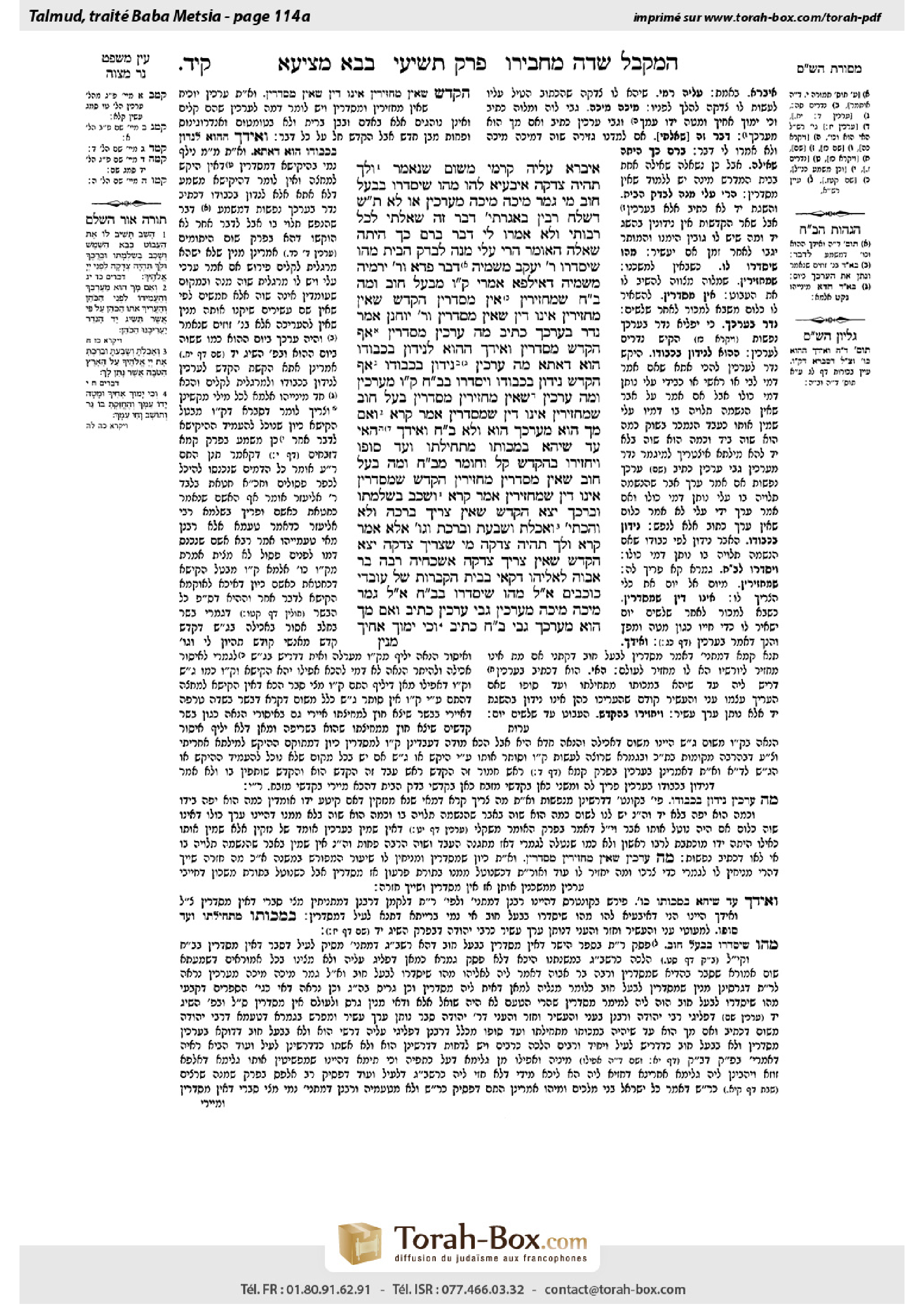
Bava Metzia 114a: Talmud study for Daf Yomi
Study the Talmud for Daf Yomi with scanned pages, Hebrew text, English translations from Sefaria and AI-generated French translations.
Passage selection and English or AI-generated French translation are available where the scan has annotations. Daf Study is independent of Torah-Box and Sefaria.
Browse Bava Metzia · בבא מציעא · All tractatesBava Metzia 114a text and translations
This page of Bava Metzia includes the Aramaic text, an English translation and an AI-generated French translation, alongside the scan above.
בבא מציעא קי״ד א · Aramaic and Hebrew text
אִיבְרָא עֲלֵיהּ קָרְמֵי, מִשּׁוּם שֶׁנֶּאֱמַר: ״וּלְךָ תִּהְיֶה צְדָקָה״.
אִיבַּעְיָא לְהוּ: מַהוּ שֶׁיְּסַדְּרוּ בְּבַעַל חוֹב? מִי גָמַר ״מִיכָה״ ״מִיכָה״ מֵעֲרָכִין, אוֹ לָא?
תָּא שְׁמַע, דִּשְׁלַח רָבִין בְּאִגַּרְתֵּיהּ: דָּבָר זֶה שָׁאַלְתִּי לְכׇל רַבּוֹתַי, וְלֹא אָמְרוּ לִי דָּבָר. בְּרַם כָּךְ הָיְתָה שְׁאֵלָה: הָאוֹמֵר ״הֲרֵי עָלַי מָנֶה לְבֶדֶק הַבַּיִת״, מַהוּ שֶׁיְּסַדְּרוּ?
רַבִּי יַעֲקֹב מִשְּׁמֵיהּ דְּבַר פַּדָּא, וְרַבִּי יִרְמְיָה מִשְּׁמֵיהּ דְּאִילְפָא אָמְרִי: קַל וָחוֹמֶר מִבַּעַל חוֹב. וּמָה בַּעַל חוֹב שֶׁמַּחְזִירִין – אֵין מְסַדְּרִין, הֶקְדֵּשׁ שֶׁאֵין מַחְזִירִין – אֵינוֹ דִּין שֶׁאֵין מְסַדְּרִין! וְרַבִּי יוֹחָנָן אָמַר: ״נֶדֶר בְּעֶרְכְּךָ״ כְּתִיב, מָה עֲרָכִין מְסַדְּרִין – אַף הֶקְדֵּשׁ מְסַדְּרִין.
וְאִידַּךְ: הַהוּא לְנִידּוֹן בִּכְבוֹדוֹ הוּא דַּאֲתָא. מָה עֲרָכִין נִידּוֹן בִּכְבוֹדוֹ – אַף הֶקְדֵּשׁ נִידּוֹן בִּכְבוֹדוֹ.
וִיסַדְּרוּ בְּבַעַל חוֹב קַל וָחוֹמֶר מֵעֲרָכִין: וּמָה עֲרָכִין שֶׁאֵין מַחְזִירִין – מְסַדְּרִין, בַּעַל חוֹב שֶׁמַּחְזִירִין – אֵינוֹ דִּין שֶׁמְּסַדְּרִין? אָמַר קְרָא: ״וְאִם מָךְ הוּא מֵעֶרְכֶּךָ״ – ״הוּא״ וְלֹא בַּעַל חוֹב.
וְאִידַּךְ: הַאי, עַד שֶׁיְּהֵא בְּמָכוּתוֹ מִתְּחִילָּתוֹ וְעַד סוֹפוֹ.
וְיַחְזִירוּ בְּהֶקְדֵּשׁ קַל וָחוֹמֶר מִבַּעַל חוֹב: וּמָה בַּעַל חוֹב שֶׁאֵין מְסַדְּרִין – מַחְזִירִין, הֶקְדֵּשׁ שֶׁמְּסַדְּרִין – אֵינוֹ דִּין שֶׁמַּחְזִירִין? אָמַר קְרָא: ״וְשָׁכַב בְּשַׂלְמָתוֹ וּבֵרְכֶךָּ״, יָצָא הֶקְדֵּשׁ, שֶׁאֵין צָרִיךְ בְּרָכָה.
וְלָא? וְהָכְתִיב: ״וְאָכַלְתָּ וְשָׂבָעְתָּ וּבֵרַכְתָּ וְגוֹ׳״! אֶלָּא אָמַר קְרָא: ״וּלְךָ תִּהְיֶה צְדָקָה״, מִי שֶׁצָּרִיךְ צְדָקָה, יָצָא הֶקְדֵּשׁ שֶׁאֵין צָרִיךְ צְדָקָה.
אַשְׁכְּחֵיהּ רַבָּה בַּר אֲבוּהּ לְאֵלִיָּהוּ דְּקָאֵי בְּבֵית הַקְּבָרוֹת שֶׁל גּוֹיִם, אֲמַר לֵיהּ: מַהוּ שֶׁיְּסַדְּרוּ בְּבַעַל חוֹב? אֲמַר לֵיהּ: גָּמַר ״מִיכָה״ ״מִיכָה״ מֵעֲרָכִין. גַּבֵּי עֲרָכִין כְּתִיב ״וְאִם מָךְ הוּא מֵעֶרְכֶּךָ״, גַּבֵּי בַּעַל חוֹב כְּתִיב ״וְכִי יָמוּךְ אָחִיךָ״.
Bava Metzia 114a · English translation
Indeed, the debtor’s needs are cast upon him, because it is stated in connection with this same issue of returning the collateral: “And it shall be righteousness to you” (Deuteronomy 24:13), which indicates that there is an obligation for the creditor to act toward the debtor with righteousness.
§ A dilemma was raised before the Sages: What is the halakha with regard to making arrangements for the debtor so that he will retain some of his possessions so that he may continue living as before, albeit at a slightly lower standard? The issue on which this is based is whether or not a verbal analogy is derived from the usage of the term “poor” written in the context of a debtor (Leviticus 25:35) and the term “poor” written in the context of valuations (Leviticus 27:8), as the Gemara will discuss further at the end of the amud.
The Gemara suggests: Come and hear a proof, as Ravin sent a message in his letter from Eretz Yisrael: I asked all my teachers concerning this matter, but they did not tell me anything. But there was this question concerning a similar matter that I heard them discuss: With regard to one who says: It is incumbent upon me to bring one hundred dinars for the Temple maintenance, what is the halakha as to whether they make arrangements for him? Although an arrangement is explicitly taught only with regard to the specific type of donation of valuations, is it applicable here as well?
Rabbi Ya’akov in the name of bar Padda, and Rabbi Yirmeya in the name of Ilfa, each say: It is an a fortiori inference from the halakhot of a debtor: And if for a debtor, to whom one returns his collateral, they do not make arrangements for the payment of his debt, then in the case of consecration, where they do not return his collateral, is it not logical that they should not make arrangements for the payment of his debt? And Rabbi Yoḥanan says: It is written: “When a man shall clearly utter a vow according to your valuation” (Leviticus 27:2). In this verse, all vows of consecrated property are juxtaposed to valuations, teaching that just as they make arrangements for the payment of a debt with regard to valuations, so too they make arrangements for the payment of a debt with regard to any vow of consecration.
The Gemara asks: And what do the other Sages, i.e., Rabbi Ya’akov and Rabbi Yirmeya, derive from this juxtaposition between vows and valuations? The Gemara replies: They maintain that this juxtaposition comes to teach the halakha that a vow of consecration is judged by its significance. If one stated a vow of valuation concerning a vital part of his body, e.g., that he will donate the value of his heart, he is obligated to pay not only the value of that organ, but the valuation of his entire self. Consequently, the phrase “a vow according to your valuation” indicates that just as valuations are judged by their significance, so too consecrated property is judged by its significance.
The Gemara asks: But they should make arrangements for a debtor based on an a fortiori inference from the halakhot of valuations, as follows: And if in the case of valuations the halakha is that they do not return his collateral and yet they do make arrangements for the payment of his debt, then with regard to a debtor, where the halakha is that one does return his collateral, is it not logical that they should make arrangements for the payment of his debt? The Gemara responds: The verse states: “But if he is too poor for your valuation…and the priest shall value him, according to the means of the one that vowed shall the priest value him” (Leviticus 27:8). The Torah emphasizes that this halakha is applicable only to “he” who makes a valuation, but not to a debtor.
The Gemara asks: And according to the other opinion, which maintains that they do make arrangements for a debtor, how is the word “he” interpreted? The Gemara answers: This word teaches that the halakha does not apply unless he remains in his state of poverty from the beginning to the end. If he was rich at the outset, or grew wealthy at some later stage, arrangements are not made for him.
The Gemara asks an additional question: And once it is established that arrangements are not made for a debtor, they should return the collateral in the case of consecration based on an a fortiori inference from the halakhot of a debtor: And if in the case of a debtor, where they do not make arrangements for him, the creditor nevertheless returns his collateral, with regard to consecration, where they do make arrangements for the payment of his debt, is it not logical that they should return his collateral to him? The Gemara answers: The verse states with regard to a regular loan: “You shall restore to him the collateral…and he will sleep in his garment and he will bless you” (Deuteronomy 24:13), excluding consecration, where there is no need for a blessing, and therefore it is not included in the halakha of returning the collateral.
The Gemara is puzzled by this claim: And is consecrated property not in need of a blessing? But isn’t it written: “And you shall eat and be satisfied, and bless the Lord your God” (Deuteronomy 8:10), indicating that consecrated property also requires a blessing? Rather, the reason is that the verse states with regard to the restoration of collateral: “And it shall be righteousness [tzedaka] for you” (Deuteronomy 24:13), which is referring to caring for one who requires charity [tzedaka], excluding consecrated property, which does not require charity.
§ The Gemara relates: Rabba bar Avuh found Elijah standing in a graveyard of gentiles. Rabba bar Avuh said to him: What is the halakha with regard to making arrangements for the debtor? Elijah said to him: A verbal analogy is derived from the usage of the term “poor” written in the context of a debtor and the term “poor” written in the context of valuations. With regard to valuations, it is written: “But if he is too poor [makh] for your valuation” (Leviticus 27:8), and with regard to a creditor, it is written: “But if your brother be poor [yamukh]” (Leviticus 25:35).
Bava Metzia 114a · Traduction française (IA)
En effet, les besoins du débiteur sont imposés à lui, car il est dit à propos de cette même question de restitution du garant : « Et cela sera droit pour toi » (Deutéronome 24:13), ce qui indique qu'il y a une obligation pour le créancier d'agir envers le débiteur avec justice.
§ Un dilemme a été soulevé devant les Sages : Quel est le halakha concernant l'arrangement pour le débiteur afin qu'il conserve une partie de ses biens et puisse continuer à vivre comme avant, bien qu'à un niveau légèrement inférieur ? La question sur laquelle cela s'appuie est de savoir si une analogie verbale peut être tirée de l'usage du terme « pauvre » dans le contexte d'un débiteur (Lévitique 25:35) et du terme « pauvre » dans le contexte des estimations (Lévitique 27:8), comme le discutera la Guemara à la fin de la page.
La Guemara suggère : Viens écouter une preuve, car Ravin a envoyé un message dans sa lettre d'Israël : J'ai interrogé tous mes maîtres à propos de cette question, mais ils ne m'ont rien dit. Mais il y avait cette question concernant une affaire similaire que j'ai entendu discuter : Concernant celui qui dit : Il m'est impératif de présenter cent drachmes pour l'entretien du Temple, quelle est la halakha concernant l'arrangement ? Bien que l'arrangement soit explicitement enseigné uniquement concernant le type spécifique de don d'estimation, s'applique-t-il également ici ?
Rabbi Ya'akov, en nom de bar Padda, et Rabbi Yirmeya, en nom d'Ilfa, disent chacun : C'est une déduction a fortiori à partir des halakhot du débiteur : Et si, pour un débiteur, à qui on restitue son garantie, on ne fait pas d'arrangements pour le paiement de sa dette, alors, dans le cas de la consécration, où on ne restitue pas sa garantie, n'est-il pas logique que l'on ne fasse pas d'arrangements pour le paiement de sa dette ? Et Rabbi Yoḥanan dit : Il est écrit : « Quand un homme aura clairement prononcé un vœu selon votre estimation » (Lévitique 27:2). Dans cette verset, tous les vœux de propriété consacrée sont juxtaposés aux estimations, enseignant que tout comme on fait des arrangements pour le paiement d'une dette concernant les estimations, ainsi on fait des arrangements pour le paiement d'une dette concernant tout vœu de consécration.
La Guemara pose la question : Et qu'en disent les autres Sages, c'est-à-dire Rabbi Ya'akov et Rabbi Yirmeya, à partir de cette juxtaposition entre vœux et estimations ? La Guemara répond : Ils maintiennent que cette juxtaposition vient enseigner la halakha que le vœu de consécration est jugé selon son importance. Si l'on a prononcé un vœu d'estimation concernant une partie vitale de son corps, par exemple, qu'il donnera la valeur de son cœur, il est tenu de payer non seulement la valeur de cet organe, mais l'estimation de son entier être. Ainsi, la phrase « un vœu selon votre estimation » indique que tout comme les estimations sont jugées selon leur importance, ainsi les biens consacrés sont jugés selon leur importance.
La Guemara pose la question : Mais ils devraient faire des arrangements pour le débiteur en se basant sur une déduction a fortiori à partir des halakhot des estimations, comme suit : Et si, dans le cas des estimations, la halakha est que l'on ne restitue pas sa garantie et pourtant on fait des arrangements pour le paiement de sa dette, alors, dans le cas du débiteur, où la halakha est que l'on restitue sa garantie, n'est-il pas logique que l'on fasse des arrangements pour le paiement de sa dette ? La Guemara répond : Le verset dit : « Mais s'il est trop pauvre pour votre estimation... et le prêtre évaluera lui, selon les moyens de celui qui a fait le vœu, le prêtre évaluera lui » (Lévitique 27:8). La Torah insiste sur le fait que cette halakha s'applique uniquement à « lui » qui fait l'estimation, mais pas au débiteur.
La Guemara pose la question : Et selon l'autre opinion, qui maintient qu'ils font des arrangements pour le débiteur, comment interpréter le mot « lui » ? La Guemara répond : Ce mot enseigne que la halakha ne s'applique pas à moins qu'il reste dans son état de pauvreté du début à la fin. Si il était riche au début, ou s'est enrichi à un moment ultérieur, les arrangements ne sont pas faits pour lui.
La Guemara pose une autre question : Et une fois que cela est établi que les arrangements ne sont pas faits pour le débiteur, ils devraient restituer la garantie dans le cas de la consécration en se basant sur une déduction a fortiori à partir des halakhot du débiteur : Et si, dans le cas du débiteur, où l'on ne fait pas d'arrangements pour lui, le créancier ne restitue tout de même sa garantie, dans le cas de la consécration, où l'on fait des arrangements pour le paiement de sa dette, n'est-il pas logique que l'on restitue sa garantie à lui ? La Guemara répond : Le verset dit concernant un prêt ordinaire : « Et tu lui restitueras la garantie... et il dormira dans son vêtement et il bénira l'Éternel » (Deutéronome 24:13), excluant la consécration, où il n'y a pas besoin de bénédiction, et donc il n'est pas inclus dans la halakha de la restitution de la garantie.
La Guemara est perplexe face à cette affirmation : Et la propriété consacrée n'a-t-elle pas besoin de bénédiction ? Mais n'est-il pas écrit : « Et tu mangeras et tu seras rassasié, et tu béniras l'Éternel ton Dieu » (Deutéronome 8:10), indiquant que la propriété consacrée a aussi besoin de bénédiction ? Plutôt, la raison est que le verset dit concernant la restitution de la garantie : « Et cela sera droit pour toi » (Deutéronome 24:13), ce qui fait référence à prendre soin de celui qui a besoin de charité [tzedaka], excluant la propriété consacrée, qui n'a pas besoin de charité.
§ La Guemara relate : Rabba bar Avuh a trouvé Eliehou debout dans un cimetière de non-Juifs. Rabba bar Avuh a dit à lui : Quel est le halakha concernant l'arrangement pour le débiteur ? Eliehou a dit à lui : Une analogie verbale est tirée de l'usage du terme « pauvre » dans le contexte du débiteur et du terme « pauvre » dans le contexte des estimations. Concernant les estimations, il est écrit : « Mais s'il est trop pauvre [makh] pour votre estimation » (Lévitique 27:8), et concernant le créancier, il est écrit : « Mais si ton frère est pauvre [yamukh] » (Lévitique 25:35).
Traduction française générée par IA à partir de l’édition anglaise de Sefaria. Vérifie toujours un passage avec le texte source.
Text from Sefaria: William Davidson Edition - Vocalized Aramaic (CC BY NC); William Davidson Edition - English (CC BY NC).