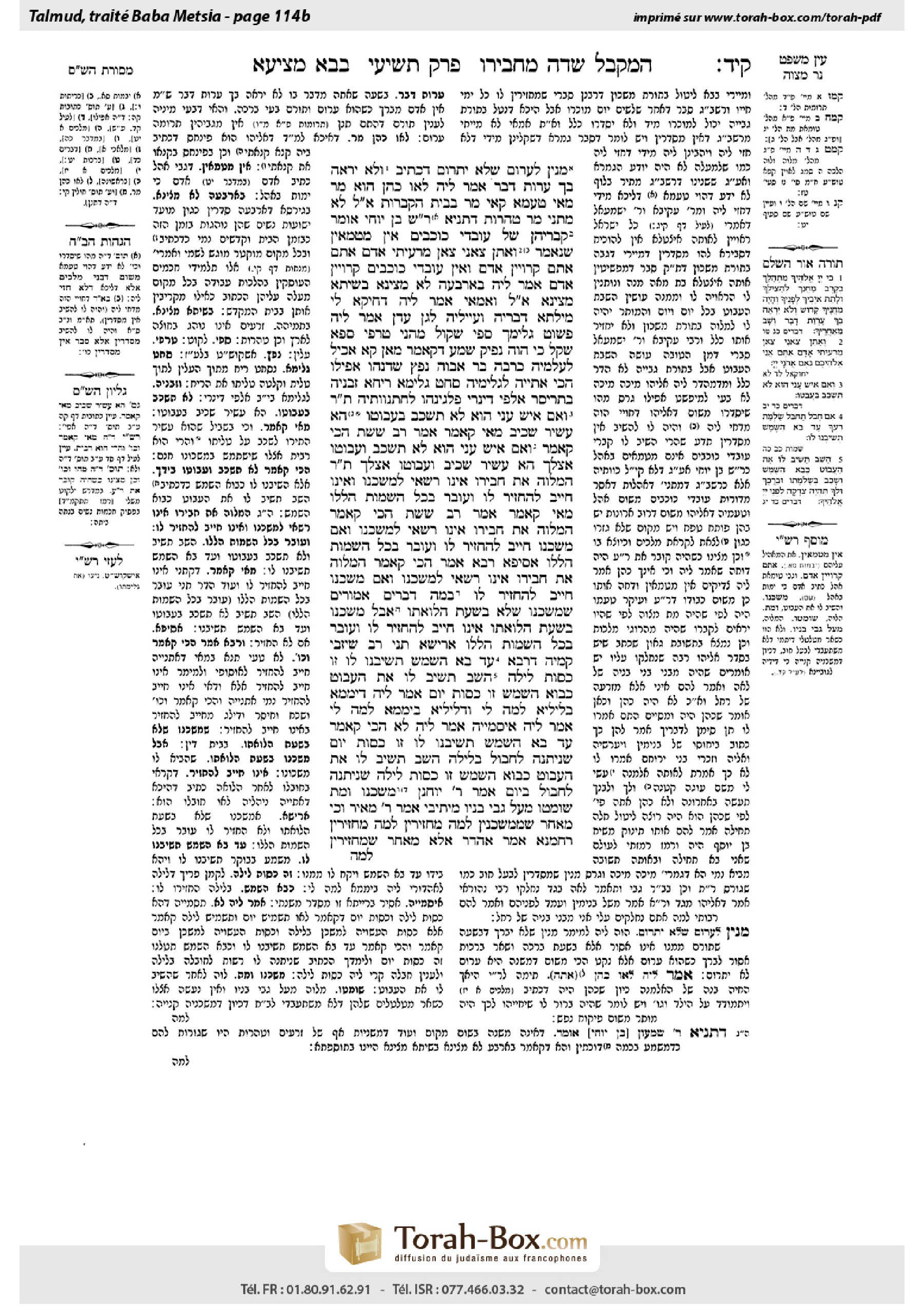
Bava Metzia 114b: Talmud study for Daf Yomi
Study the Talmud for Daf Yomi with scanned pages, Hebrew text, English translations from Sefaria and AI-generated French translations.
Passage selection and English or AI-generated French translation are available where the scan has annotations. Daf Study is independent of Torah-Box and Sefaria.
Browse Bava Metzia · בבא מציעא · All tractatesBava Metzia 114b text and translations
This page of Bava Metzia includes the Aramaic text, an English translation and an AI-generated French translation, alongside the scan above.
בבא מציעא קי״ד ב · Aramaic and Hebrew text
מִנַּיִן לְעָרוֹם שֶׁלֹּא יִתְרוֹם? דִּכְתִיב: ״וְלֹא יִרְאֶה בְךָ עֶרְוַת דָּבָר״.
אֲמַר לֵיהּ: לָאו כֹּהֵן הוּא מָר? מַאי טַעְמָא קָאֵי מָר בְּבֵית הַקְּבָרוֹת! אֲמַר לֵיהּ: לָא מַתְנֵי מָר טְהָרוֹת? דְּתַנְיָא, רַבִּי שִׁמְעוֹן בֶּן יוֹחַי אוֹמֵר: קִבְרֵיהֶן שֶׁל נׇכְרִים אֵין מְטַמְּאִין, שֶׁנֶּאֱמַר: ״וְאַתֵּן צֹאנִי צֹאן מַרְעִיתִי אָדָם אַתֶּם״. אַתֶּם קְרוּיִין ״אָדָם״, וְאֵין נׇכְרִים קְרוּיִין ״אָדָם״.
אֲמַר לֵיהּ: בְּאַרְבְּעָה לָא מָצֵינָא, בְּשִׁיתָּא מָצֵינָא? אֲמַר לֵיהּ: וְאַמַּאי? אֲמַר לֵיהּ: דְּחִיקָא לִי מִילְּתָא. דַּבְרֵיהּ וְעַיְּילֵיהּ לְגַן עֵדֶן. אֲמַר לֵיהּ: פְּשׁוֹט גְּלִימָךְ, סְפִי שְׁקוֹל מֵהָנֵי טַרְפֵי. סְפָא שְׁקַל.
כִּי הֲוָה נָפֵיק, שְׁמַע דְּקָאָמַר: מַאן קָא אָכֵיל לְעָלְמֵיהּ כְּרַבָּה בַּר אֲבוּהּ. נְפַץ שְׁדָנְהוּ. אֲפִילּוּ הָכִי אַתְיֵיהּ לִגְלִימֵיהּ, סְחַט גְּלִימָא רֵיחָא. זַבְּנֵיהּ בִּתְרֵיסַר אַלְפֵי דִּינָרֵי, פַּלְגִינְהוּ לְחַתְנָווֹתֵיהּ.
תָּנוּ רַבָּנַן: ״וְאִם אִישׁ עָנִי הוּא לֹא תִשְׁכַּב בַּעֲבֹטוֹ״, הָא עָשִׁיר – שְׁכַיב. מַאי קָאָמַר? אָמַר רַב שֵׁשֶׁת: הָכִי קָאָמַר: ״וְאִם אִישׁ עָנִי הוּא״ – לֹא תִשְׁכַּב וַעֲבוֹטוֹ אֶצְלְךָ. הָא עָשִׁיר – שְׁכַב וַעֲבוֹטוֹ אֶצְלְךָ.
תָּנוּ רַבָּנַן: הַמַּלְוֶה אֶת חֲבֵירוֹ אֵינוֹ רַשַּׁאי לְמַשְׁכְּנוֹ, וְאֵינוֹ חַיָּיב לְהַחְזִיר לוֹ, וְעוֹבֵר בְּכׇל הַשֵּׁמוֹת הַלָּלוּ. מַאי קָאָמַר? אָמַר רַב שֵׁשֶׁת: הָכִי קָאָמַר, הַמַּלְוֶה אֶת חֲבֵירוֹ אֵינוֹ רַשַּׁאי לְמַשְׁכְּנוֹ, וְאִם מִשְׁכְּנוֹ – חַיָּיב לְהַחְזִיר לוֹ. וְעוֹבֵר בְּכׇל הַשֵּׁמוֹת הַלָּלוּ – אַסֵּיפָא.
רָבָא אָמַר: הָכִי קָאָמַר: הַמַּלְוֶה אֶת חֲבֵירוֹ אֵינוֹ רַשַּׁאי לְמַשְׁכְּנוֹ, וְאִם מִשְׁכְּנוֹ – חַיָּיב לְהַחְזִיר לוֹ. בַּמֶּה דְּבָרִים אֲמוּרִים – שֶׁמִּשְׁכְּנוֹ שֶׁלֹּא בִּשְׁעַת הַלְוָאָתוֹ, אֲבָל מִשְׁכְּנוֹ בִּשְׁעַת הַלְוָאָתוֹ – אֵינוֹ חַיָּיב לְהַחְזִיר לוֹ. וְעוֹבֵר בְּכׇל הַשֵּׁמוֹת הַלָּלוּ – אַרֵישָׁא.
תָּנֵי רַב שֵׁיזְבִי קַמֵּיהּ דְּרָבָא: ״עַד בֹּא הַשֶּׁמֶשׁ תְּשִׁיבֶנּוּ לוֹ״ – זוֹ כְּסוּת לַיְלָה, ״הָשֵׁב תָּשִׁיב לוֹ אֶת הַעֲבוֹט כְּבוֹא הַשֶּׁמֶשׁ״ – זוֹ כְּסוּת יוֹם. אֲמַר לֵיהּ: דִּימָמָא בְּלֵילְיָא לְמָה לִי, וּדְלֵילְיָא בִּימָמָא לְמָה לִי?
אֲמַר לֵיהּ: אִיסְמְיַיהּ? אֲמַר לֵיהּ: לָא, הָכִי קָאָמַר: ״עַד בֹּא הַשֶּׁמֶשׁ תְּשִׁיבֶנּוּ לוֹ״ – זוֹ כְּסוּת יוֹם שֶׁנִּיתְּנָה לַחֲבוֹל בַּלַּיְלָה, ״הָשֵׁב תָּשִׁיב לוֹ אֶת הַעֲבוֹט כְּבוֹא הַשֶּׁמֶשׁ״ – זוֹ כְּסוּת לַיְלָה שֶׁנִּיתְּנָה לַחֲבוֹל בַּיּוֹם.
אָמַר רַבִּי יוֹחָנָן: מִשְׁכְּנוֹ וּמֵת, שׁוֹמְטוֹ מֵעַל גַּבֵּי בָנָיו. מֵיתִיבִי, אָמַר רַבִּי מֵאִיר: וְכִי מֵאַחַר שֶׁמְּמַשְׁכְּנִין לָמָּה מַחְזִירִין? לָמָּה מַחְזִירִין?! רַחֲמָנָא אָמַר אַהְדַּר! אֶלָּא: מֵאַחַר שֶׁמַּחְזִירִין,
Bava Metzia 114b · English translation
Rabba bar Avuh now asks Elijah another question: From where is it derived with regard to a naked person that he may not separate teruma? He replied: As it is written: “And He see no unseemly thing in you” (Deuteronomy 23:15). This verse indicates that one may not recite any words of sanctity, including the blessing upon separating teruma, in front of one who is naked.
The amora proceeded to ask Elijah a different question and said to him: Is not the Master a priest? What is the reason that the Master is standing in a cemetery? Elijah said to him: Has the Master not studied the mishnaic order of Teharot? As it is taught in a baraita: Rabbi Shimon ben Yoḥai says that the graves of gentiles do not render one impure, as it is stated: “And you, My sheep, the sheep of My pasture, are man” (Ezekiel 34:31), which teaches that you, i.e., the Jewish people, are called “man,” but gentiles are not called “man.” Since the Torah states with regard to ritual impurity imparted in a tent: “If a man dies in a tent” (Numbers 19:14), evidently impurity imparted by a tent does not apply to gentiles.
Rabba bar Avuh said to him: How could I be familiar with that baraita? If I cannot be proficient in the more commonly studied four orders of the Mishna, can I be knowledgeable in all six? Elijah said to him: Why are you not learned in them all? Rabba bar Avuh said to him: The matter of a livelihood is pressing for me, and I am therefore unable to study properly. Elijah led him and brought him into the Garden of Eden and said to him: Remove your cloak, gather up and take some of these leaves lying around. Rabba Bar Avuh gathered them up and took them.
When he was exiting, he heard a voice that declared: Who else consumes his World-to-Come like Rabba bar Avuh, who takes his merit of the next world for his use in the present one? He spread out his cloak and threw away the leaves. Even so, when he brought his cloak back, he discovered that the cloak had absorbed such a good scent from those leaves that he sold it for twelve thousand dinars. Since he knew that this was taken from his portion in the World-to-Come, he did not want to benefit from it himself, and he therefore divided the sum among his sons-in-law.
§ The Sages taught with regard to the verse: “If he be a poor man, you shall not sleep with his collateral” (Deuteronomy 24:12), but if he is wealthy, one may lie down. The Gemara asks: What is the tanna saying? Rav Sheshet said that this is what he is saying: And if he be a poor man, you shall not sleep while his collateral is with you; rather, you must restore it to him before the sun sets. But if he is a wealthy man, you may lie down while his collateral is with you.
The Sages taught: One who lends money to another is not permitted to take collateral from him, and is not obligated to return it to him, and transgresses all of these labels [shemot] of prohibitions. The meaning of this baraita is unclear, and the Gemara asks: What is the tanna saying? Rav Sheshet said: This is what he is saying: One who lends money to another is not permitted to take collateral from him, and if he did take collateral from him, he is obligated to return it to him. As for the clause: And he transgresses all of these labels of prohibitions, this is referring to the latter clause, i.e., the case implicit in the baraita, where the creditor took collateral from the debtor and did not return it, and the baraita explains that such a person violates all of the Torah prohibitions that apply to this situation.
Rava said: This is what the tanna is saying: One who lends money to another is not permitted to take collateral from him, and if he did take collateral from him, he is obligated to return it to him. In what case is this statement said? It is referring to where he took collateral from him when it was not at the time of the loan, but rather as a means of ensuring payment. But if he took collateral from him at the time of the loan, in which case the collateral serves as a guarantee of the loan, he is not obligated to return it to him. According to this interpretation, the statement: And he transgresses of all these labels of prohibitions, is referring to the first clause of the baraita, concerning the prohibition against taking collateral.
Rav Sheizevi taught the following baraita before Rava: With regard to the verse: “And if you take as collateral your neighbor’s garment, you shall restore it to him until the sun goes down” (Exodus 22:25), this is referring to a garment worn at night and teaches that the garment is returned during the day; and with regard to the verse: “You shall restore to him the collateral when the sun goes down” (Deuteronomy 24:13), this is referring to a garment worn during the day. Rava said to him: This statement is puzzling, as with regard to a garment worn in the day, why do I need it at night, and as for a garment worn at night, why do I need it in the day? What purpose is served by giving back the garments at such times?
Rav Sheizevi said to him: Do you think this baraita is so corrupt that I should erase it, i.e., no longer teach it? Rava said to him: No, do not erase it, because this is what it is saying: With regard to the verse “You shall restore it to him until when the sun goes down,” this is referring to a garment worn during the day, which may be taken as collateral by night but must be returned to the debtor for the day. With regard to the verse “You shall restore to him the collateral when the sun goes down,” this is referring to a garment worn at night, which may be taken as collateral by day.
§ Rabbi Yoḥanan said: If he took collateral from him, returned it, and then the debtor died, the creditor may take the collateral from the debtor’s children and is under no obligation to leave it with them. The Gemara raises an objection to this from a baraita: Rabbi Meir said: But since one takes collateral, why does he return it? The Gemara expresses surprise at this question: Why does he return it? The Merciful One states to return it. Rather, the question is as follows: Since he must return it,
Bava Metzia 114b · Traduction française (IA)
Rabba bar Avuh pose maintenant à Elie une autre question : D'où tire-t-on que l'on ne doit pas séparer la terouma devant une personne nue ? Il répondit : Comme il est écrit : « Et il ne voit point de chose inappropriée en vous » (Deutéronome 23:15). Cette versette indique que l'on ne doit pas réciter aucune parole de sainteté, y compris la bénédiction sur la séparation de la terouma, devant une personne nue.
L'amora passa à poser à Elie une autre question et dit : N'est-ce pas un prêtre ? Pourquoi le Maître est-il debout dans un cimetière ? Elie lui répondit : N'a-t-il pas étudié l'ordre mishnaïque des Téhorot ? Comme il est enseigné dans une baraïta : Rabbi Shimon ben Yoḥai dit que les sépultures des nations ne rendent pas impur, car il est dit : « Et vous, mon brebis, la brebis de mon pâturage, êtes l'homme » (Ezéchiel 34:31), ce qui enseigne que vous, c'est-à-dire le peuple juif, êtes appelés « l'homme », mais les nations ne sont pas appelés « l'homme ». Puisque la Torah mentionne concernant l'impureté rituelle transmise dans une tente : « Si un homme meurt dans une tente » (Nombres 19:14), il est évident que l'impureté transmise par une tente ne s'applique pas aux nations.
Rabba bar Avuh dit à lui : Comment puis-je être familier avec cette baraïta ? Si je ne suis pas compétent dans les quatre ordres plus couramment étudiés de la Michna, comment puis-je être expert dans les six ? Elie lui dit : Pourquoi ne sont-vous pas compétent dans tous ? Rabba bar Avuh dit à lui : La question de subsistance est pressante pour moi, et je ne peux donc pas étudier correctement. Elie le conduisit et le fit entrer dans le Jardin d'Éden et lui dit : Retirez votre manteau, ramassez et prenez quelques feuilles qui sont autour. Rabba bar Avuh les ramassa et les prit.
Quand il sortait, il entendit une voix qui déclara : Qui consomme son monde à venir comme Rabba bar Avuh, qui prend son mérite du monde à venir pour l'utiliser dans le présent ? Il étala son manteau et jeta les feuilles. Même ainsi, quand il rapporta son manteau, il découvrit que le manteau avait absorbé un tel bon parfum de ces feuilles qu'il le vendit pour douze mille drachmes. Puisqu'il savait que cela provenait de sa part dans le monde à venir, il ne voulait pas en bénéficier lui-même, et il divisa donc la somme entre ses gendres.
§ Les Sages enseignèrent concernant la versette : « Si c'est un homme pauvre, vous ne dormirez pas avec sa garantie » (Deutéronome 24:12), mais si c'est un homme riche, on peut dormir. Le Guemara pose la question : De quel tanna s'agit-il ? Rav Sheshet dit que c'est ce qu'il dit : Et si c'est un homme pauvre, vous ne dormirez pas pendant que sa garantie est avec vous ; plutôt, vous devez le lui rendre avant que le soleil ne se couche. Mais si c'est un homme riche, vous pouvez dormir pendant que sa garantie est avec vous.
Les Sages enseignèrent : Celui qui prête de l'argent à un autre n'est pas autorisé à prendre une garantie de lui, et n'est pas tenu de le lui rendre, et transgresse toutes ces étiquettes [shemot] de prohibitions. Le sens de cette baraïta est ambigu, et le Guemara pose la question : De quel tanna s'agit-il ? Rav Sheshet dit : C'est ce qu'il dit : Celui qui prête de l'argent à un autre n'est pas autorisé à prendre une garantie de lui, et si il a pris une garantie de lui, il est tenu de le lui rendre. En ce qui concerne la clause : Et il transgresse toutes ces étiquettes de prohibitions, cela fait référence au cas implicite dans la baraïta, où le créancier a pris une garantie du débiteur et ne l'a pas rendue, et la baraïta explique que cette personne viole toutes les prohibitions de la Torah qui s'appliquent à cette situation.
Rava dit : C'est ce que le tanna dit : Celui qui prête de l'argent à un autre n'est pas autorisé à prendre une garantie de lui, et si il a pris une garantie de lui, il est tenu de le lui rendre. Dans quel cas cette déclaration est-elle dite ? C'est en référence à un cas où il a pris une garantie de lui à un moment où il n'était pas en train de prêter, mais plutôt comme moyen de garantie. Mais si il a pris une garantie de lui au moment du prêt, dans lequel cas la garantie sert de garantie du prêt, il n'est pas tenu de le lui rendre. Selon cette interprétation, la déclaration : Et il transgresse toutes ces étiquettes de prohibitions, fait référence à la première clause de la baraïta, concernant la prohibition de prendre une garantie.
Rav Sheizevi enseigna devant Rava la suivante baraïta : Concernant la versette : « Et si tu prends comme garantie le vêtement de ton voisin, tu le lui rendras jusqu'à ce que le soleil se couche » (Exode 22:25), cela fait référence à un vêtement porté la nuit et enseigne que le vêtement est rendu pendant la journée ; et concernant la versette : « Tu lui rendras la garantie quand le soleil se couche » (Deutéronome 24:13), cela fait référence à un vêtement porté pendant la journée. Rava dit à lui : Cette déclaration est confuse, car concernant un vêtement porté pendant la journée, pourquoi ai-je besoin de le rendre la nuit, et concernant un vêtement porté la nuit, pourquoi ai-je besoin de le rendre pendant la journée ? À quel usage sert de rendre les vêtements à ces moments-là ?
Rav Sheizevi dit à lui : Pensez-vous que cette baraïta est si corrompue que je devrais la supprimer, c'est-à-dire ne plus la faire connaître ? Rava dit à lui : Non, ne la supprimez pas, car c'est ce qu'elle dit : Concernant la versette « Tu le lui rendras jusqu'à ce que le soleil se couche », cela fait référence à un vêtement porté pendant la journée, qui peut être pris comme garantie la nuit mais doit être rendu au débiteur pour la journée. Concernant la versette « Tu lui rendras la garantie quand le soleil se couche », cela fait référence à un vêtement porté la nuit, qui peut être pris comme garantie pendant la journée.
§ Rabbi Yoḥanan dit : Si l'on a pris une garantie de lui, l'on l'a rendue, et que le débiteur est mort, le créancier peut prendre la garantie des enfants du débiteur et n'est pas tenu de la laisser avec eux. Le Guemara soulève une objection contre cela à partir d'une baraïta : Rabbi Meir dit : Mais pourquoi un homme prend-il une garantie, pourquoi doit-il la rendre ? Le Guemara exprime une surprise à ce sujet : Pourquoi doit-il la rendre ? Le Très Miséricordieux dit de la rendre. Plutôt, la question est la suivante : Puisque il doit la rendre,
Traduction française générée par IA à partir de l’édition anglaise de Sefaria. Vérifie toujours un passage avec le texte source.
Text from Sefaria: William Davidson Edition - Vocalized Aramaic (CC BY NC); William Davidson Edition - English (CC BY NC).