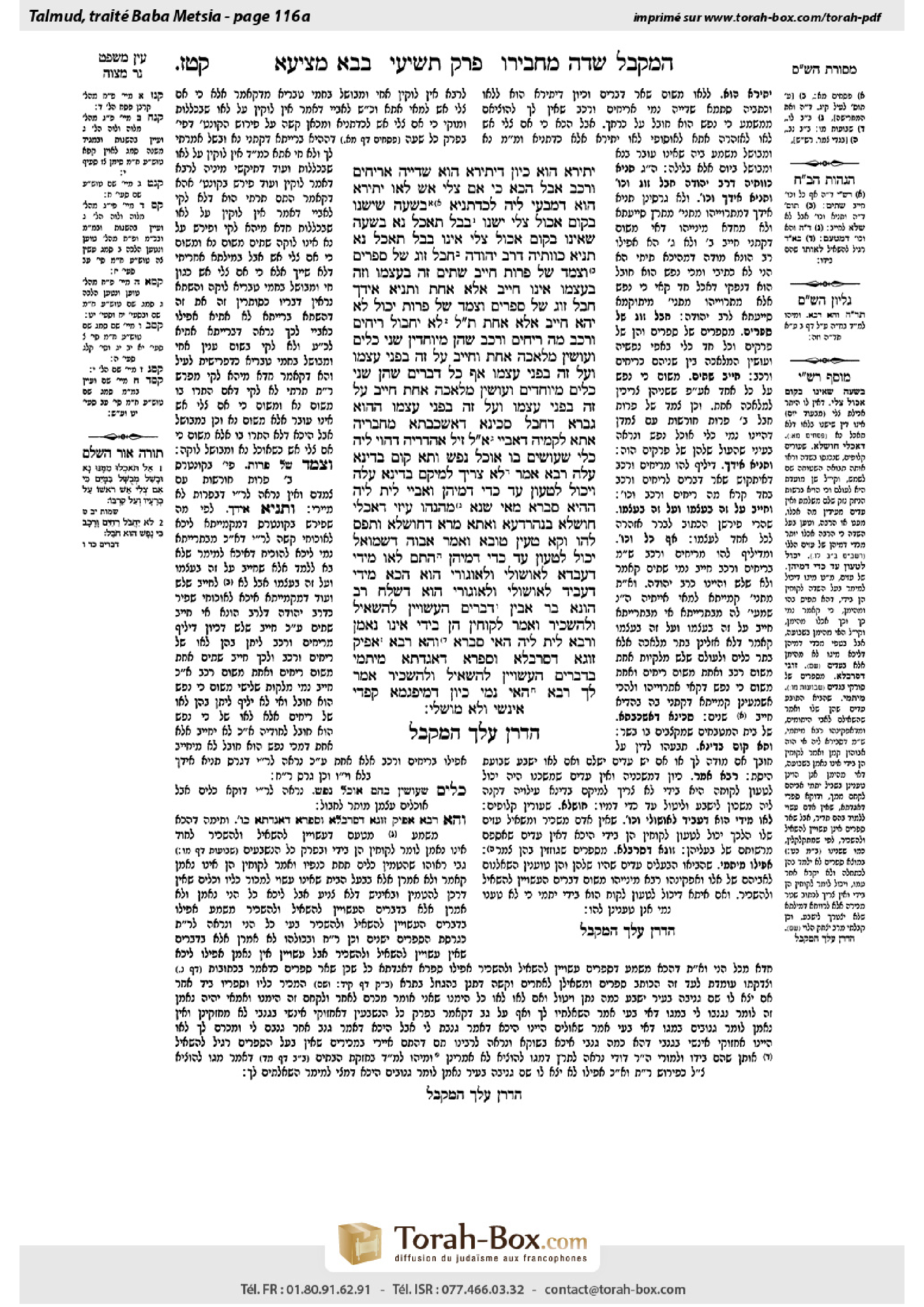
Bava Metzia 116a: Talmud study for Daf Yomi
Study the Talmud for Daf Yomi with scanned pages, Hebrew text, English translations from Sefaria and AI-generated French translations.
Passage selection and English or AI-generated French translation are available where the scan has annotations. Daf Study is independent of Torah-Box and Sefaria.
Browse Bava Metzia · בבא מציעא · All tractatesBava Metzia 116a text and translations
This page of Bava Metzia includes the Aramaic text, an English translation and an AI-generated French translation, alongside the scan above.
בבא מציעא קי״ו א · Aramaic and Hebrew text
יַתִּירָא הוּא, כֵּיוָן דְּיַתִּירָא הוּא – שִׁדְיֵיהּ אַרֵיחַיִם וָרָכֶב.
אֲבָל הָכָא, ״כִּי אִם צְלִי אֵשׁ״ לָאו יַתִּירָא הוּא, דְּמִבְּעֵי לֵיהּ לְכִדְתַנְיָא: בְּשָׁעָה שֶׁיֶּשְׁנוֹ בְּקוּם אֱכוֹל צָלִי, יֶשְׁנוֹ – בְּבַל תֹּאכַל נָא. בְּשָׁעָה שֶׁאֵינוֹ בְּקוּם אֱכוֹל צָלִי – אֵינוֹ בְּבַל תֹּאכַל נָא.
תַּנְיָא כְּווֹתֵיהּ דְּרַב יְהוּדָה: חָבַל זוּג שֶׁל סַפָּרִים וְצֶמֶד שֶׁל פָּרוֹת – חַיָּיב שְׁתַּיִם. זֶה בְּעַצְמוֹ וְזֶה בְּעַצְמוֹ – אֵינוֹ חַיָּיב אֶלָּא אַחַת.
וְתַנְיָא אִידַּךְ: חָבַל זוּג שֶׁל סַפָּרִים וְצֶמֶד שֶׁל פָּרוֹת, יָכוֹל לֹא יְהֵא חַיָּיב אֶלָּא אַחַת – תַּלְמוּד לוֹמַר ״לֹא יַחֲבֹל רֵיחַיִם וָרָכֶב״. מָה רֵיחַיִם וָרֶכֶב שֶׁהֵן מְיוּחָדִין שְׁנֵי כֵּלִים וְעוֹשִׂין מְלָאכָה אַחַת, וְחַיָּיב עַל זֶה בִּפְנֵי עַצְמוֹ וְעַל זֶה בִּפְנֵי עַצְמוֹ – אַף כׇּל דְּבָרִים שֶׁהֵן שְׁנֵי כֵּלִים מְיוּחָדִים וְעוֹשִׂין מְלָאכָה אַחַת – חַיָּיב עַל זֶה בִּפְנֵי עַצְמוֹ וְעַל זֶה בִּפְנֵי עַצְמוֹ.
הָהוּא גַּבְרָא דַּחֲבַל סַכִּינָא דְּאַשְׁכַּבְתָּא מֵחַבְרֵיהּ. אֲתָא לְקַמֵּיהּ דְּאַבָּיֵי, אֲמַר לֵיהּ: זִיל אַהְדְּרֵיהּ, דְּהָוֵי לֵיהּ כְּלִי שֶׁעוֹשִׂים בּוֹ אוֹכֶל נֶפֶשׁ, וְתָא קוּם בְּדִינָא עֲלֵהּ. רָבָא אָמַר: לָא צְרִיךְ לְמֵיקַם בְּדִינָא עֲלֵהּ, וְיָכוֹל לִטְעוֹן עַד כְּדֵי דְּמֵיהֶן.
וְאַבָּיֵי לֵית לֵיהּ הָהִיא סְבָרָא: מַאי שְׁנָא מֵהָנְהוּ עִיזֵּי דְּאָכְלִי חוּשְׁלָא בִּנְהַרְדְּעָא, וַאֲתָא מָרָא דְחוּשְׁלָא וּתְפַס לְהוּ וְקָא טָעֵין טוּבָא. וַאֲמַר אֲבוּהּ דִּשְׁמוּאֵל יָכוֹל לִטְעוֹן עַד כְּדֵי דְּמֵיהֶן!
הָתָם לָאו מִידֵּי (דַּעֲבִדָא) [דַּעֲבִיד] לְאוֹשׁוֹלֵי וּלְאוֹגוֹרֵי הוּא. הָכָא מִידֵּי דַּעֲבִיד לְאוֹשׁוֹלֵי וּלְאוֹגוֹרֵי הוּא. דִּשְׁלַח רַב הוּנָא בַּר אָבִין: דְּבָרִים הָעֲשׂוּיִין לְהַשְׁאִיל וּלְהַשְׂכִּיר, וְאָמַר לְקוּחִין הֵן בְּיָדִי – אֵינוֹ נֶאֱמָן.
וְרָבָא לֵית לֵיהּ הַאי סְבָרָא? וְהָא רָבָא אַפֵּיק זוּגָא דְסַרְבָּלָא וְסִפְרָא דְאַגָּדְתָּא מִיַּתְמֵי בִּדְבָרִים הָעֲשׂוּיִין לְהַשְׁאִיל וּלְהַשְׂכִּיר! אָמַר לָךְ רָבָא: הַאי נָמֵי, כֵּיוָן דְּמִיפַּגְמָא – קָפְדִי אִינָשֵׁי וְלָא מוֹשְׁלִי.
הֲדַרַן עֲלָךְ הַמְקַבֵּל
Bava Metzia 116a · English translation
is superfluous and therefore includes other utensils as well. Since it is superfluous, apply it as another prohibition upon the lower and upper millstones.
But here, with regard to the Paschal offering, the phrase “but roasted with fire” is not superfluous, as he requires it for that which is taught in a baraita: At the time when one is included in the mitzva to arise and eat the roasted Paschal offering, he is also included in the prohibition not to eat of it raw, but at a time when one is not included in the mitzva to arise and eat the roasted Paschal offering, he is not included in the prohibition not to eat of it raw either. Consequently, one who eats the Paschal offering at that time is not liable to receive lashes.
§ The Gemara returns to the dispute concerning the lower and upper millstones. It is taught in a baraita in accordance with the opinion of Rav Yehuda: If one took as collateral barbers’ scissors [zog] or a pair of cows, he is liable to receive two sets of lashes. If he took this one blade of the pair of scissors by itself or that one cow by itself, he is liable to receive only one set of lashes. According to this tanna, he is not liable for the general prohibition.
And it is taught in another baraita: If one took as collateral barbers’ scissors or a pair of cows, one might have thought that he is liable to receive only one set of lashes. Therefore, the verse states: “He may not take as collateral the lower or upper millstone,” which indicates that just as the lower and upper millstones are unique in that they are two distinct vessels and they perform one task together, and nevertheless one is liable separately for this and separately for that, so too, with regard to all items that are composed of two individual vessels, such as barbers’ scissors or a pair of cows, and they perform one task, he is liable separately for this and separately for that.
§ The Gemara relates: There was a certain man who took as collateral a slaughtering knife from another. He came before Abaye to ask him what to do. Abaye said to him: Go and return it, as it is a vessel used in the preparation of food, and it is therefore forbidden to take as collateral, and go stand in judgment, i.e., litigate with the debtor in court, concerning how much money he owes you. Rava said: He does not have to stand in judgment for this. Since the knife is in his possession, he can claim the amount of the debt up to its value.
The Gemara asks: And does Abaye not accept that reasoning, that one who seized an item belonging to a debtor may claim the sum owed to him up to the value of the item? In what way is it different from the incident involving those goats that ate peeled barley [ḥushla] in Neharde’a, and the owner of the peeled barley came and seized the goats and claimed that their owner was indebted to him for a large amount, and Shmuel’s father, who acted as a judge in this case, said that he can claim a sum up to their value?
The Gemara answers that there is a difference between the two cases: There, a goat is an item that is not usually lent out or rented. Consequently, the one who possesses them has a presumptive right of ownership upon which he can base his claim. Conversely, here, the slaughtering knife is an item that is usually lent out or rented. Therefore, he is not deemed credible without proof that it is his merely by virtue of its being in his possession. The Gemara supports this distinction: As Rav Huna bar Avin sent the following ruling: In a case of items that are usually lent out or rented, and one in possession of them says: They were acquired by me, he is not deemed credible by this claim alone. He must provide further proof, as he might have borrowed or rented them.
The Gemara asks: And does Rava not accept this reasoning? But didn’t Rava himself remove scissors used for wool and a scroll of aggada from the possession of orphans as items that are usually lent out or rented? The Gemara answers: Rava could have said to you: With regard to this slaughtering knife too, since it is likely to be damaged, people are particular and do not lend it out. Therefore, it is not considered an item that is typically lent out, and the one in possession of it can claim the money owed to him up to the value of the knife.
Bava Metzia 116a · Traduction française (IA)
Il est superflu et donc inclut d'autres ustensiles également. Puisque c'est superflu, il est appliqué comme une autre interdiction sur les moulinets supérieur et inférieur.
Mais ici, concernant l'offrande pascal, la phrase « mais cuit à feu » n'est pas superflue, car il le nécessite pour ce qui est enseigné dans une baraïta : Lorsqu'on est inclus dans la mitsva de se lever et de manger l'offrande pascal cuit, on est également inclus dans l'interdiction de ne pas la manger crue ; mais lorsqu'on n'est pas inclus dans la mitsva de se lever et de manger l'offrande pascal cuit, on n'est pas non plus inclus dans l'interdiction de ne pas la manger crue. Ainsi, celui qui mange l'offrande pascal à ce moment-là n'est pas puni de flagellation.
§ Le Guemara reprend le débat concernant les moulinets supérieur et inférieur. Il est enseigné dans une baraïta selon l'opinion de Rava Yehuda : Si l'on a pris comme caution des ciseaux de barbier [zog] ou une paire de vaches, on est puni de deux séries de flagellations. Si l'on a pris un seul ciseau de la paire ou une seule vache, on est puni d'une seule série de flagellations. Selon ce tanna, on n'est pas puni pour l'interdiction générale.
Et il est enseigné dans une autre baraïta : Si l'on a pris comme caution des ciseaux de barbier ou une paire de vaches, on pourrait penser qu'on est puni d'une seule série de flagellations. Ainsi, la Parashah dit : « Il ne doit pas prendre comme caution le moulin inférieur ou le moulin supérieur », ce qui indique que tout comme les moulin inférieur et supérieur sont uniques dans le sens où ils sont deux ustensiles distincts et accomplissent une tâche ensemble, et pourtant on est puni séparément pour l'un et pour l'autre, de même, concernant tous les objets composés de deux ustensiles individuels, tels que des ciseaux de barbier ou une paire de vaches, et qui accomplissent une tâche, on est puni séparément pour l'un et pour l'autre.
§ Le Guemara rapporte : Il y avait un homme qui avait pris comme caution un couteau de boucher appartenant à un autre. Il est venu devant Abaye pour lui demander ce qu'il devait faire. Abaye lui a dit : Va et rends-le, car c'est un ustensile utilisé dans la préparation des aliments et il est donc interdit de le prendre comme caution, et va te mettre en jugement, c'est-à-dire litige avec le débiteur devant le tribunal, concernant la somme qu'il te doit. Rava a dit : Il n'a pas besoin de se mettre en jugement à ce sujet. Puisque le couteau est en son possession, il peut réclamer la somme de la dette jusqu'à sa valeur.
Le Guemara pose la question : Et Abaye ne accepte pas ce raisonnement, que celui qui a saisi un objet appartenant à un débiteur peut réclamer la somme due jusqu'à la valeur de l'objet ? Dans quel sens est-ce différent de l'incident concernant ces brebis qui ont mangé du blé épluché [ḥushla] à Nehardea, et l'propriétaire du blé épluché est venu saisir les brebis et a réclamé qu'il devait à leur propriétaire une somme importante, et le père de Shmuel, qui agissait comme juge dans ce cas, a dit qu'il pouvait réclamer une somme jusqu'à leur valeur ?
Le Guemara répond que c'est une différence entre les deux cas : Là, un bouc est un objet qui n'est pas habituellement prêté ou loué. Ainsi, celui qui les possède a un droit présomptif d'ownership sur lequel il peut se baser pour sa réclamation. À l'inverse, ici, le couteau de boucher est un objet qui est habituellement prêté ou loué. Ainsi, il n'est pas considéré comme crédible sans preuve qu'il est à lui simplement par le fait qu'il est en sa possession. Le Guemara soutient cette distinction : Comme Rav Huna bar Avin a rendu le suivant : Dans un cas d'objets qui sont habituellement prêtés ou loués, et celui qui les possède dit : J'ai acquis cela, il n'est pas considéré comme crédible par ce seul argument. Il doit fournir une preuve supplémentaire, car il pourrait avoir emprunté ou loué ces objets.
Le Guemara pose la question : Et Rava ne accepte pas ce raisonnement ? Mais n'a-t-il pas lui-même retiré des ciseaux utilisés pour la laine et un rouleau d'aggada de la possession des orphelins comme des objets qui sont habituellement prêtés ou loués ? Le Guemara répond : Rava aurait pu dire à vous : Concernant ce couteau de boucher également, puisque cela peut être endommagé, les gens sont particuliers et ne le prêtent pas. Ainsi, il n'est pas considéré comme un objet habituellement prêté, et celui qui le possède peut réclamer la somme due jusqu'à la valeur du couteau.
Traduction française générée par IA à partir de l’édition anglaise de Sefaria. Vérifie toujours un passage avec le texte source.
Text from Sefaria: William Davidson Edition - Vocalized Aramaic (CC BY NC); William Davidson Edition - English (CC BY NC).