Bava Metzia 115b: Talmud study for Daf Yomi
Study the Talmud for Daf Yomi with scanned pages, Hebrew text, English translations from Sefaria and AI-generated French translations.
Passage selection and English or AI-generated French translation are available where the scan has annotations. Daf Study is independent of Torah-Box and Sefaria.
Browse Bava Metzia · בבא מציעא · All tractatesBava Metzia 115b text and translations
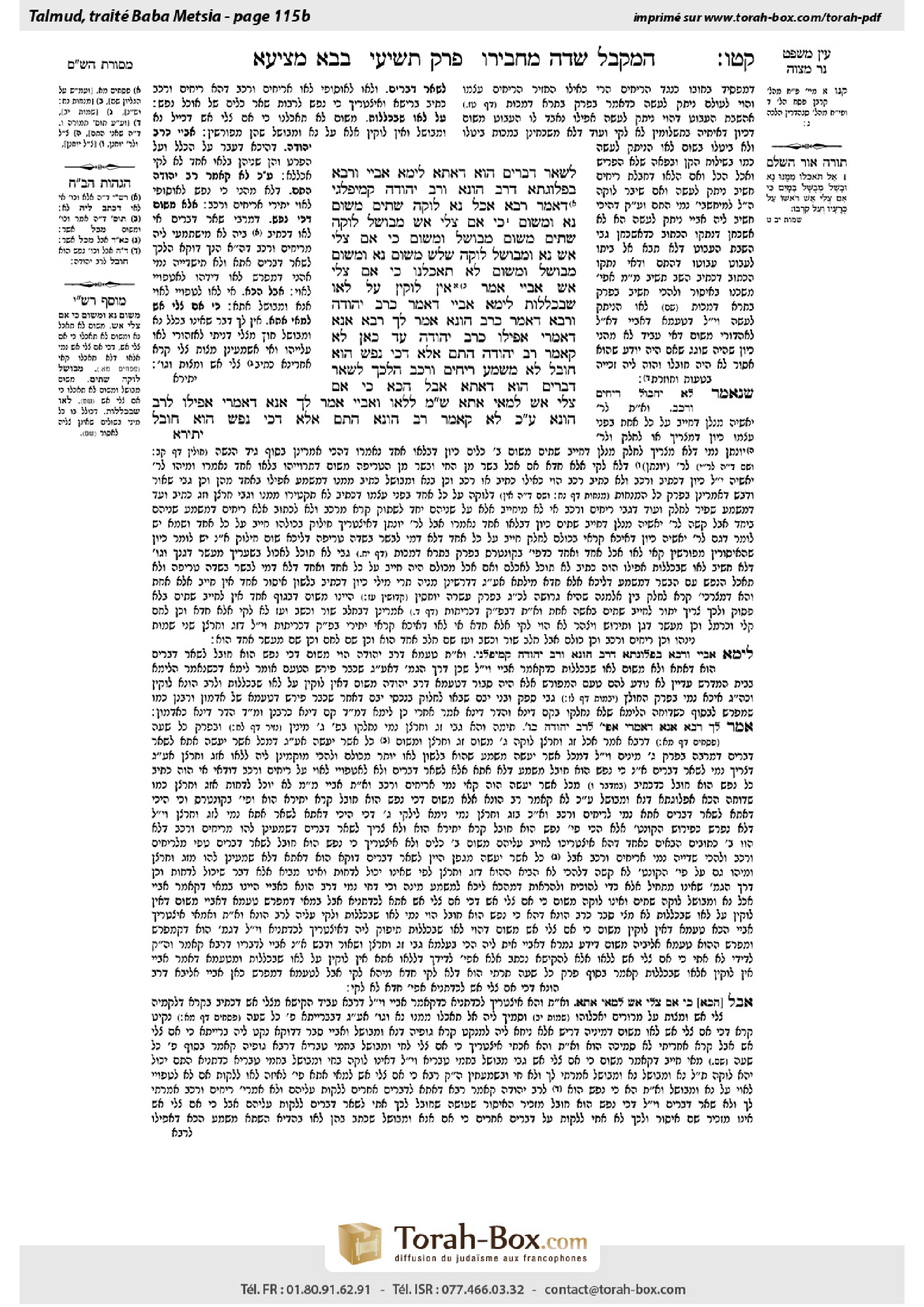
This page of Bava Metzia includes the Aramaic text, an English translation and an AI-generated French translation, alongside the scan above.
בבא מציעא קי״ה ב · Aramaic and Hebrew text
לִשְׁאָר דְּבָרִים הוּא דַּאֲתָא.
לֵימָא אַבָּיֵי וְרָבָא, בִּפְלוּגְתָּא דְּרַב הוּנָא וְרַב יְהוּדָה קָמִיפַּלְגִי?
דְּאָמַר רָבָא: אָכַל נָא – לוֹקֶה שְׁתַּיִם: מִשּׁוּם ״נָא״, וּמִשּׁוּם ״כִּי אִם צְלִי אֵשׁ״. מְבוּשָּׁל – לוֹקֶה שְׁתַּיִם: מִשּׁוּם ״מְבוּשָּׁל״, וּמִשּׁוּם ״כִּי אִם צְלִי אֵשׁ״. נָא וּמְבוּשָּׁל – לוֹקֶה שָׁלֹשׁ: מִשּׁוּם ״נָא״, וּמִשּׁוּם ״מְבוּשָּׁל״, וּמִשּׁוּם ״לֹא תֹּאכְלֶנּוּ כִּי אִם צְלִי אֵשׁ״.
אַבָּיֵי אָמַר: אֵין לוֹקִין עַל לָאו שֶׁבִּכְלָלוֹת. לֵימָא אַבָּיֵי דְּאָמַר כְּרַב יְהוּדָה, וְרָבָא דְּאָמַר כְּרַב הוּנָא?
אָמַר לָךְ רָבָא: אֲנָא דַּאֲמַרִי אֲפִילּוּ כְּרַב יְהוּדָה, עַד כָּאן לָא קָאָמַר רַב יְהוּדָה הָתָם, אֶלָּא דְּ״כִי נֶפֶשׁ הוּא חֹבֵל״ לָא מַשְׁמַע רֵיחַיִם וָרֶכֶב, הִלְכָּךְ לִשְׁאָר דְּבָרִים הוּא דַּאֲתָא.
אֲבָל הָכָא ״כִּי אִם צְלִי אֵשׁ״ לְמַאי אֲתָא? שְׁמַע מִינַּהּ לְלָאו.
וְאַבָּיֵי אָמַר לָךְ: אֲנָא דַּאֲמַרִי אֲפִילּוּ לְרַב הוּנָא: עַד כָּאן לָא קָאָמַר רַב הוּנָא הָתָם, אֶלָּא דְּ״כִי נֶפֶשׁ הוּא חֹבֵל״
Bava Metzia 115b · English translation
it comes to teach about the prohibition against taking as collateral other items used in the preparation of food.
§ The Gemara suggests: Shall we say that Abaye and Rava, in another dispute, disagree with regard to the issue that is the subject of this dispute between Rav Huna and Rav Yehuda concerning the collateral? The Torah commands with regard to the preparation of the Paschal offering: “Do not eat of it raw, nor cooked in water, but roasted with fire, its head with its legs and with the innards thereof” (Exodus 12:9). Abaye and Rava engage in a dispute concerning the case of one who ate the meat when it was not properly roasted.
As Rava says: If he ate an olive-bulk of it raw, he is flogged with two sets of lashes. One set of lashes is due to the prohibition: “Do not eat of it raw,” and the other is due to the prohibition: “But roasted with fire.” If he ate an olive-bulk of a Paschal offering that had been cooked, he also is flogged with two sets of lashes: One set of lashes is due to the prohibition against it being cooked in water, and the second is due to the injunction: “But roasted with fire.” If he ate an olive-bulk of both raw meat and cooked meat, he is flogged with three sets of lashes: One set of lashes is due to the prohibition against it being raw, and the second is due to the prohibition against it being cooked, and the third is due to the prohibition: “Do not eat of it…but roasted with fire.”
Conversely, Abaye says: The prohibition “Do not eat of it…but roasted with fire” is not referring exclusively to this issue, but includes many cases, and one is not flogged for violating a general prohibition. In this case, Abaye and Rava apparently disagree over the same matter as do Rav Huna and Rav Yehuda. Shall we say that Abaye states his opinion in accordance with the opinion of Rav Yehuda, and Rava states his opinion in accordance with the opinion of Rav Huna?
The Gemara responds: Rava could have said to you: I state my opinion even in accordance with the opinion of Rav Yehuda, as there is a difference between the two cases: Rav Yehuda states his opinion only there, with regard to collateral, because the phrase: “For he takes a man’s life as collateral” (Deuteronomy 24:6), does not itself indicate that the verse is referring to the lower and upper millstones. Rather, it is a general statement, and therefore it comes to teach about the prohibition against taking as collateral other items used in the preparation of food, not to add a prohibition to take as collateral the lower and upper millstones.
But here, the phrase “but roasted with fire” comes for what purpose? It excludes only raw or cooked meat, which were already mentioned. Therefore, learn from it that it comes to include another prohibition in addition to those specific directives referring to raw and cooked meat.
And Abaye could have said to you: I state my opinion even in accordance with the opinion of Rav Huna. This is because Rav Huna states his opinion only there, with regard to collateral, because the prohibition “For he takes a man’s life as collateral”
Bava Metzia 115b · Traduction française (IA)
il vient enseigner la prohibition de prendre comme garant d'autres objets utilisés dans la préparation des aliments.
§ La Guemara suggère : devons-nous dire que Abaye et Rava, dans un autre débat, diffèrent sur la question qui est l'objet de ce débat entre Rav Huna et Rav Yehuda concernant le garant ? La Torah commande concernant la préparation de l'offrande pascal : « Ne mangez pas de lui cru, ni cuits dans l'eau, mais rôtis au feu, sa tête avec ses jambes et ses entrailles » (Exode 12:9). Abaye et Rava s'engagent dans un débat concernant le cas d'une personne qui a mangé la viande lorsqu'elle n'était pas correctement rôtie.
Selon Rava : si l'on a mangé une quantité d'olive de viande crue, on est fouetté avec deux séries de coups de fouet. Une série de coups est due à la prohibition : « Ne mangez pas de lui cru », et l'autre est due à la prohibition : « mais rôtis au feu ». Si l'on a mangé une quantité d'olive d'une offrande pascal cuite, on est également fouetté avec deux séries de coups de fouet : une série de coups est due à la prohibition contre la cuisson dans l'eau, et la seconde est due à l'interdiction : « mais rôtis au feu ». Si l'on a mangé une quantité d'olive à la fois de viande crue et de viande cuite, on est fouetté avec trois séries de coups de fouet : une série de coups est due à la prohibition contre la consommation crue, la seconde à la prohibition contre la cuisson, et la troisième à la prohibition : « Ne mangez pas de lui... mais rôtis au feu ».
Inversement, Abaye dit : la prohibition « Ne mangez pas de lui... mais rôtis au feu » ne se réfère pas uniquement à cette question, mais inclut de nombreux cas, et l'on n'est pas fouetté pour violer une prohibition générale. Dans ce cas, Abaye et Rava diffèrent apparemment sur la même question que Rav Huna et Rav Yehuda. Devons-nous dire que Abaye exprime son opinion conformément à celle de Rav Yehuda, et Rava conformément à celle de Rav Huna ?
La Guemara répond : Rava aurait pu dire à vous : j'exprime mon opinion même conformément à celle de Rav Yehuda, car il y a une différence entre les deux cas : Rav Yehuda exprime son opinion uniquement là, concernant le garant, car la phrase : « car il prend la vie d'un homme comme garant » (Lévitique 24:6) ne s'indique pas lui-même que la versette se réfère aux meules inférieure et supérieure. C'est une déclaration générale, et donc il vient enseigner la prohibition de prendre comme garant d'autres objets utilisés dans la préparation des aliments, pas pour ajouter une prohibition de prendre comme garant les meules inférieure et supérieure.
Mais ici, la phrase « mais rôtis au feu » a quel but ? Elle exclut uniquement la viande crue ou cuite, qui avait déjà été mentionnée. Ainsi, on en tire que cela vient inclure une autre prohibition en plus des directives spécifiques concernant la viande crue et cuite.
Et Abaye aurait pu dire à vous : je formule mon avis même conformément à celui de Rav Huna. C'est parce que Rav Huna formule son avis uniquement là, concernant le garant, car la prohibition « car il prend la vie d'un homme comme garant »
Traduction française générée par IA à partir de l’édition anglaise de Sefaria. Vérifie toujours un passage avec le texte source.
Text from Sefaria: William Davidson Edition - Vocalized Aramaic (CC BY NC); William Davidson Edition - English (CC BY NC).