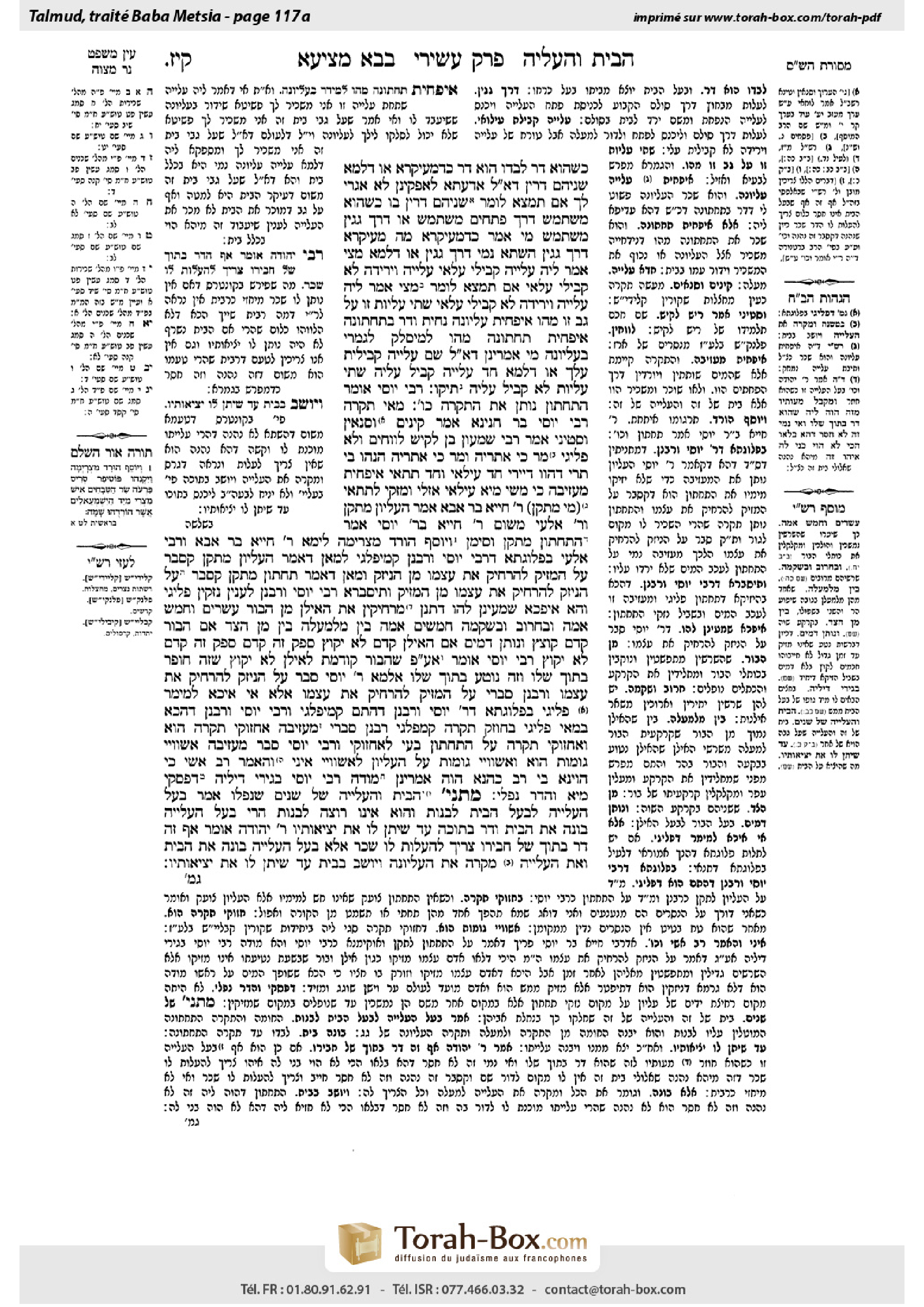
Bava Metzia 117a: Talmud study for Daf Yomi
Study the Talmud for Daf Yomi with scanned pages, Hebrew text, English translations from Sefaria and AI-generated French translations.
Passage selection and English or AI-generated French translation are available where the scan has annotations. Daf Study is independent of Torah-Box and Sefaria.
Browse Bava Metzia · בבא מציעא · All tractatesBava Metzia 117a text and translations
This page of Bava Metzia includes the Aramaic text, an English translation and an AI-generated French translation, alongside the scan above.
בבא מציעא קי״ז א · Aramaic and Hebrew text
כְּשֶׁהוּא דָּר, לְבַדּוֹ הוּא דָּר כִּדְמֵעִיקָּרָא, אוֹ דִלְמָא שְׁנֵיהֶם דָּרִין, דַּאֲמַר לֵיהּ: אַדַּעְתָּא לְאַפֹּקִינַן לָא אֹגַרִי לָךְ.
אִם תִּמְצָא לוֹמַר שְׁנֵיהֶם דָּרִין בּוֹ, כְּשֶׁהוּא מִשְׁתַּמֵּשׁ – דֶּרֶךְ פְּתָחִים מִשְׁתַּמֵּשׁ, אוֹ דֶּרֶךְ גַּגִּין מִשְׁתַּמֵּשׁ? מִי אָמַר כִּדְמֵעִיקָּרָא: מָה מֵעִיקָּרָא, דֶּרֶךְ גַּגִּין – הַשְׁתָּא נָמֵי דֶּרֶךְ גַּגִּין. אוֹ דִלְמָא מָצֵי אֲמַר לֵיהּ: עֲלִיָּיה – קַבֵּילִי עֲלַאי, עֲלִיָּיה וִירִידָה – לָא קַבֵּילִי עֲלַאי.
אִם תִּמְצָא לוֹמַר, מָצֵי אֲמַר לֵיהּ: עֲלִיָּיה וִירִידָה לָא קַבֵּילִי עֲלַאי. שְׁתֵּי עֲלִיּוֹת זוֹ עַל גַּב זוֹ, מַהוּ? אִיפְּחִית עֶלְיוֹנָה, נָחֵית וְדָר בְּתַחְתּוֹנָה. אִיפְּחִית תַּחְתּוֹנָה, מַהוּ לְמִיסְלַק לִגְמָרֵי בְּעֶלְיוֹנָה?
מִי אָמְרִינַן דַּאֲמַר לֵיהּ: שֵׁם עֲלִיָּיה קַבֵּילְיתְּ עֲלָךְ? אוֹ דִלְמָא: חַד עֲלִיָּיה – קַבֵּיל עֲלֵיהּ, שְׁתֵּי עֲלִיּוֹת – לָא קַבֵּיל עֲלֵיהּ? תֵּיקוּ.
רַבִּי יוֹסֵי אוֹמֵר: הַתַּחְתּוֹן נוֹתֵן אֶת הַתִּקְרָה כּוּ׳. מַאי ״תִּקְרָה״? רַבִּי יוֹסֵי בַּר חֲנִינָא אָמַר: קִינִּים וּסְנָאִין. וְ[יוּ]סְטִינִי אָמַר רַבִּי שִׁמְעוֹן בֶּן לָקִישׁ: לְווֹחִים. וְלָא פְּלִיגִי: מָר כִּי אַתְרֵיהּ וּמָר כִּי אַתְרֵיהּ.
הָנְהוּ בֵּי תְרֵי דַּהֲווֹ דָּיְירִי, חַד עִילַּאי וְחַד תַּתַּאי. אִיפְּחִית מַעֲזִיבָה. כִּי מָשֵׁי מַיָּא, עִילַּאי אָזְלִי וּמַזְּקִי לְתַתַּאי. מִי מְתַקֵּן? רַבִּי חִיָּיא בַּר אַבָּא אָמַר: הָעֶלְיוֹן מְתַקֵּן, וְרַבִּי אִלְעַי מִשּׁוּם רַבִּי חִיָּיא בְּרַבִּי יוֹסֵי אָמַר: הַתַּחְתּוֹן מְתַקֵּן. וְסִימָן: ״וְיוֹסֵף הוּרַד מִצְרָיְמָה״.
לֵימָא רַבִּי חִיָּיא בַּר אַבָּא וְרַבִּי אִלְעַי בִּפְלוּגְתָּא דְּרַבִּי יוֹסֵי וְרַבָּנַן קָמִיפַּלְגִי? לְמַאן דְּאָמַר הָעֶלְיוֹן מְתַקֵּן, קָסָבַר עַל הַמַּזִּיק לְהַרְחִיק אֶת עַצְמוֹ מִן הַנִּיזָּק. וּמַאן דְּאָמַר תַּחְתּוֹן מְתַקֵּן, קָסָבַר עַל הַנִּיזָּק לְהַרְחִיק אֶת עַצְמוֹ מִן הַמַּזִּיק.
וְתִיסְבְּרָא רַבִּי יוֹסֵי וְרַבָּנַן לְעִנְיַן נְזָקִין פְּלִיגִי? וְהָא אִיפְּכָא שָׁמְעִינַן לְהוּ, דִּתְנַן: מַרְחִיקִין אֶת הָאִילָן מִן הַבּוֹר עֶשְׂרִים וְחָמֵשׁ אַמָּה, וּבֶחָרוּב וּבַשִּׁקְמָה חֲמִשִּׁים אַמָּה, בֵּין מִלְּמַעְלָה בֵּין מִן הַצַּד. אִם הַבּוֹר קָדַם – קוֹצֵץ וְנוֹתֵן דָּמִים. אִם הָאִילָן קָדַם – לֹא יָקוֹץ. סָפֵק זֶה קָדַם סָפֵק זֶה קָדַם – לֹא יָקוֹץ.
רַבִּי יוֹסֵי אוֹמֵר: אַף עַל פִּי שֶׁהַבּוֹר קוֹדֶמֶת לָאִילָן – לֹא יָקוֹץ, שֶׁזֶּה חוֹפֵר בְּתוֹךְ שֶׁלּוֹ, וְזֶה נוֹטֵעַ בְּתוֹךְ שֶׁלּוֹ. אַלְמָא, רַבִּי יוֹסֵי סָבַר עַל הַנִּיזָּק לְהַרְחִיק אֶת עַצְמוֹ, וְרַבָּנַן סָבְרִי עַל הַמַּזִּיק לְהַרְחִיק אֶת עַצְמוֹ!
אֶלָּא אִי אִיכָּא לְמֵימַר פְּלִיגִי, בִּפְלוּגְתָּא דְּרַבִּי יוֹסֵי וְרַבָּנַן דְּהָתָם קָמִיפַּלְגִי.
וְרַבִּי יוֹסֵי וְרַבָּנַן דְּהָכָא, בְּמַאי פְּלִיגִי? בְּחוֹזֶק תִּקְרָה קָמִיפַּלְגִי. רַבָּנַן סָבְרִי: מַעֲזִיבָה אַחְזוֹקֵי תִּקְרָה הוּא, וְאַחְזוֹקֵי תִּקְרָה (עַל הַ)תַּחְתּוֹן בָּעֵי (לְ)אַחְזוֹקֵי. וְרַבִּי יוֹסֵי סָבַר: מַעֲזִיבָה אַשְׁווֹיֵי גּוּמּוֹת הוּא, וְאַשְׁווֹיֵי גּוּמּוֹת (עַל הָעֶלְיוֹן לְאַשְׁווֹיֵי).
אִינִי? וְהָאָמַר רַב אָשֵׁי: כִּי הֲוֵינָא בֵּי רַב כָּהֲנָא, הֲוָה אָמְרִינַן: מוֹדֶה רַבִּי יוֹסֵי בְּגִירֵי דִּילֵיהּ!
דְּפָסְקִי מַיָּא וַהֲדַר נָפְלִי.
מַתְנִי׳ הַבַּיִת וְהָעֲלִיָּיה שֶׁל שְׁנַיִם שֶׁנָּפְלוּ, אָמַר בַּעַל הָעֲלִיָּיה לְבַעַל הַבַּיִת לִבְנוֹת וְהוּא אֵינוֹ רוֹצֶה לִבְנוֹת – הֲרֵי בַּעַל הָעֲלִיָּיה בּוֹנֶה אֶת הַבַּיִת וְדָר בְּתוֹכָהּ, עַד שֶׁיִּתֵּן לוֹ אֶת יְצִיאוֹתָיו.
רַבִּי יְהוּדָה אוֹמֵר: אַף זֶה דָּר בְּתוֹךְ שֶׁל חֲבֵירוֹ, צָרִיךְ לְהַעֲלוֹת לוֹ שָׂכָר. אֶלָּא בַּעַל הָעֲלִיָּיה בּוֹנֶה אֶת הַבַּיִת וְאֶת הָעֲלִיָּיה, [וּ]מְקָרֶה אֶת הָעֶלְיוֹנָה, וְיוֹשֵׁב בַּבַּיִת עַד שֶׁיִּתֵּן לוֹ אֶת יְצִיאוֹתָיו.
Bava Metzia 117a · English translation
With regard to a resident of the upper story who is entitled to move into the lower story, when he resides there, does he reside alone as he did at the outset when he occupied the upper story, and the owner of the house has no choice but to move out? Or perhaps they both reside there together, as the owner can say to him: I did not rent the upper story to you with the intention of being removed from my domicile.
If you say that they both reside there, when the upper-story resident uses the house, does he use it by way of its entrances, like the owner, or must he use it by way of the roofs? Must he climb the stairs and enter the upper story, and then descend to the house from there? Can the owner say: The tenant must act as he did at the outset; just as at the outset he entered by way of the roofs, now too, he must enter by way of the roofs? Or perhaps the renter can say to him: I accepted upon myself an ascent and agreed to climb the stairs to the upper story, but I did not accept upon myself an ascent and a descent, which would be necessary if I entered by way of the roofs.
If you say that the tenant can say to the owner: I did not accept upon myself an ascent and a descent, in a case where there were two upper stories, this one on top of that one, what is the halakha? The Gemara clarifies the circumstances of this case: If the floor of the higher upper story was broken, clearly he may descend and reside in the lower one, but if the floor of the lower upper story was broken, what is the halakha? Is he required to ascend the full way and reside in the higher upper story, or does he go down to reside on the ground floor?
Do we say that the owner of the house can say to the tenant: You accepted upon yourself the term: An upper story, and I have provided one for you? Or perhaps one says that the tenant accepted upon himself one ascent, but he did not accept upon himself two ascents. No answer was found for these questions, and the Gemara concludes: These dilemmas shall stand unresolved.
§ The mishna teaches: Rabbi Yosei says: The lower resident provides the ceiling and the upper resident provides the plaster. The Gemara asks: What is the word ceiling referring to in this context? Rabbi Yosei bar Ḥanina says: Mats and beams. And the Sage Setini says that Rabbi Shimon ben Lakish says: Wide wooden planks. The Gemara comments: And these two opinions do not disagree over the basic halakha; rather, this Sage rules in accordance with the custom of his locale and this Sage in accordance with the custom of his locale, and they each were describing the necessary materials for a ceiling, according to the local building conventions.
§ The Gemara relates: An incident occurred with these two people who were residing in the same house, one in the upper story, and the other one in the lower story. The plaster of the floor of the upper story broke, so that when the resident of the upper apartment would wash with water, it would run down and cause damage to the lower story. The question was: Who must repair the ceiling? Rabbi Ḥiyya bar Abba says: The upper resident repairs it, and Rabbi Elai says in the name of Rabbi Ḥiyya, son of Rabbi Yosei: The lower resident repairs it. The Gemara comments: And the following verse can serve as a mnemonic device to remember who issued which ruling: “And Joseph was brought down to Egypt” (Genesis 39:1). Rabbi Ḥiyya, son of Rabbi Yosei, indicated by Joseph, is the Sage who maintains that the owner of the lower story, indicated by: Brought down, must repair the ceiling.
The Gemara suggests: Shall we say that Rabbi Ḥiyya bar Abba and Rabbi Elai disagree with regard to the matter subject to dispute between Rabbi Yosei and the Rabbis in the mishna? The explanation of the dispute would then be as follows: According to the one who says that the upper resident repairs it, he holds that the responsibility is on the one potentially responsible for the damage to distance himself from the one whose property is potentially damaged. This accounts for the opinion of Rabbi Yosei in the mishna, who holds that the resident of the upper story must provide the plaster, because his water is clearly causing damage below. And the one who says that the lower resident repairs it, he holds like the Rabbis, who say that the responsibility is on the one whose property is potentially damaged to distance himself from the one potentially responsible for the damage.
The Gemara asks: And how can you understand it that way? Do Rabbi Yosei and the Rabbis disagree in the mishna with regard to distancing oneself from damages? But haven’t we heard them say the opposite? As we learned in a mishna (Bava Batra 25b): One must distance a tree twenty-five cubits from a pit, because its roots damage the pit, and in the case of a carob or sycamore tree, whose roots spread far, one must distance it by fifty cubits. This is the halakha whether the pit or tree is located above or to the side of the other. If the pit preceded the tree, the owner of the pit may cut down the tree and pay its monetary value. If the tree preceded the pit, then he may not cut it down. If it is uncertain whether this tree preceded that pit, and it is uncertain whether that pit preceded this tree, he may not cut down the tree.
Rabbi Yosei says: Even if the pit preceded the tree, he may not cut it down. Why is that? As this one digs in his own property, and that one plants in his own property. Consequently, the owner of the pit cannot complain about the damage, and if he wants to avoid it, he can dig his pit elsewhere. Apparently, this mishna indicates that Rabbi Yosei holds that the responsibility is on the one whose property is potentially damaged to distance himself from the one potentially responsible for the damage, and the Rabbis hold that the responsibility is on the one potentially responsible for the damage to distance himself from the one whose property is potentially damaged.
Rather, if it can be said that these amora’im disagree with regard to the issue that is the subject of the dispute between these tanna’im, then they disagree in the dispute between Rabbi Yosei and the Rabbis there, concerning the question of who is obligated to distance himself from the damage, but it has nothing to do with the dispute in the mishna here.
The Gemara asks: And with regard to what principle do Rabbi Yosei and the Rabbis of the mishna here disagree? The Gemara answers: They disagree with regard to the strength of a ceiling. The Rabbis hold that the function of the plaster is to strengthen the ceiling, and strengthening the ceiling is the obligation of the lower resident, as he is required to strengthen it. And Rabbi Yosei holds that the function of the plaster is to level out any holes, so that the surface of the ceiling will be flat, and leveling out holes it is the obligation of the upper resident, as he is required to level them out.
The Gemara challenges the above conclusion: Is that so? But didn’t Rav Ashi say: When I was in the school of Rav Kahana we would say that Rabbi Yosei concedes in a case of his arrows. Although Rabbi Yosei holds that the responsibility is on the one whose property is potentially damaged to distance himself from the one potentially responsible for the damage, that is only if the one causing the damage is not performing a direct action that is causing the damage, as in the case of the tree and the pit. But if he is performing an action that causes damage from a distance, as in this case, where the water he pours damages the resident of the lower story, he is like someone shooting arrows, who is certainly obligated to ensure that he does not cause any damage.
The Gemara answers: This is a case in which the water flow stops in one place, as the hole in the floor is not directly in the place where the water was poured, and subsequently it falls into the lower story once it flows to the opening in the floor. Consequently, even in this case, the upper resident does not directly cause the damage.
MISHNA: In the case of the house and the upper story belonging to two different people, and that house and upper story collapsed, and the owner of the upper story told the owner of the house to build the lower story in order to enable him to rebuild the upper story, and he does not want to build it, the owner of the upper story may build the house and reside in it, until the other gives him his expenses for the construction of the house, and he then rebuilds his upper story.
Rabbi Yehuda says: This one too, i.e., the owner of the upper story, who is meanwhile residing inside the property of the other, must pay him rent. Since he derived benefit by living in the house of the other, as he had no other place in which he could live, he must pay rent. This solution is therefore flawed. Rather, the owner of the upper story builds the house and the upper story, and he roofs the upper story, i.e., he completes the entire construction of the upper story, and he may then sit in the house, i.e., the lower story, until the other gives him his expenses for the building of the house, at which point he returns to his upper story. Since in any event he could have lived in the upper story, he is not considered to have derived any benefit by living in the lower story, and is not obligated to pay rent.
Bava Metzia 117a · Traduction française (IA)
Concernant un résident du haut qui a le droit de descendre dans la pièce inférieure, lorsque ce dernier y demeure, demeure-t-il seul comme au début lorsqu'il occupait la pièce supérieure, et l'propriétaire de la maison n'a pas d'autre choix que de quitter son domicile ? Ou bien demeurent-ils ensemble, comme l'propriétaire peut dire à l'autre : Je ne louais pas la pièce supérieure à toi avec l'intention de me faire expulser de mon domicile ?
Si vous dites qu'ils demeurent ensemble, lorsque le résident de la pièce supérieure utilise la maison, utilise-t-il la maison par l'intermédiaire de ses entrées, comme l'propriétaire, ou doit-il l'utiliser par le toit ? Doit-il monter les escaliers et entrer dans la pièce supérieure, puis descendre dans la maison depuis là ? L'propriétaire peut-il dire : Le locataire doit agir comme au début ; tout comme au début il entrait par le toit, maintenant aussi il doit entrer par le toit ? Ou bien le locataire peut-il dire à l'propriétaire : J'ai accepté de monter, et j'ai convenu de monter les escaliers pour accéder à la pièce supérieure, mais je n'ai pas accepté de monter et de descendre, ce qui serait nécessaire s'il entrait par le toit ?
Si vous dites que le locataire peut dire à l'propriétaire : Je n'ai pas accepté de monter et de descendre, dans un cas où il y avait deux étages, l'un au-dessus de l'autre, quelle est la halakha ? La Guemara clarifie les circonstances de ce cas : Si le plancher du haut étage était brisé, il est clair qu'il peut descendre et demeurer dans l'étage inférieur, mais si le plancher de l'étage inférieur était brisé, quelle est la halakha ? Doit-il monter tout le long et demeurer dans l'étage supérieur, ou descend-il pour demeurer au rez-de-chaussée ?
Disons-nous que l'propriétaire de la maison peut dire au locataire : Tu as accepté le terme : un étage, et je t'ai fourni un ? Ou bien l'un dit que le locataire a accepté une montée, mais il n'a pas accepté deux montées. Aucune réponse n'a été trouvée à ces questions, et la Guemara conclut : Ces dilemmes restent sans réponse.
§ La mitsva enseigne : Rabbi Yosei dit : Le résident du bas fournit le plafond et le résident du haut fournit le plâtre. La Guemara demande : Quel est le sens du mot plafond dans ce contexte ? Rabbi Yosei bar Ḥanina dit : Des planches et des poutres. Et le Sage Setini dit que Rabbi Shimon ben Lakish dit : Des planches larges. La Guemara commente : Et ces deux opinions ne s'opposent pas sur la halakha fondamentale ; plutôt, ce Sage règle selon la coutume de son lieu et ce Sage selon la coutume de son lieu, et ils décrivent tous les matériaux nécessaires pour un plafond, selon les conventions de construction locales.
§ La Guemara rapporte : Un incident s'est produit avec ces deux personnes qui résidaient dans la même maison, l'un au rez-de-chaussée et l'autre au premier étage. Le plâtre du plancher du premier étage s'était brisé, de sorte que lorsque le résident du premier étage se lavait avec de l'eau, celle-ci coulait et causait des dommages au rez-de-chaussée. La question était : Qui doit réparer le plafond ? Rabbi Ḥiyya bar Abba dit : Le résident du haut doit le réparer, et Rabbi Elai, dans le nom de Rabbi Ḥiyya, fils de Rabbi Yosei, dit : Le résident du bas doit le réparer. La Guemara commente : Et la suivante verset peut servir de mnémonique pour se souvenir de qui a émis quelle décision : « Et Joseph fut ramené en Égypte » (Genèse 39:1). Rabbi Ḥiyya, fils de Rabbi Yosei, indique par Joseph, c'est le Sage qui maintient que l'propriétaire du rez-de-chaussée, indiqué par : ramené, doit réparer le plafond.
La Guemara suggère : Disons-nous que Rabbi Ḥiyya bar Abba et Rabbi Elai s'opposent sur la question soulevée entre Rabbi Yosei et les Rabbins dans la mitsna ? L'explication de ce désaccord serait alors la suivante : Selon celui qui dit que le résident du haut doit le réparer, il maintient que la responsabilité incombe à celui qui peut éloigner le dommage de celui dont la propriété est potentiellement endommagée. Cela explique l'opinion de Rabbi Yosei dans la mitsna, qui maintient que le résident du haut doit fournir le plâtre, car son eau cause clairement des dommages en bas. Et celui qui dit que le résident du bas doit le réparer, il maintient l'opinion des Rabbins, qui disent que la responsabilité incombe à celui dont la propriété est potentiellement endommagée pour s'éloigner de celui qui peut causer le dommage.
La Guemara demande : Et comment pouvez-vous comprendre cela ainsi ? Les Rabbins Yosei et les Rabbins s'opposent-ils dans la mitsna concernant l'éloignement des dommages ? Mais n'avons-nous pas entendu qu'ils disaient l'opposé ? Comme nous avons appris dans une mitsna (Bava Batra 25b) : On doit éloigner un arbre à vingt-cinq coudées d'un puits, car ses racines endommagent le puits, et dans le cas d'un carob ou d'un chêne, dont les racines s'étendent loin, on doit l'éloigner à cinquante coudées. C'est la halakha que ce soit le puits ou l'arbre qui soit situé au-dessus ou à côté de l'autre. Si le puits a précédé l'arbre, l'propriétaire du puits peut couper l'arbre et payer sa valeur monétaire. Si l'arbre a précédé le puits, il ne peut pas le couper. Si on est incertain si cet arbre a précédé ce puits et si on est incertain si ce puits a précédé cet arbre, on ne peut pas couper l'arbre.
Rabbi Yosei dit : Même si le puits a précédé l'arbre, il ne peut pas le couper. Pourquoi ? Parce que celui-ci creuse dans sa propre propriété et que celui-là plante dans sa propre propriété. Par conséquent, l'propriétaire du puits ne peut pas se plaindre du dommage, et s'il veut l'éviter, il peut creuser son puits ailleurs. Apparemment, cette mitsna indique que Rabbi Yosei maintient que la responsabilité incombe à celui dont la propriété est potentiellement endommagée pour s'éloigner de celui qui peut causer le dommage, et les Rabbins maintiennent que la responsabilité incombe à celui qui peut causer le dommage pour s'éloigner de celui dont la propriété est potentiellement endommagée.
Plutôt, si l'on peut dire que ces amora’im divergent concernant l'issue qui est au centre du débat entre ces tanna’im, alors ils divergent dans le débat entre Rabbi Yosei et les Rabbins là, concernant la question de qui est tenu de s'éloigner du dommage, mais cela n'a rien à voir avec le débat dans la mitsna ici.
Le Guemara demande : Et sur quel principe Rabbi Yosei et les Rabbins de la mitsna ici divergent-ils ? Le Guemara répond : Ils divergent concernant la solidité du plafond. Les Rabbins pensent que la fonction de la chape est de renforcer le plafond, et renforcer le plafond est l'obligation du résident du dessous, car c'est lui qui est tenu de le renforcer. Rabbi Yosei pense que la fonction de la chape est de niveler les trous, afin que la surface du plafond soit plate, et niveler les trous est l'obligation du résident du dessus, car c'est lui qui est tenu de les niveler.
Le Guemara remet en question la conclusion ci-dessus : Est-ce ainsi ? Mais n'a-t-il pas dit Rav Ashi : Quand j'étais dans l'école de Rav Kahana, nous disions que Rabbi Yosei reconnaît un cas de ses flèches. Bien que Rabbi Yosei pense que la responsabilité incombe à celui dont la propriété est potentiellement endommagée pour s'éloigner de celui potentiellement responsable du dommage, cela n'est valable que si celui qui cause le dommage ne réalise pas une action directe qui cause le dommage, comme dans le cas de l'arbre et du puits. Mais si l'action qu'il réalise cause le dommage à distance, comme dans ce cas, où l'eau qu'il verse endommage le résident du dessous, il est comme celui qui tire des flèches, qui est certainement tenu de s'assurer qu'il ne cause aucun dommage.
Le Guemara répond : C'est un cas où le courant d'eau s'arrête dans un endroit précis, car le trou au plancher n'est pas directement à l'endroit où l'eau a été versée, et ensuite il tombe dans l'étage inférieur une fois qu'il s'écoule vers l'ouverture du plancher. Ainsi, même dans ce cas, le résident du dessus ne cause pas directement le dommage.
MICHNA : Dans le cas d'une maison et d'un étage supérieur appartenant à deux personnes différentes, et que cette maison et cet étage supérieur s'effondrent, et que le propriétaire de l'étage supérieur demande au propriétaire de la maison de reconstruire l'étage inférieur afin de pouvoir reconstruire son étage supérieur, et qu'il refuse de le faire, le propriétaire de l'étage supérieur peut reconstruire la maison et y résider jusqu'à ce que l'autre lui rembourse les coûts de la construction de la maison, et il reconstruit alors son étage supérieur.
Rabbi Yehuda dit : Celui-ci aussi, c'est-à-dire le propriétaire de l'étage supérieur, qui habite temporairement dans la propriété de l'autre, doit lui payer un loyer. Comme il a tiré avantage en vivant dans la maison de l'autre, puisqu'il n'avait nulle part ailleurs où habiter, il doit payer un loyer. Cette solution est donc inadéquate. Plutôt, le propriétaire de l'étage supérieur reconstruit la maison et l'étage supérieur, et il couvre l'étage supérieur, c'est-à-dire qu'il termine la construction complète de l'étage supérieur, et il peut alors s'installer dans la maison, c'est-à-dire l'étage inférieur, jusqu'à ce que l'autre lui rembourse les coûts de la construction de la maison, à ce moment-là il retourne dans son étage supérieur. Comme il pouvait en tout cas vivre dans l'étage supérieur, il n'est pas considéré comme ayant tiré avantage en vivant dans l'étage inférieur, et n'est donc pas tenu de payer un loyer.
Traduction française générée par IA à partir de l’édition anglaise de Sefaria. Vérifie toujours un passage avec le texte source.
Text from Sefaria: William Davidson Edition - Vocalized Aramaic (CC BY NC); William Davidson Edition - English (CC BY NC).