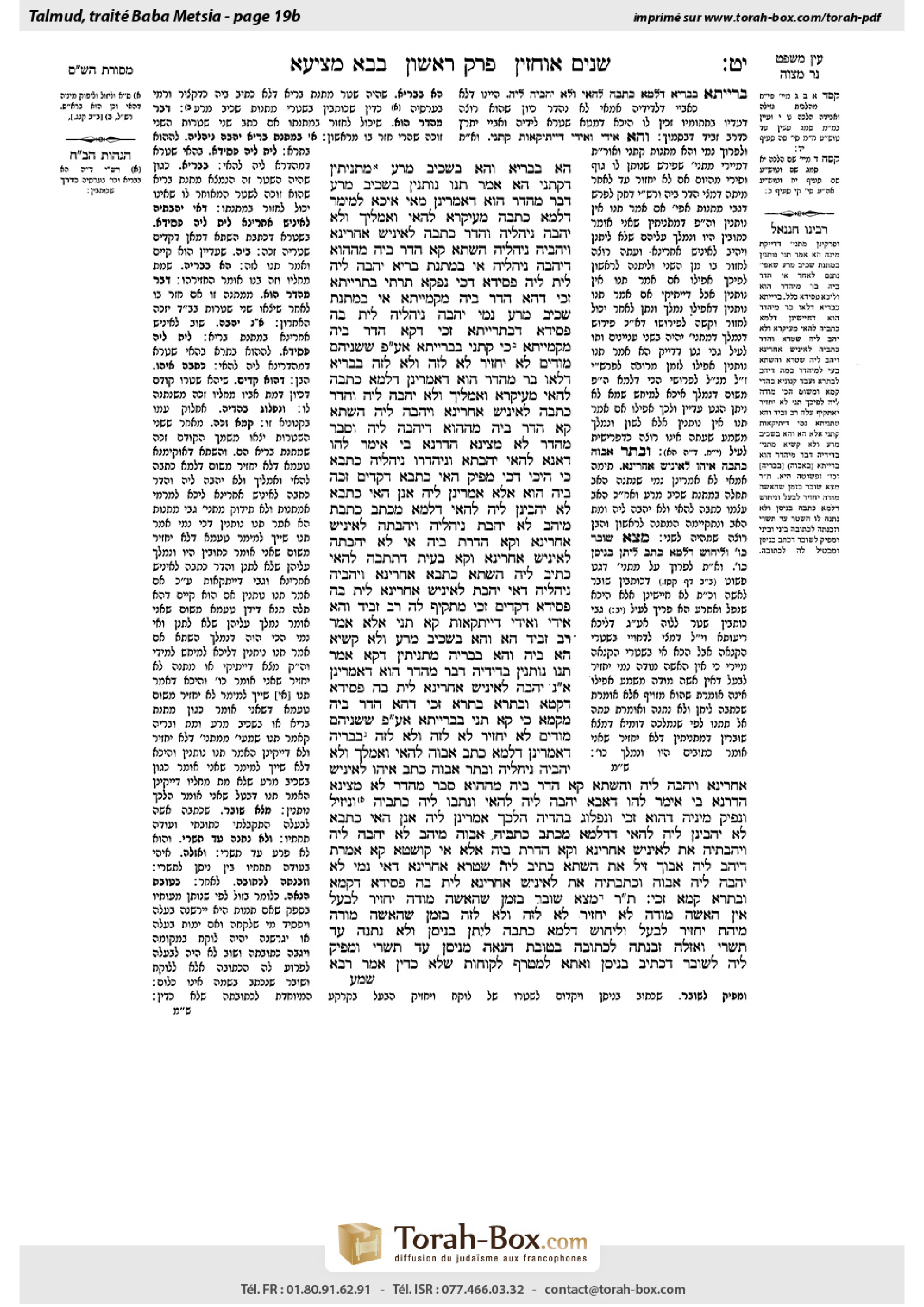
Bava Metzia 19b: Talmud study for Daf Yomi
Study the Talmud for Daf Yomi with scanned pages, Hebrew text, English translations from Sefaria and AI-generated French translations.
Passage selection and English or AI-generated French translation are available where the scan has annotations. Daf Study is independent of Torah-Box and Sefaria.
Browse Bava Metzia · בבא מציעא · All tractatesBava Metzia 19b text and translations
This page of Bava Metzia includes the Aramaic text, an English translation and an AI-generated French translation, alongside the scan above.
בבא מציעא י״ט ב · Aramaic and Hebrew text
הָא בְּבָרִיא, וְהָא בִּשְׁכִיב מְרַע.
מַתְנִיתִין דְּקָתָנֵי: הָא אָמַר תְּנוּ נוֹתְנִין – בִּשְׁכִיב מְרַע, דְּבַר מִהְדַּר הוּא.
דְּאָמְרִינַן, מַאי אִיכָּא לְמֵימַר: דִּלְמָא כַּתְבַהּ מֵעִיקָּרָא לְהַאי וְאִמְּלִיךְ וְלָא יַהֲבַהּ נִיהֲלֵיהּ, וַהֲדַר כַּתְבַהּ לְאִינִישׁ אַחֲרִינָא וְיַהֲבַיהּ נִיהֲלֵיהּ – הַשְׁתָּא קָא הָדַר בֵּיהּ מֵהָהוּא דְּיַהֲבַהּ נִיהֲלֵיהּ.
אִי בְּמַתְּנַת בָּרִיא יַהֲבַהּ לֵיהּ – לֵית לֵיהּ פְּסֵידָא, דְּכִי נָפְקָא תַּרְתֵּי, בָּתְרָיְיתָא זָכֵי, דְּהָא הֲדַר בֵּיהּ מִקַּמָּיְיתָא.
אִי בְּמַתְּנַת שְׁכִיב מְרַע נָמֵי יַהֲבַהּ נִיהֲלֵיהּ, לֵית בַּהּ פְּסֵידָא – דְּבָתְרָיְיתָא זָכֵי, דְּקָא הָדַר בֵּיהּ מִקַּמָּיְיתָא.
כִּי קָתָנֵי בְּבָרַיְיתָא: אַף עַל פִּי שֶׁשְּׁנֵיהֶם מוֹדִים לֹא יַחְזִיר לֹא לָזֶה וְלֹא לָזֶה – בְּבָרִיא, דְּלָאו בַּר מִהְדַּר הוּא,
דְּאָמְרִינַן: דִּלְמָא כַּתְבַהּ לְהַאי מֵעִיקָּרָא וְאִמְּלִיךְ וְלָא יַהֲבַהּ לֵיהּ, וַהֲדַר כַּתְבַהּ לְאִינִישׁ אַחֲרִינָא וְיַהֲבַהּ לֵיהּ – הַשְׁתָּא קָא הָדַר בֵּיהּ מֵהָהוּא דְּיַהֲבַהּ לֵיהּ וְסָבַר: מִהְדָּר לָא מָצֵינָא הָדַרְנָא בִּי, אֵימַר לְהוּ דַּאֲנָא לְהַאי יַהֲבִתַהּ, וְנַיהְדְּרוּ נִיהֲלֵיהּ כְּתָבָא, כִּי הֵיכִי דְּכִי מַפֵּיק הַאי כְּתָבָא, דְּקָדֵים זָכֵה בֵּיהּ הוּא.
אֶלָּא אָמְרִינַן לֵיהּ אֲנַן: הַאי כְּתָבָא לָא יָהֲבִינַן לֵיהּ לְהַאי. דִּלְמָא מִכְתָּב כְּתַבְתְּ, מֵיהָב לָא יְהַבְתְּ נִיהֲלֵיהּ, וִיהַבְתַּהּ לְאִינִישׁ אַחֲרִינָא וְקָא הָדְרַתְּ בֵּיהּ. אִי לָא יְהַבְתַּהּ לְאִינִישׁ אַחֲרִינָא וְקָא בָּעֵית דְּתִתְּבַהּ לְהַאי, כְּתֹב לֵיהּ הַשְׁתָּא כְּתָבָא אַחֲרִינָא וְיַהֲבֵיהּ נִיהֲלֵיהּ, דְּאִי יָהֲבַתְּ לְאִינִישׁ אַחֲרִינָא לֵית בַּהּ פְּסֵידָא, דְּקָדֵים זָכֵי.
מַתְקֵיף לַהּ רַב זְבִיד: וְהָא אִידֵּי וְאִידֵּי דְּיָיתֵקָאוֹת קָא תָנֵי! אֶלָּא אָמַר רַב זְבִיד: הָא וְהָא בִּשְׁכִיב מְרַע, וְלָא קַשְׁיָא: הָא בֵּיהּ, וְהָא בִּבְרֵיהּ!
דְּקָא אָמַר ״תְּנוּ״ נוֹתְנִין, בְּדִידֵיהּ דְּבַר מִהְדָּר הוּא, דְּאָמְרִינַן: אִי נָמֵי יַהֲבַהּ לְאִינִישׁ אַחֲרִינָא לֵית בַּהּ פְּסֵידָא, דְּקַמָּא וּבָתְרָא – בָּתְרָא זָכֵי, דְּהָא הֲדַר בֵּיהּ מִקַּמָּא.
כִּי קָא תָנֵי בְּבָרַיְיתָא: אַף עַל פִּי שֶׁשְּׁנֵיהֶם מוֹדִים, לֹא יַחְזִיר לֹא לָזֶה וְלֹא לָזֶה, בִּבְרֵיהּ.
דְּאָמְרִינַן: דִּלְמָא כְּתַב אֲבוּהּ לְהַאי, וְאִמְּלִיךְ וְלָא יַהֲבַיהּ נִיהֲלֵיהּ, וּבָתַר אֲבוּהּ כְּתַב אִיהוּ לְאִינִישׁ אַחֲרִינָא וְיַהֲבַהּ לֵיהּ, וְהַשְׁתָּא קָא הָדַר בֵּיהּ מֵהָהוּא. סָבַר: מִהְדָּר לָא מָצֵינָא הָדַרְנָא בִּי. אֵימַר לְהוּ דְּאַבָּא יַהֲבַהּ לֵיהּ לְהַאי, וְנִתְּבוּ לֵיהּ כְּתָבֵיהּ, וְנֵיזִיל וְנַפֵּיק מִינֵּיהּ דְּהוּא זָכֵי וְנִפְלוֹג בַּהֲדֵיהּ.
הִלְכָּךְ אָמְרִינַן לֵיהּ אֲנַן: הַאי כְּתָבָא לָא יָהֲבִינַן לֵיהּ לְהַאי, דְּדִלְמָא מִכְתָּב כַּתְבֵיהּ אֲבוּהּ מֵיהָב לָא יַהֲבַהּ לֵיהּ, וִיהַבְתֵּיהּ אַתְּ לְאִינִישׁ אַחֲרִינָא וְקָא הָדְרַתְּ בֵּיהּ.
אֶלָּא אִי קוּשְׁטָא קָא אָמְרַתְּ, דִּיהַב לֵיהּ אֲבוּךְ – זִיל אַתְּ הַשְׁתָּא כְּתֹב לֵיהּ שְׁטָרָא אַחֲרִינָא, דְּאִי נָמֵי לָא יַהֲבַהּ לֵיהּ אֲבוּהּ וּכְתַבְתֵּיהּ אַתְּ לְאִינִישׁ אַחֲרִינָא – לֵית בַּהּ פְּסֵידָא, דְּקַמָּא וּבָתְרָא – קַמָּא זָכֵי.
תָּנוּ רַבָּנַן: מָצָא שׁוֹבָר, בִּזְמַן שֶׁהָאִשָּׁה מוֹדֶה – יַחְזִיר לַבַּעַל. אֵין הָאִשָּׁה מוֹדֶה – לֹא יַחְזִיר לֹא לָזֶה וְלֹא לָזֶה.
בִּזְמַן שֶׁהָאִשָּׁה מוֹדֶה מִיהַת יַחְזִיר לַבַּעַל, וְלֵיחוּשׁ דִּלְמָא כָּתְבָה לִיתֵּן בְּנִיסָן, וְלֹא נָתְנָה עַד תִּשְׁרֵי, וַאֲזַלָה זְבֵנְתַּהּ לִכְתוּבְּ[תַ]הּ בְּטוֹבַת הֲנָאָה מִנִּיסָן עַד תִּשְׁרֵי.
וּמַפֵּיק לֵיהּ לְשׁוֹבָר דִּכְתִיב בְּנִיסָן, וְאָתֵא לְמִטְרַף לָקוֹחוֹת שֶׁלֹּא כַּדִּין!
אָמַר רָבָא:
Bava Metzia 19b · English translation
This halakha applies in a case of a gift given by a healthy person, and that halakha applies in a case of a gift given by a person on his deathbed.
The Gemara explains: The mishna that teaches that if the giver says: Give it to its intended recipient, the finder must give it, applies in a case of a gift given by a person on his deathbed, who is capable of retracting his gift.
Therefore, the finder must give the deed to the recipient, as we say: What is there to say as a reason for not returning the deed? One might suggest that perhaps the giver initially wrote a deed of gift for this person, but then reconsidered and did not give it to him, and then he wrote a second deed of gift for another person and thereby gave his property to him. And now that his first deed was found, he wishes to retract his gift to that second person to whom he gave the property, by dishonestly validating the first deed.
This attempt to retract his latter gift will not succeed. If he gave his property to the recipient of the second deed of gift as the gift of a healthy person, then the second recipient incurs no loss by the first deed being given to its intended recipient. This is because, when the two deeds are produced in court, the recipient of the later one acquires the property, as the owner evidently retracted the first gift. Since one who gave away his property while on his deathbed can subsequently retract his gift, the second recipient acquires the property.
So too, if he gave it to the second person as the gift of a person on his deathbed, he incurs no loss. This is because the recipient of the later deed acquires the property, as the giver evidently retracted his gift to the first recipient.
And when the baraita teaches that even if both the one who wrote the deed and its intended recipient agree that it is valid, the one who found it should neither return it to this person nor to that person, it is referring to the case of a gift given by a healthy person, who is not able to retract his gift.
Therefore, one may not return the deed, as we say that perhaps the giver initially wrote a deed of gift for this person but then reconsidered and did not give it to him, and then he wrote a second deed of gift for another person and thereby gave his property to him; and now he wishes to retract his gift to that second person to whom he gave the property, thinking: Since I cannot retract the gift legally, I will say to the court that I gave the first deed of gift to this first person, and they will return the deed of gift to him, in order that when he produces this deed of gift, which is dated earlier, he will thereby acquire the property.
Rather, we say to the giver: We will not give this document to this person, as perhaps you wrote it but did not give it to him, and then you gave the property to another person, and you now wish to retract your gift to him unlawfully. Therefore, if in fact you did not give this property as a gift to another person, and you wish to return it to this person, then do the following: Write another deed of gift for him now and give it to him, so that if you did previously give the property to another person, he will incur no loss, as the earlier recipient acquires the gift.
Rav Zevid objects to this distinction between the mishna and baraita, asking: But don’t this mishna and that baraita both teach halakhot with regard to wills? How can Rabbi Abba bar Memel explain that the baraita is referring to the gift of a healthy person? Rather, Rav Zevid said that both this mishna and that baraita are referring to the gift of a person on his deathbed, and nevertheless, the contradiction between them is not difficult; this mishna is referring to him, the giver himself, who authorizes the return of the will to its intended recipient, and that baraita is referring to a case where the giver died, and his son is the one who is authorizing the return of the will.
The Gemara explains: The mishna, which indicates that if the giver says: Give it to the recipient, the finder must give it to him, is referring to a case where the giver himself authorizes giving the will, as he is capable of retracting it. Therefore, there is no harm in giving the will to the recipient, as we say that even if in the meantime he already gave the property to another person, the latter recipient incurs no loss. This is because in a case where there are two wills, a first one and a last one, the recipient of the last one acquires the property, as the owner evidently retracted the first will.
And when the baraita teaches that even if both the one who wrote the deed and its intended recipient agree that it is valid, the one who found it should neither return it to this person nor to that person, it is referring to a case where the one who wrote it died, and it is his son who authorizes its return to the recipient.
In that case, the deed may not be returned, as we say that perhaps his father wrote the deed of gift for this person and then reconsidered and did not give it to him, and after his father died, the son wrote a deed of gift giving the property to another person and gave it to him. And now the son wishes to retract that gift, thinking: Since I cannot retract the gift legally, I will say to the court that my father gave his deed of gift to this first person, and they will return him his deed of gift, and he will then go and appropriate the property from the one who legally acquired the property, as he will be successful in acquiring it, and I will divide it with him.
Therefore, we say to the son: We will not give this deed to this person, as perhaps your father wrote it but did not give it to him, and then you gave the property to another person, and now you wish to retract your gift.
Rather, if you are telling the truth that your father gave him this property, then you should go now and write another deed of gift for him, so that even if your father did not give him this property, and you wrote a deed of gift giving this property to another person, he will incur no loss. This is because in a case where there are two deeds of gift, a first one and a last one, the recipient of the first one acquires the property.
§ The Sages taught in a baraita: If one found a receipt for payment of a marriage contract, in a case when the wife admits that it was paid, he should return it to the husband. If the wife does not admit that it was paid, he should neither return it to this person, the husband, nor to that person, the wife.
In any event, the baraita states that when the wife admits that it was paid, one should return the receipt to the husband. The Gemara asks: But let us suspect that perhaps the wife wrote the receipt intending to give it to the husband in Nisan, but ultimately she did not give it to him until Tishrei, and she went and sold her marriage contract for financial advantage in the interim, between Nisan and Tishrei. In other words, she received a sum of money and in exchange agreed that if she were to be divorced or widowed and become entitled to payment of her marriage contract, the money would belong to the purchaser of the rights to her marriage contract.
And then after the couple is divorced, and the purchaser collects payment of the marriage contract from the husband, the husband will produce the receipt that was written in Nisan and will come to repossess property from the purchasers unlawfully.
Rava said:
Bava Metzia 19b · Traduction française (IA)
Cette halakha s'applique dans le cas d'un don fait par une personne en bonne santé, et cette halakha s'applique également dans le cas d'un don fait par une personne sur son lit de mort.
La Guemara explique : La Michna qui enseigne que si le donneur dit : Donnez-le à son destinataire prévu, le trouvateur doit le restituer, s'applique dans le cas d'un don fait par une personne sur son lit de mort, capable de rétracter son don.
Ainsi, le trouvateur doit restituer le document au destinataire, comme nous disons : Quel est le motif pour ne pas restituer le document ? On pourrait suggérer que peut-être le donneur avait initialement rédigé un document de don pour cette personne, mais avait ensuite changé d'avis et ne lui avait pas donné la propriété, puis avait rédigé un second document de don pour une autre personne et avait ainsi donné sa propriété à cette dernière. Et maintenant que son premier document a été trouvé, il souhaite rétracter son don à cette deuxième personne en validant de manière frauduleuse le premier document.
Cette tentative de rétracter son dernier don ne réussira pas. Si l'on avait donné sa propriété à la personne destinataire du second document de don comme un don fait par une personne en bonne santé, alors la deuxième personne ne subit aucun préjudice à cause du premier document restitué à son destinataire prévu. Cela est dû au fait que, lorsqu'on produit les deux documents devant un tribunal, le destinataire du second document acquiert la propriété, car le propriétaire a évidemment rétracté le premier don. Puisque celui qui a donné sa propriété sur son lit de mort peut ultérieurement rétracter son don, le second destinataire acquiert la propriété.
De même, si l'on avait donné la propriété à la deuxième personne comme un don fait par une personne sur son lit de mort, il ne subit aucun préjudice. Cela est dû au fait que le destinataire du second document acquiert la propriété, car le donneur a évidemment rétracté son don à la première personne.
Et lorsque la baraïta enseigne que même si à la fois celui qui a rédigé le document et son destinataire prévu conviennent qu'il est valide, celui qui l'a trouvé ne doit ni le restituer à cette personne ni à celle-ci, cela fait référence au cas d'un don fait par une personne en bonne santé, qui ne peut pas rétracter son don.
Ainsi, on ne doit pas restituer le document, car nous disons que peut-être le donneur avait initialement rédigé un document de don pour cette personne mais avait ensuite changé d'avis et ne lui avait pas donné la propriété, puis avait rédigé un second document de don pour une autre personne et avait ainsi donné sa propriété à cette dernière ; et maintenant il souhaite rétracter son don à cette deuxième personne, en pensant : Puisque je ne peux pas rétracter le don légalement, je dirai au tribunal que j'ai donné le premier document de don à cette première personne, et ils le restitueront à lui, afin que lorsqu'il produira ce document de don, daté plus tôt, il pourra ainsi acquérir la propriété.
Plutôt, nous disons au donneur : Nous ne restituerons pas ce document à cette personne, car peut-être vous l'avez rédigé mais n'avez pas donné la propriété à cette personne, puis vous avez donné la propriété à une autre personne, et vous souhaitez maintenant rétracter votre don à cette personne de manière illégale. Ainsi, si en réalité vous n'avez pas donné cette propriété comme un don à une autre personne, et que vous souhaitez la restituer à cette personne, faites-le ainsi : rédigez un nouveau document de don pour lui maintenant et donnez-le-lui, afin que si vous avez effectivement donné la propriété à une autre personne auparavant, il ne subisse aucun préjudice, car le premier destinataire acquiert le don.
Rav Zevid s'oppose à cette distinction entre la Michna et la baraïta, en demandant : Mais ne sont-ce pas ces deux halakhot qui enseignent toutes deux sur les testaments ? Comment Rabbi Abba bar Memel peut-il expliquer que la baraïta fait référence à un don fait par une personne en bonne santé ? Plutôt, Rav Zevid a dit que ces deux Michnas et cette baraïta font référence à un don fait par une personne sur son lit de mort, et néanmoins, la contradiction entre elles n'est pas difficile ; cette Michna fait référence à lui, le donneur lui-même, qui autorise la restitution du testament à son destinataire prévu, et cette baraïta fait référence à un cas où le donneur est décédé et c'est son fils qui autorise la restitution du testament.
La Guemara explique : La Michna, qui indique que si le donneur dit : Donnez-le au destinataire, le trouvateur doit le lui restituer, fait référence à un cas où le donneur lui-même autorise la restitution du testament, car il est capable de le rétracter. Ainsi, il n'y a aucun préjudice à restituer le testament au destinisateur, comme nous disons que même si en cours de route il a déjà donné la propriété à une autre personne, le dernier destinataire ne subit aucun préjudice. Cela est dû au fait que, dans le cas de deux testaments, un premier et un dernier, le destinataire du dernier acquiert la propriété, car le propriétaire a évidemment rétracté le premier testament.
Et lorsque la baraïta enseigne que même si à la fois celui qui a rédigé le document et son destinataire prévu conviennent qu'il est valide, celui qui l'a trouvé ne doit ni le restituer à cette personne ni à celui-ci, cela fait référence à un cas où celui qui l'a rédigé est décédé et c'est son fils qui autorise sa restitution au destinataire.
Dans ce cas, le document ne peut pas être restitué, comme nous disons que peut-être son père avait rédigé le document de don pour cette personne et avait ensuite changé d'avis et ne lui avait pas donné la propriété, et après la mort de son père, le fils avait rédigé un document de don donnant la propriété à une autre personne et l'avait donné à cette dernière. Et maintenant, le fils souhaite rétracter ce don, en pensant : Puisque je ne peux pas rétracter le don légalement, je dirai au tribunal que mon père avait donné son document de don à cette première personne, et ils le restitueront à lui, et il ira ensuite s'approprier la propriété de celui qui l'avait légalement acquise, car il sera réussi à l'acquérir, et je le partagerai avec lui.
Ainsi, nous disons au fils : Nous ne restituerons pas ce document à cette personne, car peut-être votre père l'avait rédigé mais ne lui avait pas donné la propriété, et ensuite vous avez donné la propriété à une autre personne, et maintenant vous souhaitez rétracter votre don.
Plutôt, si vous dites la vérité que votre père a donné cette propriété à cet homme, alors vous devriez aller maintenant et rédiger un autre acte de donation pour lui, afin que même si votre père n’a pas donné cette propriété à cet homme, et que vous avez rédigé un acte de donation donnant cette propriété à une autre personne, il ne subisse aucun préjudice. Cela est dû au fait qu’en cas de deux actes de donation, un premier et un dernier, le bénéficiaire du premier acquiert la propriété.
§ Les Sages enseignent dans une baraïta : Si l’on trouve un reçu de paiement d’un contrat de mariage, dans le cas où la femme admet qu’il a été payé, on doit le rendre au mari. Si la femme ne reconnaît pas qu’il a été payé, on ne doit ni le rendre à cette personne, le mari, ni à celle-ci, la femme.
En tout cas, la baraïta stipule que lorsqu’elle admet qu’il a été payé, on doit rendre le reçu au mari. La Guemara demande : Mais supposons que l’on soupçonne que la femme a rédigé le reçu avec l’intention de le donner au mari en Nisan, mais qu’elle n’a finalement pas réussi à le lui donner jusqu’en Tishrei, et qu’elle a vendu son contrat de mariage à des fins financières entre Nisan et Tishrei. En d’autres termes, elle a reçu une somme d’argent et, en échange, a convenu que si elle devenait divorcée ou veuve et avait droit au paiement de son contrat de mariage, l’argent appartiendrait à l’acheteur des droits sur son contrat de mariage.
Et ensuite, après le divorce, lorsque l’acheteur récupère le paiement du contrat de mariage auprès du mari, le mari produira le reçu rédigé en Nisan et viendra réclamer la propriété aux acheteurs de manière illégale.
Rava dit :
Traduction française générée par IA à partir de l’édition anglaise de Sefaria. Vérifie toujours un passage avec le texte source.
Text from Sefaria: William Davidson Edition - Vocalized Aramaic (CC BY NC); William Davidson Edition - English (CC BY NC).