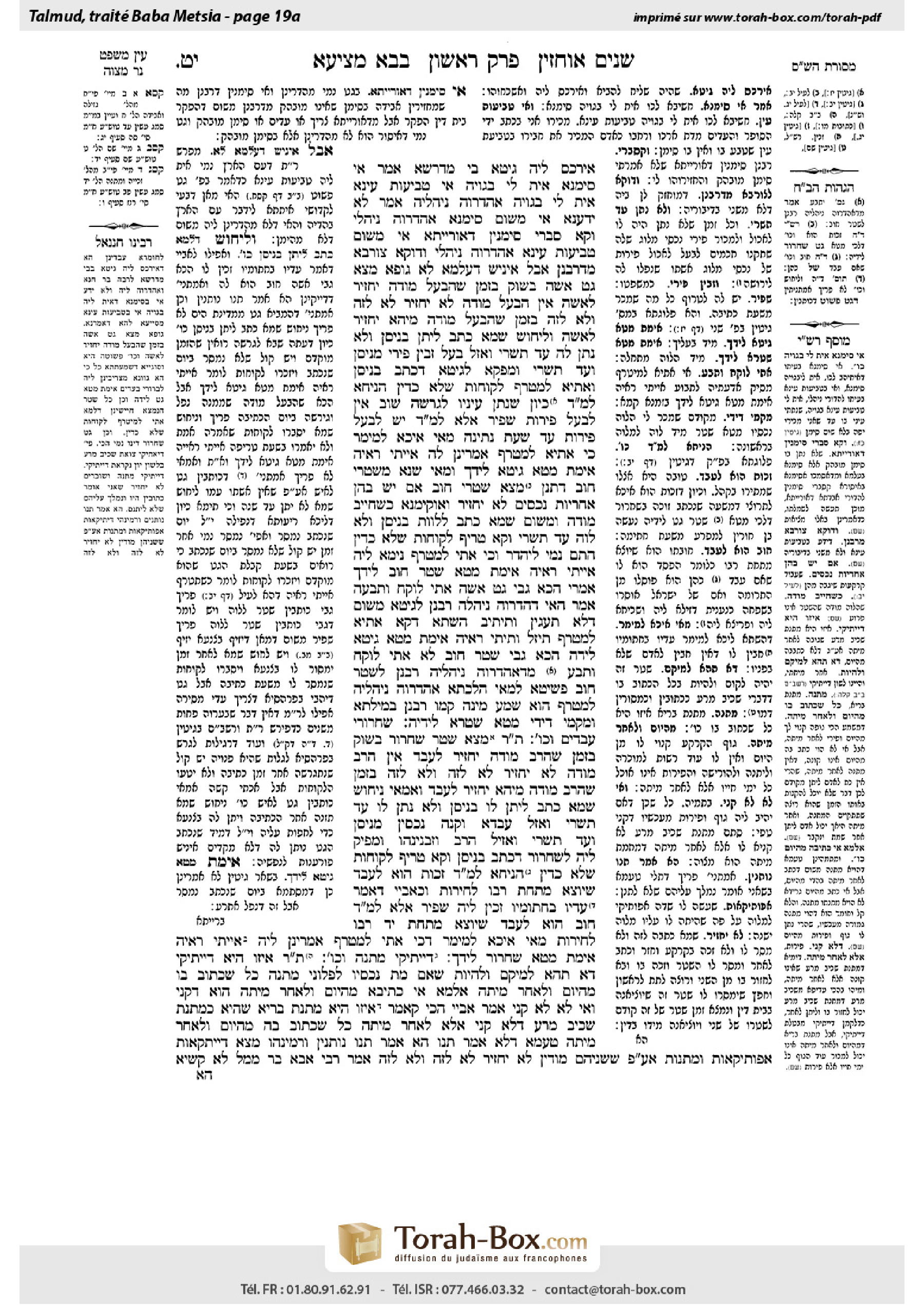
Bava Metzia 19a: Talmud study for Daf Yomi
Study the Talmud for Daf Yomi with scanned pages, Hebrew text, English translations from Sefaria and AI-generated French translations.
Passage selection and English or AI-generated French translation are available where the scan has annotations. Daf Study is independent of Torah-Box and Sefaria.
Browse Bava Metzia · בבא מציעא · All tractatesBava Metzia 19a text and translations
This page of Bava Metzia includes the Aramaic text, an English translation and an AI-generated French translation, alongside the scan above.
בבא מציעא י״ט א · Aramaic and Hebrew text
אִירְכַס לֵיהּ גִּיטָּא בֵּי מִדְרְשָׁא. אֲמַר: אִי סִימָנָא – אִית לִי בְּגַוֵּיהּ, אִי טְבִיעוּת עֵינָא – אִית לִי בְּגַוֵּיהּ. אַהְדְּרוּהּ נִיהֲלֵיהּ. אֲמַר: לָא יָדַעְנָא אִי מִשּׁוּם סִימָנָא אַהְדְּרוּהּ נִיהֲלִי, וְקָא סָבְרִי סִימָנִין דְּאוֹרָיְיתָא. אִי מִשּׁוּם טְבִיעוּת עֵינָא אַהְדְּרוּהּ נִיהֲלִי, וְדַוְקָא צוּרְבָּא מִדְּרַבָּנַן. אֲבָל אִינִישׁ דְּעָלְמָא – לָא.
גּוּפָא: מָצָא גֵּט אִשָּׁה בַּשּׁוּק, בִּזְמַן שֶׁהַבַּעַל מוֹדֶה – יַחְזִיר לְאִשָּׁה. אֵין הַבַּעַל מוֹדֶה – לֹא יַחְזִיר לֹא לָזֶה וְלֹא לָזֶה.
בִּזְמַן שֶׁהַבַּעַל מוֹדֶה מִיהָא יַחְזִיר לָאִשָּׁה. וְלֵיחוּשׁ שֶׁמָּא כָּתַב לִיתֵּן בְּנִיסָן וְלֹא נָתַן לָהּ עַד תִּשְׁרֵי, וַאֲזַל בַּעַל זַבֵּין פֵּירֵי מִנִּיסָן וְעַד תִּשְׁרֵי, וּמַפְּקָא לְגִיטָּא דִּכְתִיב בְּנִיסָן, וְאָתְיָא לְמִטְרַף לָקוֹחוֹת שֶׁלֹּא כַּדִּין.
הָנִיחָא לְמַאן דְּאָמַר כֵּיוָן שֶׁנָּתַן עֵינָיו לְגָרְשָׁהּ שׁוּב אֵין לַבַּעַל פֵּירוֹת – שַׁפִּיר. אֶלָּא לְמַאן דְּאָמַר יֵשׁ לַבַּעַל פֵּירוֹת עַד שְׁעַת נְתִינָה, מַאי אִיכָּא לְמֵימַר?
כִּי אָתְיָא לְמִטְרַף אָמְרִינַן לַהּ: אַיְיתַי רְאָיָה אֵימַת מְטָא גִּיטָּא לְיָדְךָ.
וּמַאי שְׁנָא מִשְּׁטָרֵי חוֹב? דִּתְנַן: מָצָא שְׁטָרֵי חוֹב, אִם יֵשׁ בָּהֶן אַחְרָיוּת נְכָסִים – לֹא יַחְזִיר. וְאוֹקֵימְנָא כְּשֶׁחַיָּיב מוֹדֶה, וּמִשּׁוּם שֶׁמָּא כָּתַב לִלְווֹת בְּנִיסָן וְלֹא לָוָה עַד תִּשְׁרֵי וְקָא טָרֵיף לָקוֹחוֹת שֶׁלֹּא כַּדִּין.
הָתָם נָמֵי לִיהְדַּר, וְכִי אָתֵי לְמִטְרַף נֵימָא לֵיהּ: אַיְיתִי רְאָיָה אֵימַת מְטָא שְׁטַר חוֹב לְיָדָךְ!
אָמְרִי, הָכָא גַּבֵּי גֵּט אִשָּׁה אָתֵי לוֹקֵחַ וְתָבַעה, אָמַר: הַאי דְּ[אַ]הְדְּרוּהּ נִיהֲלַהּ רַבָּנַן לְגִיטָּא, מִשּׁוּם דְּלָא תִּעֲגִין וְתֵיתִיב. הַשְׁתָּא דְּקָא אָתְיָא לְמִטְרַף – תֵּיזִל וְתַיְתֵי רְאָיָה אֵימַת מְטָא גִּיטָּא לִידַהּ.
הָכָא גַּבֵּי שְׁטַר חוֹב לָא אָתֵי לוֹקֵחַ וְתָבַע, [אָמַר] מִדְּאַהְדְּרוּהּ נִיהֲלֵיהּ רַבָּנַן לִשְׁטַר חוֹב, פְּשִׁיטָא לְמַאי הִלְכְתָא אַהְדְּרוּהּ נִיהֲלֵיהּ – לְמִטְרַף הוּא, שְׁמַע מִינַּהּ קָמוּ רַבָּנַן בְּמִילְּתָא, וּמִקַּמֵּי דִּידִי מְטָא שְׁטָרָא לִידֵיהּ.
שִׁחְרוּרֵי עֲבָדִים וְכוּ׳. תָּנוּ רַבָּנַן: מָצָא שְׁטַר שִׁחְרוּר בְּשׁוּק, בִּזְמַן שֶׁהָרַב מוֹדֶה – יַחְזִיר לָעֶבֶד, אֵין הָרַב מוֹדֶה – לֹא יַחְזִיר לֹא לָזֶה וְלֹא לָזֶה.
בִּזְמַן שֶׁהָרַב מוֹדֶה מִיהָא יַחְזִיר לָעֶבֶד, וְאַמַּאי? נֵיחוּשׁ שֶׁמָּא כָּתַב לִיתֵּן לוֹ בְּנִיסָן וְלֹא נָתַן לוֹ עַד תִּשְׁרֵי, וַאֲזַל עַבְדָּא וּקְנָה נִכְסִין מִנִּיסָן וְעַד תִּשְׁרֵי, וַאֲזַיל הָרַב וְזַבְּנִינְהוּ וּמַפֵּיק לֵיהּ לְשִׁחְרוּר דִּכְתִב בְּנִיסָן, וְקָא טָרֵיף לָקוֹחוֹת שֶׁלֹּא כַּדִּין.
הָנִיחָא לְמַאן דְּאָמַר זְכוּת הוּא לָעֶבֶד שֶׁיּוֹצֵא מִתַּחַת רַבּוֹ לְחֵירוּת, וּכְאַבָּיֵי דְּאָמַר: עֵדָיו בַּחֲתוּמָיו זָכִין לֵיהּ, שַׁפִּיר. אֶלָּא לְמַאן דְּאָמַר חוֹב הוּא לָעֶבֶד שֶׁיּוֹצֵא מִתַּחַת רַבּוֹ לְחֵירוּת, מַאי אִיכָּא לְמֵימַר?
דְּכִי אָתֵי לְמִטְרַף אָמְרִינַן לֵיהּ: אַיְיתִי רְאָיָה אֵימַת מְטָא שִׁחְרוּר לְיָדָךְ.
דְּיָיתֵיקֵי מַתָּנָה וְכוּ׳. תָּנוּ רַבָּנַן: אֵיזוֹ הִיא דְּיָיתֵיקֵי – דָּא תְּהֵא לְמֵיקַם וְלִהְיוֹת שֶׁאִם מֵת נְכָסָיו לִפְלוֹנִי. מַתָּנָה – כֹּל שֶׁכָּתוּב בּוֹ ״מֵהַיּוֹם וּלְאַחַר מִיתָה״.
אַלְמָא אִי כְּתִיבָא ״מֵהַיּוֹם וּלְאַחַר מִיתָה״ הוּא דְּקָנֵי, וְאִי לָא – לָא קָנֵי?!
אָמַר אַבָּיֵי, הָכִי קָאָמַר: אֵיזוֹ הִיא מַתְּנַת בָּרִיא שֶׁהִיא כְּמַתְּנַת שְׁכִיב מְרַע, דְּלָא קָנֵי אֶלָּא לְאַחַר מִיתָה, כֹּל שֶׁכָּתוּב בָּהּ ״מֵהַיּוֹם וּלְאַחַר מִיתָה״.
טַעְמָא דְּלָא אָמַר ״תְּנוּ״. הָא אָמַר ״תְּנוּ״ – נוֹתְנִין.
וּרְמִינְהוּ: מָצָא דְּיָיתֵקָאוֹת, אַפּוֹתֵיקָאוֹת וּמַתָּנוֹת, אַף עַל פִּי שֶׁשְּׁנֵיהֶם מוֹדִין – לֹא יַחְזִיר לֹא לָזֶה וְלֹא לָזֶה!
אָמַר רַבִּי אַבָּא בַּר מֶמֶל: לָא קַשְׁיָא,
Bava Metzia 19a · English translation
lost a bill of divorce, which had been given to him to deliver, in the study hall. When it was found, he said: If they request a distinguishing mark, I have one for it. If it depends on visual recognition, I have methods of recognition for it. They returned the bill of divorce to him. He said afterward: I do not know if they returned it to me due to the distinguishing mark that I supplied, and they hold that distinguishing marks are used to return lost items by Torah law, or if they returned it to me due to my visual recognition, and it was specifically because I am a Torah scholar, as Torah scholars are relied upon when they say that they recognize an item, but an ordinary person would not be relied upon to recognize the item and have it returned to him.
§ The Gemara discusses the matter itself cited above: If one found a woman’s bill of divorce in the marketplace, in a case when the husband admits that he wrote and gave it, the finder must return it to the wife. If the husband does not admit to this, the finder may neither return it to this one, the husband, nor to that one, the wife.
In any event, the baraita states that when the husband admits that he wrote and gave it, the finder must return it to the wife. The Gemara challenges: But let us suspect that perhaps he wrote the bill of divorce intending to give it in Nisan, but did not give it to her until Tishrei, and the husband went and sold the produce of his wife’s property in the interim, between Nisan and Tishrei, since the divorce had not yet taken effect. And the wife might then produce the bill of divorce, which he wrote in Nisan, and come to repossess the produce from the purchasers unlawfully.
This works out well according to the one who says that once he has decided to divorce her, the husband no longer has the rights to his wife’s produce. Since the husband had no right to sell the produce, the wife repossessed it rightfully. But according to the one who says that the husband has rights to his wife’s produce until the actual time of giving the bill of divorce, what is there to say?
The Gemara answers: When she comes to repossess the produce, we say to her: First bring proof as to when the bill of divorce came into your possession, and then we will allow you to repossess the sold produce.
The Gemara asks: But in what way is it different from promissory notes? As we learned in a mishna (12b): With regard to one who found promissory notes, if they include a property guarantee for the loan, he may not return them to the creditor. And we interpreted the mishna as referring to a case where the liable party admits that he has not yet repaid the debt, and the reason the promissory note cannot be returned is due to the possibility that perhaps he wrote it intending to borrow money in Nisan, but ultimately did not borrow it until Tishrei, and the creditor might therefore use the promissory note to unlawfully repossess property that the debtor sold between Nisan and Tishrei from the purchasers.
According to the Gemara’s suggestion with regard to a bill of divorce, there, in the case of a promissory note, it should also be returned, and when the creditor comes to repossess the debtor’s property that was sold in the interim, let the court say to him: First bring proof as to when the promissory note came into your possession.
The Sages say that it is not comparable. Here, with regard to a woman’s bill of divorce, the purchaser will come and demand that the wife prove when it was given to her, as he will say to himself: The fact that the Sages returned the bill of divorce to her was only so that she would not dwell alone as a deserted wife and not be able to remarry for lack of a bill of divorce. Now that she is coming to repossess the property her husband sold me, she should go and bring proof as to when the bill of divorce came into her possession.
By contrast, here, with regard to a promissory note, the purchaser will not come and demand proof, because he will infer from the fact that the Sages returned the promissory note to him that it is obviously valid from the date written in it. After all, for what halakha did the court return it to him? It was clearly in order to repossess property with it. Therefore, he will conclude from it: The Sages clarified the matter and determined that, in fact, this promissory note came into the possession of the creditor prior to my purchase of property from the debtor.
§ The mishna teaches: Bills of manumission of slaves that are found should not to be returned. The Sages taught in a baraita: If one found a bill of manumission in the marketplace, in a case when the master admits that he gave the bill to the slave, one should return it to the slave. If the master does not admit to it, one should neither return it to this person, the master, nor to that person, the slave.
The Gemara asks: In any event, the baraita states that when the master admits that he gave the bill of manumission to the slave, the one who found it should return it to the slave. But why should he return it? Let us suspect that perhaps he wrote the bill of manumission intending to give it to him in Nisan, but he did not give it to him until Tishrei, and the slave went and bought property in the interim, between Nisan and Tishrei, at which time he was still a slave, in which case the property belongs to his master, and the master then went and sold that property. And if the bill of manumission is returned to the slave, he might produce the bill of manumission, which his master wrote in Nisan, in order to claim that the property was not his master’s to sell, and repossess the property from the purchasers unlawfully.
This works out well according to the one who says that it is in a slave’s interest to leave his master’s authority and attain freedom and in accordance with the opinion of Abaye, who says that when a document serves the interests of its intended recipient, its witnesses, with their signatures, acquire it on his behalf. Accordingly, a slave attains freedom at the moment his bill of manumission is signed, even if it is given to him at a later date. Therefore, the halakha in the baraita works out well. But according to the one who says that it is against a slave’s interests to leave his master’s authority and attain freedom, what is there to say?
The Gemara answers that when the slave comes to repossess the property, we say to him: Bring proof as to when the bill of manumission reached your possession and you were freed.
§ The mishna teaches: If one found wills [deyaytiki] or deeds of gift, he should not return them. The Sages taught in a baraita: What is considered a deyaytiki and is collected by the designated recipient after the death of the giver? It is a deed that states: This deed will be to stand [da tehe lemeikam] and exist as proof that if this person dies, his property is to be given to so-and-so. An ordinary deed of gift, by contrast, is any deed in which it is written: This gift is given from today and after the death of the giver.
The Gemara asks: Apparently, only if it is written in the deed: From today and after the death of the giver, the recipient acquires the gift, and otherwise, he does not acquire the gift. Is there no deed of gift that is effective even without the clause: And after my death?
Abaye said that this is what the baraita is saying: What deed of gift of a healthy person is considered like the deed of gift of a person on his deathbed, in that the recipient acquires it only after the death of the giver? It is any deed in which it is written: This gift is given from today and after the giver’s death.
§ The mishna teaches that these documents may not be returned to the one who is presumed to have lost them, as perhaps the one who wrote them reconsidered and decided not to deliver them. The Gemara infers: The reason that these deeds may not be returned is that the one who wrote them doesn’t say to the finder: Give them to their intended recipient. But if he says: Give them, the finder must give them.
And the Gemara raises a contradiction to that inference from a baraita that states that if one found wills, or deeds of designated repayment, or deeds of gift, even if both the one who wrote the deed and its intended recipient agree that it is valid, he should return it neither to this person nor to that person.
Rabbi Abba bar Memel said: This is not difficult.
Bava Metzia 19a · Traduction française (IA)
Il avait perdu un acte de divorce, qui avait été donné à lui pour le remettre, dans la salle de study. Lorsqu'il fut retrouvé, il dit : Si on demande un signe distinctif, j'en ai un pour cela. Si cela dépend de la reconnaissance visuelle, j'ai des méthodes de reconnaissance pour cela. Ils lui rendirent l'acte de divorce. Il dit plus tard : Je ne sais pas si ils me l'ont rendu à cause du signe distinctif que j'ai fourni, et qu'ils considèrent que les signes distinctifs sont utilisés pour retrouver les objets perdus selon la Loi, ou à cause de ma reconnaissance visuelle, et c'est spécifiquement parce que je suis un savant de la Torah, car les savants de la Torah sont consultés lorsqu'ils disent reconnaître un objet, mais un homme ordinaire ne serait pas consulté pour reconnaître l'objet et le faire retrouver.
§ Le Guemara discute la question citée ci-dessus : Si l'on trouve un acte de divorce d'une femme dans le marché, dans un cas où le mari admet qu'il a écrit et donné l'acte, le trouver doit le rendre à la femme. Si le mari ne reconnaît pas cela, le trouver ne peut ni le rendre à ce dernier, le mari, ni à celle-ci, la femme.
En tout cas, la baraïta dit que lorsque le mari admet qu'il a écrit et donné l'acte, le trouver doit le rendre à la femme. Le Guemara questionne : Mais supposons qu'il ait écrit l'acte de divorce avec l'intention de le donner en Nisan, mais ne l'a pas donné à elle jusqu'en Tishrei, et que le mari ait vendu les produits de la propriété de sa femme entre Nisan et Tishrei, puisque le divorce n'avait pas encore pris effet. Et la femme pourrait alors produire l'acte de divorce, qu'il a écrit en Nisan, et venir réclamer les produits de la vente auprès des acheteurs de manière illégale.
Cela fonctionne bien selon celui qui dit que dès qu'il a décidé de divorcer, le mari n'a plus les droits sur les produits de sa femme. Puisque le mari n'avait pas le droit de vendre les produits, la femme les réclamait légitimement. Mais selon celui qui dit que le mari a les droits sur les produits de sa femme jusqu'au moment réel de la remise de l'acte de divorce, que dire alors ?
Le Guemara répond : Lorsqu'elle vient réclamer les produits, on dit à elle : D'abord apporte la preuve de l'époque où l'acte de divorce est entré en votre possession, et ensuite nous permettrons de réclamer les produits vendus.
Le Guemara pose la question : Mais en quoi cela diffère-t-il des billets de change ? Comme nous l'avons appris dans une mitsva (12b) : Concernant celui qui trouve des billets de change, si ceux-ci incluent une garantie de propriété pour le prêt, il ne peut pas les rendre au créancier. Et nous avons interprété la mitsva comme se référant à un cas où la partie responsable admet qu'il n'a pas encore remboursé la dette, et la raison pour laquelle le billet de change ne peut être rendu est due à la possibilité que peut-être il l'a écrit avec l'intention de prêter de l'argent en Nisan, mais finalement n'a pas prêté jusqu'en Tishrei, et le créancier pourrait alors utiliser le billet de change pour réclamer illégalement la propriété que le débiteur a vendu entre Nisan et Tishrei aux acheteurs.
Selon la suggestion du Guemara concernant l'acte de divorce, là, dans le cas d'un billet de change, il devrait aussi être rendu, et lorsque le créancier viendra réclamer la propriété du débiteur vendue entretemps, disons au tribunal : D'abord apporte la preuve de l'époque où le billet de change est entré en votre possession.
Les Sages disent qu'il n'est pas comparable. Ici, concernant l'acte de divorce d'une femme, l'acheteur viendra demander que la femme apporte la preuve de l'époque où l'acte lui a été remis, car il se dira : Le fait que les Sages ont rendu l'acte de divorce à elle était uniquement pour qu'elle ne demeure pas seule comme veuve et ne puisse pas se remarier à cause de l'absence d'acte de divorce. Maintenant qu'elle vient réclamer la propriété que son mari a vendue à moi, elle devrait aller apporter la preuve de l'époque où l'acte de divorce est entré en sa possession.
Par contraste, ici, concernant le billet de change, l'acheteur ne viendra pas demander la preuve, car il en déduira que les Sages ont rendu le billet de change à lui parce qu'il est clairement valide à la date indiquée. En effet, pour quelle halakha le tribunal l'a-t-il rendu ? C'était clairement pour permettre de réclamer la propriété. Ainsi, il en conclura : Les Sages ont clarifié la question et ont décidé que, en effet, ce billet de change est entré en possession du créancier avant ma propre acquisition de la propriété du débiteur.
§ La mitsva enseigne : Les actes de manumission des esclaves qui sont trouvés ne doivent pas être rendus. Les Sages ont enseigné dans une baraïta : Si l'on trouve un acte de manumission dans le marché, dans un cas où le maître admet qu'il a donné l'acte à l'esclave, on devrait le rendre à l'esclave. Si le maître ne reconnaît pas cela, on ne devrait pas le rendre à cette personne, le maître, ni à celle-ci, l'esclave.
Le Guemara pose la question : En tout cas, la baraïta dit que lorsque le maître admet qu'il a donné l'acte de manumission à l'esclave, celui qui l'a trouvé devrait le rendre à l'esclave. Mais pourquoi devrait-il le rendre ? Supposons qu'il ait écrit l'acte de manumission avec l'intention de le donner à lui en Nisan, mais qu'il ne l'ait pas donné à lui jusqu'en Tishrei, et que l'esclave ait acheté des biens entre Nisan et Tishrei, à l'époque où il était encore esclave, et que le maître ait ensuite vendu ces biens. Et si l'acte de manumission est rendu à l'esclave, il pourrait produire l'acte de manumission, qu'il a écrit en Nisan, pour réclamer que la propriété n'appartenait pas à son maître à vendre, et réclamer illégalement la propriété auprès des acheteurs.
Cela fonctionne bien selon celui qui affirme que c'est dans l'intérêt d'un esclave de quitter l'autorité de son maître et d'atteindre la liberté, et conformément à l'opinion d'Abaye, qui dit que lorsque un document sert les intérêts de son destinataire, ses témoins, avec leurs signatures, l'acquièrent à sa place. Ainsi, un esclave obtient la liberté au moment où son acte de manumission est signé, même s'il est remis à plus tard. Par conséquent, la halakha dans la baraïta fonctionne bien. Mais selon celui qui affirme que c'est contraire à l'intérêt d'un esclave de quitter l'autorité de son maître et d'atteindre la liberté, que dire alors ?
Le Guemara répond que lorsque l'esclave vient récupérer la propriété, on lui dit : Apporte une preuve sur le moment où l'acte de manumission t'a été remis et tu as été libéré.
§ La mitsna enseigne : Si l'on trouve des testaments [deyaytiki] ou des dons, on ne doit pas les rendre. Les Sages ont enseigné dans une baraïta : Quel est le testament considéré comme un deyaytiki et collecté par le destinataire désigné après la mort du donneur ? C'est un testament qui stipule : Ce testament restera [da tehe lemeikam] et servira de preuve que si cette personne meurt, sa propriété doit être donnée à tel ou tel. Un testament ordinaire de don, en revanche, est tout testament dans lequel il est écrit : Ce don est donné à partir d'aujourd'hui et après la mort du donneur.
Le Guemara pose la question : Apparemment, seulement si cela est écrit dans le document : À partir d'aujourd'hui et après la mort du donneur, le destinataire acquiert le don, et autrement, il ne l'acquiert pas. N'existe-t-il pas un document de don efficace même sans la clause : Et après ma mort ?
Abaye a dit que c'est ce que la baraïta dit : Quel document de don d'une personne en bonne santé est considéré comme un document de don d'une personne sur son lit de mort, dans le sens où le destinataire l'acquiert seulement après la mort du donneur ? C'est tout document dans lequel il est écrit : Ce don est donné à partir d'aujourd'hui et après la mort du donneur.
§ La mitsna enseigne que ces documents ne doivent pas être rendus à celui qui est supposé avoir perdu, car peut-être celui qui les a écrit a réfléchi et décidé de ne pas les remettre. Le Guemara déduit : La raison pour laquelle ces documents ne doivent pas être rendus est que celui qui les a écrit ne dit pas au trouver : Donne-les à leur destinataire. Mais s'il dit : Donne-les, le trouver doit les donner.
Et la Guemara soulève une contradiction avec cette déduction à partir d'une baraïta qui stipule que si l'on trouve des testaments, des actes de réparation désignée, ou des dons, même si à la fois celui qui a rédigé l'acte et son destinataire désigné sont d'accord sur sa validité, on ne doit pas le rendre ni à celui-ci ni à celui-là.
Rabbi Abba bar Memel a dit : Ce n'est pas difficile.
Traduction française générée par IA à partir de l’édition anglaise de Sefaria. Vérifie toujours un passage avec le texte source.
Text from Sefaria: William Davidson Edition - Vocalized Aramaic (CC BY NC); William Davidson Edition - English (CC BY NC).