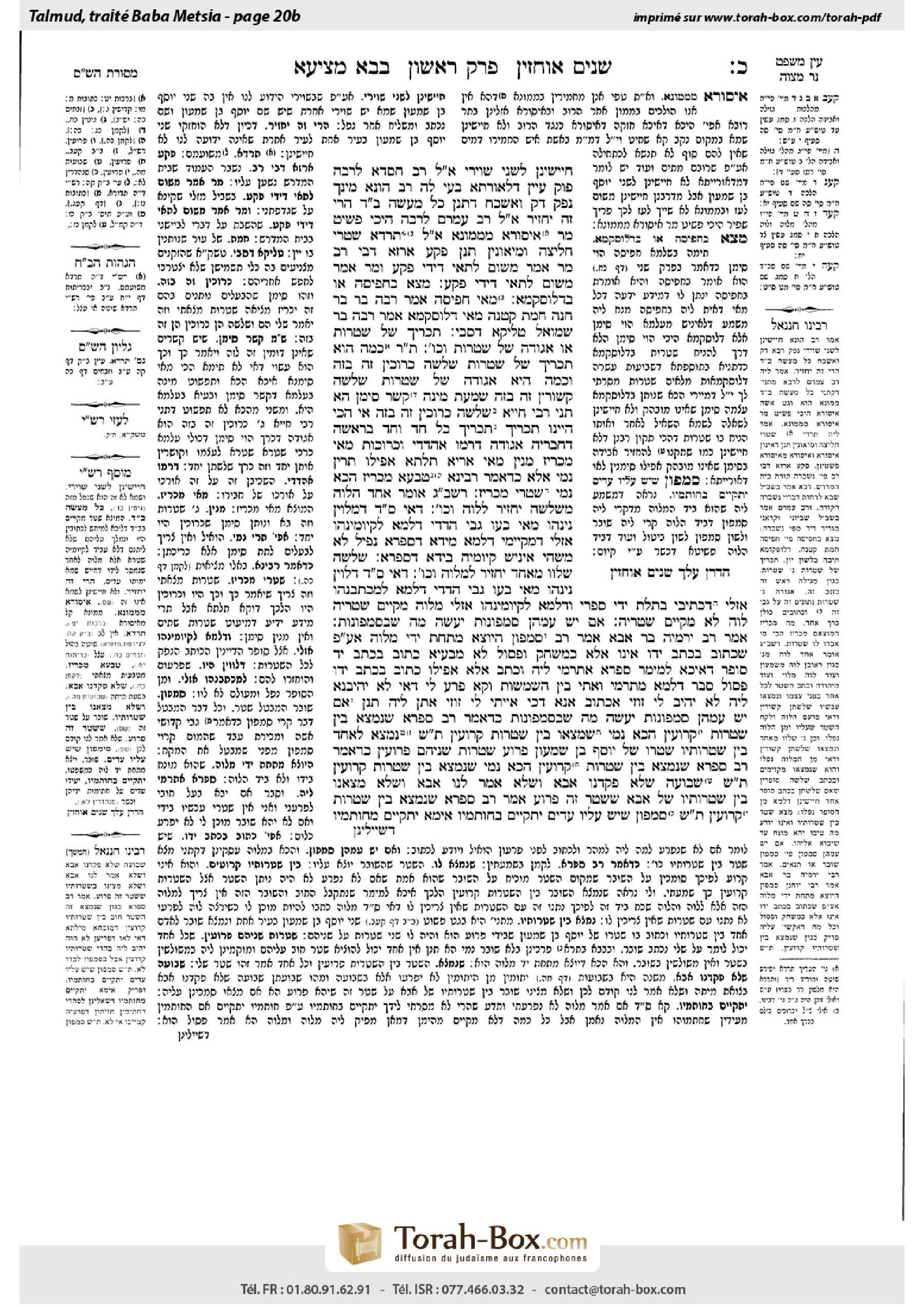
Bava Metzia 20b: Talmud study for Daf Yomi
Study the Talmud for Daf Yomi with scanned pages, Hebrew text, English translations from Sefaria and AI-generated French translations.
Passage selection and English or AI-generated French translation are available where the scan has annotations. Daf Study is independent of Torah-Box and Sefaria.
Browse Bava Metzia · בבא מציעא · All tractatesBava Metzia 20b text and translations
This page of Bava Metzia includes the Aramaic text, an English translation and an AI-generated French translation, alongside the scan above.
בבא מציעא כ׳ ב · Aramaic and Hebrew text
חָיְישִׁינַן לִשְׁנֵי שְׁוִירֵי. אֲמַר לֵיהּ רַב חִסְדָּא לְרַבָּה: פּוֹק עַיֵּין, דִּלְאוּרְתָּא בָּעֵי לַהּ רַב הוּנָא מִינָּךְ. נְפַק דַּק וְאַשְׁכַּח, דִּתְנַן: כׇּל מַעֲשֵׂה בֵּית דִּין הֲרֵי זֶה יַחְזִיר.
אֲמַר לֵיהּ רַב עַמְרָם לְרַבָּה: הֵיכִי פָּשֵׁיט מָר אִיסּוּרָא מִמָּמוֹנָא? אֲמַר לֵיהּ: תְּרָדָא, ״שְׁטָרֵי חֲלִיצָה וּמֵיאוּנִין״ תְּנַן.
פְּקַע אַרְזָא דְּבֵי רַב. מָר אָמַר: מִשּׁוּם לַתַּאי דִּידִי פְּקַע. וּמָר אָמַר: מִשּׁוּם לַתַּאי דִּידִי פְּקַע.
מָצָא בַּחֲפִיסָה אוֹ בִדְלוֹסְקָמָא. מַאי חֲפִיסָה? אָמַר רַבָּה בַּר בַּר חָנָה: חֵמֶת קְטַנָּה. מַאי דְּלוֹסְקָמָא? אָמַר רַבָּה בַּר שְׁמוּאֵל: טְלִיקָא דְסָבֵי.
תַּכְרִיךְ שֶׁל שְׁטָרוֹת אוֹ אֲגוּדָּה שֶׁל שְׁטָרוֹת וְכוּ׳. תָּנוּ רַבָּנַן: כַּמָּה הוּא תַּכְרִיךְ שֶׁל שְׁטָרוֹת? שְׁלֹשָׁה כְּרוּכִין זֶה בָּזֶה. וְכַמָּה הִיא אֲגוּדָּה שֶׁל שְׁטָרוֹת? שְׁלֹשָׁה קְשׁוּרִין זֶה בָּזֶה.
שָׁמְעַתְּ מִינַּהּ קֶשֶׁר סִימָן.
הָא תָּנֵי רַבִּי חִיָּיא: שְׁלֹשָׁה כְּרוּכִין זֶה בָּזֶה.
אִי הָכִי, הַיְינוּ תַּכְרִיךְ? תַּכְרִיךְ כֹּל חַד וְחַד בְּרֵאשֵׁהּ דְּחַבְרֵיהּ, אֲגוּדָּה דִּרְמוּ אַהֲדָדֵי (וּכְרוּכוֹת).
מַאי מַכְרִיז, מִנְיָן?
מַאי אִרְיָא תְּלָתָא אֲפִילּוּ תְּרֵין נָמֵי!
אֶלָּא כִּדְאָמַר רָבִינָא: טִבְעָא מַכְרֵיז, הָכָא נָמֵי ״שְׁטָרֵי״ מַכְרֵיז.
רַבָּן שִׁמְעוֹן בֶּן גַּמְלִיאֵל אוֹמֵר: אֶחָד הַלֹּוֶה מִשְּׁלֹשָׁה יַחְזִיר לַלֹּוֶה וְכוּ׳. דְּאִי סָלְקָא דַעְתָּךְ דְּמַלְוִין נִינְהוּ, מַאי בָּעוּ גַּבֵּי הֲדָדֵי?
דִּלְמָא לְקַיּוֹמִינְהוּ אָזְלִי? דִּמְקַיְּימִי.
דִּלְמָא מִידָא דְסָפְרָא נְפֻל? לָא מְשַׁהֵי אִינִישׁ קִיּוּמֵיהּ בִּידָא דְסָפְרָא.
שְׁלֹשָׁה שֶׁלָּווּ מֵאֶחָד יַחְזִיר לַמַּלְוֶה וְכוּ׳. דְּאִי סָלְקָא דַעְתָּךְ דְּלֹוִין נִינְהוּ, מַאי בָּעוּ גַּבֵּי הֲדָדֵי?
דִּלְמָא לְמִכְתְּבִנְהוּ אֲזֻל? דִּכְתִיבִי בִּתְלָת יְדֵי סָפְרֵי.
וְדִלְמָא לְקַיּוֹמִינְהוּ אֲזֻל? מַלְוֶה מְקַיֵּים שְׁטָרֵיהּ, לֹוֶה לָא מְקַיֵּים שְׁטָרֵיהּ.
אִם יֵשׁ עִמָּהֶן סִמְפּוֹנוֹת – יַעֲשֶׂה מָה שֶׁבַּסִּמְפּוֹנוֹת. אָמַר רַב יִרְמְיָה בַּר אַבָּא אָמַר רַב: סִמְפּוֹן הַיּוֹצֵא מִתַּחַת יְדֵי מַלְוֶה, אַף עַל פִּי שֶׁכָּתוּב בִּכְתַב יָדוֹ – אֵינוֹ אֶלָּא כִּמְשַׂחֵק, וּפָסוּל.
לָא מִבַּעְיָא כָּתוּב בִּכְתַב יַד סוֹפֵר, דְּאִיכָּא לְמֵימַר סָפְרָא אִתְרְמִי לֵיהּ וּכְתַב, אֶלָּא אֲפִילּוּ כָּתוּב בִּכְתַב יָדוֹ פָּסוּל. סָבַר דִּלְמָא מִתְרְמֵי וְאָתֵי בֵּין הַשְּׁמָשׁוֹת וְקָא פָרַע לִי, דְּאִי לָא יָהֵיבְנָא לֵיהּ לָא יָהֵיב לִי זוּזֵי, אֶכְתּוֹב אֲנָא דְּכִי (אַיְיתַי) [מַיְיתֵי] לִי זוּזַי אֶתֵּן לֵיהּ.
תְּנַן: אִם יֵשׁ עִמָּהֶן סִמְפּוֹנוֹת, יַעֲשֶׂה מָה שֶׁבְּסִמְפּוֹנוֹת.
כִּדְאָמַר רַב סָפְרָא: שֶׁנִּמְצָא בֵּין שְׁטָרוֹת קְרוּעִין, הָכָא נָמֵי שֶׁמְּצָאוֹ בֵּין שְׁטָרוֹת קְרוּעִין.
תָּא שְׁמַע: נִמְצָא לְאֶחָד בֵּין שְׁטָרוֹתָיו שְׁטָרוֹ שֶׁל יוֹסֵף בֶּן שִׁמְעוֹן פָּרוּעַ – שְׁטָרוֹת שְׁנֵיהֶם פְּרוּעִין!
כִּדְאָמַר רַב סָפְרָא: שֶׁנִּמְצָא בֵּין שְׁטָרוֹת קְרוּעִין, הָכָא נָמֵי שֶׁנִּמְצָא בֵּין שְׁטָרוֹת קְרוּעִין.
תָּא שְׁמַע: ״שְׁבוּעָה שֶׁלֹּא פְּקָדַנוּ אַבָּא, וְשֶׁלֹּא אָמַר לָנוּ אַבָּא, וְשֶׁלֹּא מָצָאנוּ בֵּין שְׁטָרוֹתָיו שֶׁל אַבָּא שֶׁשְּׁטָר זֶה פָּרוּעַ״.
אָמַר רַב סָפְרָא: שֶׁנִּמְצָא בֵּין שְׁטָרוֹת קְרוּעִין.
תָּא שְׁמַע: סִמְפּוֹן שֶׁיֵּשׁ עָלָיו עֵדִים יִתְקַיֵּים בְּחוֹתְמָיו. אֵימָא ״יִתְקַיֵּים מֵחוֹתְמָיו״!
Bava Metzia 20b · English translation
We are concerned for the possibility that there are two cities named Sheviri, and that this bill of divorce may belong to someone else who lives in the other Sheviri, and therefore it should not be returned. Rav Ḥisda said to Rabba: Go out and examine this halakha, as in the evening Rav Huna will ask you about it. He went out, examined it, and discovered a relevant source, as we learned in the mishna: With regard to any court enactment, the one who found it must return it to its presumed owner. Since this bill of divorce was found in court, it belongs to this category and should be returned.
Rav Amram said to Rabba: How can the Master resolve the halakha in the case of a bill of divorce, which is a ritual matter, from the mishna, which discusses monetary matters? Rabba said to him: Fool, we learned in the mishna that this halakha applies in the case of documents of ḥalitza and documents of refusal as well, which are ritual matters.
At that point, the supporting cedar beam of the study hall dislodged. One Sage said: It was due to my fortune that it dislodged, as you spoke to me offensively, and the other Sage said: It was due to my fortune that it dislodged, as it was you who spoke to me offensively.
§ The mishna teaches: If one found documents in a ḥafisa or in a deluskema, he must return them. The Gemara asks: What is a ḥafisa? Rabba bar bar Ḥana says: It is a small flask. What is a deluskema? Rabba bar Shmuel says: It is a container [telika] used by the elderly.
The mishna teaches: If one found a roll of documents or a bundle of documents, he must return them. The Sages taught in a baraita: How many documents constitute a roll of documents? A roll is three documents rolled together. And how many constitute a bundle of documents? A bundle is three documents tied together.
The Gemara infers: Conclude from it that if one lost an item that has a knot, the type of knot can serve as a distinguishing mark by means of which the owner can describe the item, and it therefore must be returned to him.
The Gemara rejects this inference: Doesn’t Rabbi Ḥiyya teach that the reference is to three documents that are rolled together? The fact that they are rolled together is what serves as a distinguishing mark, rather than the knots.
The Gemara asks: If so, this case is identical to the case of a roll of documents, which is also mentioned in the mishna. What is the difference between a roll and a bundle? The Gemara answers: A roll is referring to a case where each and every one of the documents is located at the top of another one, i.e., they are rolled together such that the top of each page is near the bottom of the previous page. A bundle, by contrast, is referring to a case where they are located one on top of the other and rolled together.
The Gemara asks: What does the person who found the documents proclaim so that the owner can claim it? The Gemara answers: He proclaims the number of documents that he found, and the owner can describe them by saying that they were rolled together.
The Gemara asks: If so, why does the tanna teach specifically a case of three documents? Even if two documents are found, they can also be returned in this manner.
Rather, the finder proclaims his find in a manner similar to that which Ravina said: If one finds coins, he simply proclaims that he found coins, without specifying the number. Here too, the finder proclaims that he found documents, and the owner describes them by both their exact number and the fact that they were rolled together. Therefore, if there are only two documents the description is deficient, as the number two is already implicit in the finder’s proclamation that he found documents, which is plural.
§ The mishna teaches that Rabban Shimon ben Gamliel says: If one finds three promissory notes that make reference to the loans of one person who borrowed from three people, he must return them to the debtor. The Gemara explains: The reason for this is that if it enters your mind that these promissory notes belong to the creditors, what are they doing together in one place?
The Gemara suggests: Perhaps the three creditors all went to court in order to ratify their promissory notes, and the notes were lost together there. The Gemara responds that the mishna is referring to a case where the promissory notes are ratified.
The Gemara asks: Perhaps they fell from the hand of the scribe of the court after he ratified them. The Gemara answers: A person does not leave his ratified promissory note in the possession of the scribe. Therefore, the most likely scenario is that the promissory notes were lost by the debtor.
§ The mishna teaches: If the promissory notes make reference to the loans of three people who borrowed from one person, the one who found them must return them to the creditor. The Gemara explains: The reason for this is that if it enters your mind that these promissory notes belong to the debtors, what are they doing together?
The Gemara asks: Perhaps the three went to one scribe to write the promissory notes, and the notes were then lost together. The Gemara answers that the mishna is referring to a case where the promissory notes are written in the handwriting of three different scribes.
The Gemara suggests: And perhaps the three debtors went to the court in order to ratify the promissory notes, and they lost them there. The Gemara answers: It is the creditor who ratifies his promissory note; the debtor does not ratify his promissory note.
§ The mishna teaches: If there are cancellations of contracts [simponot] among one’s documents, he should do what is stated in the simponot. The Gemara cites that which Rav Yirmeya bar Abba says that Rav says: With regard to a simpon that emerges from the possession of a creditor, even if it is written in his own handwriting and is clearly not forged, it is considered as though he were merely jesting and the simpon is invalid.
The Gemara explains: It is not necessary to state this halakha in a case where it is written in the handwriting of a scribe, as it can be said that he happened to have an opportunity to have the scribe write the simpon, and therefore he had him write it before the debt was repaid. But even in a case where it is written in the handwriting of the creditor it is invalid. The creditor may have written the simpon himself before the debt was repaid, thinking: Perhaps the debtor will happen to come at twilight on the eve of Shabbat and wish to repay me. I should prepare a document of cancellation, as, if I do not give him one, he will not give me the money. I will therefore write the document now, so that when he brings me the money, I will give it to him.
The Gemara challenges the statement of Rav based on that which we learned in the mishna: If there are simponot among one’s documents, he should do what is stated in the simponot. This is apparently referring to simponot that are in the possession of the creditor.
The Gemara answers that the mishna is to be understood in accordance with that which Rav Safra said in response to another difficulty: It is referring to a case where the simpon was found among torn documents. This indicates that the simpon is valid, as had the debt not been repaid, the creditor would not have put the simpon note among torn documents. Here too, the mishna is referring to a case where the simpon was found among torn documents.
Come and hear another challenge to Rav’s statement from a mishna (Bava Batra 172a): If one found among his documents a simpon that says: The debt mentioned in the promissory note of Yosef ben Shimon is repaid, and there are two people by that name who owe him money, the debts mentioned in the promissory notes of both of them are considered repaid, as each can claim that the cancellation is referring to his debt, and the burden of proof rests upon the creditor. Apparently, a simpon that is found in the possession of the creditor is valid.
The Gemara answers that this mishna, too, is to be understood in accordance with that which Rav Safra said in response to another difficulty: It is referring to a case where the simpon was found among torn documents. Here too, the mishna is referring to a case where the simpon was found among torn documents.
Come and hear another challenge to Rav’s statement from a mishna (Shevuot 45a): If orphans who inherited their father’s property demand repayment of a debt owed to their father from the orphans of the debtor, they are required to take an oath stating: We take an oath that our father did not instruct us on his deathbed that the debt mentioned in this promissory note was repaid and it should be returned to the debtor, nor did our father say to us on an earlier date that it was repaid, nor did we find among the documents of our father a simpon stating that this promissory note was repaid. This too, seems to indicate that a simpon is valid even if it is found in the possession of the creditor.
The Gemara answers by citing the statement of Rav Safra, who said in this context that this reference is to a case where the simpon was found among torn documents.
Come and hear another challenge from a baraita: A simpon upon which witnesses are signed is ratified by means of its signatories. The court verifies the validity of the witnesses’ signatures and thereby ratifies the document. This too seems to include a simpon that is in the possession of the creditor. The Gemara answers: Say that the baraita reads: Is ratified by obtaining confirmation from its signatories,
Bava Metzia 20b · Traduction française (IA)
Nous craignons qu'il y ait deux villes appelées Sheviri, et que ce contrat de divorce appartienne à quelqu'un d'autre qui habite dans l'autre Sheviri, et donc il ne devrait pas être rendu. Rav Ḥisda a dit à Rabba : Sortez et examinez cette halakha, car en soirée Rav Huna vous posera une question à ce sujet. Il est sorti, a examiné la question et a découvert une source pertinente, comme nous l'avons appris dans la michna : En ce qui concerne toute ordonnance du tribunal, celui qui l'a trouvé doit le rendre à son propriétaire supposé. Puisque ce contrat de divorce a été trouvé dans le tribunal, il appartient à cette catégorie et doit être rendu.
Rav Amram a dit à Rabba : Comment le Maître peut-il résoudre cette halakha concernant un contrat de divorce, qui est une affaire rituelle, à partir de la michna, qui discute des affaires monétaires ? Rabba a répondu à lui : Sotnik, nous avons appris dans la michna que cette halakha s'applique également aux documents de ḥalitza et aux documents de refus, qui sont des affaires rituelles.
À ce moment-là, le poteau de bois de soutien de la salle de étude s'est détaché. Un sage a dit : C'est à cause de ma fortune qu'il s'est détaché, car vous m'avez parlé de manière offensante, et l'autre sage a dit : C'est à cause de ma fortune qu'il s'est détaché, car c'était vous qui avez parlé de manière offensante à moi.
§ La michna enseigne : Si l'on trouve des documents dans une ḥafisa ou dans une deluskema, on doit les rendre. La Guemara pose la question : Qu'est-ce qu'une ḥafisa ? Rabba bar bar Ḥana dit : C'est une petite amphore. Qu'est-ce qu'une deluskema ? Rabba bar Shmuel dit : C'est un contenant [telika] utilisé par les personnes âgées.
La michna enseigne : Si l'on trouve un rouleau de documents ou un paquet de documents, on doit les rendre. Les Sages ont enseigné dans une baraïta : Combien de documents constituent un rouleau de documents ? Un rouleau est trois documents roulés ensemble. Et combien constituent un paquet de documents ? Un paquet est trois documents liés ensemble.
La Guemara déduit : On peut conclure que si l'on a perdu un objet qui a un nœud, le type de nœud peut servir de marque distinctive par laquelle le propriétaire peut décrire l'objet, et il doit donc être rendu à lui.
La Guemara rejette cette déduction : N'est-ce pas Rabbi Ḥiyya qui enseigne que la référence est à trois documents roulés ensemble ? Le fait qu'ils soient roulés ensemble est ce qui sert de marque distinctive, et non le nœud.
La Guemara pose la question : Si c'est ainsi, ce cas est identique au cas d'un rouleau de documents, qui est également mentionné dans la michna. Quelle est la différence entre un rouleau et un paquet ? La Guemara répond : Un rouleau fait référence à un cas où chaque document est situé au sommet d'un autre, c'est-à-dire qu'ils sont roulés ensemble de sorte que le sommet de chaque page est près du bas de la page précédente. Un paquet, en revanche, fait référence à un cas où ils sont situés les uns au-dessus des autres et roulés ensemble.
La Guemara pose la question : Qu'est-ce que la personne qui a trouvé les documents proclame afin que le propriétaire puisse réclamer ? La Guemara répond : Il proclame le nombre de documents qu'il a trouvés, et le propriétaire peut les décrire en disant qu'ils étaient roulés ensemble.
La Guemara pose la question : Si c'est ainsi, pourquoi le tanna enseigne spécifiquement le cas de trois documents ? Même si deux documents sont trouvés, ils peuvent également être rendus de cette manière.
Plutôt, le trouver proclame sa découverte de manière similaire à celle que Ravina a dite : Si l'on trouve des pièces, on proclame simplement qu'on a trouvé des pièces, sans préciser le nombre. Ici aussi, le trouver proclame qu'il a trouvé des documents, et le propriétaire les décrit à la fois par leur nombre exact et par le fait qu'ils étaient roulés ensemble. Ainsi, si seuls deux documents sont trouvés, la description est insuffisante, car le nombre deux est déjà implicite dans la proclamation du trouver qu'il a trouvé des documents, qui est au pluriel.
§ La michna enseigne que Rabban Shimon ben Gamliel dit : Si l'on trouve trois notes de promesse qui font référence aux prêts d'une même personne qui a emprunté à trois personnes, on doit les rendre au débiteur. La Guemara explique : La raison de cela est que si cela entre dans votre tête que ces notes de promesse appartiennent aux créanciers, à quoi bon sont-elles ensemble dans un seul lieu ?
La Guemara suggère : Peut-être que les trois créanciers sont allés au tribunal afin de ratifier leurs notes de promesse, et ces notes ont été perdues ensemble là-bas. La Guemara répond que la Michna fait référence à un cas où les notes de promesse sont ratifiées.
La Guemara pose la question : Peut-être qu'elles sont tombées de la main du scribe du tribunal après qu'elles aient été ratifiées. La Guemara répond : Une personne ne laisse pas son note de promesse ratifiée entre les mains du scribe. Ainsi, la scène la plus probable est que les notes de promesse ont été perdues par le débiteur.
§ La michna enseigne : Si les notes de promesse font référence aux prêts de trois personnes qui ont emprunté à une même personne, celui qui les a trouvés doit les rendre au créancier. La Guemara explique : La raison de cela est que si cela entre dans votre tête que ces notes de promesse appartiennent aux débiteurs, à quoi bon sont-elles ensemble ?
La Guemara pose la question : Peut-être que les trois sont allés chez un même scribe pour écrire les notes de promesse, et les notes ont été perdues ensemble. La Guemara répond que la Michna fait référence à un cas où les notes de promesse sont écrites à la main de trois scribes différents.
La Guemara suggère : Et peut-être que les trois débiteurs sont allés au tribunal pour ratifier les notes de promesse, et elles ont été perdues là-bas. La Guemara répond : C'est le créancier qui ratifie sa note de promesse ; le débiteur ne ratifie pas sa note de promesse.
§ La Michna enseigne : Si des simponot sont présentes parmi les documents d'une personne, il doit faire ce qui est mentionné dans les simponot. La Guemara cite ce que dit Rav Yirmeya bar Abba, qui rapporte que Rav dit : En ce qui concerne un simpon qui émerge de la possession d'un créancier, même s'il est écrit de sa propre main et qu'il est clairement authentique, il est considéré comme s'il s'agissait simplement de plaisanter, et le simpon est invalide.
La Guemara explique : Il n'est pas nécessaire d'énoncer cette halakha dans un cas où le simpon est écrit à la main d'un scribe, car on peut dire qu'il a eu l'occasion de faire écrire le simpon par le scribe, et donc il l'a fait avant que la dette ne soit remboursée. Mais même dans le cas où le simpon est écrit à la main du créancier, il est invalide. Le créancier pourrait avoir écrit lui-même le simpon avant que la dette ne soit remboursée, en pensant : Peut-être le débiteur viendra à l'heure du crépuscule, le soir de Shabbat, et souhaitera me rembourser. Je devrais préparer un document de rétractation, car si je ne lui donne pas un tel document, il ne me donnera pas l'argent. Je vais donc écrire ce document maintenant, afin que lorsqu'il me donnera l'argent, je le lui donne.
La Guemara conteste l'affirmation de Rav en se basant sur ce que nous avons appris dans la Michna : Si des simponot sont présentes parmi les documents d'une personne, il doit faire ce qui est mentionné dans les simponot. Cela semble faire référence à des simponot qui sont en possession du créancier.
La Guemara répond que la Michna doit être comprise selon ce que Rav Safra a dit en réponse à un autre doute : il s'agit d'un cas où le simpon a été trouvé parmi des documents déchirés. Cela indique que le simpon est valide, car si la dette n'avait pas été remboursée, le créancier n'aurait pas mis le document de rétractation parmi des documents déchirés. Ici aussi, la Michna fait référence à un cas où le simpon a été trouvé parmi des documents déchirés.
Viens écouter un autre défi à l'affirmation de Rav, tiré d'une Michna (Bava Batra 172a) : si l'on trouve parmi ses documents un simpon qui dit : la dette mentionnée dans le promissoire de Yosef ben Shimon est remboursée, et il y a deux personnes portant ce nom qui lui doivent de l'argent, les dettes mentionnées dans les promissaires des deux sont considérées comme remboursées, car chacun peut affirmer que la rétractation concerne sa dette, et la charge de la preuve incombe au créancier. Apparemment, un simpon trouvé en possession du créancier est valide.
La Guemara répond que cette Michna, tout comme la précédente, doit être comprise selon ce que Rav Safra a dit en réponse à une autre difficulté : il s'agit d'un cas où le simpon a été trouvé parmi des documents déchirés. Ici aussi, la Michna fait référence à un cas où le simpon a été trouvé parmi des documents déchirés.
Viens écouter un autre défi à l'affirmation de Rav, tiré d'une Michna (Shevuot 45a) : Si des orphelins qui ont hérité de la propriété de leur père demandent le remboursement d'une dette due à leur père par les orphelins du débiteur, ils doivent prendre un serment affirmant : Nous prêtons serment que notre père n'a pas instruit nous, à son lit de mort, que la dette mentionnée dans ce promissoire a été remboursée et qu'elle doive être rendue au débiteur, ni n'a dit à nous, à une date antérieure, qu'elle avait été remboursée, ni n'avons trouvé parmi les documents de notre père un simpon indiquant que ce promissoire avait été remboursé. Cela semble également indiquer qu'un simpon est valide même s'il est trouvé en possession du créancier.
La Guemara répond en citant l'affirmation de Rav Safra, qui a dit dans ce contexte que cette référence concerne un cas où le simpon a été trouvé parmi des documents déchirés.
Viens écouter un autre défi tiré d'une baraïta : Un simpon sur lequel des témoins sont signés est validé par l'obtention de la confirmation de ses signataires. Le tribunal vérifie la validité des signatures des témoins et valide ainsi le document. Cela semble également inclure un simpon en possession du créancier. La Guemara répond : Dis que la baraïta dit : Est validé par l'obtention de la confirmation de ses signataires,
Traduction française générée par IA à partir de l’édition anglaise de Sefaria. Vérifie toujours un passage avec le texte source.
Text from Sefaria: William Davidson Edition - Vocalized Aramaic (CC BY NC); William Davidson Edition - English (CC BY NC).