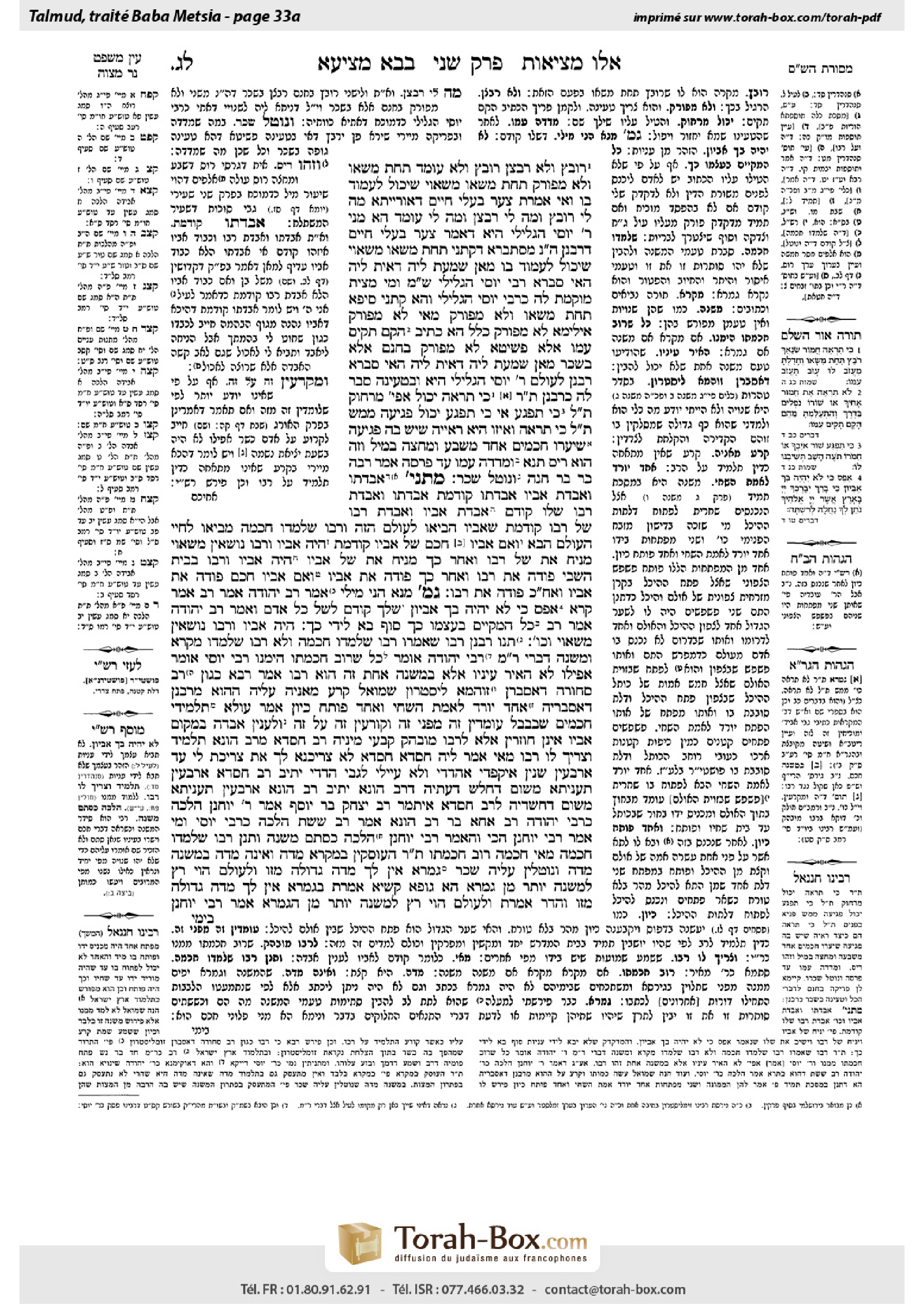
Bava Metzia 33a: Talmud study for Daf Yomi
Study the Talmud for Daf Yomi with scanned pages, Hebrew text, English translations from Sefaria and AI-generated French translations.
Passage selection and English or AI-generated French translation are available where the scan has annotations. Daf Study is independent of Torah-Box and Sefaria.
Browse Bava Metzia · בבא מציעא · All tractatesBava Metzia 33a text and translations
This page of Bava Metzia includes the Aramaic text, an English translation and an AI-generated French translation, alongside the scan above.
בבא מציעא ל״ג א · Aramaic and Hebrew text
״רֹבֵץ״ וְלֹא רַבְצָן, ״רֹבֵץ״ וְלֹא עוֹמֵד. ״תַּחַת מַשָּׂאוֹ״ וְלֹא מְפוֹרָק. ״תַּחַת מַשָּׂאוֹ״, מַשּׂאוֹי שֶׁיָּכוֹל לַעֲמוֹד בּוֹ. וְאִי אָמְרַתְּ צַעַר בַּעֲלֵי חַיִּים דְּאוֹרָיְיתָא, מָה לִי רוֹבֵץ, וּמָה לִי רַבְצָן, וּמָה לִי עוֹמֵד!
הָא מַנִּי? רַבִּי יוֹסֵי הַגְּלִילִי הִיא, דְּאָמַר צַעַר בַּעֲלֵי חַיִּים דְּרַבָּנַן.
הָכִי נָמֵי מִסְתַּבְּרָא, דְּקָתָנֵי: ״תַּחַת מַשָּׂאוֹ״ – מַשּׂאוֹי שֶׁיָּכוֹל לַעֲמוֹד בּוֹ, מַאן שָׁמְעַתְּ לֵיהּ דְּאִית לֵיהּ הַאי סְבָרָא – רַבִּי יוֹסֵי הַגְּלִילִי, שְׁמַע מִינַּהּ.
וּמִי מָצֵית מוֹקְמַתְּ לַהּ כְּרַבִּי יוֹסֵי הַגְּלִילִי? וְהָא קָתָנֵי סֵיפָא: ״תַּחַת מַשָּׂאוֹ״ – וְלֹא מְפוֹרָק. מַאי ״לֹא מְפוֹרָק״? אִילֵּימָא לֹא מְפוֹרָק כְּלָל, הָא כְּתִיב: ״הָקֵם תָּקִים עִמּוֹ״! אֶלָּא פְּשִׁיטָא: ״לֹא מְפוֹרָק״ בְּחִנָּם, אֶלָּא בְּשָׂכָר, מַאן שָׁמְעַתְּ לֵיהּ דְּאִית לֵיהּ הַאי סְבָרָא – רַבָּנַן! לְעוֹלָם רַבִּי יוֹסֵי הַגְּלִילִי הִיא, וּבִטְעִינָה סָבַר לַהּ כְּרַבָּנַן.
תָּנוּ רַבָּנַן: ״כִּי תִרְאֶה״ – יָכוֹל אֲפִילּוּ מֵרָחוֹק, תַּלְמוּד לוֹמַר: ״כִּי תִפְגַּע״. אִי ״כִּי תִפְגַּע״, יָכוֹל פְּגִיעָה מַמָּשׁ? תַּלְמוּד לוֹמַר: ״כִּי תִרְאֶה״. וְאֵיזוֹ הִיא רְאִיָּיה שֶׁיֵּשׁ בָּהּ פְּגִיעָה – שִׁיעֲרוּ חֲכָמִים אֶחָד מִשֶּׁבַע וּמֶחֱצָה בְּמִיל, וְזֶה הוּא רִיס.
תָּנָא: וּמִדַּדֶּה עִמּוֹ עַד פַּרְסָה. אָמַר רַבָּה בַּר בַּר חָנָה: וְנוֹטֵל שָׂכָר.
מַתְנִי׳ אֲבֵדָתוֹ וַאֲבֵדַת אָבִיו – אֲבֵדָתוֹ קוֹדֶמֶת. אֲבֵדָתוֹ וַאֲבֵדַת רַבּוֹ – שֶׁלּוֹ קוֹדֵם.
אֲבֵדַת אָבִיו וַאֲבֵדַת רַבּוֹ – שֶׁל רַבּוֹ קוֹדֶמֶת, שֶׁאָבִיו הֱבִיאוֹ לָעוֹלָם הַזֶּה, וְרַבּוֹ שֶׁלִּמְּדוֹ חׇכְמָה מְבִיאוֹ לְחַיֵּי הָעוֹלָם הַבָּא. וְאִם אָבִיו חָכָם – שֶׁל אָבִיו קוֹדֶמֶת.
הָיָה אָבִיו וְרַבּוֹ נוֹשְׂאִין מַשּׂאוֹי – מַנִּיחַ אֶת שֶׁל רַבּוֹ, וְאַחַר כָּךְ מַנִּיחַ אֶת שֶׁל אָבִיו. הָיָה אָבִיו וְרַבּוֹ בְּבֵית הַשְּׁבִי – פּוֹדֶה אֶת רַבּוֹ, וְאַחַר כָּךְ פּוֹדֶה אֶת אָבִיו. וְאִם אָבִיו חָכָם – פּוֹדֶה אֶת אָבִיו, וְאַחַר כָּךְ פּוֹדֶה אֶת רַבּוֹ.
גְּמָ׳ מְנָא הָנֵי מִילֵּי? אָמַר רַב יְהוּדָה אָמַר רַב, אָמַר קְרָא: ״אֶפֶס כִּי לֹא יִהְיֶה בְּךָ אֶבְיוֹן״, שֶׁלְּךָ קוֹדֵם לְשֶׁל כׇּל אָדָם.
וְאָמַר רַב יְהוּדָה אָמַר רַב: כׇּל הַמְקַיֵּים בְּעַצְמוֹ כָּךְ, סוֹף בָּא לִידֵי כָּךְ.
הָיָה אָבִיו וְרַבּוֹ נוֹשְׂאִין מַשּׂאוֹי וְכוּ׳. תָּנוּ רַבָּנַן: רַבּוֹ שֶׁאָמְרוּ רַבּוֹ שֶׁלִּמְּדוֹ חׇכְמָה, וְלֹא רַבּוֹ שֶׁלִּמְּדוֹ מִקְרָא וּמִשְׁנָה, דִּבְרֵי רַבִּי מֵאִיר. רַבִּי יְהוּדָה אוֹמֵר: כֹּל שֶׁרוֹב חׇכְמָתוֹ הֵימֶנּוּ. רַבִּי יוֹסֵי אוֹמֵר: אֲפִילּוּ לֹא הֵאִיר עֵינָיו אֶלָּא בְּמִשְׁנָה אַחַת, זֶה הוּא רַבּוֹ.
אָמַר רָבָא: כְּגוֹן רַב סְחוֹרָה, דְּאַסְבְּרַן זוּהֲמָא לִיסְטְרוֹן. שְׁמוּאֵל קְרַע מָאנֵיהּ עֲלֵיהּ הָהוּא מֵרַבָּנַן דְּאַסְבְּרֵיהּ ״אֶחָד יוֹרֵד לְאַמַּת הַשֶּׁחִי וְאֶחָד פּוֹתֵחַ כֵּיוָן״.
אָמַר עוּלָּא: תַּלְמִידֵי חֲכָמִים שֶׁבְּבָבֶל, עוֹמְדִין זֶה מִפְּנֵי זֶה, וְקוֹרְעִין זֶה עַל זֶה. וּלְעִנְיַן אֲבֵדָה בִּמְקוֹם אָבִיו, אֵינָן חוֹזְרִין אֶלָּא לְרַבּוֹ מוּבְהָק.
קָבָעֵי מִינֵּיהּ רַב חִסְדָּא מֵרַב הוּנָא: תַּלְמִיד וְצָרִיךְ לוֹ רַבּוֹ, מַאי? אֲמַר לֵיהּ: חִסְדָּא חִסְדָּא, לָא צְרִיכְנָא לָךְ, אַתְּ צְרִיכַתְּ לִי עַד אַרְבְּעִין שְׁנִין. אִיקְּפַדוּ אַהֲדָדֵי וְלָא עָיְילִי לְגַבֵּי הֲדָדֵי. יְתֵיב רַב חִיסְדָּא אַרְבְּעִין תַּעֲנִיָּתָא, מִשּׁוּם דַּחֲלַשׁ דַּעְתֵּיהּ דְּרַב הוּנָא. יָתֵיב רַב הוּנָא אַרְבְּעִין תַּעֲנִיָּתָא, מִשּׁוּם דְּחַשְׁדֵיהּ לְרַב חִסְדָּא.
אִיתְּמַר: רַב יִצְחָק בַּר יוֹסֵף אָמַר רַבִּי יוֹחָנָן: הֲלָכָה כְּרַבִּי יְהוּדָה. רַב אַחָא בַּר רַב הוּנָא אָמַר רַב שֵׁשֶׁת: הֲלָכָה כְּרַבִּי יוֹסֵי.
וּמִי אָמַר רַבִּי יוֹחָנָן הָכִי? וְהָאָמַר רַבִּי יוֹחָנָן: הֲלָכָה כִּסְתַם מִשְׁנָה, וּתְנַן: רַבּוֹ שֶׁלִּמְּדוֹ חׇכְמָה. מַאי ״חׇכְמָה״? רוֹב חׇכְמָתוֹ.
תָּנוּ רַבָּנַן: הָעוֹסְקִין בְּמִקְרָא – מִדָּה וְאֵינָהּ מִדָּה, בַּמִּשְׁנָה – מִדָּה וְנוֹטְלִין עָלֶיהָ שָׂכָר, בַּתַּלְמוּד – אֵין לָךְ מִדָּה גְּדוֹלָה מִזּוֹ, וּלְעוֹלָם הֱוֵי רָץ לַמִּשְׁנָה יוֹתֵר מִן הַתַּלְמוּד.
הָא גוּפַאּ קַשְׁיָא. אָמְרַתְּ בַּתַּלְמוּד אֵין לְךָ מִדָּה גְּדוֹלָה מִזּוֹ, וַהֲדַר אָמְרַתְּ: וּלְעוֹלָם הֱוֵי רָץ לַמִּשְׁנָה יוֹתֵר מִן הַתַּלְמוּד! אָמַר רַבִּי יוֹחָנָן:
Bava Metzia 33a · English translation
It is written: “If you see the donkey…collapsed under its burden” (Exodus 23:5). The baraita infers that this obligation to unload a burden applies with regard to an animal that is “collapsed,” but not with one that is a habitual collapser; “collapsed,” but not standing; “under its burden,” but not when it is unloaded; and “under its burden,” meaning a burden that is not excessive, that the animal can bear. The Gemara reasons: And if you say that the requirement to prevent suffering to animals is by Torah law, what is it to me if the animal is collapsed; and what is it to me if the animal is a habitual collapser; and what is it to me if the animal is standing? One should be obligated to unload its burden in any case, if the animal is suffering.
The Gemara answers: In accordance with whose opinion is this baraita? It is in accordance with the opinion of Rabbi Yosei HaGelili, who says that the requirement to prevent suffering to animals is by rabbinic law, and the ordinance does not apply in these circumstances.
The Gemara supports its answer: So too, it is reasonable to explain the baraita in this manner, as it is taught in the baraita cited above: “Under its burden” indicates a burden that the animal can bear. About whom did you hear that he holds that line of reasoning? It is Rabbi Yosei HaGelili. The Gemara affirms: Learn from it that the baraita is in accordance with the opinion of Rabbi Yosei HaGelili.
The Gemara asks: And can you establish the baraita in accordance with the opinion of Rabbi Yosei HaGelili? But isn’t it taught in the latter clause of the baraita: “Under its burden,” but not when it is unloaded? What is the meaning of: Not when it is unloaded? If we say that it means that when it is unloaded there is no obligation at all, isn’t it written in that case: “You shall lift them with him” (Deuteronomy 22:4), teaching that there is a mitzva to load an animal? Rather, it is obvious that the meaning is that when it is unloaded, one is not obligated to load it for free; rather, he may do so for remuneration. About whom did you hear that he holds that line of reasoning? It is the Rabbis. Apparently, the baraita is in accordance with the opinion of the Rabbis and not the opinion of Rabbi Yosei HaGelili. The Gemara answers: Actually, the baraita is in accordance with the opinion of Rabbi Yosei HaGelili, and in the matter of loading he holds in accordance with the opinion of the Rabbis.
The Sages taught in a baraita: It is written: “If you see the donkey of him that hates you collapsed under its burden…you shall release it with him” (Exodus 23:5). I might have thought one is obligated even if he sees the animal from a distance; therefore the previous verse states: “If you encounter your enemy’s ox or his donkey going astray, you shall return it to him” (Exodus 23:4). If the Torah had written only: “If you encounter,” I might have thought that one is obligated to unload the burden only if there was an actual encounter; therefore, the verse states: “If you see.” And what is seeing in which there is an element of encounter? The Sages calculated it as one of seven and a half portions, i.e., two-fifteenths, of a mil, and that is the measure of a ris.
It is taught in a baraita: After loading the burden onto the animal, one walks with it up to one parasang [parsa] to ensure that the burden will not fall again. Rabba bar bar Ḥana says: And he takes remuneration for accompanying the animal, as that is not included in the mitzva.
MISHNA: If one finds his lost item and his father’s lost item, tending to his own lost item takes precedence. Similarly, if one finds his lost item and his teacher’s lost item, tending to his own lost item takes precedence.
If one finds his father’s lost item and his teacher’s lost item, tending to his teacher’s lost item takes precedence, as his father brought him into this world, and his teacher, who taught him the wisdom of Torah, brings him to life in the World-to-Come. And if his father is a Torah scholar, then his father’s lost item takes precedence.
If his father and his teacher were each carrying a burden and he wants to assist them in putting down their burdens, he first places his teacher’s burden down and thereafter places his father’s burden down. If his father and his teacher were in captivity, he first redeems his teacher and thereafter redeems his father. And if his father is a Torah scholar, he first redeems his father and thereafter redeems his teacher.
GEMARA: With regard to precedence in the return of lost items, the Gemara asks: From where are these matters derived? Rav Yehuda says that Rav says that the verse states: “Only so that there shall be no needy among you” (Deuteronomy 15:4). This verse can be understood as a command, indicating that it is incumbent upon each individual to ensure that he will not become needy. Therefore, your property takes precedence over the property of any other person.
And Rav Yehuda says that Rav says: Although that is the halakha, anyone who fastidiously fulfills this principle with regard to his property at the expense of others’ property ultimately comes to experience that fate. He will become impoverished, and others will prioritize their interests at his expense.
§ The mishna teaches: If his father and his teacher were each carrying a burden, he first places his teacher’s burden down and thereafter places his father’s burden down. The Sages taught in a baraita (Tosefta 2:30): His teacher, with regard to whom the tanna’im stated in the mishna that his burden takes precedence, is his teacher who taught him wisdom, i.e., the profound analysis of the Torah that constitutes the Talmud, and not his teacher who taught him Bible or Mishna; this is the statement of Rabbi Meir. Rabbi Yehuda says: The reference is to any teacher from whom one learned most of his knowledge, be it Bible, Mishna, or Talmud. Rabbi Yosei says: Even if he enlightened him in the understanding of only one mishna, that is his teacher.
Rava said: For example, Rav Seḥora is my teacher with regard to these matters, as he explained to me the meaning of the term in a mishna (Kelim 13:2) zuhama listeron, a utensil with a spoon on one end and a fork on the other. Shmuel rent his garment in mourning over the passing of one of the Sages who explained to him the meaning of a mishna (Tamid 3:6) that describes the two keys that opened the compartment through which the priest would enter the Sanctuary each morning: One is the key with which the priest would open the inside lock. He would insert his arm up to his armpit through a small opening in the door and reach down and open the lock that was at the bottom of the door on the inside, and he would go through that door into a compartment. And the other one is the key with which the priest opened the lock on the inner door of the compartment, through which he entered the Sanctuary, and he opened that lock directly.
Ulla says: The Torah scholars who are in Babylonia rise in deference before one another and rend their garments in mourning over one another’s passing. In contrast to Eretz Yisrael, where the preeminent Torah scholars and teachers served at the heads of the Torah academies, in Babylonia most scholars studied Torah with peers and there was no preeminent teacher. But with regard to returning a lost item in a case where both one’s father and one’s teacher lost an item, he returns the lost item only to his preeminent teacher before returning that of his father, and not to his peer or to one who taught him the meaning of one mishna or one term.
Rav Ḥisda raised a dilemma before Rav Huna: If there is a student, and his teacher needs him because he serves as his peer and study partner, what is the halakha with regard to precedence in a case where he finds a lost item belonging to his father and one belonging to his teacher? As Rav Ḥisda was Rav Huna’s disciple-colleague, Rav Huna assumed that Rav Ḥisda was referring to himself and said to him: Ḥisda, Ḥisda, I do not need you. On the contrary, you need me until you complete forty years of study before me. They grew angry with each other over the perceived insult and the harsh reaction, and each did not enter to visit the other. Rav Ḥisda was contrite and observed forty fasts due to the fact that Rav Huna was offended, although it had not been his intention to offend him. Rav Huna observed forty fasts due to the fact that he had erroneously suspected that Rav Ḥisda was referring to the relationship between them.
It was stated that Rav Yitzḥak bar Yosef says that Rabbi Yoḥanan says: The halakha is in accordance with the opinion of Rabbi Yehuda, who says that returning the teacher’s lost item takes precedence only in the case of his preeminent teacher. Rav Aḥa bar Rav Huna says that Rav Sheshet says: The halakha is in accordance with the opinion of Rabbi Yosei, who says that returning the teacher’s lost item takes precedence even if the teacher enlightened him with regard to only one mishna.
The Gemara asks: And did Rabbi Yoḥanan say that? But doesn’t Rabbi Yoḥanan say: The halakha is always in accordance with the opinion cited in an unattributed mishna; and we learned an unattributed opinion in the mishna that returning the teacher’s lost item takes precedence in the case of: His teacher, who taught him the wisdom of Torah. The ruling of the unattributed mishna is in accordance with the opinion of Rabbi Meir. The Gemara answers: What is the meaning of wisdom in this context? It means the majority of his wisdom.
The Sages taught in a baraita: For those who engage in the study of Bible, it is a virtue but not a complete virtue. For those who engage in the study of Mishna, it is a virtue and they receive reward for its study. For those who engage in the study of Talmud, you have no virtue greater than that. And always pursue study of the Mishna more than study of the Talmud.
The Gemara asks: This matter itself is difficult, as the baraita is self-contradictory. You said: For those who engage in the study of Talmud, you have no virtue greater than that. And then you said: And always pursue study of the Mishna more than study of the Talmud. Rabbi Yoḥanan says:
Bava Metzia 33a · Traduction française (IA)
Il est écrit : « Si tu vois le chameau… chargé et s'effondrant sous son fardeau » (Exode 23:5). La baraïta infère que cette obligation de décharger un fardeau s'applique à un animal « s'effondrant », mais pas à un animal qui s'effondre habituellement ; « s'effondrant », mais pas debout ; « sous son fardeau », mais pas lorsqu'il est déchargé ; et « sous son fardeau », signifiant un fardeau qu'il peut porter. La Guemara raisonne : Et si tu dis que la nécessité de prévenir la souffrance aux animaux est une loi divine, qu'est-ce que cela me fait si l'animal est s'effondrant ; et qu'est-ce que cela me fait si l'animal est un habituel s'effondrant ; et qu'est-ce que cela me fait si l'animal est debout ? On devrait être obligé de décharger son fardeau dans tous les cas, si l'animal souffre.
La Guemara répond : Selon l'opinion de qui est cette baraïta ? C'est selon l'opinion de Rabbi Yosei HaGelili, qui dit que la nécessité de prévenir la souffrance aux animaux est une loi rabbinique, et l'ordonnance ne s'applique pas dans ces circonstances.
La Guemara soutient sa réponse : De même, il est raisonnable d'expliquer la baraïta ainsi, car il est enseigné dans la baraïta citée ci-dessus : « sous son fardeau » indique un fardeau que l'animal peut porter. À propos de qui as-tu entendu qu'il adopte cette ligne de raisonnement ? C'est Rabbi Yosei HaGelili. La Guemara affirme : Apprends-en que la baraïta est selon l'opinion de Rabbi Yosei HaGelili.
La Guemara demande : Et peux-tu établir la baraïta selon l'opinion de Rabbi Yosei HaGelili ? Mais n'est-il pas enseigné dans la dernière partie de la baraïta : « sous son fardeau », mais pas lorsqu'il est déchargé ? Quel est le sens de : pas lorsqu'il est déchargé ? Si nous disons que cela signifie que lorsqu'il est déchargé, il n'y a aucune obligation du tout, n'est-il pas écrit dans ce cas : « Tu le soulèveras avec lui » (Deutéronome 22:4), enseignant qu'il y a une mitsva de charger un animal ? Plutôt, il est évident que le sens est que lorsqu'il est déchargé, on n'est pas obligé de le charger gratuitement ; plutôt, on peut le faire en échange de rémunération. À propos de qui as-tu entendu qu'il adopte cette ligne de raisonnement ? C'est les Rabbins. Apparemment, la baraïta est selon l'opinion des Rabbins et non celle de Rabbi Yosei HaGelili. La Guemara répond : En réalité, la baraïta est selon l'opinion de Rabbi Yosei HaGelili, et en matière de chargement, il adopte celle des Rabbins.
Les Sages enseignent dans une baraïta : Il est écrit : « Si tu vois le chameau de celui qui t'aime moins que toi s'effondrant sous son fardeau… tu le libéreras avec lui » (Exode 23:5). Je pouvais penser qu'on est obligé même si l'on voit l'animal de loin ; donc le verset précédent dit : « Si tu rencontres l'âne de ton ennemi ou son chameau errant, tu le ramèneras à lui » (Exode 23:4). Si la Torah avait écrit seulement : « Si tu rencontres », je pouvais penser qu'on est obligé de décharger le fardeau seulement si l'encounter était réel ; donc le verset dit : « Si tu vois ». Et qu'est-ce que voir qui contient un élément d'encounter ? Les Sages ont calculé cela comme une portion de sept et demi, c'est-à-dire deux quinzièmes, d'un mil, et c'est la mesure d'un ris.
Il est enseigné dans une baraïta : Après avoir chargé le fardeau sur l'animal, on marche avec lui jusqu'à un parasang [parsa] pour s'assurer que le fardeau ne tombera pas à nouveau. Rabba bar bar Ḥana dit : Et il reçoit une rémunération pour accompagner l'animal, car cela n'est pas inclus dans la mitsva.
MICHNA : Si l'on trouve l'objet perdu de son père et l'objet perdu de son maître, prendre soin de son propre objet a la priorité. De même, si l'on trouve l'objet perdu de son père et l'objet perdu de son maître, prendre soin de son propre objet a la priorité.
Si l'on trouve l'objet perdu de son père et l'objet perdu de son maître, prendre soin de l'objet perdu de son maître a la priorité, car son père l'a amené dans ce monde, et son maître, qui lui a enseigné la sagesse de la Torah, l'amène à la vie dans le Monde à Venir. Et si son père est un savant de la Torah, alors l'objet perdu de son père a la priorité.
Si son père et son maître portaient chacun un fardeau et qu'il voulait les aider à poser leurs fardeaux, il posait d'abord le fardeau de son maître et ensuite celui de son père. Si son père et son maître étaient en captivité, il rachetait d'abord son maître et ensuite son père. Et si son père est un savant de la Torah, il rachetait d'abord son père et ensuite son maître.
GUEMARA : En ce qui concerne la priorité dans le retour des objets perdus, la Guemara pose la question : D'où sont issus ces enseignements ? Rav Yehuda dit que Rav dit que le verset dit : « Ainsi il n'y aura pas de pauvre parmi vous » (Lévitique 15:4). Ce verset peut être compris comme un commandement, indiquant que c'est à chaque individu de s'assurer qu'il ne deviendra pas pauvre. Ainsi, votre propriété a la priorité sur la propriété de toute autre personne.
Et Rav Yehuda dit que Rav dit : Bien que ce soit la halakha, celui qui applique rigoureusement ce principe avec son propre bien au détriment des biens d'autrui finit par subir ce destin. Il devient ruiné, et les autres priorisent leurs intérêts à son détriment.
§ La mitsna enseigne : Si son père et son maître étaient chacun chargés d'une charge, il pose d'abord la charge de son maître et ensuite celle de son père. Les Sages enseignent dans une baraïta (Tosefta 2:30) : Son maître, concernant lequel les tanna'ïm ont dit dans la mitsna que sa charge a la priorité, est celui qui lui a enseigné la sagesse, c'est-à-dire l'analyse approfondie de la Torah qui constitue le Talmud, et non celui qui lui a enseigné la Bible ou la Michna ; c'est la déclaration de Rabbi Meir. Rabbi Yehuda dit : La référence est à tout maître d'où l'on a appris la plupart de ses connaissances, qu'il s'agisse de la Bible, de la Michna ou du Talmud. Rabbi Yosei dit : Même s'il a éclairé sa compréhension d'une seule mitsva, c'est son maître.
Rava a dit : Par exemple, Rav Séchora est mon maître concernant ces questions, car il m'a expliqué le sens du terme d'une mitsva (Kelim 13:2) zuhama listeron, un ustensile avec une cuillère d'un côté et une fourchette de l'autre. Shmuel déchira sa robe en deuil à la mort d'un des Sages qui lui avait expliqué le sens d'une mitsva (Tamid 3:6) décrivant les deux clés qui ouvraient la cloison par laquelle le prêtre entrait dans le Saint des Saints chaque matin : l'une est la clé avec laquelle le prêtre ouvrait le verrou intérieur. Il insérait son bras jusqu'au coude par une petite ouverture de la porte et atteignait le verrou qui était en bas de la porte à l'intérieur, et il passait par cette porte dans la cloison. L'autre clé est celle avec laquelle le prêtre ouvrait le verrou de la porte de la cloison, par laquelle il entrait dans le Saint des Saints, et il ouvrait ce verrou directement.
Ulla dit : Les savants de Babylone se lèvent en signe de respect les uns devant les autres et déchirent leur robe en deuil à la mort de l'un d'entre eux. À l'inverse d'Éretz Yisraël, où les savants et enseignants prééminents présidaient les yéhoudim, à Babylone la plupart des savants étudiaient la Torah avec des pairs et il n'y avait pas de maître prééminent. Cependant, concernant la restitution d'un objet perdu, dans le cas où à la fois son père et son maître ont perdu un objet, il restitue l'objet perdu uniquement à son maître prééminent avant de le restituer à son père, et non à son pair ou à celui qui lui avait expliqué le sens d'une seule mitsva ou d'un seul terme.
Rav Ḥisda posa un dilemme devant Rav Huna : Si un étudiant a un maître qui a besoin de lui car il sert de pair et de compagnon d'étude, quelle est la halakha concernant la priorité dans le cas où il trouve un objet perdu appartenant à son père et un autre appartenant à son maître ? Comme Rav Ḥisda était le disciple-colleaque de Rav Huna, Rav Huna supposa que Rav Ḥisda faisait référence à lui-même et lui dit : Ḥisda, Ḥisda, je n'ai pas besoin de toi. Au contraire, tu as besoin de moi jusqu'à ce que tu aies étudié quarante ans avec moi. Ils s'insultèrent à cause de l'insulte perçue et de la réaction dure, et aucun ne s'approcha chez l'autre. Rav Ḥisda s'excusa et observa quarante jeûnes en raison du fait que Rav Huna était offensé, bien qu'il n'ait pas eu l'intention d'offenser. Rav Huna observa quarante jeûnes en raison du fait qu'il avait erronément supposé que Rav Ḥisda faisait référence à leur relation.
On a dit que Rav Yitzḥak bar Yosef dit que Rabbi Yoḥanan dit : La halakha suit l'opinion de Rabbi Yehuda, qui dit que la restitution de l'objet perdu du maître a priorité uniquement dans le cas de son maître prééminent. Rav Aḥa bar Rav Huna dit que Rav Sheshet dit : La halakha suit l'opinion de Rabbi Yosei, qui dit que la restitution de l'objet perdu du maître a priorité même si le maître l'avait éclairé concernant une seule mitsva.
Le Guemara demande : Et Rabbi Yoḥanan a-t-il dit cela ? Mais ne dit-il pas Rabbi Yoḥanan : La halakha suit toujours l'opinion citée dans une mitsva non attribuée ; et nous avons appris une opinion non attribuée dans la mitsva que la restitution de l'objet perdu du maître a priorité dans le cas de : Son maître, qui lui a transmis la sagesse de la Torah. La décision de la mitsva non attribuée suit l'opinion de Rabbi Meir. Le Guemara répond : Quelle est la signification de la sagesse dans ce contexte ? Cela signifie la majorité de sa sagesse.
Les Sages ont enseigné dans une baraïta : Pour ceux qui étudient la Torah écrite, c'est une vertu mais pas une vertu complète. Pour ceux qui étudient la Michna, c'est une vertu et ils reçoivent la récompense de leur étude. Pour ceux qui étudient le Talmud, il n'y a pas de vertu supérieure à cela. Et toujours privilégiez l'étude de la Michna par rapport à l'étude du Talmud.
Le Guemara demande : Cette question elle-même est difficile, car la baraïta est contradictoire. Vous dites : Pour ceux qui étudient le Talmud, il n'y a pas de vertu supérieure à cela. Et ensuite vous dites : Et toujours privilégiez l'étude de la Michna par rapport à l'étude du Talmud. Rabbi Yoḥanan dit :
Traduction française générée par IA à partir de l’édition anglaise de Sefaria. Vérifie toujours un passage avec le texte source.
Text from Sefaria: William Davidson Edition - Vocalized Aramaic (CC BY NC); William Davidson Edition - English (CC BY NC).