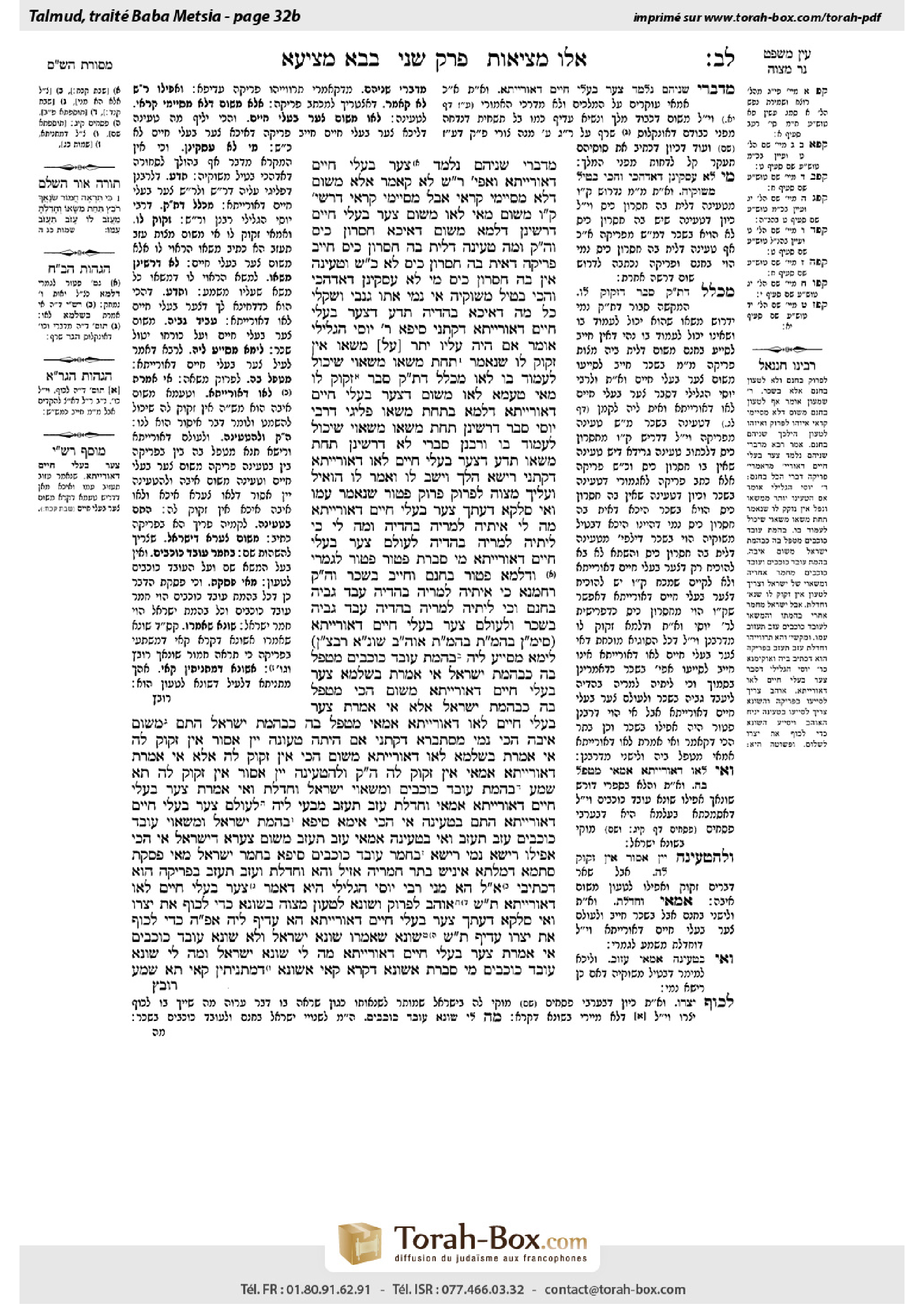
Bava Metzia 32b: Talmud study for Daf Yomi
Study the Talmud for Daf Yomi with scanned pages, Hebrew text, English translations from Sefaria and AI-generated French translations.
Passage selection and English or AI-generated French translation are available where the scan has annotations. Daf Study is independent of Torah-Box and Sefaria.
Browse Bava Metzia · בבא מציעא · All tractatesBava Metzia 32b text and translations
This page of Bava Metzia includes the Aramaic text, an English translation and an AI-generated French translation, alongside the scan above.
בבא מציעא ל״ב ב · Aramaic and Hebrew text
מִדִּבְרֵי שְׁנֵיהֶם נִלְמַד צַעַר בַּעֲלֵי חַיִּים דְּאוֹרָיְיתָא. וַאֲפִילּוּ רַבִּי שִׁמְעוֹן לָא קָאָמַר, אֶלָּא מִשּׁוּם דְּלָא מְסַיְּימִי קְרָאֵי. אֲבָל מְסַיְּימִי קְרָאֵי דָּרְשִׁינַן קַל וָחוֹמֶר, מִשּׁוּם מַאי? לָאו מִשּׁוּם צַעַר בַּעֲלֵי חַיִּים דָּרְשִׁינַן?
דִּלְמָא מִשּׁוּם דְּאִיכָּא חֶסְרוֹן כִּיס. וְהָכִי קָאָמַר: וּמָה טְעִינָה דְּלֵית בַּהּ חֶסְרוֹן כִּיס – חַיָּיב, פְּרִיקָה דְּאִית בַּהּ חֶסְרוֹן כִּיס, לֹא כׇּל שֶׁכֵּן?!
וּטְעִינָה אֵין בָּהּ חֶסְרוֹן כִּיס? מִי לָא עָסְקִינַן דְּאַדְּהָכִי וְהָכִי בָּטֵיל מִשּׁוּקֵיהּ, אִי נָמֵי אָתוּ גַּנָּבֵי וְשָׁקְלִי כֹּל מָה דְּאִיכָּא בַּהֲדֵיהּ?
תֵּדַע דְּצַעַר בַּעֲלֵי חַיִּים דְּאוֹרָיְיתָא, דְּקָתָנֵי סֵיפָא: רַבִּי יוֹסֵי הַגְּלִילִי אוֹמֵר: אִם הָיָה עָלָיו יָתֵר [עַל] מַשָּׂאוֹ – אֵין זָקוּק לוֹ, שֶׁנֶּאֱמַר ״תַּחַת מַשָּׂאוֹ״, מַשּׂאוֹי שֶׁיָּכוֹל לַעֲמוֹד בּוֹ. לָאו מִכְּלָל דְּתַנָּא קַמָּא סָבַר זָקוּק לוֹ? מַאי טַעְמָא? לָאו מִשּׁוּם דְּצַעַר בַּעֲלֵי חַיִּים דְּאוֹרָיְיתָא?
דִּלְמָא ״בְּתַחַת מַשָּׂאוֹ״ פְּלִיגִי, דְּרַבִּי יוֹסֵי סָבַר: דָּרְשִׁינַן ״תַּחַת מַשָּׂאוֹ״, מַשּׂאוֹי שֶׁיָּכוֹל לַעֲמוֹד בּוֹ, וְרַבָּנַן סָבְרִי: לָא דָּרְשִׁינַן ״תַּחַת מַשָּׂאוֹ״.
תֵּדַע דְּצַעַר בַּעֲלֵי חַיִּים לָאו דְּאוֹרָיְיתָא, דְּקָתָנֵי רֵישָׁא: הָלַךְ וְיָשַׁב לוֹ וְאָמַר לוֹ הוֹאִיל וְעָלֶיךָ מִצְוָה לִפְרוֹק, פְּרוֹק פָּטוּר, שֶׁנֶּאֱמַר עִמּוֹ. וְאִי סָלְקָא דַעְתָּךְ צַעַר בַּעֲלֵי חַיִּים דְּאוֹרָיְיתָא, מָה לִי אִיתֵיהּ לְמָרֵיהּ בַּהֲדֵיהּ, וּמָה לִי כִּי לֵיתֵיהּ לְמָרֵיהּ בַּהֲדֵיהּ?
לְעוֹלָם צַעַר בַּעֲלֵי חַיִּים דְּאוֹרָיְיתָא, מִי סָבְרַתְּ פָּטוּר פָּטוּר לִגְמָרֵי? וְדִלְמָא פָּטוּר בְּחִנָּם, וְחַיָּיב בְּשָׂכָר. וְהָכִי קָאָמַר רַחֲמָנָא: כִּי אִיתֵיהּ לְמָרֵיהּ בַּהֲדֵיהּ – עֲבֵד גַּבֵּיהּ בְּחִנָּם, וְכִי לֵיתֵיהּ לְמָרֵיהּ בַּהֲדֵיהּ – עֲבֵד גַּבֵּיהּ בְּשָׂכָר, וּלְעוֹלָם צַעַר בַּעֲלֵי חַיִּים דְּאוֹרָיְיתָא.
(סִימַן בֶּהֱמַת, בֶּהֱמַת, אוֹהֵב, שׂוֹנֵא, רַבְצָן).
לֵימָא מְסַיַּיע לֵיהּ: בֶּהֱמַת גּוֹי מִטַּפֵּל בָּהּ כְּבֶהֱמַת יִשְׂרָאֵל. אִי אָמְרַתְּ בִּשְׁלָמָא צַעַר בַּעֲלֵי חַיִּים דְּאוֹרָיְיתָא – מִשּׁוּם הָכִי מִטַּפֵּל בָּהּ כְּבֶהֱמַת יִשְׂרָאֵל, אֶלָּא אִי אָמְרַתְּ צַעַר בַּעֲלֵי חַיִּים לָאו דְּאוֹרָיְיתָא, אַמַּאי מִטַּפֵּל בָּהּ כְּבֶהֱמַת יִשְׂרָאֵל? הָתָם מִשּׁוּם אֵיבָה.
הָכִי נָמֵי מִסְתַּבְּרָא, דְּקָתָנֵי: אִם הָיְתָה טְעוּנָה יֵין נֶסֶךְ – אֵין זָקוּק לָהּ. אִי אָמְרַתְּ בִּשְׁלָמָא לָאו דְּאוֹרָיְיתָא – מִשּׁוּם הָכִי אֵין זָקוּק לָהּ, אֶלָּא אִי אָמְרַתְּ דְּאוֹרָיְיתָא – אַמַּאי אֵין זָקוּק לָהּ? הָכִי קָאָמַר: וּלְהַטְעִינָהּ יֵין נֶסֶךְ אֵין זָקוּק לָהּ.
תָּא שְׁמַע: בֶּהֱמַת גּוֹי וּמַשּׂאוֹי יִשְׂרָאֵל, ״וְחָדַלְתָּ״. וְאִי אָמְרַתְּ צַעַר בַּעֲלֵי חַיִּים דְּאוֹרָיְיתָא, אַמַּאי ״וְחָדַלְתָּ״? ״עָזֹב תַּעֲזֹב״ מִבְּעֵי לֵיהּ! לְעוֹלָם צַעַר בַּעֲלֵי חַיִּים דְּאוֹרָיְיתָא, הָתָם בִּטְעִינָה.
אִי הָכִי, אֵימָא סֵיפָא: בֶּהֱמַת יִשְׂרָאֵל וּמַשּׂאוֹי גּוֹי ״עָזֹב תַּעֲזֹב״. וְאִי בִּטְעִינָה, אַמַּאי ״עָזֹב תַּעֲזֹב״? מִשּׁוּם צַעֲרָא דְּיִשְׂרָאֵל.
אִי הָכִי, אֲפִילּוּ רֵישָׁא נָמֵי! רֵישָׁא בְּחַמָּר גּוֹי סֵיפָא בְּחַמָּר יִשְׂרָאֵל. מַאי פָּסְקַתְּ? סְתָמָא דְּמִלְּתָא אִינִישׁ בָּתַר חֲמָרֵיהּ אָזֵיל.
וְהָא ״וְחָדַלְתָּ״ וְ״עָזֹב תַּעֲזֹב״ בִּפְרִיקָה הוּא דִּכְתִיבִי!
אֲמַר לֵיהּ: הָא מַנִּי? רַבִּי יוֹסֵי הַגְּלִילִי הִיא, דְּאָמַר: צַעַר בַּעֲלֵי חַיִּים לָאו דְּאוֹרָיְיתָא.
תָּא שְׁמַע: אוֹהֵב לִפְרוֹק וְשׂוֹנֵא לִטְעוֹן – מִצְוָה בְּשׂוֹנֵא, כְּדֵי לָכוֹף אֶת יִצְרוֹ. וְאִי סָלְקָא דַּעְתָּךְ צַעַר בַּעֲלֵי חַיִּים דְּאוֹרָיְיתָא, הָא עֲדִיף לֵיהּ? אֲפִילּוּ הָכִי, כְּדֵי לָכוֹף אֶת יִצְרוֹ עָדִיף.
תָּא שְׁמַע: שׂוֹנֵא שֶׁאָמְרוּ – שׂוֹנֵא יִשְׂרָאֵל וְלֹא שׂוֹנֵא אוּמּוֹת הָעוֹלָם. אִי אָמְרַתְּ צַעַר בַּעֲלֵי חַיִּים דְּאוֹרָיְיתָא, מָה לִי שׂוֹנֵא יִשְׂרָאֵל וּמָה לִי שׂוֹנֵא אוּמּוֹת הָעוֹלָם?
מִי סָבְרַתְּ אַשּׂוֹנֵא דִקְרָא קָאֵי? אַשּׂוֹנֵא דְמַתְנִיתִין קָאֵי.
תָּא שְׁמַע:
Bava Metzia 32b · English translation
From the statements of both of these tanna’im it can be learned that the requirement to prevent suffering to animals is by Torah law. As even Rabbi Shimon says that he disagreed with the opinion of the Rabbis only because the verses are not clearly defined; but had the verses been clearly defined, we would have learned the same a fortiori inference. Due to what factor can that inference be learned? What, is it not due to the matter of suffering of animals, which is a factor in unloading and not a factor in loading, that we would have learned the a fortiori inference?
The Gemara rejects that proof. Perhaps the a fortiori inference is due to the fact that there is the factor of monetary loss in unloading but not in loading, and this is what the Rabbis are saying: If in the case of loading, where if one fails to assist the owner there is no potential monetary loss, one is obligated to help load the animal, in the case of unloading, where if one fails to assist the owner there is potential monetary loss, is it not all the more so clear that one is required to unload the burden?
The Gemara asks: But is there no potential monetary loss in loading? Are we not also dealing with a case where in the meanwhile, while the owner waits for assistance, he will be prevented from bringing his merchandise to the marketplace in time to sell it; alternatively, thieves might come and take all the merchandise that is there with him? Therefore, no a fortiori inference can be learned on the basis of monetary loss, and the inference must be based on the matter of the suffering of animals.
The Gemara cites an additional proof: Know that the requirement to prevent suffering to animals is by Torah law, as it is taught in the latter clause of the mishna: Rabbi Yosei HaGelili says: If there was a burden upon the animal greater than its typical burden, one need not attend to it, as it is stated: “Under its burden” (Exodus 23:5). Rabbi Yosei holds that the obligation to unload an animal is with regard to a burden that the animal can bear; does this not indicate by inference that the first tanna holds that he must attend to it to unload a burden that is greater than its typical burden? What is the reason for this ruling; is it not due to the fact that the requirement to prevent suffering to animals is by Torah law?
The Gemara rejects that proof: Perhaps it is with regard to the meaning of the phrase “under its burden” that they disagree, as Rabbi Yosei HaGelili holds that we interpret the phrase “under its burden” to mean: A burden that the animal can bear. And the Rabbis hold that we do not interpret the phrase “under its burden” in this manner.
The Gemara cites an additional proof: Know that the requirement to prevent suffering to animals is not by Torah law, as it is taught in the former clause of the mishna: If the owner went, and sat, and said to a passerby: Since there is a mitzva incumbent upon you to unload the burden, unload it, the passerby is exempt, as it is stated: “You shall release it with him” (Exodus 23:5). And if it enters your mind that the requirement to prevent suffering to animals is by Torah law, what is it to me if its owner is working with the passerby and what is it to me if its owner is not working with the passerby? The animal suffers in both cases.
The Gemara rejects that proof: Actually, one could say that the requirement to prevent suffering to animals is by Torah law. And when the tanna exempts the passerby when the owner does not participate in unloading the burden, do you maintain that exempt means completely exempt? Perhaps it means that the passerby is exempt from unloading the burden for free, but is obligated to do so for remuneration; and this is what the Merciful One said: If its owner is working with the passerby, perform the unloading with him for free; and if its owner is not working with the passerby, perform the unloading for him for remuneration. And actually, the requirement to prevent suffering to animals is by Torah law.
The Gemara presents a mnemonic for a series of proposed proofs cited by the Gemara: Animal of; animal of; friend; enemy; collapser.
Let us say that a baraita supports Rava’s opinion that the requirement to prevent suffering to animals is by Torah law: If one encounters the animal of a gentile collapsed under its burden, he tends to it and unloads its burden, as he would the animal of a Jew. The Gemara reasons: Granted, if you say that the requirement to prevent suffering to animals is by Torah law, it is due to that reason that he tends to it as he would the animal of a Jew. But if you say that the requirement to prevent suffering to animals is not by Torah law, why does he tend to it as he would the animal of a Jew? The Gemara rejects the proof: There one tends to the animal due to enmity that would arise if gentiles see Jews assisting their own people and not gentiles. The obligation is not due to the requirement to prevent suffering of animals.
So too, it is reasonable to explain the baraita in this manner, as it is taught in another baraita: If the animal of a gentile was loaded with wine used for a libation to idolatry, and the animal is collapsed under its burden, a Jew does not attend to it. Granted, if you say that the requirement to prevent suffering of animals is not by Torah law, it is due to that reason that he does not attend to it. But if you say that the obligation is by Torah law, why does he not attend to it; isn’t the animal suffering? The Gemara answers that this is what the tanna is saying: And to load the animal with wine used for a libation to idolatry, he does not attend to it. Loading an animal does not alleviate its suffering. Furthermore, the refusal of the Jew to handle the libation wine will not cause enmity, because he can explain that his religion precludes him from handling these materials.
The Gemara suggests: Come and hear proof from a baraita: If one encounters the animal of a gentile collapsed under the burden of a Jew, he may refuse to unload the burden, as it is written: “If you see the donkey of him that hates you collapsed under its burden, you shall forgo passing him by; you shall release it with him” (Exodus 23:5). By employing the phrase “you shall forgo,” the verse indicates that there are circumstances in which one may forgo unloading the animal. The Gemara reasons: And if you say that the requirement to prevent suffering to animals is by Torah law, why is there the option of: “You shall forgo”? The Torah should have commanded only: “You shall release it with him.” The Gemara answers: Actually, say that the requirement to prevent suffering to animals is by Torah law, and there the baraita is referring to a case of loading, where suffering of animals is not a factor.
The Gemara asks: If so, say the latter clause of the baraita: With regard to a case involving the animal of a Jew collapsed under the burden of a gentile, it is written: “You shall release it.” And if the baraita is referring to a case of loading, where suffering of animals is not a factor, why does the baraita state: “You shall release it”? The Gemara answers: It is because in that case, there is suffering of the Jew, who is delayed while waiting for the animal to be loaded.
The Gemara asks: If so, then the halakha should be the same even in the first clause. Why is there no requirement to prevent the suffering of the Jewish partner in that case? The Gemara answers: The ruling of the first clause is stated with regard to a gentile donkey driver, and the Jewish owner of the burden is absent. The ruling of the latter clause is stated with regard to a Jewish donkey driver and one is obligated to prevent his suffering. The Gemara asks: On what basis did you arrive at this definitive assertion that the animal of a Jew is driven by that Jew and the animal of a gentile is driven by that gentile? The Gemara answers: The typical state of matters is that a person follows his donkey. The first clause addressed the case of a gentile’s donkey, so presumably its driver is gentile. The latter clause addressed the case of a Jew’s donkey, so presumably its driver is a Jew.
The Gemara questions the explanation that the baraita is referring to cases involving loading. But isn’t it with regard to unloading that the phrases cited in the baraita: “You shall forgo passing him by,” and: “You shall release it,” are written?
The Gemara answers that he said to him: Indeed, the fact that one need not unload the burden from the donkey in the first clause of the baraita indicates that the requirement to prevent suffering to animals is not by Torah law. In accordance with whose opinion is this baraita? It is in accordance with the opinion of Rabbi Yosei HaGelili, who says that the requirement to prevent suffering to animals is not by Torah law. That is the minority opinion, as the Rabbis disagree.
The Gemara suggests: Come and hear proof from a baraita: If one encounters a friend whose animal collapsed and it is necessary to unload its burden, and one also encounters an enemy who needs assistance to load a burden onto his animal, the mitzva is to assist the enemy, in order to subjugate one’s evil inclination. The Gemara reasons: And if it enters your mind that the requirement to prevent suffering to animals is by Torah law, that option, to unload his friend’s animal, is the preferable course of action for him. The Gemara answers: Even if the requirement to prevent suffering to animals is by Torah law, even so, loading his enemy’s animal in order to subjugate his evil inclination is preferable.
The Gemara suggests: Come and hear proof from a baraita. The enemy with regard to which they stated the halakha that one must assist with his animal is a Jewish enemy and not a gentile enemy. The Gemara asks: If you say that the requirement to prevent suffering to animals is by Torah law, what is it to me if it is a Jewish enemy and what is it to me if it is a gentile enemy? In either case, failure to unload the burden will cause the animal suffering.
The Gemara answers: Do you maintain that the reference in the baraita to an enemy applies to the enemy mentioned in the verse: “If you see the donkey of him that hates you collapsed under its burden…you shall release it with him”? It applies to the enemy mentioned in the baraita cited above, in which the tanna taught that loading a burden onto an enemy’s animal is preferable to unloading a burden from a friend’s animal.
The Gemara suggests: Come and hear proof from a baraita:
Bava Metzia 32b · Traduction française (IA)
D'après les déclarations des deux tannaïm, on peut déduire que l'obligation de prévenir les souffrances des animaux est une loi divine. Car même Rabbi Shimon affirme qu'il s'est opposé à l'opinion des Rabbins uniquement parce que les versets ne sont pas clairs ; mais si les versets avaient été clairs, nous aurions appris la même déduction a fortiori. Pourquoi cette déduction peut-elle être tirée ? Qu'est-ce que ce n'est pas dû au fait de la souffrance des animaux, qui est un facteur dans le déchargement mais pas dans le chargement, que nous aurions appris cette déduction a fortiori ?
La Guemara rejette cette preuve. Peut-être que la déduction a fortiori est dûe au fait qu'il y a un facteur de perte monétaire dans le déchargement mais pas dans le chargement, et c'est ce que les Rabbins affirment : dans le cas du chargement, où si l'on ne rend pas assistance à l'owner, il n'y a pas de perte monétaire potentielle, l'assistance est obligatoire ; dans le cas du déchargement, où si l'on ne rend pas assistance à l'owner, il y a une perte monétaire potentielle, n'est-ce pas encore plus clair que l'on est tenu de décharger le fardeau ?
La Guemara pose la question : Mais n'y a-t-il pas une perte monétaire potentielle dans le chargement ? Ne sommes-nous pas aussi dans un cas où, pendant que l'owner attend de l'assistance, il ne pourra pas amener ses marchandises au marché à temps pour les vendre ; ou des voleurs pourraient venir et emporter toutes les marchandises qui sont avec lui ? Ainsi, aucune déduction a fortiori ne peut être tirée sur la base de la perte monétaire, et la déduction doit être basée sur la question de la souffrance des animaux.
La Guemara cite une autre preuve : Sachez que l'obligation de prévenir les souffrances des animaux est une loi divine, comme il est dit dans la seconde partie de la mishna : Rabbi Yosei HaGelili dit : Si le fardeau sur l'animal est plus lourd que son fardeau normal, on n'a pas besoin de s'en occuper, comme il est dit : « Sous son fardeau » (Exode 23:5). Rabbi Yosei affirme que l'obligation de décharger l'animal est envers un fardeau qu'il peut porter ; ne montre-t-il pas par déduction que le premier tanna considère qu'il faut s'en occuper pour décharger un fardeau plus lourd que son fardeau normal ? Quel est le motif de cette décision ; n'est-ce pas dû au fait que l'obligation de prévenir les souffrances des animaux est une loi divine ?
La Guemara rejette cette preuve : Peut-être qu'il s'agit de la signification de la phrase « sous son fardeau » qu'ils discutent, comme Rabbi Yosei HaGelili considère que cette phrase signifie : un fardeau que l'animal peut porter. Et les Rabbins pensent que nous ne devons pas interpréter la phrase « sous son fardeau » ainsi.
La Guemara cite une autre preuve : Sachez que l'obligation de prévenir les souffrances des animaux n'est pas une loi divine, comme il est dit dans la première partie de la mishna : Si l'propriétaire est allé, s'est assis, et a dit à un passant : Il y a une mitsva qui incombe à vous pour décharger le fardeau, déchargez-le, le passant est exempt, comme il est dit : « Vous le libérerez avec lui » (Exode 23:5). Et si vous pensez que l'obligation de prévenir les souffrances des animaux est une loi divine, à quoi cela me touche-t-il si son propriétaire travaille avec le passant et à quoi cela me touche-t-il si son propriétaire ne travaille pas avec le passant ? L'animal souffre dans les deux cas.
La Guemara rejette cette preuve : En réalité, on pourrait dire que l'obligation de prévenir les souffrances des animaux est une loi divine. Et lorsque le tanna exempt le passant lorsque l'propriétaire ne participe pas au déchargement du fardeau, est-ce que vous maintenez que exempt signifie totalement exempt ? Peut-être qu'il signifie que le passant est exempt de décharger le fardeau gratuitement, mais qu'il est tenu de le faire contre rémunération ; et c'est ce que l'Éternel a dit : Si son propriétaire travaille avec le passant, déchargez-le gratuitement ; et si son propriétaire ne travaille pas avec le passant, déchargez-le contre rémunération. En réalité, l'obligation de prévenir les souffrances des animaux est une loi divine.
La Guemara présente un mnémotechnique pour une série de preuves proposées par la Guemara : Animal de ; animal de ; ami ; ennemi ; effondré.
Disons qu'un baraïta soutient l'opinion de Rava que l'obligation de prévenir les souffrances des animaux est une loi divine : Si l'on rencontre l'animal d'un non-Juif effondré sous son fardeau, on s'en occupe et on décharge son fardeau, comme on le ferait pour l'animal d'un Juif. La Guemara raisonne : D'accord, si vous dites que l'obligation de prévenir les souffrances des animaux est une loi divine, c'est pour cette raison que l'on s'en occupe comme on le ferait pour l'animal d'un Juif. Mais si vous dites que l'obligation n'est pas une loi divine, pourquoi l'on s'en occupe comme on le ferait pour l'animal d'un Juif ? La Guemara rejette cette preuve : C'est pour l'ennui qui pourrait surgir si les non-Juifs voient les Juifs aider leurs propres gens et non les non-Juifs. L'obligation n'est pas dûe à l'obligation de prévenir les souffrances des animaux.
De même, il est raisonnable d'expliquer ce baraïta ainsi, car il est dit dans un autre baraïta : Si l'animal d'un non-Juif a été chargé de vin utilisé pour une libation idolâtrique, et que l'animal s'effondre sous son fardeau, un Juif ne s'en occupe pas. D'accord, si vous dites que l'obligation de prévenir les souffrances des animaux ne provient pas de la Loi divine, c'est pour cette raison que l'on ne s'en occupe pas. Mais si vous dites que cette obligation provient de la Loi divine, pourquoi ne s'en occupe-t-on pas ; n'est-ce pas que l'animal souffre ? La Guemara répond que c'est ce que le tanna dit : Et pour charger l'animal avec du vin utilisé pour une libation idolâtrique, il ne s'en occupe pas. Charger l'animal ne soulage pas sa souffrance. De plus, le refus du Juif de manipuler le vin de libation ne causera pas d'ennui, car il peut expliquer que sa religion l'interdit de manipuler ces matériaux.
La Guemara suggère : Approchez-vous et entendez la preuve d'une baraïta : Si l'on rencontre l'animal d'un non-Juif écrasé sous le fardeau d'un Juif, on peut refuser de décharger le fardeau, car il est écrit : « Si vous voyez le chameau de celui qui vous hait écrasé sous son fardeau, vous devriez passer outre ; vous le libérerez avec lui » (Exode 23:5). En utilisant l'expression « vous devriez passer outre », la Sainte Écriture indique qu'il existe des circonstances où l'on peut passer outre à décharger l'animal. La Guemara raisonne : Et si vous dites que la nécessité de prévenir la souffrance des animaux est une loi divine, pourquoi y a-t-il l'option : « vous devriez passer outre » ? La Torah aurait dû commander uniquement : « vous le libérerez avec lui ». La Guemara répond : En réalité, disons que la nécessité de prévenir la souffrance des animaux est une loi divine, et là, la baraïta fait référence à un cas de chargement, où la souffrance des animaux n'est pas en jeu.
La Guemara pose la question : Si c'est ainsi, dites la seconde partie de la baraïta : En ce qui concerne le cas d'un animal juif écrasé sous le fardeau d'un non-Juif, il est écrit : « vous le libérerez ». Et si la baraïta fait référence à un cas de chargement, où la souffrance des animaux n'est pas en jeu, pourquoi la baraïta dit-elle : « vous le libérerez » ? La Guemara répond : C'est parce que dans ce cas, il y a la souffrance du Juif, qui est retardé en attendant que l'animal soit chargé.
La Guemara pose la question : Si c'est ainsi, alors la halakha devrait être la même même dans la première clause. Pourquoi n'y a-t-il pas de nécessité de prévenir la souffrance du partenaire juif dans ce cas ? La Guemara répond : La déclaration de la première clause est faite concernant un conducteur de chameau gentil, et l'propriétaire juif du fardeau est absent. La déclaration de la seconde clause est faite concernant un conducteur de chameau juif, et l'on est tenu de prévenir sa souffrance. La Guemara pose la question : Sur quelle base avez-vous atteint cette affirmation définitive que l'animal d'un Juif est conduit par ce Juif et que l'animal d'un non-Juif est conduit par ce non-Juif ? La Guemara répond : L'état normal des choses est que la personne suit son chameau. La première clause abordait le cas d'un chameau gentil, donc son conducteur est probablement gentil. La seconde clause abordait le cas d'un chameau juif, donc son conducteur est probablement un Juif.
La Guemara remet en question l'explication selon laquelle la baraïta fait référence aux cas de chargement. Mais n'est-ce pas concernant le déchargement que les phrases citées dans la baraïta : « Vous devriez passer outre », et : « Vous le libérerez », sont écrites ?
La Guemara répond qu'il dit à lui : En effet, le fait que l'on n'ait pas besoin de décharger le fardeau du chameau dans la première partie de la baraïta indique que la nécessité de prévenir la souffrance des animaux n'est pas une loi divine. Selon quel avis est-ce que cette baraïta ? C'est selon l'avis de Rabbi Yosei HaGelili, qui dit que la nécessité de prévenir la souffrance des animaux n'est pas une loi divine. C'est l'avis minoritaire, car les Rabbins sont en désaccord.
La Guemara suggère : Approchez-vous et entendez la preuve d'une baraïta : Si l'on rencontre un ami dont l'animal s'est écrasé et qu'il est nécessaire de décharger son fardeau, et qu'on rencontre également un ennemi qui a besoin d'aide pour charger un fardeau sur son animal, la mitsva est d'aider l'ennemi afin de dominer sa mauvaise inclination. La Guemara raisonne : Et si cela entre dans votre esprit que la nécessité de prévenir la souffrance des animaux est une loi divine, cette option, de décharger l'animal de son ami, est la voie préférable pour lui. La Guemara répond : Même si la nécessité de prévenir la souffrance des animaux est une loi divine, même ainsi, charger l'animal de son ennemi afin de dominer sa mauvaise inclination est préférable.
La Guemara suggère : Approchez-vous et entendez la preuve d'une baraïta. L'ennemi concernant lequel ils ont établi la halakha que l'on doit aider avec son animal est un ennemi juif et non un ennemi non-Juif. La Guemara pose la question : Si vous dites que la nécessité de prévenir la souffrance des animaux est une loi divine, qu'y a-t-il pour moi si c'est un ennemi juif et qu'y a-t-il pour moi si c'est un ennemi non-Juif ? Dans les deux cas, le non-déchargement du fardeau causera la souffrance de l'animal.
La Guemara répond : Vous maintenez-vous que la référence dans la baraïta à un ennemi s'applique à l'ennemi mentionné dans la Sainte Écriture : « Si vous voyez le chameau de celui qui vous hait écrasé sous son fardeau… vous devriez le libérer avec lui » ? Elle s'applique à l'ennemi mentionné dans la baraïta citée ci-dessus, dans laquelle le tanna a enseigné que charger un fardeau sur l'animal d'un ennemi est préférable à décharger un fardeau d'un animal d'un ami.
La Guemara suggère : Approchez-vous et entendez la preuve d'une baraïta :
Traduction française générée par IA à partir de l’édition anglaise de Sefaria. Vérifie toujours un passage avec le texte source.
Text from Sefaria: William Davidson Edition - Vocalized Aramaic (CC BY NC); William Davidson Edition - English (CC BY NC).