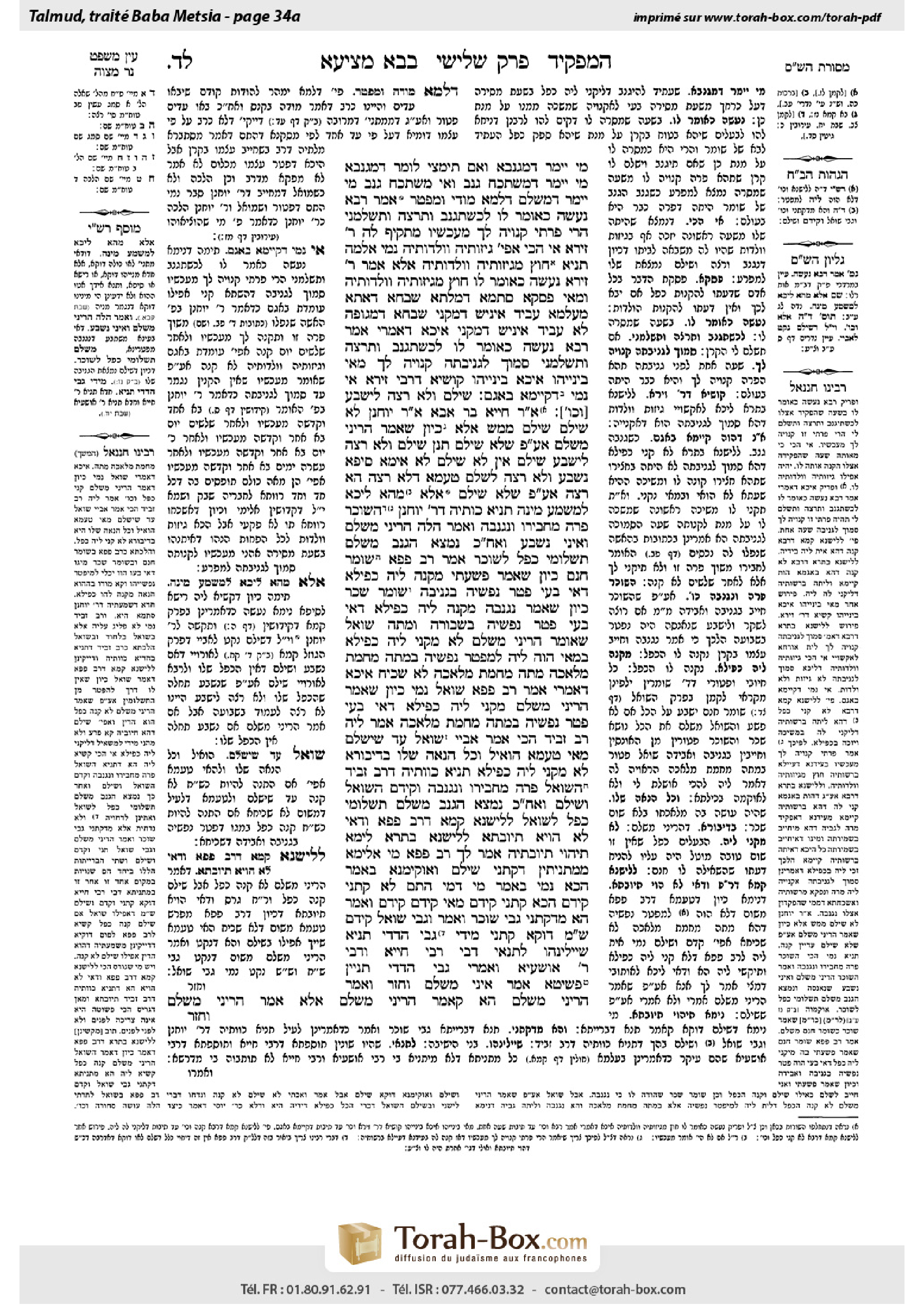
Bava Metzia 34a: Talmud study for Daf Yomi
Study the Talmud for Daf Yomi with scanned pages, Hebrew text, English translations from Sefaria and AI-generated French translations.
Passage selection and English or AI-generated French translation are available where the scan has annotations. Daf Study is independent of Torah-Box and Sefaria.
Browse Bava Metzia · בבא מציעא · All tractatesBava Metzia 34a text and translations
This page of Bava Metzia includes the Aramaic text, an English translation and an AI-generated French translation, alongside the scan above.
בבא מציעא ל״ד א · Aramaic and Hebrew text
מִי יֵימַר דְּמִגַּנְבָא, וְאִם תִּמְצֵי לוֹמַר דְּמִגַּנְבָא – מִי יֵימַר דְּמִשְׁתְּכַח גַּנָּב, וְאִי מִשְׁתְּכַח גַּנָּב – מִי יֵימַר דִּמְשַׁלֵּם, דִּלְמָא מוֹדֵי וּמִפְּטַר? אָמַר רָבָא: נַעֲשָׂה כְּאוֹמֵר לוֹ, לִכְשֶׁתִּגָּנֵב וְתִרְצֶה וּתְשַׁלְּמֵנִי הֲרֵי פָּרָתִי קְנוּיָה לְךָ מֵעַכְשָׁיו.
מַתְקֵיף לַהּ רַבִּי זֵירָא: אִי הָכִי, אֲפִילּוּ גִּיזּוֹתֶיהָ וּוַלְדוֹתֶיהָ נָמֵי! אַלְּמָה תַּנְיָא חוּץ מִגִּיזּוֹתֶיהָ וּוַלְדוֹתֶיהָ? אֶלָּא אָמַר רַבִּי זֵירָא: נַעֲשָׂה כְּאוֹמֵר לוֹ, חוּץ מִגִּיזּוֹתֶיהָ וּוַלְדוֹתֶיהָ.
וּמַאי פְּסָקַאּ? סְתָמָא דְּמִלְּתָא שְׁבָחָא דְּאָתֵא מֵעָלְמָא, עֲבִיד אִינִישׁ דְּמַקְנֵי. שְׁבָחָא דְּמִגּוּפַהּ, לָא עֲבִיד אִינִישׁ דְּמַקְנֵי.
אִיכָּא דְּאָמְרִי, אָמַר רָבָא: נַעֲשָׂה כְּאוֹמֵר לוֹ, לִכְשֶׁתִּגָּנֵב וְתִרְצֶה וּתְשַׁלְּמֵנִי, סָמוּךְ לִגְנֵיבָתָהּ קְנוּיָה לָךְ. מַאי בֵּינַיְיהוּ?
אִיכָּא בֵּינַיְיהוּ קוּשְׁיָא דְּרַבִּי זֵירָא. אִי נָמֵי דְּקָיְימָא בַּאֲגַם.
שִׁילֵּם וְלֹא רָצָה לִישָּׁבַע [וְכוּ׳]. אָמַר רַבִּי חִיָּיא בַּר אַבָּא אָמַר רַבִּי יוֹחָנָן: לֹא ״שִׁילֵּם״ – שִׁילֵּם מַמָּשׁ, אֶלָּא כֵּיוָן שֶׁאָמַר ״הֲרֵינִי מְשַׁלֵּם״, אַף עַל פִּי שֶׁלֹּא שִׁילֵּם.
תְּנַן: שִׁילֵּם וְלֹא רָצָה לִישָּׁבַע. שִׁילֵּם – אִין, לֹא שִׁילֵּם – לָא. אֵימָא סֵיפָא: נִשְׁבַּע וְלֹא רָצָה לְשַׁלֵּם. טַעְמָא דְּלֹא רָצָה, הָא רָצָה אַף עַל פִּי שֶׁלֹּא שִׁילֵּם. אֶלָּא מֵהָא לֵיכָּא לְמִשְׁמַע מִינַּהּ.
תַּנְיָא כְּוָתֵיהּ דְּרַבִּי יוֹחָנָן: הַשּׂוֹכֵר פָּרָה מֵחֲבֵירוֹ, וְנִגְנְבָה, וְאָמַר הַלָּה: ״הֲרֵינִי מְשַׁלֵּם וְאֵינִי נִשְׁבָּע״, וְאַחַר כָּךְ נִמְצָא הַגַּנָּב – מְשַׁלֵּם תַּשְׁלוּמֵי כֶפֶל לַשּׂוֹכֵר.
אָמַר רַב פָּפָּא: שׁוֹמֵר חִנָּם, כֵּיוָן שֶׁאָמַר ״פָּשַׁעְתִּי״, מַקְנֵה לֵיהּ כְּפֵילָא. דְּאִי בָּעֵי פָּטַר נַפְשֵׁיהּ בִּגְנֵיבָה. שׁוֹמֵר שָׂכָר, כֵּיוָן שֶׁאָמַר ״נִגְנְבָה״, מַקְנֵה לֵיהּ כְּפֵילָא. דְּאִי בָּעֵי פָּטַר נַפְשֵׁיהּ בִּשְׁבוּרָה וּמֵתָה.
שׁוֹאֵל שֶׁאוֹמֵר ״הֲרֵינִי מְשַׁלֵּם״ – לָא מַקְנֵי לֵיהּ כְּפֵילָא, בְּמַאי הֲוָה לֵיהּ לְמִפְטַר נַפְשֵׁיהּ? בְּמֵתָה מֵחֲמַת מְלָאכָה, מֵתָה מֵחֲמַת מְלָאכָה לָא שְׁכִיחַ.
אִיכָּא דְּאָמְרִי, אָמַר רַב פָּפָּא: שׁוֹאֵל נָמֵי כֵּיוָן שֶׁאָמַר ״הֲרֵינִי מְשַׁלֵּם״ – מַקְנֵי לֵיהּ כְּפֵילָא, דְּאִי בָּעֵי פָּטַר נַפְשֵׁיהּ בְּמֵתָה מֵחֲמַת מְלָאכָה. אֲמַר לֵיהּ רַב זְבִיד: הָכִי אָמַר אַבָּיֵי: שׁוֹאֵל עַד שֶׁיְּשַׁלֵּם. מַאי טַעְמָא? הוֹאִיל וְכׇל הֲנָאָה שֶׁלּוֹ, בְּדִיבּוּרָא לָא מַקְנֵי לֵיהּ כְּפֵילָא.
תַּנְיָא כְּווֹתֵיהּ דְּרַב זְבִיד: הַשּׁוֹאֵל פָּרָה מֵחֲבֵירוֹ וְנִגְנְבָה, וְקִידֵּם הַשּׁוֹאֵל וְשִׁילֵּם, וְאַחַר כָּךְ נִמְצָא הַגַּנָּב – מְשַׁלֵּם תַּשְׁלוּמֵי כֶפֶל לַשּׁוֹאֵל.
לְלִישָּׁנָא קַמָּא דְּרַב פָּפָּא – וַדַּאי לָא הָוְיָא תְּיוּבְתָּא. לְלִישָּׁנָא בָּתְרָא לֵימָא תֶּיהְוֵי תְּיוּבְתֵּיהּ?
אָמַר לְךָ רַב פָּפָּא: מִי אַלִּימָא מִמַּתְנִיתִין? דְּקָתָנֵי ״שִׁילֵּם״, וְאוֹקֵימְנָא, בְּאָמַר הָכָא נָמֵי בְּאָמַר.
מִי דָּמֵי? הָתָם לָא קָתָנֵי ״קִידֵּם״, הָכָא קָתָנֵי ״קִידֵּם״! מַאי ״קִידֵּם״? קִידֵּם וְאָמַר.
הָא מִדְּקָתָנֵי גַּבֵּי שׂוֹכֵר ״וְאָמַר״, וְגַבֵּי שׁוֹאֵל ״קִידֵּם״ – שְׁמַע מִינַּהּ דַּוְקָא קָתָנֵי! מִידֵּי גַּבֵּי הֲדָדֵי תַּנְיָא?
שַׁיְילִינְהוּ לְתַנָּאֵי דְּבֵי רַבִּי חִיָּיא וּדְבֵי רַבִּי אוֹשַׁעְיָא, וְאָמְרִי: גַּבֵּי הֲדָדֵי תַּנְיָין.
פְּשִׁיטָא: אָמַר ״אֵינִי מְשַׁלֵּם״ וְחָזַר וְאָמַר ״הֲרֵינִי מְשַׁלֵּם״, – הָא קָאָמַר ״הֲרֵינִי מְשַׁלֵּם״. אֶלָּא אָמַר ״הֲרֵינִי מְשַׁלֵּם״
Bava Metzia 34a · English translation
who could say that the deposit will be stolen? And if you say it will be stolen, who could say that the thief will be found? And even if the thief will be found, who could say that he will pay the double payment? Perhaps he will confess and will be exempted from the double payment. Rava said in response: It is as though the owner said to the bailee at the time that he gave him the deposit: When it will be stolen, and you will wish to refrain from taking an oath, and you will pay me instead, ownership of my cow is hereby transferred to you from this time, and the cow is an entity that already came into the world. Since ownership of the cow is retroactively transferred to the bailee from the time of the deposit, any profits generated by the cow, e.g., the double payment, belong to the bailee.
Rabbi Zeira objects to this: If so, then even the fleece and offspring of the animal that grew while it was in the bailee’s possession should be the property of the bailee. Why, then, is it taught in a baraita that the bailee receives all profits generated by the animal except for its fleece and its offspring? Rather, Rabbi Zeira says that it is as though the owner said to the bailee: My animal is hereby transferred to you from this time except for its fleece and its offspring.
The Gemara asks: If so, why was this halakha stated in the mishna without qualification? Does every owner necessarily have that condition in mind? The Gemara answers: Typically, profit that comes from elsewhere, e.g., the double payment from a thief, which is difficult to anticipate, a person is apt to transfer to the bailee. But profit that originates from the body of the animal, which can be anticipated, a person is not apt to transfer to the bailee.
Some say that Rava says his response differently. It is as though the owner said to the bailee at the time of the deposit: When it will be stolen, and you will wish to refrain from taking an oath, and you will pay me instead, ownership of my animal is transferred to you adjacent to, i.e., immediately before, its theft. The Gemara asks: What is the difference between the formulations in Rava’s two responses?
The Gemara answers: There is a difference between them with regard to the difficulty raised by Rabbi Zeira with regard to fleece and offspring, which is irrelevant according to the second formulation. Alternatively, there is a difference in a case where the animal is standing in a marsh [ba’agam] at the time of its theft. Since the animal was not on the bailee’s property at that time, he could not acquire it.
§ The mishna teaches that if the bailee paid the owner and did not wish to take an oath, the thief pays the double payment to the bailee. Rabbi Ḥiyya bar Abba says that Rabbi Yoḥanan says: When the mishna says: If the bailee paid, it does not mean that he actually paid. Rather, once the bailee said: I hereby choose to pay, even if he did not yet actually pay, he acquired the double payment and all other profits.
The Gemara raises an objection from that which we learned in the mishna: If the bailee paid the owner and did not wish to take an oath, the thief pays the double payment to the bailee. The Gemara infers: If the bailee paid, yes, he acquires these rights; if the bailee did not pay, he does not. The Gemara answers: Say the latter clause of the mishna: In the case of a bailee who took an oath and did not wish to pay, the thief pays the double payment to the owner. The Gemara infers: The reason that the thief pays the owner is that the bailee did not wish to pay. But if the bailee wished to pay, although he did not actually pay, he acquires the rights to the double payment. Rather, because the inference from the first clause and the inference from the latter clause are contradictory, no inference is to be learned from this mishna.
The Gemara notes: It is taught in a baraita in accordance with the opinion of Rabbi Yoḥanan: In the case of one who rents a cow from another, and it was stolen, and the other party, the renter, said: I hereby choose to pay and I will not take an oath, and the thief was located thereafter, the thief pays the double payment to the renter. Apparently, once the renter chooses to pay, he acquires the rights to the double payment.
Rav Pappa says: In the case of an unpaid bailee, once he stated: I was negligent, thereby rendering himself liable to compensate the owner, the owner transfers rights to the double payment to him, as, if the unpaid bailee wishes, he can exempt himself from that liability with the claim of theft. Admitting negligence is tantamount to agreeing to pay rather than taking an oath. Likewise, in the case of a paid bailee, once he stated: It was stolen, the owner transfers rights to the double payment to him, as, if the paid bailee wishes, he can exempt himself from that liability with the claim that the animal was maimed or died due to circumstances beyond his control.
By contrast, in the case of a borrower who says: I hereby choose to pay, the owner does not transfer the rights to the double payment to him. The borrower’s statement that he chooses to pay is ineffectual, as he is liable to pay even without it. Because the statement is ineffectual, it does not confer any rights. With what claim would a borrower be able to exempt himself from payment? It is only with the claim that the animal died due to ordinary labor. A case of an animal that died due to ordinary labor is uncommon, and this claim is therefore accepted only with corroborating proof.
Some say that Rav Pappa said: In the case of a borrower, once he stated: I hereby choose to pay, the owner transfers rights to the double payment to him, as, if a borrower wishes, he can exempt himself from that liability with the claim that the animal died due to ordinary labor. Rav Zevid said to him that this is what Abaye said: A borrower acquires the rights to the double payment only when he actually pays for the item. What is the reason for this? Since all of the benefit accrues to the borrower, as he enjoys the use of the item without payment, the owner does not transfer the rights to the double payment to the borrower due to his statement that he chooses to pay.
The Gemara notes: It is taught in a baraita in accordance with the opinion of Rav Zevid: In the case of one who borrows a cow from another, and it was stolen, and the borrower went ahead and paid, and the thief was located thereafter, the thief pays the double payment to the borrower. This indicates that the borrower receives the double payment only if he actually paid the owner for the item.
The Gemara comments: According to the first version of the statement of Rav Pappa, that the owner transfers rights to the double payment to the borrower only if he actually pays the owner, this baraita certainly is not a conclusive refutation [teyuvta] of the opinion of Rav Pappa, as the baraita corresponds to his opinion. According to the latter version of Rav Pappa’s statement, that the owner transfers rights to the double payment to the borrower even if the borrower merely says that he chooses to pay, shall we say that this baraita would be a conclusive refutation of the opinion of Rav Pappa?
The Gemara answers: Rav Pappa could have said to you: Is the baraita stronger than the mishna, which teaches that the bailee receives the double payment if he already paid the owner, and nevertheless, we established that the mishna is referring to one who states his intent to pay but has not yet paid? Here, too, establish the baraita as referring to one who states his intent to pay but has not yet paid.
The Gemara questions this: Are these cases comparable? There, in the mishna, it is not taught that he went ahead and paid. Here, in the baraita, it is taught that he went ahead and paid, which indicates that he actually paid and not merely that he agreed to pay. The Gemara responds: What is the meaning of went ahead? It means that he went ahead and stated his intent to pay, although he did not yet actually pay.
The Gemara asks: But from the fact that the tanna teaches the halakha in the baraita cited earlier with regard to a renter with the formulation: And he said that he would pay, and in the baraita with regard to a borrower the tanna uses the formulation: Went ahead, conclude from it that the baraita concerning a borrower is teaching specifically that he actually paid. The Gemara rejects this proof: Are these two baraitot taught together so that one can draw a conclusion based on a discrepancy in their formulation? Perhaps the baraitot are unrelated and are simply formulated in different styles.
The Gemara comments: The Sages asked the tanna’im of the school of Rabbi Ḥiyya and Rabbi Oshaya, experts in mishnayot and baraitot, if these baraitot were formulated together. And they said that the baraitot were taught together as one long baraita, and therefore one can draw a conclusion based on a discrepancy in their formulation.
§ The Gemara comments that it is obvious that if the bailee initially said: I will not pay, and then said: I hereby choose to pay rather than taking an oath, he is entitled to the double payment, as didn’t he ultimately say: I hereby choose to pay? The Gemara raises a dilemma: But if he initially said: I hereby choose to pay,
Bava Metzia 34a · Traduction française (IA)
Qui pourrait dire que le dépôt sera volé ? Et si l'on dit qu'il sera volé, qui pourrait dire que le voleur sera trouvé ? Et même si le voleur sera trouvé, qui pourrait dire qu'il paiera le double ? Peut-être qu'il reconnaîtra sa faute et sera exempté du double. Rava répondit : C'est comme si l'owner avait dit au dépositaire au moment où il lui donnait le dépôt : Lorsqu'il sera volé, et que tu voudras t'abstenir de prendre un serment, et que tu me paieras plutôt, la propriété de ma vache est transférée à toi à partir de ce moment, et la vache est un être qui est déjà entré dans le monde. Puisque la propriété de la vache est transférée rétroactivement au dépositaire à partir du moment du dépôt, tout profit généré par la vache, par exemple le double, appartient au dépositaire.
Rabbi Zéira s'oppose à cela : Si c'est ainsi, alors même la laine et les petits de l'animal qui ont grandi pendant qu'il était en possession du dépositaire devraient appartenir au dépositaire. Pourquoi alors est-il enseigné dans une baraïta que le dépositaire reçoit tous les profits générés par l'animal, sauf la laine et ses petits ? Plutôt, Rabbi Zéira dit que c'est comme si l'owner avait dit au dépositaire : Mon animal est transféré à toi à partir de ce moment, sauf la laine et ses petits.
Le Guemara demande : Si c'est ainsi, pourquoi cette halakha a-t-elle été énoncée dans la mishna sans qualification ? Un propriétaire a-t-il nécessairement cette intention ? Le Guemara répond : Généralement, un profit qui vient d'ailleurs, par exemple le double du voleur, qui est difficile à anticiper, une personne a tendance à transférer à l'égard du dépositaire. Mais un profit qui provient du corps de l'animal, qui peut être anticipé, une personne n'a pas tendance à transférer à l'égard du dépositaire.
Certains disent que Rava dit sa réponse différemment. C'est comme si l'owner avait dit au dépositaire au moment du dépôt : Lorsqu'il sera volé, et que tu voudras t'abstenir de prendre un serment, et que tu me paieras plutôt, la propriété de mon animal est transférée à toi immédiatement avant son vol. Le Guemara demande : Quelle est la différence entre les formulations dans les réponses de Rava ?
Le Guemara répond : Il y a une différence entre eux concernant la difficulté soulevée par Rabbi Zéira concernant la laine et les petits, qui est irrélevante selon la deuxième formulation. Alternativement, il y a une différence dans le cas où l'animal est dans une marécage [ba'agam] au moment de son vol. Puisque l'animal n'était pas sur la propriété du dépositaire à ce moment-là, il ne pouvait pas l'acquérir.
§ La mishna enseigne que si le dépositaire a payé l'owner et ne voulait pas prendre un serment, le voleur paie le double à l'égard du dépositaire. Rabbi Ḥiyya bar Abba dit que Rabbi Yoḥanan dit : Lorsque la mishna dit : Si le dépositaire a payé, cela ne signifie pas qu'il a effectivement payé. Plutôt, une fois que le dépositaire a dit : Je choisis de payer, même s'il n'a pas encore effectivement payé, il acquiert le double et tous les autres profits.
Le Guemara soulève une objection à partir de ce que nous avons appris dans la Michna : Si le dépositaire a payé l'owner et ne voulait pas prendre un serment, le voleur paie le double au dépositaire. Le Guemara infère : Si le dépositaire a payé, oui, il acquiert ces droits ; si le dépositaire n'a pas payé, il n'en acquiert pas. Le Guemara répond : Dites la dernière partie de la Michna : Dans le cas d'un dépositaire qui a pris un serment et ne voulait pas payer, le voleur paie le double à l'égard de l'owner. Le Guemara infère : La raison pour laquelle le voleur paie l'owner est que le dépositaire ne voulait pas payer. Mais si le dépositaire voulait payer, même s'il n'a pas effectivement payé, il acquiert les droits au double. Plutôt, puisque l'inférence de la première partie et l'inférence de la dernière partie sont contradictoires, aucune inférence ne peut être tirée de cette Michna.
Le Guemara note : Il est enseigné dans une baraïta selon l'opinion de Rabbi Yoḥanan : Dans le cas d'une personne qui loue une vache à un autre, et qu'elle a été volée, et que l'autre partie, le locataire, a dit : Je choisis de payer et je ne prendrai pas de serment, et que le voleur a été trouvé ensuite, le voleur paie le double au locataire. Apparemment, une fois que le locataire choisit de payer, il acquiert les droits au double.
Rav Pappa dit : Dans le cas d'un dépositaire non payé, une fois qu'il a dit : J'ai été négligent, ce qui le rend responsable de compenser l'owner, l'owner transfère les droits au double à lui, car, si le dépositaire non payé veut, il peut s'écarter de cette responsabilité avec la revendication du vol. Admettre la négligence est équivalent à accepter de payer plutôt que de prendre un serment. De même, dans le cas d'un dépositaire payé, une fois qu'il a dit : Il a été volé, l'owner transfère les droits au double à lui, car, si le dépositaire payé veut, il peut s'écarter de cette responsabilité avec la revendication que l'animal a été blessé ou est mort à cause de circonstances au-delà de son contrôle.
Par contraste, dans le cas d'un emprunteur qui dit : Je choisis de payer, l'owner ne transfère pas les droits au double à lui. L'énoncé de l'emprunteur qu'il choisit de payer est inefficace, car il est tenu de payer même sans cela. Puisque l'énoncé est inefficace, il ne confère aucun droit. Avec quelle revendication un emprunteur pourrait-il s'émanciper du paiement ? C'est uniquement avec la revendication que l'animal est mort à cause du travail ordinaire. Un cas d'un animal mort à cause du travail ordinaire est rare, et cette revendication est donc acceptée uniquement avec une preuve corroborante.
Certains disent que Rav Pappa a dit : Dans le cas d'un emprunteur, une fois qu'il a déclaré : Je choisis de payer, le propriétaire transfère les droits à la double réparation à l'emprunteur, car, si l'emprunteur le souhaite, il peut s'émanciper de cette responsabilité en affirmant que l'animal est mort à cause du travail ordinaire. Rav Zevid a répondu à cela en disant que c'est ce que Abaye a dit : L'emprunteur acquiert les droits à la double réparation uniquement lorsqu'il paie effectivement l'objet. Pourquoi est-ce ainsi ? Parce que tout le bénéfice revient à l'emprunteur, car il profite de l'usage de l'objet sans payer, le propriétaire ne transfère donc pas les droits à la double réparation à l'emprunteur en raison de sa déclaration selon laquelle il choisit de payer.
La Guemara note : Il est enseigné dans une baraïta selon l'opinion de Rav Zevid : Dans le cas d'une personne qui emprunte un taureau à un autre, et qu'il est volé, et que l'emprunteur a payé en avance, et que le voleur est ensuite retrouvé, le voleur paie la double réparation à l'emprunteur. Cela indique que l'emprunteur reçoit la double réparation uniquement s'il a effectivement payé le propriétaire pour l'objet.
La Guemara commente : Selon la première version de la déclaration de Rav Pappa, que le propriétaire transfère les droits à la double réparation à l'emprunteur uniquement s'il paie effectivement au propriétaire, cette baraïta ne constitue certainement pas une réfutation définitive [teyuvta] de l'opinion de Rav Pappa, car la baraïta correspond à son opinion. Selon la seconde version de la déclaration de Rav Pappa, que le propriétaire transfère les droits à la double réparation à l'emprunteur même si l'emprunteur n'a que déclaré qu'il choisit de payer, devons-nous dire que cette baraïta constituerait une réfutation définitive de l'opinion de Rav Pappa ?
La Guemara répond : Rav Pappa aurait pu te dire : La baraïta est-elle plus forte que la mitsna, qui enseigne que le bailee reçoit le double paiement s'il a déjà payé le propriétaire, et pourtant, nous avons établi que la mitsna fait référence à celui qui a déclaré son intention de payer mais n'a pas encore payé ? Ici aussi, établisse la baraïta comme faisant référence à celui qui a déclaré son intention de payer mais n'a pas encore payé.
La Guemara pose une question : Ces cas sont-ils comparables ? Là, dans la mitsna, il n'est pas enseigné qu'il a payé en avance. Ici, dans la baraïta, il est enseigné qu'il a payé en avance, ce qui indique qu'il a effectivement payé et non simplement qu'il a exprimé son intention de payer. La Guemara répond : Qu'entend-on par « a payé en avance » ? Cela signifie qu'il a déclaré son intention de payer, bien qu'il n'ait pas encore effectivement payé.
La Guemara pose une question : Mais à partir du fait que le tanna enseigne la halakha dans la baraïta citée précédemment concernant un locataire avec la formulation : Et il a dit qu'il paierait, et dans la baraïta concernant un emprunteur, le tanna utilise la formulation : A payé en avance, conclure que la baraïta concernant l'emprunteur enseigne spécifiquement qu'il a effectivement payé. La Guemara rejette cette preuve : Ces deux baraitot ont-elles été enseignées ensemble de manière à ce qu'on puisse tirer une conclusion à partir d'une différence dans leur formulation ? Peut-être que les baraitot sont indépendantes et sont simplement formulées différemment.
La Guemara commente : Les Sages ont interrogé les tannaïm de l'école de Rabbi Ḥiyya et de Rabbi Oshaya, experts en mitsvot et baraitot, si ces baraitot avaient été formulées ensemble. Et ils ont dit que les baraitot avaient été enseignées ensemble comme une seule baraïta longue, et par conséquent, on peut tirer une conclusion à partir d'une différence dans leur formulation.
§ La Guemara commente que c'est évident que si le bailee a d'abord dit : Je ne paierai pas, et puis a dit : Je choisis de payer plutôt que de jurer, il est dû à la double réparation, car n'a-t-il pas finalement dit : Je choisis de payer ? La Guemara soulève un dilemme : Mais si il a d'abord dit : Je choisis de payer,
Traduction française générée par IA à partir de l’édition anglaise de Sefaria. Vérifie toujours un passage avec le texte source.
Text from Sefaria: William Davidson Edition - Vocalized Aramaic (CC BY NC); William Davidson Edition - English (CC BY NC).