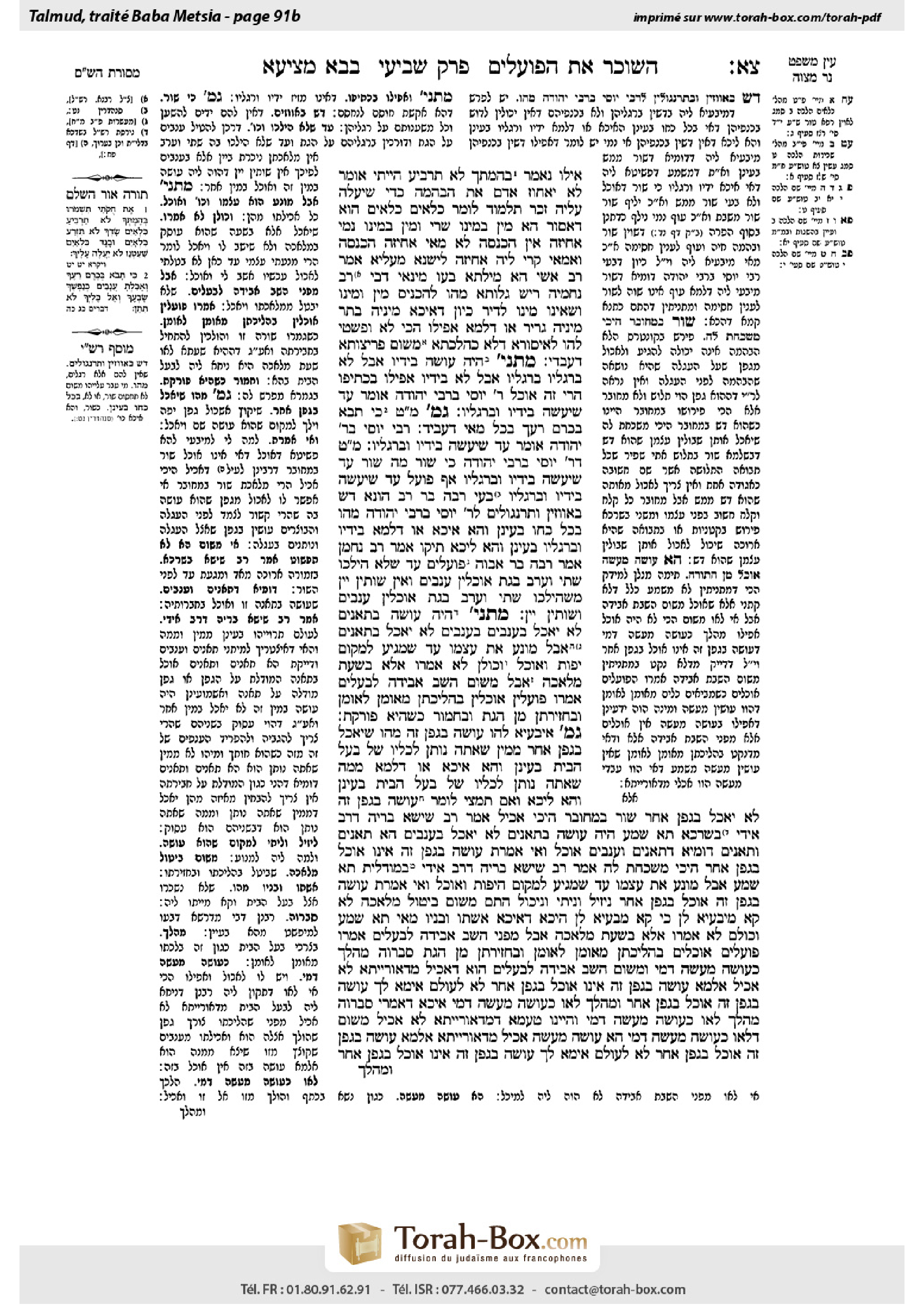
Bava Metzia 91b: Talmud study for Daf Yomi
Study the Talmud for Daf Yomi with scanned pages, Hebrew text, English translations from Sefaria and AI-generated French translations.
Passage selection and English or AI-generated French translation are available where the scan has annotations. Daf Study is independent of Torah-Box and Sefaria.
Browse Bava Metzia · בבא מציעא · All tractatesBava Metzia 91b text and translations
This page of Bava Metzia includes the Aramaic text, an English translation and an AI-generated French translation, alongside the scan above.
בבא מציעא צ״א ב · Aramaic and Hebrew text
אִלּוּ נֶאֱמַר ״בְּהֶמְתְּךָ לֹא תַרְבִּיעַ״ הָיִיתִי אוֹמֵר: לֹא יֶאֱחוֹז אָדָם אֶת הַבְּהֵמָה כְּדֵי שֶׁיַּעֲלֶה עָלֶיהָ זָכָר, תַּלְמוּד לוֹמַר: ״כִּלְאַיִם״. כִּלְאַיִם הוּא דְּאָסוּר, הָא מִין בְּמִינוֹ – שְׁרֵי.
וּמִין בְּמִינוֹ נָמֵי: אֲחִיזָה אִין, הַכְנָסָה – לָא! מַאי ״אֲחִיזָה״ – הַכְנָסָה, וְאַמַּאי קָרֵי לֵיהּ ״אֲחִיזָה״ – לִישָּׁנָא מְעַלְּיָא.
אָמַר רַב אָשֵׁי: הָא מִילְּתָא בְּעוֹ מִינַּאי דְּבֵי רַב נְחֶמְיָה רֵישׁ גָּלוּתָא: מַהוּ לְהַכְנִיס מִין וּמִינוֹ וְשֶׁאֵינוֹ מִינוֹ לַדִּיר? כֵּיוָן דְּאִיכָּא מִינֵיהּ – בָּתַר מִינֵיהּ גְּרִיר. אוֹ דִלְמָא אֲפִילּוּ הָכִי לָא? וּפְשַׁטִי לְהוּ לְאִיסּוּרָא דְּלָא כְּהִלְכְתָא, מִשּׁוּם פְּרִיצוּתָא דְּעַבְדֵי.
מַתְנִי׳ הָיָה עוֹשֶׂה בְּיָדָיו אֲבָל לֹא בְּרַגְלָיו, בְּרַגְלָיו אֲבָל לֹא בְּיָדָיו, אֲפִילּוּ בִּכְתֵיפוֹ – הֲרֵי זֶה אוֹכֵל. רַבִּי יוֹסֵי בְּרַבִּי יְהוּדָה אוֹמֵר: עַד שֶׁיַּעֲשֶׂה בְּיָדָיו וּבְרַגְלָיו.
גְּמָ׳ מַאי טַעְמָא? ״כִּי תָבֹא בְּכֶרֶם רֵעֶךָ״, בְּכֹל מַאי דְּעָבֵיד.
רַבִּי יוֹסֵי בְּרַבִּי יְהוּדָה אוֹמֵר: עַד שֶׁיַּעֲשֶׂה בְּיָדָיו וּבְרַגְלָיו. מַאי טַעְמָא דְּרַבִּי יוֹסֵי בְּרַבִּי יְהוּדָה? כִּי שׁוֹר, מָה שׁוֹר עַד שֶׁיַּעֲשֶׂה בְּיָדָיו וּבְרַגְלָיו – אַף פּוֹעֵל עַד שֶׁיַּעֲשֶׂה בְּיָדָיו וּבְרַגְלָיו.
בָּעֵי רַבָּה בַּר רַב הוּנָא: דָּשׁ בַּאֲווֹזִין וְתַרְנְגוֹלִים, לְרַבִּי יוֹסֵי בְּרַבִּי יְהוּדָה מַהוּ? בְּכׇל כֹּחוֹ בָּעֵינַן – וְהָא אִיכָּא, אוֹ דִלְמָא בְּיָדָיו וּבְרַגְלָיו בָּעֵינַן – וְהָא לֵיכָּא. תֵּיקוּ.
אָמַר רַב נַחְמָן אָמַר רַבָּה בַּר אֲבוּהּ: פּוֹעֲלִים, עַד שֶׁלֹּא הִילְּכוּ שְׁתִי וָעֵרֶב בַּגַּת – אוֹכְלִין עֲנָבִים וְאֵין שׁוֹתִין יַיִן. מִשֶּׁהִילְּכוּ שְׁתִי וָעֵרֶב בַּגַּת – אוֹכְלִין עֲנָבִים וְשׁוֹתִין יַיִן.
מַתְנִי׳ הָיָה עוֹשֶׂה בִּתְאֵנִים – לֹא יֹאכַל בַּעֲנָבִים. בַּעֲנָבִים – לֹא יֹאכַל בִּתְאֵנִים. אֲבָל מוֹנֵעַ אֶת עַצְמוֹ עַד שֶׁמַּגִּיעַ לִמְקוֹם יָפוֹת וְאוֹכֵל.
וְכוּלָּן לֹא אָמְרוּ אֶלָּא בִּשְׁעַת מְלָאכָה, אֲבָל מִשּׁוּם הָשֵׁב אֲבֵידָה לַבְּעָלִים אָמְרוּ: פּוֹעֲלִין אוֹכְלִין בַּהֲלִיכָתָן מֵאוֹמָן לְאוֹמָן, וּבַחֲזִירָתָן מִן הַגַּת, וּבַחֲמוֹר כְּשֶׁהִיא פּוֹרֶקֶת.
גְּמָ׳ אִיבַּעְיָא לְהוּ: עוֹשֶׂה בְּגֶפֶן זֶה, מַהוּ שֶׁיֹּאכַל בְּגֶפֶן אַחֵר? מִמִּין שֶׁאַתָּה נוֹתֵן לְכֵלָיו שֶׁל בַּעַל הַבַּיִת בָּעֵינַן – וְהָא אִיכָּא, אוֹ דִלְמָא מִמַּה שֶׁאַתָּה נוֹתֵן לְכֵלָיו שֶׁל בַּעַל הַבַּיִת בָּעֵינַן – וְהָא לֵיכָּא?
וְאִם תִּמְצֵי לוֹמַר עוֹשֶׂה בְּגֶפֶן זֶה לֹא יֹאכַל בְּגֶפֶן אַחֵר, שׁוֹר בִּמְחוּבָּר הֵיכִי אָכֵיל? אָמַר רַב שִׁישָׁא בְּרֵיהּ דְּרַב אִידִי: בִּשְׁרָכָא.
תָּא שְׁמַע: הָיָה עוֹשֶׂה בִּתְאֵנִים – לֹא יֹאכַל בַּעֲנָבִים. הָא תְּאֵנִים וּתְאֵנִים דּוּמְיָא דִּתְאֵנִים וַעֲנָבִים – אוֹכֵל. וְאִי אָמְרַתְּ: עוֹשֶׂה בְּגֶפֶן זֶה אֵינוֹ אוֹכֵל בְּגֶפֶן אַחֵר, הֵיכִי מַשְׁכַּחַתְּ לַהּ? אָמַר רַב שִׁישָׁא בְּרֵיהּ דְּרַב אִידִי: בְּמוּדְלֵית.
תָּא שְׁמַע: אֲבָל מוֹנֵעַ אֶת עַצְמוֹ עַד שֶׁמַּגִּיעַ לִמְקוֹם הַיָּפוֹת, וְאוֹכֵל. וְאִי אָמְרַתְּ עוֹשֶׂה בְּגֶפֶן זֶה אוֹכֵל בְּגֶפֶן אַחֵר, נֵיזִיל וְנֵיתֵי וְנֵיכוֹל! הָתָם מִשּׁוּם בִּיטּוּל מְלָאכָה לָא קָא מִיבַּעְיָא לַן, כִּי קָא מִבַּעְיָא לַן הֵיכָא דְּאִיכָּא אִשְׁתּוֹ וּבָנָיו, מַאי?
תָּא שְׁמַע: וְכוּלָּם לֹא אָמְרוּ אֶלָּא בִּשְׁעַת מְלָאכָה, אֲבָל מִפְּנֵי הָשֵׁב אֲבֵידָה לַבְּעָלִים אָמְרוּ: פּוֹעֲלִים אוֹכְלִים בַּהֲלִיכָתָן מֵאוֹמָן לְאוֹמָן וּבַחֲזִירָתָן מִן הַגַּת.
סַבְרוּהָ מְהַלֵּךְ כְּעוֹשֶׂה מַעֲשֶׂה דָּמֵי, וּמִשּׁוּם הָשֵׁב אֲבֵידָה לִבְעָלִים הוּא דְּאָכֵיל, מִדְּאוֹרָיְיתָא לָא אָכֵיל. אַלְמָא עוֹשֶׂה בְּגֶפֶן זֶה אֵינוֹ אוֹכֵל בְּגֶפֶן אַחֵר.
לָא, לְעוֹלָם אֵימָא לָךְ: עוֹשֶׂה בְּגֶפֶן זֶה אוֹכֵל בְּגֶפֶן אַחֵר, וּמְהַלֵּךְ לָאו כְּעוֹשֶׂה מַעֲשֶׂה דָּמֵי.
אִיכָּא דְּאָמְרִי סַבְרוּהָ מְהַלֵּךְ לָאו כְּעוֹשֶׂה מַעֲשֶׂה דָּמֵי. וְהַיְינוּ טַעְמָא דְּמִדְּאוֹרָיְיתָא לָא אָכֵיל – מִשּׁוּם דְּלָאו כְּעוֹשֶׂה מַעֲשֶׂה דָּמֵי, הָא עוֹשֶׂה מַעֲשֶׂה – אָכֵיל מִדְּאוֹרָיְיתָא, אַלְמָא עוֹשֶׂה בְּגֶפֶן זֶה אוֹכֵל בְּגֶפֶן אַחֵר!
לָא. לְעוֹלָם אֵימָא לָךְ: עוֹשֶׂה בְּגֶפֶן זֶה אֵינוֹ אוֹכֵל בְּגֶפֶן אַחֵר,
Bava Metzia 91b · English translation
Had the Torah merely stated: “You shall not let your cattle copulate,” I would have said that a person may not hold the female animal when a male mounts it. Therefore, the verse states: “With a diverse kind” (Leviticus 19:19). This shows that it is a crossbreed of diverse kinds that is prohibited, from which it may be inferred that mating an animal of one species with an animal of its own species is permitted.
Rav Aḥadvoi bar Ami infers from the baraita: And even concerning mating an animal of one species with an animal of its own species, with regard to holding, yes, this is permitted, but with regard to inserting, no, this is not allowed. The fact that the tanna specifies the act of holding indicates that inserting is prohibited even in the case of two animals of the same species. The Gemara again rejects this claim: What is the meaning of holding in this context? It means inserting. And why does the tanna call it holding? It is a euphemism.
Rav Ashi said: This matter was asked of me by the members of the house of Rav Neḥemya, the Exilarch: What is the halakha with regard to bringing into the same pen an animal of one species with two other animals, one of its own species and the other of a species different from it? Is the halakha that since there is another animal of its own species, it will be drawn after its species, and therefore there is no concern whatsoever with regard to diverse kinds, or perhaps one should not act even in this manner, in case it leads to crossbreeding? And I resolved it for them by saying that there is a prohibition, but this was not in accordance with the halakha. The reason for my decision was due to the immorality of the slaves. I reasoned that if they are permitted to engage in this practice, they will intentionally crossbreed and claim that it occurred without their intervention.
MISHNA: If a laborer was performing labor with his hands but not with his feet, or with his feet but not with his hands, e.g., pressing grapes, or even if he was performing labor only with his shoulder, this one may eat the produce of the field. Rabbi Yosei, son of Rabbi Yehuda, says: A laborer may not eat unless he performs labor with his hands and with his feet.
GEMARA: The Gemara asks: What is the reason for the ruling of the Rabbis stated in the first clause of the mishna? The Gemara explains that the verse states: “When you come into your neighbor’s vineyard” (Deuteronomy 23:25). Since the Torah does not specify a particular kind of task, it is understood as referring to any labor he performs.
The mishna teaches that Rabbi Yosei, son of Rabbi Yehuda, says: A laborer may not eat unless he performs labor with his hands and with his feet. The Gemara asks: What is the reasoning of Rabbi Yosei, son of Rabbi Yehuda? The Gemara explains: This halakha is like that of a threshing ox; just as one is not required to let an ox feed unless it is performing labor with its hands and with its feet, as it uses all four of its legs to thresh, so too a laborer is not entitled to eat unless he is performing labor with his hands and with his feet.
§ With regard to a similar issue, Rabba bar Rav Huna raised a dilemma: If one threshed with geese and chickens, rather than four-legged animals, what is the halakha according to the opinion of Rabbi Yosei, son of Rabbi Yehuda? The Gemara clarifies the sides of the dilemma: Do we require threshing with all its force, as it is for this reason that an ox must thresh with all four of its legs, and that condition is fulfilled here, as these birds perform labor with all their strength, or perhaps we require that the animal must actually perform labor with its hands and with its feet, i.e., with all four legs, and this is not the case here? No answer was found, and the Gemara says that the dilemma shall stand unresolved.
Rav Naḥman says that Rabba bar Avuh says: With regard to laborers in a vineyard, until they have walked lengthwise and crosswise in the winepress, the first stage of the making of wine, they may eat grapes, as they are performing labor with grapes, but they may not yet drink wine, since their labor has not produced wine. Once they have walked lengthwise and crosswise in the winepress, they are now performing labor with wine as well, and therefore they may eat grapes and drink wine.
MISHNA: If a laborer was performing labor with figs he may not eat grapes; if he was performing labor with grapes he may not eat figs, as he may eat only the type of food with which he is working. This is the halakha even if he was employed to perform labor with both types of produce but is currently performing labor with only one of them. But he may hold himself back from eating until he reaches a place of good-quality grapes or figs and eat from these, as they are the same type of food.
And with regard to all of these cases the Sages said that he may eat only at the time of work. But due to the obligation to restore lost property to its owners, i.e., so that workers would not neglect their task, they said that laborers may eat as they walk from one row of a vineyard or plantation to another row, and upon their return from the winepress. And with regard to a donkey, it is permitted to eat when it is being unloaded. This statement will be explained in the Gemara.
GEMARA: A dilemma was raised before the Sages with regard to the ruling of the mishna: If a laborer was performing labor on this vine, what is the halakha concerning the possibility that he may eat from another vine? Do we require only that the food must be from the type that you are placing into the homeowner’s vessels, and this condition is fulfilled here, or perhaps we require that it must be from that very food which you are placing into the homeowner’s vessels, and this is not the case here?
And if you say that one who was performing labor on this vine may not in fact eat from another vine, a further question arises: With regard to an ox performing labor with produce attached to the ground, how can one enable it to eat? The ox is tied to the front of the wagon, while the laborers are working on a vine adjacent to the wagon. Consequently, it is impossible for the ox to eat from the vine on which labor is being performed. Rav Sheisha, son of Rav Idi, said: In the case of long branches it is possible for the animal to perform labor at one end of the branch while eating from the other.
This difficulty has been resolved, but the original dilemma remains. The Gemara therefore suggests: Come and hear a resolution from the mishna: If a laborer was performing labor with figs he may not eat grapes. This indicates that if the two types of produce are figs and other figs, similar to the figs and grapes mentioned in the mishna, he may eat. Now, if you say that one who was performing labor on this vine may not eat from another vine, how can you find these circumstances? Rav Sheisha, son of Rav Idi, said: The ruling of the mishna is stated with regard to a hanging vine, and he eats from one edge of the branch while working on the other side.
The Gemara offers another suggestion: Come and hear another resolution from the mishna: But he may hold himself back from eating until he reaches a place of good-quality fruit and eat. And if you say that one who was performing labor on this vine may eat from another vine, let him go and bring and eat. Why must he wait until he reaches that particular vine? The Gemara answers: There, the reason is due to the neglect of work caused by the laborer walking to the other vine. We do not raise the dilemma with regard to that case, as he may certainly not stop performing labor to go and eat elsewhere. When the dilemma was raised before us, it was with regard to a case where his wife and children are present. What is the halakha as to whether his family members, who are not performing labor, may bring him fruit?
Once again the Gemara suggests: Come and hear a resolution from the mishna: And with regard to all of these cases they said that he may eat only at the time of work. But due to the mitzva to restore lost property to its owners, the Sages said that laborers may eat as they walk from one row to another row, and upon their return from the winepress.
The Gemara explains the attempted resolution: The Sages assumed that the basic principle of this halakha is that a laborer who was walking is considered like one who was performing his labor, and it is therefore permitted for him to eat. And yet, it is due to the mitzva to restore lost property to its owner that he may eat, whereas by Torah law he may not eat. But if he is performing labor, why is he not allowed to eat? Apparently, this indicates that one who was performing labor on this vine may not eat from another vine, and therefore once he starts walking and is no longer alongside the vine he may not partake of it by Torah law.
The Gemara refutes this argument: No; actually, I could say to you that one who was performing labor on this vine may even eat from another vine, but a laborer who was walking is not considered like one who was performing his labor. The reason that he is not permitted to eat by Torah law is not because he is performing labor on a different vine, but because he is walking at the time.
The Gemara cites an alternative version of this discussion. There are those who say as follows: The Sages assumed that a worker who was walking is not considered like one who was performing his labor, and this is the reason that the baraita says that he may not eat by Torah law: Because he is not considered like one who was performing his labor. This indicates that if he is performing his labor, he may eat by Torah law. Apparently, it may be inferred that one who was performing labor on this vine may eat from another vine.
The Gemara rejects this claim: No; this is not a proof, as actually I could say to you that one who was performing labor on this vine may not eat from another vine,
Bava Metzia 91b · Traduction française (IA)
Si la Torah avait simplement dit : « Tu ne laisseras pas tes bêtes se reproduire », je dirais qu'une personne ne peut pas tenir la femelle quand le mâle la monte. Cependant, le verset dit : « Avec une espèce diverse » (Lévitique 19:19). Cela montre que ce qui est interdit est un croisement entre des espèces diverses, d'où l'on peut déduire que l'union d'une bête d'une espèce avec une bête de la même espèce est permise.
Rav Aḥadvoi bar Ami tire une conclusion de la baraïta : Même concernant l'union d'une bête d'une espèce avec une bête de la même espèce, en ce qui concerne le tenir, oui, cela est permis, mais en ce qui concerne l'insertion, non, cela n'est pas autorisé. Le fait que le tanna précise l'acte de tenir indique que l'insertion est interdite même dans le cas de deux bêtes de la même espèce. La Guemara rejette à nouveau cette affirmation : Qu'entend-on par « tenir » dans ce contexte ? Cela signifie l'insertion. Et pourquoi le tanna l'appelle-t-il « tenir » ? C'est une euphémisme.
Rav Ashi a dit : Cette question fut posée à moi par les membres de la maison de Rav Neḥemya, l'Exilarch : Quel est le halakha concernant l'introduction dans le même enclos d'une bête d'une espèce avec deux autres bêtes, l'une de la même espèce et l'autre d'une espèce différente ? Est-ce que le halakha est que, puisque l'on a une autre bête de la même espèce, elle suivra sa propre espèce, et donc il n'y a aucune inquiétude concernant les espèces diverses, ou peut-être devrait-on ne pas agir ainsi, de peur qu'il y ait un croisement ? Et j'ai résolu cela pour eux en disant qu'il y a une interdiction, mais cela ne correspondait pas au halakha. La raison de ma décision était due à l'immoralité des esclaves. J'ai raisonné que si ils sont autorisés à pratiquer cela, ils croiseront intentionnellement et affirmeront que cela s'est produit sans leur intervention.
MICHNA : Si un ouvrier travaillait avec ses mains mais pas avec ses pieds, ou avec ses pieds mais pas avec ses mains, par exemple, en pressant des raisins, ou même s'il travaillait seulement avec son épaule, il peut manger les produits du champ. Rabbi Yosei, fils de Rabbi Yehuda, dit : Un ouvrier ne peut pas manger à moins qu'il ne travaille avec ses mains et ses pieds.
GUEMARA : La Guemara pose la question : Quel est le motif de la décision des Rabbins énoncée dans la première partie de la mishna ? La Guemara explique que le verset dit : « Quand tu entreras dans le vignoble de ton voisin » (Dt 23:25). Puisque la Torah ne précise pas un type particulier de tâche, on comprend qu'il s'agit de toute tâche qu'il effectue.
La mishna enseigne que Rabbi Yosei, fils de Rabbi Yehuda, dit : Un ouvrier ne peut pas manger à moins qu'il ne travaille avec ses mains et ses pieds. La Guemara pose la question : Quel est le raisonnement de Rabbi Yosei, fils de Rabbi Yehuda ? La Guemara explique : Cette halakha est comme celle d'un bœuf de labour ; tout comme on n'est pas tenu de laisser un bœuf manger à moins qu'il ne travaille avec ses mains et ses pieds, car il utilise toutes ses quatre pattes pour labourer, de même un ouvrier n'est pas autorisé à manger à moins qu'il ne travaille avec ses mains et ses pieds.
§ Concernant une question similaire, Rabba bar Rav Huna a soulevé un dilemme : Si l'on foulait avec des canards et des poulets, au lieu d'animaux à quatre pattes, quelle est la halakha selon l'opinion de Rabbi Yosei, fils de Rabbi Yehuda ? La Guemara clarifie les deux côtés du dilemme : Exige-t-on un foulage avec toute sa force, car c'est pour cette raison qu'un bœuf doit fouler avec ses quatre pattes, et cette condition est remplie ici, car ces oiseaux travaillent avec toute leur force, ou peut-être exige-t-on que l'animal doive effectivement travailler avec ses mains et ses pieds, c'est-à-dire avec ses quatre pattes, et cela n'est pas le cas ici ? Aucune réponse n'a été trouvée, et la Guemara dit que ce dilemme restera sans réponse.
Rav Naḥman dit que Rabba bar Avuh dit : Concernant les ouvriers dans un vignoble, jusqu'à ce qu'ils aient marché longitudinalement et transversalement dans la presse à vin, la première étape de la fabrication du vin, ils peuvent manger des raisins, car ils travaillent avec les raisins, mais ils ne peuvent pas encore boire du vin, car leur travail n'a pas produit de vin. Une fois qu'ils ont marché longitudinalement et transversalement dans la presse à vin, ils travaillent maintenant avec le vin également, et par conséquent ils peuvent manger des raisins et boire du vin.
MICHNA : Si un ouvrier travaillait avec des figues, il ne peut pas manger des raisins ; si il travaillait avec des raisins, il ne peut pas manger des figues, car il peut manger seulement la nourriture avec laquelle il travaille. C'est la halakha même si il était employé à travailler avec les deux types de produits mais qu'il travaille actuellement seulement avec l'un d'eux. Mais il peut se retenir de manger jusqu'à ce qu'il atteigne un lieu de raisins ou de figues de qualité et manger de ceux-ci, car ils sont de la même nourriture.
Et concernant toutes ces situations, les Sages ont dit qu'il peut manger seulement pendant le travail. Mais en raison de l'obligation de rendre la propriété perdue à ses propriétaires, c'est-à-dire afin que les travailleurs ne négligent pas leur tâche, ils ont dit que les ouvriers peuvent manger en marchant d'une rangée de vignoble ou de plantation à une autre rangée, et lors de leur retour de la presse à vin. Et concernant un âne, il est permis de manger lorsqu'il est déchargé. Cette déclaration sera expliquée dans la Guemara.
GUEMARA : Un dilemme fut soulevé devant les Sages concernant la décision de la Michna : Si un ouvrier travaillait sur cette vigne, quelle est la halakha concernant la possibilité qu'il mange d'une autre vigne ? Exige-t-on seulement que la nourriture soit de la sorte que vous placez dans les récipients du propriétaire, et cette condition est remplie ici, ou peut-être exige-t-on qu'il soit de la même nourriture que vous placez dans les récipients du propriétaire, et cela n'est pas le cas ici ?
Et si vous dites que celui qui travaillait sur cette vigne ne peut pas en réalité manger d'une autre vigne, une autre question se pose : concernant un bœuf travaillant avec des produits attachés au sol, comment peut-on lui permettre de manger ? Le bœuf est attaché devant la charrette, tandis que les travailleurs travaillent sur une vigne adjacente à la charrette. Ainsi, il est impossible au bœuf de manger de la vigne sur laquelle le travail est en cours. Rav Sheisha, fils de Rav Idi, a dit : dans le cas de branches longues, il est possible à l'animal de travailler d'un côté de la branche tout en mangeant de l'autre.
Cette difficulté a été résolue, mais le dilemme original reste. La Guemara suggère donc : viens écouter une résolution de la mitsna : Si un travailleur travaillait avec des figues, il ne peut pas manger des raisins. Cela indique que si les deux types de produits sont des figues et d'autres figues, semblables aux figues et aux raisins mentionnés dans la mitsna, il peut manger. Maintenant, si vous dites que celui qui travaillait sur cette vigne ne peut pas manger d'une autre vigne, comment pouvez-vous trouver ces circonstances ? Rav Sheisha, fils de Rav Idi, a dit : la décision de la mitsna est formulée concernant une vigne suspendue, et il mange d'un côté de la branche tout en travaillant sur l'autre côté.
La Guemara propose une autre suggestion : viens écouter une autre résolution de la mitsna : mais il peut se retenir de manger jusqu'à ce qu'il atteigne un lieu de fruits de qualité et manger. Et si vous dites que celui qui travaillait sur cette vigne peut manger d'une autre vigne, qu'il aille et apporte et mange. Pourquoi doit-il attendre jusqu'à ce qu'il atteigne cette vigne particulière ? La Guemara répond : là, la raison est due à l'oubli du travail causé par le travailleur marchant vers l'autre vigne. Nous ne soulevons pas ce dilemme concernant ce cas, car il ne peut certainement pas s'arrêter de travailler pour aller manger ailleurs. Lorsque ce dilemme a été soulevé devant nous, c'était concernant un cas où sa femme et ses enfants sont présents. Quelle est la halakha concernant le fait que ses membres de famille, qui ne travaillent pas, peuvent lui apporter des fruits ?
Une fois de plus, la Guemara suggère : viens écouter une résolution de la mitsna : et concernant tous ces cas, ils ont dit qu'il peut manger uniquement au moment du travail. Mais en raison de la mitsva de rendre la propriété per de son propriétaire, les Sages ont dit que les travailleurs peuvent manger en marchant d'une rangée à une autre rangée, et lors de leur retour du pressoir.
La Guemara explique la résolution tentée : les Sages ont supposé que le principe fondamental de cette halakha est que le travailleur qui marchait est considéré comme celui qui effectuait son travail, et il est donc permis de manger. Et pourtant, c'est en raison de la mitsva de rendre la propriété perdue à son propriétaire qu'il peut manger, alors que selon la loi divine il ne peut pas manger. Mais si il travaille, pourquoi n'est-il pas autorisé à manger ? Apparemment, cela indique que celui qui travaillait sur cette vigne ne peut pas manger d'une autre vigne, et donc une fois qu'il commence à marcher et n'est plus à côté de la vigne, il ne peut pas participer à cela selon la loi divine.
La Guemara réfute cet argument : Non ; en réalité, je pourrais dire à vous que celui qui travaillait sur cette vigne peut même manger d'une autre vigne, mais un travailleur qui marchait n'est pas considéré comme celui qui effectuait son travail. La raison pour laquelle il n'est pas autorisé à manger selon la loi divine n'est pas parce qu'il travaille sur une autre vigne, mais parce qu'il marche à ce moment-là.
La Guemara cite une version alternative de cette discussion. Il y a ceux qui disent comme suit : les Sages ont supposé qu'un travailleur qui marchait n'était pas considéré comme celui qui effectuait son travail, et c'est la raison pour laquelle la baraïta dit qu'il ne peut pas manger selon la loi divine : parce qu'il n'est pas considéré comme celui qui effectuait son travail. Cela indique que s'il effectue son travail, il peut manger selon la loi divine. Apparemment, on peut en déduire que celui qui travaillait sur cette vigne peut manger d'une autre vigne.
La Guemara rejette cette affirmation : Non ; cela n'est pas une preuve, car en réalité je pourrais dire à vous que celui qui travaillait sur cette vigne ne peut pas manger d'une autre vigne,
Traduction française générée par IA à partir de l’édition anglaise de Sefaria. Vérifie toujours un passage avec le texte source.
Text from Sefaria: William Davidson Edition - Vocalized Aramaic (CC BY NC); William Davidson Edition - English (CC BY NC).