Bava Metzia 91a: Talmud study for Daf Yomi
Study the Talmud for Daf Yomi with scanned pages, Hebrew text, English translations from Sefaria and AI-generated French translations.
Passage selection and English or AI-generated French translation are available where the scan has annotations. Daf Study is independent of Torah-Box and Sefaria.
Browse Bava Metzia · בבא מציעא · All tractatesBava Metzia 91a text and translations
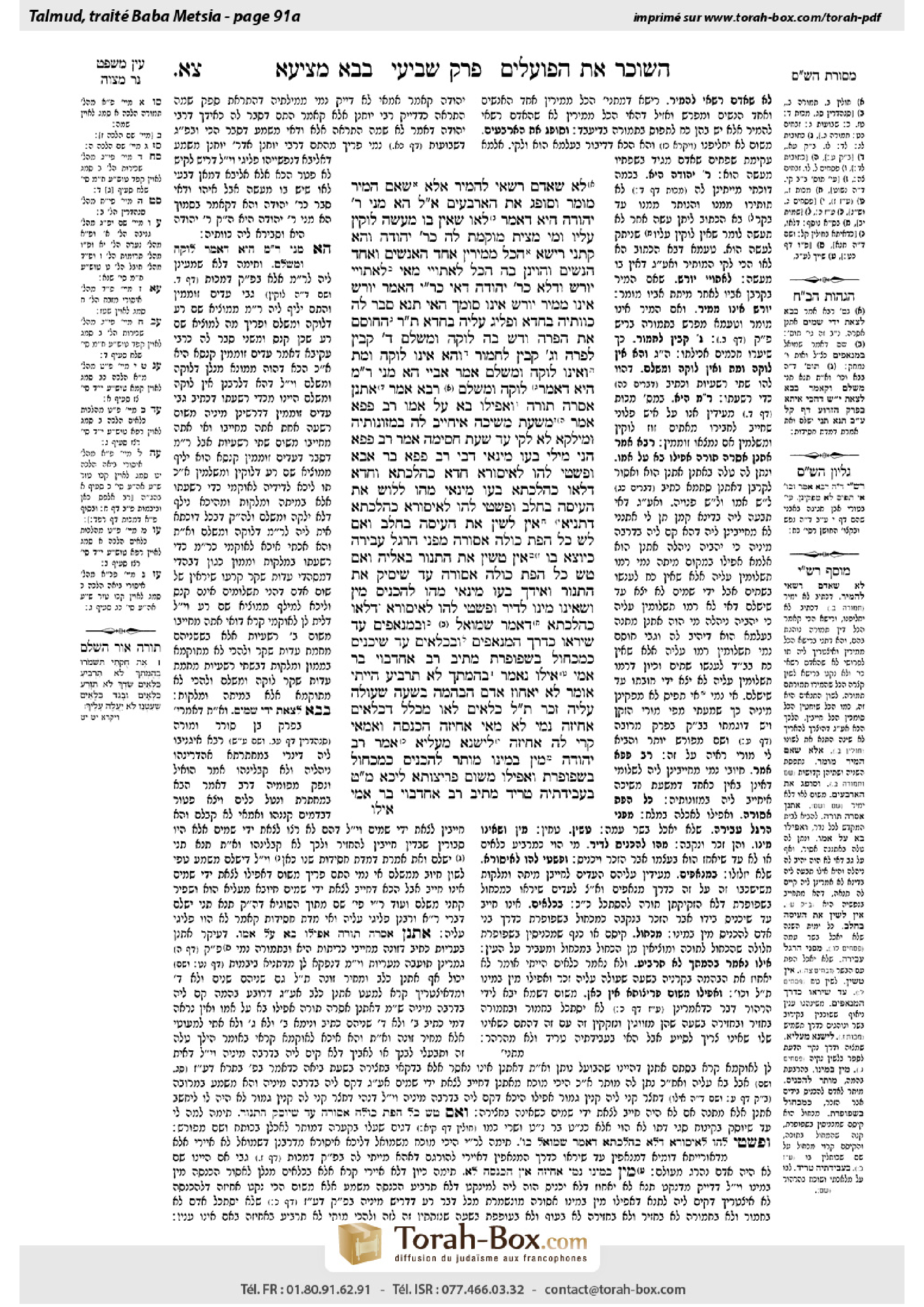
This page of Bava Metzia includes the Aramaic text, an English translation and an AI-generated French translation, alongside the scan above.
בבא מציעא צ״א א · Aramaic and Hebrew text
לֹא שֶׁאָדָם רַשַּׁאי לְהָמִיר, אֶלָּא שֶׁאִם הֵמִיר – מוּמָר, וְסוֹפֵג אֶת הָאַרְבָּעִים. אֲמַר לֵיהּ: הָא מַנִּי רַבִּי יְהוּדָה הִיא, דְּאָמַר: לָאו שֶׁאֵין בּוֹ מַעֲשֶׂה לוֹקִין עָלָיו.
וּמִי מָצֵית מוֹקְמַתְּ לַהּ כְּרַבִּי יְהוּדָה? וְהָא קָתָנֵי רֵישָׁא: הַכֹּל מְמִירִין, אֶחָד הָאֲנָשִׁים וְאֶחָד הַנָּשִׁים, וְהָוֵינַן בָּהּ: ״הַכֹּל״ לְאֵתוֹיֵי מַאי? לְאֵתוֹיֵי יוֹרֵשׁ, וּדְלָא כְּרַבִּי יְהוּדָה,
דְּאִי כְּרַבִּי יְהוּדָה, הָאָמַר: יוֹרֵשׁ אֵינוֹ מֵמִיר, יוֹרֵשׁ אֵינוֹ סוֹמֵךְ! הַאי תַּנָּא סָבַר לַהּ כְּווֹתֵיהּ בַּחֲדָא, וּפָלֵיג עֲלֵיהּ בַּחֲדָא.
תָּנוּ רַבָּנַן: הַחוֹסֵם אֶת הַפָּרָה וְדָשׁ בָּהּ – לוֹקֶה, וּמְשַׁלֵּם אַרְבָּעָה קַבִּין לְפָרָה וּשְׁלֹשָׁה קַבִּין לַחֲמוֹר. וְהָא אֵינוֹ לוֹקֶה וָמֵת, וְאֵינוֹ לוֹקֶה וּמְשַׁלֵּם. אָמַר אַבָּיֵי: הָא מַנִּי – רַבִּי מֵאִיר הִיא, דְּאָמַר: לוֹקֶה וּמְשַׁלֵּם.
רָבָא אָמַר: ״אֶתְנַן״ אָסְרָה תּוֹרָה, וַאֲפִילּוּ בָּא עַל אִמּוֹ.
רַב פָּפָּא אָמַר: מִשְּׁעַת מְשִׁיכָה אִיחַיַּיב לֵהּ בִּמְזוֹנוֹתֶיהָ, וּמִילְקָא לָא לָקֵי עַד שְׁעַת חֲסִימָה.
אָמַר רַב פָּפָּא: הָנֵי מִילֵּי בְּעוֹ מִינַּאי דְּבֵי רַב פָּפָּא בַּר אַבָּא, וּפְשַׁטִי לְהוּ לְאִיסּוּרָא – חֲדָא כְּהִלְכְתָא, וַחֲדָא דְּלָאו כְּהִלְכְתָא.
בְּעוֹ מִינַּאי: מַהוּ לָלוּשׁ אֶת הָעִיסָּה בְּחָלָב? וּפְשַׁטִי לְהוּ לְאִיסּוּרָא כְּהִלְכְתָא, דְּתַנְיָא: אֵין לָשִׁין אֶת הָעִיסָּה בְּחָלָב, וְאִם לָשׁ – כׇּל הַפַּת כּוּלָּהּ אֲסוּרָה, מִפְּנֵי הֶרְגֵּל עֲבֵירָה. כַּיּוֹצֵא בוֹ: אֵין טָשִׁין אֶת הַתַּנּוּר בְּאַלְיָה, וְאִם טָשׁ – כׇּל הַפַּת כּוּלָּהּ אֲסוּרָה, עַד שֶׁיַּסִּיק אֶת הַתַּנּוּר.
וְאִידָּךְ בְּעוֹ מִינַּאי: מַהוּ לְהַכְנִיס מִין וְשֶׁאֵינוֹ מִינוֹ לַדִּיר? וּפְשַׁטִי לְהוּ לְאִיסּוּרָא דְּלָאו כְּהִלְכְתָא.
דְּאָמַר שְׁמוּאֵל: וּבִמְנָאֲפִים – עַד שֶׁיִּרְאוּ כְּדֶרֶךְ הַמְנָאֲפִים. וּבְכִלְאַיִם – עַד שֶׁיַּכְנִיס כְּמִכְחוֹל בַּשְּׁפוֹפֶרֶת.
מֵתִיב רַב אַחָדְבוּי בַּר אַמֵּי: אִילּוּ נֶאֱמַר ״בְּהֶמְתְּךָ לֹא תַרְבִּיעַ״ הָיִיתִי אוֹמֵר, לֹא יֶאֱחוֹז אָדָם הַבְּהֵמָה בְּשָׁעָה שֶׁעוֹלֶה עָלֶיהָ זָכָר, תַּלְמוּד לוֹמַר: ״כִּלְאַיִם״.
לָאו מִכְּלָל דְּכִלְאַיִם אֲחִיזָה נָמֵי לָא? מַאי ״אֲחִיזָה״ – הַכְנָסָה, וְאַמַּאי קָרֵי לַהּ ״אֲחִיזָה״ – לִישָּׁנָא מְעַלְּיָא.
אָמַר רַב יְהוּדָה: מִין בְּמִינוֹ, מוּתָּר לְהַכְנִיס כְּמִכְחוֹל בַּשְּׁפוֹפֶרֶת, וַאֲפִילּוּ מִשּׁוּם פְּרִיצוּתָא לֵיכָּא. מַאי טַעְמָא – בַּעֲבִידְתֵּיהּ טְרִיד. מֵתִיב רַב אַחָדְבוּי בַּר אַמֵּי:
Bava Metzia 91a · English translation
It is taught at the beginning of tractate Temura that the Torah prohibits the substitution of a non-consecrated animal for a consecrated one. The mishna teaches (Temura 2a): That is not to say that it is permitted for a person to effect substitution; rather it means that if one substituted a non-sacred animal for a consecrated animal, the substitution takes effect. The non-sacred animal becomes consecrated, the consecrated animal remains sacred, and the one who substituted the non-sacred animal incurs the forty lashes. This indicates that one is held liable for mere speech, even without any accompanying action. Reish Lakish said to him: In accordance with whose opinion is this mishna? It is in accordance with the opinion of Rabbi Yehuda, who says that one is flogged for violating a prohibition that does not involve an action. By contrast, the dispute between Rabbi Yoḥanan and Reish Lakish is in accordance with the opinion of the Rabbis, who maintain that one is punished only for a transgression that includes a full-fledged action.
The Gemara asks: But can you establish and explain that mishna in accordance with the opinion of Rabbi Yehuda? After all, it teaches in the first clause: Everyone substitutes a non-sacred animal for a consecrated animal, both men and women. And we discussed this statement by asking the following question: This term: Everyone, serves to add what? What is the tanna including by this phrase? We answered that it serves to add an heir, who can substitute an animal for an animal he inherited that was designated as an offering. And this clause is not in accordance with the opinion of Rabbi Yehuda.
The Gemara elaborates: As, if it were in accordance with the opinion of Rabbi Yehuda, doesn’t he say that an heir cannot effect substitution, and an heir cannot place his hands on the head of an offering? The Gemara refutes this difficulty: This is not a conclusive proof, as it is possible to say that this tanna of the mishna in Temura holds in accordance with the opinion of Rabbi Yehuda with regard to one matter and disagrees with him with regard to one other matter.
§ The Sages taught: One who muzzles a cow and threshes with it is flogged, and in addition he must pay the owner of the cow four kav for a cow, the usual amount it consumes while threshing, and three kav for a donkey. The Gemara asks: But isn’t there a principle that an offender is not flogged and also punished by death, and likewise he is not flogged and rendered liable to pay? One who transgresses a prohibition is liable to receive only one punishment for a single offense. Abaye said: In accordance with whose opinion is this ruling? It is that of Rabbi Meir, who says in general that one can be flogged and be liable to pay.
Rava said that there is a difference between the transgression itself, which is between the offender and God, for which he is liable to be flogged, and the loss he caused the owner of the cow, for which he must pay restitution. The Torah prohibits one from bringing as an offering an animal given as the payment to a prostitute for services rendered (Deuteronomy 23:19); and this prohibition applies even if the man in question engaged in intercourse with his own mother, which is a capital offence. Although this man would certainly not be rendered liable to pay compensation by a court, as he is liable to receive court-imposed capital punishment, nevertheless, since he is technically liable to pay compensation, the money is subject to the prohibition as well. In this case too, despite the fact that the court cannot compel one to pay for the produce his cow ate, he does owe this sum. Furthermore, if the owner of the produce were to seize this sum from him, the court would not force him to return the money.
Rav Pappa stated a different answer: From the time of his pulling of the cow to rent it for threshing he was rendered obligated to provide its sustenance when it threshes, but as for flogging, he is not liable to be flogged until the actual time of muzzling. In other words, he was liable to pay the monetary payment before he incurred liability to receive lashes, which means that they are two separate liabilities.
In relation to the above discussion, Rav Pappa said: These matters, stated below, were raised as a dilemma to me by the members of the house of Rav Pappa bar Abba, and I resolved these matters for them by saying that there is a prohibition in both cases. One of my decisions was in accordance with the halakha, and the other one was not in accordance with the halakha.
They first raised this dilemma before me: What is the halakha with regard to the possibility of kneading dough with milk? And I resolved it for them by saying that there is a prohibition, in accordance with the halakha. As it is taught in a baraita: One may not knead dough with milk, lest one eat this bread with meat, and if he kneaded dough in this manner the entire loaf is forbidden, because he will become accustomed to sin. Similarly, one may not smear over an oven with the fat of an animal’s tail, and if he did smear the oven in this manner then the entire loaf baked in that oven is forbidden, lest he eat it with milk, until he heats the oven without bread for long enough to burn off the fat.
And the other question they asked of me was as follows: What is the halakha with regard to bringing in a male animal and a female animal of different species together into a single pen? Is there a concern that they might mate, which would violate the prohibition against crossbreeding animals? And I resolved it for them by saying that there is a prohibition, but this was not in accordance with the halakha.
As Shmuel says: With regard to adulterers, the witnesses must observe from when they appear as behaving in the manner of adulterers, and they do not need to directly observe the actual moment of the act of intercourse. But with regard to one who crossbreeds two animals of diverse kinds, he is liable only if witnesses attest that he inserted the male organ into the female like a brush into a tube. This clearly shows that crossbreeding is punishable only if performed manually, not if the animals were merely enclosed together.
Rav Aḥadvoi bar Ami raises an objection against this opinion, from a baraita: Had the Torah stated merely: “You shall not let your cattle copulate,” I would have said that it is prohibited to assist animals in their mating at all, and consequently a person may not hold the female animal when a male mounts it. Therefore, the verse states: “You shall not let your cattle copulate with a diverse kind” (Leviticus 19:19), which indicates that it is prohibited to mate only different species, but not animals of the same type.
Can one not derive from here by inference that with regard to diverse kinds, holding the animal is also not allowed? This indicates that not only is the act of crossbreeding itself prohibited, but any type of assistance is also prohibited, e.g., restraining the female animal. But if this is the case, placing two animals in the same pen should also be considered a violation. The Gemara refutes this argument: What is the meaning of the term: Holding? It means the insertion of the sexual organ, and why does the tanna call it holding? This is a euphemism.
Rav Yehuda says: If one desires to mate an animal of one species with an animal of its own species, it is permitted to insert the male organ into the female like a brush into a tube, and there is not even a concern due to licentiousness and immoral thoughts here. What is the reason for this lenient ruling? It is because he is occupied with his work, and therefore his mind will not entertain sinful thoughts. Rav Aḥadvoi bar Ami raises an objection against this:
Bava Metzia 91a · Traduction française (IA)
Il est enseigné au début du traité Temura que la Torah interdit de substituer un animal non consacré à un animal consacré. La Michna enseigne (Temura 2a) : Ce n’est pas pour dire que l’homme peut effectuer la substitution ; plutôt cela signifie que si l’on substitue un animal non sacré à un animal consacré, la substitution prend effet. L’animal non sacré devient consacré, l’animal consacré reste sacré, et celui qui a substitué l’animal non sacré est puni de quarante coups de fouet. Cela montre que l’on est tenu responsable de la simple parole, même sans action accompagée. Reish Lakish dit à lui : Selon quel avis est-ce que cette Michna ? C’est selon l’avis de Rabbi Yehuda, qui dit que l’on est fouetté pour avoir violé une interdiction qui ne comporte pas d’action. À l’inverse, le débat entre Rabbi Yoḥanan et Reish Lakish est selon l’avis des Rabbins, qui maintiennent que l’on est puni uniquement pour une transgression qui inclut une action complète.
Le Guemara pose la question : Mais pouvez-vous établir et expliquer cette Michna selon l’avis de Rabbi Yehuda ? Après tout, elle enseigne dans la première clause : Tout le monde substitue un animal non sacré à un animal consacré, hommes et femmes. Et nous avons discuté de cette déclaration en posant la question suivante : Ce terme : Tout le monde, sert à ajouter quoi ? Quel tanna inclut-t-il par cette phrase ? Nous avons répondu que cela sert à ajouter un héritier, qui peut substituer un animal à un animal qu’il a hérité et qui était désigné comme offrande. Et cette clause n’est pas selon l’avis de Rabbi Yehuda.
Le Guemara développe : Comme, si c’était selon l’avis de Rabbi Yehuda, ne dit-il pas qu’un héritier ne peut pas effectuer la substitution, et qu’un héritier ne peut pas poser ses mains sur la tête d’une offrande ? Le Guemara réfute cette difficulté : Ce n’est pas une preuve concluante, car on peut dire que ce tanna de la Michna dans Temura suit l’avis de Rabbi Yehuda concernant une question et s’y oppose concernant une autre question.
§ Les Sages ont enseigné : Celui qui mousse un bœuf et le fait paître est fouetté, et en plus il doit payer à l’propriétaire du bœuf quatre kav pour un bœuf, la quantité normale qu’il consomme pendant le paillage, et trois kav pour un âne. Le Guemara pose la question : Mais n’y a-t-il pas un principe selon lequel l’offenseur n’est pas fouetté et ne subit pas la peine de mort, et de même il n’est pas fouetté et ne doit pas payer ? Celui qui transgresse une interdiction est tenu à une seule punition pour une seule offense. Abaye dit : Selon quel avis est-ce que cette décision ? C’est celui de Rabbi Meir, qui dit en général que l’on peut être fouetté et être tenu à payer.
Rava dit qu’il y a une différence entre la transgression elle-même, qui est entre l’offenseur et Dieu, pour laquelle il est tenu à être fouetté, et la perte qu’il a causée à l’propriétaire du bœuf, pour laquelle il doit réparer. La Torah interdit de présenter comme offrande un animal donné comme paiement à une prostituée pour ses services (Deutéronôme 23:19) ; et cette interdiction s’applique même si l’homme en question a eu des relations sexuelles avec sa propre mère, qui est un péché capital. Bien que cet homme ne soit certainement pas tenu à payer une compensation par un tribunal, car il est tenu à recevoir une peine de mort imposée par le tribunal, néanmoins, puisqu’il est techniquement tenu à payer une compensation, l’argent est soumis à cette interdiction également. Dans ce cas également, malgré le fait que le tribunal ne peut pas obliger à payer pour les produits que le bœuf a mangés, il doit tout de même payer cette somme. De plus, si l’propriétaire des produits voulait saisir cette somme de lui, le tribunal ne forcerait pas l’homme à rendre l’argent.
Rav Pappa a donné une autre réponse : Depuis le moment où il a tiré le bœuf pour le louer pour le paillage, il était tenu à fournir son alimentation pendant le paillage, mais concernant la fouettation, il n’était pas tenu à être fouetté jusqu’au moment réel de la bâti. En d’autres termes, il était tenu à payer la somme monétaire avant d’être tenu à recevoir des coups de fouet, ce qui signifie qu’il s’agit de deux responsabilités distinctes.
En rapport avec la discussion ci-dessus, Rav Pappa a dit : Ces questions, énoncées ci-dessous, ont été soulevées comme un dilemme pour moi par les membres de la maison de Rav Pappa bar Abba, et j’ai résolu ces questions pour eux en disant qu’il y a une interdiction dans les deux cas. Une de mes décisions était selon la halakha, et l’autre n’était pas selon la halakha.
Ils ont d’abord soulevé ce dilemme devant moi : Quelle est la halakha concernant la possibilité de pétrir du pain avec du lait ? Et j’ai résolu cela pour eux en disant qu’il y a une interdiction, selon la halakha. Comme il est enseigné dans une baraïta : On ne doit pas pétrir du pain avec du lait, de peur de manger ce pain avec de la viande, et si l’on pétrit du pain ainsi, l’ensemble du pain est interdit, car l’on s’habitue à pécher. De même, on ne doit pas étaler sur une fournaise la graisse de la queue d’un animal, et si l’on étale la fournaise ainsi, l’ensemble du pain cuit dans cette fournaise est interdit, de peur de le manger avec du lait, jusqu’à ce qu’on chauffe la fournaise sans pain pendant assez longtemps pour brûler la graisse.
Et la deuxième question qu’ils m’ont posée était la suivante : Quelle est la halakha concernant l’introduction d’un animal mâle et d’un animal femelle de différentes espèces dans un même enclos ? Y a-t-il une crainte qu’ils puissent s’accoupler, en violant l’interdiction d’hybrider des animaux ? Et j’ai résolu cela pour eux en disant qu’il y a une interdiction, mais cela n’était pas selon la halakha.
Comme Shmuel dit : Concernant les adultères, les témoins doivent observer à partir du moment où ils se comportent comme des adultères, et ils n’ont pas besoin d’observer directement le moment de l’acte sexuel. Mais concernant celui qui hybride deux animaux de différentes espèces, il est tenu seulement si les témoins attestent qu’il a inséré l’organe masculin dans l’organe féminin comme un balai dans un tube. Cela montre clairement que l’hybridation est punissable uniquement si elle est manuelle, pas si les animaux étaient simplement enfermés ensemble.
Rav Aḥadvoi bar Ami émet un contre-argument contre cette opinion, tiré d'une baraïta : Si la Torah avait dit simplement : « Tu ne laisseras pas tes bêtes se reproduire », je dirais qu'il est interdit d'aider les animaux dans leur accouplement, et par conséquent une personne ne doit pas tenir la femelle quand le mâle la monte. Ainsi, la Parashah dit : « Tu ne laisseras pas tes bêtes se reproduire avec une espèce différente » (Lévitique 19:19), ce qui indique que seul l'accouplement entre espèces différentes est interdit, mais pas les animaux de la même espèce.
Ne peut-on pas en déduire par analogie que, concernant les espèces différentes, tenir l'animal est également interdit ? Cela montre que non seulement l'accouplement lui-même est interdit, mais toute forme d'assistance est également interdite, par exemple, maintenir la femelle. Mais si c'est le cas, placer deux animaux dans la même enclos devrait également être considéré comme une transgression. La Guemara réfute cet argument : Qu'entend-on par le terme « tenir » ? Cela signifie l'insertion du membre sexuel, et pourquoi le tanna l'appelle-t-il « tenir » ? C'est une expression courtoise.
Rav Yéhuda dit : Si l'on désire accoupler un animal d'une espèce avec un animal de la même espèce, il est permis d'insérer le membre masculin dans la femelle comme un pinceau dans un tube, et il n'y a même pas de préoccupation liée à la luxure et aux pensées immorales ici. Quelle est la raison de cette décision clémente ? C'est parce qu'il est occupé par son travail, et par conséquent son esprit ne nourrira pas de pensées criminelles. Rav Aḥadvoi bar Ami émet un contre-argument contre cela :
Traduction française générée par IA à partir de l’édition anglaise de Sefaria. Vérifie toujours un passage avec le texte source.
Text from Sefaria: William Davidson Edition - Vocalized Aramaic (CC BY NC); William Davidson Edition - English (CC BY NC).