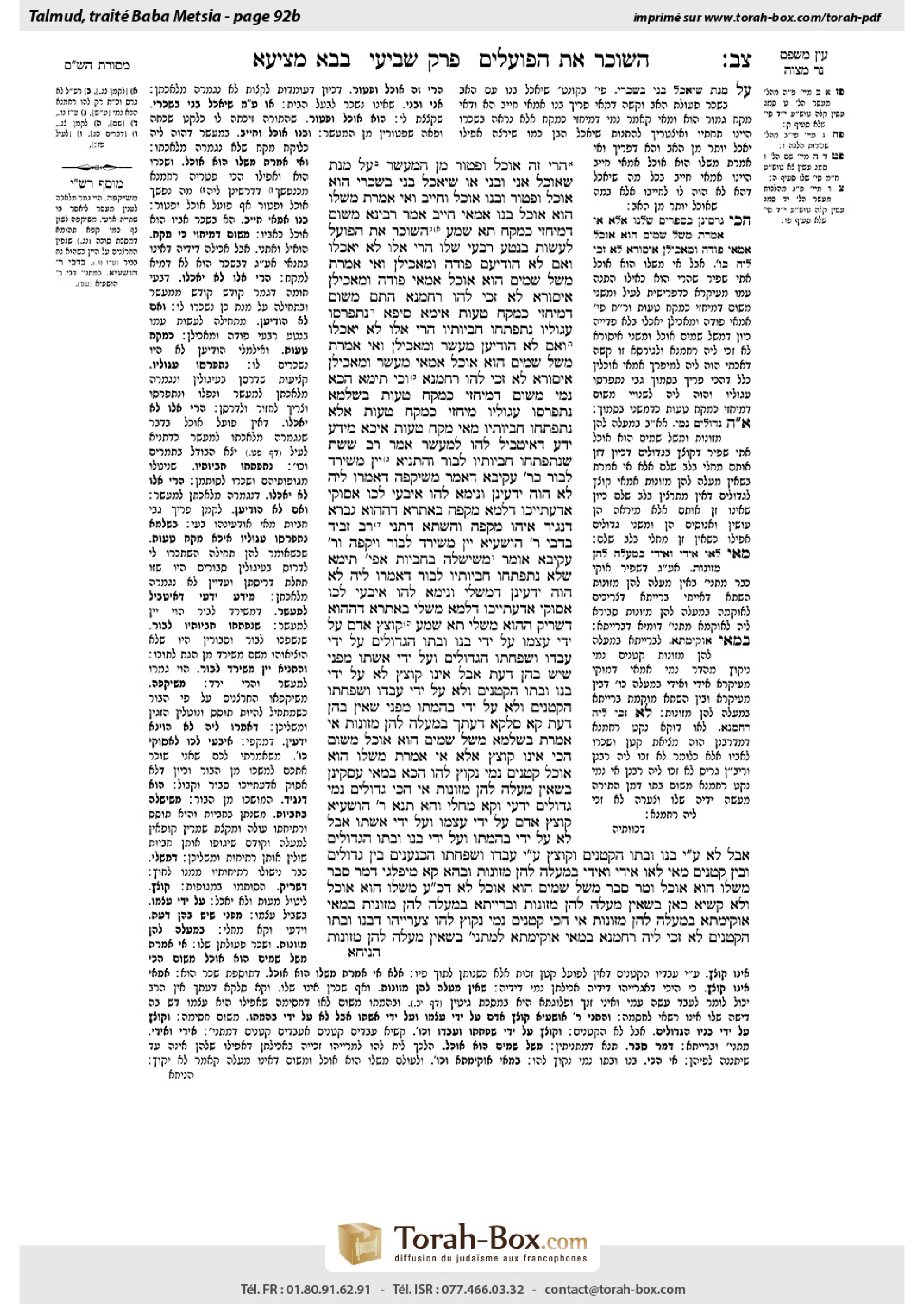
Bava Metzia 92b: Talmud study for Daf Yomi
Study the Talmud for Daf Yomi with scanned pages, Hebrew text, English translations from Sefaria and AI-generated French translations.
Passage selection and English or AI-generated French translation are available where the scan has annotations. Daf Study is independent of Torah-Box and Sefaria.
Browse Bava Metzia · בבא מציעא · All tractatesBava Metzia 92b text and translations
This page of Bava Metzia includes the Aramaic text, an English translation and an AI-generated French translation, alongside the scan above.
בבא מציעא צ״ב ב · Aramaic and Hebrew text
הֲרֵי זֶה אוֹכֵל וּפָטוּר מִן הַמַּעֲשֵׂר. ״עַל מְנָת שֶׁאוֹכֵל אֲנִי וּבְנִי״, אוֹ ״שֶׁיֹּאכַל בְּנִי בִּשְׂכָרִי״ – הוּא אוֹכֵל וּפָטוּר, וּבְנוֹ אוֹכֵל וְחַיָּיב.
וְאִי אָמְרַתְּ מִשֶּׁלּוֹ הוּא אוֹכֵל, בְּנוֹ אַמַּאי חַיָּיב? אָמַר רָבִינָא: מִשּׁוּם דְּמִיחֲזֵי כְּמִקָּח.
תָּא שְׁמַע: הַשּׂוֹכֵר אֶת הַפּוֹעֵל לַעֲשׂוֹת בְּנֶטַע רְבָעִי שֶׁלּוֹ – הֲרֵי אֵלּוּ לֹא יֹאכֵלוּ. וְאִם לֹא הוֹדִיעָם – פּוֹדֶה וּמַאֲכִילָן.
וְאִי אָמְרַתְּ מִשֶּׁל שָׁמַיִם הוּא אוֹכֵל – אַמַּאי פּוֹדֶה וּמַאֲכִילָן? אִיסּוּרָא לָא זַכִּי לְהוּ רַחֲמָנָא! הָתָם מִשּׁוּם דְּמִיחֲזֵי כְּמִקָּח טָעוּת.
אֵימָא סֵיפָא: נִתְפָּרְסוּ עִגּוּלָיו, נִתְפַּתְּחוּ חָבִיּוֹתָיו – הֲרֵי אֵלּוּ לֹא יֹאכֵלוּ, וְאִם לֹא הוֹדִיעָן – מְעַשֵּׂר וּמַאֲכִילָן. וְאִי אָמְרַתְּ מִשֶּׁל שָׁמַיִם הוּא אוֹכֵל, אַמַּאי מְעַשֵּׂר וּמַאֲכִילָן? אִיסּוּרָא לָא זַכִּי לְהוּ רַחֲמָנָא!
וְכִי תֵּימָא: הָכָא נָמֵי מִשּׁוּם דְּמִיחֲזֵי כְּמִקָּח טָעוּת. בִּשְׁלָמָא נִתְפָּרְסוּ עִגּוּלָיו – מִיחֲזֵי כְּמִקָּח טָעוּת. אֶלָּא נִתְפַּתְּחוּ חָבִיּוֹתָיו, מַאי מִקָּח טָעוּת אִיכָּא? מִידָּע יָדַע דְּאִיטְּבִיל לְהוּ לְמַעֲשֵׂר!
אָמַר רַב שֵׁשֶׁת: שֶׁנִּתְפַּתְּחוּ חָבִיּוֹתָיו לַבּוֹר. וְהָתַנְיָא: יַיִן מִשֶּׁיֵּרֵד לַבּוֹר!
כְּרַבִּי עֲקִיבָא דְּאָמַר מִשֶּׁיְּקַפֶּה, דַּאֲמַרוּ לֵיהּ: לָא הֲוָה יָדְעִינַן. וְנֵימָא לְהוּ: אִיבְּעִי לְכוּ אַסּוֹקֵי אַדַּעְתַּיְיכוּ דִּלְמָא מְקַפֶּה! בְּאַתְרָא דְּהָהוּא גַּבְרָא דְּנָגֵיד אִיהוּ מְקַפֶּה!
וְהַשְׁתָּא דְּתָנֵי רַב זְבִיד בִּדְבֵי רַבִּי הוֹשַׁעְיָא: יַיִן מִשֶּׁיֵּרֵד לַבּוֹר וִיקַפֶּה, וְרַבִּי עֲקִיבָא אוֹמֵר: מִשֶּׁיְּשַׁלֶּה בֶּחָבִיּוֹת. אֲפִילּוּ תֵּימָא שֶׁלֹּא נִתְפַּתְּחוּ חָבִיּוֹתָיו לַבּוֹר, דַּאֲמַרוּ לֵיהּ: לָא הֲוָה יָדְעִינַן דִּמְשַׁלֵּי.
וְנֵימָא לְהוּ: אִיבְּעִי לְכוּ אַסּוֹקֵי אַדַּעְתַּיְיכוּ דִּלְמָא מְשַׁלֵּי! בְּאַתְרָא דְּהָהוּא דְּשָׁרֵיק הָהוּא מְשַׁלֵּי.
תָּא שְׁמַע: קוֹצֵץ אָדָם עַל יְדֵי עַצְמוֹ, עַל יְדֵי בְּנוֹ וּבִתּוֹ הַגְּדוֹלִים, עַל יְדֵי עַבְדּוֹ וְשִׁפְחָתוֹ הַגְּדוֹלִים, וְעַל יְדֵי אִשְׁתּוֹ – מִפְּנֵי שֶׁיֵּשׁ בָּהֶן דַּעַת. אֲבָל אֵינוֹ קוֹצֵץ לֹא עַל יְדֵי בְּנוֹ וּבִתּוֹ הַקְּטַנִּים, וְלֹא עַל יְדֵי עַבְדּוֹ וְשִׁפְחָתוֹ הַקְּטַנִּים, וְלֹא עַל יְדֵי בְּהֶמְתּוֹ – מִפְּנֵי שֶׁאֵין בָּהֶן דַּעַת.
קָא סָלְקָא דַּעְתָּךְ בְּמַעֲלֶה לָהֶן מְזוֹנוֹת. אִי אָמְרַתְּ בִּשְׁלָמָא מִשֶּׁל שָׁמַיִם הוּא אוֹכֵל – מִשּׁוּם הָכִי אֵינוֹ קוֹצֵץ, אֶלָּא אִי אָמְרַתְּ מִשֶּׁלּוֹ הוּא אוֹכֵל – קְטַנִּים נָמֵי נִקּוֹץ לְהוּ!
הָכָא בְּמַאי עָסְקִינַן – בְּשֶׁאֵין מַעֲלֶה לָהֶן מְזוֹנוֹת. אִי הָכִי, גְּדוֹלִים נָמֵי! גְּדוֹלִים יָדְעִי וְקָא מָחֲלִי.
וְהָא תָּנֵא רַבִּי הוֹשַׁעְיָא: קוֹצֵץ אָדָם עַל יְדֵי עַצְמוֹ וְעַל יְדֵי אִשְׁתּוֹ, אֲבָל לֹא עַל יְדֵי בְּהֶמְתּוֹ. וְעַל יְדֵי בְּנוֹ וּבִתּוֹ הַגְּדוֹלִים, אֲבָל לֹא עַל יְדֵי בְּנוֹ וּבִתּוֹ הַקְּטַנִּים. וְקוֹצֵץ עַל יְדֵי עַבְדּוֹ וְשִׁפְחָתוֹ הַכְּנַעֲנִים, בֵּין גְּדוֹלִים וּבֵין קְטַנִּים.
מַאי לָאו, אִידֵּי וְאִידֵּי בְּמַעֲלֶה לָהֶן מְזוֹנוֹת, וּבְהָא קָא מִיפַּלְגִי: דְּמָר סָבַר מִשֶּׁלּוֹ הוּא אוֹכֵל, וּמָר סָבַר מִשֶּׁל שָׁמַיִם הוּא אוֹכֵל?! לָא, דְּכוּלֵּי עָלְמָא מִשֶּׁלּוֹ הוּא אוֹכֵל, וְלָא קַשְׁיָא: כָּאן – בְּשֶׁאֵין מַעֲלֶה לָהֶן מְזוֹנוֹת, וּבָרַיְיתָא – בְּמַעֲלֶה לָהֶן מְזוֹנוֹת.
בְּמַאי אוֹקֵימְתַּהּ – בְּמַעֲלֶה לָהֶן מְזוֹנוֹת? אִי הָכִי קְטַנִּים נָמֵי נִקּוֹץ לְהוּ! צַעֲרַיְיהוּ דִּבְנוֹ וּבִתּוֹ הַקְּטַנִּים לָא זַכִּי לֵיהּ רַחֲמָנָא.
בְּמַאי אוֹקֵימְתָּא לְמַתְנִיתִין – בְּשֶׁאֵין מַעֲלֶה לָהֶן מְזוֹנוֹת,
Bava Metzia 92b · English translation
this laborer may eat and is exempt from separating tithe. Since the Torah granted him permission to eat, he may do so while he is working without separating tithes, as is the case with regard to gifts due to the poor. But if the laborer stipulated: On the condition that I and my sons may eat, or that my son may eat for my wages, he himself may eat and is exempt from separating tithes, as he is permitted to eat by Torah law, and his son may eat but is obligated to separate tithes.
And if you say he eats from his own property, why is his son obligated? A son may eat from his father’s table without rendering the food subject to tithes. Ravina said: The reason is because it looks like a sale. Although the produce belongs to the laborer by Torah law, when he makes a deal involving his son it has the appearance of a transaction. Therefore, he must separate tithes to avoid any misunderstanding on the part of observers.
The Gemara cites yet another relevant source: Come and hear a proof from a mishna (93a): In the case of one who hires a laborer to perform labor with his fourth-year produce, such laborers may not eat the fruit, as all fruit of the fourth year of a tree must be taken and consumed in Jerusalem. And if he did not inform them beforehand that they were working with fourth-year produce, they are considered to have been hired under false pretenses. Consequently, he must redeem the fruit and feed them.
And if you say that the laborer eats from the property of Heaven, why must the owner redeem the fruit and feed them? The Merciful One certainly did not entitle them to transgress a prohibition. Even if by Torah law the laborer is granted a personal right to eat, this applies only to permitted food. The Gemara explains: There, the reason is because it looks like a mistaken transaction, as they accepted employment under the assumption that they would be permitted to eat the fruit. He is therefore obligated to compensate them.
The Gemara suggests another proof: But now state the latter clause of that same mishna: If his cakes, in which he had earlier preserved his figs, broke apart and crumbled, so that they must be preserved once again, or if his barrels of wine opened and he hired laborers to reseal them, these laborers may not eat. The reason is that the figs and wine were already subject to tithes, from which point a laborer may not eat them. And if the owner did not inform them that it is prohibited for them to consume the food, he must tithe the food and feed them. But if you say he eats from the property of Heaven, why must he tithe the food and feed them? The Merciful One certainly did not entitle them to transgress a prohibition.
And if you would say: Here too, is it because it looks like a mistaken transaction, that explanation is not tenable. Granted, in the case where his cakes broke apart, this does look like a mistaken transaction, as the laborers were unaware that the figs had been preserved once already, and they mistakenly thought that the fruit had not yet reached the stage at which it would become subject to tithes. But with regard to the other case, when his barrels opened, what mistaken transaction is there here? They certainly know that the wine had already been rendered untithed produce with regard to tithes, as wine is subject to tithes as soon as it has been collected into the pit alongside the winepress.
Rav Sheshet said: This is referring to a case where his barrels opened in such a manner that the wine once again fell into the pit from which it came. The laborers therefore assumed that the owner was not yet obligated to set aside tithes. The Gemara raises a difficulty against this explanation: But isn’t it taught in a baraita that wine is immediately subject to tithes from when it descends into the pit?
The Gemara answers: This baraita is in accordance with the opinion of Rabbi Akiva, who says that wine is subject to tithes only from when one starts to remove the seeds and the waste floats to the top, which occurs after the wine has already descended into the pit. The reason for this halakha is that the laborers can say to him: We did not know that the wine had already been removed from the pit. The Gemara asks: But let us say to them: It should have entered your minds that perhaps its waste had already floated. The Gemara responds: The ruling of the mishna is stated with regard to a place where that same man who pulls the wine from the pit is also the one who floats its waste. Consequently, it was reasonable for the laborers to assume that they had been hired to perform both tasks.
The Gemara adds: And one can reach a different conclusion now that Rav Zevid has taught the following version of the above dispute, heard from the school of Rabbi Hoshaya: Wine is subject to tithes from when it descends into the pit and its waste floats. And Rabbi Akiva says: It is subject to tithes from when he drains the waste from the barrels. They would pour all of the wine into a barrel, before draining and removing the waste after fermentation. With this in mind, you can even say that the barrels were not opened into the pit, but simply opened up, as the laborers can say to him: We did not know that he had already drained the waste.
The Gemara poses a question: But let us say to them: It should have entered your minds that perhaps its waste had already been drained. The Gemara answers: This is referring to a place where that same man who plugs the barrel with a stopper is also the one who drains its waste, and therefore they assumed they had been hired to perform both tasks.
The Gemara suggests: Come and hear a proof from a mishna (93a): A man can stipulate on his own behalf that he receive a certain increase in his wages instead of eating the produce with which he works, and similarly, he can stipulate this on behalf of his adult son or daughter, on behalf of his adult Canaanite slave or Canaanite maidservant, or on behalf of his wife, with their agreement, because they have the basic level of mental competence, i.e., they are legally competent and can therefore waive their rights. But he cannot stipulate this on behalf of his minor son or daughter, nor on behalf of his minor Canaanite slave or Canaanite maidservant, nor on behalf of his animal, as they do not have the basic level of mental competence.
The Gemara analyzes this mishna: It might enter your mind that all these examples involve cases where the father, master, or husband, depending on the case, provides his children, slaves, or wife with food, and they assist him in his work. Granted, if you say that a laborer eats from the property of Heaven, it is due to that reason that he may not stipulate this on behalf of minors, as the Torah also entitled minors themselves to eat when they work, and they cannot waive their rights. But if you say that a laborer eats from his own property, and the food he consumes is a monetary obligation, let him be allowed to stipulate on behalf of minors as well. Since in a case where a father provides sustenance for his children he keeps the profits of their labor, he should be entitled to stipulate this concerning their payment.
The Gemara answers: With what are we dealing here? We are dealing with a situation in which the father does not provide his children with food. Therefore, he does not keep the profits of their labor and has no right to make stipulations concerning the terms of their employment. The Gemara raises a difficulty: If so, in the case of adult children and slaves too, the father or master should not be able to stipulate in this manner. Since he does not provide them with food, why should he be able to waive their rights? The Gemara responds: Adults are aware of the stipulation and forgive their rights to the food. He can stipulate this only with their agreement.
The Gemara asks: But didn’t Rabbi Hoshaya teach in a baraita: A person can stipulate on his own behalf that he receive a certain increase in his wages instead of eating the produce with which he works, and on his wife’s behalf, but not on behalf of his animal; and he can stipulate this on behalf of his adult son or daughter, but not on behalf of his minor son or daughter; and he can stipulate this on behalf of his Canaanite slave or Canaanite maidservant, whether they are adults or minors. This contradicts the ruling of the previous mishna that one cannot stipulate this on behalf of his minor slave.
What, is it not correct to say that this and that, both sources, are referring to cases where the master provides the slaves with food, and they disagree with regard to this: That one Sage, the tanna of the mishna, holds that a laborer eats from his own property, and therefore he can relinquish the rights of his minor slave, and one Sage, of the baraita, holds that a laborer eats from the property of Heaven, and therefore he cannot relinquish the rights of his minor slave? The Gemara refutes this suggestion: No; everyone agrees that a laborer eats from his own property, and it is not difficult. Here, in the mishna, it is referring to a case where he does not provide the slaves with food, as stated previously, and the baraita is referring to a case where he provides them with food.
The Gemara asks: To what case did you interpret the baraita to be referring? Did you interpret it as referring to a case where he provides the slaves with food? If so, let him also be allowed to stipulate on behalf of his minor children that they receive no food, as presumably the baraita is referring to a case where he provides his minor children with food. The Gemara answers: The Merciful One does not entitle him to waive the suffering of his minor son and daughter. His young children will suffer if they are prevented from eating the food they see before them.
The Gemara further asks: To what case did you interpret the baraita to be referring? Did you interpret it as referring to a case where he does not provide the slaves with food?
Bava Metzia 92b · Traduction française (IA)
Ce travailleur peut manger et est exempt de séparer la dîme. Puisque la Torah lui a donné la permission de manger, il peut le faire tout en travaillant sans séparer la dîme, comme c'est le cas pour les offrandes destinées aux pauvres. Mais si le travailleur stipule : sous condition que moi et mes fils puissions manger, ou que mon fils puisse manger pour mes salaires, lui-même peut manger et est exempt de séparer la dîme, car il est autorisé à manger selon la loi, et son fils peut manger mais est tenu de séparer la dîme.
Et si vous dites qu'il mange de sa propre propriété, pourquoi est-ce que son fils est tenu ? Un fils peut manger de la table de son père sans que les aliments soient soumis à la dîme. Ravina a dit : La raison est qu'il y a l'aspect d'une vente. Bien que les produits appartiennent au travailleur selon la loi, lorsqu'il fait une transaction impliquant son fils, cela a l'air d'une vente. Par conséquent, il doit séparer la dîme pour éviter toute confusion de la part des observateurs.
Le Guemara cite une autre source pertinente : Venez écouter une preuve à partir d'une mitsva (93a) : Dans le cas où l'on engage un travailleur pour effectuer un travail avec ses produits du quatrième an, ces travailleurs ne peuvent pas manger les fruits, car tous les fruits du quatrième an d'un arbre doivent être récoltés et consommés à Jérusalem. Et si l'on n'a pas informé d'avance qu'ils travaillaient avec des produits du quatrième an, ils sont considérés comme ayant été engagés sous des prétextes faux. Par conséquent, il faut racheter les fruits et les nourrir.
Et si vous dites qu'il mange de la propriété du Ciel, pourquoi doit-il racheter les fruits et les nourrir ? L'Éternel n'a certainement pas autorisé qu'ils transgressent une interdiction. Même si selon la loi du Torah le travailleur est autorisé à manger, cela s'applique uniquement aux aliments permis. Le Guemara explique : Là, la raison est qu'il y a l'aspect d'une transaction erronée, car ils ont accepté un emploi en supposant qu'ils pourraient manger les fruits. Il est donc tenu de les compenser.
Le Guemara suggère une autre preuve : Mais maintenant, dites la seconde partie de cette même mitsva : Si ses gâteaux, dans lesquels il avait précédemment conservé ses figues, se sont brisés et sont tombés en poussière, de sorte qu'ils doivent être conservés à nouveau, ou si ses barriques de vin s'ouvrent et qu'il engage des travailleurs pour les sceller à nouveau, ces travailleurs ne peuvent pas manger. La raison est que les figues et le vin étaient déjà soumis à la dîme, à partir de ce moment-là un travailleur ne peut pas manger ces aliments. Et si l'owner n'a pas informé qu'il est interdit de consommer les aliments, il doit dîmer les aliments et les nourrir. Mais si vous dites qu'il mange de la propriété du Ciel, pourquoi doit-il dîmer les aliments et les nourrir ? L'Éternel n'a certainement pas autorisé qu'ils transgressent une interdiction.
Et si vous dites : ici aussi, c'est parce qu'il y a l'aspect d'une transaction erronée, cette explication n'est pas tenable. En effet, dans le cas où ses gâteaux se sont brisés, cela a l'air d'une transaction erronée, car les travailleurs ignoraient que les figues avaient déjà été conservés une fois, et ils pensaient que les fruits n'avaient pas encore atteint la phase où ils devaient être soumis à la dîme. Mais concernant l'autre cas, lorsque ses barriques s'ouvrent, quelle transaction erronée y a-t-il ici ? Ils savent certainement que le vin avait déjà été rendu à la dîme, car le vin est soumis à la dîme dès qu'il est descendu dans le puits avec la presse.
Rav Sheshet a dit : Cela fait référence à un cas où ses barriques s'ouvrent de telle sorte que le vin tombe à nouveau dans le puits d'où il venait. Les travailleurs ont donc supposé que l'propriétaire n'était pas encore tenu de séparer la dîme. Le Guemara soulève une difficulté contre cette explication : Mais n'est-il pas enseigné dans une baraïta que le vin est immédiatement soumis à la dîme dès qu'il descend dans le puits ?
Le Guemara répond : Cette baraïta est selon l'opinion de Rabbi Akiva, qui dit que le vin est soumis à la dîme seulement à partir du moment où l'on commence à retirer les graines et que le déchet flotte à la surface, ce qui arrive après que le vin ait déjà descendu dans le puits. La raison de cette halakha est que les travailleurs peuvent dire à lui : Nous ne savions pas que le vin avait déjà été retiré du puits. Le Guemara demande : Mais disons-leur : Il aurait dû leur entrer en tête que peut-être le déchet avait déjà flotté. Le Guemara répond : La décision de la mitsva est formulée dans un lieu où la même personne qui retire le vin du puits est aussi celle qui flotte le déchet. Par conséquent, il était raisonnable pour les travailleurs d'assumer qu'ils avaient été engagés pour effectuer les deux tâches.
Le Guemara ajoute : Et l'on peut tirer une conclusion différente maintenant que Rav Zevid a enseigné la version suivante de ce débat, entendue auprès de l'école de Rabbi Hoshaya : Le vin est soumis à la dîme dès qu'il descend dans le puits et que son déchet flotte. Et Rabbi Akiva dit : Il est soumis à la dîme dès qu'on retire le déchet des barriques. Ils versaient tout le vin dans une barrique, avant de retirer le déchet après la fermentation. Avec cela en tête, vous pouvez même dire que les barriques n'ont pas été ouvertes dans le puits, mais simplement ouvertes, car les travailleurs peuvent dire à lui : Nous ne savions pas qu'il avait déjà retiré le déchet.
Le Guemara pose une question : Mais disons-leur : Il aurait dû leur entrer en tête que peut-être le déchet avait déjà été évacué. Le Guemara répond : Cela fait référence à un lieu où la même personne qui bouchonne la barrique est aussi celle qui évacue le déchet, et par conséquent ils ont supposé qu'ils avaient été engagés pour effectuer les deux tâches.
La Guemara suggère : Viens écouter une preuve tirée d’une mitsva (93a) : Un homme peut stipuler à son propre sujet qu’il reçoive une augmentation déterminée sur ses salaires plutôt que de manger les produits qu’il produit, et de même, il peut stipuler cela à l’égard de son fils ou de sa fille adultes, à l’égard de son esclave cananéen ou de sa servante cananéenne adultes, ou à l’égard de sa femme, avec leur accord, car ils possèdent un niveau de compétence mentale de base, c’est-à-dire qu’ils sont légalement compétents et peuvent donc renoncer à leurs droits. Mais il ne peut stipuler cela à l’égard de son fils ou de sa fille mineurs, ni à l’égard de son esclave cananéen ou de sa servante cananéenne mineurs, ni à l’égard de son animal, car ils n’ont pas ce niveau de compétence mentale de base.
La Guemara analyse cette mitsva : Il pourrait t’entrer en tête que tous ces exemples concernent des cas où le père, le maître ou le mari, selon le cas, fournit à ses enfants, esclaves ou femme de la nourriture, et qu’ils l’aident dans son travail. Admettons que tu dises qu’un ouvrier mange de la propriété du Ciel, c’est pour cette raison qu’il ne peut stipuler cela à l’égard des mineurs, car la Torah a également donné aux mineurs eux-mêmes le droit de manger lorsqu’ils travaillent, et ils ne peuvent pas renoncer à leurs droits. Mais si tu dis qu’un ouvrier mange de sa propre propriété, et que la nourriture qu’il consomme est une obligation monétaire, il devrait être autorisé à stipuler à l’égard des mineurs également. En effet, dans un cas où le père fournit de la nourriture à ses enfants, il garde les bénéfices de leur travail, il devrait donc être autorisé à stipuler concernant leurs salaires.
La Guemara répond : De quoi sommes-nous en train de parler ici ? Nous parlons d’un cas où le père ne fournit pas de nourriture à ses enfants. Par conséquent, il ne garde pas les bénéfices de leur travail et n’a pas le droit de faire des stipulations concernant les conditions de leur travail. La Guemara soulève une difficulté : Si c’est ainsi, dans le cas des enfants adultes et des esclaves également, le père ou le maître ne devrait pas pouvoir stipuler ainsi. Comme il ne fournit pas de nourriture à ses enfants, pourquoi devrait-il pouvoir renoncer à leurs droits ? La Guemara répond : Les adultes savent la stipulation et pardonnent leurs droits à la nourriture. Il peut stipuler cela uniquement avec leur accord.
La Guemara pose une question : N’a-t-il pas dit Rabbi Hoshaya dans une baraïta : Un homme peut stipuler à son propre sujet qu’il reçoive une augmentation déterminée sur ses salaires plutôt que de manger les produits qu’il produit, et à l’égard de sa femme, mais pas à l’égard de son animal ; et il peut stipuler cela à l’égard de son fils ou de sa fille adultes, mais pas à l’égard de son fils ou de sa fille mineurs ; et il peut stipuler cela à l’égard de son esclave cananéen ou de sa servante cananéenne, qu’ils soient adultes ou mineurs. Cela contredit la décision de la mitsva précédente qui disait qu’on ne peut stipuler cela à l’égard de son esclave mineur.
Qu’est-ce que cela signifie ? N’est-ce pas correct de dire que ces deux sources, celle-ci et celle-là, parlent tous deux de cas où le maître fournit de la nourriture à ses esclaves, et qu’ils s’opposent à ce sujet : que l’un des sages, le tanna de la mitsna, considère qu’un ouvrier mange de sa propre propriété, et qu’il peut donc renoncer aux droits de son esclave mineur, et que l’autre sage, celui de la baraïta, considère qu’un ouvrier mange de la propriété du Ciel, et qu’il ne peut donc renoncer aux droits de son esclave mineur ? La Guemara réfute cette suggestion : Non ; tout le monde convient qu’un ouvrier mange de sa propre propriété, et cela n’est pas difficile. Ici, dans la mitsna, il s’agit d’un cas où il ne fournit pas de nourriture à ses esclaves, comme mentionné précédemment, et la baraïta s’applique à un cas où il fournit de la nourriture à ses esclaves.
La Guemara pose une question : À quel cas as-tu interprété la baraïta ? As-tu interprété cela comme un cas où il fournit de la nourriture à ses esclaves ? Si c’est le cas, il devrait être autorisé à stipuler à l’égard de ses enfants mineurs qu’ils ne reçoivent pas de nourriture, car probablement la baraïta s’applique à un cas où il fournit de la nourriture à ses enfants mineurs. La Guemara répond : L’Éternel ne permet pas de renoncer au souffrance de son fils ou de sa fille mineurs. Ses jeunes enfants souffriraient s’ils étaient empêchés de manger la nourriture qu’ils voient devant eux.
La Guemara pose une autre question : À quel cas as-tu interprété la baraïta ? As-tu interprété cela comme un cas où il ne fournit pas de nourriture aux esclaves ?
Traduction française générée par IA à partir de l’édition anglaise de Sefaria. Vérifie toujours un passage avec le texte source.
Text from Sefaria: William Davidson Edition - Vocalized Aramaic (CC BY NC); William Davidson Edition - English (CC BY NC).