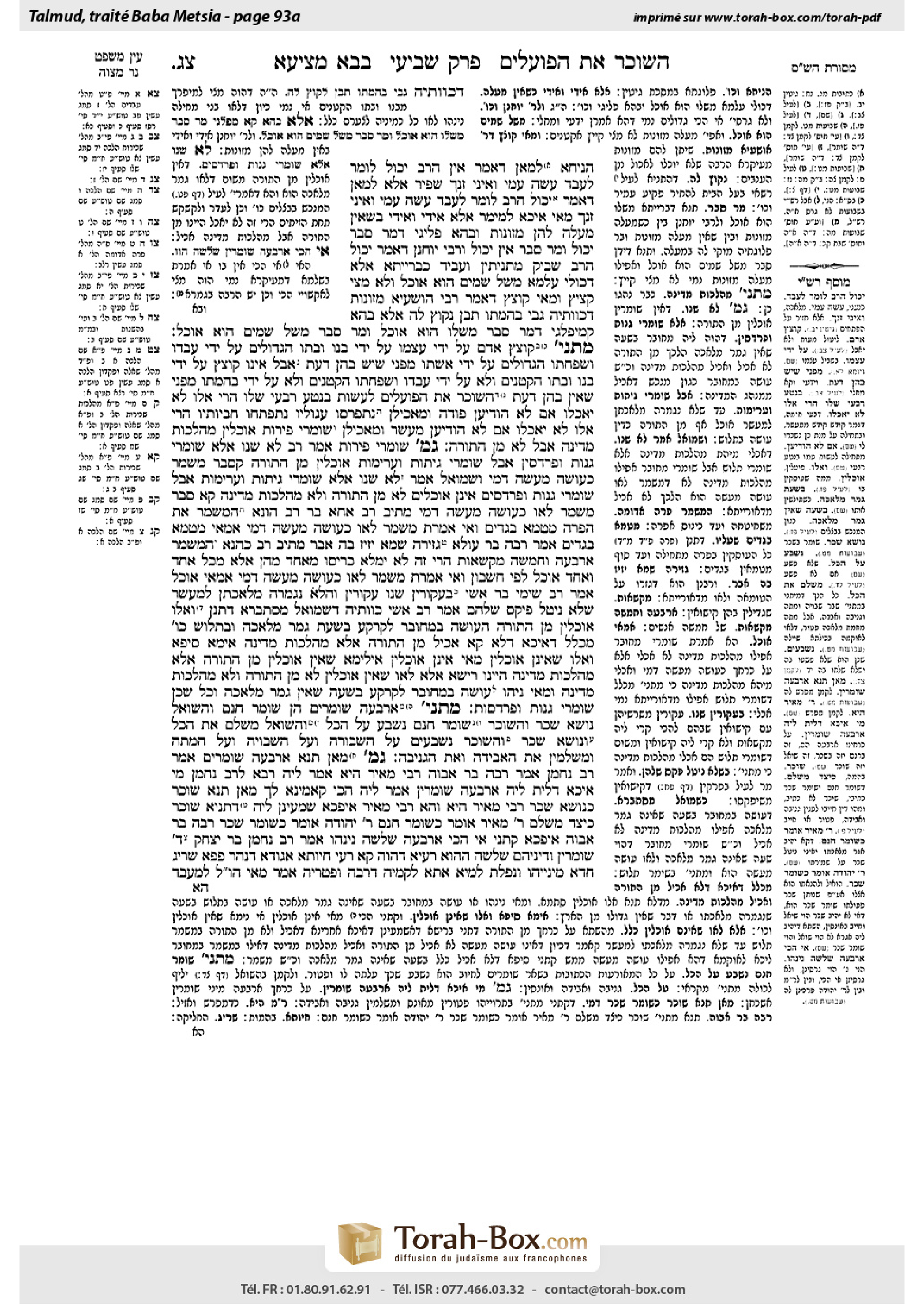
Bava Metzia 93a: Talmud study for Daf Yomi
Study the Talmud for Daf Yomi with scanned pages, Hebrew text, English translations from Sefaria and AI-generated French translations.
Passage selection and English or AI-generated French translation are available where the scan has annotations. Daf Study is independent of Torah-Box and Sefaria.
Browse Bava Metzia · בבא מציעא · All tractatesBava Metzia 93a text and translations
This page of Bava Metzia includes the Aramaic text, an English translation and an AI-generated French translation, alongside the scan above.
בבא מציעא צ״ג א · Aramaic and Hebrew text
הָנִיחָא לְמַאן דְּאָמַר אֵין הָרַב יָכוֹל לוֹמַר לָעֶבֶד עֲשֵׂה עִמִּי וְאֵינִי זָנָךְ – שַׁפִּיר. אֶלָּא לְמַאן דְּאָמַר יָכוֹל הָרַב לוֹמַר לָעֶבֶד עֲשֵׂה עִמִּי וְאֵינִי זָנָךְ, מַאי אִיכָּא לְמֵימַר?
אֶלָּא אִידֵּי וְאִידֵּי בְּשֶׁאֵין מַעֲלֶה לָהֶן מְזוֹנוֹת, וּבְהָא פְּלִיגִי: דְּמָר סָבַר יָכוֹל, וּמַר סָבַר אֵין יָכוֹל. וְרַבִּי יוֹחָנָן, דְּאָמַר: יָכוֹל הָרַב, שָׁבֵיק מַתְנִיתִין וְעָבֵיד כְּבָרַיְיתָא?!
אֶלָּא דְּכוּלֵּי עָלְמָא מִשֶּׁל שָׁמַיִם הוּא אוֹכֵל, וְלָא מָצֵי קָצֵיץ. וּמַאי ״קוֹצֵץ״ דְּאָמַר רַבִּי הוֹשַׁעְיָא – מְזוֹנוֹת.
דִּכְווֹתֵיהּ גַּבֵּי בְּהֶמְתּוֹ תֶּבֶן נִקּוֹץ לַהּ! אֶלָּא בְּהָא קָמִיפַּלְגִי: דְּמָר סָבַר – מִשֶּׁלּוֹ הוּא אוֹכֵל, וּמָר סָבַר – מִשֶּׁל שָׁמַיִם הוּא אוֹכֵל.
מַתְנִי׳ קוֹצֵץ אָדָם עַל יְדֵי עַצְמוֹ, עַל יְדֵי בְּנוֹ וּבִתּוֹ הַגְּדוֹלִים, עַל יְדֵי עַבְדּוֹ וְשִׁפְחָתוֹ הַגְּדוֹלִים, עַל יְדֵי אִשְׁתּוֹ, מִפְּנֵי שֶׁיֵּשׁ בָּהֶן דַּעַת. אֲבָל אֵינוֹ קוֹצֵץ עַל יְדֵי בְּנוֹ וּבִתּוֹ הַקְּטַנִּים, וְלֹא עַל יְדֵי עַבְדּוֹ וְשִׁפְחָתוֹ הַקְּטַנִּים, וְלֹא עַל יְדֵי בְּהֶמְתּוֹ, מִפְּנֵי שֶׁאֵין בָּהֶן דַּעַת.
הַשּׂוֹכֵר אֶת הַפּוֹעֲלִים לַעֲשׂוֹת בְּנֶטַע רְבָעִי שֶׁלּוֹ – הֲרֵי אֵלּוּ לֹא יֹאכְלוּ. אִם לֹא הוֹדִיעָן – פּוֹדֶה וּמַאֲכִילָן. נִתְפָּרְסוּ עִגּוּלָיו, נִתְפַּתְּחוּ חָבִיּוֹתָיו – הֲרֵי אֵלּוּ לֹא יֹאכְלוּ. אִם לֹא הוֹדִיעָן – מְעַשֵּׂר וּמַאֲכִילָן.
שׁוֹמְרֵי פֵירוֹת אוֹכְלִין מֵהִלְכוֹת מְדִינָה, אֲבָל לֹא מִן הַתּוֹרָה.
גְּמָ׳ שׁוֹמְרֵי פֵירוֹת. אָמַר רַב: לֹא שָׁנוּ אֶלָּא שׁוֹמְרֵי גַנּוֹת וּפַרְדֵּסִין. אֲבָל שׁוֹמְרֵי גִיתּוֹת וַעֲרֵימוֹת – אוֹכְלִין מִן הַתּוֹרָה. קָסָבַר: מְשַׁמֵּר כְּעוֹשֶׂה מַעֲשֶׂה דָּמֵי.
וּשְׁמוּאֵל אָמַר: לֹא שָׁנוּ אֶלָּא שׁוֹמְרֵי גִיתּוֹת וַעֲרֵימוֹת. אֲבָל שׁוֹמְרֵי גַנּוֹת וּפַרְדֵּסִים – אֵינָן אוֹכְלִים לֹא מִן הַתּוֹרָה וְלֹא מֵהִלְכוֹת מְדִינָה. קָא סָבַר מְשַׁמֵּר לָאו כְּעוֹשֶׂה מַעֲשֶׂה דָּמֵי.
מֵתִיב רַב אַחָא בַּר רַב הוּנָא: הַמְשַׁמֵּר אֶת הַפָּרָה – מְטַמֵּא בְּגָדִים. וְאִי אָמְרַתְּ מְשַׁמֵּר לָאו כְּעוֹשֶׂה מַעֲשֶׂה דָּמֵי – אַמַּאי מְטַמֵּא בְּגָדִים? אָמַר רַבָּה בַּר עוּלָּא: גְּזֵירָה שֶׁמָּא יָזִיז בָּהּ אֵבֶר.
מֵתִיב רַב כָּהֲנָא: הַמְשַׁמֵּר אַרְבַּע וְחָמֵשׁ מִקְשָׁאוֹת – הֲרֵי זֶה לֹא יְמַלֵּא כְּרֵסוֹ מֵאֶחָד מֵהֶן, אֶלָּא מִכׇּל אֶחָד וְאֶחָד אוֹכֵל לְפִי חֶשְׁבּוֹן. וְאִי אָמְרַתְּ מְשַׁמֵּר לָאו כְּעוֹשֶׂה מַעֲשֶׂה דָּמֵי – אַמַּאי אוֹכֵל?
אָמַר רַב שִׁימִי בַּר אָשֵׁי: בַּעֲקוּרִין שָׁנוּ. עֲקוּרִין – וַהֲלֹא נִגְמְרָה מְלַאכְתָּן לְמַעֲשֵׂר? שֶׁלֹּא נִיטַּל פֵּיקֶס שֶׁלָּהֶם.
אָמַר רַב אָשֵׁי: כְּווֹתֵיהּ דִּשְׁמוּאֵל מִסְתַּבְּרָא, דִּתְנַן, וְאֵלּוּ אוֹכְלִין מִן הַתּוֹרָה: הָעוֹשֶׂה בִּמְחוּבָּר לַקַּרְקַע בִּשְׁעַת גְּמַר מְלָאכָה, וּבְתָלוּשׁ כּוּ׳. מִכְּלָל דְּאִיכָּא דְּלָא קָא אָכֵיל מִן הַתּוֹרָה אֶלָּא מֵהִלְכוֹת מְדִינָה.
אֵימָא סֵיפָא: וְאֵלּוּ שֶׁאֵינָן אוֹכְלִין. מַאי אֵינָן אוֹכְלִין? אִילֵּימָא שֶׁאֵין אוֹכְלִין מִן הַתּוֹרָה אֶלָּא מֵהִלְכוֹת מְדִינָה – הַיְינוּ רֵישָׁא, אֶלָּא לָאו שֶׁאֵין אוֹכְלִין לֹא מִן הַתּוֹרָה וְלֹא מֵהִלְכוֹת מְדִינָה. וּמַאי נִיהוּ – עוֹשֶׂה בִּמְחוּבָּר לַקַּרְקַע בְּשָׁעָה שֶׁאֵין גְּמַר מְלָאכָה, וְכׇל שֶׁכֵּן שׁוֹמְרֵי גַנּוֹת וּפַרְדֵּסוֹת.
מַתְנִי׳ אַרְבָּעָה שׁוֹמְרִים הֵן: שׁוֹמֵר חִנָּם וְהַשּׁוֹאֵל, נוֹשֵׂא שָׂכָר וְהַשּׂוֹכֵר. שׁוֹמֵר חִנָּם נִשְׁבָּע עַל הַכֹּל, וְהַשּׁוֹאֵל מְשַׁלֵּם אֶת הַכֹּל.
וְנוֹשֵׂא שָׂכָר וְהַשּׂוֹכֵר נִשְׁבָּעִים עַל הַשְּׁבוּרָה וְעַל הַשְּׁבוּיָה וְעַל הַמֵּתָה, וּמְשַׁלְּמִין אֶת הָאֲבֵידָה וְאֶת הַגְּנֵיבָה.
גְּמָ׳ מַאן תְּנָא אַרְבָּעָה שׁוֹמְרִים? אָמַר רַב נַחְמָן אָמַר רַבָּה בַּר אֲבוּהּ: רַבִּי מֵאִיר הִיא. אֲמַר לֵיהּ רָבָא לְרַב נַחְמָן: מִי אִיכָּא דְּלֵית לֵיהּ אַרְבָּעָה שׁוֹמְרִין? אֲמַר לֵיהּ: הָכִי קָאָמֵינָא לָךְ, מַאן תָּנָא שׂוֹכֵר כְּנוֹשֵׂא שָׂכָר – רַבִּי מֵאִיר הִיא.
וְהָא רַבִּי מֵאִיר אִיפְּכָא שָׁמְעִינַן לֵיהּ, דְּתַנְיָא: שׂוֹכֵר כֵּיצַד מְשַׁלֵּם? רַבִּי מֵאִיר אוֹמֵר: כְּשׁוֹמֵר חִנָּם, רַבִּי יְהוּדָה אוֹמֵר: כְּשׁוֹמֵר שָׂכָר! רַבָּה בַּר אֲבוּהּ אִיפְּכָא קָתָנֵי.
אִי הָכִי, אַרְבָּעָה? שְׁלֹשָׁה נִינְהוּ! אָמַר רַב נַחְמָן בַּר יִצְחָק: אַרְבָּעָה שׁוֹמְרִין, וְדִינֵיהֶם שְׁלֹשָׁה.
הָהוּא רָעֲיָא דַּהֲוָה קָא רָעֵי חֵיוָתָא אַגּוּדָּא דִּנְהַר פָּפָּא. שְׂרִיג חֲדָא מִינַּיְיהוּ וּנְפַלַת לְמַיָּא. אֲתָא לְקַמֵּיהּ דְּרַבָּה וּפַטְרֵיהּ. אָמַר: מַאי הֲוָה לֵיהּ לְמֶעְבַּד?
Bava Metzia 93a · English translation
This works out well according to the one who says that a master cannot say to a slave: Work for me and I will not feed you, i.e., he is obligated to provide the slave with a livelihood. For the purposes of the case at hand, this means that the master cannot stipulate that he is relinquishing his slaves’ right to eat while performing labor, and therefore it works out well. But according to the one who says that a master can say to a slave: Work for me and I will not feed you, what can be said? He should be able to stipulate to that effect with regard to his minor slave, as he is entitled to all profits that result from the slaves’ labor.
Rather, according to this opinion one must accept a different explanation: Both this mishna and that baraita are referring to a case when he does not provide the slaves with food, and the two tannaitic sources disagree with regard to that very issue. As one Sage, the tanna of the baraita, holds that a master can say to a slave: Work for me and I will not feed you, and one Sage, the tanna of the mishna, holds that he cannot do so. The Gemara is puzzled by this response: If so, Rabbi Yoḥanan, who says that a master can say to his slave that he will not feed him, has left aside the mishna and acted and ruled in accordance with the baraita.
Rather, the Gemara retracts the previous explanation in favor of another: Everyone agrees that a laborer eats from the property of Heaven, and even if a father or master provides his child or slave with food he cannot stipulate that the child or slave should not eat when performing labor, as the father or master has no rights over that which they consume. And what is the meaning of: Stipulates, that Rabbi Hoshaya says in the baraita? That does not mean, as in the mishna, that the master relinquishes the slaves’ right to food; rather, he stipulates that they should eat food before they work, so that they will be too full to eat at a later stage.
The Gemara raises a difficulty: If so, in the corresponding situation, with regard to his animal, there should likewise be no discussion at all because he can stipulate in this manner and distribute straw for it before it starts work, as everyone agrees that this is permitted. Rather, the Gemara retracts this interpretation and says that in fact they disagree with regard to this: That one Sage, the tanna of the mishna, holds that a laborer eats from his own property, and one Sage, the tanna of the baraita, holds that a laborer eats from the property of Heaven. This proves that this issue is in fact a dispute between tanna’im.
MISHNA: A man can stipulate on his own behalf that he receive a certain increase in his wages instead of eating the produce with which he works, and similarly, he can stipulate this on behalf of his adult son or daughter, on behalf of his adult Canaanite slave or Canaanite maidservant, or on behalf of his wife, with their agreement, because they have the basic level of mental competence, i.e., they are legally competent and can therefore waive their rights. But he cannot stipulate this on behalf of his minor son or daughter, nor on behalf of his minor Canaanite slave or Canaanite maidservant, nor on behalf of his animal, as they do not have the basic level of mental competence.
In the case of one who hires a laborer to perform labor with his fourth-year fruit, such laborers may not eat the fruit. And if he did not inform them beforehand that they were working with fourth-year fruit, he must redeem the fruit and feed them. If his fig cakes broke apart and crumbled, so that they must be preserved again, or if his barrels of wine opened and he hired workers to reseal them, these laborers may not eat, as the work of the figs or wine had already been completed with regard to tithes, from which point a laborer may not eat them. And if he did not inform them, he must tithe the food and feed them.
The mishna adds: Watchmen of produce may eat the produce of the field or vineyard by local regulations, i.e., in accordance with the ordinances accepted by the residents of that place, but not by Torah law.
GEMARA: The mishna mentions watchmen of produce. Rav says: They taught this halakha only with regard to watchmen of gardens and orchards, in which the produce is still attached to the ground, and therefore the watchman would have no legal right to it were it not for the local custom. But watchmen of winepresses and piles of detached produce may eat from them by Torah law, as the decisive factor is whether or not the produce is attached to the ground. Evidently, Rav maintains that one who safeguards is considered like one who performs labor, and therefore he has the status of a laborer.
And conversely, Shmuel says that the Sages taught the halakha of the mishna, that they may eat by local regulations, only with regard to watchmen of winepresses and piles of detached produce. But watchmen of gardens and orchards may not eat, neither by Torah law nor by local regulations. This shows that Shmuel holds that one who safeguards is not considered like one who performs labor, and therefore no watchman is entitled to eat by Torah law. In the particular case of detached produce, there is a local custom to allow a watchman of detached produce to eat from it.
Rav Aḥa bar Rav Huna raises an objection to this reasoning from a baraita: One who safeguards the red heifer after it has been burned renders his garments impure, in accordance with halakha concerning all those who take part in the ritual of the red heifer. The Torah decrees that all those who take part in the ritual of the red heifer contract impurity (Numbers, chapter 19). It is therefore necessary to establish which people are considered to have taken part in this ritual. And if you say that one who safeguards is not considered like one who performs labor, why does he render his garments impure? He has not performed any labor. Rabba bar Ulla said: He does not render them impure due to his work as a watchman; rather, this is a rabbinic decree, lest he move a limb of the heifer.
Rav Kahana raises an objection: With regard to one who safeguards four or five cucumber fields, which contain various types of cucumbers and gourds belonging to different people, this one may not fill his stomach from any single one of them. Rather, he must eat from each and every one by a proportionate amount. But if you say that one who safeguards is not considered like one who performs labor, why is he allowed to eat at all?
Rav Shimi bar Ashi said: They taught this halakha with regard to uprooted cucumbers, concerning which even Shmuel agrees that a watchman may eat them by local regulations. The Gemara raises a difficulty: Uprooted? But at that stage hasn’t their work already been completed with regard to tithes, and therefore no laborer should be permitted to eat them? The Gemara answers: This is referring to a case when their blossom had not yet been removed. Since the cucumbers still require work, they are not yet subject to tithes.
Rav Ashi said: It stands to reason that the halakha is in accordance with the opinion of Shmuel, as we learned in a mishna (87a): And these laborers may eat by Torah law: A laborer who performs labor with produce attached to the ground at the time of the completion of its work, e.g., harvesting produce; and a laborer who performs labor with produce detached from the ground before the completion of its work. The mishna’s phrase: By Torah law, proves by inference that with regard to detached produce there is one who does not eat by Torah law but by local regulations.
The Gemara continues its proof: Now, say the latter clause of that mishna: And these may not eat. What is the meaning of: May not eat? If we say this means that they may not eat by Torah law but by local regulations, this is the same as the first clause. Rather, is it not correct to say that it means they may not eat at all, neither by Torah law nor by local regulations? And who are the people included in this list? They are one who performs labor with produce attached to the ground at a time when it has not reached the completion of its work, and all the more so watchmen of gardens and orchards, who do not perform any significant action.
MISHNA: There are four types of bailees, to whom different halakhot apply. They are as follows: An unpaid bailee, who receives no compensation for safeguarding the item; and the borrower of an item for his own use; a paid bailee, who is provided with a salary for watching over an item; and a renter, i.e., a bailee who pays a fee for the use of a vessel or animal. If the item was stolen, lost, or broken, or if the animal died in any manner, their halakhot are as follows: An unpaid bailee takes an oath over every outcome; whether the item was lost, stolen, or broken, or if the animal died, the unpaid bailee must take an oath that it happened as he described, and he is then exempt from payment. The borrower does not take an oath, but pays for every outcome, even in a circumstance beyond his control.
And the halakhot of a paid bailee and a renter are the same: They take an oath over an injured animal, over a captured animal, and over a dead animal, attesting that the mishaps were caused by circumstances beyond their control, and they are exempt, but they must pay for loss or theft.
GEMARA: The Gemara asks: Who is the tanna who taught this mishna about four types of bailees? Rav Naḥman said that Rabba bar Avuh said: It is Rabbi Meir. Rava said to Rav Naḥman: Is there any Sage who does not accept the halakha concerning four types of bailees? All of the Sages agree that the Torah spoke of these four types of bailees. Rav Naḥman said to him: This is what I am saying to you, i.e., I mean as follows: Who is the tanna who maintains that the halakha of a renter is like that of a paid bailee? It is Rabbi Meir.
The Gemara raises a difficulty: But didn’t we hear that Rabbi Meir said the opposite, as it is taught in a baraita: With regard to a renter, whose halakha is not stated in the Torah, how does he pay, i.e., in which cases is he liable to pay? Rabbi Meir says: He pays in the same cases as an unpaid bailee; Rabbi Yehuda says he pays in the same cases as a paid bailee. The Gemara explains: Rabba bar Avuh teaches this baraita in the opposite manner to the version here.
The Gemara asks a question with regard to the accepted number of bailees: If so, that the same halakha applies to a renter and a paid bailee, why does the tanna say that there are four bailees? They are only three. Rav Naḥman bar Yitzḥak said that the mishna should be understood as follows: There are four types of bailees, whose halakhot are three.
§ The Gemara relates: There was a certain shepherd who was herding animals on the bank of the Pappa River, when one of them slipped and fell into the water and drowned. He came before Rabba, and Rabba exempted him from payment. Rabba stated the following reasoning in support of his ruling: What could he have done? A drowning of this kind is a circumstance beyond his control, and although a shepherd is a paid bailee he is exempt from liability in circumstances beyond his control.
Bava Metzia 93a · Traduction française (IA)
Cela fonctionne bien selon celui qui affirme qu'un maître ne peut pas dire à un esclave : Travaille pour moi et je ne te nourrirai pas, c'est-à-dire qu'il est tenu de fournir à l'esclave un mode de vie. Pour les besoins du cas en question, cela signifie que le maître ne peut pas stipuler qu'il renonce au droit de l'esclave à manger pendant qu'il travaille, et donc cela fonctionne bien. Mais selon celui qui affirme qu'un maître peut dire à un esclave : Travaille pour moi et je ne te nourrirai pas, que peut-on dire ? Il devrait pouvoir stipuler ainsi concernant son esclave mineur, car il est autorisé à tous les profits résultant du travail de l'esclave.
Plutôt, selon cet avis, on doit accepter une autre explication : à la fois cette mitsva et cette baraïta font référence à un cas où il ne nourrit pas ses esclaves, et les deux sources tannaïtiques s'opposent sur ce point précis. Un Sage, le tanna de la baraïta, affirme qu'un maître peut dire à un esclave : Travaille pour moi et je ne te nourrirai pas, et un autre Sage, le tanna de la mitsva, affirme qu'il ne peut pas le faire. La Guemara est perplexe face à cette réponse : Si c'est ainsi, Rabbi Yoḥanan, qui affirme qu'un maître peut dire à son esclave qu'il ne le nourrira pas, a laissé de côté la mitsva et agi et rendu un jugement conformément à la baraïta.
Plutôt, la Guemara retire cette explication précédente en faveur d'une autre : Tout le monde convient qu'un ouvrier mange de la propriété du Ciel, et même si un père ou un maître nourrit son enfant ou son esclave, il ne peut stipuler que l'enfant ou l'esclave ne doive pas manger pendant qu'il travaille, car le père ou le maître n'a aucun droit sur ce qu'ils consomment. Et que signifie : stipuler, selon Rabbi Hoshaya dans la baraïta ? Cela ne signifie pas, comme dans la mitsva, que le maître renonce au droit de l'esclave à manger ; plutôt, il stipule qu'ils doivent manger avant de travailler, afin qu'ils soient trop rassasiés pour manger plus tard.
La Guemara soulève une difficulté : Si c'est ainsi, dans le cas correspondant, concernant son animal, il ne devrait pas y avoir de discussion du tout, car il peut stipuler ainsi et distribuer du foin avant qu'il ne commence à travailler, car tout le monde convient que cela est permis. Plutôt, la Guemara retire cette interprétation et dit que, en réalité, ils s'opposent sur ce point : un Sage, le tanna de la mitsna, affirme qu'un ouvrier mange de sa propre propriété, et un autre Sage, le tanna de la baraïta, affirme qu'un ouvrier mange de la propriété du Ciel. Cela prouve que cette question est en réalité un débat entre les tannaïm.
MITSNA : Un homme peut stipuler en son propre nom qu'il recevra une augmentation déterminée dans ses salaires au lieu de manger les produits avec lesquels il travaille, et de même, il peut stipuler cela en faveur de son fils ou de sa fille adulte, en faveur de son esclave cananéen adulte ou de sa servante cananéenne, ou en faveur de sa femme, avec leur accord, car ils possèdent le niveau de compétence mentale de base, c'est-à-dire qu'ils sont légalement compétents et peuvent donc renoncer à leurs droits. Mais il ne peut pas stipuler cela en faveur de son fils ou de sa fille mineurs, ni en faveur de son esclave cananéen ou de sa servante cananéenne mineurs, ni en faveur de son animal, car ils n'ont pas le niveau de compétence mentale de base.
Dans le cas d'une personne qui embauche un ouvrier pour travailler avec les fruits de son quatrième an, ces ouvriers ne peuvent pas manger les fruits. Et si il n'a pas informé d'avance qu'ils travaillaient avec des fruits de quatrième an, il doit racheter les fruits et les nourrir. Si ses gâteaux de figues se sont écrasés et sont devenus inutilisables, de sorte qu'ils doivent être conservés à nouveau, ou si ses barriques de vin s'ouvrant et qu'il a embauché des ouvriers pour les sceller à nouveau, ces ouvriers ne peuvent pas manger, car le travail des figues ou du vin a déjà été accompli concernant les dîmes, à partir duquel un ouvrier ne peut pas manger. Et si il n'a pas informé, il doit dîmer la nourriture et nourrir les ouvriers.
La mitsva ajoute : les gardiens des récoltes peuvent manger les produits du champ ou de la vigne selon les règles locales, c'est-à-dire conformément aux ordonnances acceptées par les habitants de cette place, mais pas selon la loi divine.
GUEMARA : La mitsva mentionne les gardiens des récoltes. Rav dit : Ils ont enseigné cette halakha uniquement concernant les gardiens des jardins et des vergers, où les produits sont encore attachés au sol, et donc le gardien n'aurait aucun droit légal à eux sans la coutume locale. Mais les gardiens des pressoirs et des tas de produits détachés peuvent manger selon la loi divine, car le facteur décisif est de savoir si les produits sont attachés au sol ou non. Évidemment, Rav maintient que celui qui garde est considéré comme celui qui travaille, et donc il a le statut d'un ouvrier.
Et inversement, Shmuel dit que les Sages ont enseigné la halakha de la mitsva, qu'ils peuvent manger selon les règles locales, uniquement concernant les gardiens des pressoirs et des tas de produits détachés. Mais les gardiens des jardins et des vergers ne peuvent pas manger, ni selon la loi divine ni selon les règles locales. Cela montre que Shmuel considère que celui qui garde n'est pas considéré comme celui qui travaille, et donc aucun gardien n'a le droit de manger selon la loi divine. Dans le cas particulier des produits détachés, il existe une coutume locale permettant à un gardien de produits détachés de manger de celui-ci.
Rav Aḥa bar Rav Huna émet un objet contre cette raisonnement à partir d'une baraïta : Celui qui garde la vache rouge après qu'elle ait été brûlée rend ses vêtements impurs, conformément à la halakha concernant tous ceux qui participent à la cérémonie de la vache rouge. La Torah ordonne que tous ceux qui participent à la cérémonie de la vache rouge contractent l'impureté (Nombres, chapitre 19). Il est donc nécessaire d'établir qui sont considérés comme ayant participé à cette cérémonie. Et si vous dites que celui qui garde n'est pas considéré comme celui qui travaille, pourquoi rend-il ses vêtements impurs ? Il n'a pas accompli de travail. Rabba bar Ulla dit : Il ne rend pas les vêtements impurs en raison de son travail de gardien ; plutôt, c'est un décret rabbinique, afin qu'il ne déplace pas un membre de la vache.
Rav Kahana émet une objection : Concernant celui qui garde quatre ou cinq champs de concombres, qui contiennent divers types de concombres et de courges appartenant à différents propriétaires, il ne doit pas se remplir le ventre à partir d’un seul d’entre eux. Il doit manger de chaque champ une quantité proportionnelle. Mais si l’on dit que celui qui garde n’est pas considéré comme celui qui travaille, pourquoi est-il autorisé à manger du tout ?
Rav Shimi bar Ashi dit : Ils ont enseigné cette halakha concernant les concombres arrachés, concernant lesquels même Shmuel est d'accord pour dire qu'un gardien peut manger selon les règles locales. La Guemara soulève une difficulté : Arrachés ? Mais à ce stade n'a-t-on pas déjà accompli le travail concernant les dîmes, et donc aucun travailleur ne devrait être autorisé à manger ? La Guemara répond : Cela fait référence à un cas où leur corolle n'avait pas encore été retirée. Puisque les concombres nécessitent encore un travail, ils ne sont pas encore soumis aux dîmes.
Rav Ashi dit : Il est logique que la halakha soit selon l'opinion de Shmuel, comme nous avons appris dans une mitsva (87a) : Et ces travailleurs peuvent manger selon la loi divine : Un travailleur qui travaille avec des produits attachés au sol au moment de la fin de leur travail, par exemple la récolte des produits ; et un travailleur qui travaille avec des produits détachés du sol avant la fin de leur travail. La formule de la mitsva : Selon la loi divine, prouve par déduction que concernant les produits détachés, il y a celui qui ne mange pas selon la loi divine mais selon les règles locales.
La Guemara continue sa démonstration : Maintenant, disons la seconde partie de cette mitsva : Et ces personnes ne peuvent pas manger. Quelle est la signification de : Ne peuvent pas manger ? Si l’on dit cela signifie qu’ils ne peuvent pas manger selon la loi divine mais selon les règles locales, c’est la même chose que la première clause. Plutôt, n’est-ce pas correct de dire qu’il signifie qu’ils ne peuvent pas manger du tout, ni selon la loi divine ni selon les règles locales ? Et qui sont les personnes incluses dans cette liste ? Ce sont ceux qui travaillent avec des produits attachés au sol à un moment où ils n’ont pas atteint la fin de leur travail, et encore plus les gardiens de jardins et d’orangers, qui ne font aucun travail significatif.
MITSVA : Il y a quatre types de personnes qui gardent, auxquelles s’appliquent des halakhot différentes. Ils sont les suivants : Un gardien non rémunéré, qui ne reçoit aucune rémunération pour la garde de l’objet ; et le prêteur d’un objet à son propre usage ; un gardien rémunéré, qui est rémunéré pour la garde d’un objet ; et un locataire, c’est-à-dire un gardien qui paie une somme pour l’usage d’un vase ou d’un animal. Si l’objet a été volé, perdu ou brisé, ou si l’animal est mort de toute manière, leurs halakhot sont les suivantes : Le gardien non rémunéré prend un serment sur chaque issue ; que l’objet ait été perdu, volé ou brisé, ou que l’animal soit mort, le gardien non rémunéré doit prendre un serment qu’il s’est passé comme il l’a décrit, et il est alors exempt de paiement. Le prêteur ne prend pas de serment, mais paie pour chaque issue, même dans un cas au-delà de son contrôle.
Et les halakhot du gardien rémunéré et du locataire sont les mêmes : Ils prennent un serment sur un animal blessé, sur un animal capturé, et sur un animal mort, attestant que ces accidents ont été causés par des circonstances au-delà de leur contrôle, et ils sont exemptés, mais ils doivent payer pour la perte ou le vol.
GUEMARA : La Guemara pose une question : Qui est le tanna qui a enseigné cette mitsna concernant les quatre types de gardiens ? Rav Naḥman dit que Rabba bar Avuh a dit : C’est Rabbi Meir. Rava dit à Rav Naḥman : Y a-t-il un Sage qui ne reconnaisse pas la halakha concernant les quatre types de gardiens ? Tous les Sages sont d’accord pour dire que la Torah a parlé de ces quatre types de gardiens. Rav Naḥman dit à lui : C’est ce que je dis à vous, c’est-à-dire je veux dire comme suit : Qui est le tanna qui maintient que la halakha du locataire est comme celle du gardien rémunéré ? C’est Rabbi Meir.
La Guemara soulève une difficulté : Mais n’avons-nous pas entendu que Rabbi Meir a dit l’opposé, comme il est enseigné dans une baraïta : Concernant le locataire, dont la halakha n’est pas mentionnée dans la Torah, comment paie-t-il, c’est-à-dire dans quels cas est-il tenu de payer ? Rabbi Meir dit : Il paie dans les mêmes cas que le gardien non rémunéré ; Rabbi Yehuda dit qu’il paie dans les mêmes cas que le gardien rémunéré. La Guemara explique : Rabba bar Avuh enseigne cette baraïta dans un sens opposé à celui présenté ici.
La Guemara pose une question concernant le nombre accepté de gardiens : Si tel est le cas, que la même halakha s’applique au locataire et au gardien rémunéré, pourquoi le tanna dit-il qu’il y a quatre gardiens ? Ils ne sont que trois. Rav Naḥman bar Yitzḥak dit que la mitsna devrait être comprise comme suit : Il y a quatre types de gardiens, dont les halakhot sont trois.
§ La Guemara rapporte : Il y avait un certain berger qui faisait paître des animaux sur la rive du fleuve Pappa, lorsqu’un d’entre eux glissa et tomba dans l’eau et mourut. Il vint devant Rabba, et Rabba l’exonéra de paiement. Rabba établit la raison suivante pour soutenir son jugement : Que pouvait-il faire ? Une noyade de ce genre est une circonstance au-delà de son contrôle, et bien qu’un berger soit un gardien rémunéré, il est exempt de responsabilité dans les circonstances au-delà de son contrôle.
Traduction française générée par IA à partir de l’édition anglaise de Sefaria. Vérifie toujours un passage avec le texte source.
Text from Sefaria: William Davidson Edition - Vocalized Aramaic (CC BY NC); William Davidson Edition - English (CC BY NC).