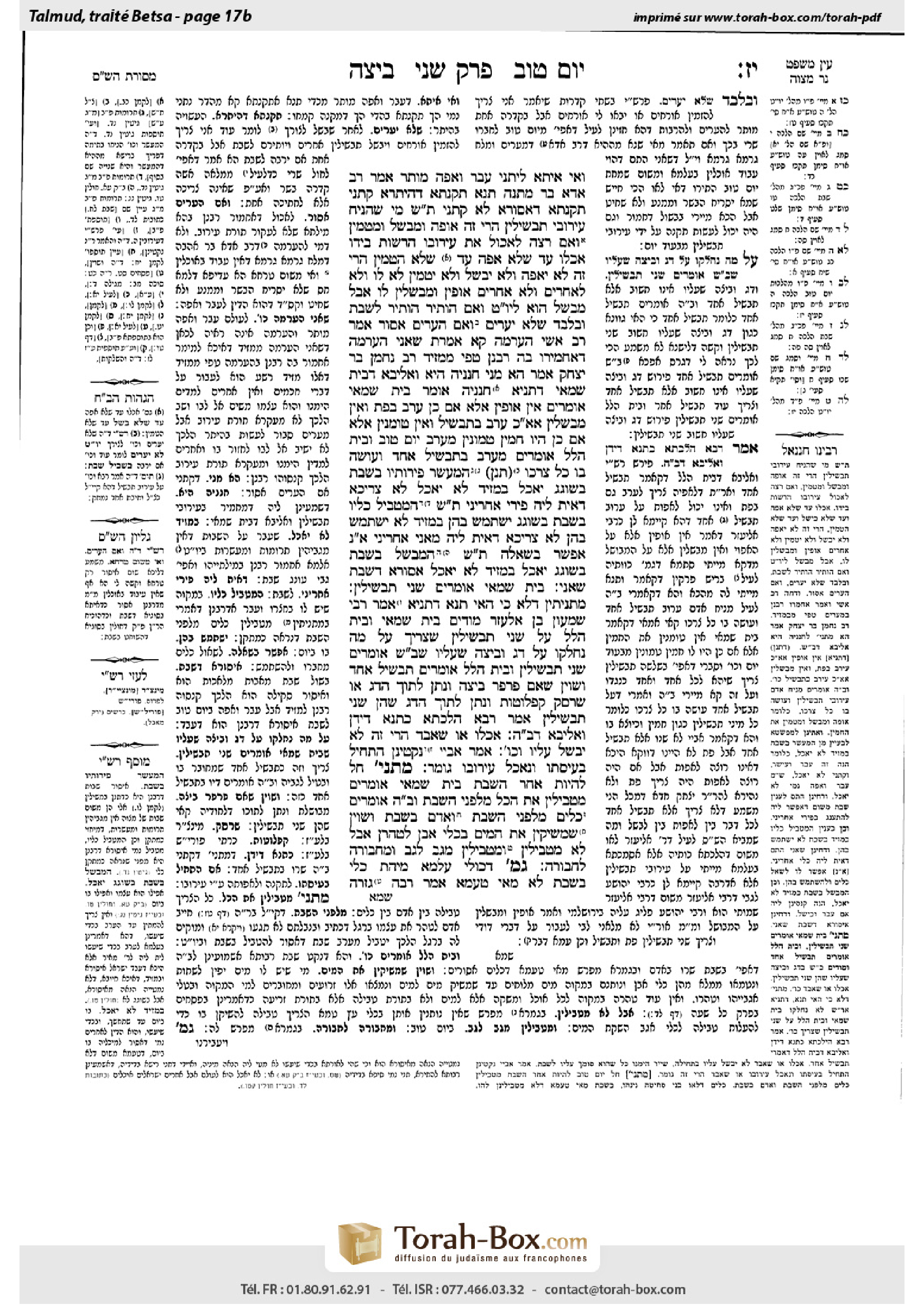
Beitzah 17b: Talmud study for Daf Yomi
Study the Talmud for Daf Yomi with scanned pages, Hebrew text, English translations from Sefaria and AI-generated French translations.
Passage selection and English or AI-generated French translation are available where the scan has annotations. Daf Study is independent of Torah-Box and Sefaria.
Browse Beitzah · ביצה · All tractatesBeitzah 17b text and translations
This page of Beitzah includes the Aramaic text, an English translation and an AI-generated French translation, alongside the scan above.
ביצה י״ז ב · Aramaic and Hebrew text
וְאִי אִיתָא, לִיתְנֵי: עָבַר וְאָפָה מוּתָּר! אָמַר רַב אַדָּא בַּר מַתְנָה: תַּנָּא, תַּקַּנְתָּא דְהֶיתֵּרָא — קָתָנֵי, תַּקַּנְתָּא דְאִסּוּרָא — לָא קָתָנֵי.
תָּא שְׁמַע: מִי שֶׁהִנִּיחַ עֵירוּבֵי תַבְשִׁילִין — הֲרֵי זֶה אוֹפֶה וּמְבַשֵּׁל וּמַטְמִין, וְאִם רָצָה לֶאֱכוֹל אֶת עֵירוּבוֹ — הָרְשׁוּת בְּיָדוֹ. אֲכָלוֹ עַד שֶׁלֹּא אָפָה עַד שֶׁלֹּא הִטְמִין — הֲרֵי זֶה לֹא יֹאפֶה וְלֹא יְבַשֵּׁל וְלֹא יַטְמִין, לֹא לוֹ וְלֹא לַאֲחֵרִים. וְלֹא אֲחֵרִים אוֹפִין וּמְבַשְּׁלִין לוֹ.
אֲבָל מְבַשֵּׁל הוּא לְיוֹם טוֹב, וְאִם הוֹתִיר — הוֹתִיר לַשַּׁבָּת, וּבִלְבַד שֶׁלֹּא יַעֲרִים. וְאִם הֶעֱרִים — אָסוּר!
אָמַר רַב אָשֵׁי: הַעֲרָמָה קָא אָמְרַתְּ — שָׁאנֵי הַעֲרָמָה דְּאַחְמִירוּ בַּהּ רַבָּנַן טְפֵי מִמֵּזִיד.
רַב נַחְמָן בַּר יִצְחָק אָמַר: הָא מַנִּי — חֲנַנְיָה הִיא, וְאַלִּיבָּא דְּבֵית שַׁמַּאי. דְּתַנְיָא, חֲנַנְיָה אוֹמֵר, בֵּית שַׁמַּאי אוֹמְרִים: אֵין אוֹפִין אֶלָּא אִם כֵּן עֵרֵב בְּפַת, וְאֵין מְבַשְּׁלִין אֶלָּא אִם כֵּן עֵרֵב בְּתַבְשִׁיל, וְאֵין טוֹמְנִין אֶלָּא אִם כֵּן הָיוּ חַמִּין טְמוּנִין מֵעֶרֶב יוֹם טוֹב.
ובֵית הִלֵּל אוֹמְרִים: מְעָרֵב בְּתַבְשִׁיל אֶחָד, וְעוֹשֶׂה בּוֹ כׇּל צָרְכּוֹ.
(תְּנַן:) הַמְעַשֵּׂר פֵּירוֹתָיו בְּשַׁבָּת, בְּשׁוֹגֵג — יֹאכַל, בְּמֵזִיד — לֹא יֹאכַל. לָא צְרִיכָא, דְּאִית לֵיהּ פֵּירֵי אַחֲרִינֵי.
תָּא שְׁמַע: הַמַּטְבִּיל כֵּלָיו בַּשַּׁבָּת, בְּשׁוֹגֵג — יִשְׁתַּמֵּשׁ בָּהֶן, בְּמֵזִיד — לֹא יִשְׁתַּמֵּשׁ בָּהֶן.
לָא צְרִיכָא, דְּאִית לֵיהּ מָאנֵי אַחֲרִינֵי. אִי נָמֵי, אֶפְשָׁר בִּשְׁאֵלָה.
תָּא שְׁמַע: הַמְבַשֵּׁל בְּשַׁבָּת, בְּשׁוֹגֵג — יֹאכַל, בְּמֵזִיד — לֹא יֹאכַל. אִסּוּרָא דְשַׁבָּת שָׁאנֵי.
בֵּית שַׁמַּאי אוֹמְרִים: שְׁנֵי תַבְשִׁילִין. מַתְנִיתִין דְּלָא כִּי הַאי תַּנָּא, דְּתַנְיָא, אָמַר רַבִּי שִׁמְעוֹן בֶּן אֶלְעָזָר: מוֹדִים בֵּית שַׁמַּאי וּבֵית הִלֵּל עַל שְׁנֵי תַבְשִׁילִין שֶׁצָּרִיךְ, עַל מָה נֶחְלְקוּ — עַל דָּג וּבֵיצָה שֶׁעָלָיו, שֶׁבֵּית שַׁמַּאי אוֹמְרִים שְׁנֵי תַבְשִׁילִין. ובֵית הִלֵּל אוֹמְרִים: תַּבְשִׁיל אֶחָד. וְשָׁוִין, שֶׁאִם פִּרְפֵּר בֵּיצָה וְנָתַן לְתוֹךְ הַדָּג, אוֹ שֶׁרִסֵּק קַפְלוֹטוֹת וְנָתַן לְתוֹךְ הַדָּג, שֶׁהֵן שְׁנֵי תַבְשִׁילִין.
אָמַר רָבָא: הִלְכְתָא כְּתַנָּא דִּידַן, וְאַלִּיבָּא דְּבֵית הִלֵּל.
אֲכָלוֹ אוֹ שֶׁאָבַד — הֲרֵי זֶה לֹא יְבַשֵּׁל עָלָיו וְכוּ׳. אָמַר אַבָּיֵי: נָקְטִינַן, הִתְחִיל בְּעִיסָּתוֹ וְנֶאֱכַל עֵירוּבוֹ — גּוֹמֵר.
מַתְנִי׳ חָל לִהְיוֹת אַחַר הַשַּׁבָּת — בֵּית שַׁמַּאי אוֹמְרִים: מַטְבִּילִין אֶת הַכֹּל מִלִּפְנֵי הַשַּׁבָּת. וּבֵית הִלֵּל אוֹמְרִים: כֵּלִים מִלִּפְנֵי הַשַּׁבָּת, וְאָדָם בְּשַׁבָּת.
וְשָׁוִין שֶׁמַּשִּׁיקִין אֶת הַמַּיִם בִּכְלִי אֶבֶן לְטַהֲרָן, אֲבָל לֹא מַטְבִּילִין. וּמַטְבִּילִין מִגַּב לְגַב וּמֵחֲבוּרָה לַחֲבוּרָה.
גְּמָ׳ דְּכוּלֵּי עָלְמָא מִיהַת — כְּלִי בְּשַׁבָּת לָא. מַאי טַעְמָא? אָמַר רַבָּה: גְּזֵרָה
Beitzah 17b · English translation
And if it is so that if one baked without having placed an eiruv for the joining of cooked foods, it is permitted to eat the bread, let the baraita simply teach: With regard to one who transgressed the prohibition and baked, it is permitted to eat the bread. Rav Adda bar Mattana said: There is no proof from here, as the tanna is teaching a remedy involving acting in a permitted manner, and is not teaching a remedy involving a prohibited act. The tanna did not want to teach that it is also possible to solve the problem in this proscribed manner.
The Gemara suggests: Come and hear a resolution from a different baraita: One who prepared an eiruv for the joining of cooked foods on a Festival eve may bake and cook and insulate food on the Festival for Shabbat that occurs on the following day, and if he wants to eat his eiruv on Shabbat, he has permission to do so. But if he ate it on the Festival before he baked or before he insulated, he may neither bake, nor cook, nor insulate, neither for himself nor for others, and likewise others may neither bake nor cook for him.
However, even without an eiruv, one in this situation may cook for the Festival itself, and if he left over part of what he cooked, he has left it over for Shabbat, provided that he does not employ artifice to circumvent the prohibition by saying that he is cooking a large amount for guests on the Festival, when in fact he has Shabbat in mind. And if he employed artifice to circumvent the prohibition, it is prohibited to eat the food, by decree of the Sages. This indicates that one who cooks on a Festival for Shabbat in a prohibited manner may not eat the food.
Rav Ashi said: This is no proof, as you speak of a case of artifice, and a case of artifice is different, as the Sages were more stringent with regard to one who employs artifice than with regard to one who intentionally cooks on a Festival for Shabbat. One who purposely transgresses is aware of his sin; therefore, he might repent and desist from his prohibited behavior, thereby preventing others from learning from his actions. However, one who employs artifice to circumvent a prohibition thinks that he is acting in a permitted manner. He is therefore likely to continue his practice. Furthermore, people might emulate him, and the halakha of preparing an eiruv might be forgotten.
Rav Naḥman bar Yitzḥak said that there is another reason to reject the proof from this baraita: In accordance with whose opinion is this baraita? It is in accordance with the opinion of Ḥananya and in accordance with the opinion of Beit Shammai. As it is taught in a baraita that Ḥananya says that Beit Shammai say: One may not bake bread on a Festival for Shabbat unless he prepared an eiruv for the joining of cooked foods on the eve of the Festival specifically with bread; and one may not cook any type of dish unless he prepared an eiruv with a cooked dish; and one may not insulate food unless there was hot food insulated from the eve of the Festival.
And Beit Hillel say: One may prepare an eiruv for the joining of cooked foods with one cooked dish and use it for all his needs, i.e., baking, cooking, and insulating. Since Ḥananya’s opinion in accordance with the opinion of Beit Shammai is strict in this case, it may be assumed that he is stringent after the fact as well, and therefore the baraita provides no proof.
The Gemara offers yet another suggestion. We learned in a mishna: In the case of one who transgressed a rabbinic prohibition and tithed his produce on Shabbat, if he did so unwittingly, he may eat of it; if he acted intentionally, he may not eat of it. This indicates that one may not derive benefit from a transgression that he committed intentionally. The Gemara rejects this argument: No, it is necessary to teach this halakha with regard to a case where he has other produce and therefore does not greatly suffer as a result. However, the Sages may have been more lenient with one who did not make an eiruv for the joining of cooked food and consequently has nothing to eat.
The Gemara poses another resolution: Come and hear a proof from a different source: In the case of one who immerses his vessels on Shabbat, an activity that the Sages prohibited because it is akin to repairing a vessel, if he did so unwittingly, he may use them; however, if he did so intentionally, he may not use them. This shows that the product of an action performed in a prohibited manner is prohibited.
The Gemara rejects this argument: No, it is necessary to teach this halakha with regard to a case where he has other vessels and is not forced to use these ones. Alternatively, it is possible for him to manage by borrowing vessels from others. But if one failed to set aside an eiruv for the joining of cooked foods, perhaps the Sages allowed him to eat the food he cooked on the Festival for Shabbat since it is difficult to obtain food from others on Shabbat.
The Gemara suggests another proof: Come and hear that which was taught in the following baraita: In the case of one who cooks on Shabbat, if he did so unwittingly, he may eat the food that he cooked; but if he cooked it intentionally, he may not eat it. This demonstrates that one who purposely violated a prohibition may not benefit from his prohibited action. The Gemara rejects this argument: There is no proof from here; the prohibition of Shabbat desecration is different, since it entails karet and execution by a court. The same stringency might not necessarily apply to cooking on a Festival for the sake of the next day, and therefore the question raised above remains unresolved.
§ It is stated in the mishna: Beit Shammai say that for the purpose of the joining of cooked foods one must prepare two cooked dishes, whereas Beit Hillel say that one dish suffices. The Gemara comments: The mishna is not in accordance with the opinion of this tanna, who taught in the Tosefta that Rabbi Shimon ben Elazar said: Beit Shammai and Beit Hillel agree that two dishes are necessary. With regard to what do they disagree? They disagree with regard to a fried fish and the egg on it, as Beit Shammai say: Two proper dishes are required, and this fish is considered only a single dish; and Beit Hillel say: One dish of this kind is viewed as two dishes and is therefore suitable for an eiruv for the joining of cooked foods. And they both agree that if one sliced a cooked egg and placed it inside the fish, or if he mashed leeks [kaflotot] and placed them inside the fish, they are considered two dishes.
Rava said: The halakha is in accordance with the opinion of the tanna of our mishna and in accordance with the opinion of Beit Hillel that one dish suffices.
The mishna states that if one ate the food prepared before the Festival as an eiruv or if it was lost, he may not rely on it and cook with the initial intent to cook for Shabbat. Abaye said: We have a tradition that if one prepared a proper eiruv and began kneading his dough on a Festival for Shabbat, and in the meantime his eiruv was eaten, he may finish baking the bread. Since he had begun in a permitted manner, he is allowed to complete the process and bake the bread.
MISHNA: If a Festival occurs directly after Shabbat, i.e., on a Sunday, and one wishes to behave in a proper manner and purify himself and his vessels in honor of the Festival, Beit Shammai say: One must immerse everything before Shabbat, and Beit Hillel say: Vessels must be immersed before Shabbat, but a person may immerse himself even on Shabbat.
And Beit Shammai and Beit Hillel both agree that one may bring ritually impure water into contact with ritually pure water in stone vessels on Shabbat in order to purify the water. Impure water can be purified if it is placed into a vessel that does not contract ritual impurity, such as a stone vessel, and then lowered with the vessel into a ritual bath. The water becomes purified when it comes into contact with the water of the ritual bath. Although this is not considered proper immersion, water may nevertheless be purified in this manner. However, one may not immerse the impure water in a ritually impure vessel in order to purify the vessel at the same time. Likewise, one may immerse on a Festival from one principle to another, and from one group to another, as will be explained in the Gemara.
GEMARA: In any event, everyone agrees, i.e., both Beit Shammai and Beit Hillel agree, that one may not immerse a vessel on Shabbat. The Gemara asks: What is the reason that one may not do so? Which type of prohibited labor does it involve? Rabba said: It is a decree issued by the Sages as a preventive measure,
Beitzah 17b · Traduction française (IA)
Et si c'est ainsi que si l'on a cuit sans avoir mis un eiruv pour la cuisson conjointe des aliments, il est permis de manger le pain, que la baraïta enseigne simplement ainsi : concernant celui qui a transgressé l'interdiction et a cuit, il est permis de manger le pain. Rav Adda bar Mattana a dit : il n'y a pas de preuve ici, car le tanna enseigne un remède impliquant une action permise, et ne parle pas d'un remède impliquant une action interdite. Le tanna n'avait pas l'intention d'enseigner que l'on pouvait résoudre le problème de cette manière interdite.
La Guemara suggère : viens écouter une résolution d'une autre baraïta : celui qui a préparé un eiruv pour la cuisson conjointe des aliments la veille de la fête peut cuire et insoler des aliments sur la fête pour le sabbat qui suit, et s'il veut manger son eiruv le sabbat, il a le droit de le faire. Mais s'il l'a mangé à la fête avant de cuire ou avant d'isoler, il ne peut ni cuire, ni insoler, ni isoler, ni pour lui-même ni pour autrui, et de même, les autres ne peuvent ni cuire ni insoler pour lui.
Cependant, même sans eiruv, une personne dans cette situation peut cuire pour la fête elle-même, et si il a laissé une partie de ce qu'il a cuisiné, il l'a laissé pour le sabbat, à condition qu'il n'emploie pas d'artifice pour contourner l'interdiction en disant qu'il cuisine une grande quantité pour ses invités à la fête, alors qu'en réalité il pense au sabbat. Et si il a employé un artifice pour contourner l'interdiction, il est interdit de manger les aliments, par décision des Sages. Cela montre que celui qui cuisine à la fête pour le sabbat de manière interdite ne peut pas manger les aliments.
Rav Ashi a dit : cela n'est pas une preuve, car vous parlez d'un cas d'artifice, et un cas d'artifice est différent, car les Sages étaient plus stricts concernant celui qui utilise un artifice que celui qui cuisine intentionnellement à la fête pour le sabbat. Celui qui transgresse intentionnellement est conscient de son péché ; il pourrait donc se repentir et s'arrêter de son comportement interdit, empêchant ainsi les autres de s'inspirer de ses actions. Cependant, celui qui utilise un artifice pour contourner une interdiction pense qu'il agit dans un mode permis. Il est donc susceptible de continuer sa pratique. De plus, les gens pourraient s'inspirer de lui, et la halakha de préparer un eiruv pourrait être oubliée.
Rav Naḥman bar Yitzḥak a dit que l'on peut rejeter la preuve de cette baraïta pour une autre raison : selon quel opinion est-ce que cette baraïta ? C'est selon l'opinion de Ḥananya et selon l'opinion de Beit Shammai. Car il est enseigné dans une baraïta que Ḥananya dit que Beit Shammai disent : on ne peut pas cuire du pain à la fête pour le sabbat sans avoir préparé un eiruv pour la cuisson conjointe des aliments la veille de la fête spécifiquement avec du pain ; et on ne peut pas cuire n'importe quel plat sans avoir préparé un eiruv avec un plat cuisiné ; et on ne peut pas isoler des aliments sans avoir eu un aliment chaud isolé la veille de la fête.
Et Beit Hillel disent : on peut préparer un eiruv pour la cuisson conjointe des aliments avec un seul plat cuisiné et l'utiliser pour toutes ses besoins, c'est-à-dire cuire, cuisiner et isoler. Puisque l'opinion de Ḥananya selon l'opinion de Beit Shammai est stricte dans ce cas, on peut supposer qu'il est strict après coup également, et donc la baraïta ne fournit pas de preuve.
La Guemara propose une autre suggestion. Nous avons appris dans une mitsna : dans le cas d'une personne qui a transgressé une interdiction rabbinique et a titré ses produits le sabbat, s'il l'a fait sans le savoir, il peut manger de cela ; s'il l'a fait intentionnellement, il ne peut pas manger de cela. Cela montre que l'on ne peut pas tirer un bénéfice d'une transgression que l'on a commise intentionnellement. La Guemara rejette cet argument : Non, il faut enseigner cette halakha dans un cas où il a d'autres produits et n'endure donc pas grand-chose. Cependant, les Sages auraient pu être plus indulgents envers celui qui n'a pas préparé un eiruv pour la cuisson conjointe des aliments et a donc rien à manger.
La Guemara pose une autre résolution : viens écouter une preuve d'une autre source : dans le cas d'une personne qui immerse ses ustensiles le sabbat, une activité que les Sages ont interdite car elle ressemble à la réparation d'un ustensile, s'il l'a fait sans le savoir, il peut utiliser ceux-ci ; cependant, s'il l'a fait intentionnellement, il ne peut pas les utiliser. Cela montre que le produit d'une action accomplie de manière interdite est interdit.
La Guemara rejette cet argument : Non, il faut enseigner cette halakha dans un cas où il a d'autres ustensiles et n'est pas contraint d'utiliser ceux-ci. Alternativement, il est possible qu'il puisse s'en sortir en empruntant des ustensiles à d'autres. Mais si l'on n'a pas mis de côté un eiruv pour la cuisson conjointe des aliments, peut-être les Sages ont-ils permis de manger les aliments cuits à la fête pour le sabbat, car il est difficile d'obtenir des aliments d'autres personnes le sabbat.
La Guemara suggère une autre preuve : viens écouter ce qui a été enseigné dans la baraïta suivante : dans le cas d'une personne qui cuisine le sabbat, s'il l'a fait sans le savoir, il peut manger la nourriture qu'il a cuisinée ; mais s'il l'a fait intentionnellement, il ne peut pas manger cette nourriture. Cela montre que celui qui a volontairement violé une interdiction ne peut pas tirer un bénéfice de son action interdite. La Guemara rejette cet argument : il n'y a pas de preuve ici ; l'interdiction de désobliger le sabbat est différente, car elle implique la karet et l'exécution par un tribunal. La même stricteur ne s'appliquerait pas nécessairement à la cuisson à la fête pour le sabbat suivant, et donc la question soulevée ci-dessus reste sans réponse.
§ Il est dit dans la mitsna : Beit Shammai disent que pour l'union des aliments cuits, il faut préparer deux plats cuits, tandis que Beit Hillel disent qu'un seul plat suffit. La Guemara commente : La mitsna ne suit pas l'opinion de ce tanna, qui a enseigné dans la Tosefta que Rabbi Shimon ben Elazar a dit : Beit Shammai et Beit Hillel s'accordent sur le fait que deux plats sont nécessaires. Sur quel point s'opposent-ils ? Ils s'opposent sur un poisson frit et l'œuf qui y est placé, car Beit Shammai disent : Deux plats appropriés sont requis, et ce poisson est considéré comme un seul plat ; et Beit Hillel disent : Un plat de ce genre est considéré comme deux plats et est donc adapté à l'eiruv pour l'union des aliments cuits. Et ils s'accordent tous deux sur le fait que si l'on avait tranché un œuf cuit et l'avait placé à l'intérieur du poisson, ou si l'on avait écrasé des oignons [kaflotot] et les avait placés à l'intérieur du poisson, ils seraient considérés comme deux plats.
Rava a dit : La halakha suit l'opinion du tanna de notre mitsna et l'opinion de Beit Hillel qui disent qu'un seul plat suffit.
La mitsna stipule que si l'on a mangé les aliments préparés avant la Fête comme un eiruv ou s'ils ont été perdus, on ne peut pas compter sur eux et cuisiner avec l'intention initiale de cuisiner pour le Sabbat. Abaye a dit : Nous avons une tradition selon laquelle si l'on avait préparé un eiruv approprié et avait commencé à pétrir sa pâte le Sabbat pour la Fête, et en attendant que son eiruv soit mangé, il pouvait terminer la cuisson du pain. Puisqu'il avait commencé de manière permise, il était autorisé à terminer le processus et à cuire le pain.
MICHNA : Si une Fête survient directement après le Sabbat, c'est-à-dire un dimanche, et qu'on désire se comporter de manière appropriée, se purifier soi-même et ses ustensiles en l'honneur de la Fête, Beit Shammai disent : Il faut immerger tout avant le Sabbat, et Beit Hillel disent : Les ustensiles doivent être immergés avant le Sabbat, mais une personne peut s'immerger même le Sabbat.
Et Beit Shammai et Beit Hillel s'accordent tous deux sur le fait qu'on peut introduire de l'eau impure rituellement en contact avec de l'eau pure rituellement dans des récipients en pierre le Sabbat afin de purifier l'eau. L'eau impure peut être purifiée si elle est placée dans un récipient qui ne contracte pas l'impureté rituelle, comme un récipient en pierre, et ensuite abaissé avec le récipient dans un bain rituel. L'eau devient pure lorsqu'elle entre en contact avec l'eau du bain rituel. Bien que cela ne soit pas considéré comme une immersion appropriée, l'eau peut toutefois être purifiée ainsi. Cependant, on ne peut pas immerger l'eau impure dans un récipient impur rituellement afin de purifier le récipient en même temps. De même, on peut immerger le Sabbat d'un principe à un autre et d'un groupe à un autre, comme cela sera expliqué dans la Guemara.
GUEMARA : En tout cas, tout le monde s'accorde, c'est-à-dire que Beit Shammai et Beit Hillel s'accordent, sur le fait qu'on ne peut pas immerger un récipient le Sabbat. La Guemara pose la question : Quel est le motif qui empêche de le faire ? Quel type de travail interdit cela implique-t-il ? Rabba a dit : C'est un décret émis par les Sages comme mesure préventive,
Traduction française générée par IA à partir de l’édition anglaise de Sefaria. Vérifie toujours un passage avec le texte source.
Text from Sefaria: William Davidson Edition - Vocalized Aramaic (CC BY NC); William Davidson Edition - English (CC BY NC).