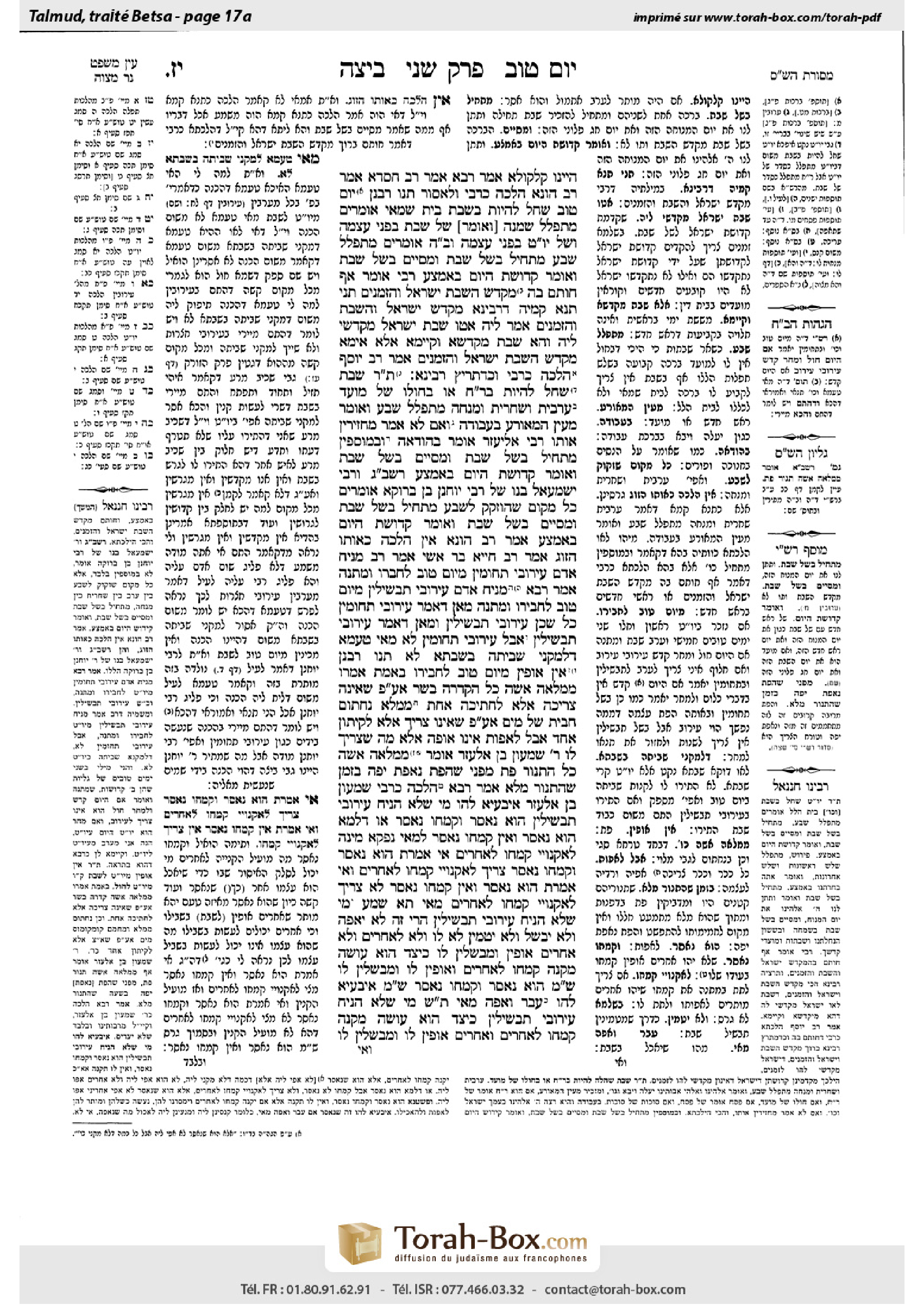
Beitzah 17a: Talmud study for Daf Yomi
Study the Talmud for Daf Yomi with scanned pages, Hebrew text, English translations from Sefaria and AI-generated French translations.
Passage selection and English or AI-generated French translation are available where the scan has annotations. Daf Study is independent of Torah-Box and Sefaria.
Browse Beitzah · ביצה · All tractatesBeitzah 17a text and translations
This page of Beitzah includes the Aramaic text, an English translation and an AI-generated French translation, alongside the scan above.
ביצה י״ז א · Aramaic and Hebrew text
הַיְינוּ קִלְקוּלָא. אָמַר רָבָא אָמַר רַב חִסְדָּא אָמַר רַב הוּנָא: הֲלָכָה כְּרַבִּי, וּלְאִסּוּר.
תָּנוּ רַבָּנַן: יוֹם טוֹב שֶׁחָל לִהְיוֹת בְּשַׁבָּת, בֵּית שַׁמַּאי אוֹמְרִים: מִתְפַּלֵּל שְׁמֹנֶה, [וְאוֹמֵר] שֶׁל שַׁבָּת בִּפְנֵי עַצְמָהּ, וְשֶׁל יוֹם טוֹב בִּפְנֵי עַצְמָהּ. וּבֵית הִלֵּל אוֹמְרִים: מִתְפַּלֵּל שֶׁבַע, מַתְחִיל בְּשֶׁל שַׁבָּת וּמְסַיֵּים בְּשֶׁל שַׁבָּת, וְאוֹמֵר קְדוּשַּׁת הַיּוֹם בָּאֶמְצַע. רַבִּי אוֹמֵר, אַף חוֹתֵם בָּהּ: ״מְקַדֵּשׁ הַשַּׁבָּת, יִשְׂרָאֵל וְהַזְּמַנִּים״.
תָּנֵי תַּנָּא קַמֵּיהּ דְּרָבִינָא: ״מְקַדֵּשׁ יִשְׂרָאֵל וְהַשַּׁבָּת וְהַזְּמַנִּים״. אֲמַר לֵיהּ: אַטּוּ שַׁבָּת יִשְׂרָאֵל מְקַדְּשִׁי לֵיהּ? וְהָא שַׁבָּת מִקַּדְּשָׁא וְקָיְימָא. אֶלָּא אֵימָא: ״מְקַדֵּשׁ הַשַּׁבָּת, יִשְׂרָאֵל וְהַזְּמַנִּים״. אָמַר רַב יוֹסֵף: הֲלָכָה כְּרַבִּי, וְכִדְתָרֵיץ רָבִינָא.
תָּנוּ רַבָּנַן: שַׁבָּת שֶׁחָל לִהְיוֹת בְּרֹאשׁ חוֹדֶשׁ אוֹ בְּחוּלּוֹ שֶׁל מוֹעֵד, עַרְבִית וְשַׁחֲרִית וּמִנְחָה מִתְפַּלֵּל שֶׁבַע, וְאוֹמֵר מֵעֵין הַמְאוֹרָע בָּעֲבוֹדָה, וְאִם לֹא אָמַר — מַחְזִירִין אוֹתוֹ. רַבִּי אֱלִיעֶזֶר אוֹמֵר: בַּהוֹדָאָה. וּבַמּוּסָפִין מַתְחִיל בְּשֶׁל שַׁבָּת וּמְסַיֵּים בְּשֶׁל שַׁבָּת, וְאוֹמֵר קְדוּשַּׁת הַיּוֹם בָּאֶמְצַע.
רַבָּן שִׁמְעוֹן בֶּן גַּמְלִיאֵל וְרַבִּי יִשְׁמָעֵאל בְּנוֹ שֶׁל רַבִּי יוֹחָנָן בֶּן בְּרוֹקָא אוֹמְרִים: כׇּל מָקוֹם שֶׁהוּזְקַק לְשֶׁבַע, מַתְחִיל בְּשֶׁל שַׁבָּת וּמְסַיֵּים בְּשֶׁל שַׁבָּת וְאוֹמֵר קְדוּשַּׁת הַיּוֹם בָּאֶמְצַע. אָמַר רַב הוּנָא: אֵין הֲלָכָה כְּאוֹתוֹ הַזּוּג.
אָמַר רַב חִיָּיא בַּר אָשֵׁי אָמַר רַב: מַנִּיחַ אָדָם עֵירוּבֵי תְחוּמִין מִיּוֹם טוֹב לַחֲבֵרוֹ, וּמַתְנֶה.
אָמַר רָבָא: מַנִּיחַ אָדָם עֵירוּבֵי תַבְשִׁילִין מִיּוֹם טוֹב לַחֲבֵירוֹ, וּמַתְנֶה.
מַאן דְּאָמַר עֵירוּבֵי תְחוּמִין — כׇּל שֶׁכֵּן עֵירוּבֵי תַבְשִׁילִין, וּמַאן דְּאָמַר עֵירוּבֵי תַבְשִׁילִין — אֲבָל עֵירוּבֵי תְחוּמִין לָא. מַאי טַעְמָא — דִּלְמִקְנֵי שְׁבִיתָה בְּשַׁבְּתָא לָא.
תָּנוּ רַבָּנַן: אֵין אוֹפִין מִיּוֹם טוֹב לַחֲבֵירוֹ. בֶּאֱמֶת אָמְרוּ: מְמַלְּאָה אִשָּׁה כׇּל הַקְּדֵרָה בָּשָׂר, אַף עַל פִּי שֶׁאֵינָהּ צְרִיכָה אֶלָּא לַחֲתִיכָה אַחַת. מְמַלֵּא נַחְתּוֹם חָבִית שֶׁל מַיִם, אַף עַל פִּי שֶׁאֵינוֹ צָרִיךְ אֶלָּא לְקִיתוֹן אֶחָד. אֲבָל לֶאֱפוֹת — אֵינוֹ אוֹפֶה אֶלָּא מַה שֶּׁצָּרִיךְ לוֹ.
רַבִּי שִׁמְעוֹן בֶּן אֶלְעָזָר אוֹמֵר: מְמַלְּאָה אִשָּׁה כׇּל הַתַּנּוּר פַּת, מִפְּנֵי שֶׁהַפַּת נֶאֱפֵת יָפֶה בִּזְמַן שֶׁהַתַּנּוּר מָלֵא. אָמַר רָבָא: הֲלָכָה כְּרַבִּי שִׁמְעוֹן בֶּן אֶלְעָזָר.
אִיבַּעְיָא לְהוּ: מִי שֶׁלֹּא הִנִּיחַ עֵירוּבֵי תַבְשִׁילִין, הוּא נֶאֱסָר וְקִמְחוֹ נֶאֱסָר, אוֹ דִלְמָא: הוּא נֶאֱסָר וְאֵין קִמְחוֹ נֶאֱסָר?
לְמַאי נָפְקָא מִינַּהּ? לְאַקְנוֹיֵי קִמְחוֹ לַאֲחֵרִים. אִי אָמְרַתְּ הוּא נֶאֱסָר וְקִמְחוֹ נֶאֱסָר — צָרִיךְ לְאַקְנוֹיֵי קִמְחוֹ לַאֲחֵרִים. וְאִי אָמְרַתְּ הוּא נֶאֱסָר וְאֵין קִמְחוֹ נֶאֱסָר — לָא צְרִיךְ לְאַקְנוֹיֵי קִמְחוֹ לַאֲחֵרִים. מַאי?
תָּא שְׁמַע: מִי שֶׁלֹּא הִנִּיחַ עֵירוּבֵי תַבְשִׁילִין, הֲרֵי זֶה לֹא יֹאפֶה וְלֹא יְבַשֵּׁל וְלֹא יַטְמִין, לֹא לוֹ וְלֹא לַאֲחֵרִים. וְלֹא אֲחֵרִים אוֹפִין וּמְבַשְּׁלִין לוֹ. כֵּיצַד הוּא עוֹשֶׂה — מַקְנֶה קִמְחוֹ לַאֲחֵרִים וְאוֹפִין לוֹ וּמְבַשְּׁלִין לוֹ. שְׁמַע מִינַּהּ: הוּא נֶאֱסָר וְקִמְחוֹ נֶאֱסָר, שְׁמַע מִינַּהּ.
אִיבַּעְיָא לְהוּ: עָבַר וְאָפָה, מַאי? תָּא שְׁמַע: מִי שֶׁלֹּא הִנִּיחַ עֵירוּבֵי תַבְשִׁילִין, כֵּיצַד הוּא עוֹשֶׂה — מַקְנֶה קִמְחוֹ לַאֲחֵרִים, וַאֲחֵרִים אוֹפִין לוֹ וּמְבַשְּׁלִין לוֹ.
Beitzah 17a · English translation
this is the corruption that might result from a ruling that renders it prohibited to prepare an eiruv the day before. Therefore, this cannot serve as proof of the conclusive ruling. Rava said that Rav Ḥisda said that Rav Huna said: The halakha is in accordance with the opinion of Rabbi Yehuda HaNasi to prohibit one from preparing either type of eiruv. One may not prepare an eiruv either for courtyards or for boundaries, as the halakha is in accordance with Rabbi Elazar’s version of the opinion of Rabbi Yehuda HaNasi.
§ The Sages taught the following baraita: In the case of a Festival that occurs on Shabbat, Beit Shammai say: One must recite an Amida prayer that includes eight blessings, inserting two additional blessings between the standard opening three and concluding three. As for the two middle blessings, one recites one for Shabbat as an independent blessing and a second for the Festival as an independent blessing. And Beit Hillel say: One must pray an Amida comprising only seven blessings, i.e., the three opening ones, the three concluding ones, and one in between. One begins the middle blessing with Shabbat and concludes it with Shabbat, and he recites a passage referring to the sanctity of the day of the Festival in the middle. Rabbi Yehuda HaNasi says: He even concludes this blessing with mention of both Shabbat and the Festival, saying: Who sanctifies Shabbat, the Jewish people, and the seasons.
A tanna taught a baraita before Ravina with a slightly different reading: He concludes the blessing with: Who sanctifies the Jewish people, Shabbat, and the seasons. Ravina said to that tanna: Is that to say that the Jewish people sanctify Shabbat? Isn’t Shabbat already sanctified from the six days of Creation? Every seventh day is automatically Shabbat, without the need for any declaration on the part of the Jewish people. Rather, amend it and say as follows: Who sanctifies Shabbat, the Jewish people, and the seasons, as the Jewish people indeed sanctify the New Moon and the Festival days. Rav Yosef said: The halakha with regard to the conclusion of the blessing is in accordance with the opinion of Rabbi Yehuda HaNasi and as the difficulty was resolved by Ravina.
The Sages taught the following baraita: In the case of Shabbat that occurs on a New Moon or on one of the intermediate days of a Festival, for the evening, morning, and afternoon prayers, one prays in his usual manner, reciting seven blessings in the Amida, and recites a passage pertaining to the event of the day, i.e.: May there rise and come [ya’aleh veyavo], during the blessing of the Temple service, known as retze; and if he did not recite it, he is required to return to the beginning of the Amida prayer and repeat it. Rabbi Eliezer disagrees and says: This passage is recited during the blessing of thanksgiving, known as modim. And in the additional prayer one begins the fourth blessing, the special blessing for the additional service, with Shabbat, and concludes it with Shabbat, and recites a passage pertaining to the sanctity of the day of the New Moon or the Festival in the middle.
Rabban Shimon ben Gamliel and Rabbi Yishmael, son of Rabbi Yoḥanan ben Beroka, disagree and say: Wherever one is required to recite seven blessings, whether in the evening, morning, or afternoon prayers, he begins the fourth blessing with Shabbat and concludes it with Shabbat, and recites a passage referring to the sanctity of the day of the New Moon or the Festival in the middle. Rav Huna said: The halakha is not in accordance with the opinion of that pair of scholars; rather, it is in accordance with the opinion of the first tanna, that in the evening, morning, and afternoon prayers one recites the usual seven blessings and recites a passage pertaining to the event of the day during the blessing of the Temple service.
§ Rav Ḥiyya bar Ashi said that Rav said: If a person forgot to place an eiruv before a Festival occurring on Thursday and Friday in the Diaspora, he may act as follows: He may place an eiruv for the joining of Shabbat boundaries on the first Festival day for the next, i.e., on the first Festival day for the second Festival day kept in the Diaspora, based on a doubt as to which day is the real day of the Festival, and stipulate as follows: If today is in fact the Festival, then tomorrow is a weekday, on which I may walk as far as I wish in all directions; and if today is a weekday and tomorrow is the Festival, I hereby place an eiruv for the joining of Shabbat boundaries for tomorrow. On the following day he makes a similar stipulation with the same eiruv, so that he will have an eiruv for Shabbat.
Rava said: A person may place an eiruv for the joining of cooked foods on the first Festival day for the next day and stipulate as follows: If today is a weekday and tomorrow is the Festival, this is my joining of cooked foods, so that I may rely on it to cook tomorrow for Shabbat; and if today is in fact the Festival and tomorrow is a weekday, I may cook tomorrow as on a regular weekday.
The Gemara comments: With regard to the one who said this halakha concerning an eiruv for the joining of Shabbat boundaries, all the more so would he permit one to act in this manner concerning an eiruv for the joining of cooked foods. On the other hand, the one who said this halakha with regard to an eiruv for the joining of cooked foods spoke only with regard to the joining of cooked foods; however, as for an eiruv for the joining of Shabbat boundaries, this is not permitted. The Gemara asks: What is the reason for this difference? It is that they did not permit the acquisition of residence on a day of rest, even in a case of uncertainty. However, with regard to an eiruv for the joining of cooked foods, since it is merely symbolic, it is permitted for the sake of the honor of Shabbat.
The Sages taught in a baraita: One may not bake bread on one Festival day for the next, i.e., on the first Festival day for the second Festival day kept in the Diaspora. Nevertheless, actually, they said the following established halakha: A woman may fill an entire pot with meat to cook on a Festival, although she requires only one piece for that day, and all the remainder will be for the following day. Similarly, a baker may fill an entire barrel with water in order to heat it up although he requires only a jug of hot water. But with regard to baking, he may bake only that which he requires for that day.
The baraita continues: Rabbi Shimon ben Elazar says: A woman may fill the entire oven with bread, although she does not intend to use it all on that day, because bread bakes well when the oven is full. A full oven has less empty space and is therefore hotter; consequently, filling the oven with bread serves not only to provide bread for the next day but also to improve the bread to be eaten that same day. Rava said: The halakha is in accordance with the opinion of Rabbi Shimon ben Elazar.
§ A dilemma was raised before the Sages: In the case of one who did not prepare an eiruv for the joining of cooked foods, is he prohibited from cooking for Shabbat and his flour is likewise prohibited, meaning that none of his food may be prepared for Shabbat? Or perhaps only he is prohibited from performing this type of labor, but his flour is not prohibited.
The Gemara asks: What is the practical halakhic difference that emerges from this question? The Gemara explains: There is a difference with respect to whether or not he must transfer ownership of his flour to others. If you say that he is prohibited and his flour is also prohibited, he must transfer his flour to others so that they are able to bake for him if they so desire. But if you say that only he is prohibited but his flour is not prohibited, he need not transfer his flour to others, as they may bake for him even if the flour is not theirs. The Gemara asks: What, then, is the halakha?
The Gemara answers: Come and hear a resolution from the following baraita: One who did not prepare an eiruv for the joining of cooked foods on a Festival eve may neither bake, nor cook, nor insulate food on the Festival for Shabbat that occurs on the following day, neither for himself nor for others, and others may neither bake nor cook for him. What should he do so that he will have food to eat on Shabbat? He must transfer his flour to others, and they may then bake and cook for him. Learn from here, from the fact that the baraita states that he must transfer his flour to others, that he is prohibited and his flour is also prohibited. The Gemara concludes: Indeed, learn from here that this is the case.
Another dilemma was raised before the Sages: In the case of one who transgressed this prohibition and baked on a Festival for Shabbat without having placed an eiruv for the joining of cooked foods on the eve of the Festival, what is the halakha? Is it permitted to partake of his bread and his cooking? The Gemara suggests: Come and hear a resolution to this question from the following baraita: With regard to one who did not prepare an eiruv for the joining of cooked foods, what should he do so that he will have food to eat on Shabbat? He must transfer his flour to others, and they may then bake and cook for him.
Beitzah 17a · Traduction française (IA)
C’est la corruption qui pourrait résulter d’un décret rendant interdit de préparer un eiruv la veille. Par conséquent, cela ne peut pas servir de preuve d’un décret définitif. Rava a dit que Rav Ḥisda a dit que Rav Huna a dit : La halakha suit l’opinion de Rabbi Yehuda HaNasi interdisant de préparer l’un ou l’autre type d’eiruv. On ne peut pas préparer un eiruv, qu’il s’agisse des courtyards ou des limites, car la halakha suit l’opinion de Rabbi Elazar concernant l’opinion de Rabbi Yehuda HaNasi.
§ Les Sages ont enseigné la suivante baraïta : Dans le cas d’un festival qui tombe un samedi, Beit Shammai disent : On doit réciter une prière d’Amida comprenant huit bénédictions, en insérant deux bénédictions supplémentaires entre les trois bénédictions d’ouverture et les trois bénédictions de conclusion. Quant aux deux bénédictions du milieu, on récite une pour le samedi en tant que bénéfice indépendant et une seconde pour le festival en tant que bénéfice indépendant. Et Beit Hillel disent : On doit prier une Amida comprenant sept bénédictions, c’est-à-dire les trois bénédictions d’ouverture, les trois bénédictions de conclusion et une bénéfice intermédiaire. On commence la bénéfice intermédiaire avec le samedi et on le termine avec le samedi, et on récite un passage faisant référence à la sainteté du jour du festival au milieu. Rabbi Yehuda HaNasi dit : On termine même cette bénéfice avec la mention des deux, le samedi et le festival, en disant : Celui qui sanctifie le samedi, le peuple juif et les saisons.
Un tanna a enseigné une baraïta devant Ravina avec une lecture légèrement différente : On termine la prière avec : Celui qui sanctifie le peuple juif, le samedi et les saisons. Ravina a dit à ce tanna : Est-ce que cela signifie que le peuple juif sanctifie le samedi ? N’est-ce pas le samedi qui est déjà sanctifié à partir des six jours de la Création ? Chaque septième jour est automatiquement samedi, sans la nécessité d’aucune déclaration de la part du peuple juif. Plutôt, corrigez cela et dites comme suit : Celui qui sanctifie le samedi, le peuple juif et les saisons, car le peuple juif sanctifie effectivement la nouvelle lune et les jours de fête. Rav Yosef a dit : La halakha concernant la conclusion de la prière suit l’opinion de Rabbi Yehuda HaNasi et la difficulté a été résolue par Ravina.
Les Sages ont enseigné la suivante baraïta : Dans le cas d’un samedi qui tombe une nouvelle lune ou un jour intermédiaire d’un festival, pour la prière du soir, de l’aurore et de l’après-midi, on prie selon sa manière habituelle, récitant sept bénédictions dans l’Amida, et on récite un passage concernant l’événement du jour, c’est-à-dire : Que monte et vienne [ya’aleh veyavo], pendant la bénéfice du service du Temple, connu sous le nom de retze ; et s’il n’a pas récité cela, il est tenu de retourner au début de la prière d’Amida et de la répéter. Rabbi Eléazar désaccorde et dit : Ce passage est récité pendant la bénéfice de gratitude, connu sous le nom de modim. Et dans la prière additionnelle, on commence la quatrième bénéfice, la bénéfice spéciale pour la prière additionnelle, avec le samedi et on le termine avec le samedi, et on récite un passage concernant la sainteté du jour de la nouvelle lune ou du festival au milieu.
Rabban Shimon ben Gamliel et Rabbi Yishmael, fils de Rabbi Yoḥanan ben Beroka, s'opposent et disent : Partout où l'on est tenu de réciter sept bénédictions, qu'il s'agisse de la prière du soir, de l'aurore ou de l'après-midi, on commence la quatrième bénédictions avec le Shabbat et on la termine avec le Shabbat, et on récite un passage faisant référence à la sainteté du jour de la nouvelle lune ou du festival au milieu. Rav Huna a dit : La halakha ne suit pas l'opinion de ce couple de savants ; plutôt, elle suit l'opinion du premier tanna, qui dit que dans la prière du soir, de l'aurore et de l'après-midi, on récite les sept bénédictions habituels et on récite un passage concernant l'événement du jour pendant la bénédictions du service du Temple.
§ Rav Ḥiyya bar Ashi a dit que Rav a dit : Si une personne a oublié de placer un eiruv avant un festival qui tombe le jeudi et le vendredi en diaspora, il peut agir ainsi : Il peut placer un eiruv pour la réunion des limites du samedi sur le premier jour du festival pour le suivant, c'est-à-dire sur le premier jour du festival pour le deuxième festival de la diaspora, en raison d'un doute concernant quel jour est le vrai jour du festival, et stipuler comme suit : Si aujourd'hui est effectivement le festival, alors demain est un jour ordinaire, sur lequel je peux marcher aussi loin que je veux dans toutes les directions ; et si aujourd'hui est un jour ordinaire et demain est le festival, je stipule ici un eiruv pour la réunion des limites du samedi pour demain. Le lendemain, il fait une stipulation similaire avec le même eiruv, afin d'avoir un eiruv pour le samedi.
Rava a dit : Une personne peut placer un eiruv pour la réunion des aliments cuits sur le premier jour du festival pour le lendemain et stipuler comme suit : Si aujourd'hui est un jour ordinaire et demain est le festival, c'est ma réunion des aliments cuits, afin que je puisse m'appuyer dessus pour cuire demain pour le samedi ; et si aujourd'hui est effectivement le festival et demain est un jour ordinaire, je peux cuire demain comme un jour ordinaire.
La Guemara commente : Concernant celui qui a dit cette halakha concernant un eiruv pour la réunion des limites du samedi, tout autant que cela permettrait à une personne d’agir ainsi concernant un eiruv pour la réunion des aliments cuits. D’autre part, celui qui a dit cette halakha concernant un eiruv pour la réunion des aliments cuits a parlé uniquement concernant la réunion des aliments cuits ; cependant, concernant un eiruv pour la réunion des limites du samedi, cela n’est pas permis. La Guemara pose la question : Quelle est la raison de cette différence ? C’est que l’acquisition de résidence un jour de repos n’est pas permise, même dans un cas de doute. Cependant, concernant un eiruv pour la réunion des aliments cuits, puisque c’est simplement symbolique, il est permis à l’effet de l’honneur du samedi.
Les Sages ont enseigné dans une baraïta : On ne peut pas cuire du pain le jour de la fête pour le lendemain, c'est-à-dire le premier jour de la fête pour le deuxième jour célébré en diaspora. Cependant, en réalité, ils ont établi la halakha suivante : Une femme peut remplir entièrement une marmite de viande pour cuisiner le jour de la fête, même si elle n'en a besoin que d'une seule portion pour ce jour-là, et toutes les autres portions seront pour le lendemain. De même, un boulanger peut remplir entièrement un tonneau d'eau pour le chauffer, même s'il n'en a besoin que d'une seule juge deau chaude. Cependant, en ce qui concerne la cuisson, il ne peut cuire que ce qu'il a besoin pour ce jour-là.
La baraïta continue : Rabbi Shim'on ben Elazar dit : Une femme peut remplir entièrement le four de pain, même si elle n'a pas l'intention d'utiliser tout le pain ce jour-là, car le pain cuit bien lorsque le four est plein. Un four plein a moins d'espace vide et est donc plus chaud ; par conséquent, remplir le four de pain sert non seulement à fournir du pain pour le lendemain, mais aussi à améliorer la qualité du pain à manger ce même jour. Rava a dit : La halakha suit l'opinion de Rabbi Shim'on ben Elazar.
§ Un dilemme a été soulevé devant les Sages : Dans le cas d'une personne qui n'a pas préparé un eiruv pour la cuisson conjointe des aliments, est-il interdit de cuisiner pour le sabbat et son farine est-elle également interdite, ce qui signifie que aucun de ses aliments ne peut être préparé pour le sabbat ? Ou peut-être est-il seulement interdit d'effectuer ce type de travail, mais sa farine n'est pas interdite.
La Guemara demande : Quelle est la différence halakhique pratique qui découle de cette question ? La Guemara explique : Il y a une différence concernant la nécessité de transférer la propriété de sa farine à d'autres. Si vous dites qu'il est interdit et que sa farine est également interdite, il doit transférer sa farine à d'autres afin qu'ils puissent le faire cuire s'ils le souhaitent. Mais si vous dites qu'il est seulement interdit mais sa farine n'est pas interdite, il n'a pas besoin de transférer sa farine à d'autres, car ils peuvent le faire cuire même si la farine n'est pas la leur. La Guemara demande : Quelle est alors la halakha ?
La Guemara répond : Viens écouter une résolution à partir de la baraïta suivante : Celui qui n'a pas préparé un eiruv pour la cuisson conjointe des aliments le soir de la fête ne peut ni cuire, ni faire bouillir, ni isoler les aliments pour le sabbat qui arrive le lendemain, ni pour lui-même ni pour les autres, et les autres ne peuvent pas non plus cuire ou faire bouillir pour lui. Que doit-il faire pour avoir de la nourriture à manger le sabbat ? Il doit transférer sa farine à d'autres, et ils peuvent alors le faire cuire et faire bouillir pour lui. Apprends-en ici, du fait que la baraïta indique qu'il doit transférer sa farine à d'autres, qu'il est interdit et que sa farine est également interdite. La Guemara conclut : En effet, apprends-en ici que c'est le cas.
Un autre dilemme a été soulevé devant les Sages : Dans le cas d'une personne qui a transgressé cette interdiction et a cuisiné le jour de la fête pour le sabbat sans avoir placé un eiruv pour la cuisson conjointe des aliments le soir du jour de la fête, quelle est la halakha ? Est-il permis de manger son pain et ses préparations ? La Guemara suggère : Viens écouter une résolution à cette question à partir de la baraïta suivante : Concernant celui qui n'a pas préparé un eiruv pour la cuisson conjointe des aliments, que doit-il faire pour avoir de la nourriture à manger le sabbat ? Il doit transférer sa farine à d'autres, et ils peuvent alors le faire cuire et faire bouillir pour lui.
Traduction française générée par IA à partir de l’édition anglaise de Sefaria. Vérifie toujours un passage avec le texte source.
Text from Sefaria: William Davidson Edition - Vocalized Aramaic (CC BY NC); William Davidson Edition - English (CC BY NC).