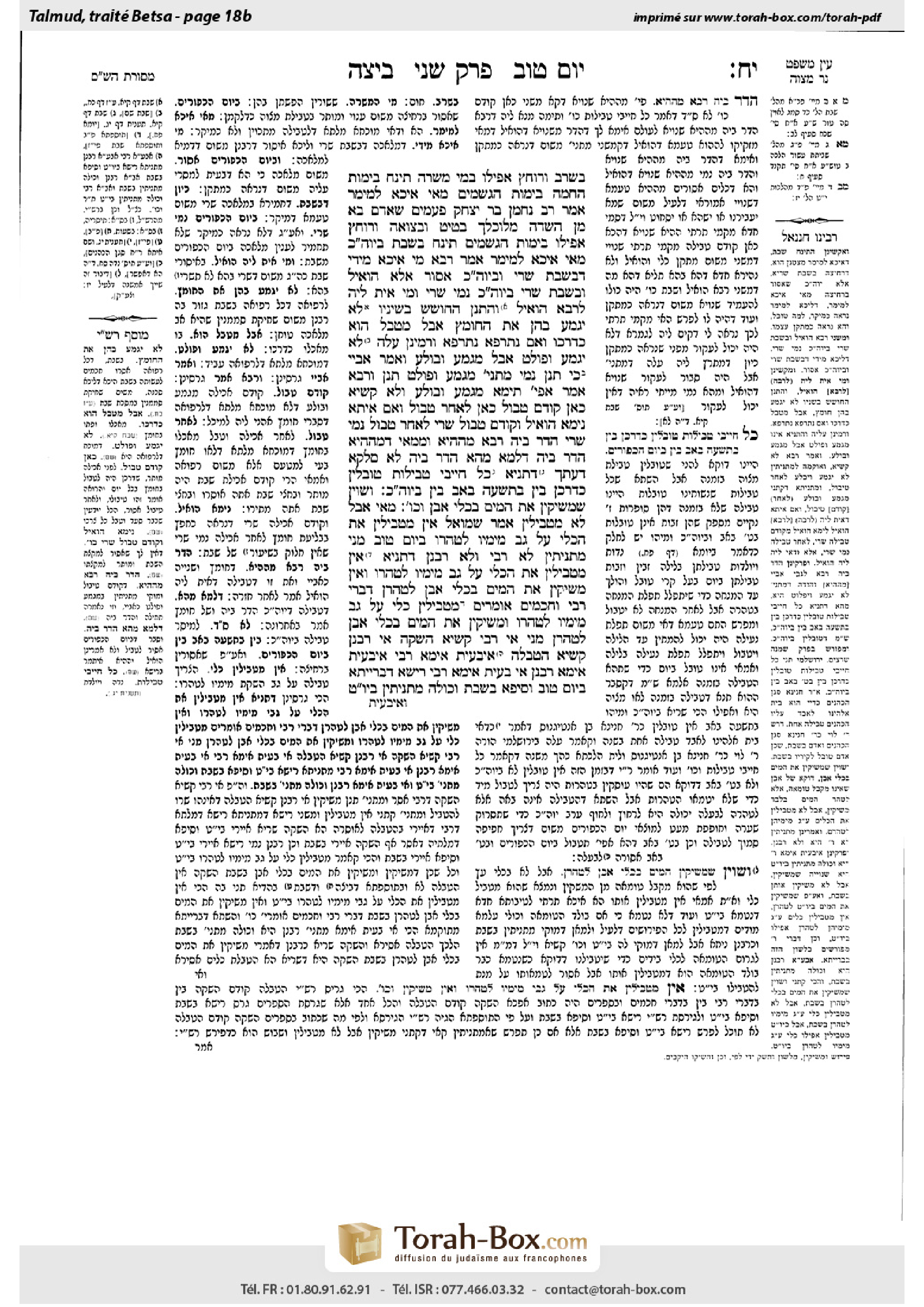
Beitzah 18b: Talmud study for Daf Yomi
Study the Talmud for Daf Yomi with scanned pages, Hebrew text, English translations from Sefaria and AI-generated French translations.
Passage selection and English or AI-generated French translation are available where the scan has annotations. Daf Study is independent of Torah-Box and Sefaria.
Browse Beitzah · ביצה · All tractatesBeitzah 18b text and translations
This page of Beitzah includes the Aramaic text, an English translation and an AI-generated French translation, alongside the scan above.
ביצה י״ח ב · Aramaic and Hebrew text
בַּשָּׁרָב, וְרוֹחֵץ אֲפִילּוּ בְּמֵי מִשְׁרָה.
תִּינַח בִּימוֹת הַחַמָּה, בִּימוֹת הַגְּשָׁמִים מַאי אִיכָּא לְמֵימַר? אָמַר רַב נַחְמָן בַּר יִצְחָק: פְּעָמִים שֶׁאָדָם בָּא מִן הַשָּׂדֶה מְלוּכְלָךְ בְּטִיט וּבְצוֹאָה, וְרוֹחֵץ אֲפִילּוּ בִּימוֹת הַגְּשָׁמִים.
תִּינַח בְּשַׁבָּת, בְּיוֹם הַכִּפּוּרִים מַאי אִיכָּא לְמֵימַר?
אָמַר רָבָא: מִי אִיכָּא מִידֵּי דִּבְשַׁבָּת שְׁרֵי וּבְיוֹם הַכִּפּוּרִים אָסוּר? אֶלָּא הוֹאִיל וּבְשַׁבָּת שְׁרֵי — בְּיוֹם הַכִּפּוּרִים נָמֵי שְׁרֵי.
וּמִי אִית לֵיהּ לְרָבָא ״הוֹאִיל״? וְהָתְנַן: הַחוֹשֵׁשׁ בְּשִׁינָּיו — לֹא יְגַמֵּעַ בָּהֶן אֶת הַחוֹמֶץ, אֲבָל מְטַבֵּל הוּא כְּדַרְכּוֹ, וְאִם נִתְרַפֵּא — נִתְרַפֵּא. וְרָמֵינַן עֲלַהּ: לֹא יְגַמֵּעַ וּפוֹלֵט, אֲבָל מְגַמֵּעַ וּבוֹלֵעַ!
וַאֲמַר אַבָּיֵי: כִּי תְּנַן נָמֵי מַתְנִיתִין, מְגַמֵּעַ וּפוֹלֵט תְּנַן. וְרָבָא אָמַר: אֲפִילּוּ תֵּימָא מְגַמֵּעַ וּבוֹלֵעַ, וְלָא קַשְׁיָא: כָּאן קוֹדֶם טִבּוּל, כָּאן לְאַחַר טִבּוּל.
וְאִם אִיתָא, נֵימָא: הוֹאִיל וְקוֹדֶם טִבּוּל שְׁרֵי — לְאַחַר טִבּוּל נָמֵי שְׁרֵי! הֲדַר בֵּיהּ רָבָא מֵהַהִיא.
וּמִמַּאי דְּמֵהַהִיא הֲדַר בֵּיהּ, דִּלְמָא מֵהָא הֲדַר בֵּיהּ? לָא סָלְקָא דַּעְתָּךְ, דְּתַנְיָא: כׇּל חַיָּיבֵי טְבִילוֹת טוֹבְלִין כְּדַרְכָּן, בֵּין בְּתִשְׁעָה בְּאָב בֵּין בְּיוֹם הַכִּיפּוּרִים.
וְשָׁוִין שֶׁמַּשִּׁיקִין אֶת הַמַּיִם בִּכְלִי אֶבֶן וְכוּ׳. מַאי ״אֲבָל לֹא מַטְבִּילִין״? אָמַר שְׁמוּאֵל: אֵין מַטְבִּילִין אֶת הַכְּלִי עַל גַּב מֵימָיו לְטַהֲרוֹ בְּיוֹם טוֹב.
מַנִּי מַתְנִיתִין? לָא רַבִּי וְלָא רַבָּנַן, דְּתַנְיָא: אֵין מַטְבִּילִין אֶת הַכְּלִי עַל גַּב מֵימָיו לְטַהֲרוֹ, וְאֵין מַשִּׁיקִין אֶת הַמַּיִם בִּכְלִי אֶבֶן לְטַהֲרָן, דִּבְרֵי רַבִּי. וַחֲכָמִים אוֹמְרִים: מַטְבִּילִין כְּלִי עַל גַּב מֵימָיו לְטַהֲרוֹ, וּמַשִּׁיקִין אֶת הַמַּיִם בִּכְלִי אֶבֶן לְטַהֲרָן.
מַנִּי? אִי רַבִּי — קַשְׁיָא הַשָּׁקָה, אִי רַבָּנַן — קַשְׁיָא הַטְבָּלָה!
אִיבָּעֵית אֵימָא רַבִּי, אִיבָּעֵית אֵימָא רַבָּנַן. אִי בָּעֵית אֵימָא רַבִּי: רֵישָׁא דְּבָרַיְיתָא בְּיוֹם טוֹב, וְסֵיפָא בְּשַׁבָּת, וְכוּלַּהּ מַתְנִיתִין בְּיוֹם טוֹב.
Beitzah 18b · English translation
on a hot day and washes himself even in putrid water in which flax was soaked, because the heat has made him so uncomfortable.
The Gemara raises another objection: This works out well in the summer season; however, in the rainy season, when people do not usually immerse themselves in water in order to cool off, what is there to say? Rav Naḥman bar Yitzḥak said: Sometimes a person comes home from the field soiled with mud and excrement and washes himself even in the rainy season.
The Gemara continues with another objection: This works out well and explains why it is permitted for one to immerse himself on Shabbat, when it is permitted to wash, and therefore it can be argued that it is not clearly evident that he is immersing in order to purify himself; but on Yom Kippur, when all bathing apart from ritual immersion is prohibited, what is there to say? His actions prove that his intention is to purify himself, and this should be prohibited because it looks as though he is repairing himself through purification.
Rava said: It is impossible to prohibit immersion on Yom Kippur alone, as is there anything that is permitted on Shabbat and the very same act is prohibited as labor on Yom Kippur? In fact, the prohibition against labor is more stringent on Shabbat than on Yom Kippur. Rather, since it is permitted on Shabbat, it is also permitted on Yom Kippur. The Sages did not issue decrees with regard to Yom Kippur that would make it more stringent than Shabbat. Therefore, since they allowed a person to immerse on Shabbat because it looks as if he is doing so for pleasure, to escape the heat or to remove dirt, and not necessarily in order to purify himself, they permitted it on Yom Kippur as well, even though it is evident in that situation that his immersion is for the purpose of achieving purity.
The Gemara asks: Does Rava accept the principle of: Since? But didn’t we learn in a mishna: One who is concerned about pain in his teeth may not sip vinegar through them on Shabbat in order to alleviate his toothache; however, he may dip his food in vinegar in his usual manner during the meal and eat it, and if he is healed by the vinegar, he is healed. And we raised a contradiction to this mishna from the following baraita: One may not sip vinegar and immediately spit it out, as this is clearly done for medicinal purposes; however, one may sip the vinegar and swallow it, since it looks as though he is drinking it. This indicates that there is a permitted way to use vinegar even without dipping his food into it.
And Abaye said: Also when we learned this ruling in the mishna, we learned it with regard to the case of one who sips and spits it out. Rava said: Even if you say that the mishna prohibits sipping vinegar even in a case where one sips and swallows it, it is still not difficult: Here, the baraita permits sipping vinegar before dipping one’s food in it, as he appears to be doing so for pleasure. There, the mishna prohibits sipping the vinegar after dipping his food in it, when it is clear that one is doing so for medicinal purposes only.
The Gemara completes its question: And if it is so that Rava accepts the principle of: Since, let him say: Since it is permitted to sip vinegar before dipping, it is also permitted to do so after dipping. The Gemara answers: Rava retracted that statement with regard to vinegar and accepted Abaye’s resolution of the difficulty, along with the principle of: Since.
The Gemara asks: And from where can it be determined that he retracted that teaching? Perhaps he retracted this statement with regard to immersion in a ritual bath on Yom Kippur. The Gemara answers: This cannot enter your mind that he retracted his view in that case, as it is taught in a baraita: All who are obligated in immersions immerse in their usual manner, both on the Ninth of Av and on Yom Kippur, even though it is prohibited to wash on these days. Rava would certainly have aligned his opinion with the explicit ruling of a baraita.
§ It was taught in the mishna: And Beit Shammai and Beit Hillel both agree that one may bring ritually impure water into contact with ritually pure water in stone vessels in order to purify the water. However, one may not immerse the impure water. The Gemara asks: What is the meaning of the mishna’s statement: However, one may not immerse the impure water? Shmuel said: One may not immerse an impure vessel on account of its water in order to purify it on a Festival. The Sages allowed impure water to be purified through contact with ritually pure water only in a stone vessel or in another vessel that does not contract impurity, but not in an impure vessel that would itself become purified through this immersion.
The Gemara asks: If that is its meaning, in accordance with whose opinion is the mishna? It is not in accordance with the opinion of Rabbi Yehuda HaNasi nor with that of the Rabbis. As it is taught in the Tosefta: One may not immerse an impure vessel on account of its water in order to purify the vessel, and one may not bring impure water into contact with pure water in a stone vessel in order to purify the water; this is the statement of Rabbi Yehuda HaNasi. And the Rabbis say: One may immerse an impure vessel on account of its water in order to purify the vessel, and one may bring impure water into contact with pure water in a stone vessel in order to purify the water.
If so, in accordance with whose opinion is the mishna? If it is in accordance with the opinion of Rabbi Yehuda HaNasi, then the ruling with regard to bringing impure water into contact with pure water in a stone vessel is difficult, as in the Tosefta Rabbi Yehuda HaNasi prohibits doing so, whereas the mishna permits it; and if it is in accordance with the opinion of the Rabbis, then the ruling with regard to the immersion of an impure vessel on account of its water is difficult, as in the Tosefta the Rabbis permit this, while the mishna, as explained by Shmuel, prohibits it.
The Gemara answers: If you wish, say that the mishna is in accordance with the opinion of Rabbi Yehuda HaNasi; and if you wish, say instead that it is in accordance with the opinion of the Rabbis. How so? If you wish, say that the mishna is in accordance with the opinion of Rabbi Yehuda HaNasi and explain that the first clause of that baraita, i.e., the first part of Rabbi Yehuda HaNasi’s statement in the Tosefta, deals with a Festival; it is in that case that Rabbi Yehuda HaNasi prohibits immersing an impure vessel on account of its water, but bringing impure water into contact with pure water in a stone vessel would be permitted. And the latter clause, which extends the prohibition to bringing impure water into contact with pure water, is referring to the more stringent case of Shabbat. And the entire mishna is referring to a Festival, when it is permitted to purify impure water by bringing it into contact with pure water in a stone vessel.
Beitzah 18b · Traduction française (IA)
sur un jour chaud, il se lave même dans de l'eau putride dans lequel du lin avait été trempé, car la chaleur l'a rendu si inconfortable.
La Guemara soulève une autre objection : cela fonctionne bien en saison estivale ; cependant, en saison des pluies, lorsque les gens ne s'immergent généralement pas dans l'eau pour se rafraîchir, que dire alors ? Rav Naḥman bar Yitzḥak a dit : parfois, une personne rentre à la maison souillée de boue et d'excréments et se lave même en saison des pluies.
La Guemara continue avec une autre objection : cela fonctionne bien et explique pourquoi il est permis à une personne de s'immerger le sabbat, lorsque l'on peut se laver, et donc on pourrait argumenter qu'il n'est pas clair que l'immersion ait pour but de se purifier ; mais le jour de l'Atonement, lorsque tout bain autre que l'immersion rituelle est interdit, que dire alors ? Ses actions prouvent que son intention est de se purifier, et cela devrait être interdit car cela semble comme s'il se réparait par la purification.
Rava a dit : Il est impossible d'interdire l'immersion le jour de l'Atonement seul, car y a-t-il quelque chose qui soit permis le sabbat et que l'acte même soit interdit comme travail le jour de l'Atonement ? En réalité, l'interdiction du travail est plus stricte le sabbat que le jour de l'Atonement. Plutôt, puisque c'est permis le sabbat, il est également permis le jour de l'Atonement. Les Sages n'ont pas émis des décrets concernant le jour de l'Atonement qui le rendent plus strict que le sabbat. Ainsi, puisque les Sages ont permis à une personne de s'immerger le sabbat car cela semble qu'il le fasse pour le plaisir, pour s'évader de la chaleur ou pour enlever la saleté, et non nécessairement pour se purifier, ils ont permis cela également le jour de l'Atonement, même si cela est évident dans ce cas que son immersion a pour but d'atteindre la pureté.
La Guemara pose une question : Rava accepte-t-il le principe de : Puisque ? Mais n'avons-nous pas appris dans une mitsva : Une personne qui craint la douleur dans ses dents ne doit pas sucer du vinaigre à travers ses dents le sabbat pour soulager sa gencive ; cependant, il peut tremper son aliment dans du vinaigre selon sa manière habituelle pendant le repas et le manger, et si il guérit grâce au vinaigre, il guérit. Et nous avons soulevé une contradiction avec cette mitsva à partir de la suivante baraïta : On ne doit pas sucer du vinaigre et le recracher immédiatement, car cela est clairement fait à des fins médicales ; cependant, on peut sucer le vinaigre et le avaler, car cela semble qu'on boit. Cela indique qu'il existe une manière permise d'utiliser le vinaigre même sans tremper son aliment dedans.
Et Abaye a dit : Aussi lorsque nous avons appris cette décision dans la mitsna, nous l'avons apprise dans le cas d'une personne qui boit et recrache. Rava a dit : Même si vous dites que la mitsna interdit de boire du vinaigre même dans le cas où l'on boit et l'avale, cela reste facile : ici, la baraïta permet de boire du vinaigre avant de tremper son aliment dedans, car il semble qu'il le fasse pour le plaisir. Là, la mitsna interdit de boire le vinaigre après avoir tremper son aliment dedans, lorsque c'est clair qu'on le fait uniquement à des fins médicales.
La Guemara termine sa question : Et si c'est ainsi que Rava accepte le principe de : Puisque, qu'il dise : Puisque c'est permis de boire du vinaigre avant de tremper, c'est également permis de le faire après avoir tremper. La Guemara répond : Rava a rétracté cette déclaration concernant le vinaigre et a accepté la résolution d'Abaye de la difficulté, ainsi que le principe de : Puisque.
La Guemara pose une question : Et d'où peut-on déterminer qu'il a rétracté cette enseignement ? Peut-être qu'il a rétracté cette déclaration concernant l'immersion dans un bain rituel le jour de l'Atonement. La Guemara répond : Cela ne peut pas entrer dans votre esprit qu'il ait rétracté son opinion dans ce cas-là, car il est enseigné dans une baraïta : Tous ceux qui sont obligés d'immerger s'immergent selon leur manière habituelle, à la fois le neuvième d'Av et le jour de l'Atonement, même si il est interdit de se laver ces jours-là. Rava aurait certainement aligné son opinion avec la décision explicite d'une baraïta.
§ Il a été enseigné dans la Michna : Et Beit Shammai et Beit Hillel sont tous deux d'accord sur le fait qu'on peut faire entrer de l'eau impure en contact avec de l'eau pure dans des récipients en pierre afin de purifier l'eau. Cependant, on ne peut pas immerger l'eau impure. La Guemara pose une question : Quelle est la signification de l'affirmation de la Michna : Cependant, on ne peut pas immerger l'eau impure ? Shmuel a dit : On ne peut pas immerger un récipient impur à cause de son eau afin de le purifier lors d'un festival. Les Sages ont permis de purifier de l'eau impure par contact avec de l'eau pure uniquement dans un récipient en pierre ou un autre récipient qui ne contracte pas l'impureté, mais pas dans un récipient impur qui deviendrait lui-même purifié par cette immersion.
La Guemara pose une question : Si c'est ainsi que cela signifie, selon quel avis est la Michna ? Ce n'est pas selon l'avis de Rabbi Yehuda HaNasi ni celui des Rabbins. Car il est enseigné dans la Tosefta : On ne peut pas immerger un récipient impur à cause de son eau afin de le purifier, et on ne peut pas faire entrer de l'eau impure en contact avec de l'eau pure dans un récipient en pierre afin de purifier l'eau ; c'est l'affirmation de Rabbi Yehuda HaNasi. Et les Rabbins disent : On peut immerger un récipient impur à cause de son eau afin de le purifier, et on peut faire entrer de l'eau impure en contact avec de l'eau pure dans un récipient en pierre afin de purifier l'eau.
Si c'est ainsi, selon quel avis est la mitsva ? Si c'est selon l'avis de Rabbi Yehuda HaNasi, alors la décision concernant le fait de faire entrer de l'eau impure en contact avec de l'eau pure dans un récipient en pierre est difficile, car dans la Tosefta Rabbi Yehuda HaNasi interdit cela, alors que la mitsva permet cela ; et si c'est selon l'avis des Rabbins, alors la décision concernant l'immersion d'un récipient impur à cause de son eau est difficile, car dans la Tosefta les Rabbins permettent cela, tandis que la mitsva, comme expliqué par Shmuel, l'interdit.
La Guemara répond : Si vous le souhaitez, dites que la Michna suit l'opinion de Rabbi Yehuda HaNasi ; et si vous le souhaitez, dites plutôt qu'elle suit l'opinion des Sages. Comment cela ? Si vous le souhaitez, dites que la Michna suit l'opinion de Rabbi Yehuda HaNasi et expliquez que la première clause de ce baraïta, c'est-à-dire la première partie de la déclaration de Rabbi Yehuda HaNasi dans la Tosefta, concerne un festival ; dans ce cas précis, Rabbi Yehuda HaNasi interdit d'immerger un récipient impur en raison de son eau, mais de faire entrer de l'eau impure en contact avec de l'eau pure dans un récipient en pierre serait permis. Et la seconde clause, qui étend l'interdiction à l'entrée en contact de l'eau impure avec l'eau pure, fait référence au cas plus strict de la Shabbat. Et toute la Michna fait référence à un festival, lorsqu'il est permis de purifier l'eau impure en la faisant entrer en contact avec de l'eau pure dans un récipient en pierre.
Traduction française générée par IA à partir de l’édition anglaise de Sefaria. Vérifie toujours un passage avec le texte source.
Text from Sefaria: William Davidson Edition - Vocalized Aramaic (CC BY NC); William Davidson Edition - English (CC BY NC).