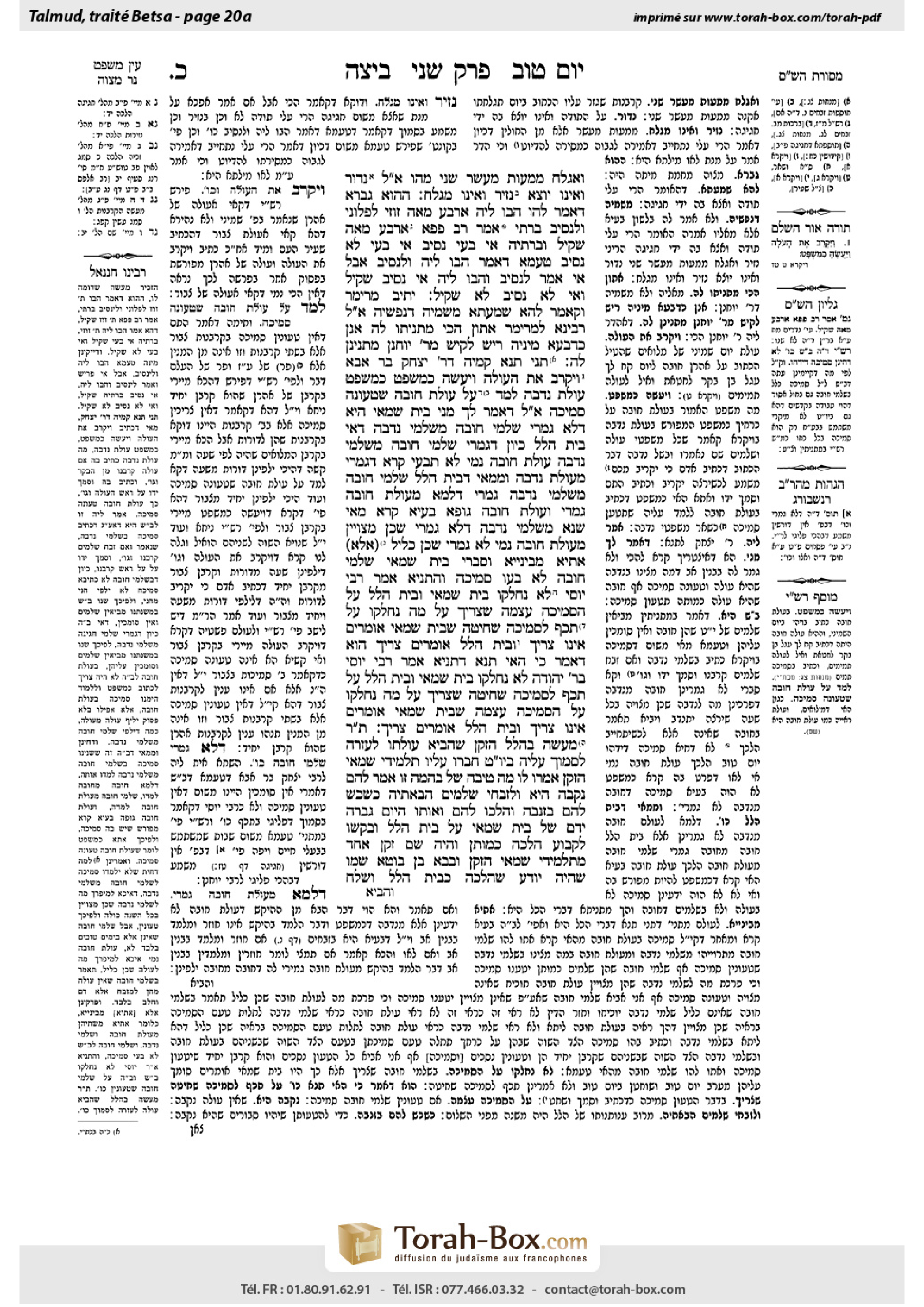
Beitzah 20a: Talmud study for Daf Yomi
Study the Talmud for Daf Yomi with scanned pages, Hebrew text, English translations from Sefaria and AI-generated French translations.
Passage selection and English or AI-generated French translation are available where the scan has annotations. Daf Study is independent of Torah-Box and Sefaria.
Browse Beitzah · ביצה · All tractatesBeitzah 20a text and translations
This page of Beitzah includes the Aramaic text, an English translation and an AI-generated French translation, alongside the scan above.
ביצה כ׳ א · Aramaic and Hebrew text
וַאֲגַלַּח מִמְּעוֹת מַעֲשֵׂר שֵׁנִי, מַהוּ? אֲמַר לֵיהּ: נָדוּר, וְאֵינוֹ יוֹצֵא. נָזִיר, וְאֵינוֹ מְגַלֵּחַ.
הָהוּא גַּבְרָא דַּאֲמַר לְהוּ: הַבוּ לֵיהּ אַרְבַּע מְאָה זוּזֵי לִפְלוֹנִי, וְלִנְסֵיב בְּרַתִּי. אָמַר רַב פָּפָּא: אַרְבַּע מְאָה — שָׁקֵיל, וּבְרַתֵּיה — אִי בָּעֵי נָסֵיב, אִי בָּעֵי — לָא נָסֵיב.
טַעְמָא דְּאָמַר הַבוּ לֵיהּ וְלִנְסֵיב, אֲבָל אִי אָמַר לִנְסֵיב וְהַבוּ לֵיהּ, אִי נָסֵיב — שָׁקֵיל, וְאִי לָא נָסֵיב — לָא שָׁקֵיל.
יָתֵיב מָרִימָר וְקָאָמַר לְהָא שְׁמַעְתָּא מִשְּׁמֵיהּ דְּנַפְשֵׁיהּ. אֲמַר לֵיהּ רָבִינָא לְמָרִימָר: אַתּוּן הָכִי מַתְנִיתוּ לַהּ, אֲנַן כְּדִבְעָא מִינֵּיהּ רֵישׁ לָקִישׁ מֵרַבִּי יוֹחָנָן מַתְנִינַן לַהּ.
תָּנֵי תַּנָּא קַמֵּיהּ דְּרַבִּי יִצְחָק בַּר אַבָּא: ״וַיַּקְרֵב אֶת הָעוֹלָה וַיַּעֲשֶׂהָ כַּמִּשְׁפָּט״, כְּמִשְׁפַּט עוֹלַת נְדָבָה. לִמֵּד עַל עוֹלַת חוֹבָה שֶׁטְּעוּנָה סְמִיכָה.
אֲמַר לֵיהּ: דַּאֲמַר לָךְ מַנִּי — בֵּית שַׁמַּאי הִיא, דְּלָא גָּמְרִי שַׁלְמֵי חוֹבָה מִשַּׁלְמֵי נְדָבָה. דְּאִי בֵּית הִלֵּל, כֵּיוָן דְּגָמְרִי שַׁלְמֵי חוֹבָה מִשַּׁלְמֵי נְדָבָה, עוֹלַת חוֹבָה נָמֵי לָא תִּבְעֵי קְרָא, דְּגָמְרִי מֵעוֹלַת נְדָבָה.
וּמִמַּאי דְּבֵית הִלֵּל שַׁלְמֵי חוֹבָה מִשַּׁלְמֵי נְדָבָה גָּמְרִי? דִּלְמָא מֵעוֹלַת חוֹבָה גָּמְרִי, וְעוֹלַת חוֹבָה גּוּפָא בָּעֲיָא קְרָא.
מַאי שְׁנָא מִשַּׁלְמֵי נְדָבָה דְּלָא גָּמְרִי — שֶׁכֵּן מְצוּיִין. מֵעוֹלַת חוֹבָה נָמֵי לָא גָּמְרִי — שֶׁכֵּן כָּלִיל!
(אֶלָּא) אָתְיָא מִבֵּינַיָּיא.
וְסָבְרִי בֵּית שַׁמַּאי שַׁלְמֵי חוֹבָה לָא בָּעוּ סְמִיכָה? וְהָתַנְיָא, אָמַר רַבִּי יוֹסֵי: לֹא נֶחְלְקוּ בֵּית שַׁמַּאי וּבֵית הִלֵּל עַל הַסְּמִיכָה עַצְמָהּ שֶׁצָּרִיךְ. עַל מָה נֶחְלְקוּ, עַל תֵּכֶף לִסְמִיכָה שְׁחִיטָה. שֶׁבֵּית שַׁמַּאי אוֹמְרִים: אֵינוֹ צָרִיךְ. וּבֵית הִלֵּל אוֹמְרִים: צָרִיךְ!
הוּא דְּאָמַר כִּי הַאי תַּנָּא, דְּתַנְיָא: אָמַר רַבִּי יוֹסֵי בְּרַבִּי יְהוּדָה: לֹא נֶחְלְקוּ בֵּית שַׁמַּאי וּבֵית הִלֵּל עַל תֵּכֶף לִסְמִיכָה שְׁחִיטָה שֶׁצָּרִיךְ, עַל מָה נֶחְלְקוּ — עַל הַסְּמִיכָה עַצְמָהּ, שֶׁבֵּית שַׁמַּאי אוֹמְרִים: אֵינוֹ צָרִיךְ, וּבֵית הִלֵּל אוֹמְרִים: צָרִיךְ.
תָּנוּ רַבָּנַן: מַעֲשֶׂה בְּהִלֵּל הַזָּקֵן שֶׁהֵבִיא עוֹלָתוֹ לָעֲזָרָה לִסְמוֹךְ עָלֶיהָ בְּיוֹם טוֹב. חָבְרוּ עָלָיו תַּלְמִידֵי שַׁמַּאי הַזָּקֵן, אָמְרוּ לוֹ: מָה טִיבָהּ שֶׁל בְּהֵמָה זוֹ? אָמַר לָהֶם: נְקֵבָה הִיא, וּלְזִבְחֵי שְׁלָמִים הֲבֵאתִיהָ. כִּשְׁכֵּשׁ לָהֶם בִּזְנָבָהּ, וְהָלְכוּ לָהֶם.
וְאוֹתוֹ הַיּוֹם גָּבְרָה יָדָם שֶׁל בֵּית שַׁמַּאי עַל בֵּית הִלֵּל, וּבִקְּשׁוּ לִקְבּוֹעַ הֲלָכָה כְּמוֹתָן. וְהָיָה שָׁם זָקֵן אֶחָד מִתַּלְמִידֵי שַׁמַּאי הַזָּקֵן, וּבָבָא בֶּן בּוּטָא שְׁמוֹ, שֶׁהָיָה יוֹדֵעַ שֶׁהֲלָכָה כְּבֵית הִלֵּל, וְשָׁלַח
Beitzah 20a · English translation
and I will shave my head, meaning I will purchase the nazirite offerings that are brought when a nazirite shaves himself, with second-tithe money, which I am obligated in any case to bring to Jerusalem, what is the halakha? Rabbi Yoḥanan said to him: With regard to the thanks-offering, he has vowed and must bring the offering, but he does not fulfill his obligation of the Festival peace-offering with it, as the latter offering must be brought from unconsecrated animals. Similarly, one who took the vow of naziriteship is a nazirite, but he may not shave his head and bring nazirite offerings purchased with second-tithe money.
In relation to the previous case, in which one makes a conditional statement and only part of his statement is accepted, the Gemara relates a somewhat similar incident: A certain man said to those tending to him, in the form of a will: Give four hundred zuz to so-and-so, and let him marry my daughter. Rav Pappa said: The four hundred zuz he takes, but as for the benefactor’s daughter, if he wishes, he may marry her, and if he wishes, he need not marry her.
The Gemara comments: The reason is solely that he said it in this manner: Give him the money and let him marry my daughter, mentioning the gift before the condition. However, if he specified the condition first, by saying: Let him marry my daughter and give him the money, in that case, if he marries her, he takes the money, but if he does not marry her, he may not take it.
The Gemara relates: Mareimar sat and stated this halakha with regard to one who attaches a condition to his vow to bring a thanks-offering in his own name, without attributing it to the Sage who stated it. Ravina said to Mareimar: You teach this halakha in this manner, without attribution, whereas we teach it in the form of a question that Reish Lakish asked of Rabbi Yoḥanan.
§ A tanna taught the following baraita before Rabbi Yitzḥak bar Abba: The verse concerning the burnt-offering that Aaron was commanded to sacrifice for the inauguration of the Tabernacle: “And he brought the burnt-offering and sacrificed it according to regulation” (Leviticus 9:16), indicates that the halakha of an obligatory burnt-offering is similar to the regulation governing a gift burnt-offering. This teaches with regard to an obligatory burnt-offering that it too requires the person bringing the offering to place his hands on the head of the animal to be sacrificed.
Rabbi Yitzḥak said to the tanna: He who told you that this halakha requires an explicit biblical source, in accordance with whose opinion did he say this? It is that of Beit Shammai, who do not learn the halakha of obligatory peace-offerings from that of gift peace-offerings by way of an analogy [binyan av], as they distinguish between the two with regard to the requirement of placing hands on the peace-offerings brought on a Festival. As, if it were the opinion of Beit Hillel, since they learn the halakha of obligatory peace-offerings from that of gift peace-offerings, there being no distinction between the two categories, then an obligatory burnt-offering should also not require a special verse to teach this halakha, as they can learn it from the halakha governing a gift burnt-offering by means of an analogy.
The Gemara asks: And from where may it be shown that Beit Hillel learn the halakhot of obligatory peace-offerings from those of gift peace-offerings? Perhaps they do not learn the halakhot of obligatory peace-offerings from those of gift peace-offerings. Rather, they learn the halakha governing obligatory peace-offerings from the halakha governing an obligatory burnt-offering: Just as an obligatory burnt-offering requires the one bringing the offering to place his hands on the animal to be sacrificed, so too do obligatory peace-offerings. And an obligatory burnt-offering itself requires an explicit verse from which to derive this halakha, and perhaps the verse cited above is the source: “And he brought the burnt-offering and sacrificed it according to regulation.”
The Gemara challenges this argument: What is different about obligatory peace-offerings such that Beit Hillel do not learn the halakha governing them from the halakha applying to gift peace-offerings? It is that gift peace-offerings are more common, and perhaps a different halakha applies to them. If so, they should also not learn the halakha governing obligatory peace-offerings from the halakha applying to an obligatory burnt-offering, as the latter is entirely burnt, unlike peace-offerings.
The Gemara answers: Rather, the halakha governing obligatory peace-offerings is derived from between the two of them. The Torah explicitly states that one must place hands on the heads of both obligatory burnt-offerings and gift peace-offerings. It is possible to extend the same obligation to obligatory peace-offerings by combining the two sources, as follows: If one says that an obligatory burnt-offering is different from an obligatory peace-offering because it is entirely burnt, gift peace-offerings prove that this is not the critical factor; and if one counters that gift peace-offerings are different from obligatory peace-offerings because they are common, an obligatory burnt-offering proves that this is not crucial. Therefore, there is no proof from here with regard to Beit Hillel’s position, as they too might learn the halakha governing an obligatory burnt-offering from the verse: “And he brought the burnt-offering and sacrificed it according to regulation.”
The Gemara raises a question with regard to the halakha itself: And do Beit Shammai hold that obligatory peace-offerings do not require placing of hands on the head of the animal? But isn’t it taught in a baraita: Rabbi Yosei said: Beit Shammai and Beit Hillel did not disagree with regard to the placing of hands itself that it is required in the case of obligatory peace-offerings. With regard to what, then, did they disagree? They disagreed with regard to the halakha that states that immediately following placing hands on the head of an offering is its slaughter. As Beit Shammai say: It is not necessary to be particular in this regard, and the ceremony of placing hands on the animal’s head may be performed even on the eve of the Festival, long before the animal is slaughtered. And Beit Hillel say: It is necessary, and therefore one who brings an offering on a Festival must place his hands on the animal’s head on the Festival itself.
The Gemara answers: The tanna of the mishna said what he said in accordance with the opinion of this tanna, as it is taught in a different baraita: Rabbi Yosei, son of Rabbi Yehuda, said: Beit Shammai and Beit Hillel did not disagree with regard to the halakha that immediately following placing hands on the head of an offering is its slaughter, that it is necessary. With regard to what, then, did they disagree? They disagreed with regard to the placing of hands itself on the head of obligatory peace-offerings. Beit Shammai say: It is not necessary, and Beit Hillel say: It is necessary.
§ The Gemara returns to the basic dispute between Beit Shammai and Beit Hillel. The Sages taught in a baraita: There was an incident involving Hillel the Elder, who brought his burnt-offering to the Temple courtyard in order to place his hands on the animal’s head on a Festival. The students of Shammai the Elder gathered around him and said to him: What is the nature of this animal that you are bringing? Hillel, being humble and meek, did not want to quarrel with them in the Temple and therefore concealed the truth from them for the sake of peace. He said to them: It is a female, and I have brought it as a peace-offering, as burnt-offerings are always male. He swung its tail for them so that they would not be able to properly discern whether the animal was male or female, and they departed.
On that day, when the incident became known, suggesting that even Hillel had accepted Shammai’s view, Beit Shammai gained the upper hand over Beit Hillel, and they sought to establish the halakha in this regard in accordance with their opinion. But a certain Elder of the disciples of Shammai the Elder was there, and Bava ben Buta was his name, who knew that the halakha is in accordance with the opinion of Beit Hillel in this matter. And he sent for
Beitzah 20a · Traduction française (IA)
et je raserai ma tête, c'est-à-dire que je vais acheter les offrandes de nazirite qui sont apportées lorsqu'un nazirite se rase, avec l'argent de la deuxième dîme, qui est en tout cas une obligation que je dois apporter à Jérusalem, quelle est la halakha ? Rabbi Yoḥanan dit à lui : En ce qui concerne l'offrande de remerciement, il a fait un vœu et doit apporter l'offrande, mais il ne remplit pas son obligation de l'offrande de paix du festival avec celle-ci, car cette dernière offrande doit être apportée d'animaux non consacrés. De même, celui qui a pris le vœu de nazirité est un nazirite, mais il ne peut pas se raser la tête et apporter les offrandes de nazirite achetées avec l'argent de la deuxième dîme.
En ce qui concerne le cas précédent, dans lequel l'on fait une déclaration conditionnelle et seule une partie de cette déclaration est acceptée, le Guemara rapporte un incident assez similaire : Un certain homme a dit à ceux qui s'occupaient de lui, sous la forme d'un testament : Donnez quatre cents zuz à tel et tel, et qu'il épouse ma fille. Rav Pappa a dit : Il prend les quatre cents zuz, mais quant à la fille du bénéficiaire, s'il le veut, il peut l'épouser, et s'il le veut, il n'a pas besoin de l'épouser.
Le Guemara commente : La raison est uniquement qu'il a dit cela ainsi : Donnez-lui l'argent et qu'il épouse ma fille, mentionnant la donation avant la condition. Cependant, s'il avait spécifié la condition en premier, en disant : Qu'il épouse ma fille et donne-lui l'argent, dans ce cas, s'il l'épouse, il prend l'argent, mais s'il ne l'épouse pas, il ne peut pas le prendre.
Le Guemara rapporte : Mareimar s'est assis et a énoncé cette halakha concernant celui qui attache une condition à son vœu d'apporter une offrande de remerciement en son propre nom, sans attribuer cela à la Sage qui l'a énoncé. Ravina a dit à Mareimar : Vous enseignez cette halakha ainsi, sans attribution, alors que nous l'enseignons sous la forme d'une question que Reish Lakish a posée à Rabbi Yoḥanan.
§ Un tanna a enseigné la suivante baraïta avant Rabbi Yitzḥak bar Abba : La versette concernant l'holocauste que Aaron était commandé à sacrifier pour l'inauguration du Tabernacle : « Et il apporta l'holocauste et la sacrifia selon la réglementation » (Lévitique 9:16), indique que la halakha de l'holocauste obligatoire est semblable à la réglementation concernant l'holocauste donnée. Cela enseigne concernant l'holocauste obligatoire que celle-ci exige également que la personne apportant l'offrande pose ses mains sur la tête de l'animal à sacrifier.
Rabbi Yitzḥak a dit au tanna : Celui qui vous a dit que cette halakha exige une source biblique explicite, selon quel avis a-t-il dit cela ? C'est celui de Beit Shammai, qui ne tirent pas la halakha de l'offrande de paix obligatoire de celle de l'offrande de paix donnée par analogie [binyan av], car ils distinguent les deux concernant la nécessité de poser les mains sur les offrandes de paix apportées lors d'un festival. En effet, si c'était l'avis de Beit Hillel, puisqu'ils tirent la halakha de l'offrande de paix obligatoire de celle de l'offrande de paix donnée, il n'y ayant pas de distinction entre les deux catégories, alors l'holocauste obligatoire devrait également ne pas nécessiter une source explicite pour enseigner cette halakha, car ils pourraient l'apprendre de la halakha concernant l'offrande de paix donnée par analogie.
Le Guemara pose la question : Et d'où peut-on montrer que Beit Hillel tirent les halakhot de l'offrande de paix obligatoire de celles de l'offrande de paix donnée ? Peut-être qu'ils ne tirent pas les halakhot de l'offrande de paix obligatoire de celles de l'offrande de paix donnée. Plutôt, ils tirent la halakha concernant l'offrande de paix obligatoire de la halakha concernant l'holocauste obligatoire : Tout comme l'holocauste obligatoire exige que la personne apportant l'offrande pose ses mains sur l'animal à sacrifier, ainsi l'offrande de paix obligatoire. Et l'holocauste obligatoire elle-même exige une source explicite pour enseigner cette halakha, et peut-être la versette citée ci-dessus est la source : « Et il apporta l'holocauste et la sacrifia selon la réglementation. »
Le Guemara conteste cet argument : Qu'est-ce qui diffère dans l'offrande de paix obligatoire tel que Beit Hillel ne tirent pas la halakha concernant celle-ci de celle applicable à l'offrande de paix donnée ? C'est que les offrandes de paix données sont plus courantes, et peut-être une halakha différente s'applique à elles. Si c'est le cas, ils ne devraient pas non plus tirer la halakha concernant l'offrande de paix obligatoire de celle applicable à l'holocauste obligatoire, car celle-ci est entièrement brûlée, contrairement aux offrandes de paix.
Le Guemara répond : Plutôt, la halakha concernant l'offrande de paix obligatoire est tirée entre les deux. La Torah énonce explicitement qu'il faut poser ses mains sur la tête des offrandes brûlées obligatoires et des offrandes de paix données. Il est possible d'étendre la même obligation aux offrandes de paix obligatoires en combinant les deux sources, comme suit : Si l'on dit que l'holocauste obligatoire diffère de l'offrande de paix obligatoire car elle est entièrement brûlée, les offrandes de paix données prouvent que cela n'est pas le facteur critique ; et si l'on conteste que les offrandes de paix données diffèrent des offrandes de paix obligatoires car elles sont courantes, l'holocauste obligatoire prouve que cela n'est pas crucial. Ainsi, il n'y a pas de preuve concernant la position de Beit Hillel, car ils aussi pourraient tirer la halakha concernant l'holocauste obligatoire de la versette : « Et il apporta l'holocauste et la sacrifia selon la réglementation. »
La Guemara pose une question concernant la halakha elle-même : Et Beit Shammai considèrent-ils que les offrandes de paix obligatoires n'exigent pas la pose des mains sur la tête de l'animal ? Mais n'est-il pas enseigné dans une baraïta : Rabbi Yosei dit : Beit Shammai et Beit Hillel n'ont pas discuté concernant la pose des mains elle-même, qui est requise dans le cas des offrandes de paix obligatoires. À propos de quoi, alors, ont-ils discuté ? Ils ont discuté concernant la halakha qui stipule que tout de suite après la pose des mains sur la tête d'une offrande, vient la mise à mort de celle-ci. Selon Beit Shammai, il n'est pas nécessaire d'être précis à cet égard, et la cérémonie de la pose des mains sur la tête de l'animal peut être effectuée même la veille de la fête, bien avant que l'animal ne soit sacrifié. Et selon Beit Hillel, il est nécessaire, et donc celui qui apporte une offrande pendant une fête doit poser ses mains sur la tête de l'animal pendant la fête elle-même.
La Guemara répond : Le tanna de la mitsva a dit ce qu'il a dit conformément à l'opinion de ce tanna, comme il est enseigné dans une autre baraïta : Rabbi Yosei, fils de Rabbi Yéhuda, dit : Beit Shammai et Beit Hillel n'ont pas discuté concernant la halakha qui stipule que tout de suite après la pose des mains sur la tête d'une offrande vient la mise à mort de celle-ci, qui est nécessaire. À propos de quoi, alors, ont-ils discuté ? Ils ont discuté concernant la pose des mains elle-même sur la tête des offrandes de paix obligatoires. Beit Shammai disent : Ce n'est pas nécessaire, et Beit Hillel disent : C'est nécessaire.
§ La Guemara revient au débat fondamental entre Beit Shammai et Beit Hillel. Les Sages enseignèrent dans une baraïta : Il y avait un incident concernant Hillel le Vieil, qui apporta son holocauste dans le courtyard du Temple afin de poser ses mains sur la tête de l'animal pendant une fête. Les élèves de Shammai le Vieil se rassemblèrent autour de lui et lui dirent : Quelle est la nature de cet animal que vous apportez ? Hillel, étant humble et modeste, ne voulait pas se disputer avec eux dans le Temple et donc dissimula la vérité pour la paix. Il leur dit : C'est une femelle, et j'ai apporté cela comme offrande de paix, car les holocaustes sont toujours masculins. Il fit bouger la queue de l'animal afin qu'ils ne puissent pas bien distinguer si l'animal était masculin ou féminin, et ils s'en allèrent.
Le jour où l'incident devint connu, suggérant même que Hillel avait accepté l'opinion de Shammai, Beit Shammai gagna du terrain sur Beit Hillel, et ils cherchèrent à établir la halakha concernant cela selon leur opinion. Mais un certain ancien parmi les disciples de Shammai le Vieil était présent, et son nom était Bava ben Buta, qui savait que la halakha est selon l'opinion de Beit Hillel concernant cette question. Et il envoya quelqu'un
Traduction française générée par IA à partir de l’édition anglaise de Sefaria. Vérifie toujours un passage avec le texte source.
Text from Sefaria: William Davidson Edition - Vocalized Aramaic (CC BY NC); William Davidson Edition - English (CC BY NC).