Beitzah 20b: Talmud study for Daf Yomi
Study the Talmud for Daf Yomi with scanned pages, Hebrew text, English translations from Sefaria and AI-generated French translations.
Passage selection and English or AI-generated French translation are available where the scan has annotations. Daf Study is independent of Torah-Box and Sefaria.
Browse Beitzah · ביצה · All tractatesBeitzah 20b text and translations
This page of Beitzah includes the Aramaic text, an English translation and an AI-generated French translation, alongside the scan above.
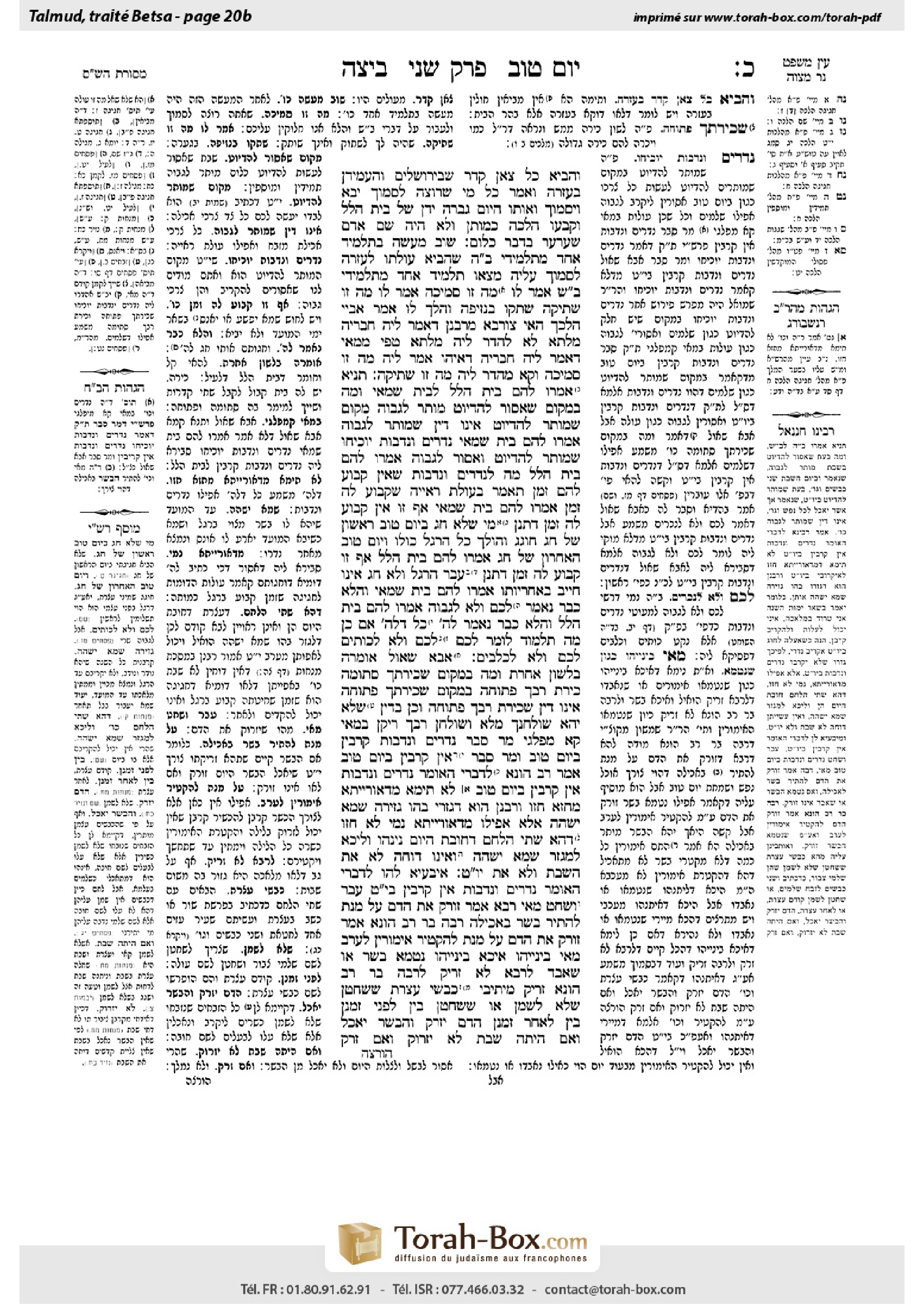
ביצה כ׳ ב · Aramaic and Hebrew text
וְהֵבִיא כׇּל צֹאן קֵדָר שֶׁבִּירוּשָׁלַיִם וְהֶעֱמִידָן בָּעֲזָרָה, וְאָמַר: כׇּל מִי שֶׁרוֹצֶה לִסְמוֹךְ — יָבֹא וְיִסְמוֹךְ, וְאוֹתוֹ הַיּוֹם גָּבְרָה יָדָן שֶׁל בֵּית הִלֵּל וְקָבְעוּ הֲלָכָה כְּמוֹתָן, וְלֹא הָיָה שָׁם אָדָם שֶׁעִרְעֵר בַּדָּבָר כְּלוּם.
שׁוּב מַעֲשֶׂה בְּתַלְמִיד אֶחָד מִתַּלְמִידֵי בֵּית הִלֵּל שֶׁהֵבִיא עוֹלָתוֹ לָעֲזָרָה לִסְמוֹךְ עָלֶיהָ, מְצָאוֹ תַּלְמִיד אֶחָד מִתַּלְמִידֵי בֵּית שַׁמַּאי, אָמַר לוֹ: מָה זוֹ סְמִיכָה? אָמַר לוֹ: מָה זוֹ שְׁתִיקָה? שִׁתְּקוֹ בִּנְזִיפָה, וְהָלַךְ לוֹ.
אָמַר אַבָּיֵי: הִלְכָּךְ, הַאי צוּרְבָּא מֵרַבָּנַן דְּאָמַר לֵיהּ חַבְרֵיהּ מִלְּתָא, לָא לַהְדַּר לֵיהּ מִלְּתָא טְפֵי מִמַּאי דַּאֲמַר לֵיהּ חַבְרֵיהּ, דְּאִיהוּ אָמַר לֵיהּ: ״מָה זוֹ סְמִיכָה״, וְקָא מַהְדַּר לֵיהּ: ״מָה זוֹ שְׁתִיקָה״.
תַּנְיָא, אָמְרוּ לָהֶם בֵּית הִלֵּל לְבֵית שַׁמַּאי: וּמָה בִּמְקוֹם שֶׁאָסוּר לַהֶדְיוֹט — מוּתָּר לַגָּבוֹהַּ, מְקוֹם שֶׁמּוּתָּר לַהֶדְיוֹט — אֵינוֹ דִּין שֶׁמּוּתָּר לַגָּבוֹהַּ? אָמְרוּ לָהֶם בֵּית שַׁמַּאי: נְדָרִים וּנְדָבוֹת יוֹכִיחוּ, שֶׁמּוּתָּר לַהֶדְיוֹט וְאָסוּר לַגָּבוֹהַּ!
אָמְרוּ לָהֶם בֵּית הִלֵּל: מָה לִנְדָרִים וּנְדָבוֹת — שֶׁאֵין קָבוּעַ לָהֶם זְמַן, תֹּאמַר בְּעוֹלַת רְאִיָּיה — שֶׁקָּבוּעַ לָהּ זְמַן. אָמְרוּ לָהֶם בֵּית שַׁמַּאי: אַף זוֹ אֵין קָבוּעַ לָהּ זְמַן, דִּתְנַן: מִי שֶׁלֹּא חָג בְּיוֹם טוֹב רִאשׁוֹן שֶׁל חַג — חוֹגֵג וְהוֹלֵךְ כָּל הָרֶגֶל כּוּלּוֹ, וְיוֹם טוֹב הָאַחֲרוֹן שֶׁל חַג.
אָמְרוּ לָהֶם בֵּית הִלֵּל: אַף זוֹ קָבוּעַ לָהּ זְמַן. דִּתְנַן: עָבַר הָרֶגֶל וְלֹא חָג — אֵינוֹ חַיָּיב בְּאַחְרָיוּתוֹ.
אָמְרוּ לָהֶם בֵּית שַׁמַּאי, וַהֲלֹא כְּבָר נֶאֱמַר: ״לָכֶם״ — וְלֹא לְגָבוֹהַּ. אָמְרוּ לָהֶם בֵּית הִלֵּל, וַהֲלֹא כְּבָר נֶאֱמַר: ״לַה׳״ — כֹּל דְּלַה׳. אִם כֵּן, מָה תַּלְמוּד לוֹמַר ״לָכֶם״, לָכֶם — וְלֹא לְגוֹיִם, לָכֶם — וְלֹא לִכְלָבִים.
אַבָּא שָׁאוּל אוֹמְרָהּ בְּלָשׁוֹן אַחֶרֶת: וּמָה בִּמְקוֹם שֶׁכִּירָתְךָ סְתוּמָה — כִּירַת רַבְּךָ פְּתוּחָה, בִּמְקוֹם שֶׁכִּירָתְךָ פְּתוּחָה — אֵינוֹ דִּין שֶׁכִּירַת רַבְּךָ פְּתוּחָה? וְכֵן בְּדִין, שֶׁלֹּא יְהֵא שׁוּלְחָנְךָ מָלֵא וְשׁוּלְחַן רַבְּךָ רֵיקָן.
בְּמַאי קָא מִפַּלְגִי? מָר סָבַר: נְדָרִים וּנְדָבוֹת קְרֵבִין בְּיוֹם טוֹב, וּמַר סָבַר: אֵין קְרֵבִין בְּיוֹם טוֹב.
אָמַר רַב הוּנָא: לְדִבְרֵי הָאוֹמֵר נְדָרִים וּנְדָבוֹת אֵין קְרֵבִין בְּיוֹם טוֹב, לָא תֵּימָא: מִדְּאוֹרָיְיתָא מִחְזֵא חֲזוּ, וְרַבָּנַן הוּא דְּגָזְרִי בְּהוּ גְּזֵירָה שֶׁמָּא יְשַׁהֶה,
אֶלָּא אֲפִילּוּ מִדְּאוֹרָיְיתָא נָמֵי לָא חָזוּ. דְּהָא שְׁתֵּי הַלֶּחֶם, דְּחוֹבַת הַיּוֹם נִינְהוּ, וְלֵיכָּא לְמִגְזַר שֶׁמָּא יְשַׁהֶה, וְאֵינוֹ דּוֹחֶה לֹא אֶת הַשַּׁבָּת וְלֹא אֶת יוֹם טוֹב.
אִיבַּעְיָא לְהוּ: לְדִבְרֵי הָאוֹמֵר נְדָרִים וּנְדָבוֹת אֵין קְרֵבִין בְּיוֹם טוֹב, עָבַר וְשָׁחַט מַאי? רָבָא אָמַר: זוֹרֵק אֶת הַדָּם עַל מְנָת לְהַתִּיר בָּשָׂר בַּאֲכִילָה. רַבָּה בַּר רַב הוּנָא אָמַר: זוֹרֵק אֶת הַדָּם עַל מְנָת לְהַקְטִיר אֵימוּרִין לָעֶרֶב.
מַאי בֵּינַיְיהוּ? אִיכָּא בֵּינַיְיהוּ נִטְמָא בָּשָׂר אוֹ שֶׁאָבַד. לְרָבָא — לָא זָרֵיק, לְרַבָּה בַּר רַב הוּנָא — זָרֵיק.
מֵיתִיבִי: כִּבְשֵׂי עֲצֶרֶת שֶׁשְּׁחָטָן שֶׁלֹּא לִשְׁמָן, אוֹ שֶׁשְּׁחָטָן בֵּין לִפְנֵי זְמַנָּן בֵּין לְאַחַר זְמַנָּן — הַדָּם יִזָּרֵק וְהַבָּשָׂר יֵאָכֵל. וְאִם הָיְתָה שַׁבָּת — לֹא יִזְרוֹק. וְאִם זָרַק —
Beitzah 20b · English translation
and brought all the high-quality sheep of Kedar that were in Jerusalem, and he stood them in the Temple courtyard and said: Anyone who wishes to place his hands on the head of an animal should come and place his hands there. And on that day Beit Hillel gained the upper hand over Beit Shammai, and they established the halakha in this case in accordance with their opinion, and there was no one there who disputed the matter in any way.
And some time later there was another incident involving a certain disciple from among the disciples of Beit Hillel who brought his burnt-offering to the Temple courtyard in order to place his hands on the animal’s head on a Festival. A certain disciple from among the disciples of Beit Shammai found him and said to him: What is this placing of hands? Why do you place your hands on the animal’s head and thereby violate the statement of Beit Shammai? He said to him: What is this silence? Why do you not stay silent, as the halakha was not established in accordance with their opinion? He silenced him with a rebuke, and he, Beit Shammai’s disciple, departed quietly.
Abaye said: Therefore, it is clear from here that a Torah scholar whose colleague says something reprimanding or insulting to him should not answer back with something more than his colleague had said to him, to avoid adding fuel to the fire, as in the above story the one said to the other: What is this placing of hands? and the latter responded to the former using the same language: What is this silence?
§ With regard to the dispute concerning the sacrifice of burnt-offerings of appearance on a Festival, it is taught in a baraita: Beit Hillel said to Beit Shammai: Just as in a place where it is prohibited to slaughter for the sake of a common person [hedyot], e.g., on Shabbat, it is permitted to slaughter offerings in the Temple for the Most High, such as the daily and additional offerings, then so too, with regard to a place where it is permitted to slaughter for the sake of a common person, e.g., on a Festival, is it not right that it should be permitted for the sake of the Most High? This argument should include burnt-offerings of appearance as well. Beit Shammai said to them: This is no proof. Vow-offerings and gift-offerings prove that this reasoning is not valid, as it is permitted to slaughter an animal on a Festival for a common person to eat, but it is prohibited to slaughter vow-offerings and gift-offerings on a Festival for the sake of the Most High.
Beit Hillel said to them: If vow-offerings and gift-offerings may not be slaughtered on a Festival, that is because they do not have a fixed time and there is no obligation to sacrifice them on a Festival in particular, but can you say the same with regard to a burnt-offering of appearance, which has a fixed time, the Festival itself? Beit Shammai said to them: It too has no fixed time, as we learned in a mishna: One who did not bring his Festival offering on the first Festival day of Sukkot may bring it throughout the entire Festival, including the last Festival day of Sukkot, on the Eighth Day of Assembly, as that day is regarded as part of Sukkot for this purpose. This shows that a burnt-offering of appearance need not be brought at a fixed time on the Festival either.
Beit Hillel said to them: Although a burnt-offering of appearance need not be sacrificed on a particular day of the Festival, nevertheless it too has a fixed time, albeit a lengthier one. As we learned in a mishna: If the entire Festival passed and he did not bring his Festival-offering, he is not accountable for it. That is to say, he is not required to bring another offering, as the mitzva has already passed. This indicates that the offering is limited specifically to the Festival days, unlike vow-offerings and gift-offerings, which may be brought at any time.
Beit Shammai said to Beit Hillel in support of their own position: But wasn’t it already stated in the verse: “Only that which every soul must eat, that alone may be done for you” (Exodus 12:16), which indicates that for you may food be prepared, but not for the Most High? Beit Hillel said to them: But wasn’t it already stated in the verse: “You shall observe it as a Festival to the Lord” (Leviticus 23:41), which teaches: Anything sacrificed to the Lord may be sacrificed? If so, what is the meaning when the verse states “for you”? It means for you, but not for gentiles; for you, but not for dogs.
Abba Shaul stated the same disagreement in a different formulation, that Beit Hillel said to Beit Shammai as follows: Just as in a place where your stove is closed, i.e., on Shabbat, when a person may not cook for himself, your Master’s stove is open, as it is permitted to light a fire on the altar and sacrifice offerings upon it, so too, in a place where your stove is open, i.e., on a Festival, when one may cook food that he will eat, is it not right that your Master’s stove should be open? And it likewise stands to reason that your table should not be full while your Master’s table, the altar, remains empty.
The Gemara asks: With regard to what do the tanna of the first baraita and Abba Shaul disagree in their different versions of Beit Hillel’s statement? The Gemara explains: One Sage, Abba Shaul, holds that according to Beit Hillel, even vow-offerings and gift-offerings may be sacrificed on a Festival, and therefore Beit Shammai could not cite as proof the fact that they may not be sacrificed, as they claim in the first baraita. And one Sage, the tanna of the first baraita, holds that according to Beit Hillel, vow-offerings and gift-offerings may not be sacrificed on a Festival, and therefore Beit Shammai could adduce this halakha in support of their opinion.
Rav Huna said: According to the statement of the one who says that vow-offerings and gift-offerings may not be sacrificed on a Festival, you should not say that by Torah law they are in fact fit to be sacrificed, and that it was the Sages who issued a decree about them that they should not be sacrificed on a Festival as a preventive measure, lest one delay sacrificing them until the Festival, when it is more convenient for him to bring them to the Temple, and thereby transgress the prohibition against delaying the fulfillment of one’s pledge.
This is not the reason; rather, according to this opinion, they are not fit to be sacrificed on a Festival even by Torah law. As the two loaves brought on the festival of Shavuot are an obligation of that day, and there is no reason to issue a decree about them lest one come to delay their offering, since they may be brought only on that Festival, and yet their baking and preparation override neither Shabbat nor the Festival. According to this view, anything that need not be performed on the Festival itself may not be done on the Festival.
§ A dilemma was raised before the Sages: According to the statement of the one who says that vow-offerings and gift-offerings may not be sacrificed on a Festival, if one transgressed and slaughtered those vow-offerings and gift-offerings on a Festival, what is the halakha? Rava said: He sprinkles the blood of these offerings on the altar in order to allow the meat to be eaten on the Festival. Rabba bar Rav Huna, however, said: He sprinkles the blood in order to burn the sacrificial parts of the animal, including the fats and other portions that are brought upon the altar, in the evening.
The Gemara asks: What is the practical difference between the opinion of Rava and that of Rabba bar Rav Huna, since both agree that the blood is sprinkled? The Gemara answers: There is a practical difference between them in a case where the meat became ritually impure or was lost. According to Rava, who holds that the blood is sprinkled in order to permit the meat to be eaten, by rabbinic decree one may not sprinkle the blood, as this sprinkling is not required for the Festival. On the other hand, according to Rabba bar Rav Huna, who holds that the blood is sprinkled in order to burn the sacrificial parts upon the altar in the evening, he does sprinkle the blood, even though it does not enable him to eat the meat.
The Gemara raises an objection to the opinion of Rabba bar Rav Huna from the following baraita: With regard to the lambs of Shavuot, i.e., the two lambs sacrificed as peace-offerings that accompany the two loaves of bread brought on that Festival, if one slaughtered them not for their own purpose, i.e., at the time of slaughter his intent was to slaughter them as a different offering, or if he slaughtered them not at their proper time, whether before their time or after their time, the offerings themselves are valid, although the community has not fulfilled its obligation. What is to be done with them? The blood should be sprinkled and the meat should be eaten. And if the day he slaughtered the lambs was Shabbat, on which cooking or roasting the meat is prohibited, then since the sprinkling of the blood serves no purpose, neither with regard to their mitzva nor for any other matter, he may not sprinkle the blood. And if nevertheless he sprinkled the blood,
Beitzah 20b · Traduction française (IA)
et il apporta tous les brebis de Kedar de qualité supérieure qui étaient à Jérusalem, et il les dressa dans la cour du Temple et dit : Quiconque veut poser ses mains sur la tête d'un animal doit venir et poser ses mains là. Et ce jour-là, Beit Hillel prit le dessus sur Beit Shammai, et ils établirent la halakha dans ce cas conformément à leur opinion, et personne ne contesta cette affaire d'une quelconque manière.
Et plus tard, un autre incident survint concernant un disciple particulier parmi les disciples de Beit Hillel, qui apporta son holocauste dans la cour du Temple afin de poser ses mains sur la tête de l'animal lors d'un festival. Un disciple particulier parmi les disciples de Beit Shammai le trouva et lui dit : Qu'est-ce que cette pose des mains ? Pourquoi poses-tu tes mains sur la tête de l'animal et ainsi enfreins-tu l'opinion de Beit Shammai ? Il lui répondit : Qu'est-ce que ce silence ? Pourquoi ne restes-tu pas silencieux, puisque la halakha n'a pas été établie conformément à leur opinion ? Il le réprimanda et il, le disciple de Beit Shammai, s'en alla en silence.
Abaye dit : Cela montre clairement que lorsqu'un savant de la Torah est confronté à un collègue qui lui dit quelque chose de réprimandant ou d'insultant, il ne doit pas répondre avec quelque chose de plus que ce que son collègue lui a dit, afin d'éviter d'aggraver la situation, comme dans l'histoire ci-dessus, l'un dit à l'autre : Qu'est-ce que cette pose des mains ? et l'autre répondit à l'autre avec la même formule : Qu'est-ce que ce silence ?
§ Concernant le débat concernant la sacrifice des holocaustes d'apparence lors d'un festival, il est enseigné dans une baraïta : Beit Hillel dit à Beit Shammai : Comme dans un lieu où il est interdit de sacrifier pour le compte d'un homme ordinaire [hedyot], par exemple le sabbat, il est permis de sacrifier des offrandes dans le Temple pour le Très Haut, comme les offrandes quotidiennes et supplémentaires, ainsi aussi, dans un lieu où il est permis de sacrifier pour le compte d'un homme ordinaire, par exemple lors d'un festival, n'est-il pas juste que cela soit permis pour le compte du Très Haut ? Ce raisonnement devrait inclure les holocaustes d'apparence également. Beit Shammai dit à eux : Cela n'est pas une preuve. Les offrandes de vœu et d'offrande de don prouvent que ce raisonnement n'est pas valide, car il est permis de sacrifier un animal lors d'un festival pour un homme ordinaire afin de le manger, mais il est interdit de sacrifier des offrandes de vœu et d'offrande de don lors d'un festival pour le compte du Très Haut.
Beit Hillel dit à eux : Si les offrandes de vœu et d'offrande de don ne peuvent pas être sacrifiées lors d'un festival, c'est parce qu'elles n'ont pas de temps fixe et qu'il n'y a pas d'obligation de les sacrifier spécifiquement lors d'un festival, mais pouvez-vous dire la même chose concernant un holocauste d'apparence, qui a un temps fixe, le festival lui-même ? Beit Shammai dit à eux : Il n'a pas non plus de temps fixe, comme nous l'avons appris dans une mitsva : Celui qui n'a pas apporté son offrande de festival le premier jour du festival de Tabernacles peut l'apporter tout au long du festival, y compris le dernier jour du festival de Tabernacles, le huitième jour de réunion, car ce jour est considéré comme faisant partie du Tabernacles à cet effet. Cela montre que le holocauste d'apparence n'a pas besoin d'être sacrifié à un moment fixe lors du festival non plus.
Beit Hillel dit à eux : Bien que le holocauste d'apparence n'ait pas besoin d'être sacrifié à un jour particulier du festival, il a tout de même un temps fixe, bien qu'il soit plus long. Comme nous l'avons appris dans une mitsna : Si tout le festival est passé et qu'il n'a pas apporté son offrande de festival, il n'est pas tenu responsable de cela. Cela signifie qu'il n'est pas tenu de présenter une autre offrande, car la mitsva a déjà été accomplie. Cela indique que l'offrande est limitée spécifiquement aux jours du festival, contrairement aux offrandes de vœu et d'offrande de don, qui peuvent être présentes à tout moment.
Beit Shammai dit à Beit Hillel en soutien de leur propre position : N'était-ce pas déjà dit dans la parabole : « Seulement ce qui est nécessaire à l'âme pour manger, cela seul peut être fait pour vous » (Exode 12:16), qui indique que pour vous peut être préparé, mais pas pour le Très Haut ? Beit Hillel dit à eux : N'était-ce pas déjà dit dans la parabole : « Vous observerez cela comme un festival pour l'Éternel » (Lévitique 23:41), qui enseigne : Tout ce qui est sacrifié à l'Éternel peut être sacrifié ? Si c'est ainsi, quelle est la signification lorsque la parabole dit « pour vous » ? Cela signifie pour vous, mais pas pour les gentils ; pour vous, mais pas pour les chiens.
Abba Shaul exprima le même désaccord sous une autre formulation, disant que Beit Hillel dit à Beit Shammai comme suit : Comme dans un lieu où votre four est fermé, c'est-à-dire le sabbat, lorsque personne ne peut cuisiner pour lui-même, votre four maître est ouvert, car il est permis d'allumer un feu sur l'autel et de sacrifier des offrandes dessus, ainsi aussi, dans un lieu où votre four est ouvert, c'est-à-dire lors d'un festival, lorsque l'on peut cuisiner de la nourriture que l'on mangera, n'est-il pas juste que votre four maître soit ouvert ? Et cela montre également que votre table ne devrait pas être pleine alors que votre table maître, l'autel, reste vide.
La Guemara demande : Concernant quel point les tannaïm de la première baraïta et Abba Shaul divergent-ils dans leurs formulations différentes de l'argument de Beit Hillel ? La Guemara explique : Un sage, Abba Shaul, maintient que selon Beit Hillel, même les offrandes de vœu et les offrandes de don peuvent être sacrifiées lors d'un festival, et donc Beit Shammai ne pouvait pas invoquer comme preuve le fait qu'elles ne puissent pas être sacrifiées, comme ils le disent dans la première baraïta. Et un autre sage, le tanna de la première baraïta, maintient que selon Beit Hillel, les offrandes de vœu et les offrandes de don ne peuvent pas être sacrifiées lors d'un festival, et donc Beit Shammai pouvait invoquer cette halakha en soutien de leur opinion.
Rav Huna a dit : Selon l'opinion de celui qui affirme que les offrandes de vœu et les offrandes de don ne peuvent être sacrifiées pendant un festival, vous ne devez pas dire qu'ils sont en fait aptes à être sacrifiés selon la loi talmudique, et que c'est les Sages qui ont émis un décret selon lequel ils ne doivent pas être sacrifiés pendant un festival comme mesure préventive, de peur qu'on diffère à les sacrifier jusqu'au festival, moment où il est plus pratique de les apporter au Temple, et ainsi transgresser l'interdiction de retarder la réalisation de son vœu.
Ce n'est pas la raison ; plutôt, selon cette opinion, ils ne sont pas aptes à être sacrifiés pendant un festival même selon la loi talmudique. Comme les deux pains offerts pendant la fête de Shavuot constituent une obligation de ce jour, et qu'il n'y a pas de raison d'émettre un décret à leur sujet de peur qu'on vienne à différer leur sacrifice, puisqu'ils peuvent être offerts uniquement ce jour-là, et pourtant leur préparation et leur cuisson ne contredisent ni le sabbat ni la fête. Selon cette vue, toute chose qui n'a pas besoin d'être accomplie pendant la fête ne peut pas être accomplie pendant la fête.
§ Un dilemme a été soulevé devant les Sages : Selon l'opinion de celui qui affirme que les offrandes de vœu et les offrandes de don ne peuvent être sacrifiées pendant un festival, si l'on a transgressé et que l'on a sacrifié ces offrandes de vœu et de don pendant un festival, quelle est la halakha ? Rava a dit : Il asperge le sang de ces offrandes sur l'autel afin de permettre de manger la viande pendant le festival. Rabba bar Rav Huna, cependant, a dit : Il asperge le sang afin de brûler les parties sacrées de l'animal, y compris les graisses et autres parties offertes sur l'autel, le soir.
La Guemara pose la question : Quelle est la différence pratique entre l'opinion de Rava et celle de Rabba bar Rav Huna, puisque les deux s'accordent sur le fait que le sang est aspergé ? La Guemara répond : Il y a une différence pratique entre eux dans le cas où la viande est devenue impure rituellement ou a été perdue. Selon Rava, qui considère que l'aspersion du sang permet de manger la viande, on ne peut pas asperger le sang par décret rabbinique, car cette aspersion n'est pas requise pour le festival. D'autre part, selon Rabba bar Rav Huna, qui considère que l'aspersion du sang a pour but de brûler les parties sacrées sur l'autel le soir, il aspère le sang, même si cela ne permet pas de manger la viande.
La Guemara soulève une objection contre l'opinion de Rabba bar Rav Huna à partir de la suivante baraïta : En ce qui concerne les agnels de Shavuot, c'est-à-dire les deux agnels sacrifiés comme offrandes de paix qui accompagnent les deux pains de ce festival, si l'on les a sacrifiés sans leur but propre, c'est-à-dire si à l'heure du sacrifice son intention était de les sacrifier comme une autre offrande, ou si l'on les a sacrifiés à un moment inapproprié, que ce soit avant ou après leur moment, les offrandes elles-mêmes sont valides, bien que la communauté n'ait pas accompli son obligation. Que faire avec elles ? Le sang doit être aspergé et la viande mangée. Et si le jour où l'on a sacrifié les agnels était un sabbat, où la cuisson ou la grillade de la viande est interdite, alors puisque l'aspersion du sang ne sert à rien, ni en ce qui concerne leur mitsva ni pour toute autre raison, il ne peut pas asperger le sang. Et si toutefois on asperge le sang,
Traduction française générée par IA à partir de l’édition anglaise de Sefaria. Vérifie toujours un passage avec le texte source.
Text from Sefaria: William Davidson Edition - Vocalized Aramaic (CC BY NC); William Davidson Edition - English (CC BY NC).