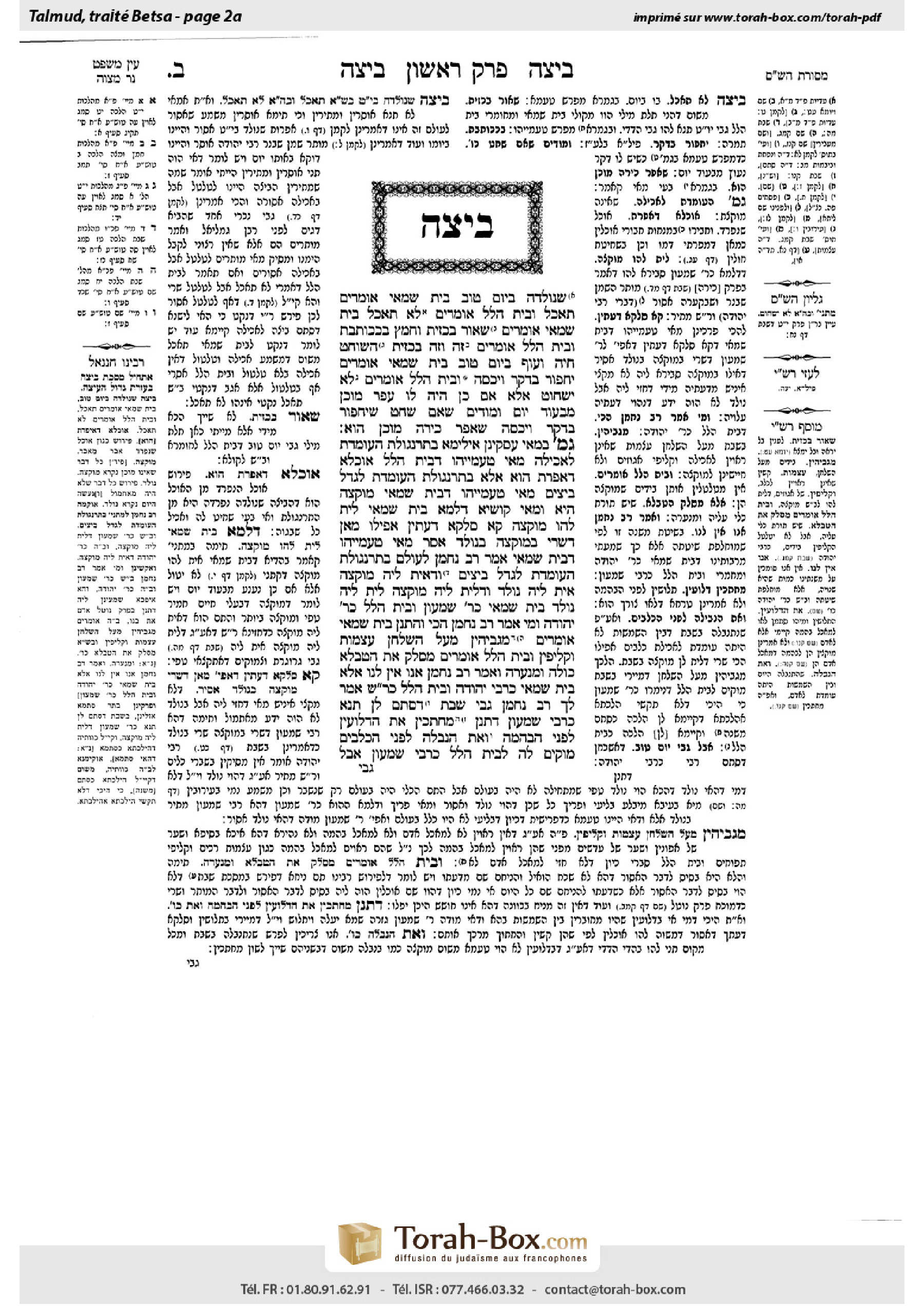
Beitzah 2a: Talmud study for Daf Yomi
Study the Talmud for Daf Yomi with scanned pages, Hebrew text, English translations from Sefaria and AI-generated French translations.
Passage selection and English or AI-generated French translation are available where the scan has annotations. Daf Study is independent of Torah-Box and Sefaria.
Browse Beitzah · ביצה · All tractatesBeitzah 2a text and translations
This page of Beitzah includes the Aramaic text, an English translation and an AI-generated French translation, alongside the scan above.
ביצה ב׳ א · Aramaic and Hebrew text
בֵּיצָה שֶׁנּוֹלְדָה בְּיוֹם טוֹב, בֵּית שַׁמַּאי אוֹמְרִים: תֵּאָכֵל, וּבֵית הִלֵּל אוֹמְרִים: לֹא תֵּאָכֵל. בֵּית שַׁמַּאי אוֹמְרִים: שְׂאוֹר בְּכַזַּיִת וְחָמֵץ בְּכַכּוֹתֶבֶת, וּבֵית הִלֵּל אוֹמְרִים: זֶה וְזֶה בְּכַזַּיִת.
הַשּׁוֹחֵט חַיָּה וָעוֹף בְּיוֹם טוֹב, בֵּית שַׁמַּאי אוֹמְרִים: יַחְפּוֹר בַּדָּקָר וִיכַסֶּה, וּבֵית הִלֵּל אוֹמְרִים: לֹא יִשְׁחוֹט אֶלָּא אִם כֵּן הָיָה לוֹ עָפָר מוּכָן מִבְּעוֹד יוֹם. וּמוֹדִים שֶׁאִם שָׁחַט, שֶׁיַּחְפּוֹר בַּדָּקָר וִיכַסֶּה — שֶׁאֵפֶר כִּירָה מוּכָן הוּא.
גְּמָ׳ בְּמַאי עָסְקִינַן? אִילֵימָא בְּתַרְנְגוֹלֶת הָעוֹמֶדֶת לַאֲכִילָה, מַאי טַעְמַיְיהוּ דְּבֵית הִלֵּל? אוּכְלָא דְּאִפְּרַת הוּא!
אֶלָּא, בְּתַרְנְגוֹלֶת הָעוֹמֶדֶת לְגַדֵּל בֵּיצִים.
מַאי טַעְמַיְיהוּ דְּבֵית שַׁמַּאי? מוּקְצֶה הִיא! וּמַאי קוּשְׁיָא? דִּלְמָא בֵּית שַׁמַּאי לֵית לְהוּ מוּקְצֶה!
קָא סָלְקָא דַּעְתִּין: אֲפִלּוּ מַאן דְּשָׁרֵי בְּמוּקְצֶה, בְּנוֹלָד אָסַר. מַאי טַעְמַיְיהוּ דְּבֵית שַׁמַּאי?
אָמַר רַב נַחְמָן: לְעוֹלָם בְּתַרְנְגוֹלֶת הָעוֹמֶדֶת לְגַדֵּל בֵּיצִים, וּדְאִית לֵיהּ מוּקְצֶה — אִית לֵיהּ נוֹלָד, וּדְלֵית לֵיהּ מוּקְצֶה — לֵית לֵיהּ נוֹלָד. בֵּית שַׁמַּאי כְּרַבִּי שִׁמְעוֹן, וּבֵית הִלֵּל כְּרַבִּי יְהוּדָה.
וּמִי אָמַר רַב נַחְמָן הָכִי? וְהָתְנַן: בֵּית שַׁמַּאי אוֹמְרִים: מַגְבִּיהִין מֵעַל הַשֻּׁלְחָן עֲצָמוֹת וּקְלִיפִּין, וּבֵית הִלֵּל אוֹמְרִים: מְסַלֵּק אֶת הַטַּבְלָא כּוּלָּהּ וּמְנַעֲרָהּ.
וְאָמַר רַב נַחְמָן: אָנוּ אֵין לָנוּ אֶלָּא בֵּית שַׁמַּאי כְּרַבִּי יְהוּדָה, וּבֵית הִלֵּל כְּרַבִּי שִׁמְעוֹן!
אָמַר לְךָ רַב נַחְמָן: גַּבֵּי שַׁבָּת, דִּסְתַם לַן תְּנָא כְּרַבִּי שִׁמְעוֹן, דִּתְנַן: מְחַתְּכִין אֶת הַדִּלּוּעִין לִפְנֵי הַבְּהֵמָה, וְאֶת הַנְּבֵלָה לִפְנֵי הַכְּלָבִים —
מוֹקֵים לָהּ לְבֵית הִלֵּל כְּרַבִּי שִׁמְעוֹן. אֲבָל
Beitzah 2a · English translation
MISHNA: With regard to an egg that was laid on a Festival (Eduyyot 4:1), Beit Shammai say: It may be eaten even on that day, and Beit Hillel say: It may not be eaten, as the Gemara will explain at length. Apropos this exceptional case, in which Beit Shammai are lenient and Beit Hillel are strict, the mishna cites additional halakhot of the Festivals in which this unusual phenomenon occurs (Yoma 79b). Beit Shammai say: Leaven, i.e., dough that has leavened to such an extent that it is no longer used as food but as a leavening agent for other dough, is prohibited on Passover in the measure of an olive-bulk. However, the measure for edible leavened bread is greater, that of a large date-bulk. And Beit Hillel say: For both this and that, the measure is that of an olive-bulk.
Furthermore, with regard to one who slaughters an undomesticated animal or a bird on a Festival (Eduyyot 4:2), in which case there is a mitzva from the Torah to cover the blood after slaughtering (Leviticus 17:13), Beit Shammai say: He digs earth with a shovel and covers the blood with that earth ab initio. And Beit Hillel say: He may not slaughter ab initio, unless he had earth prepared for that purpose while it was still day. But even Beit Hillel concede that if one already slaughtered the animal or the bird, then he should dig with a shovel and cover the blood. Additionally, they agree that the ashes of a stove are considered prepared for the use of covering blood, as will be explained by the Gemara.
GEMARA: The Gemara inquires: With what case are we dealing in this mishna? If we say that the mishna is referring to a chicken that is designated for eating, i.e., one planned to slaughter and eat a chicken that laid an egg, what is the reason that Beit Hillel prohibit eating the egg? It is food that has been separated [de’ifrat]. The entire chicken is considered food, as it is designated for eating, and this egg is simply a part that became detached. Just as one may partake of the chicken itself on a Festival, its egg should likewise be fit for consumption.
Rather, the mishna must be referring to the case of a chicken designated for laying eggs. Since the owner of this chicken decided not to eat it on the Festival, it is classified as set-aside [muktze], and muktze items may not even be moved, let alone eaten. Since the chicken itself is muktze, its egg is muktze as well.
The Gemara asks: If so, what is the reason of Beit Shammai for permitting one to eat the egg? After all, it is muktze. The Gemara expresses surprise at this question: And what is the difficulty? Perhaps Beit Shammai do not hold that there is a prohibition of muktze? There are different opinions with regard to the scope of the prohibition of muktze. It is possible that Beit Shammai, like other tanna’im, maintain that there is no prohibition of this type of muktze. Perhaps this is the subject of their dispute with Beit Hillel.
Before stating its proposed solutions for this difficulty, the Gemara notes: It enters our mind to say that even one who permits moving an item that was set aside by its owners on a Festival or Shabbat prohibits the owners from doing so with an object that came into being [nolad] on a Festival. One may not move an object that came into being on a Festival or Shabbat, since the owner never entertained the notion that he would be able to use it. This egg is certainly an object that came into being on the Festival. What, then, is the reason of Beit Shammai?
Rav Naḥman said: Actually, the mishna is referring to a chicken designated for laying eggs. However, our previous assumption was mistaken, as the Sage who holds that there is a prohibition of muktze in general also holds that there is a prohibition of objects that came into being, while one who does not hold that there is a prohibition of muktze likewise does not hold that there is a prohibition of objects that came into being (Shabbat 45b). Consequently, the dispute can be summed up as follows: Beit Shammai hold in accordance with the opinion of Rabbi Shimon, who maintains that there is no prohibition of muktze; and Beit Hillel hold in accordance with the opinion of Rabbi Yehuda, who rules that there is a prohibition of muktze.
The Gemara is puzzled by this explanation: And did Rav Naḥman actually say that Beit Hillel hold in accordance with the opinion of Rabbi Yehuda? But didn’t we learn in a mishna (Shabbat 143a) that Beit Shammai say: One may remove bones and shells left from the meal from the table, despite the fact that they are inedible and are muktze. And Beit Hillel say: It is prohibited to do so; rather, one may remove the entire board [tavla] that is the table surface, which is a vessel that may be carried, and shake it all at once. By moving the table, which is not muktze, one is able to shake off the bones and shells, but he may not move the items themselves.
And Rav Naḥman said: That version of the mishna is not in accordance with the halakha; rather, the opinions should be reversed, as we have nothing other than the following version of this dispute: Beit Shammai hold in accordance with the opinion of Rabbi Yehuda, who maintains that the prohibition of muktze applies, while Beit Hillel hold in accordance with the opinion of Rabbi Shimon, who maintains that the halakha of muktze does not apply. Why, then, does Rav Naḥman explain that the ruling of Beit Hillel in the case of the egg in the mishna is based on the opinion of Rabbi Yehuda, who holds that there actually is a prohibition of muktze?
The Gemara answers that Rav Naḥman could have said to you in reply: With regard to Shabbat, this is a case where the tanna taught us an unattributed mishna, which is generally accepted as the halakha, in accordance with the opinion of Rabbi Shimon, as we learned in a mishna (Shabbat 156b): One may cut pumpkins before an animal to facilitate their consumption, and likewise one may cut up an animal carcass before dogs, even if the animal died on Shabbat, to enable them to consume it. Although that carcass is classified as muktze, it may be moved on Shabbat.
The Gemara concludes: That unattributed mishna in tractate Shabbat is in accordance with the opinion of Rabbi Shimon. For this reason, Rav Naḥman establishes that the dispute between Beit Hillel and Beit Shammai should be understood to mean that Beit Hillel hold in accordance with the opinion of Rabbi Shimon, whom the halakha apparently follows, as there is a principle that the halakha is always in accordance with Beit Hillel’s opinion. However,
Beitzah 2a · Traduction française (IA)
MICHNA: Concernant un œuf laid pendant un festival (Eduyyot 4:1), Beit Shammai disent : On peut le manger ce jour-là, et Beit Hillel disent : On ne peut pas le manger, comme l'expliquera la Guemara en détail. A propos de ce cas exceptionnel, où Beit Shammai sont indulgents et Beit Hillel stricts, la Michna cite d'autres halakhot des festivals où ce phénomène inhabituel se produit (Yoma 79b). Beit Shammai disent : Le levain, c'est-à-dire la pâte qui a fermenté à tel point qu'elle n'est plus utilisée comme aliment mais comme agent de fermentation pour d'autres pâtes, est interdit pendant la Pâque dans la mesure d'une olivette. Cependant, la mesure pour le pain levé comestible est plus grande, celle d'une date. Et Beit Hillel disent : Pour les deux, la mesure est celle d'une olivette.
De plus, concernant celui qui sacrifie un animal sauvage ou un oiseau pendant un festival (Eduyyot 4:2), dans lequel il y a une mitsva de la Torah de recouvrir le sang après la sacrifice (Lévitique 17:13), Beit Shammai disent : Il creuse la terre avec une pelle et recouvre le sang avec cette terre dès le début. Et Beit Hillel disent : Il ne peut pas sacrifier dès le début, sauf s'il avait préparé de la terre à cet effet pendant la journée. Mais même Beit Hillel reconnaissent que si l'on a déjà sacrifié l'animal ou l'oiseau, alors on doit creuser avec une pelle et recouvrir le sang. De plus, ils s'accordent sur le fait que les cendres d'une cheminée sont considérées comme préparées à l'usage de recouvrir le sang, comme l'expliquera la Guemara.
GUEMARA : La Guemara interroge : De quel cas s'agit-il dans cette mésorah ? Si nous disons que la mésorah fait référence à un poulet destiné à être mangé, c'est-à-dire un poulet prévu pour être sacrifié et mangé, et que ce poulet a pondu un œuf, quelle est la raison pour laquelle Beit Hillel interdisent de manger l'œuf ? C'est un aliment séparé [de’ifrat]. L'ensemble du poulet est considéré comme un aliment, car il est destiné à être mangé, et cet œuf est simplement une partie qui s'est détachée. Tout comme l'on peut consommer le poulet lui-même pendant un festival, son œuf devrait également être considéré comme comestible.
Au contraire, la mésorah doit faire référence au cas d'un poulet destiné à pondre des œufs. Puisque le propriétaire de ce poulet a décidé de ne pas le manger pendant le festival, il est classé comme muktze, et les objets muktze ne peuvent même pas être déplacés, encore moins mangés. Puisque le poulet lui-même est muktze, son œuf est également muktze.
La Guemara interroge : Si c'est ainsi, quelle est la raison de Beit Shammai pour permettre de manger l'œuf ? Après tout, il est muktze. La Guemara exprime une surprise à ce sujet : Et quelle est la difficulté ? Peut-être Beit Shammai ne considèrent-ils pas que le muktze est interdit ? Il existe différentes opinions concernant l'étendue de l'interdiction du muktze. Il est possible que Beit Shammai, comme d'autres tannaïm, maintiennent qu'il n'y a pas d'interdiction de ce type de muktze. Peut-être est-ce la matière de leur débat avec Beit Hillel.
Avant d'annoncer ses solutions proposées pour cette difficulté, la Guemara note : Il nous vient à l'esprit de dire que même celui qui permet le déplacement d'un objet désigné par ses propriétaires pour être mis de côté pendant un festival ou un sabbat interdit aux propriétaires de le faire avec un objet qui est né [nolad] pendant un festival. On ne peut pas déplacer un objet né pendant un festival ou un sabbat, car le propriétaire n'avait jamais l'intention de l'utiliser. Cet œuf est certainement un objet né pendant le festival. Quelle est alors la raison de Beit Shammai ?
Rav Naḥman a dit : En réalité, la mésorah fait référence à un poulet destiné à pondre des œufs. Cependant, notre hypothèse précédente était erronée, car le Sage qui maintient qu'il y a une interdiction du muktze en général maintient également qu'il y a une interdiction des objets nés. Celui qui ne considère pas qu'il y a une interdiction du muktze ne considère pas non plus qu'il y a une interdiction des objets nés (Shabbat 45b). Ainsi, le débat peut être résumé comme suit : Beit Shammai suivent l'opinion de Rabbi Shimon, qui maintient qu'il n'y a pas d'interdiction du muktze ; et Beit Hillel suivent l'opinion de Rabbi Yehuda, qui décide qu'il y a une interdiction du muktze.
La Guemara est perplexe avec cette explication : Et Rav Naḥman a-t-il vraiment dit que Beit Hillel suivent l'opinion de Rabbi Yehuda ? Mais n'avons-nous pas appris dans une mésorah (Shabbat 143a) que Beit Shammai disent : On peut retirer les os et les coquilles restantes du repas de la table, même si elles sont inedibles et sont muktze. Et Beit Hillel disent : Il est interdit de le faire ; plutôt, on peut retirer la table [tavla] qui est la surface de la table, qui est un objet transportable, et secouer tout cela. En déplaçant la table, qui n'est pas muktze, on peut secouer les os et les coquilles, mais on ne peut pas déplacer les objets eux-mêmes.
Et Rav Naḥman a dit : Cette version de la mésorah n'est pas conforme à la halakha ; plutôt, les opinions devraient être inversées, car nous n'avons rien d'autre que cette version du débat : Beit Shammai suit l'opinion de Rabbi Yehuda, qui affirme que l'interdiction du muktze s'applique, tandis que Beit Hillel suit l'opinion de Rabbi Shimon, qui affirme que l'halakha du muktze ne s'applique pas. Pourquoi, alors, Rav Naḥman explique-t-il que le jugement de Beit Hillel dans le cas de l'œuf dans la mésorah est basé sur l'opinion de Rabbi Yehuda, qui affirme qu'il y a effectivement une interdiction du muktze ?
La Guemara répond que Rav Naḥman aurait pu dire à votre réponse : Concernant le sabbat, c'est un cas où le tanna nous a appris une mésorah non attribuée, généralement acceptée comme la halakha, conformément à l'opinion de Rabbi Shimon, comme nous l'avons appris dans une mésorah (Shabbat 156b) : On peut couper les citrouilles avant un animal pour faciliter leur consommation, et de même on peut découper un cadavre d'animal avant les chiens, même si l'animal est mort le sabbat, pour permettre qu'ils le mangent. Bien que ce cadavre soit classé comme muktze, il peut être déplacé le sabbat.
La Guemara conclut : La michna non attribuée dans le traité de Shabbat est selon l'opinion du Rabbi Shimon. C'est pourquoi Rav Naḥman établit que le débat entre Beit Hillel et Beit Shammai doit être compris comme signifiant que Beit Hillel suit l'opinion du Rabbi Shimon, celui que la halakha suit apparemment, car il y a un principe selon lequel la halakha suit toujours l'opinion de Beit Hillel. Cependant,
Traduction française générée par IA à partir de l’édition anglaise de Sefaria. Vérifie toujours un passage avec le texte source.
Text from Sefaria: William Davidson Edition - Vocalized Aramaic (CC BY NC); William Davidson Edition - English (CC BY NC).