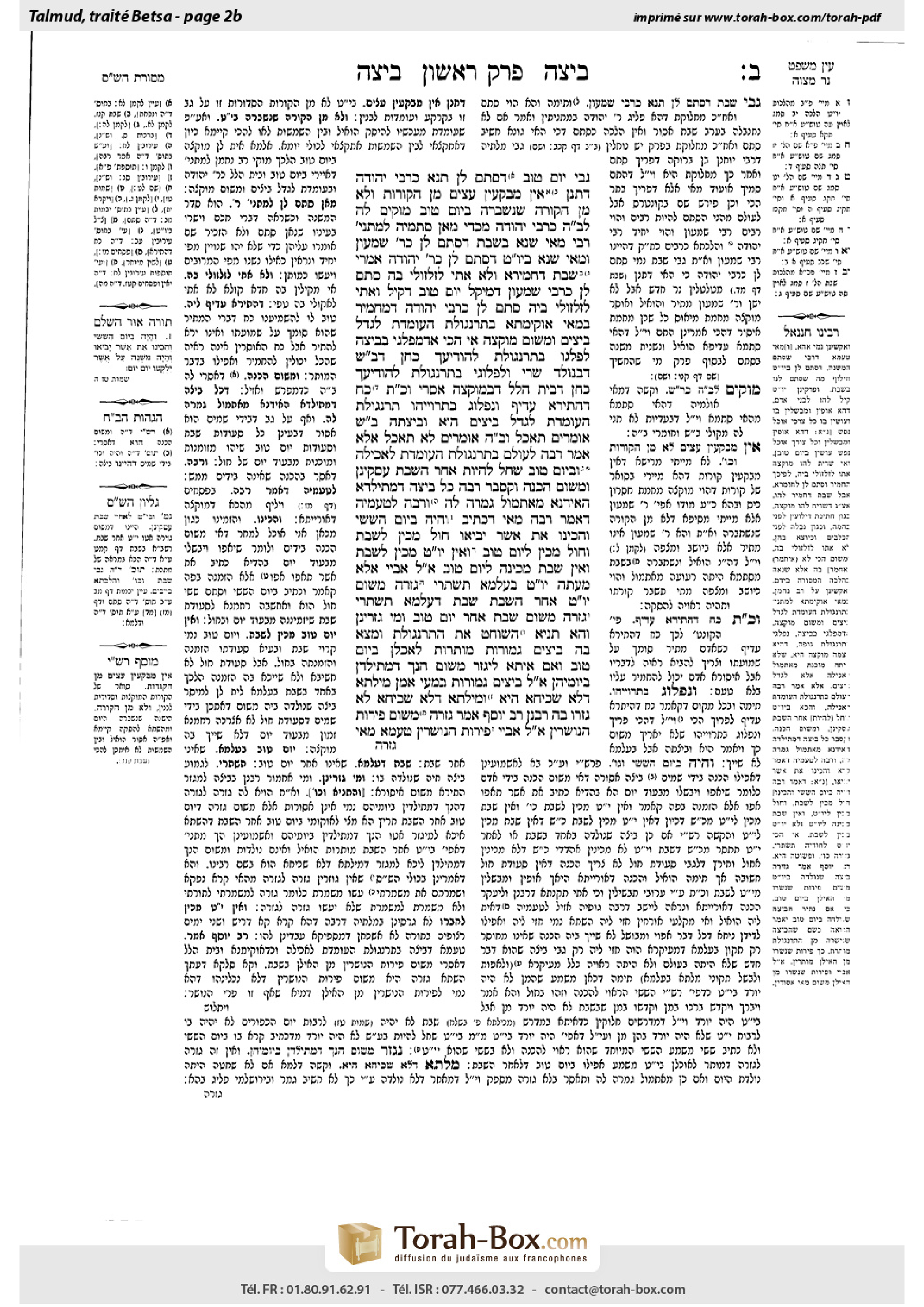
Beitzah 2b: Talmud study for Daf Yomi
Study the Talmud for Daf Yomi with scanned pages, Hebrew text, English translations from Sefaria and AI-generated French translations.
Passage selection and English or AI-generated French translation are available where the scan has annotations. Daf Study is independent of Torah-Box and Sefaria.
Browse Beitzah · ביצה · All tractatesBeitzah 2b text and translations
This page of Beitzah includes the Aramaic text, an English translation and an AI-generated French translation, alongside the scan above.
ביצה ב׳ ב · Aramaic and Hebrew text
גַּבֵּי יוֹם טוֹב, דִּסְתַם לַן תַּנָּא כְּרַבִּי יְהוּדָה, דִּתְנַן: אֵין מְבַקְּעִין עֵצִים מִן הַקּוֹרוֹת וְלֹא מִן הַקּוֹרָה שֶׁנִּשְׁבְּרָה בְּיוֹם טוֹב — מוֹקֵים לָהּ לְבֵית הִלֵּל כְּרַבִּי יְהוּדָה.
מִכְּדֵי, מַאן סַתְמַיהּ לְמַתְנִיתִין — רַבִּי. מַאי שְׁנָא בְּשַׁבָּת דִּסְתַם לַן כְּרַבִּי שִׁמְעוֹן, וּמַאי שְׁנָא בְּיוֹם טוֹב דִּסְתַם לַן כְּרַבִּי יְהוּדָה?
אָמְרִי: שַׁבָּת דַּחֲמִירָא, וְלָא אָתֵי לְזַלְזוֹלֵי בַּהּ — סָתֵם לַן כְּרַבִּי שִׁמְעוֹן דְּמֵיקֵל, יוֹם טוֹב דְּקִיל, וְאָתֵי לְזַלְזוֹלֵי בֵּיהּ — סָתֵם לַן כְּרַבִּי יְהוּדָה דְּמַחְמִיר.
בְּמַאי אוֹקֵימְתָּא — בְּתַרְנְגוֹלֶת הָעוֹמֶדֶת לְגַדֵּל בֵּיצִים, וּמִשּׁוּם מוּקְצֶה. אִי הָכִי, אַדְּמִפַּלְגִי בְּבֵיצָה, לִפַּלְגוּ בְּתַרְנְגוֹלֶת?
לְהוֹדִיעֲךָ כֹּחָן דְּבֵית שַׁמַּאי, דִּבְנוֹלָד שְׁרֵי.
וְלִפְלוּגי בְּתַרְנְגוֹלֶת, לְהוֹדִיעֲךָ כֹּחָן דְּבֵית הִלֵּל, דִּבְמוּקְצֶה אָסְרִי! וְכִי תֵּימָא כֹּחַ דְּהֶתֵּירָא עֲדִיף — וְנִפְלוֹג בְּתַרְוַיְיהוּ:
תַּרְנְגוֹלֶת הָעוֹמֶדֶת לְגַדֵּל בֵּיצִים, הִיא וּבֵיצָתָהּ, בֵּית שַׁמַּאי אוֹמְרִים: תֵּאָכֵל, וּבֵית הִלֵּל אוֹמְרִים: לֹא תֵּאָכֵל.
אֶלָּא, אָמַר רַבָּה: לְעוֹלָם בְּתַרְנְגוֹלֶת הָעוֹמֶדֶת לַאֲכִילָה, וּבְיוֹם טוֹב שֶׁחָל לִהְיוֹת אַחַר הַשַּׁבָּת עָסְקִינַן, וּמִשּׁוּם הֲכָנָה.
וְקָסָבַר רַבָּה, כֹּל בֵּיצָה דְּמִתְיַלְדָא הָאִידָּנָא — מֵאֶתְמוֹל גָּמְרָה לָהּ.
וְרַבָּה לְטַעְמֵיהּ. דְּאָמַר רַבָּה, מַאי דִּכְתִיב: ״וְהָיָה בַּיּוֹם הַשִּׁשִּׁי וְהֵכִינוּ אֶת אֲשֶׁר יָבִיאוּ״ — חוֹל מֵכִין לְשַׁבָּת, וְחוֹל מֵכִין לְיוֹם טוֹב, וְאֵין יוֹם טוֹב מֵכִין לְשַׁבָּת, וְאֵין שַׁבָּת מְכִינָה לְיוֹם טוֹב.
אֲמַר לֵיהּ אַבָּיֵי: אֶלָּא מֵעַתָּה, יוֹם טוֹב בְּעָלְמָא תִּשְׁתְּרֵי! גְּזֵרָה מִשּׁוּם יוֹם טוֹב אַחַר הַשַּׁבָּת. שַׁבָּת דְּעָלְמָא תִּשְׁתְּרֵי! גְּזֵרָה מִשּׁוּם שַׁבָּת אַחַר יוֹם טוֹב.
וּמִי גָּזְרִינַן? וְהָא תַּנְיָא: הַשּׁוֹחֵט אֶת הַתַּרְנְגוֹלֶת וּמָצָא בָּהּ בֵּיצִים גְּמוּרוֹת — מוּתָּרוֹת לְאָכְלָן בְּיוֹם טוֹב. וְאִם אִיתָא — לִיגְזַר מִשּׁוּם הָנָךְ דְּמִתְיַלְּדָן בְּיוֹמֵיהֶן!
אֲמַר לֵיהּ: בֵּיצִים גְּמוּרוֹת בִּמְעֵי אִמָּן — מִילְּתָא דְלָא שְׁכִיחָא הִיא, וּמִילְּתָא דְלָא שְׁכִיחָא לָא גְּזַרוּ בַּהּ רַבָּנַן.
רַב יוֹסֵף אָמַר: גְּזֵרָה מִשּׁוּם פֵּרוֹת הַנּוֹשְׁרִין.
אֲמַר לֵיהּ אַבָּיֵי: פֵּרוֹת הַנּוֹשְׁרִין טַעְמָא מַאי —
Beitzah 2b · English translation
with regard to a Festival, the tanna taught us an unattributed mishna in accordance with the opinion of Rabbi Yehuda (Shabbat 156b), as we learned in a mishna in this tractate: One may not chop wood on a Festival from beams prepared for use in construction work, nor may one chop kindling wood from a beam that broke on a Festival. As the beams were not prepared for this use when the Festival began, they are classified as muktze; this demonstrates that an unattributed mishna prohibits muktze on a Festival. Consequently, Rav Naḥman establishes the opinion of Beit Hillel in accordance with the opinion of Rabbi Yehuda, who prohibits muktze. He does so by asserting that the mishna is referring to the case of a chicken designated for laying eggs, which is muktze. This concludes the Gemara’s explanation of Rav Naḥman’s rendering of the tannaitic dispute.
The Gemara asks: Now since, i.e., consider the following: Who is the one who wrote and edited the Mishna, and arranged the unattributed mishnayot? It was Rabbi Yehuda HaNasi. Since the same Sage formulated the statements in both tractates, the question arises: What is different with regard to the halakhot of Shabbat, that he stated the unattributed opinion and ruled for us in accordance with the opinion of Rabbi Shimon, and what is different with regard to the halakhot of a Festival, that he stated the unattributed opinion and ruled for us in accordance with the opinion of Rabbi Yehuda?
They answer and say: In the case of Shabbat, which is stringent with regard to its punishments (see 35b), and therefore people will not come to treat it with contempt, Rabbi Yehuda HaNasi taught us the unattributed mishna in accordance with the opinion of Rabbi Shimon, who rules leniently. Conversely, with regard to a Festival, which is lenient, as certain labors may be performed on a Festival, and therefore people will be more likely to come to treat it with contempt, he stated the unattributed opinion for us in accordance with the opinion of Rabbi Yehuda, who rules stringently.
The Gemara asks: In what manner did you ultimately establish the mishna? It was established as referring to a chicken designated for laying eggs, and the prohibition is due to muktze. If so, rather than disputing with regard to an egg laid on a Festival, let them dispute with regard to the chicken itself. Instead of considering the secondary detail of an egg, Beit Shammai and Beit Hillel could discuss whether or not the chicken itself may be slaughtered on a Festival.
The Gemara answers: Beit Shammai and Beit Hillel also disagree with regard to the chicken, but the dispute was phrased in this manner to convey the far-reaching nature of the opinion of Beit Shammai. The formulation of the mishna emphasizes the extent of Beit Shammai’s lenient opinion, that even in the case of an egg, which is not a regular muktze item but an item that came into being, an especially stringent type of muktze, Beit Shammai nevertheless permit it. By stating the dispute with regard to an egg, the mishna stresses Beit Shammai’s lenient opinion.
The Gemara raises an objection: And let them disagree with regard to a chicken, rather than an egg, to convey the far-reaching nature of the opinion of Beit Hillel, who prohibit its use even in the more lenient case of muktze. And if you say it is better to present the dispute as in the mishna, so as to clarify the more lenient opinion, as the strength of leniency is preferable (Berakhot 60a), there is another option: And let them disagree with regard to both of these cases.
The mishna could have said: With regard to a chicken designated for laying eggs, it and its eggs, Beit Shammai say: It may be eaten, and Beit Hillel say: It may not be eaten. In this manner, the mishna could have referred to all aspects of the dispute, without the need for any lengthy addition. Consequently, Rav Naḥman’s explanation of the mishna is inadequate.
Rather, Rabba said: Actually, the above explanation should be rejected. We are dealing with a chicken designated for food and we are dealing with an egg that was laid on a Festival that occurs after Shabbat, i.e., on a Sunday. And the relevant issue is not the halakhot of muktze; rather, one may not eat the egg due to the prohibition against preparation from Shabbat to a Festival.
And in this regard, Rabba holds that any egg laid now was already fully developed yesterday, and merely emerged from the chicken today. Consequently, an egg laid on a Festival that occurred on a Sunday may not be eaten, as it was prepared on Shabbat, despite the fact that it was prepared naturally, by Heaven, rather than by man.
The Gemara comments: And Rabba, who prohibits one to derive benefit even from something that was not prepared by man, conforms to his standard line of reasoning. As Rabba said: What is the meaning of that which is written with regard to the manna: “And it shall come to pass on the sixth day, that they shall prepare that which they bring in” (Exodus 16:5)? According to Rabba, it can be inferred from this verse that on an ordinary weekday, “the sixth day,” one may prepare what is needed for Shabbat, and similarly, on an ordinary weekday one may prepare what is needed for a Festival. However, on a Festival one may not prepare for Shabbat, and likewise on Shabbat one may not prepare for a Festival.
Abaye said to Rabba: However, if that is so, and the concern is only due to preparation, let an egg laid on a regular Festival, one that does not occur on a Sunday, be permitted. Rabba responded: That egg is not prohibited by Torah law, but by rabbinic decree, due to the case of a Festival that occurs after Shabbat. Abaye asked: On a regular Shabbat, one that does not occur after a Festival, let it be permitted to eat an egg that was laid on that day, provided that one does not cook it. Rabba similarly answered: It is a decree due to a Shabbat that occurs after a Festival.
Abaye further asked: And do we issue a decree of this kind? But isn’t it taught in a baraita (see 6b): In the case of one who slaughters a chicken on a Festival and finds inside it fully developed eggs with their shells, it is permitted to eat them on the Festival. And if it is so, that the aforementioned decree is in effect, let him issue a decree and prohibit these eggs found inside the chicken, due to those that are laid on that day.
Rabba said to him: This is not difficult, as the case of fully developed eggs found inside their mother is an uncommon matter, and in a case of an uncommon matter the Sages did not issue a decree as a preventive measure (Eiruvin 63b). The Sages issued their decrees only for usual situations, in which people might err, but they did not apply them to rare cases. This concludes the Gemara’s discussion of Rabba’s explanation.
The Gemara proceeds to explain other interpretations of the mishna. Rav Yosef said: An egg laid by a chicken designated for food is prohibited for a different reason: It is a decree due to fruits that fall from a tree (Eiruvin 39b). Fruits that fall from a tree on Shabbat or a Festival may not be eaten, and the same applies to eggs that emerge from a chicken.
Abaye said to Rav Yosef: With regard to fruits that fall, what in fact is the reason that the Sages prohibited them?
Beitzah 2b · Traduction française (IA)
En ce qui concerne un festival, le tanna nous a appris une mésna non attribuée conformément à l'opinion de Rabbi Yehuda (Shabbat 156b), comme nous l'avons appris dans une mésna de ce traité : On ne doit pas couper du bois sur un festival provenant de poutres préparées pour l'usage de la construction, ni non plus couper des bûches de bois de chauffage d'une poutre qui s'est cassée sur un festival. Puisque ces poutres n'étaient pas préparées à cette fin lorsque le festival a commencé, elles sont classées comme muktze ; cela démontre que une mésna non attribuée interdit le muktze sur un festival. Par conséquent, Rav Naḥman établit l'opinion de Beit Hillel conformément à l'opinion de Rabbi Yehuda, qui interdit le muktze. Il le fait en affirmant que la mésna fait référence au cas d'un poulet désigné pour pondre, qui est muktze. Cela conclut l'explication de la Guemara sur la manière dont Rav Naḥman interprète le débat tannaitique.
La Guemara pose la question : Maintenant, c'est-à-dire, considérons le suivant : Qui est celui qui a rédigé et édité la Michna, et a organisé les mésnayot non attribuées ? C'était Rabbi Yehuda HaNasi. Puisque le même Sage a formulé les déclarations dans les deux traités, la question se pose : Qu'est-ce qui diffère concernant les halakhot de Shabbat, qu'il a exprimé l'opinion non attribuée et a décidé pour nous conformément à l'opinion de Rabbi Shimon, et qu'est-ce qui diffère concernant les halakhot d'un festival, qu'il a exprimé l'opinion non attribuée et a décidé pour nous conformément à l'opinion de Rabbi Yehuda ?
Ils répondent et disent : Concernant le Shabbat, qui est strict concernant ses sanctions (voir 35b), et donc les gens ne viendront pas à le mépriser, Rabbi Yehuda HaNasi nous a appris la mésna non attribuée conformément à l'opinion de Rabbi Shimon, qui règlement lenient. À l'inverse, concernant un festival, qui est lenient, puisque certains travaux peuvent être effectués sur un festival, et donc les gens seront plus enclins à le mépriser, il a exprimé l'opinion non attribuée pour nous conformément à l'opinion de Rabbi Yehuda, qui règlement strictement.
La Guemara pose la question : De quelle manière avez-vous finalement établi la mésna ? Elle a été établie comme faisant référence à un poulet désigné pour pondre, et l'interdiction provient du muktze. Si c'est ainsi, plutôt que de discuter concernant un œuf pondu sur un festival, laissez-les discuter concernant le poulet lui-même. Au lieu de considérer le détail secondaire d'un œuf, Beit Shammai et Beit Hillel pourraient discuter de savoir si le poulet lui-même peut être sacrifié sur un festival.
La Guemara répond : Beit Shammai et Beit Hillel s'opposent également concernant le poulet, mais le débat a été formulé ainsi pour faire comprendre la portée de l'opinion de Beit Shammai. La formulation de la mésna souligne l'étendue de l'opinion leniente de Beit Shammai, que même dans le cas d'un œuf, qui n'est pas un objet muktze ordinaire mais un objet qui est apparu, un type particulièrement strict de muktze, Beit Shammai permet toutefois. En indiquant le débat concernant un œuf, la mésna souligne l'opinion leniente de Beit Shammai.
La Guemara soulève une objection : Et laissez-les s'opposer concernant un poulet, plutôt qu'un œuf, pour faire comprendre la portée de l'opinion de Beit Hillel, qui interdit son utilisation même dans le cas plus lenient de muktze. Et si vous dites qu'il est préférable de présenter le débat comme dans la Michna afin de clarifier l'opinion plus leniente, comme la force de la leniencité est préférable (Berakhot 60a), il existe une autre option : Et laissez-les s'opposer concernant les deux cas.
La Michna aurait pu dire : Concernant un poulet désigné pour la nourriture, lui et ses œufs, Beit Shammai disent : On peut le manger, et Beit Hillel disent : On ne peut pas le manger. Ainsi, la Michna aurait pu faire référence à tous les aspects du débat, sans avoir besoin d'aucune addition prolongée. Par conséquent, l'explication de Rav Naḥman de la Michna est insuffisante.
Au contraire, Rabba dit : En réalité, l'explication ci-dessus devrait être rejetée. Nous sommes en présence d'un poulet désigné pour la nourriture et nous sommes en présence d'un œuf qui a été pondu sur un festival qui a eu lieu après le Shabbat, c'est-à-dire un dimanche. Et l'question en jeu n'est pas les halakhot du muktze ; plutôt, on ne peut pas manger l'œuf en raison de l'interdiction de préparation du Shabbat au festival.
Et à cet égard, Rabba considère que tout œuf pondu maintenant était déjà pleinement développé hier, et n'a simplement pas émergé du poulet aujourd'hui. Par conséquent, un œuf pondu sur un festival qui a eu lieu un dimanche ne peut pas être mangé, car il a été préparé le Shabbat, malgré le fait qu'il ait été préparé naturellement, par le Ciel, plutôt que par l'homme.
La Guemara commente : Et Rabba, qui interdit de tirer un bénéfice même d'une chose qui n'a pas été préparée par l'homme, correspond à sa ligne de raisonnement habituelle. Comme Rabba a dit : Quelle est la signification de ce qui est écrit concernant la manne : « Et cela arrivera le sixième jour, qu'ils prépareront ce qu'ils apporteront » (Exode 16:5) ? Selon Rabba, on peut en déduire de cette verset que sur un jour ordinaire, « le sixième jour », on peut préparer ce qui est nécessaire pour le Shabbat, et de même, sur un jour ordinaire, on peut préparer ce qui est nécessaire pour un festival. Cependant, sur un festival, on ne peut pas préparer pour le Shabbat, et de même, sur le Shabbat, on ne peut pas préparer pour un festival.
Abaye a dit à Rabba : Cependant, si c'est ainsi, et que l'inquiétude est uniquement due à la préparation, laissez un œuf pondu sur un festival ordinaire, celui qui ne se produit pas un dimanche, être permis. Rabba a répondu : Cet œuf n'est pas interdit par la Loi, mais par un décret rabbinique, en raison du cas d'un festival qui a eu lieu après le Shabbat. Abaye a demandé : Sur un Shabbat ordinaire, celui qui ne se produit pas après un festival, laissez-le être permis de manger un œuf qui a été pondu ce jour-là, à condition qu'on ne le cuisine pas. Rabba a répondu de la même manière : C'est un décret en raison d'un Shabbat qui a eu lieu après un festival.
Abaye demanda ensuite : Et nous émettons un tel décret ? Mais n’est-il pas enseigné dans une baraïta (voir 6b) : Dans le cas d’une personne qui sacrifie un poulet pendant un festival et découvre à l’intérieur des œufs entièrement développés avec leurs coquilles, il est permis de les manger pendant le festival. Et si c’est ainsi, que ce décret précité est en vigueur, qu’on émette un décret et interdise ces œufs trouvés à l’intérieur du poulet, en raison de ceux qui sont pondus ce jour-là.
Rabba répondit à lui : Ce n’est pas difficile, car le cas d’œufs entièrement développés trouvés à l’intérieur de leur mère est une affaire inhabituelle, et dans un cas d’affaire inhabituelle, les Sages n’ont pas émis un décret en tant que mesure préventive (Eiruvin 63b). Les Sages ont émis leurs décrets uniquement pour les situations habituelles, dans lesquelles les gens pourraient commettre une erreur, mais ils ne les ont pas appliqués aux cas rares. Cela conclut la discussion de la Guemara sur l’explication de Rabba.
La Guemara poursuit en expliquant d’autres interprétations de la mitsna. Rav Yosef dit : Un œuf pondu par un poulet désigné pour la nourriture est interdit pour une autre raison : il s’agit d’un décret en raison des fruits qui tombent d’un arbre (Eiruvin 39b). Les fruits qui tombent d’un arbre le sabbat ou un festival ne peuvent pas être mangés, et la même chose s’applique aux œufs qui sortent d’un poulet.
Abaye dit à Rav Yosef : En ce qui concerne les fruits qui tombent, quelle est en réalité la raison pour laquelle les Sages les ont interdits ?
Traduction française générée par IA à partir de l’édition anglaise de Sefaria. Vérifie toujours un passage avec le texte source.
Text from Sefaria: William Davidson Edition - Vocalized Aramaic (CC BY NC); William Davidson Edition - English (CC BY NC).