Beitzah 40b: Talmud study for Daf Yomi
Study the Talmud for Daf Yomi with scanned pages, Hebrew text, English translations from Sefaria and AI-generated French translations.
Passage selection and English or AI-generated French translation are available where the scan has annotations. Daf Study is independent of Torah-Box and Sefaria.
Browse Beitzah · ביצה · All tractatesBeitzah 40b text and translations
This page of Beitzah includes the Aramaic text, an English translation and an AI-generated French translation, alongside the scan above.
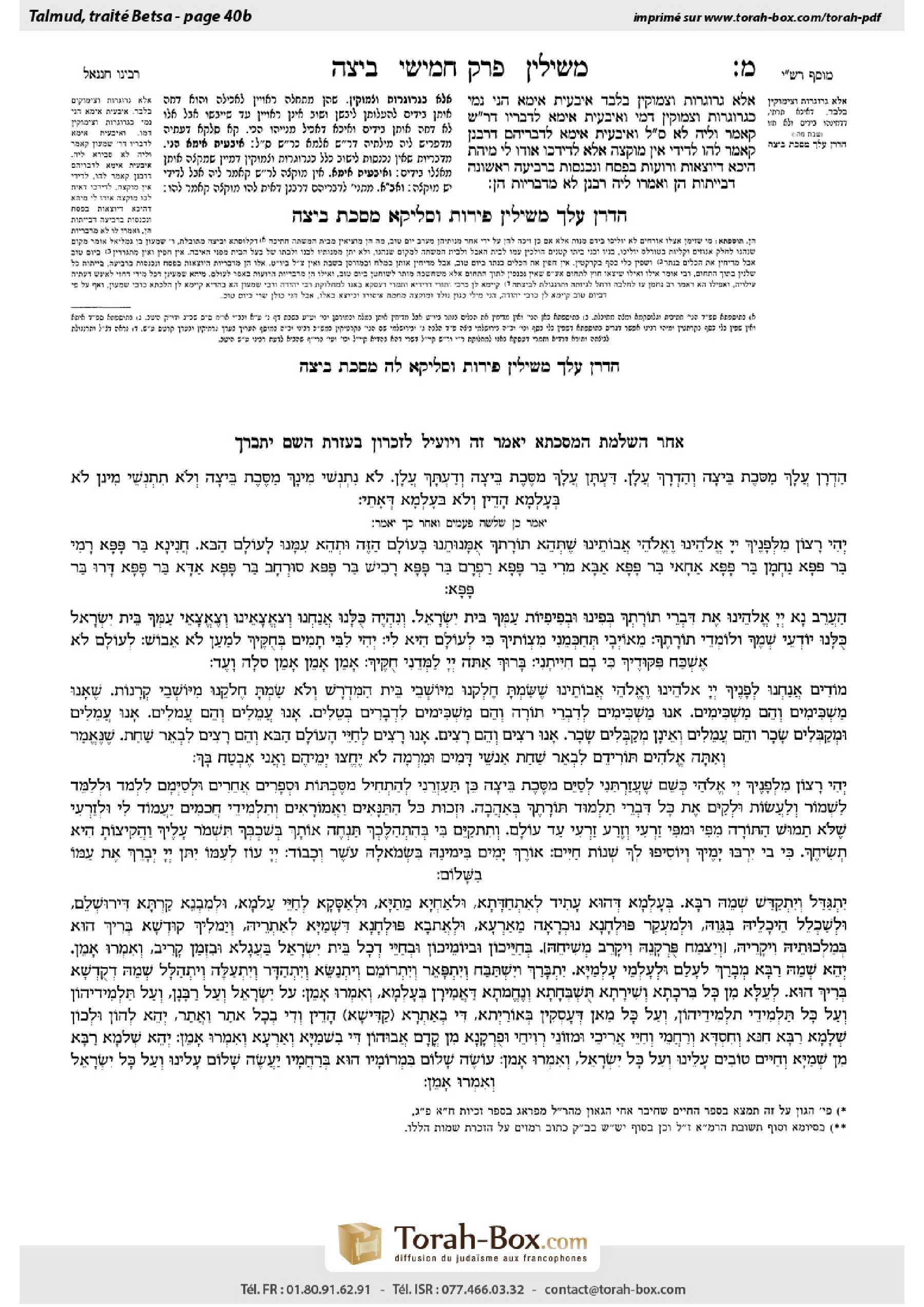
ביצה מ׳ ב · Aramaic and Hebrew text
אֶלָּא גְּרוֹגְרוֹת וְצִמּוּקִין בִּלְבַד!
אִיבָּעֵית אֵימָא: הָנֵי נָמֵי כִּגְרוֹגְרוֹת וְצִמּוּקִין דָּמֵי, וְאִיבָּעֵית אֵימָא: לִדְבָרָיו דְּרַבִּי שִׁמְעוֹן קָאָמַר, וְלֵיהּ לָא סְבִירָא לֵיהּ.
וְאִיבָּעֵית אֵימָא: לְדִבְרֵיהֶם דְּרַבָּנַן קָאָמַר לְהוּ. לְדִידִי אֵין מוּקְצֶה, אֶלָּא לְדִידְכוּ: אוֹדוֹ לִי מִיהַת הֵיכָא דְּיוֹצְאוֹת וְרוֹעוֹת בַּפֶּסַח וְנִכְנָסוֹת בִּרְבִיעָה רִאשׁוֹנָה דְּבַיָּיתוֹת הֵן. וַאֲמַרוּ לֵיהּ רַבָּנַן: לָא, מִדְבָּרִיּוֹת הֵן.
הֲדַרַן עֲלָךְ מַשִּׁילִין פֵּירוֹת וּסְלִיקָא מַסֶּכֶת בֵּיצָה
Beitzah 40b · English translation
except for the case of dried figs and raisins in the midst of the drying process alone. These are fruits that are fit to be eaten fresh and were deliberately removed from use to allow them to undergo a drying process, during which time they are inedible; they have therefore been actively removed from one’s mind for the interim. Unripe dates, however, are unfit to be eaten fresh and become fit for eating only when they are ripe. Therefore, if one places unripe dates in a basket to ripen, they are never completely removed from his mind, not having been changed from an edible state to an inedible state, and are permitted. If so, desert animals, which are similarly never completely removed from one’s mind, should also not be considered muktze. Why, then, does Rabbi Yehuda HaNasi indicate that they have the status of muktze?
The Gemara suggests several resolutions: If you wish, say that these desert animals are also considered similar to dried figs and raisins, as by sending them outside the town the owner has actively removed them from use. And if you wish, say instead that the fact that Rabbi Yehuda HaNasi told his son that Rabbi Shimon does not accept the halakha of muktze except for the case of dried figs and raisins does not prove anything about his own opinion; he stated this only in accordance with the statement of Rabbi Shimon, but he himself does not hold accordingly.
And if you wish, say a different answer: He himself, like Rabbi Shimon, did not accept the concept of muktze, and when he spoke in the baraita he was speaking, for the sake of argument, in accordance with the words of the Rabbis who had spoken before him, saying to them, in effect: According to my opinion, there is no halakha of muktze at all, in accordance with the opinion of Rabbi Shimon, and all animals may be slaughtered on the Festival. But even according to your approach, that there is a halakha of muktze, agree with me, in any event, that with regard to a case where they go out and graze on Passover and enter again at the first rainfall, they are considered domestic animals and should be permitted. But the Rabbis said to him: No, even those are desert animals.
Beitzah 40b · Traduction française (IA)
sauf le cas des figues sèches et des raisins au milieu du processus de séchage. Ces fruits sont ceux qui peuvent être mangés frais et ont été délibérément retirés de l'usage afin de subir un processus de séchage, pendant lequel ils sont inedibles ; ils ont donc été activement retirés de l'esprit de l'homme. Les dattes vertes, en revanche, ne sont pas adaptées à la consommation fraîche et deviennent comestibles seulement lorsqu'elles sont mûres. Par conséquent, si l'on place des dattes vertes dans un panier pour qu'elles mûrissent, elles ne sont jamais complètement retirées de l'esprit de l'homme, n'ayant pas été transformées d'un état comestible à un état inedible, et sont permises. Si tel est le cas, les animaux des déserts, qui sont semblables dans ce sens, ne devraient pas non plus être considérés comme muktze. Pourquoi, alors, Rabbi Yehuda HaNasi indique-t-il qu'ils ont le statut de muktze ?
La Guemara suggère plusieurs résolutions : Si vous le souhaitez, dites que ces animaux des déserts sont également considérés comme semblables aux figues sèches et aux raisins, car en les envoyant hors de la ville, l'homme les a activement retirés de l'usage. Et si vous le souhaitez, dites plutôt que le fait que Rabbi Yehuda HaNasi ait dit à son fils que Rabbi Shimon ne reconnaît pas la halakha de muktze sauf dans le cas des figues sèches et des raisins ne prouve rien à propos de son propre avis ; il a dit cela uniquement en conformité avec l'avis de Rabbi Shimon, mais il ne le maintient pas personnellement ainsi.
Et si vous le souhaitez, dites une autre réponse : lui-même, comme Rabbi Shimon, n'acceptait pas la notion de muktze, et lorsqu'il a parlé dans la baraïta, il parlait, à titre de démonstration, en conformité avec les paroles des tannaïm qui s'étaient exprimés avant lui, disant en effet : selon mon avis, il n'y a pas de halakha de muktze du tout, conformément à l'avis de Rabbi Shimon, et tous les animaux peuvent être sacrifiés pendant la fête. Mais même selon votre approche, que la halakha de muktze existe, convenez avec moi, en tout cas, que concernant le cas où ils sortent et paissent pendant la Pessah et rentrent à la première pluie, ils sont considérés comme des animaux domestiques et devraient être permis. Mais les tannaïm ont dit à lui : Non, même ceux-là sont des animaux des déserts.
Traduction française générée par IA à partir de l’édition anglaise de Sefaria. Vérifie toujours un passage avec le texte source.
Text from Sefaria: William Davidson Edition - Vocalized Aramaic (CC BY NC); William Davidson Edition - English (CC BY NC).