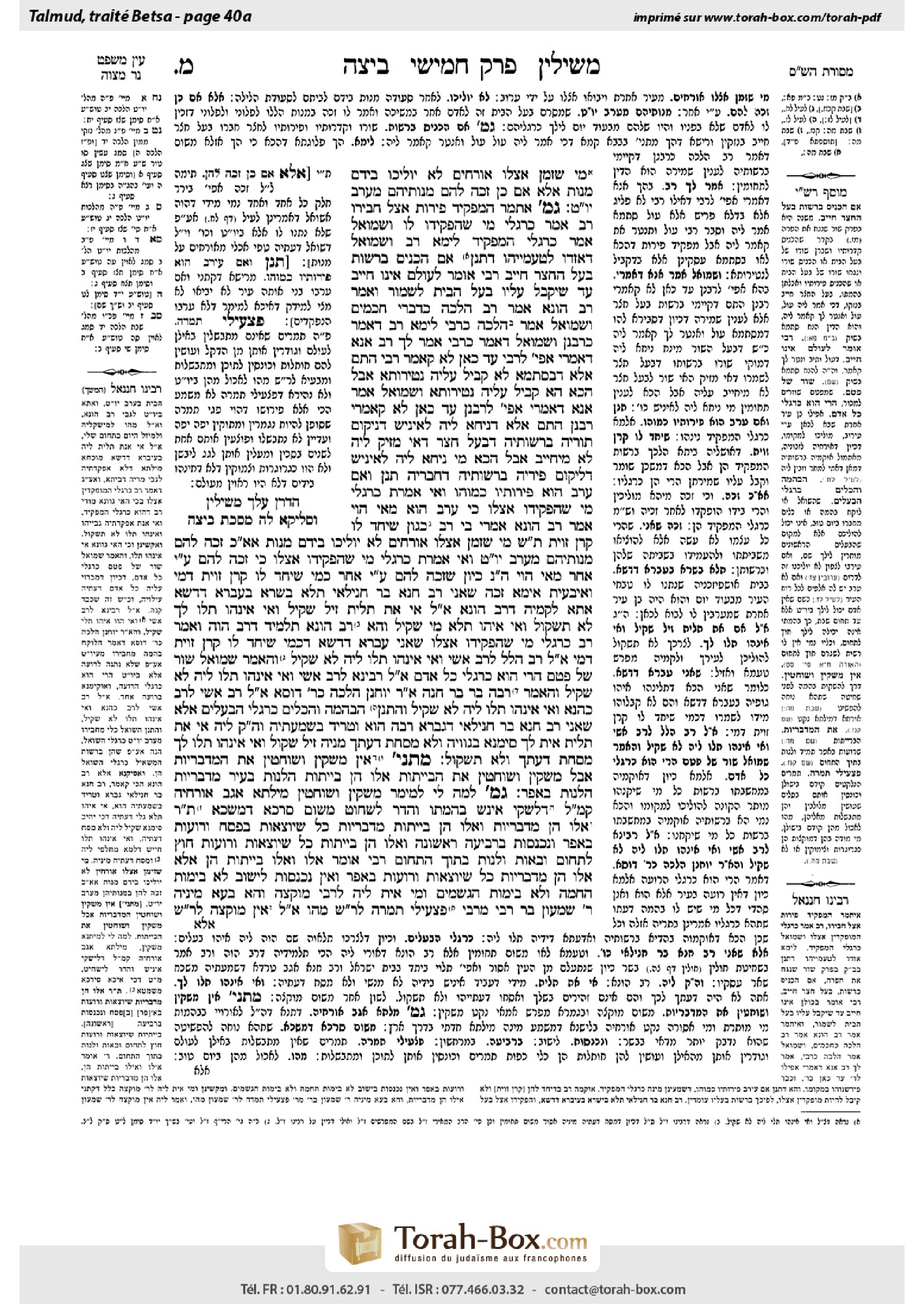
Beitzah 40a: Talmud study for Daf Yomi
Study the Talmud for Daf Yomi with scanned pages, Hebrew text, English translations from Sefaria and AI-generated French translations.
Passage selection and English or AI-generated French translation are available where the scan has annotations. Daf Study is independent of Torah-Box and Sefaria.
Browse Beitzah · ביצה · All tractatesBeitzah 40a text and translations
This page of Beitzah includes the Aramaic text, an English translation and an AI-generated French translation, alongside the scan above.
ביצה מ׳ א · Aramaic and Hebrew text
מִי שֶׁזִּמֵּן אֶצְלוֹ אוֹרְחִים — לֹא יוֹלִיכוּ בְּיָדָם מָנוֹת, אֶלָּא אִם כֵּן זִכָּה לָהֶם מָנוֹתֵיהֶם מֵעֶרֶב יוֹם טוֹב.
גְּמָ׳ אִתְּמַר: הַמַּפְקִיד פֵּירוֹת אֵצֶל חֲבֵירוֹ — רַב אָמַר: כְּרַגְלֵי מִי שֶׁהִפְקִידוּ לוֹ, וּשְׁמוּאֵל אָמַר: כְּרַגְלֵי הַמַּפְקִיד. לֵימָא רַב וּשְׁמוּאֵל דְּאָזְדוּ לְטַעְמַיְיהוּ, דִּתְנַן: אִם הִכְנִיס בִּרְשׁוּת — בַּעַל הֶחָצֵר חַיָּיב. רַבִּי אוֹמֵר: לְעוֹלָם אֵינוֹ חַיָּיב עַד שֶׁיְּקַבֵּל עָלָיו בַּעַל הַבַּיִת לִשְׁמוֹר.
וְאָמַר רַב הוּנָא אָמַר רַב: הֲלָכָה כְּדִבְרֵי חֲכָמִים, וּשְׁמוּאֵל אָמַר: הֲלָכָה כְּרַבִּי. לֵימָא רַב דְּאָמַר כְּרַבָּנַן וּשְׁמוּאֵל דְּאָמַר כְּרַבִּי?
אָמַר לְךָ רַב: אֲנָא דַּאֲמַרִי אֲפִילּוּ לְרַבִּי — עַד כָּאן לָא קָאָמַר רַבִּי הָתָם, אֶלָּא דְּבִסְתָמָא לָא קַבֵּיל עֲלֵיהּ נְטִירוּתָא, אֲבָל הָכָא — הָא קַבֵּיל עֲלֵיהּ נְטִירוּתָא.
וּשְׁמוּאֵל אָמַר: אֲנָא דַּאֲמַרִי אֲפִילּוּ לְרַבָּנַן — עַד כָּאן לָא קָאָמְרִי רַבָּנַן הָתָם, אֶלָּא דְּנִיחָא לֵיהּ לְאִינִישׁ דְּנֵיקוּם תּוֹרֵיהּ בִּרְשׁוּתֵיהּ דְּבַעַל חָצֵר, דְּאִי מַזֵּיק לֵיהּ — לָא מִיחַיַּיב. אֲבָל הָכָא — מִי נִיחָא לֵיהּ לְאִינִישׁ דְּלֵיקוּם פֵּירֵיהּ בִּרְשׁוּתֵיהּ דְּחַבְרֵיהּ?!
תְּנַן: וְאִם עֵרַב הוּא — פֵּירוֹתָיו כָּמוֹהוּ. וְאִי אָמְרַתְּ כְּרַגְלֵי מִי שֶׁהִפְקִידוּ אֶצְלוֹ, כִּי עֵרַב הוּא מַאי הָוֵי? אָמַר רַב הוּנָא, אָמְרִי בֵּי רַב: כְּגוֹן שֶׁיִּחֵד לוֹ קֶרֶן זָוִית.
תָּא שְׁמַע: מִי שֶׁזִּמֵּן אֶצְלוֹ אוֹרְחִים — לֹא יוֹלִיכוּ בְּיָדָם מָנוֹת, אֶלָּא אִם כֵּן זִכָּה לָהֶם מָנוֹתֵיהֶם מֵעֶרֶב יוֹם טוֹב. וְאִי אָמְרַתְּ כְּרַגְלֵי מִי שֶׁהִפְקִידוֹ אֶצְלוֹ, כִּי זִכָּה לָהֶם עַל יְדֵי אַחֵר מַאי הָוֵי? הָכִי נָמֵי, כֵּיוָן שֶׁזִּכָּה לָהֶם עַל יְדֵי אַחֵר — כְּמִי שֶׁיִּחֵד לוֹ קֶרֶן זָוִית דָּמֵי.
וְאִיבָּעֵית אֵימָא: זִכָּה שָׁאנֵי.
רַב חָנָא בַּר חֲנִילַאי תְּלָא בִּשְׂרָא בְּעִבְרָא דְּדַשָּׁא. אֲתָא לְקַמֵּיהּ דְּרַב הוּנָא, אֲמַר לֵיהּ: אִי אַתְּ תְּלֵית — זִיל שְׁקֵיל, וְאִי אִינְהוּ תְּלוֹ לָךְ — לָא תִּשְׁקוֹל.
וְאִי אִיהוּ תְּלָא מִי שָׁקֵיל? וְהָא רַב הוּנָא תַּלְמִיד דְּרַב הֲוָה, וְאָמַר רַב: כְּרַגְלֵי מִי שֶׁהִפְקִידוּ אֶצְלוֹ! שָׁאנֵי עִבְרָא דְּדָשָׁא, דִּכְמִי שֶׁיִּחֵד לוֹ קֶרֶן זָוִית דָּמֵי.
אֲמַר לֵיהּ רַב הִלֵּל לְרַב אָשֵׁי: וְאִי אִינְהוּ תָּלוּ לֵיהּ לָא שָׁקֵיל? וְהָאָמַר שְׁמוּאֵל: שׁוֹר שֶׁל פַּטָּם — הֲרֵי הוּא כְּרַגְלֵי כׇּל אָדָם.
אֲמַר לֵיהּ רָבִינָא לְרַב אָשֵׁי: וְאִי אִינְהוּ תָּלוּ לֵיהּ לָא שָׁקֵיל? וְהָאָמַר רַבָּה בַּר בַּר חָנָה אָמַר רַבִּי יוֹחָנָן: הֲלָכָה כְּרַבִּי דּוֹסָא. אֲמַר לֵיהּ רַב אָשֵׁי לְרַב כָּהֲנָא: וְאִי אִינְהוּ תָּלוּ לֵיהּ לָא שָׁקֵיל? וְהָתְנַן: הַבְּהֵמָה וְהַכֵּלִים כְּרַגְלֵי הַבְּעָלִים!
אֶלָּא, שָׁאנֵי רַב חָנָא בַּר חֲנִילַאי — דְּגַבְרָא רַבָּה הוּא וּטְרִיד בִּשְׁמַעְתֵּיהּ, וְהָכִי קָאָמַר לֵיהּ: אִי אַתְּ תְּלֵית, אִית לָךְ סִימָנָא בְּגַוֵּויהּ וְלָא מַסְּחַתְּ דַּעְתָּךְ מִנֵּיהּ, זִיל שְׁקוֹל. וְאִי אִינְהוּ תָּלוּ לָךְ, מַסְּחַתְּ דַּעְתָּךְ, וְלָא תִּשְׁקוֹל.
מַתְנִי׳ אֵין מַשְׁקִין וְשׁוֹחֲטִין אֶת הַמִּדְבָּרִיּוֹת, אֲבָל מַשְׁקִין וְשׁוֹחֲטִין אֶת הַבַּיָּיתוֹת. אֵלּוּ הֵן בַּיָּיתוֹת — הַלָּנוֹת בָּעִיר. מִדְבָּרִיּוֹת — הַלָּנוֹת בָּאֲפָר.
גְּמָ׳ לְמָה לִי לְמֵימַר מַשְׁקִין וְשׁוֹחֲטִין? מִילְּתָא אַגַּב אוֹרְחֵיהּ קָא מַשְׁמַע לַן, דְּלַשְׁקֵי אִינָשׁ בְּהֶמְתּוֹ וַהֲדַר לִשְׁחוֹט, מִשּׁוּם סִרְכָא דְמַשְׁכָּא.
תָּנוּ רַבָּנַן: אֵלּוּ הֵן מִדְבָּרִיּוֹת וְאֵלּוּ הֵן בַּיָּיתוֹת. מִדְבָּרִיּוֹת — כֹּל שֶׁיּוֹצְאוֹת בַּפֶּסַח וְרוֹעוֹת בָּאֲפָר, וְנִכְנָסוֹת בִּרְבִיעָה רִאשׁוֹנָה. וְאֵלּוּ הֵן בַּיָּיתוֹת — כֹּל שֶׁיּוֹצְאוֹת וְרוֹעוֹת חוּץ לַתְּחוּם, וּבָאוֹת וְלָנוֹת בְּתוֹךְ הַתְּחוּם. רַבִּי אוֹמֵר: אֵלּוּ וְאֵלּוּ בַּיָּיתוֹת הֵן. אֶלָּא אֵלּוּ הֵן מִדְבָּרִיּוֹת — כֹּל שֶׁיּוֹצְאוֹת וְרוֹעוֹת בָּאֲפָר, וְאֵין נִכְנָסוֹת לַיִּשּׁוּב, לֹא בִּימוֹת הַחַמָּה וְלֹא בִּימוֹת הַגְּשָׁמִים.
וּמִי אִית לֵיהּ לְרַבִּי מוּקְצֶה? וְהָא בְּעָא מִינֵּיהּ רַבִּי שִׁמְעוֹן בַּר רַבִּי מֵרַבִּי: פַּצְעִילֵי תְמָרָה — לְרַבִּי שִׁמְעוֹן מַהוּ? אֲמַר לֵיהּ: אֵין מוּקְצֶה לְרַבִּי שִׁמְעוֹן
Beitzah 40a · English translation
With regard to one who invited guests to visit him from a town beyond his Shabbat limit, and they joined the Shabbat boundaries to enable them to reach his house, they may not carry in their hands back to their town any portions they received from him as gifts. These portions are as the feet of the host, since they belonged to him on the eve of the Festival. This is true unless he transferred ownership of their portions to them on the eve of the Festival, in which case the gifts may be carried wherever the recipients may walk.
GEMARA: It is stated that amora’im disagreed with regard to one who deposits produce with another for safekeeping: In whose possession is the produce with regard to determining its place of rest over the Festival? Rav said: They are as the feet of the one with whom they were deposited. And Shmuel said: They are as the feet of the object’s owner. The Gemara suggests: Let us say that Rav and Shmuel follow their usual line of reasoning, as we learned in a mishna: If one brought in his produce or his ox to another’s courtyard with his permission, the owner of the courtyard is liable for any damage caused to them. And Rabbi Yehuda HaNasi said: The homeowner is never liable for damages, unless the homeowner explicitly accepts upon himself the responsibility to watch them.
And Rav Huna said that Rav said: The halakha is in accordance with the statement of the Rabbis, who disagreed with Rabbi Yehuda HaNasi, and that Shmuel said: The halakha is in accordance with the opinion of Rabbi Yehuda HaNasi. If so, let us say that Rav spoke here in accordance with the opinion of the Rabbis, with the following reasoning: Just as when one gives permission to store something in his yard, that object is under his jurisdiction concerning monetary responsibility, so too, it is in his jurisdiction concerning the establishment of the Shabbat limit. And Shmuel spoke here in accordance with the opinion of Rabbi Yehuda HaNasi: When a homeowner gives permission to store something in his yard, the object is not in his jurisdiction, whether with regard to monetary responsibility or with regard to the Shabbat limit.
The Gemara rejects the comparison: Rav could have said to you: I said my statement in this case even in accordance with the opinion of Rabbi Yehuda HaNasi. For Rabbi Yehuda HaNasi stated his halakha only there, that an object brought into a courtyard is not considered in the possession of the homeowner with regard to monetary responsibility, because in the ordinary situation one who allows someone to bring items into his courtyard does not accept upon himself the responsibility of watching them. But here, the homeowner has accepted upon himself the responsibility of watching the produce, and consequently it is as his feet.
And similarly, Shmuel could have said: I said my statement here even in accordance with the opinion of the Rabbis, as the Rabbis stated their opinion only there, maintaining that the objects are considered in the jurisdiction of the homeowner, because it is a person’s, i.e., the owner’s, preference that his ox or other object be established in the jurisdiction of the owner of the courtyard, so that if his ox does damage to the homeowner’s property the owner will not be liable. But here, is it a person’s preference for his produce to be in another’s jurisdiction with regard to the establishment of its Shabbat limit? It is certainly inconvenient for him to have his produce out of his Shabbat limit. Consequently, the two disputes between Rav and Shmuel are not necessarily connected.
The Gemara asks concerning Rav’s opinion: We learned in the mishna: However, if the owner placed an eiruv, the legal status of his produce is like his status. And if you say that deposited produce is as the feet of the one with whom they were deposited, even if the owner of the produce placed an eiruv, what of it? The produce is under the jurisdiction of the people in the other town with whom it was deposited. It should be as their feet, not as the feet of the owner. Rav Huna said that the Sages of the school of Rav said in reply to this question: The mishna is dealing with a case where the keeper designated a corner of his house for the owner, thereby revealing his intention that the produce not be considered in his own jurisdiction but rather in that of the owner. Consequently, it remains as the feet of the owner.
The Gemara raises another challenge to Rav’s opinion: Come and hear a different proof from the mishna: With regard to one who invited guests to visit him, they may not carry in their hands any portions they may have received back to their town, unless he transferred ownership of their portions to them on the eve of the Festival. And if you say that the halakha is that deposited items are as the feet of the one with whom they were deposited, even if he transferred ownership to them by means of another person taking possession on their behalf, what of it? The portions are in any event deposited in the house of the host, and they should be as his feet. The Gemara answers: Here too, since he transferred ownership to them by means of another person, it is considered as a case of one who designated a corner for him, so that the gifts are considered in the jurisdiction of the guests and may be carried wherever they may walk.
And if you wish, say instead that the entire case of transferring ownership is different because the host’s specific intention is to transfer possession of the portions entirely to his guests. This means that the guests have certainly established the place of rest of these portions in their own jurisdiction and that the portions are as their feet.
The Gemara relates: Rav Ḥana bar Ḥanilai once hung meat on the bar of the door of his host’s house, located outside his own town. He subsequently wondered if he was permitted to take the meat home with him, since he had made an eiruv enabling him to walk from his home to his host’s home. He came before Rav Huna to ask his opinion. Rav Huna said to him: If you yourself hung the meat, go take it, but if your hosts hung it for you, you may not take it.
The Gemara questions this: And if he himself hung the meat, may he indeed take it? But wasn’t Rav Huna a student of Rav, and Rav said that when an object is deposited in one’s house it is as the feet of the one with whom it was deposited, which in this case is the host. The Gemara responds: Here it is different, as Rav Ḥana bar Ḥanilai hung the meat on the bar of the host’s door, and this case is considered similar to a case of one who designated a corner for him. Since he was given a particular spot for the meat, it is considered his in all respects.
The Gemara raises a further objection with regard to this incident: Rav Hillel said to Rav Ashi: And if they hung the meat for him, may he indeed not take it? But didn’t Shmuel say: An ox of a fattener, who fattens oxen in order to sell them for meat, is as the feet of all people, i.e., it is as the feet of whoever buys it on the Festival. This shows that meat that is likely to be sold is not as the feet of its owner, but rather it follows the buyer, as the intention before the Festival is that it be for whoever happens to purchase it. Here too, the intention from the outset was that Rav Ḥana would take it over the course of the Festival.
Furthermore, Ravina said to Rav Ashi: And if the hosts hung the meat for him, may he indeed not take it? But didn’t Rabba bar bar Ḥana say that Rabbi Yoḥanan says: The halakha is in accordance with the opinion of Rabbi Dosa, that in a town that has only one shepherd, an animal that will be given to that shepherd over the course of the Festival is as the feet of the shepherd, since it is certain that the animal will be transferred to him. Here too, since the meat was put aside for Rav Ḥana, he should be permitted to take it with him. There is a further difficulty: Rav Ashi said to Rav Kahana: And if they hung the meat for him, may he indeed not take it? But didn’t we learn in a mishna: The status of animals and vessels is as the feet of their owner? The same should apply to meat that was hung for him; it should be as his feet.
Because of all these questions, the Gemara reinterprets the case of Rav Ḥana. Rather, the problem with the meat concerns a completely different matter, as the issue under consideration is not the establishment of its place of rest but the prohibition against eating meat that has been left unobserved, due to the concern that it might have been exchanged for prohibited meat. Rav Ḥana bar Ḥanilai is different from the average person, as he is a great man and occupied with his studies, and this is what Rav Huna said to him: If you yourself hung it, in which case you noticed some recognizable mark on the meat and your attention was not diverted from it, the meat is not forbidden for having been left unobserved, and therefore you may go and take it. However, if the hosts hung it for you, you thereby diverted your attention from it, and they too did not pay careful attention to it after hanging it on your behalf. In that case, it is considered meat that has been left unobserved, and you may therefore not take it.
MISHNA: On a Festival one may not water and slaughter desert animals, which graze mainly outside the town, as they are considered muktze. However, one may water and slaughter domestic animals. The mishna elaborates: These are considered domestic animals: Those that sleep in the city at night. Desert animals are those that sleep in the pasture and come into town only rarely.
GEMARA: The Gemara asks: The mishna is coming to teach which animals are muktze and consequently may not be slaughtered and eaten on the Festival. Why, then, do I need the mishna to say: One may water and slaughter? What does watering have to do with the topic at hand? The Gemara explains: The tanna of the mishna teaches us a practical matter incidentally: That a person should first water his animal and only afterward slaughter it, due to the adhesion of the skin to the meat when this is not done. If one first waters the animal, it is easier to skin it after slaughtering it.
The Sages taught in a baraita: Which are desert animals, and which are domestic ones? Desert animals include all those that go out to pasture at Passover time and graze in the pasture day and night and enter the town again only at the first rainfall, at the start of the rainy season. And these are domestic animals: All that go out in the morning and graze outside the town’s boundary but come and sleep within the boundary at night. Rabbi Yehuda HaNasi says: Both these and those are considered domestic animals and may be slaughtered on the Festival. Rather, these are desert animals that may not be slaughtered on the Festival: All those that go out and graze in the pasture and do not enter the settled area, neither in the summer nor in the rainy season.
The Gemara asks concerning Rabbi Yehuda HaNasi’s opinion: And does Rabbi Yehuda HaNasi in general accept the concept of muktze? But didn’t Rabbi Shimon, son of Rabbi Yehuda HaNasi, inquire of Rabbi Yehuda HaNasi: Unripe dates that are placed in a basket to ripen until they are edible, what is the halakha according to Rabbi Shimon ben Yoḥai? Are they considered muktze or not? He said to him in response: There is no recognition of the halakha of muktze according to Rabbi Shimon,
Beitzah 40a · Traduction française (IA)
Concernant celui qui a invité des invités d'une ville située au-delà de son limites du Shabbat, et qu'ils ont joint les limites du Shabbat pour pouvoir atteindre sa maison, ils ne peuvent pas transporter avec leurs mains vers leur ville tout ce qu'ils ont reçu de lui en cadeaux. Ces portions sont comme les pieds de l'hôte, car elles appartenaient à lui la veille de la fête. Cela est vrai à moins qu'il ne transfère la propriété de ces portions à ceux-ci la veille de la fête, dans ce cas les cadeaux peuvent être transportés partout où les bénéficiaires peuvent marcher.
GUEMARA : Il est dit que les amora’im ont eu un désaccord concernant celui qui dépose des produits chez un autre pour les garder en sécurité : à qui appartient ces produits en ce qui concerne la détermination de leur lieu de repos pendant la fête ? Rav a dit : Ils sont comme les pieds de celui chez qui ils ont été déposés. Et Shmuel a dit : Ils sont comme les pieds du propriétaire des objets. La Guemara suggère : Disons que Rav et Shmuel suivent leur raisonnement habituel, comme nous l'avons appris dans une mitsva : Si l'on amène ses produits ou son bœuf dans la cour d'un autre avec son autorisation, le propriétaire de la cour est responsable de tout dommage causé à ces objets. Et Rabbi Yehuda HaNasi a dit : Le propriétaire de la maison n'est jamais responsable de dommages, sauf si le propriétaire accepte explicitement de veiller sur eux.
Et Rav Huna a dit que Rav a dit : la halakha suit l'opinion des Rabbins, qui étaient en désaccord avec Rabbi Yehuda HaNasi, et que Shmuel a dit : la halakha suit l'opinion de Rabbi Yehuda HaNasi. Si c'est ainsi, disons que Rav a parlé ici selon l'opinion des Rabbins, avec la raison suivante : Tout comme lorsqu'on donne la permission de stocker quelque chose dans son jardin, cet objet est sous sa juridiction en ce qui concerne la responsabilité monétaire, ainsi aussi, il est sous sa juridiction en ce qui concerne l'établissement de la limite du Shabbat. Et Shmuel a parlé ici selon l'opinion de Rabbi Yehuda HaNasi : Lorsqu'un propriétaire donne la permission de stocker quelque chose dans son jardin, l'objet n'est pas sous sa juridiction, qu'en ce qui concerne la responsabilité monétaire ou en ce qui concerne la limite du Shabbat.
La Guemara rejette cette comparaison : Rav aurait pu te dire : J'ai dit cette déclaration dans ce cas même selon l'opinion de Rabbi Yehuda HaNasi. Car Rabbi Yehuda HaNasi a formulé sa halakha là-bas, selon laquelle un objet apporté dans un jardin n'est pas considéré comme étant en possession du propriétaire en ce qui concerne la responsabilité monétaire, car dans la situation ordinaire, celui qui permet à quelqu'un d'apporter des objets dans son jardin ne s'engage pas à surveiller ces objets. Mais ici, le propriétaire a accepté d'assumer la responsabilité de surveiller les produits, et par conséquent, il est comme ses pieds.
Et de même, Shmuel aurait pu dire : j'ai dit ma déclaration ici même conformément à l'opinion des Rabbins, car les Rabbins ont exprimé leur opinion là-bas seulement, affirmant que les objets sont considérés dans la juridiction du propriétaire, car c'est la préférence d'une personne, c'est-à-dire du propriétaire, que son bœuf ou tout autre objet soit établi dans la juridiction du propriétaire de la cour, afin que si son bœuf cause un préjudice au bien du propriétaire, ce dernier ne soit pas tenu responsable. Mais ici, est-ce que c'est la préférence d'une personne que ses produits soient dans la juridiction d'un autre concernant l'établissement de sa limite de sabbat ? Il est certainement inconvenant pour lui de voir ses produits en dehors de sa limite de sabbat. Par conséquent, les deux débats entre Rav et Shmuel ne sont pas nécessairement liés.
Le Guemara pose une question concernant l'opinion de Rav : Nous avons appris dans la mitsva : Cependant, si l'propriétaire a mis en place un eiruv, le statut juridique de ses produits est comme le sien. Et si l'on dit que les produits déposés sont comme les pieds de celui avec qui ils ont été déposés, même si l'propriétaire des produits a mis en place un eiruv, qu'en est-il ? Les produits sont sous la juridiction des habitants de la ville voisine avec lesquels ils ont été déposés. Ils devraient être comme leurs pieds, pas comme les pieds de l'propriétaire. Rav Huna a dit que les Sages de l'école de Rav ont répondu à cette question : la mitsva traite d'un cas où le gardien a désigné un coin de sa maison pour l'propriétaire, révélant ainsi son intention que les produits ne soient pas considérés comme étant sous sa juridiction, mais plutôt celle de l'propriétaire. Par conséquent, ils restent comme les pieds de l'propriétaire.
La Guemara soulève un autre défi contre l'opinion de Rav : Viens écouter une autre preuve tirée de la Michna : Concernant celui qui a invité des hôtes à le visiter, ils ne peuvent pas porter en main les portions qu'ils ont reçues jusqu'à leur ville, sauf s'il a transféré la propriété de ces portions à eux la veille de la fête. Et si tu dis que la halakha est que les objets déposés sont comme les pieds de celui auprès duquel ils ont été déposés, même s'il a transféré la propriété à eux par l'intermédiaire d'une autre personne qui a pris possession à leur place, qu'en est-il ? Les portions sont en tout cas déposées dans la maison de l'hôte, et elles devraient être comme ses pieds. La Guemara répond : Ici aussi, puisque le transfert de propriété s'est fait par l'intermédiaire d'une autre personne, cela est considéré comme le cas d'une personne qui a désigné un coin pour lui, de sorte que les présents sont considérés comme étant sous la juridiction des hôtes et peuvent être portés partout où ils marchent.
Et si tu veux, dis plutôt que le cas entier du transfert de propriété est différent, car l'intention spécifique de l'hôte est de transférer la possession des portions entièrement à ses hôtes. Cela signifie que les hôtes ont certainement établi le lieu de repos de ces portions sous leur juridiction et que les portions sont comme leurs pieds.
La Guemara rapporte : Rav Ḥana bar Ḥanilai a un jour suspendu de la viande au bar de la porte de la maison de son hôte, située en dehors de sa propre ville. Il s'est ensuite demandé s'il était autorisé à ramener la viande chez lui, puisqu'il avait fait un eiruv lui permettant de marcher de sa maison à celle de son hôte. Il est venu devant Rav Huna pour demander son avis. Rav Huna lui a dit : Si c'est toi qui as suspendu la viande, va la prendre, mais si c'est tes hôtes qui l'ont suspendue pour toi, tu ne peux pas la prendre.
La Guemara pose une question à ce sujet : Et si c'est lui-même qui a suspendu la viande, peut-il effectivement la prendre ? Mais n'était-il pas un disciple de Rav, et Rav avait dit que lorsqu'un objet est déposé chez quelqu'un, il est considéré comme les pieds de celui avec qui il a été déposé, ce qui, dans ce cas, est l'hôte. La Guemara répond : Ici, c'est différent, car Rav Ḥana bar Ḥanilai a suspendu la viande sur la barre de la porte de l'hôte, et ce cas est considéré comme similaire à celui d'une personne qui a désigné un coin pour lui. Puisqu'il lui avait été donné un endroit spécifique pour la viande, elle est considérée comme sienne en tous points.
La Guemara soulève une autre objection concernant cet incident : Rav Hillel a dit à Rav Ashi : Et si la viande a été suspendue pour lui, peut-il effectivement ne pas la prendre ? Mais n'avait pas Shmuel dit : Un bœuf d'un éleveur, qui éleve des bœufs pour les vendre en viande, est considéré comme les pieds de tous les gens, c'est-à-dire comme les pieds de celui qui l'achète pendant la fête. Cela montre que la viande susceptible d'être vendue n'est pas considérée comme les pieds de son propriétaire, mais plutôt elle suit l'acheteur, car l'intention avant la fête est qu'elle soit pour celui qui l'achète. Ici aussi, l'intention initiale était que Rav Ḥana la prenne pendant la fête.
De plus, Ravina a dit à Rav Ashi : Et si les hôtes ont suspendu la viande pour lui, peut-il effectivement ne pas la prendre ? Mais n'avait-il pas Rabba bar bar Ḥana dit que Rabbi Yoḥanan dit : La halakha suit l'opinion de Rabbi Dosa, que dans une ville qui n'a qu'un berger, un animal qui sera donné à ce berger pendant la fête est considéré comme les pieds du berger, car il est certain que l'animal sera transféré à lui. Ici aussi, puisque la viande a été mise de côté pour Rav Ḥana, il devrait être autorisé à la prendre. Il y a une autre difficulté : Rav Ashi a dit à Rav Kahana : Et si les hôtes ont suspendu la viande pour lui, peut-il effectivement ne pas la prendre ? Mais n'avons-nous pas appris dans une mitsna : Le statut des animaux et des objets est comme les pieds de leur propriétaire ? La même chose devrait s'appliquer à la viande qui a été suspendue pour lui ; elle devrait être considérée comme ses pieds.
En raison de toutes ces questions, la Guemara réinterprète le cas de Rav Ḥana. En réalité, le problème avec la viande concerne une tout autre question, car l'objet d'étude n'est pas la détermination de son lieu de repos, mais la prohibition de manger de la viande laissée inaperçue, en raison de la crainte qu'elle ait été échangée contre de la viande interdite. Rav Ḥana bar Ḥanilai est différent du commun des hommes, car il est un grand homme et occupé par ses études, et c'est ce que Rav Huna lui a dit : Si c'est toi-même qui l'a suspendu, dans ce cas tu as remarqué un signe reconnaissable sur la viande et ton attention n'a pas été détournée, la viande n'est pas interdite pour avoir été laissée inaperçue, et donc tu peux aller la prendre. Cependant, si les hôtes l'ont suspendu pour toi, tu as ainsi détourné ton attention d'elle, et eux aussi n'ont pas pris soin d'elle après avoir suspendu la viande à ton intention. Dans ce cas, elle est considérée comme de la viande laissée inaperçue, et tu ne peux donc pas la prendre.
MICHNA: Pendant une fête, on ne peut pas arroser et sacrifier des animaux de désert, qui paissent principalement en dehors de la ville, car ils sont considérés comme muktze. Cependant, on peut arroser et sacrifier des animaux domestiques. La mitsna précise : Ces animaux sont considérés comme domestiques : ceux qui dorment dans la ville la nuit. Les animaux de désert sont ceux qui dorment dans l'enclos et entrent en ville rarement.
GUEMARA: La Guemara pose une question : La mitsna vient enseigner quels animaux sont muktze et donc ne peuvent pas être sacrifiés et mangés pendant la fête. Pourquoi, alors, a-t-elle besoin de dire : On peut arroser et sacrifier ? Quel lien a l'arrosoir avec le sujet ? La Guemara explique : Le tanna de la mitsna nous enseigne une pratique incidentelle : qu'une personne devrait d'abord arroser son animal et ensuite le sacrifier, en raison de l'adhésion de la peau à la viande si cela n'est pas fait. Si on arrose d'abord l'animal, il est plus facile de dépecer après avoir sacrifié.
Les Sages ont enseigné dans une baraïta : Quels sont les animaux de désert et quels sont les animaux domestiques ? Les animaux de désert incluent tous ceux qui sortent paître à Pessah et paissent dans l'enclos jour et nuit et entrent à nouveau en ville seulement au premier orage, au début de la saison des pluies. Et ces sont les animaux domestiques : tous ceux qui sortent le matin et paissent en dehors de la limite de la ville mais viennent dormir à l'intérieur de la limite la nuit. Rabbi Yehuda HaNasi dit : Ces deux et ceux-ci sont considérés comme des animaux domestiques et peuvent être sacrifiés pendant la fête. En réalité, ces sont des animaux de désert qui ne peuvent pas être sacrifiés pendant la fête : tous ceux qui sortent et paissent dans l'enclos et n'entrent pas dans la zone habitée, ni en été ni en saison des pluies.
La Guemara pose une question concernant l'opinion de Rabbi Yehuda HaNasi : Rabbi Yehuda HaNasi accepte-t-il généralement le concept de muktze ? Mais n'avait-il pas Rabbi Shimon, fils de Rabbi Yehuda HaNasi, interrogé Rabbi Yehuda HaNasi : Les figues vertes placées dans un panier pour mûrir jusqu'à ce qu'elles soient comestibles, quelle est la halakha selon l'opinion de Rabbi Shimon ben Yoḥai ? Sont-elles considérées comme muktze ou non ? Il lui a répondu : Il n'y a pas de reconnaissance de la halakha de muktze selon l'opinion de Rabbi Shimon,
Traduction française générée par IA à partir de l’édition anglaise de Sefaria. Vérifie toujours un passage avec le texte source.
Text from Sefaria: William Davidson Edition - Vocalized Aramaic (CC BY NC); William Davidson Edition - English (CC BY NC).