Bekhorot 40a: Talmud study for Daf Yomi
Study the Talmud for Daf Yomi with scanned pages, Hebrew text, English translations from Sefaria and AI-generated French translations.
Passage selection and English or AI-generated French translation are available where the scan has annotations. Daf Study is independent of Torah-Box and Sefaria.
Browse Bekhorot · בכורות · All tractatesBekhorot 40a text and translations
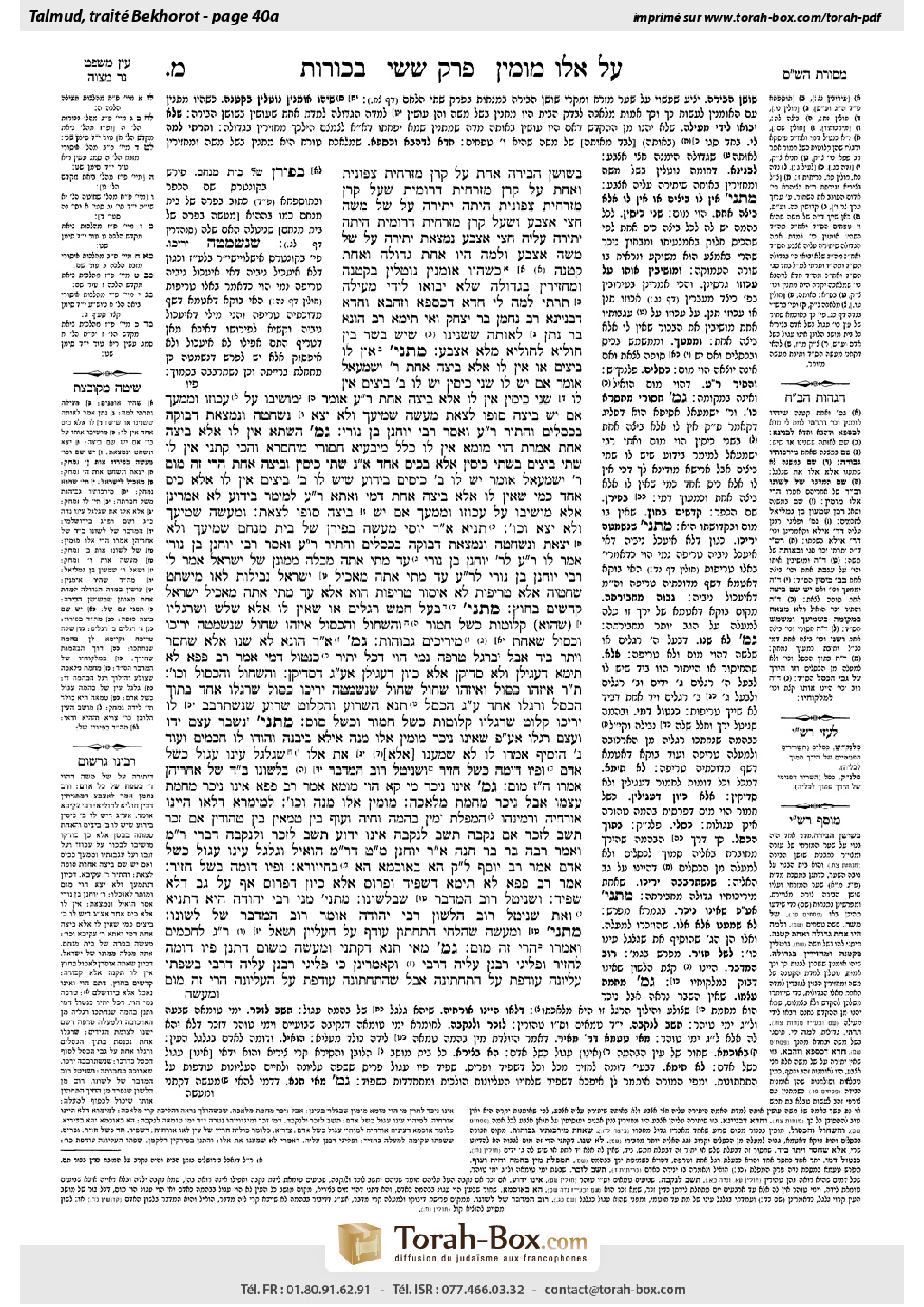
This page of Bekhorot includes the Aramaic text, an English translation and an AI-generated French translation, alongside the scan above.
בכורות מ׳ א · Aramaic and Hebrew text
בְּשׁוּשַׁן הַבִּירָה, אַחַת עַל קֶרֶן מִזְרָחִית צְפוֹנִית וְאַחַת עַל קֶרֶן מִזְרָחִית דְּרוֹמִית, שֶׁעַל קֶרֶן מִזְרָחִית צְפוֹנִית הָיְתָה יְתֵירָה עַל שֶׁל מֹשֶׁה חֲצִי אֶצְבַּע, וְשֶׁעַל קֶרֶן מִזְרָחִית דְּרוֹמִית הָיְתָה יְתֵירָה עָלֶיהָ חֲצִי אֶצְבַּע, נִמְצֵאת יְתֵירָה עַל שֶׁל מֹשֶׁה אֶצְבַּע.
וְלָמָה הָיוּ אַחַת גְּדוֹלָה וְאַחַת קְטַנָּה? (כשהיו) [שֶׁהָיוּ] אוּמָּנִין נוֹטְלִין בַּקְּטַנָּה, וּמַחְזִירִין בַּגְּדוֹלָה, שֶׁלֹּא יָבוֹאוּ לִידֵי מְעִילָה.
תַּרְתֵּי לְמָה לִי? חֲדָא — דְּכַסְפָּא וְזַהֲבָא, וַחֲדָא — דְּבִנְיָינָא.
רַב נַחְמָן בַּר יִצְחָק, וְאִי תֵּימָא רַב הוּנָא בַּר נָתָן, לְאוֹתָהּ שֶׁשָּׁנִינוּ: שֶׁיֵּשׁ בָּשָׂר בֵּין חוּלְיָא לְחוּלְיָא מְלֹא אֶצְבַּע.
מַתְנִי׳ אֵין לוֹ בֵּיצִים, אוֹ אֵין לוֹ אֶלָּא בֵּיצָה אַחַת. רַבִּי יִשְׁמָעֵאל אוֹמֵר: אִם יֵשׁ לוֹ שְׁנֵי כִּיסִין — יֵשׁ לוֹ שְׁתֵּי בֵּיצִים, אֵין לוֹ שְׁנֵי כִּיסִין — אֵין לוֹ אֶלָּא בֵּיצָה אַחַת. רַבִּי עֲקִיבָא אוֹמֵר: מוֹשִׁיבוֹ עַל עַכּוּזוֹ וּמְמַעֵךְ, אִם יֵשׁ בֵּיצָה — סוֹפָהּ לָצֵאת. מַעֲשֶׂה שֶׁמִּיעֵךְ וְלֹא יָצָא, נִשְׁחֲטָה וְנִמְצֵאת דְּבוּקָה בַּכְּסָלִים, וְהִתִּיר רַבִּי עֲקִיבָא וְאָסַר רַבִּי יוֹחָנָן בֶּן נוּרִי.
גְּמָ׳ הַשְׁתָּא אֵין לוֹ אֶלָּא בֵּיצָה אַחַת אָמְרַתְּ הָוֵי מוּמָא, אֵין לוֹ כְּלָל מִיבַּעְיָא? חַסּוֹרֵי מִיחַסְּרָא וְהָכִי קָתָנֵי: אֵין לוֹ שְׁתֵּי בֵּיצִים בִּשְׁתֵּי כִּיסִין אֶלָּא בְּכִיס אֶחָד, אִי נָמֵי שְׁתֵּי כִּיסִין וּבֵיצָה אַחַת — הֲרֵי זֶה מוּם.
רַבִּי יִשְׁמָעֵאל אוֹמֵר: יֵשׁ לוֹ שְׁתֵּי כִּיסִים — בְּיָדוּעַ שֶׁיֵּשׁ לוֹ שְׁתֵּי בֵּיצִים, אֵין לוֹ אֶלָּא כִּיס אֶחָד — כְּמִי שֶׁאֵין לוֹ אֶלָּא בֵּיצָה אַחַת דָּמֵי, וַאֲתָא רַבִּי עֲקִיבָא לְמֵימַר: בְּיָדוּעַ לָא אָמְרִינַן, אֶלָּא מוֹשִׁיבוֹ עַל עַכּוּזוֹ וּמְמַעֵךְ, אִם יֵשׁ בֵּיצָה סוֹפוֹ לָצֵאת.
וּמַעֲשֶׂה שֶׁמִּיעֵךְ וְלֹא יָצָא וְכוּ׳. תַּנְיָא, אָמַר רַבִּי יוֹסֵי: מַעֲשֶׂה בְּפָירָן שֶׁל בֵּית מְנַחֵם, שֶׁמִּיעֵךְ וְלֹא יָצָאת, וְנִשְׁחֲטָה וְנִמְצֵאת דְּבוּקָה בַּכְּסָלִים, וְהִתִּיר רַבִּי עֲקִיבָא, וְאָסַר רַבִּי יוֹחָנָן בֶּן נוּרִי.
אָמַר לוֹ רַבִּי עֲקִיבָא לְרַבִּי יוֹחָנָן בֶּן נוּרִי: עַד מָתַי אַתָּה מְכַלֶּה מָמוֹנָן שֶׁל יִשְׂרָאֵל! אָמַר לוֹ רַבִּי יוֹחָנָן בֶּן נוּרִי לְרַבִּי עֲקִיבָא: עַד מָתַי אַתָּה מַאֲכִיל יִשְׂרָאֵל נְבֵילוֹת! לָאו מִישְׁחָט שַׁחְטֵיהּ?
אֶלָּא: טְרֵיפוֹת. לָא אִיסּוּר טְרֵיפוֹת הוּא?! אֶלָּא: עַד מָתַי אַתָּה מַאֲכִיל יִשְׂרָאֵל קָדָשִׁים בַּחוּץ!
מַתְנִי׳ בַּעַל חָמֵשׁ רַגְלַיִם, אוֹ שֶׁאֵין לוֹ אֶלָּא שָׁלֹשׁ, וְשֶׁרַגְלָיו קְלוּטוֹת כְּשֶׁל חֲמוֹר, וְהַשָּׁחוּל וְהַכָּסוּל. אֵיזֶהוּ שָׁחוּל? שֶׁנִּשְׁמְטָה יְרֵיכוֹ. וְכָסוּל? שֶׁאַחַת מִירֵיכוֹתָיו גְּבוֹהוֹת.
גְּמָ׳ אָמַר רַב הוּנָא: לֹא שָׁנוּ אֶלָּא שֶׁחָסֵר וְיָתֵר בַּיָּד, אֲבָל בָּרֶגֶל — טְרֵפָה נָמֵי הָוֵי, דְּכֹל יָתֵיר כְּנָטוּל דָּמֵי.
אָמַר רַב פָּפָּא: לָא תֵּימָא דַּעֲגִילָן וְלָא סְדִיקָן, אֶלָּא כֵּיוָן דַּעֲגִילָן, אַף עַל גַּב דִּסְדִיקָן.
וְהַשָּׁחוּל וְהַכָּסוּל וְכוּ׳. תָּנוּ רַבָּנַן: אֵיזֶהוּ כָּסוּל וְאֵיזֶהוּ שָׁחוּל? שָׁחוּל — שֶׁנִּשְׁמְטָה יְרֵיכוֹ, כָּסוּל — שֶׁרַגְלוֹ אֶחָד בְּתוֹךְ הַכֶּסֶל, וְרַגְלוֹ אֶחָד עַל גַּבֵּי הַכֶּסֶל. תָּנָא: הַשָּׂרוּעַ וְהַקָּלוּט — שָׂרוּעַ שֶׁנִּשְׁתַּרְבֵּב לוֹ יְרֵיכוֹ, קָלוּט — שֶׁרַגְלָיו קְלוּטוֹת כְּשֶׁל חֲמוֹר וּכְשֶׁל סוּס.
מַתְנִי׳ נִשְׁבַּר עֶצֶם יָדוֹ וְעֶצֶם רַגְלוֹ, אַף עַל פִּי שֶׁאֵינוֹ נִיכָּר. מוּמִין אֵלּוּ מָנָה אִילָא בְּיַבְנֶה, וְהוֹדוּ לוֹ חֲכָמִים.
וְעוֹד שְׁלֹשָׁה הוֹסִיף, אָמְרוּ לוֹ: לֹא שָׁמַעְנוּ אֶת אֵלּוּ. שֶׁגַּלְגַּל עֵינוֹ עָגוֹל כְּשֶׁל אָדָם, וּפִיו דּוֹמֶה כְּשֶׁל חֲזִיר, וְשֶׁנִּיטַּל רוֹב הַמְדַבֵּר בִּלְשׁוֹנוֹ. בֵּית דִּין שֶׁל אַחֲרֵיהֶן אָמְרוּ: הֲרֵי זֶה מוּם.
גְּמָ׳ אֵינוֹ נִיכָּר, מִי קָא הָוֵי מוּמָא? אָמַר רַב פָּפָּא: אֵינוֹ נִיכָּר מֵחֲמַת עַצְמוֹ, אֲבָל נִיכָּר מֵחֲמַת מְלָאכָה.
מוּמִין אֵלּוּ מָנָה וְכוּ׳. לְמֵימְרָא דְּלָאו הַיְינוּ אוֹרְחֵיהּ? וּרְמִינְהוּ: הַמַּפֶּלֶת מִין בְּהֵמָה וְחַיָּה וָעוֹף, בֵּין טְמֵאִין בֵּין טְהוֹרִין, אִם זָכָר תֵּשֵׁב לְזָכָר.
אִם נְקֵבָה — תֵּשֵׁב לִנְקֵבָה, אֵינוֹ יָדוּעַ — תֵּשֵׁב לְזָכָר וְלִנְקֵבָה, דִּבְרֵי רַבִּי מֵאִיר.
וְאָמַר רַבָּה בַּר בַּר חָנָה אָמַר רַבִּי יוֹחָנָן: מַאי טַעְמֵיהּ דְּרַבִּי מֵאִיר? הוֹאִיל וְגַלְגַּל עֵינוֹ עָגוֹל כְּשֶׁל אָדָם! אָמַר רַב יוֹסֵף: לָא קַשְׁיָא, הָא בְּאוּכָּמָא, הָא בְּחִיוָּורָא.
וּפִיו דּוֹמֶה כְּשֶׁל חֲזִיר. אָמַר רַב פָּפָּא: לָא תֵּימָא דִּשְׁפִיד וּפְרִוס, אֶלָּא כֵּיוָן דִּפְרִוס אַף עַל גַּב דְּלָא שְׁפִיד.
וְשֶׁנִּיטַּל רוֹב הַמְדַבֵּר שֶׁבִּלְשׁוֹנוֹ. מַתְנִיתִין מַנִּי? רַבִּי יְהוּדָה הִיא, דְּתַנְיָא: וְאֶת שֶׁנִּיטַּל רוֹב הַלָּשׁוֹן, רַבִּי יְהוּדָה אוֹמֵר: רוֹב הַמְדַבֵּר שֶׁל לְשׁוֹנוֹ.
מַתְנִי׳ וּמַעֲשֶׂה שֶׁהַלְּחִי הַתַּחְתּוֹן עוֹדֵף עַל הָעֶלְיוֹן, וְשָׁאַל רַבָּן גַּמְלִיאֵל לַחֲכָמִים, וְאָמְרוּ: הֲרֵי זֶה מוּם.
גְּמָ׳ מַאי תַּנָּא דְּקָתָנֵי ״וּמַעֲשֶׂה״? מִשּׁוּם דִּתְנַן ״פִּיו דּוֹמֶה לַחֲזִיר״, וּפְלִיגִי רַבָּנַן עֲלֵיהּ דְּרַבִּי, וְקָאָמְרִינַן: כִּי פְּלִיגִי רַבָּנַן עֲלֵיהּ דְּרַבִּי בִּשְׂפָתוֹ עֶלְיוֹנָה עוֹדֶפֶת עַל הַתַּחְתּוֹנָה, אֲבָל שֶׁהַתַּחְתּוֹנָה עוֹדֶפֶת עַל הָעֶלְיוֹנָה — הֲרֵי זֶה מוּם.
Bekhorot 40a · English translation
in the chamber of Shushan the capital, which was located above the eastern gate of the Temple Mount, one in the northeast corner and one in the southeast corner. The one that was in the northeast corner was longer than the cubit used by Moses in the building of the Tabernacle, which was six handbreadths, by half a fingerbreadth, and the one that was in the southeast corner was longer than the other one by another half a fingerbreadth. One therefore finds it longer than Moses’ cubit by a full fingerbreadth.
The mishna continues: And why did the Sages say that there should be two measures of a cubit, one large and one small? It was so that the artisans who were working in the Temple would take payment according the amount of work they did, as measured by the small cubit, and return it to the Temple through their work, as measured by the large cubit, so they would not come to misuse consecrated property. If they would accept any payment that they did not deserve, they would be misusing consecrated property. It was with regard to the fingerbreadth mentioned in this mishna that the baraita cited above teaches that it is one-fourth of a handbreadth of any average person.
The Gemara asks: Why do I need two large cubits? The Gemara answers: One, the shorter of the two, was used to measure silver and gold. Since silver and gold were valuable, the difference between the two measurements was set at only half a fingerbreadth, so that the artisans would not suffer too great a loss. And the other one, which was longer than Moses’ cubit by a full fingerbreadth, was used in the construction of wood and stone structures.
Rav Naḥman bar Yitzḥak, and some say Rav Huna bar Natan, said: This baraita, which states that a fingerbreadth is one-fourth of a handbreadth of any average person, is referring to that which we learned in the mishna here with regard to the blemishes of a firstborn animal: In a case where there is a full fingerbreadth of flesh between one joint and another joint. That measure of a full fingerbreadth is one-fourth of a handbreadth.
MISHNA: The firstborn animal may be slaughtered if it has no testicles or if it has only one testicle. Rabbi Yishmael says: If the animal has two scrotal sacs, it can be assumed that it has two testicles; if the animal does not have two scrotal sacs, it can be assumed that it has only one testicle. Rabbi Akiva says: The matter can be ascertained: One seats the animal on its rump and mashes the sac; if there is a testicle, ultimately it is going to emerge. There was an incident where one mashed the sac and the testicle did not emerge. Then, the animal was slaughtered and the testicle was discovered attached to the loins. And Rabbi Akiva permitted the consumption of its flesh, as the testicle had not previously emerged, and Rabbi Yoḥanan ben Nuri prohibited its consumption.
GEMARA: The mishna teaches that a firstborn may be slaughtered if it has no testicles or if it has only one testicle. The Gemara asks: Now that with regard to a case where it has only one testicle you said that it is a blemish, is it necessary to state the same in a case where it has no testicles at all? The Gemara answers that the mishna is incomplete and this is what it is teaching: If it does not have two testicles in two scrotal sacs, but in one sac, or alternatively, if it has two sacs and one testicle, it is a blemish.
The Gemara continues this version of the mishna. Rabbi Yishmael says: If the animal has two scrotal sacs, it is known that it has two testicles, and therefore it is not blemished and may not be slaughtered; if the animal has only one scrotal sac it is considered like one that has only one testicle, even if it actually has two testicles. And Rabbi Akiva comes to say: If it has two sacs, we do not say the claim of: It is known. Rather, one seats the animal on its rump and mashes the sac; if there is a testicle, ultimately it is going to emerge. If the testicle does not emerge, clearly it has only one testicle and is blemished.
§ The mishna teaches: And there was an incident where one mashed the sac and the testicle did not emerge. Then the animal was slaughtered and the testicle was discovered attached to the loins. And Rabbi Akiva permitted the consumption of its flesh, and Rabbi Yoḥanan ben Nuri prohibited its consumption. The Gemara elaborates on this incident: It is taught in a baraita that Rabbi Yosei said: There was an incident in Piran of Beit Menaḥem where a firstborn animal apparently had only one testicle, and someone mashed its sac and the other testicle did not emerge. And the animal was slaughtered and the testicle was discovered attached to the loins. And Rabbi Akiva permitted its consumption, and Rabbi Yoḥanan ben Nuri prohibited its consumption.
The baraita continues: Rabbi Akiva said to Rabbi Yoḥanan ben Nuri: Until when will you consume the property of the Jewish people by prohibiting animals in such cases? Rabbi Yoḥanan ben Nuri said to Rabbi Akiva: Until when will you feed the Jewish people unslaughtered animal carcasses? The Gemara asks: How could Rabbi Yoḥanan ben Nuri use the term animal carcasses here? After all, aren’t they properly slaughtered?
The Gemara responds: Rather, Yoḥanan ben Nuri actually referred to animals with a wound that will cause them to die within twelve months [tereifot]. The Gemara challenges: But it is not a prohibition of tereifot. Rather, he said: Until when will you feed the Jewish people sacrificial animals outside the Temple courtyard? According to Rabbi Yoḥanan ben Nuri this is not a blemish, and therefore the animal is an unblemished offering, which may not be eaten outside the Temple.
MISHNA: An animal with five legs, or one that has only three, or one whose hooves on its legs were closed like those of a donkey and not split, or the shaḥul, or the kasul may be slaughtered. What is a shaḥul? It is an animal with a thighbone that was dislocated. And what is a kasul? It is an animal whose build is asymmetrical in that one of its thighs is higher than the other.
GEMARA: The mishna teaches that an animal with five legs or three legs is blemished. Rav Huna says: The Sages taught this only in a case where the animal was missing or had an additional foreleg. But if it was missing or had an additional hind leg, not only is it blemished, but it is also a tereifa. The reason is that any extra limb is like a removed limb, and an animal whose hind leg was removed is a tereifa.
With regard to the ruling of the mishna that an animal whose hooves were closed like those of a donkey is blemished, Rav Pappa says: Do not say that it is a blemish only in a case where its hooves are entirely like those of a donkey, i.e., round and not split at all. Rather, when they are round, even though they are also split, it is still considered a blemish.
The mishna teaches: Or the shaḥul, or the kasul may be slaughtered. In this regard, the Sages taught: What is the kasul and what is the shaḥul? The shaḥul is an animal with a thighbone that was dislocated. The kasul is an animal that is irregular in that one of its legs is inside the loin, i.e., in its proper place, and in one of its legs the bone is dislocated and is above the loin. It is taught in a baraita: What are the saru’a and kalut mentioned in the Torah (see Leviticus 22:23) among the animals disqualified from being sacrificed? The saru’a is one whose thigh is longer than the other; the kalut is one whose hooves on its legs are closed like those of a donkey and like those of a horse.
MISHNA: Additional blemishes that permit the slaughter of the firstborn include those where the bone of its foreleg or the bone of its hind leg was broken, even though it is not conspicuous. With regard to these blemishes listed in this chapter, Ila, who was expert in blemishes of the firstborn, enumerated them in Yavne, and the Sages deferred to his expertise.
And Ila added three additional blemishes, and the Sages said to him: We did not hear about those. Ila added: An animal whose eye is round like that of a person, or whose mouth is similar to that of a pig, or where most of the segment of its tongue corresponding to the segment that facilitates speech in the tongue of a person was removed. The court that followed them said with regard to each of those three blemishes: That is a blemish that enables the slaughter of the firstborn.
GEMARA: The mishna teaches that if the bone of its foreleg or the bone of its hind leg was broken it is considered a blemish, despite the fact that it is not conspicuous. The Gemara asks: If it is not conspicuous, is it a blemish? A blemish must be on an exposed part of the body (see 37b). Rav Pappa says: The mishna means that it is not conspicuous on its own account, i.e., the shape of the leg is no different from the usual. But it is conspicuous on account of its work, i.e., the manner in which the animal walks.
§ The mishna teaches that with regard to these blemishes listed in this chapter, Ila enumerated them in Yavne, and he added three more, including an animal whose eye is round like that of a person. The Gemara asks: Is this to say that it is not the manner of animals to have eyes of this kind? And one can raise a contradiction from a mishna (Nidda 21a): With regard to a woman who miscarries a fetus in the form of a type of domesticated animal, undomesticated animal, or bird, whether it is a non-kosher animal or whether it is a kosher animal, if it is male, the woman observes the periods of impurity, i.e., seven days, and purity, i.e., thirty-three days, established in the Torah for a woman who gives birth to a male.
If it is female, the woman observes the periods of impurity, i.e., fourteen days, and purity, i.e., sixty-six days, established in the Torah for a woman who gives birth to a female. If its sex is unknown, the woman observes the more severe restrictions from the case of the birth of a male and the more severe restrictions from the case of the birth of a female: She is impure for fourteen days like a woman who gave birth to a female, but blood that she sees thereafter is pure until only forty days after birth, like a woman who gave birth to a male. This is the statement of Rabbi Meir.
And Rabba bar bar Ḥana says that Rabbi Yoḥanan says: What is the reason of Rabbi Meir? Since the eye of these animals is round like that of a person, a woman who miscarries a fetus of this kind is impure. Rav Yosef said in resolution of this apparent contradiction: It is not difficult; this is referring to the black portion of the eye, whereas that is referring to the white portion of the eye.
The mishna teaches: Or its mouth is similar to that of a pig. Rav Pappa says: Do not say that this is referring only to a case where the mouth is pointed and the upper lip overlaps the bottom lip, exactly like that of a pig. Rather, when it overlaps, even though it is not pointed, this is a blemish.
The mishna teaches: Or that most of the segment of its tongue corresponding to the segment that facilitates speech in the tongue of a person was removed. The Gemara asks: Whose opinion is expressed in the mishna? It is the opinion of Rabbi Yehuda, as it is taught in a baraita: Or that most of its tongue was removed; Rabbi Yehuda says: Most of the segment of its tongue corresponding to the segment that facilitates speech in the tongue of a person must be removed to be considered a blemish.
MISHNA: And there was an incident where the lower jaw of the firstborn protruded beyond the upper jaw, and Rabban Gamliel asked the Sages for a ruling, and they said: That is a blemish that enables the slaughter of the firstborn.
GEMARA: The Gemara asks: What is the ruling taught in the previous mishna that the tanna is referring to when he teaches here: And there was an incident? The Gemara answers: Since we learned in the list of blemishes in the previous mishna the case where its mouth is similar to that of a pig, and the Rabbis disagree with Rabbi Ila in that case, we say here that when the Rabbis disagree with Rabbi Ila, it is only in a case where its upper lip overlaps the lower lip. But in a case where the lower jaw protrudes beyond the upper jaw, everyone agrees that this is a blemish.
Bekhorot 40a · Traduction française (IA)
dans la chambre de Shushan, la capitale, qui était située au-dessus de la porte orientale du Mont du Temple, l'une dans le coin nord-est et l'autre dans le coin sud-est. L'une, située dans le coin nord-est, était plus longue que le coud de Moïse utilisé dans la construction du Tabernacle, qui mesurait six paumes, d'un demi-pouce, et l'autre, située dans le coin sud-est, était plus longue que l'autre d'un autre demi-pouce. On découvre ainsi qu'elle est plus longue que le coud de Moïse d'un pouce entier.
La Michna continue : Et pourquoi les Sages ont-ils dit qu'il devait y avoir deux mesures de coud, l'une grande et l'autre petite ? C'était afin que les artisans travaillant dans le Temple puissent recevoir leur rémunération selon la quantité de travail effectué, mesurée par le petit coud, et rendent leur travail au Temple, mesuré par le grand coud, afin qu'ils ne viennent pas à abuser des biens consacrés. S'ils acceptaient une rémunération qu'ils ne méritaient pas, ils abuseraient des biens consacrés. C'est à propos de ce pouce mentionné dans cette Michna que la baraïta citée ci-dessus enseigne qu'il s'agit d'un quart d'une paume d'une personne moyenne.
Le Guemara demande : Pourquoi ai-je besoin de deux grands couds ? Le Guemara répond : L'un, le plus court des deux, était utilisé pour mesurer l'argent et l'or. Puisque l'argent et l'or étaient précieux, la différence entre les deux mesures était fixée à seulement un demi-pouce, afin que les artisans ne subissent pas une perte trop importante. L'autre, qui était plus long que le coud de Moïse d'un pouce entier, était utilisé dans la construction des structures en bois et en pierre.
Rav Naḥman bar Yitzḥak, et certains disent Rav Huna bar Natan, a dit : Cette baraïta, qui affirme qu'un pouce est un quart d'une paume d'une personne moyenne, fait référence à ce que nous avons appris dans la Michna ici concernant les défauts d'un animal prématuré : Dans le cas où il y a un pouce entier de chair entre un os et l'autre. Cette mesure d'un pouce entier est un quart d'une paume.
MICHNA : L'animal prématuré peut être sacrifié s'il n'a pas de testicules ou s'il en a seulement un. Rabbi Yishmael dit : Si l'animal a deux sacs scrotaux, on peut supposer qu'il a deux testicules ; si l'animal n'a pas deux sacs scrotaux, on peut supposer qu'il en a seulement un. Rabbi Akiva dit : La question peut être résolue : On place l'animal sur son cul et on écrase le sac ; si un testicule est présent, il finira par apparaître. Il y avait un cas où l'on avait écrasé le sac et le testicule n'avait pas émergé. L'animal a été sacrifié et le testicule a été découvert attaché aux flancs. Rabbi Akiva a permis la consommation de sa viande, car le testicule n'avait pas encore émergé, et Rabbi Yoḥanan ben Nuri a interdit cette consommation.
GUEMARA : La Michna enseigne que l'animal prématuré peut être sacrifié s'il n'a pas de testicules ou s'il en a seulement un. Le Guemara demande : Maintenant que, concernant le cas où il en a seulement un, vous avez dit qu'il s'agit d'un défaut, est-il nécessaire de mentionner la même chose dans le cas où il n'a pas de testicules du tout ? Le Guemara répond que la Michna est incomplète et c'est ce qu'elle enseigne : Si l'animal n'a pas deux testicules dans deux sacs scrotaux, mais dans un seul sac, ou alternativement, s'il a deux sacs et un seul testicule, c'est un défaut.
Le Guemara poursuit cette version de la Michna. Rabbi Yishmael dit : Si l'animal a deux sacs scrotaux, on sait qu'il a deux testicules et donc il n'est pas déficient et peut être sacrifié ; si l'animal a seulement un sac scrotal, on le considère comme celui qui a un seul testicule, même s'il en a effectivement deux. Rabbi Akiva vient dire : Si l'animal a deux sacs, on ne dit pas qu'on sait. On place l'animal sur son cul et on écrase le sac ; si un testicule est présent, il finira par apparaître. Si le testicule ne sort pas, on sait qu'il n'en a qu'un et c'est un défaut.
§ La Michna enseigne : Il y avait un cas où l'on avait écrasé le sac et le testicule n'avait pas émergé. L'animal a été sacrifié et le testicule a été découvert attaché aux flancs. Rabbi Akiva a permis la consommation de sa viande, et Rabbi Yoḥanan ben Nuri a interdit cette consommation. Le Guemara développe ce cas : Il est enseigné dans une baraïta que Rabbi Yosei a dit : Il y avait un cas à Piran de Beit Menaḥem où un animal prématuré semblait avoir un seul testicule, et quelqu'un avait écrasé son sac et le second testicule n'avait pas émergé. L'animal a été sacrifié et le testicule a été découvert attaché aux flancs. Rabbi Akiva a permis sa consommation, et Rabbi Yoḥanan ben Nuri l'a interdit.
La baraïta continue : Rabbi Akiva a dit à Rabbi Yoḥanan ben Nuri : Jusqu'à quand vas-tu consommer les biens du peuple juif en interdisant ces animaux ? Rabbi Yoḥanan ben Nuri a répondu à Rabbi Akiva : Jusqu'à quand vas-tu nourrir le peuple juif avec des carcasses d'animaux non sacrifiés ? Le Guemara demande : Comment Rabbi Yoḥanan ben Nuri a-t-il pu utiliser le terme carcasses d'animaux ici ? Après tout, ne sont-elles pas correctement sacrifiées ?
Le Guemara répond : Plutôt, Yoḥanan ben Nuri faisait référence à des animaux présentant une blessure qui les rendrait mortels dans les douze mois [tereifot]. Le Guemara conteste : Mais ce n'est pas une interdiction concernant les animaux mortels. Plutôt, il a dit : Jusqu'à quand vas-tu nourrir le peuple juif avec des animaux sacrés en dehors du cour de l'Autel ? Selon Rabbi Yoḥanan ben Nuri, cela n'est pas un défaut, et donc l'animal est un offrande non déficient, qui ne peut être mangé en dehors du Temple.
MICHNA : Un animal ayant cinq pattes, ou un ayant seulement trois, ou un dont les sabots sur ses pattes étaient fermés comme ceux d'un âne et non divisés, ou le shaḥul, ou le kasul peut être sacrifié. Qu'est-ce qu'un shaḥul ? C'est un animal dont le fémur était disloqué. Et qu'est-ce qu'un kasul ? C'est un animal dont la structure est asymétrique dans la mesure où l'un de ses avant-bras est plus haut que l'autre.
GUEMARA : La mitsna enseigne que l'animal ayant cinq ou trois pattes est blemi. Rav Huna dit : Les Sages ont enseigné cela uniquement dans le cas où l'animal manquait d'une patte ou avait une patte supplémentaire sur l'avant. Mais si l'animal manquait d'une patte ou avait une patte supplémentaire sur l'arrière, non seulement il est blemi, mais il est aussi un tereifa. La raison est que toute patte supplémentaire est comme une patte retirée, et un animal dont la patte arrière a été retirée est un tereifa.
Concernant la décision de la mitsna que l'animal dont les sabots sont fermés comme ceux d'un âne est blemi, Rav Pappa dit : Ne dites pas qu'il s'agit d'une blemish uniquement dans le cas où ses sabots sont entièrement comme ceux d'un âne, c'est-à-dire ronds et non fendus du tout. Mais lorsque les sabots sont ronds, même s'ils sont également fendus, cela est encore considéré comme une blemish.
La mitsna enseigne : Ou le shaḥul, ou le kasul peut être sacrifié. À ce sujet, les Sages ont enseigné : Qu'est-ce que le kasul et qu'est-ce que le shaḥul ? Le shaḥul est un animal dont le fémur est disloqué. Le kasul est un animal qui est irrégulier dans le sens où l'une de ses pattes est à l'intérieur de la moelle, c'est-à-dire à sa place normale, et dans l'une de ses pattes, l'os est disloqué et est au-dessus de la moelle. Il est enseigné dans une baraïta : Quels sont les saru’a et kalut mentionnés dans la Torah (voir Lévitique 22:23) parmi les animaux incompatibles avec la sacrifice ? Le saru’a est celui dont la cuisse est plus longue que l'autre ; le kalut est celui dont les sabots sur ses pattes sont fermés comme ceux d'un âne et comme ceux d'un cheval.
MICHNA : Les blemishes supplémentaires qui permettent la slaughter du premier-né incluent ceux où l'os de son avant-bras ou l'os de son arrière-bras était brisé, même s'il n'est pas évident. Concernant ces blemishes listés dans ce chapitre, Ila, qui était expert dans les blemishes du premier-né, les a énumérés à Yavne, et les Sages ont reconnu son expertise.
Et Ila a ajouté trois blemishes supplémentaires, et les Sages lui dirent : Nous n'avons pas entendu parler de ceux-là. Ila ajouta : Un animal dont l'œil est rond comme celui d'un homme, ou dont la bouche est semblable à celle d'un porc, ou où la plupart du segment de sa langue correspondant au segment qui facilite la parole dans la langue d'un homme a été retiré. Le tribunal qui les suivit dit concernant chacun de ces trois blemishes : C'est une blemish qui permet la slaughter du premier-né.
GUEMARA : La mitsva enseigne que si l'os de son avant-bras ou l'os de son arrière-bras était brisé, il est considéré comme une blemish, malgré le fait qu'il ne soit pas évident. La Guemara pose la question : Si ce n'est pas évident, est-ce une blemish ? Une blemish doit être sur une partie exposée du corps (voir 37b). Rav Pappa dit : La mitsva signifie que ce n'est pas évident en soi, c'est-à-dire que la forme de la patte n'est pas différente de la normale. Mais elle est évidente en raison de son fonctionnement, c'est-à-dire la manière dont l'animal marche.
§ La mitsva enseigne que concernant ces blemishes listés dans ce chapitre, Ila les a énumérés à Yavne, et il a ajouté trois autres, incluant un animal dont l'œil est rond comme celui d'un homme. La Guemara pose la question : Est-ce que cela signifie qu'il n'est pas la manière des animaux d'avoir des yeux de ce genre ? Et l'on peut élever une contradiction à partir d'une mitsva (Nidda 21a) : Concernant une femme qui avorte un fœtus en forme d'un animal domestique, d'un animal sauvage ou d'un oiseau, si c'est un animal non-kosher ou si c'est un animal kosher, si c'est un mâle, la femme observe les périodes d'impureté, c'est-à-dire sept jours, et de pureté, c'est-à-dire trente-trois jours, établies dans la Torah pour une femme qui donne naissance à un mâle.
Si c'est une femelle, la femme observe les périodes d'impureté, c'est-à-dire quatorze jours, et de pureté, c'est-à-dire soixante-six jours, établies dans la Torah pour une femme qui donne naissance à une femelle. Si son sexe est inconnu, la femme observe les restrictions plus sévères du cas de la naissance d'un mâle et les restrictions plus sévères du cas de la naissance d'une femelle : Elle est impure quatorze jours comme une femme qui a donné naissance à une femelle, mais le sang qu'elle voit ensuite est pur jusqu'à seulement quarante jours après la naissance, comme une femme qui a donné naissance à un mâle. C'est l'opinion de Rabbi Meir.
Et Rabba bar bar Ḥana dit que Rabbi Yoḥanan dit : Quelle est la raison de Rabbi Meir ? Puisque les yeux de ces animaux sont ronds comme ceux d'un homme, une femme qui avorte un fœtus de ce genre est impure. Rav Yosef a dit dans la résolution de cette contradiction apparente : Ce n'est pas difficile ; il s'agit de la partie noire de l'œil, tandis que cela s'agit de la partie blanche de l'œil.
La mitsva enseigne : Ou sa bouche est semblable à celle d'un porc. Rav Pappa dit : Ne dites pas que cela s'applique uniquement au cas où la bouche est pointue et que la lèvre supérieure recouvre la lèvre inférieure, exactement comme celle d'un porc. Mais lorsque la lèvre recouvre, même si elle n'est pas pointue, cela est une tache.
La mitsva enseigne : Ou que la plupart du segment de sa langue correspondant au segment qui facilite la parole dans la langue d'un homme a été retiré. La Guemara pose la question : Quel est l'avis exprimé dans la mitsva ? C'est l'avis de Rabbi Yehuda, comme il est enseigné dans une baraïta : Ou que la plupart de sa langue a été retirée ; Rabbi Yehuda dit : La plupart du segment de sa langue correspondant au segment qui facilite la parole dans la langue d'un homme doit être retiré pour être considéré comme une tache.
MITSVA : Il y avait un cas où la mâchoire inférieure du premier-né dépassait la mâchoire supérieure, et Rabban Gamliel demanda un avis aux Sages, et ils dirent : C'est une tache qui permet la sacrifice du premier-né.
GUEMARA : La Guemara pose la question : Quel est le cas enseigné dans la mishna précédente dont le tanna fait référence lorsqu'il enseigne ici : Et il y avait un incident ? La Guemara répond : Puisque nous avons appris dans la liste des défauts de la mishna précédente le cas où la bouche est semblable à celle d'un porc, et que les Rabbins divergent avec Rabbi Ila dans ce cas-là, nous disons ici que lorsque les Rabbins divergent avec Rabbi Ila, c'est uniquement dans le cas où la lèvre supérieure recouvre la lèvre inférieure. Mais dans le cas où la mâchoire inférieure dépasse la mâchoire supérieure, tout le monde convient que c'est un défaut.
Traduction française générée par IA à partir de l’édition anglaise de Sefaria. Vérifie toujours un passage avec le texte source.
Text from Sefaria: William Davidson Edition - Vocalized Aramaic (CC BY NC); William Davidson Edition - English (CC BY NC).