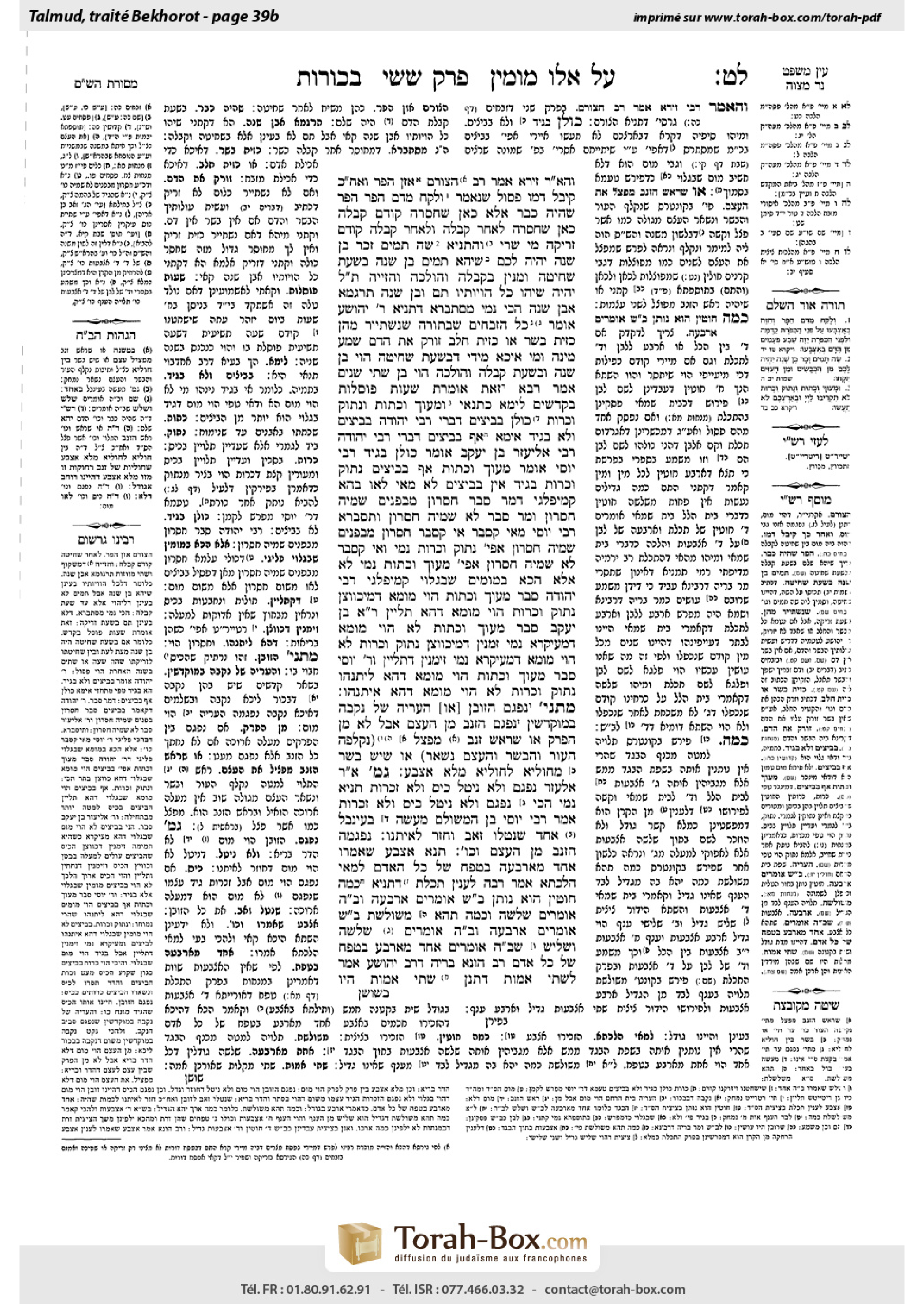
Bekhorot 39b: Talmud study for Daf Yomi
Study the Talmud for Daf Yomi with scanned pages, Hebrew text, English translations from Sefaria and AI-generated French translations.
Passage selection and English or AI-generated French translation are available where the scan has annotations. Daf Study is independent of Torah-Box and Sefaria.
Browse Bekhorot · בכורות · All tractatesBekhorot 39b text and translations
This page of Bekhorot includes the Aramaic text, an English translation and an AI-generated French translation, alongside the scan above.
בכורות ל״ט ב · Aramaic and Hebrew text
וְהָאָמַר רַבִּי זֵירָא אָמַר רַב: הַצּוֹרֵם אֹזֶן הַפָּר וְאַחַר כָּךְ קִיבֵּל דָּמוֹ — פָּסוּל, שֶׁנֶּאֱמַר ״וְלָקַח מִדַּם הַפָּר״ — הַפָּר שֶׁהָיָה כְּבָר! אֶלָּא: כָּאן שֶׁחָסְרָה קוֹדֶם קַבָּלָה, כָּאן שֶׁחָסְרָה לְאַחַר קַבָּלָה.
וּלְאַחַר קַבָּלָה קוֹדֶם זְרִיקָה, מִי שְׁרֵי? וְהָתַנְיָא: ״שֶׂה תָּמִים זָכָר בֶּן שָׁנָה יִהְיֶה לָכֶם״, שֶׁיְּהֵא תָּמִים בֶּן שָׁנָה בִּשְׁעַת שְׁחִיטָה.
וּמִנַּיִן בְּקַבָּלָה וְהוֹלָכָה וְהַזָּיָיה? תַּלְמוּד לוֹמַר: ״יִהְיֶה״, שֶׁיְּהוּ כׇּל הֲוָיוֹתָיו תָּם וּבֶן שָׁנָה.
תַּרְגְּמַהּ אַבֶּן שָׁנָה, הָכִי נָמֵי מִסְתַּבְּרָא, דְּתַנְיָא: רַבִּי יְהוֹשֻׁעַ אוֹמֵר: כׇּל הַזְּבָחִים שֶׁבַּתּוֹרָה שֶׁנִּשְׁתַּיֵּיר מֵהֶן כְּזַיִת בָּשָׂר אוֹ כְּזַיִת חֵלֶב — זוֹרֵק אֶת הַדָּם, שְׁמַע מִינַּהּ.
וּמִי אִיכָּא מִידֵּי, דְּבִשְׁעַת שְׁחִיטָה הָוֵי בֶּן שָׁנָה, וּבִשְׁעַת קַבָּלָה וְהוֹלָכָה הָוֵי בֶּן שְׁתֵּי שָׁנִים? אָמַר רָבָא: זֹאת אוֹמֶרֶת שָׁעוֹת פּוֹסְלוֹת בְּקָדָשִׁים.
לֵימָא כְּתַנָּאֵי: ״וּמָעוּךְ וְכָתוּת וְנָתוּק וְכָרוּת״ — כּוּלָּן בַּבֵּיצִים, דִּבְרֵי רַבִּי יְהוּדָה.
בַּבֵּיצִים וְלֹא בַּגִּיד? אֵימָא: אַף בַּבֵּיצִים — דִּבְרֵי רַבִּי יְהוּדָה. רַבִּי אֱלִיעֶזֶר בֶּן יַעֲקֹב אוֹמֵר: כּוּלָּן בַּגִּיד. רַבִּי יוֹסֵי אוֹמֵר: ״מָעוּךְ וְכָתוּת״ — אַף בַּבֵּיצִים, ״נָתוּק וְכָרוּת״ — בַּגִּיד אִין, בַּבֵּיצִים לָא.
מַאי לָאו בְּהָא קָמִיפַּלְגִי, דְּמָר סָבַר: חֶסְרוֹן מִבִּפְנִים שְׁמֵיהּ חֶסְרוֹן, וּמָר סָבַר: לָא שְׁמֵיהּ חֶסְרוֹן?
וְתִסְבְּרָא? רַבִּי יוֹסֵי מַאי קָסָבַר? אִי קָסָבַר חֶסְרוֹן מִבִּפְנִים שְׁמֵיהּ חֶסְרוֹן — אֲפִילּוּ ״נָתוּק וְכָרוּת״ נָמֵי! וְאִי קָסָבַר לָא שְׁמֵיהּ חֶסְרוֹן — אֲפִילּוּ ״מָעוּךְ וְכָתוּת״ נָמֵי לָא!
אֶלָּא, הָכָא בְּמוּמִים שֶׁבַּגָּלוּי קָמִיפַּלְגִי. רַבִּי יְהוּדָה סָבַר: ״מָעוּךְ וְכָתוּת״ הָוֵי מוּמָא, דְּמִיכַּוְוצָן, ״נָתוּק וְכָרוּת״ הָוֵי מוּמָא, דְּהָא תַּלְיָין. רַבִּי אֱלִיעֶזֶר בֶּן יַעֲקֹב סָבַר: ״מָעוּךְ וְכָתוּת״ לָא הָוֵי מוּמָא, דְּמֵעִיקָּרָא נָמֵי זִמְנִין דְּמִיכַּוְוצָן, ״נָתוּק וְכָרוּת״ לָא הָוֵי מוּמָא, דְּמֵעִיקָּרָא נָמֵי זִימְנִין דְּתַלְיָין.
וְרַבִּי יוֹסֵי סָבַר: ״מָעוּךְ וְכָתוּת״ הָוֵי מוּמָא — דְּהָא לֵיתַנְהוּ, ״נָתוּק וְכָרוּת״ לָא הָוֵי מוּמָא — דְּהָא אִיתַנְהוּ.
מַתְנִי׳ נִפְגַּם הַזּוֹבָן, הָעֶרְיָה שֶׁל נְקֵבָה בַּמּוּקְדָּשִׁין, נִפְגַּם הַזָּנָב מִן הָעֶצֶם, אֲבָל לֹא מִן הַפֶּרֶק, אוֹ שֶׁרֹאשׁ זָנָב מְפַצֵּל, נִקְלְפָה הָעוֹר וְהַבָּשָׂר וְהָעֶצֶם נִשְׁאַר, אוֹ שֶׁיֵּשׁ בָּשָׂר מֵחוּלְיָא לְחוּלְיָא מְלֹא אֶצְבַּע.
גְּמָ׳ אָמַר רַבִּי אֶלְעָזָר: נִפְגַּם וְלֹא נִיטַּל, כִּיס וְלֹא זַכְרוּת. תַּנְיָא נָמֵי הָכִי: נִפְגַּם וְלֹא נִיטַּל, כִּיס וְלֹא זַכְרוּת. אָמַר רַבִּי יוֹסֵי בֶּן הַמְשׁוּלָּם: מַעֲשֶׂה בְּעִינְבָּל אֶחָד שֶׁנְּטָלוֹ זְאֵב וְחָזַר לְאֵיתָנוֹ.
נִפְגְּמָה הַזָּנָב מִן הָעֶצֶם וְכוּ׳. תָּנָא: אֶצְבַּע שֶׁאָמְרוּ — אֶחָד מֵאַרְבָּעָה בְּטֶפַח שֶׁל כׇּל הָאָדָם. לְמַאי הִלְכְתָא? אָמַר רַבָּה: לְעִנְיַן תְּכֵלֶת, דְּתַנְיָא: כַּמָּה חוּטִין הוּא נוֹתֵן? בֵּית שַׁמַּאי אוֹמְרִים: אַרְבָּעָה, וּבֵית הִלֵּל אוֹמְרִים: שְׁלֹשָׁה.
וְכַמָּה תְּהֵא מְשׁוּלֶּשֶׁת? בֵּית שַׁמַּאי אוֹמְרִים: אַרְבָּעָה, וּבֵית הִלֵּל אוֹמְרִים: שְׁלֹשָׁה. וּשְׁלִישׁ שֶׁבֵּית הִלֵּל אוֹמְרִים — אֶחָד מֵאַרְבַּע בְּטֶפַח שֶׁל כׇּל אָדָם.
רַב הוּנָא בְּרֵיהּ דְּרַב יְהוֹשֻׁעַ אָמַר: לִשְׁתֵּי אַמּוֹת, דִּתְנַן: שְׁתֵּי אַמּוֹת הָיוּ
Bekhorot 39b · English translation
But doesn’t Rabbi Zeira say that Rav says: In the case of one who slits the ear of the bull with the knife after slaughter, creating a blemish, and thereafter collects its blood from the neck, the offering is disqualified, as it is stated: “And the anointed priest shall take from the blood of the bull” (Leviticus 4:5). By using the term “the bull,” the verse indicates that the bull must be at the time of collection of the blood as it already was before slaughter, without a blemish. Rather, here, in the first baraita, it is referring to a case where it lacked a kidney before the collection of the blood, whereas there, in the second baraita, it is dealing with a case where it lacked a kidney only after the collection of the blood.
The Gemara asks: And if the animal lacked a kidney after the collection of the blood but before the sprinkling of the blood, is it permitted to be sacrificed upon the altar? But isn’t it taught in a baraita that the verse states with regard to the Paschal offering: “Your lamb shall be without blemish, a male in its year” (Exodus 12:5), indicating that it shall be unblemished and in its first year at the time of slaughter?
The baraita continues: And from where is it derived that it must also be unblemished at the time of the collection of the blood, and at the time of conveying its blood to the altar, and at the time of the sprinkling of the blood? The verse states: “Shall be,” emphasizing that all actions that are performed upon it shall be performed only when it is unblemished and in its first year. This teaches that the offering must be unblemished even at the time of the sprinkling of its blood.
The Gemara answers: Interpret this baraita as teaching that only the requirement that the animal must be in its first year is necessary at the time of sprinkling. Nevertheless, it need not be unblemished at this stage. The Gemara adds: So, too, it is reasonable that this is the correct interpretation, as it is taught in a baraita that Rabbi Yehoshua says: With regard to all offerings in the Torah that were slaughtered and their blood was collected, from which there remains either an olive-bulk of flesh or an olive-bulk of fat, the priest sprinkles the blood of that offering. Learn from this baraita that even if most of the offering is lacking, it is not disqualified after the collection of the blood.
The Gemara asks with regard to the interpretation of the baraita: But is there anything where at the time of its slaughter the animal is in its first year but at the time of the collection of the blood and conveying it to the altar it is in its second year? Rava says: That is to say that hours disqualify in the case of sacrificial animals, i.e., one measures the age of the offering from the exact time of its birth. Therefore, if the animal reaches its second year between the time when it is slaughtered and the collection of its blood it is disqualified.
§ The Gemara returns to the previous discussion of whether the lack of an internal organ disqualifies an offering from being sacrificed. Let us say that this matter is the subject of a dispute between tanna’im, as it is taught in a baraita discussing the verse that provides a list of animals disqualified from the altar: “And that whose stones are bruised, or crushed, or torn, or cut you shall not sacrifice to the Lord” (Leviticus 22:24). All of these blemishes are found in the animal’s testicles; this is the statement of Rabbi Yehuda.
The Gemara asks: Does Rabbi Yehuda mean that these blemishes are only in the testicles and not in the penis? There too these should be considered blemishes, as the penis is more exposed and visible than the testicles. Rather, say that all of them also apply to the testicles; this is the statement of Rabbi Yehuda. Rabbi Eliezer ben Ya’akov says: All of them are considered blemishes only when found on the penis. Rabbi Yosei says: The blemishes of “bruised, or crushed” apply also to the testicles, while with regard to the blemishes of “torn or cut,” on the penis, yes, these are considered a blemish, but on the testicles they are not considered a blemish.
The Gemara explains the relevance of the dispute to the matter at hand: What, is it not that these tanna’im disagree about this: That one Sage, Rabbi Yehuda, holds that the lack of an internal limb is called a lack. Therefore, in cases where the testicles are damaged they are considered lacking, disqualifying the animal, despite the fact that the blemish is not exposed. And one Sage, Rabbi Eliezer ben Ya’akov, holds that the lack of an internal limb is not called a lack.
The Gemara rejects this suggestion: And can you understand the baraita in this manner? If so, what does Rabbi Yosei hold? If he holds that the lack of an internal limb is called a lack, then even “torn or cut” should be considered a lack, despite the fact that these blemishes are not visible. And if he holds that a lack of an internal limb is not called a lack, then even “bruised, or crushed,” should not be considered a lack, as they are not exposed.
Rather, here they disagree with regard to exposed blemishes. Rabbi Yehuda holds that “bruised or crushed” testicles are considered blemished, as the testicles noticeably shrink due to the crushing. Likewise, testicles that are “torn or cut” are considered blemished, as the testicles appear to be hanging, i.e., dangling, to such an extent that they do not appear to be attached in the usual manner. Rabbi Eliezer ben Ya’akov holds that testicles that are “bruised or crushed” are not considered noticeable blemishes, as initially, before they become damaged, there are times that the testicles also shrink. Furthermore, testicles that are “torn or cut” are not considered blemished either, as initially, prior to being torn or cut, there are times that the testicles also hang.
And Rabbi Yosei holds that “bruised or crushed” testicles are considered blemished, as they are no longer present in their normal state, but are entirely broken. But he maintains that “torn or cut” testicles are not considered blemished, as they are still present in the pouch, despite the fact that they no longer function.
MISHNA: The mishna details additional blemishes that enable the slaughter of firstborn animals: If the pouch [hazoven] in which the genitals of the firstborn are concealed, or if the genitalia of a female sacrificial animal, were damaged and lacking; if the tail was damaged from the tailbone, but not if it was damaged from the joint, i.e., one of the joints between the vertebrae, because it heals; or in a case where the end of the tail is split, i.e., the skin and the flesh were removed and the bone remained exposed; or in a case where there is a full fingerbreadth of flesh between one joint and another joint; these are all blemishes.
GEMARA: With regard to the case where the pouch in which the genitals of the firstborn are concealed was damaged, Rabbi Elazar says: This applies only if the pouch was damaged, but not in a case where it was removed. Furthermore, it is a blemish only if the pouch was damaged, but not if the male sex organ was damaged. The Gemara notes that this opinion is also taught in a baraita: It is a blemish only if the pouch was damaged, but not if it was removed, and only if the pouch was damaged, but not the male sex organ. Rabbi Yosei ben HaMeshullam says: An incident occurred involving one animal in Inbal, where a wolf removed its pouch and it later returned to its strength, i.e., it grew again.
§ The mishna stated: If the tail was damaged from the tailbone…or in a case where there is a full fingerbreadth of flesh between one joint and another joint. A tanna taught: The fingerbreadth of which the Sages spoke is one-fourth of a handbreadth of any average person. The Gemara asks: With regard to what halakha is this stated? Rabba says: It is stated with regard to tekhelet, i.e., ritual fringes. As it is taught in a baraita: How many strings does one place on a garment?Beit Shammai say: Four strings are inserted into the hole in the garment so that there are eight strings hanging down altogether, and Beit Hillel say: Three strings are inserted into the hole so that six are hanging down.
The baraita continues: And how much should be hanging beyond the knots and windings? Beit Shammai say: Four fingerbreadths, and Beit Hillel say: Three fingerbreadths. And the three fingerbreadths that Beit Hillel say should be hanging are each one-fourth of a handbreadth of any average person.
Rav Huna, son of Rav Yehoshua, says that this baraita discussing the fingerbreadth is referring to the two cubits mentioned in a different context, as we learned in a mishna (Kelim 17:9): There were two rods for measuring cubits
Bekhorot 39b · Traduction française (IA)
Mais n’est-ce pas ce que Rabbi Zéira rapporte que Rav ait dit : dans le cas d’une personne qui sectionne l’oreille du taureau avec le couteau après l’immolation, créant une imperfection, et ensuite recueille son sang du cou, l’offrande est disqualifiée, car il est dit : « Et le prêtre consacré prendra du sang du taureau » (Lévitique 4:5). En utilisant le terme « le taureau », la parole indique que le taureau doit être à l’époque de la récolte du sang tel qu’il était avant l’immolation, sans imperfection. En revanche, ici, dans la première baraïta, il s’agit d’un cas où l’animal manquait de rein avant la récolte du sang, tandis que là, dans la seconde baraïta, il s’agit d’un cas où l’animal manquait de rein seulement après la récolte du sang.
La Guemara pose la question : et si l’animal manquait de rein après la récolte du sang mais avant l’aspersion du sang, est-il permis de le sacrifier sur l’autel ? Mais n’est-ce pas enseigné dans une baraïta que la parole relative à l’offrande pascal dit : « Ton agneau sera sans tache, mâle de l’année » (Ex 12:5), indiquant qu’il doit être sans tache et de l’année première à l’époque de l’immolation ?
La baraïta continue : et d’où est tiré le fait qu’il doit aussi être sans tache à l’époque de la récolte du sang, et à l’époque de l’apport du sang à l’autel, et à l’époque de l’aspersion du sang ? La parole dit : « Doit être », soulignant que toutes les actions accomplies sur lui doivent être accomplies uniquement lorsqu’il est sans tache et de l’année première. Cela enseigne que l’offrande doit être sans tache même à l’époque de l’aspersion de son sang.
La Guemara répond : interprète cette baraïta comme enseignant que seule la condition que l’animal soit de l’année première est nécessaire à l’époque de l’aspersion. Cependant, il n’est pas nécessaire qu’il soit sans tache à cette étape. La Guemara ajoute : de même, il est raisonnable que cette soit l’interprétation correcte, car il est enseigné dans une baraïta que Rabbi Yéhoshua dit : concernant toutes les offrandes de la Torah qui ont été immolées et dont le sang a été recueilli, dont il reste soit une quantité d’chair égale à une olive, soit une quantité de graisse égale à une olive, le prêtre aspère le sang de cette offrande. Apprends-en cette baraïta que même si la plupart de l’offrande est manquante, elle n’est pas disqualifiée après la récolte du sang.
La Guemara pose la question concernant l’interprétation de la baraïta : mais y a-t-il un cas où à l’époque de son immolation l’animal est de l’année première, mais à l’époque de la récolte du sang et de l’apport du sang à l’autel il est de l’année suivante ? Rava dit : cela signifie que les heures disqualifient dans le cas des animaux sacrés, c’est-à-dire qu’on mesure l’âge de l’offrande à partir du moment exact de sa naissance. Ainsi, si l’animal atteint son deuxième année entre le moment de son immolation et la récolte de son sang, il est disqualifié.
§ La Guemara revient à la discussion précédente sur le fait que l’absence d’un organe interne disqualifie une offrande de l’être sacrifiée. Disons que cette question est l’objet d’un débat entre les tannaïm, car il est enseigné dans une baraïta concernant la parole qui liste les animaux disqualifiés de l’autel : « Et celui dont les testicules sont écrasés, ou brisés, ou déchirés, ou coupés, tu ne sacrifieras pas à l’Eternel » (Lévitique 22:24). Tous ces défauts sont trouvés dans les testicules de l’animal ; c’est la déclaration de Rabbi Yéhuda.
La Guemara pose la question : Rabbi Yéhuda veut-il dire que ces défauts sont seulement dans les testicules et non dans le pénis ? Là aussi, ces défauts devraient être considérés comme des défauts, car le pénis est plus exposé et visible que les testicules. Plutôt, disons que tous d’entre eux s’appliquent également aux testicules ; c’est la déclaration de Rabbi Yéhuda. Rabbi Eliezer ben Ya’akov dit : tous d’entre eux sont considérés comme des défauts uniquement s’ils sont trouvés sur le pénis. Rabbi Yosei dit : les défauts de « écrasés, ou brisés » s’appliquent également aux testicules, tandis que concernant les défauts de « déchirés ou coupés », sur le pénis, oui, ces sont considérés comme des défauts, mais sur les testicules ils ne sont pas considérés comme des défauts.
La Guemara explique la pertinence du débat concernant la question : qu’est-ce que cela signifie, n’est-ce pas que ces tannaïm débattent de cela : qu’un Sage, Rabbi Yéhuda, considère que l’absence d’un organe interne est appelée une absence. Ainsi, dans les cas où les testicules sont endommagées, elles sont considérées comme absentes, disqualifiant l’animal, malgré le fait que le défaut n’est pas visible. Et un autre Sage, Rabbi Eliezer ben Ya’akov, considère que l’absence d’un organe interne n’est pas appelée une absence.
La Guemara rejette cette suggestion : et pouvez-vous comprendre la baraïta ainsi ? Si c’est le cas, que pense Rabbi Yosei ? Si il considère que l’absence d’un organe interne est appelée une absence, alors même « déchirés ou coupés » devraient être considérés comme une absence, malgré le fait que ces défauts ne sont pas visibles. Et si il considère que l’absence d’un organe interne n’est pas appelée une absence, alors même « écrasés, ou brisés » ne devraient pas être considérés comme une absence, car ils ne sont pas visibles.
Plutôt, ici ils débattent concernant les défauts visibles. Rabbi Yéhuda considère que les testicules « écrasés ou brisés » sont considérés comme des défauts, car les testicules se réduisent notablement en raison de l’écrasement. De même, les testicules « déchirés ou coupés » sont considérés comme des défauts, car ils semblent pendre, c’est-à-dire flotter, à tel point qu’ils n’ont pas l’air attachés de la manière habituelle. Rabbi Eliezer ben Ya’akov considère que les testicules « écrasés ou brisés » ne sont pas considérés comme des défauts visibles, car avant qu’ils ne soient endommagés, il y a des moments où les testicules se réduisent également. De plus, les testicules « déchirés ou coupés » ne sont pas considérés comme des défauts non plus, car avant qu’ils ne soient déchirés ou coupés, il y a des moments où les testicules flottent également.
Et le maître Yosei affirme que les testicules écrasés ou brisés sont considérés comme blemis, car ils ne sont plus dans leur état normal et sont entièrement détruits. Mais il maintient que les testicules déchirés ou tranchés ne sont pas considérés comme blemis, car ils restent dans la poche, même s'ils ne fonctionnent plus.
MICHNA : La mishna précise d'autres blemis qui permettent la décapitation des animaux premiers-nés : Si la poche [hazoven] dans laquelle les organes génitaux des premiers-nés sont cachés, ou si les organes génitaux d'une bête sacrifiée femelle, étaient endommagés et manquaient ; si la queue était endommagée à partir de la vertèbre caudale, mais pas si elle était endommagée à partir de l'articulation, c'est-à-dire l'une des articulations entre les vertèbres, car elle guérit ; ou dans le cas où la pointe de la queue est fendue, c'est-à-dire que la peau et la chair ont été retirées et que l'os restait exposé ; ou dans le cas où il y a un doigt de chair entre une articulation et une autre articulation ; ces cas sont tous considérés comme des blemis.
GUEMARA : En ce qui concerne le cas où la poche dans laquelle les organes génitaux des premiers-nés sont cachés a été endommagée, le maître Eléazar dit : Cela s'applique uniquement si la poche a été endommagée, mais pas dans le cas où elle a été retirée. De plus, c'est un blemis uniquement si la poche a été endommagée, mais pas si l'organe sexuel masculin a été endommagé. La Guemara note que cet avis est également enseigné dans une baraïta : C'est un blemis uniquement si la poche a été endommagée, mais pas si elle a été retirée, et uniquement si la poche a été endommagée, mais pas l'organe sexuel masculin. Le maître Yosei ben HaMeshullam dit : Il y a eu un cas à Inbal, où un loup a retiré la poche d'un animal et il est revenu à sa force, c'est-à-dire qu'il a repris sa croissance.
§ La mishna a dit : Si la queue était endommagée à partir de la vertèbre caudale… ou dans le cas où il y a un doigt de chair entre une articulation et une autre articulation. Un tanna a enseigné : Le doigt de chair dont les Sages parlaient est un quart d'une main de n'importe quel individu moyen. La Guemara demande : À quel halakha cette déclaration s'applique-t-elle ? Rabba dit : Elle s'applique à la tekhelet, c'est-à-dire aux franges rituelles. Comme il est enseigné dans une baraïta : Combien de fils doit-on placer sur un vêtement ? Beit Shammai disent : Quatre fils sont insérés dans le trou du vêtement, de sorte qu'il y a huit fils pendants au total, et Beit Hillel disent : Trois fils sont insérés dans le trou, de sorte qu'il y a six fils pendants.
La baraïta continue : Et combien doit-il pendre au-delà des nœuds et des torsions ? Beit Shammai disent : Quatre doigts de chair, et Beit Hillel disent : Trois doigts de chair. Et les trois doigts de chair que Beit Hillel disent que l'on doit pendre sont chacun un quart d'une main de n'importe quel individu moyen.
Rav Huna, fils de Rav Yéhoshua, dit que cette baraïta parlant du doigt de chair fait référence aux deux coudées mentionnées dans un contexte différent, comme nous l'avons appris dans une mishna (Kelim 17:9) : Il y avait deux bâtons pour mesurer les coudées.
Traduction française générée par IA à partir de l’édition anglaise de Sefaria. Vérifie toujours un passage avec le texte source.
Text from Sefaria: William Davidson Edition - Vocalized Aramaic (CC BY NC); William Davidson Edition - English (CC BY NC).