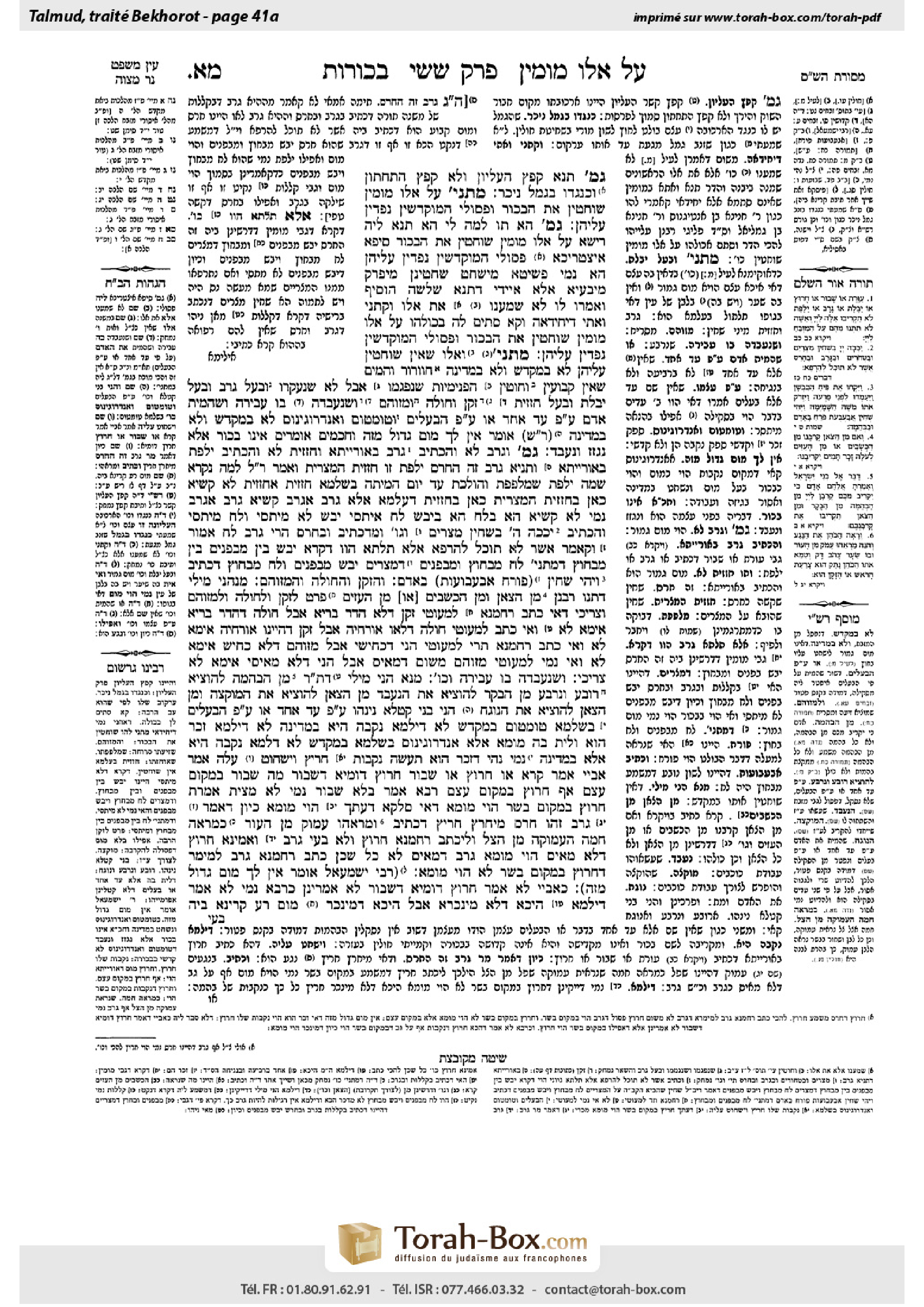
Bekhorot 41a: Talmud study for Daf Yomi
Study the Talmud for Daf Yomi with scanned pages, Hebrew text, English translations from Sefaria and AI-generated French translations.
Passage selection and English or AI-generated French translation are available where the scan has annotations. Daf Study is independent of Torah-Box and Sefaria.
Browse Bekhorot · בכורות · All tractatesBekhorot 41a text and translations
This page of Bekhorot includes the Aramaic text, an English translation and an AI-generated French translation, alongside the scan above.
בכורות מ״א א · Aramaic and Hebrew text
גְּמָ׳ תָּנָא: קֶפֶץ הָעֶלְיוֹן וְלֹא קֶפֶץ הַתַּחְתּוֹן, וּכְנֶגְדּוֹ בְּגָמָל נִיכָּר.
מַתְנִי׳ עַל אֵלּוּ מוּמִין שׁוֹחֲטִין אֶת הַבְּכוֹר, וּפְסוּלֵי הַמּוּקְדָּשִׁין נִפְדִּין עֲלֵיהֶן.
גְּמָ׳ הָא תּוּ לְמָה לִי? הָא תְּנָא לֵיהּ רֵישָׁא: עַל אֵלּוּ מוּמִין שׁוֹחֲטִין אֶת הַבְּכוֹר! סֵיפָא אִיצְטְרִיכָא: פְּסוּלֵי הַמּוּקְדָּשִׁין נִפְדִּין עֲלֵיהֶן. הָא נָמֵי פְּשִׁיטָא — מִישְׁחָט שָׁחֲטִינַן, מִיפְרָק מִיבַּעְיָא?
אֶלָּא, אַיְּידֵי דִּתְנָא שְׁלֹשָׁה הוֹסִיף, וְאָמְרוּ לוֹ: לֹא שָׁמַעְנוּ אֶת אֵלּוּ, וְקָתָנֵי וְאָתֵי דִּיחִידָאָה, וְקָא סָתֵים לַהּ בְּכוּלְּהוּ: עַל אֵלּוּ מוּמִין שׁוֹחֲטִין אֶת הַבְּכוֹר וּפְסוּלֵי הַמּוּקְדָּשִׁין נִפְדִּין עֲלֵיהֶן.
מַתְנִי׳ וְאֵלּוּ שֶׁאֵין שׁוֹחֲטִין עֲלֵיהֶן, לֹא בַּמִּקְדָּשׁ וְלֹא בַּמְּדִינָה: חֲוַורְוָר, וְהַמַּיִם שֶׁאֵין קְבוּעִין, וְחוּטִין הַפְּנִימִיּוֹת שֶׁנִּפְגְּמוּ — אֲבָל לֹא שֶׁנֶּעֶקְרוּ, וּבַעַל גָּרָב, וּבַעַל יַבֶּלֶת, וּבַעַל חֲזָזִית, זָקֵן, וְחוֹלֶה, וּמְזוֹהָם, וְשֶׁנֶּעֶבְדָה בּוֹ עֲבֵירָה, וְשֶׁהֵמִית אָדָם — עַל פִּי עֵד אֶחָד אוֹ עַל פִּי הַבְּעָלִים.
וְטוּמְטוּם וְאַנְדְּרוֹגִינוֹס, לֹא בַּמִּקְדָּשׁ וְלֹא בַּמְּדִינָה. רַבִּי שִׁמְעוֹן אוֹמֵר: אֵין לְךָ מוּם גָּדוֹל מִזֶּה, וַחֲכָמִים אוֹמְרִים: אֵינוֹ בְּכוֹר, אֶלָּא נִגְזָז וְנֶעֱבָד.
גְּמָ׳ וְגָרָב לָא? וְהָכְתִיב ״גָּרָב״ בְּאוֹרָיְיתָא! וַחֲזָזִית לָא? וְהָכְתִיב ״יַלֶּפֶת״ בְּאוֹרָיְיתָא! וְתַנְיָא: ״גָּרָב״ — זֶה הַחֶרֶס, ״יַלֶּפֶת״ — זוֹ חֲזָזִית הַמִּצְרִית, וְאָמַר רֵישׁ לָקִישׁ: לָמָּה נִקְרָא שְׁמָהּ ״יַלֶּפֶת״? שֶׁמְּלַפֶּפֶת וְהוֹלֶכֶת עַד יוֹם הַמִּיתָה.
בִּשְׁלָמָא חֲזָזִית אַחֲזָזִית לָא קַשְׁיָא: כָּאן בַּחֲזָזִית הַמִּצְרִית, כָּאן בַּחֲזָזִית דְּעָלְמָא. אֶלָּא גָּרָב אַגָּרָב קַשְׁיָא! גָּרָב אַגָּרָב נָמֵי לָא קַשְׁיָא, הָא בְּלַח, הָא בְּיָבֵשׁ. לַח — אִיתַּסִּי, יָבֵשׁ — לָא מִיתַּסֵּי.
וְלַח מִיתַּסֵּי? וְהָכְתִיב: ״יַכְּכָה ה׳ בִּשְׁחִין מִצְרַיִם וְגוֹ׳״, וּמִדִּכְתִיב ״וּבְחֶרֶס״ הֲרֵי גָּרָב לַח אָמוּר, וְקָאָמַר: ״אֲשֶׁר לֹא תוּכַל לְהֵרָפֵא״!
אֶלָּא, תְּלָתָא הֲווֹ: דִּקְרָא — יָבֵשׁ בֵּין מִבִּפְנִים בֵּין מִבַּחוּץ, דְּמַתְנִיתִין — לַח מִבַּחוּץ וּמִבִּפְנִים, דְּמִצְרַיִם — יָבֵשׁ מִבִּפְנִים וְלַח מִבַּחוּץ, דִּכְתִיב ״וַיְהִי שְׁחִין פּוֹרֵחַ אֲבַעְבּוּעוֹת בָּאָדָם״.
וְהַזָּקֵן וְהַחוֹלֶה וְהַמְזוֹהָם. מְנָהָנֵי מִילֵּי? דְּתָנוּ רַבָּנַן: ״מִן הַצֹּאן וּמִן הַכְּשָׂבִים וּמִן הָעִזִּים״ — פְּרָט לַזָּקֵן וְלַחוֹלֶה וְלַמְזוֹהָם.
וּצְרִיכִי, דְּאִי כְּתַב רַחֲמָנָא לְמַעוֹטֵי זָקֵן, דְּלָא הָדַר בָּרֵיא, אֲבָל חוֹלֶה, דַּהֲדַר בָּרֵיא — אֵימָא לָא. וְאִי כְּתַב לְמַעוֹטֵי חוֹלֶה, דְּלָאו אוֹרְחֵיהּ, אֲבָל זָקֵן, דְּהַיְינוּ אוֹרְחֵיהּ — אֵימָא לָא.
וְאִי כְּתַב רַחֲמָנָא תְּרֵי, לְמַעוֹטֵי הָנֵי דִּכְחִישִׁי, אֲבָל מְזוֹהָם דְּלָא כְּחִישׁ — אֵימָא לָא, וְאִי נָמֵי לְמַעוֹטֵי מְזוֹהָם מִשּׁוּם דִּמְאִיס, אֲבָל הָנֵי דְּלָא מְאִיסִי — אֵימָא לָא, צְרִיכִי.
וְשֶׁנֶּעֶבְדָה בּוֹ עֲבֵירָה וְכוּ׳. מְנָא הָנֵי מִילֵּי?
דְּתָנוּ רַבָּנַן: ״מִן הַבְּהֵמָה״ — לְהוֹצִיא רוֹבֵעַ וְנִרְבָּע, ״מִן הַבָּקָר״ — לְהוֹצִיא אֶת הַנֶּעֱבָד, ״מִן הַצֹּאן״ — לְהוֹצִיא אֶת הַמּוּקְצֶה, ״וּמִן הַצֹּאן״ — לְהוֹצִיא אֶת הַנּוֹגֵחַ.
הָנֵי בְּנֵי קְטָלָא נִינְהוּ! עַל פִּי עֵד אֶחָד אוֹ עַל פִּי הַבְּעָלִים.
בִּשְׁלָמָא טוּמְטוּם, בַּמִּקְדָּשׁ לָא — דִּילְמָא נְקֵבָה הִיא, בַּמְּדִינָה לָא — דִּילְמָא זָכָר הוּא וְלֵית בֵּהּ מוּמָא.
אֶלָּא אַנְדְּרוֹגִינוֹס, בִּשְׁלָמָא בַּמִּקְדָּשׁ לָא, דִּלְמָא נְקֵבָה הִיא. אֶלָּא בַּמְּדִינָה נָמֵי, נְהִי דְּזָכָר הוּא — תֵּעָשֶׂה נַקְבוּת חָרִיץ, וְיִשְׁחוֹט עָלֶהָ!
אָמַר אַבָּיֵי: אָמַר קְרָא ״אוֹ חָרוּץ אוֹ שָׁבוּר״, חָרוּץ דּוּמְיָא דְּשָׁבוּר, מָה שָׁבוּר בִּמְקוֹם עֶצֶם, אַף חָרוּץ בִּמְקוֹם עֶצֶם.
רָבָא אָמַר: בְּלָא שָׁבוּר נָמֵי לָא מָצֵית אָמְרַתְּ חָרוּץ בִּמְקוֹם בָּשָׂר הָוֵי מוּמָא, דְּאִי סָלְקָא דַעְתָּךְ הָוֵי מוּמָא, כֵּיוָן דְּאָמַר ״גָּרָב״ זֶהוּ חֶרֶס, מִיחְרָץ חֲרִיץ, דִּכְתִיב: ״וּמַרְאֵהוּ עָמוֹק מִן הָעוֹר״, כְּמַרְאֵה חַמָּה הָעֲמוּקָּה מִן הַצֵּל.
וְלִיכְתֹּב רַחֲמָנָא ״חָרוּץ״ וְלָא בָּעֵי ״גָּרָב״, וְאָמֵינָא: ״חָרוּץ״ דְּלָא מְאִיס — הָוֵי מוּמָא, ״גָּרָב״ דִּמְאִיס — לֹא כׇּל שֶׁכֵּן? כְּתַב רַחֲמָנָא ״גָּרָב״ לְמֵימַר דְּחָרוּץ בִּמְקוֹם בָּשָׂר — לָא הָוֵי מוּמָא.
רַבִּי יִשְׁמָעֵאל אוֹמֵר: אֵין לְךָ מוּם גָּדוֹל מִזֶּה. כְּאַבָּיֵי לָא אָמַר, חָרוּץ דּוּמְיָא דְּשָׁבוּר לָא אָמְרִינַן.
כְּרָבָא נָמֵי לָא אָמַר, דִּילְמָא הֵיכָא דְּלָא מִינַּכְרָא, אֲבָל הֵיכָא דְּמִינְּכַר — ״מוּם רָע״ קָרֵינָא בֵּיהּ.
Bekhorot 41a · English translation
GEMARA: With regard to the case in the mishna of the tail of a calf that does not reach the leg joint, it is taught in a baraita: This leg joint is the upper joint, between the thighbone and the tibia, and not the lower joint, between the middle and lower bones. And with regard to this upper joint, the corresponding bone in the leg of a camel is conspicuous, but in a calf it is not noticeable from the outside.
MISHNA: For these blemishes enumerated in the previous mishnayot, one slaughters the firstborn outside the Temple and disqualified consecrated animals may be redeemed on their account.
GEMARA: The Gemara asks: Why do I need this additional statement that for these blemishes one slaughters the firstborn outside the Temple? It was already taught in the first clause, at the beginning of the chapter: For these blemishes, one may slaughter the firstborn animal outside the Temple. The Gemara answers that the latter clause of the mishna was necessary: Disqualified consecrated animals may be redeemed due to these blemishes. The Gemara asks: But this too is obvious; if one may slaughter a firstborn due to these blemishes, is it necessary to state that one may redeem them?
Rather, since a previous mishna taught that Ila added three additional blemishes, and the Sages said to him: We did not hear about those, and then the tanna of the mishna proceeded to teach halakhot in the name of individual opinions, those of Rabbi Ḥananya ben Gamliel and Rabbi Ḥanina ben Antigonus, one might have thought that the halakha is not in accordance with their rulings. Therefore, he states an unattributed ruling in this mishna with regard to all their statements: For all these blemishes enumerated in the previous mishnayot, one slaughters the firstborn, and disqualified consecrated animals may be redeemed due to them. This indicates that the halakha is in accordance with all of these individual opinions.
MISHNA: And these are the blemishes that one does not slaughter the firstborn due to them, neither in the Temple nor in the rest of the country: Pale spots on the eye and tears streaming from the eye that are not constant; and internal gums that were damaged but that were not extracted; and an animal with boils that are moist inside and out [garav]; and an animal with warts; and an animal with boils [ḥazazit]; and an old or sick animal, or one with a foul odor; and one with which a transgression was performed, e.g., it copulated with a person or was the object of bestiality; and one that killed a person. In these latter two cases, the act of bestiality or killing became known on the basis of the testimony of one witness or on the basis of the owner.
And one does not slaughter a tumtum, whose sexual organs are concealed, and a hermaphrodite [ve’anderoginos], which has both male and female sexual organs, neither in the Temple nor in the rest of the country. Rabbi Shimon says: You have no blemish greater than that, and it may be slaughtered. And the Rabbis say: The halakhic status of a hermaphrodite is not that of a firstborn; rather, its halakhic status is that of a non-sacred animal that may be shorn and utilized for labor.
GEMARA: The mishna teaches that the two types of boils: Garav and ḥazazit, are not considered full-fledged blemishes for which one may slaughter a firstborn outside the Temple. The Gemara asks: And is garav not considered a blemish? But isn’t it written “garav” in the Torah, in the list of blemishes (see Leviticus 22:22)? And furthermore, is ḥazazit not considered a blemish? But isn’t it written “yalefet” in the Torah, in the same verse, and it is taught in a baraita: “Garav”; this is referring to boils that are hard as earthenware [ḥeres]; “yalefet”; this is the ḥazazit that affected the Egyptians (see Exodus 9:10). And Reish Lakish says: Why is it called yalefet? The reason is that it grabs [melapefet] continuously onto an invalid until the day of death, i.e., it cannot be healed.
Granted, the contradiction between the status of the ḥazazit mentioned in the Torah and that of the ḥazazit in the mishna is not difficult, as here the Torah is referring to an Egyptian ḥazazit, and there the mishna is referring to a regular ḥazazit. But the contradiction between the status of the garav listed in the Torah and the garav of the mishna is difficult. The Gemara answers that the contradiction between the garav in the Torah and the garav in the mishna is also not difficult: This ruling of the mishna is referring to moist boils, whereas that garav of the Torah is referring to dry boils. Moist boils will heal and therefore are considered a temporary blemish for which one may not slaughter a firstborn; dry ones will not heal.
The Gemara asks: And does a moist boil heal? But isn’t it written: “The Lord will smite you with the boil of Egypt, and with the hemorrhoids, and with garav, and with ḥares, from which you cannot be healed” (Deuteronomy 28:27). And since it is written: “And with ḥares,” which is referring to boils that are as hard as earthenware [ḥeres], moist garav is thereby stated, and with regard to both types that verse states: “From which you cannot be healed.”
Rather, there are three types of garav: First, the garav of the verse that deals with blemishes, which is dry both on the inside and on the outside. This cannot be healed, and it is called ḥares in Deuteronomy. The second is the garav of the mishna, which can be healed, and is moist on the outside and inside. Third, the garav of Egypt, mentioned in Deuteronomy as one of the types of boils of Egypt. This garav is dry on the inside and therefore cannot be healed, but it is moist on the outside, as it is written with regard to the plague of boils in Egypt: “And it became a boil breaking forth with avabu’ot upon man and upon animal” (Exodus 9:10). Avabu’ot is referring to a substance that pours out [nove’a] and is moist.
§ Among the conditions that are not considered full-fledged blemishes, but one may not sacrifice an animal with one such condition as an offering either, the mishna lists: And an old animal, or a sick animal, or one with a foul odor. The Gemara asks: From where are these matters derived? They are derived from a verse, as the Sages taught: The verse states: “And if his offering be from [min] the flock, whether from the sheep or from the goats” (Leviticus 1:10). These three instances of the word “from [min]” serve to exclude the old, and the sick, and the animal with a foul odor, which may not be sacrificed.
The Gemara notes: And all three exclusions are necessary. As, had the Merciful One written the word “from” once, one might have said that this serves to exclude an old animal, which will not become healthy again, as it will never get younger. But with regard to a sick animal, which might become healthy again, say that it is not disqualified. And, alternatively, had the Merciful One written only one term of exclusion, one might have said that it serves to exclude a sick animal, as it is not the natural manner of an animal to be sick. But with regard to an old animal, as this is the natural manner of all animals to grow old, say that it should not be disqualified from the altar.
And had the Merciful One written only two terms of exclusion, one might have said that they serve to exclude these weak animals, the sick and the old, as one should sacrifice only a fat, healthy animal. But with regard to an animal with a foul odor, which is not weak, say that it should not be disqualified. And alternatively, had there been only one term of exclusion, one might have said that it serves to exclude an animal with a foul odor, as it is repulsive. But with regard to these other two cases of an old and a sick animal, which are not repulsive, say that they are not excluded. Therefore, all three exclusions are necessary.
§ The mishna teaches: And an animal with which a transgression was performed, and one that killed a person that was known on the basis of the testimony of one witness or the owner, are disqualified from being sacrificed. The Gemara asks: From where are these matters derived?
They are derived from a verse, as the Sages taught in a baraita that when the verse states: “You shall bring your offering from the cattle, even from the herd or from the flock” (Leviticus 1:2), each mention of the word “from” is interpreted as a term of exclusion. The expression “from the cattle” serves to exclude an animal that copulated with a person and an animal that was the object of bestiality. The expression “from the herd” serves to exclude an animal worshipped as a deity, and “from the flock” serves to exclude an animal set aside for idol worship. Finally, the word “or” in the expression “or from the flock” serves to exclude an animal that gored and killed a person.
The Gemara challenges: In these cases of an animal that copulated with a person, an animal that was the subject of bestiality, and an animal that gored and killed a person, they are liable to death by stoning. Why, then, is a verse necessary to exclude them? The Gemara answers that this is referring to a case where the incident was known on the basis of the testimony of one witness or on the basis of the owner. Therefore, the animal is not killed, as there are not two witnesses to the event, but the testimony is sufficient to disqualify the animal as a sacrifice.
§ The mishna teaches that one does not slaughter a tumtum and a hermaphrodite, neither in the Temple nor in the rest of the country. The Gemara asks: Granted, one does not slaughter a tumtum, neither in the Temple, as perhaps it is a female and therefore does not have firstborn status and may not be sacrificed, nor in the rest of the country, as perhaps it is a male and it does not have a blemish, in which case he would be slaughtering a sacrificial animal.
But in the case of a hermaphrodite, granted that one does not slaughter it in the Temple, as perhaps it is a female. But with regard to the rest of the country, even let it be considered a male; nevertheless, its female sex organ should be considered as a crack [ḥaritz], which is included in the blemish of “cracked” [ḥarutz] listed in the Torah (Leviticus 22:22), and let one slaughter it due to that blemish.
Abaye said in response: The verse states: “Or cracked or broken” (Leviticus 22:22), which teaches that the blemish of being cracked is similar to that of being broken: Just as the blemish of being broken is relevant in the location of a bone, as there is no break where there is only flesh, so too, the term cracked is referring to a blemish found in the location of a bone, not in the location of the sex organs.
Rava said: Even without the comparison to “broken,” you cannot say that a crack in the location of flesh, where there is no bone, is a blemish. As, if it would enter your mind that it is a blemish, since the tanna of the baraita cited above said with regard to “garav” that this is referring to boils that are hard as earthenware [ḥeres], evidently this blemish is a crack in the skin, as it is written with regard to the skin disease of leprosy: “And its appearance is deeper than the skin” (Leviticus 13:30), and the Sages explained: It is similar to the appearance of an area lit by the sun that seems deeper than the shade, which appears to cover it.
And if so, let the Merciful One write: Crack, and it would not need to state garav, and I would say: If being cracked, which is not repulsive, is a blemish, then with regard to garav, which is repulsive, should it not all the more so be considered a blemish? Therefore, the Merciful One writes garav, to say that a crack found in the location of flesh is not a blemish. Consequently, one cannot say that the female sex organ of a hermaphrodite should be considered a blemish for which one may slaughter a firstborn outside the Temple.
In this connection, the Gemara cites the statement of the mishna with regard to a hermaphrodite: Rabbi Yishmael says: You have no blemish greater than that, and it may be slaughtered. Evidently, Rabbi Yishmael maintains that the female sex organ of a hermaphrodite is considered a blemish. The Gemara explains: Rabbi Yishmael does not state a ruling like that of Abaye, as he maintains that we do not say that the blemish of being cracked is similar to that of being broken. Rather, they are entirely different blemishes, and a crack found on flesh is considered a blemish.
Rabbi Yishmael also does not state a ruling like that of Rava, as perhaps his conclusion that a crack found where there is no bone is not a blemish applies only in a case where it is not conspicuous. But in a case where it is conspicuous, such as the female sex organ, we call it “an ill blemish” (Deuteronomy 15:21), and the animal is disqualified for use as an offering.
Bekhorot 41a · Traduction française (IA)
GUEMARA : Concernant le cas mentionné dans la mitsna du queue d'un veau qui ne parvient pas au genou supérieur, il est enseigné dans une baraïta : Ce genou supérieur est celui entre le fémur et le tibia, et non le genou inférieur, entre les os moyens et inférieurs. Et concernant ce genou supérieur, le os correspondant dans la patte d'un chameau est visible, mais chez le veau il n'est pas perceptible à l'extérieur.
MICHNA : Pour ces défauts énumérés dans les mitsnayot précédentes, on sacrifie le premier-né en dehors du Temple et les animaux consacrés défectueux peuvent être rachetés à cause de ces défauts.
GUEMARA : La Guemara se demande : Pourquoi a-t-on besoin de cette déclaration supplémentaire selon laquelle pour ces défauts on sacrifie le premier-né en dehors du Temple ? Cela avait déjà été enseigné dans la première clause, au début du chapitre : Pour ces défauts, on peut sacrifier l'animal premier-né en dehors du Temple. La Guemara répond que la seconde clause de la mitsna était nécessaire : Les animaux consacrés défectueux peuvent être rachetés à cause de ces défauts. La Guemara se demande : Mais cela est aussi évident ; si on peut sacrifier un premier-né à cause de ces défauts, pourquoi faut-il mentionner qu'on peut racheter ces animaux ?
Plutôt, puisque la mitsva précédente enseignait que Ila avait ajouté trois défauts supplémentaires, et que les Sages dirent à lui : Nous n'avons pas entendu parler de ceux-ci, et ensuite le tanna de la mitsva passa à enseigner des halakhot en nom des opinions individuelles, celles de Rabbi Ḥananya ben Gamliel et Rabbi Ḥanina ben Antigonus, on aurait pu penser que la halakha ne suit pas leurs décisions. Ainsi, il affirme une décision non attribuée dans cette mitsva concernant tous leurs propos : Pour tous ces défauts énumérés dans les mitsvot précédentes, on sacrifie le premier-né, et les animaux consacrés défectueux peuvent être rachetés à cause de ceux-ci. Cela indique que la halakha suit toutes ces opinions individuelles.
MICHNA : Et ces sont les défauts pour lesquels on ne sacrifie pas le premier-né : ni dans le Temple ni dans le reste du pays : des taches blanches dans l'œil et des larmes qui coulent de l'œil sans être constantes ; et des gencives internes endommagées mais non retirées ; et un animal avec des cloques humides à l'intérieur et à l'extérieur [garav] ; et un animal avec des verrues ; et un animal avec des cloques [ḥazazit] ; et un animal âgé ou malade, ou qui a une odeur nauséabonde ; et un animal avec lequel une transgression a été commise, par exemple, il a copulé avec une personne ou a été l'objet de bestialité ; et un animal qui a tué une personne. Dans ces deux derniers cas, l'acte de bestialité ou de meurtre a été connu grâce au témoignage d'un seul témoin ou grâce à la déclaration du propriétaire.
Et on ne sacrifie pas un tumtum, dont les organes sexuels sont cachés, et un hermaphrodite [ve’anderoginos], qui a à la fois des organes sexuels masculins et féminins, ni dans le Temple ni dans le reste du pays. Rabbi Shimon dit : Vous n'avez pas de défaut plus grave que celui-ci, et il peut être sacrifié. Et les Rabbins disent : Le statut halakhique d'un hermaphrodite n'est pas celui d'un premier-né ; plutôt, son statut halakhique est celui d'un animal non sacré qui peut être rasé et utilisé pour le travail.
GUEMARA : La mitsva enseigne que les deux types de cloques : garav et ḥazazit, ne sont pas considérés comme des défauts complets pour lesquels on peut sacrifier un premier-né en dehors du Temple. La Guemara se demande : Et le garav n'est-il pas considéré comme un défaut ? Mais n'est-il pas écrit « garav » dans la Torah, dans la liste des défauts (voir Lévitique 22:22) ? Et de plus, le ḥazazit n'est-il pas considéré comme un défaut ? Mais n'est-il pas écrit « yalefet » dans la Torah, dans la même versette, et il est enseigné dans une baraïta : « Garav » ; cela fait référence aux cloques dures comme de la terre [ḥeres] ; « yalefet » ; cela fait référence au ḥazazit qui affecta les Égyptiens (voir Exode 9:10). Et Reish Lakish dit : Pourquoi est-il appelé yalefet ? La raison est qu'il s'accroche [melapefet] continuellement à un déficient jusqu'au jour de la mort, c'est-à-dire qu'il ne peut pas être guéri.
Admettons que le conflit entre le statut du ḥazazit mentionné dans la Torah et celui du ḥazazit dans la mitsva ne soit pas difficile, car ici la Torah fait référence à un ḥazazit égyptien, et là la mitsva fait référence à un ḥazazit ordinaire. Mais le conflit entre le statut du garav listé dans la Torah et celui du garav de la mitsva est difficile. La Guemara répond que le conflit entre le garav de la Torah et le garav de la mitsva n'est pas difficile : cette décision de la mitsva fait référence aux cloques humides, tandis que ce garav de la Torah fait référence aux cloques sèches. Les cloques humides guérissent donc et sont considérées comme un défaut temporaire pour lequel on ne peut pas sacrifier un premier-né ; les cloques sèches ne guérissent pas.
La Guemara se demande : Et une cloque humide guérit-elle ? Mais n'est-il pas écrit : « Le Seigneur vous frappera de la maladie d'Égypte, et de l'escarre, et de la garav, et de la ḥares, de laquelle vous ne pouvez pas être guéri » (Deutéronome 28:27). Et puisqu'il est écrit : « Et de la ḥares », ce qui fait référence aux cloques dures comme de la terre [ḥeres], la garav humide est ainsi mentionné, et concernant les deux types, cette versette dit : « De laquelle vous ne pouvez pas être guéri ».
Plutôt, il y a trois types de garav : Premièrement, le garav de la versette qui traite des défauts, qui est sec à l'intérieur et à l'extérieur. Il ne peut pas être guéri, et il est appelé ḥares dans Deutéronome. Deuxièmement, le garav de la mitsva, qui peut être guéri, et qui est humide à l'extérieur et à l'intérieur. Troisièmement, le garav d'Égypte, mentionné dans Deutéronome comme l'un des types de cloques d'Égypte. Ce garav est sec à l'intérieur et donc ne peut pas être guéri, mais il est humide à l'extérieur, car il est écrit concernant la plaie des cloques en Égypte : « Et il devint une cloque qui éclatait avec avabu’ot sur l'homme et sur l'animal » (Exode 9:10). Avabu’ot fait référence à une substance qui coule [nove’a] et est humide.
§ Parmi les conditions qui ne sont pas considérées comme des défauts complets, mais dont on ne peut sacrifier un animal présentant l'une d'entre elles en tant qu'offrande, la Michna énumère : un animal âgé, ou un animal malade, ou un animal ayant une odeur nauséabonde. La Guemara demande : D'où ces dispositions sont-elles tirées ? Elles sont tirées d'un verset, comme les Sages l'ont enseigné : le verset dit : « Et si son offrande est d'entre le troupeau, qu'il soit de l'agneau ou de l'âne » (Lévitique 1:10). Ces trois occurrences du mot « d'entre » servent à exclure l'animal âgé, et le malade, et l'animal ayant une odeur nauséabonde, qui ne peuvent être sacrifiés.
La Guemara note : et ces trois exclusions sont nécessaires. En effet, si le Très Haut avait écrit le mot « d'entre » une seule fois, on aurait pu penser que cela servait à exclure l'animal âgé, qui ne retrouvera jamais la jeunesse, car il ne vieillit pas. Mais concernant l'animal malade, qui pourrait se rétablir, on dirait qu'il n'est pas disqualifié. De même, si le Très Haut avait écrit seulement un terme d'exclusion, on aurait pu penser qu'il servait à exclure l'animal malade, car ce n'est pas la manière naturelle d'un animal d'être malade. Mais concernant l'animal âgé, puisque c'est la manière naturelle de tous les animaux de vieillir, on dirait qu'il ne doit pas être exclu du sacrifice.
Et si le Très Haut avait écrit seulement deux termes d'exclusion, on aurait pu penser qu'ils servaient à exclure ces animaux faibles, le malade et l'âgé, car on sacrifie seulement un animal gras et sain. Mais concernant l'animal ayant une odeur nauséabonde, qui n'est pas faible, on dirait qu'il ne doit pas être exclu. De même, si le Très Haut avait écrit seulement un terme d'exclusion, on aurait pu penser qu'il servait à exclure l'animal ayant une odeur nauséabonde, car il est répugnant. Mais concernant ces deux autres cas, l'animal âgé et le malade, qui ne sont pas répugnants, on dirait qu'ils ne sont pas exclus. Ainsi, les trois exclusions sont nécessaires.
§ La Michna enseigne : un animal avec lequel un péché a été commis, et un animal qui a tué une personne connue sur la base du témoignage d'un seul témoin ou du propriétaire, est disqualifié pour être sacrifié. La Guemara demande : D'où ces dispositions sont-elles tirées ?
Elles sont tirées d'un verset, comme les Sages l'ont enseigné dans une baraïta : lorsque le verset dit : « Tu apporteras ton offrande d'entre les bêtes, même d'entre le troupeau ou d'entre le troupeau » (Lévitique 1:2), chaque mention du mot « d'entre » est interprétée comme un terme d'exclusion. L'expression « d'entre les bêtes » sert à exclure un animal qui a copulé avec une personne et un animal qui a été l'objet de bestialité. L'expression « d'entre le troupeau » sert à exclure un animal adoré comme un dieu, et « d'entre le troupeau » sert à exclure un animal réservé à l'idolâtrie. Enfin, le mot « ou » dans l'expression « ou d'entre le troupeau » sert à exclure un animal qui a écrasé et tué une personne.
La Guemara conteste : dans ces cas d'un animal qui a copulé avec une personne, d'un animal qui a été l'objet de bestialité, et d'un animal qui a écrasé et tué une personne, ils sont punis de mort par lapidation. Pourquoi, alors, un verset est-il nécessaire pour les exclure ? La Guemara répond que cela se réfère à un cas où l'incident est connu sur la base du témoignage d'un seul témoin ou sur la base du propriétaire. Ainsi, l'animal n'est pas tué, car il n'y a pas deux témoins pour l'incident, mais le témoignage suffit à disqualifier l'animal comme sacrifice.
§ La Michna enseigne que l'on ne sacrifie ni un tumtum ni un hermaphrodite, ni dans le Temple ni dans le reste du pays. La Guemara demande : Évidemment, l'on ne sacrifie pas un tumtum, ni dans le Temple, car peut-être il est une femelle et donc n'a pas le statut de premier-né et ne peut être sacrifié, ni dans le reste du pays, car peut-être il est un mâle et n'a pas de défaut, dans ce cas on sacrifierait un animal sacré.
Mais dans le cas d'un hermaphrodite, évidemment l'on ne sacrifie pas celui-ci dans le Temple, car peut-être il est une femelle. Mais concernant le reste du pays, même si l'on considère qu'il est un mâle, son organe sexuel féminin devrait être considéré comme un haritz, qui est inclus dans le défaut de « harutz » mentionné dans la Torah (Lévitique 22:22), et l'on sacrifierait celui-ci à cause de ce défaut.
Abaye répondit : le verset dit : « Ou harutz ou brisé » (Lévitique 22:22), ce qui enseigne que le défaut de harutz est semblable à celui de brisé : tout comme le défaut de brisé est pertinent dans la localisation d'un os, car il n'y a pas de fracture là où il n'y a que de la chair, de même, le terme harutz fait référence à un défaut trouvé dans la localisation d'un os, pas dans la localisation des organes sexuels.
Rava dit : même sans la comparaison avec « brisé », vous ne pouvez pas dire qu'une fissure dans la localisation de la chair, où il n'y a pas d'os, est un défaut. Car, si cela vous venait à l'esprit qu'il s'agit d'un défaut, puisque le tanna de la baraïta citée ci-dessus a dit concernant « garav » que cela fait référence à des cloques dures comme de la terre [ḥeres], évidemment ce défaut est une fissure de la peau, comme il est écrit concernant la maladie de la peste : « Et son apparence est plus profonde que la peau » (Lévitique 13:30), et les Sages ont expliqué : cela ressemble à l'apparence d'une zone éclairée par le soleil qui semble plus profonde que l'ombre, ce qui semble le couvrir.
Et si c'est ainsi, que le Très Haut écrive : fissure, et il n'aurait pas besoin d'écrire garav, et je dirais : si la fissure, qui n'est pas répugnante, est un défaut, alors concernant garav, qui est répugnant, ne devrait-il pas être considéré comme un défaut encore plus ? Ainsi, le Très Haut écrit garav pour dire qu'une fissure trouvée dans la localisation de la chair n'est pas un défaut. Par conséquent, l'on ne peut pas dire que l'organe sexuel féminin d'un hermaphrodite devrait être considéré comme un défaut pour lequel l'on peut sacrifier un premier-né en dehors du Temple.
En ce sens, la Guemara cite l'affirmation de la Michna concernant un hermaphrodite : Rabbi Yishmael dit : Vous n'avez pas de défaut plus grave que celui-ci, et il peut être sacrifié. Évidemment, Rabbi Yishmael considère que l'organe sexuel féminin d'un hermaphrodite est considéré comme un défaut. La Guemara explique : Rabbi Yishmael ne formule pas un jugement semblable à celui d'Abaye, car il maintient que nous ne disons pas que le défaut de fissure est comparable à celui de fracture. Plutôt, ils sont des défauts entièrement différents, et une fissure trouvée sur la chair est considérée comme un défaut.
Rabbi Yishmael ne formule pas non plus un jugement semblable à celui de Rava, car peut-être sa conclusion selon laquelle une fissure trouvée là où il n'y a pas de os n'est pas un défaut s'applique uniquement dans le cas où elle n'est pas évidente. Mais dans le cas où elle est évidente, comme l'organe sexuel féminin, nous l'appelons « un défaut malade » (Deutéronome 15:21), et l'animal est disqualifié pour être utilisé en sacrifice.
Traduction française générée par IA à partir de l’édition anglaise de Sefaria. Vérifie toujours un passage avec le texte source.
Text from Sefaria: William Davidson Edition - Vocalized Aramaic (CC BY NC); William Davidson Edition - English (CC BY NC).