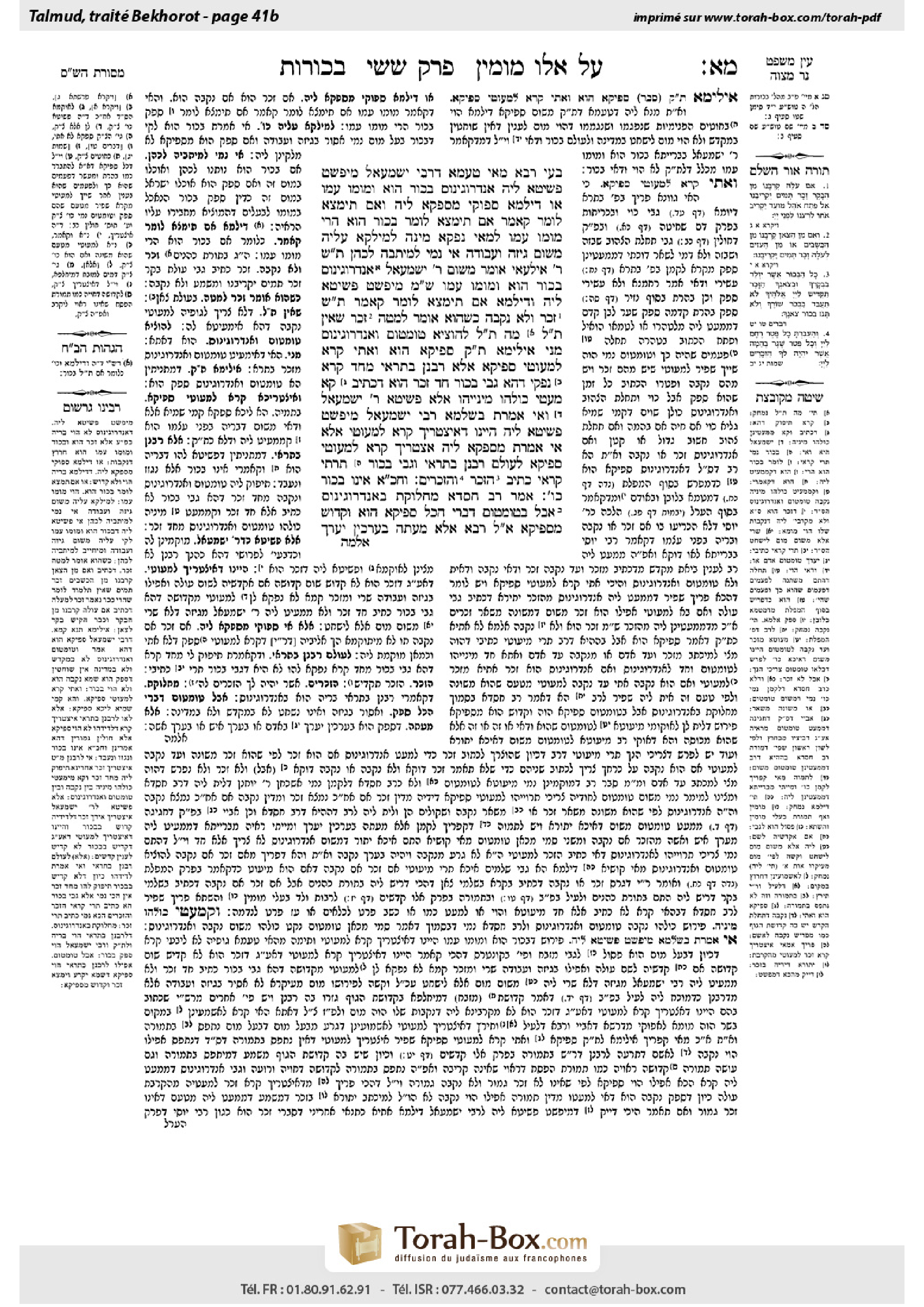
Bekhorot 41b: Talmud study for Daf Yomi
Study the Talmud for Daf Yomi with scanned pages, Hebrew text, English translations from Sefaria and AI-generated French translations.
Passage selection and English or AI-generated French translation are available where the scan has annotations. Daf Study is independent of Torah-Box and Sefaria.
Browse Bekhorot · בכורות · All tractatesBekhorot 41b text and translations
This page of Bekhorot includes the Aramaic text, an English translation and an AI-generated French translation, alongside the scan above.
בכורות מ״א ב · Aramaic and Hebrew text
בָּעֵי רָבָא: מַאי טַעְמָא דְּרַבִּי יִשְׁמָעֵאל? מִיפְשָׁט פְּשִׁיטָא לֵיהּ אַנְדְּרוֹגִינוֹס בְּכוֹר הוּא וּמוּמוֹ עִמּוֹ, אוֹ דִילְמָא סַפּוֹקֵי מְסַפְּקָא לֵיהּ, וְ״אִם תִּימְצָא לוֹמַר״ קָאָמַר — אִם תִּימְצָא לוֹמַר בְּכוֹר הוּא, הֲרֵי מוּמוֹ עִמּוֹ!
לְמַאי נָפְקָא מִינַּהּ? לְמִילְקֵא עֲלֵיהּ מִשּׁוּם גִּיזָּה וַעֲבוֹדָה, אִי נָמֵי לְמִיתְּבֵהּ לְכֹהֵן.
תָּא שְׁמַע: רַבִּי אִילְעַאי אוֹמֵר מִשּׁוּם רַבִּי יִשְׁמָעֵאל: אַנְדְּרוֹגִינוֹס בְּכוֹר הוּא, וּמוּמוֹ עִמּוֹ. שְׁמַע מִינַּהּ מִיפְשָׁט פְּשִׁיטָא לֵיהּ! וְדִילְמָא ״אִם תִּימְצָא לוֹמַר״ קָאָמַר!
תָּא שְׁמַע: זָכָר — וְלֹא נְקֵבָה. כְּשֶׁהוּא אוֹמֵר לְמַטָּה ״זָכָר״, שֶׁאֵין תַּלְמוּד לוֹמַר, מָה תַּלְמוּד לוֹמַר? לְהוֹצִיא טוּמְטוּם וְאַנְדְּרוֹגִינוֹס.
מַנִּי? אִילֵּימָא תַּנָּא קַמָּא — סְפֵיקָא הוּא, וְאָתֵי קְרָא לְמַעוֹטֵי סְפֵיקָא?
אֶלָּא רַבָּנַן בָּתְרָאֵי מֵחַד קְרָא נָפְקִי, דְּהָא גַּבֵּי בְּכוֹר חַד ״זָכָר״ הוּא דִּכְתִיב, (קא) [וְקָא] מְמַעֲטִי כּוּלְּהוּ מִינַּיְיהוּ!
אֶלָּא, פְּשִׁיטָא רַבִּי יִשְׁמָעֵאל, וְאִי אָמְרַתְּ בִּשְׁלָמָא רַבִּי יִשְׁמָעֵאל מִיפְשָׁט פְּשִׁיטָא לֵיהּ — הַיְינוּ דְּאִיצְטְרִיךְ קְרָא לְמַעוֹטֵי, אֶלָּא אִי אָמְרַתְּ מְסַפְּקָא לֵיהּ — אִצְטְרִיךְ קְרָא לְמַעוֹטֵי סְפֵיקָא?
לְעוֹלָם רַבָּנַן בָּתְרָאֵי, וְגַבֵּי בְּכוֹר תַּרְתֵּי קְרָאֵי כְּתִיב: ״הַזָּכָר״ וְ״הַזְּכָרִים״.
וַחֲכָמִים אוֹמְרִים: אֵינוֹ בְּכוֹר כּוּ׳. אָמַר רַב חִסְדָּא: מַחְלוֹקֶת בְּאַנְדְּרוֹגִינוֹס, אֲבָל בְּטוּמְטוּם — דִּבְרֵי הַכֹּל סְפֵיקָא הוּא, וְקָדוֹשׁ מִסְּפֵיקָא.
אֲמַר לֵיהּ רָבָא: אֶלָּא מֵעַתָּה, בַּעֲרָכִין יֵעָרֵךְ?
Bekhorot 41b · English translation
Rava raises a dilemma: What is the reason of Rabbi Yishmael that a hermaphrodite is definitely blemished? Is it obvious to him that a hermaphrodite animal is a male that has firstborn status, and it comes with its blemish, i.e., the female sex organ, and therefore it is permitted to slaughter it outside the Temple? Or perhaps Rabbi Yishmael is uncertain whether or not a hermaphrodite is considered a male, and he says his ruling in the manner of: If you say. In other words, if you say that a hermaphrodite animal is a firstborn, it comes with its blemish, and it may be slaughtered outside the Temple.
The Gemara asks: What is the practical difference between the reasons? The Gemara answers that there is a difference with regard to being flogged on account of this animal due to violating the prohibition of shearing and utilizing a firstborn animal for labor (see Deuteronomy 15:19). If it is definitely a firstborn, then one would be flogged for violating the prohibition. But if one is uncertain whether it is a firstborn, although one may not shear it or perform labor with it, one is not liable to flogging for doing so. Alternatively, there is a difference with regard to giving it to a priest. If its status is uncertain, the priest cannot demand the animal from him, in accordance with the principle that the burden of proof rests upon the claimant.
The Gemara suggests: Come and hear a baraita: Rabbi Ilai says in the name of Rabbi Yishmael: A hermaphrodite is a firstborn, and it comes with its blemish. Learn from the baraita that it is obvious to Rabbi Yishmael that a hermaphrodite is a firstborn. The Gemara responds: But perhaps he said his ruling in the manner of: If you say, as explained earlier.
The Gemara suggests: Come and hear another baraita. It states with regard to a burnt offering from cattle: “A male” (Leviticus 1:3), from which it can be inferred: But not a female. When it says below, with regard to a burnt offering from sheep: “A male” (Leviticus 1:10), a second time, it is difficult to understand, as there is no need for the verse to state this. Why must the verse state “a male” again? This serves to exclude a tumtum and a hermaphrodite, which are disqualified from being sacrificed as burnt offerings.
The Gemara analyzes this baraita: Whose opinion is this? If we say it is the opinion of the first tanna of the mishna, who maintains that a tumtum and a hermaphrodite may not be slaughtered in the Temple or in the rest of the country, then the status of a hermaphrodite is uncertain, as it is unknown whether it is male or female. But does a verse come to exclude a case of uncertainty?
Rather, perhaps this baraita is in accordance with the opinion of the latter Rabbis in the mishna, who hold that a hermaphrodite is definitely not a male, but a distinct entity. Therefore, it is necessary for a verse to exclude it. This, too, is difficult, as according to these Rabbis the exclusion of a female, a tumtum, and a hermaphrodite is derived from one verse alone. The Gemara elaborates: As with regard to a firstborn, it is one “male” alone that is written, from which the Rabbis exclude all of the three categories from firstborn status. By contrast, the baraita excludes a female from one mention of the word “male” and a tumtum and a hermaphrodite from another mention of the word “male.”
Rather, it is obvious that the baraita is in accordance with the opinion of Rabbi Yishmael. And in that case, granted, if you say that it is obvious to Rabbi Yishmael that a hermaphrodite is a firstborn male, that is why a verse was necessary to exclude a hermaphrodite from being brought as a burnt offering. But if you say that Rabbi Yishmael is uncertain whether or not a hermaphrodite is considered a male, is it necessary for the verse to exclude a case of uncertainty?
The Gemara responds: Actually, the baraita is in accordance with the opinion of the latter Rabbis, who maintain that a hermaphrodite is not a male, but a distinct entity. And as for the difficulty that in the case of a firstborn they excluded a female, a tumtum, and a hermaphrodite from a single verse, that is not so. With regard to a firstborn there are also two verses written: “Males” (Deuteronomy 15:19), and: “That is a male” (Exodus 13:12). As in the case of a burnt offering, one of these serves to exclude a female, while the other serves to exclude a tumtum and a hermaphrodite.
§ The mishna teaches: And the Rabbis say: A hermaphrodite does not have firstborn status; rather, its status is that of a non-sacred animal that may be shorn and utilized for labor. Rav Ḥisda says: This dispute applies to a hermaphrodite, which the Rabbis maintain is a distinct entity, as it has both male and female sex organs, and therefore it does not have firstborn status. But with regard to a tumtum, whose genitalia is covered by skin, everyone agrees that it is an uncertain case, as it is definitely either a male or a female, but there is uncertainty as to which it is. And consequently, it is consecrated due to uncertainty, and it may not be slaughtered either in the Temple or in the rest of the country.
Rava said to Rav Ḥisda: If that is so, that a tumtum is certainly either a male or a female, with regard to valuations, when someone vows to give the valuation of a tumtum, it should be valuated, either in accordance with the valuation of a man or a woman.
Bekhorot 41b · Traduction française (IA)
Rava pose un dilemme : Quel est le raisonnement de Rabbi Yishmael qui considère qu'un hermaphrodite est certainement blemi ? Est-ce évident pour lui que l'animal hermaphrodite est un mâle qui a le statut de premier-né, et qui vient avec sa blemie, c'est-à-dire l'organe génital féminin, et donc peut être sacrifié en dehors du Temple ? Ou bien Rabbi Yishmael est-il incertain quant à la nature d'un hermaphrodite, et il formule son jugement ainsi : Si tu dis. En d'autres termes, si tu dis qu'un animal hermaphrodite est un premier-né, il vient avec sa blemie et peut être sacrifié en dehors du Temple.
La Guemara demande : Quelle est la différence pratique entre ces raisonnements ? La Guemara répond que cette différence concerne la flagellation en raison de l'usage de cet animal en violation de la prohibition de tondre et d'utiliser un premier-né pour le travail (cf. Deutéronome 15:19). Si c'est certainement un premier-né, alors on serait flagellé pour avoir violé cette prohibition. Mais si l'on est incertain quant à son statut de premier-né, bien qu'on ne doive pas le tondre ou l'utiliser pour le travail, on n'est pas puni de flagellation pour cela. Alternativement, il y a une différence concernant la remise à un prêtre. Si son statut est incertain, le prêtre ne peut pas exiger l'animal de lui, conformément au principe que la charge de la preuve incombe à celui qui fait la demande.
La Guemara suggère : Viens écouter une baraïta : Rabbi Ilai, en nom de Rabbi Yishmael, dit : L'hermaphrodite est un premier-né, et il vient avec sa blemie. Apprends de cette baraïta que c'est évident pour Rabbi Yishmael que l'hermaphrodite est un premier-né. La Guemara répond : Mais peut-être qu'il a formulé son jugement ainsi : Si tu dis, comme expliqué plus haut.
La Guemara suggère : Viens écouter une autre baraïta. Elle stipule concernant un holocauste d'animal : « Un mâle » (Lévitique 1:3), d'où on peut déduire : Mais pas une femelle. Lorsqu'elle dit plus bas, concernant un holocauste de mouton : « Un mâle » (Lévitique 1:10), une seconde fois, cela est difficile à comprendre, car il n'y a pas besoin que la parole soit répétée. Pourquoi faut-il que la parole dise « un mâle » à nouveau ? Cela sert à exclure un tumtum et un hermaphrodite, qui sont disqualifiés pour être sacrifiés comme holocaustes.
La Guemara analyse cette baraïta : De quel opinion est-ce ? Si nous disons qu'il s'agit de l'opinion du premier tanna de la michna, qui maintient que le tumtum et l'hermaphrodite ne peuvent pas être sacrifiés dans le Temple ou ailleurs, alors le statut de l'hermaphrodite est incertain, car on ne sait pas s'il est mâle ou femelle. Mais une parole ne vient-elle pas exclure un cas d'incertitude ?
Plutôt, peut-être cette baraïta est-elle en conformité avec l'opinion des Rabbins plus tardifs de la michna, qui considèrent que l'hermaphrodite est certainement non mâle, mais une entité distincte. Ainsi, il est nécessaire que la parole l'exclue. Cela aussi est difficile, car selon ces Rabbins, l'exclusion de la femelle, du tumtum et de l'hermaphrodite est tirée d'une seule parole. La Guemara développe : Comme concernant le premier-né, il y a une seule « mâle » écrite, d'où les Rabbins excluent les trois catégories du statut de premier-né. À l'inverse, la baraïta exclut la femelle d'une mention de la parole « mâle », et le tumtum et l'hermaphrodite d'une autre mention de la parole « mâle ».
Plutôt, il est évident que la baraïta est conforme à l'opinion de Rabbi Yishmael. Et dans ce cas, en effet, si tu dis que c'est évident pour Rabbi Yishmael que l'hermaphrodite est un premier-né mâle, c'est pourquoi une parole a été nécessaire pour exclure l'hermaphrodite de l'offrande de holocauste. Mais si tu dis que Rabbi Yishmael est incertain quant à la nature d'un hermaphrodite, est-ce nécessaire que la parole exclue un cas d'incertitude ?
La Guemara répond : En réalité, la baraïta est conforme à l'opinion des Rabbins ultérieurs, qui maintiennent que l'hermaphrodite n'est pas un mâle, mais une entité distincte. Et concernant la difficulté que, dans le cas du premier-né, ils excluent la femelle, le tumtum et l'hermaphrodite d'une seule parole, cela n'est pas vrai. Concernant le premier-né, il y a aussi deux paroles écrites : « Mâles » (Deutéronome 15:19), et : « C'est un mâle » (Exode 13:12). Comme dans le cas du holocauste, l'une de ces paroles sert à exclure la femelle, tandis que l'autre sert à exclure le tumtum et l'hermaphrodite.
§ La mishna enseigne : Et les Rabbins disent : L'hermaphrodite n'a pas le statut de premier-né ; plutôt, son statut est celui d'un animal non sacré qui peut être tondu et utilisé pour le travail. Rav Ḥisda dit : Ce débat s'applique à l'hermaphrodite, que les Rabbins maintiennent être une entité distincte, car il possède à la fois les organes génitaux masculins et féminins, et donc n'a pas le statut de premier-né. Mais concernant le tumtum, dont les organes génitaux sont couverts par la peau, tout le monde convient qu'il s'agit d'un cas d'incertitude, car il est certainement un mâle ou une femelle, mais on ignore lequel. Et par conséquent, il est consacré en raison d'une incertitude, et il ne peut être sacrifié ni dans le Temple ni ailleurs.
Rava dit à Rav Ḥisda : Si c'est ainsi, que le tumtum est certainement un mâle ou une femelle, concernant les estimations, lorsque quelqu'un jure de donner l'estimation du tumtum, il doit être estimé, soit selon l'estimation d'un homme, soit selon celle d'une femme.
Traduction française générée par IA à partir de l’édition anglaise de Sefaria. Vérifie toujours un passage avec le texte source.
Text from Sefaria: William Davidson Edition - Vocalized Aramaic (CC BY NC); William Davidson Edition - English (CC BY NC).