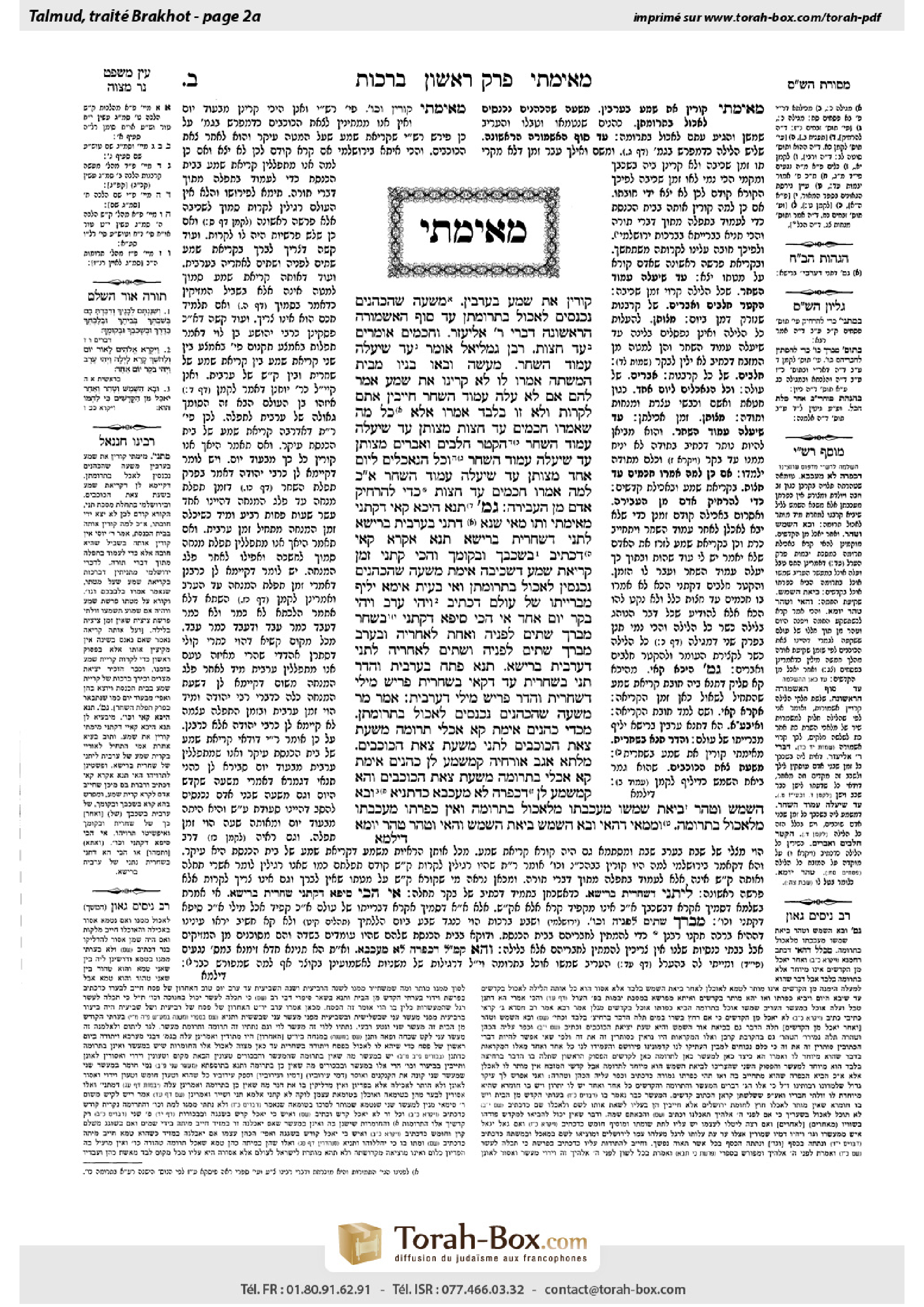
Berakhot 2a: Talmud study for Daf Yomi
Study the Talmud for Daf Yomi with scanned pages, Hebrew text, English translations from Sefaria and AI-generated French translations.
Passage selection and English or AI-generated French translation are available where the scan has annotations. Daf Study is independent of Torah-Box and Sefaria.
Browse Berakhot · ברכות · All tractatesBerakhot 2a text and translations
This page of Berakhot includes the Aramaic text, an English translation and an AI-generated French translation, alongside the scan above.
ברכות ב׳ א · Aramaic and Hebrew text
מֵאֵימָתַי קוֹרִין אֶת שְׁמַע בָּעֲרָבִין? מִשָּׁעָה שֶׁהַכֹּהֲנִים נִכְנָסִים לֶאֱכוֹל בִּתְרוּמָתָן. עַד סוֹף הָאַשְׁמוּרָה הָרִאשׁוֹנָה. דִּבְרֵי רַבִּי אֱלִיעֶזֶר.
וַחֲכָמִים אוֹמְרִים: עַד חֲצוֹת.
רַבָּן גַּמְלִיאֵל אוֹמֵר עַד שֶׁיַּעֲלֶה עַמּוּד הַשַּׁחַר.
מַעֲשֶׂה וּבָאוּ בָנָיו מִבֵּית הַמִּשְׁתֶּה, אָמְרוּ לוֹ: לֹא קָרִינוּ אֶת שְׁמַע, אָמַר לָהֶם: אִם לֹא עָלָה עַמּוּד הַשַּׁחַר חַיָּיבִין אַתֶּם לִקְרוֹת. וְלֹא זוֹ בִּלְבַד אָמְרוּ, אֶלָּא כָּל מַה שֶּׁאָמְרוּ חֲכָמִים ״עַד חֲצוֹת״, מִצְוָתָן עַד שֶׁיַּעֲלֶה עַמּוּד הַשַּׁחַר.
הֶקְטֵר חֲלָבִים וְאֵבָרִים, מִצְוָתָן עַד שֶׁיַּעֲלֶה עַמּוּד הַשַּׁחַר וְכָל הַנֶּאֱכָלִים לְיוֹם אֶחָד, מִצְוָתָן עַד שֶׁיַּעֲלֶה עַמּוּד הַשַּׁחַר. אִם כֵּן, לָמָה אָמְרוּ חֲכָמִים ״עַד חֲצוֹת״ — כְּדֵי לְהַרְחִיק אָדָם מִן הָעֲבֵירָה:
גְּמָ׳ תַּנָּא הֵיכָא קָאֵי דְּקָתָנֵי ״מֵאֵימָתַי״?
וְתוּ: מַאי שְׁנָא דְּתָנֵי בְּעַרְבִית בְּרֵישָׁא? לִתְנֵי דְּשַׁחֲרִית בְּרֵישָׁא!
תַּנָּא אַקְּרָא קָאֵי, דִּכְתִיב: ״בְּשָׁכְבְּךָ וּבְקוּמֶךָ״. וְהָכִי קָתָנֵי: זְמַן קְרִיאַת שְׁמַע דִּשְׁכִיבָה אֵימַת? — מִשָּׁעָה שֶׁהַכֹּהֲנִים נִכְנָסִין לֶאֱכוֹל בִּתְרוּמָתָן.
וְאִי בָּעֵית אֵימָא: יָלֵיף מִבְּרִיָּיתוֹ שֶׁל עוֹלָם, דִּכְתִיב: ״וַיְהִי עֶרֶב וַיְהִי בֹקֶר יוֹם אֶחָד״.
אִי הָכִי, סֵיפָא דְּקָתָנֵי ״בַּשַּׁחַר מְבָרֵךְ שְׁתַּיִם לְפָנֶיהָ וְאַחַת לְאַחֲרֶיהָ, בָּעֶרֶב מְבָרֵךְ שְׁתַּיִם לְפָנֶיהָ וּשְׁתַּיִם לְאַחֲרֶיהָ״, לִתְנֵי דְּעַרְבִית בְּרֵישָׁא!
תַּנָּא פָּתַח בְּעַרְבִית, וַהֲדַר תָּנֵי בְּשַׁחֲרִית, עַד דְּקָאֵי בְּשַׁחֲרִית, פָּרֵישׁ מִילֵּי דְשַׁחֲרִית, וַהֲדַר פָּרֵישׁ מִילֵּי דְעַרְבִית.
אָמַר מָר מִשָּׁעָה שֶׁהַכֹּהֲנִים נִכְנָסִים לֶאֱכוֹל בִּתְרוּמָתָן. מִכְּדִי כֹּהֲנִים אֵימַת קָא אָכְלִי תְּרוּמָה? — מִשְּׁעַת צֵאת הַכּוֹכָבִים, לִתְנֵי: ״מִשְּׁעַת צֵאת הַכּוֹכָבִים״!
מִלְּתָא אַגַּב אוֹרְחֵיהּ קָמַשְׁמַע לַן — כֹּהֲנִים אֵימַת קָא אָכְלִי בִּתְרוּמָה — מִשְּׁעַת צֵאת הַכּוֹכָבִים. וְהָא קָמַשְׁמַע לַן דְּכַפָּרָה לָא מְעַכְּבָא. כִּדְתַנְיָא: ״וּבָא הַשֶּׁמֶשׁ וְטָהֵר״ — בִּיאַת שִׁמְשׁוֹ מְעַכַּבְתּוֹ מִלֶּאֱכוֹל בִּתְרוּמָה, וְאֵין כַּפָּרָתוֹ מְעַכַּבְתּוֹ מִלֶּאֱכוֹל בִּתְרוּמָה.
וּמִמַּאי דְּהַאי ״וּבָא הַשֶּׁמֶשׁ״ בִּיאַת הַשֶּׁמֶשׁ, וְהַאי ״וְטָהֵר״ — טְהַר יוֹמָא.
Berakhot 2a · English translation
The beginning of tractate Berakhot, the first tractate in the first of the six orders of Mishna, opens with a discussion of the recitation of Shema, as the recitation of Shema encompasses an acceptance of the yoke of Heaven and of the mitzvot, and as such, forms the basis for all subsequent teachings. The Mishna opens with the laws regarding the appropriate time to recite Shema:
MISHNA: From when, that is, from what time, does one recite Shema in the evening? From the time when the priests enter to partake of their teruma. Until when does the time for the recitation of the evening Shema extend? Until the end of the first watch. The term used in the Torah (Deuteronomy 6:7) to indicate the time for the recitation of the evening Shema is beshokhbekha, when you lie down, which refers to the time in which individuals go to sleep. Therefore, the time for the recitation of Shema is the first portion of the night, when individuals typically prepare for sleep. That is the statement of Rabbi Eliezer.
The Rabbis say: The time for the recitation of the evening Shema is until midnight.
Rabban Gamliel says: One may recite Shema until dawn, indicating that beshokhbekha is to be understood as a reference to the entire time people sleep in their beds, the whole night.
The mishna relates that Rabban Gamliel practiced in accordance with his ruling. There was an incident where Rabban Gamliel’s sons returned very late from a wedding hall. They said to him, as they had been preoccupied with celebrating with the groom and bride: We did not recite Shema. He said to them: If the dawn has not yet arrived, you are obligated to recite Shema. Since Rabban Gamliel’s opinion disagreed with that of the Rabbis, he explained to his sons that the Rabbis actually agree with him, and that it is not only with regard to the halakha of the recitation of Shema, but rather, wherever the Sages say until midnight, the mitzva may be performed until dawn.
Rabban Gamliel cites several cases in support of his claim, such as the burning of fats and limbs on the altar. Due to the quantity of offerings each day, the priests were often unable to complete the burning of all of the fats and limbs, so they continued to be burned into the night, as it is written: “This is the law of the burnt offering: The burnt offering shall remain upon the pyre on the altar all night until morning, while the fire on the altar burns it” (Leviticus 6:2). And, with regard to all sacrifices, such as the sin-offerings and the guilt-offerings that are eaten for one day and night; although the Sages state that they may be eaten only until midnight, by Torah law they may be eaten until dawn. This is in accordance with the verse: “On the day on which it is offered must you eat. Do not leave it until the morning” (Leviticus 7:15). If so, why did the Sages say that they may be eaten only until midnight? This is in order to distance a person from transgression, as if one believes that he has until dawn to perform the mitzva, he might be negligent and postpone it until the opportunity to perform the mitzva has passed.
GEMARA: The Mishna opens with the laws concerning the appropriate time to recite Shema with the question: From when does one recite Shema in the evening? With regard to this question, the Gemara asks: On the basis of what prior knowledge does the tanna of our mishna ask: From when? It would seem from his question that the obligation to recite Shema in the evening was already established, and that the tanna seeks only to clarify details that relate to it. But our mishna is the very first mishna in the Talmud.
The Gemara asks: And furthermore, what distinguishes the evening Shema, that it was taught first? Let the tanna teach regarding the recitation of the morning Shema first. Since most mitzvot apply during the day, the tanna should discuss the morning Shema before discussing the evening Shema, just as the daily morning offering is discussed before the evening offering (Tosefot HaRosh).
The Gemara offers a single response to both questions: The tanna bases himself on the verse as it is written: “You will talk of them when you sit in your home, and when you walk along the way, when you lie down, and when you arise” (Deuteronomy 6:7). By teaching the laws of the evening Shema first, the tanna has established that the teachings of the Oral Torah correspond to that which is taught in the Written Torah. And based on the Written Torah, the tanna teaches the oral law: When is the time for the recitation of Shema of lying down as commanded in the Torah? From when the priests enter to partake of their teruma. Just as the Written Torah begins with the evening Shema, so too must the Oral Torah.
However, there is another possible explanation for why the mishna opens with the evening Shema rather than with the morning Shema. If you wish, you could say instead that the tanna derives the precedence of the evening Shema from the order of the creation of the world. As it is written in the story of creation: “And there was evening, and there was morning, one day” (Genesis 1:5). According to this verse, day begins with the evening and not the morning. For both of these reasons it was appropriate to open the discussion of the laws of the recitation of Shema with the evening Shema.
The Gemara asks: If so, why does the latter clause of the mishna, which appears later in the chapter, teach: In the morning one recites two blessings before Shema and one blessing afterward, and in the evening one recites two blessings before Shema and two afterward? Based upon the above reasoning, the mishna should have taught the blessing recited before and after the evening Shema first.
The Gemara answers: Indeed, the tanna began by discussing the laws regarding the recitation of the evening Shema, and then taught the laws regarding the recitation of the morning Shema. Once he was already dealing with the morning Shema, he explained the matters of the morning Shema, and then explained the matters of the evening Shema.
The Gemara proceeds to clarify the rest of the mishna. The Master said in the mishna that the beginning of the period when one recites Shema in the evening is when the priests enter to partake of their teruma. However, this does not specify a definitive time. When do the priests enter to partake of their teruma? From the time of the emergence of the stars. If that is the case, then let the tanna teach that the time for the recitation of the evening Shema is from the time of the emergence of the stars.
The Gemara responds: Indeed it would have been simpler to say that the time for the recitation of the evening Shema begins with the emergence of the stars, but the particular expression used by the tanna teaches us another matter in passing: When do priests partake of their teruma? From the time of the emergence of the stars. And the tanna teaches us a new halakha parenthetically: failure to bring an atonement offering does not prevent a priest from eating teruma. In cases where an impure priest is required to immerse himself in a ritual bath and bring an atonement offering, even if he already immersed himself, he is not completely ritually pure until he brings the atonement offering. Nevertheless, he is still permitted to partake of teruma. Taught in passing in our mishna, this is articulated fully in a baraita, based on a close reading of the biblical passages. As it was taught in a baraita with regard to the laws of ritual impurity, it is said: “One who touches it remains impure until evening. He should not eat of the consecrated items and he must wash his flesh with water. And the sun sets and it is purified. Afterwards, he may eat from the teruma, for it is his bread” (Leviticus 22:6–7). From the passage: “And the sun sets and it is purified,” that the absence of the setting of his sun prevents him from partaking of teruma, but failure to bring the atonement offering does not prevent him from partaking of teruma, may be inferred.
The Gemara discusses the proof offered in the baraita: From where do we know that the phrase: “And the sun sets” refers to the complete setting of the sun, and therefore, “and it is purified” refers to the fact that the day is pure, i.e., and the sun sets and it is purified is one phrase meaning that the sun will set, the air will clear, and the stars will emerge (Rav Hai Gaon)?
Berakhot 2a · Traduction française (IA)
Le début du traité Berakhot, le premier traité du premier des six ordres de la Michna, commence par une discussion sur la récitation du Chéma, car la récitation du Chéma implique l'acceptation du joug du Royaume des Cieux et des mitsvot, et constitue ainsi la base de tous les enseignements ultérieurs. La Michna commence par les lois concernant le moment approprié pour réciter le Chéma : MICHNA : À partir de quel moment, c'est-à-dire à partir de quelle heure, doit-on réciter le Chéma le soir ? À partir du moment où les prêtres entrent pour consommer leur terouma. Jusqu'à quelle heure le moment de la récitation du Chéma du soir s'étend-il ? Jusqu'à la fin de la première veille. Le terme utilisé dans la Torah (Deutéronome 6:7) pour indiquer le moment de la récitation du Chéma du soir est beshokhbekha, lorsque l'on se couche, ce qui fait référence au moment où les individus vont se coucher. Ainsi, le moment de la récitation du Chéma est la première partie de la nuit, lorsque les individus se préparent normalement à dormir. C'est la déclaration du Rabbi Eliezer.
Les Sages disent : Le moment de la récitation du Chéma du soir s'étend jusqu'à minuit.
Rabban Gamliel dit : On peut réciter le Chéma jusqu'à l'aube, indiquant que beshokhbekha doit être compris comme faisant référence à l'ensemble du temps où les gens dorment dans leur lit, toute la nuit.
La Michna rapporte que Rabban Gamliel appliquait ses enseignements. Il y avait un incident où les fils de Rabban Gamliel étaient rentrés très tard d'une salle de mariage. Ils lui dirent, comme ils avaient été occupés à célébrer avec le marié et la mariée : Nous n'avons pas récité le Chéma. Il lui dit : Si l'aube n'est pas encore arrivée, vous êtes tenu de réciter le Chéma. Puisque l'opinion de Rabban Gamliel divergeait de celle des Sages, il expliqua à ses fils que les Sages étaient d'accord avec lui, et que ce n'était pas seulement concernant la halakha de la récitation du Chéma, mais plutôt, partout où les Sages disent jusqu'à minuit, la mitsva peut être accomplie jusqu'à l'aube.
Rabban Gamliel cite plusieurs cas en faveur de son argument, tels que la combustion des graisses et des membres sur l'autel. En raison de la quantité d'offrandes chaque jour, les prêtres étaient souvent incapables de terminer la combustion de toutes les graisses et membres, donc ils continuaient à être brûlés toute la nuit, comme il est écrit : « C'est la loi de l'holocauste : L'holocauste restera sur le feu de l'autel toute la nuit jusqu'à l'aube, tandis que le feu sur l'autel la brûle » (Lévitique 6:2). Et concernant toutes les offrandes, telles que les sacrifices expiatoires et les sacrifices de culpabilité qui sont mangés pendant un jour et une nuit ; bien que les Sages disent qu'elles peuvent être mangées uniquement jusqu'à minuit, selon la loi divine, elles peuvent être mangées jusqu'à l'aube. Cela s'inspire du verset : « Le jour où il est offert, tu le mangeras. Ne le laisse pas jusqu'à l'aube » (Lévitique 7:15). Si tel est le cas, pourquoi les Sages disent-ils qu'elles peuvent être mangées uniquement jusqu'à minuit ? C'est afin d'éloigner une personne de la transgression, car si l'on croit qu'on a jusqu'à l'aube pour accomplir la mitsva, on pourrait négliger et reporter jusqu'au moment où l'opportunité d'accomplir la mitsva est passée.
GUEMARA : La Michna commence par les lois concernant le moment approprié pour réciter le Chéma avec la question : À partir de quel moment doit-on réciter le Chéma le soir ? Concernant cette question, la Guemara demande : Sur la base de quel savoir antérieur le tanna de notre Michna pose-t-il la question : À partir de quel moment ? Il semble que cela soit basé sur le fait que l'obligation de réciter le Chéma le soir était déjà établie, et que le tanna cherche uniquement à clarifier des détails liés à cela. Mais notre Michna est la première Michna du Talmud.
La Guemara demande : Et de plus, qu'est-ce qui distingue le Chéma du soir, qui a été enseigné en premier ? Que le tanna enseigne d'abord le Chéma du matin. Puisque la plupart des mitsvot s'appliquent pendant la journée, le tanna devrait discuter du Chéma du matin avant de discuter du Chéma du soir, tout comme l'offrande matinale est discutée avant l'offrande du soir (Tosefot HaRosh).
La Guemara offre une seule réponse aux deux questions : Le tanna s'appuie sur le verset qui dit : « Tu parleras d'eux quand tu seras assis dans ta maison, et quand tu marcheras sur la route, quand tu te coucheras, et quand tu te lèveras » (Deutéronome 6:7). En enseignant les lois du Chéma du soir en premier, le tanna a établi que les enseignements de la Torah orale correspondent à ce qui est enseigné dans la Torah écrite. Et sur la base de la Torah écrite, le tanna enseigne la loi orale : Quel est le moment de la récitation du Chéma du coucher, comme commandé dans la Torah ? À partir du moment où les prêtres entrent pour consommer leur terouma. Tout comme la Torah écrite commence avec le Chéma du soir, de même doit commencer la Torah orale.
Cependant, il existe une autre explication possible pour expliquer pourquoi la Michna commence avec le Chéma du soir plutôt qu'avec le Chéma du matin. Si vous le souhaitez, vous pourriez dire plutôt que le tanna dérive la priorité du Chéma du soir de l'ordre de la création du monde. Comme il est écrit dans l'histoire de la création : « Et il y eut le soir, et il y eut le matin, un jour » (Genèse 1:5). Selon ce verset, la journée commence avec le soir et non avec le matin. Pour ces deux raisons, il était approprié d'ouvrir la discussion sur les lois de la récitation du Chéma avec le Chéma du soir.
La Guemara demande : Si tel est le cas, pourquoi la clause ultérieure de la Michna, qui apparaît plus tard dans le chapitre, enseigne : Le matin, on récite deux bénédictions avant le Chéma et une après, et le soir, on récite deux bénédictions avant le Chéma et deux après ? Sur la base du raisonnement ci-dessus, la Michna devrait avoir enseigné d'abord la bénédiction récitée avant et après le Chéma du soir.
La Guemara répond : En effet, le tanna a commencé par discuter des lois concernant la récitation du Chéma du soir, puis a enseigné les lois concernant la récitation du Chéma du matin. Une fois qu'il était déjà en train de traiter du Chéma du matin, il a expliqué les points concernant le Chéma du matin, puis ceux concernant le Chéma du soir.
La Guemara poursuit pour clarifier le reste de la Michna. Le Maître a dit dans la Michna que le début de la période où l'on récite le Chéma le soir est lorsque les prêtres entrent pour consommer leur terouma. Cependant, cela ne précise pas un moment définitif. Quand les prêtres entrent-ils pour consommer leur terouma ? À partir du moment de l'apparition des étoiles. Si c'est le cas, alors le tanna devrait enseigner que le moment de la récitation du Chéma du soir commence à partir de l'apparition des étoiles.
La Guemara répond : En effet, il aurait été plus simple de dire que le moment de la récitation du Chéma du soir commence avec l'apparition des étoiles, mais l'expression particulière utilisée par le tanna nous apprend une autre chose en passant : Lorsque les prêtres consomment-ils leur terouma ? À partir du moment de l'apparition des étoiles. Et le tanna nous enseigne une nouvelle halakha en passant : l'absence de sacrifice expiatoire n'empêche pas le prêtre de consommer la terouma. Dans les cas où un prêtre impur doit s'immerger dans un mikvé et de présenter un sacrifice expiatoire, même s'il s'est déjà immergé, il n'est pas entièrement pur rituellement jusqu'à ce qu'il présente le sacrifice expiatoire. Cependant, il est toujours autorisé à consommer la terouma. Cet enseignement est articulé pleinement dans une baraïta, fondé sur une lecture attentive des passages bibliques. Comme il a été enseigné dans une baraïta concernant les lois de l'impureté, il est dit : « Celui qui le touche demeure impur jusqu'au soir. Il ne doit pas manger des choses consacrées et il doit laver sa peau avec de l'eau. Et le soleil se couche et il est purifié. Après cela, il peut manger de la terouma, car c'est son pain » (Lévitique 22:6–7). À partir du passage : « Et le soleil se couche et il est purifié », on peut inférer que l'absence du coucher du soleil l'empêche de consommer la terouma, mais l'absence de sacrifice expiatoire ne l'empêche pas de consommer la terouma.
La Guemara discute de la preuve offerte dans la baraïta : D'où savons-nous que la phrase : « Et le soleil se couche » fait référence au coucher complet du soleil, et donc, « et il est purifié » fait référence au fait que la journée est pure, c'est-à-dire que « et le soleil se couche et il est purifié » est une seule phrase signifiant que le soleil se couchera, l'air se clarifiera et les étoiles apparaîtront (Rav Hai Gaon) ?
Traduction française générée par IA à partir de l’édition anglaise de Sefaria. Vérifie toujours un passage avec le texte source.
Text from Sefaria: William Davidson Edition - Vocalized Aramaic (CC BY NC); William Davidson Edition - English (CC BY NC).