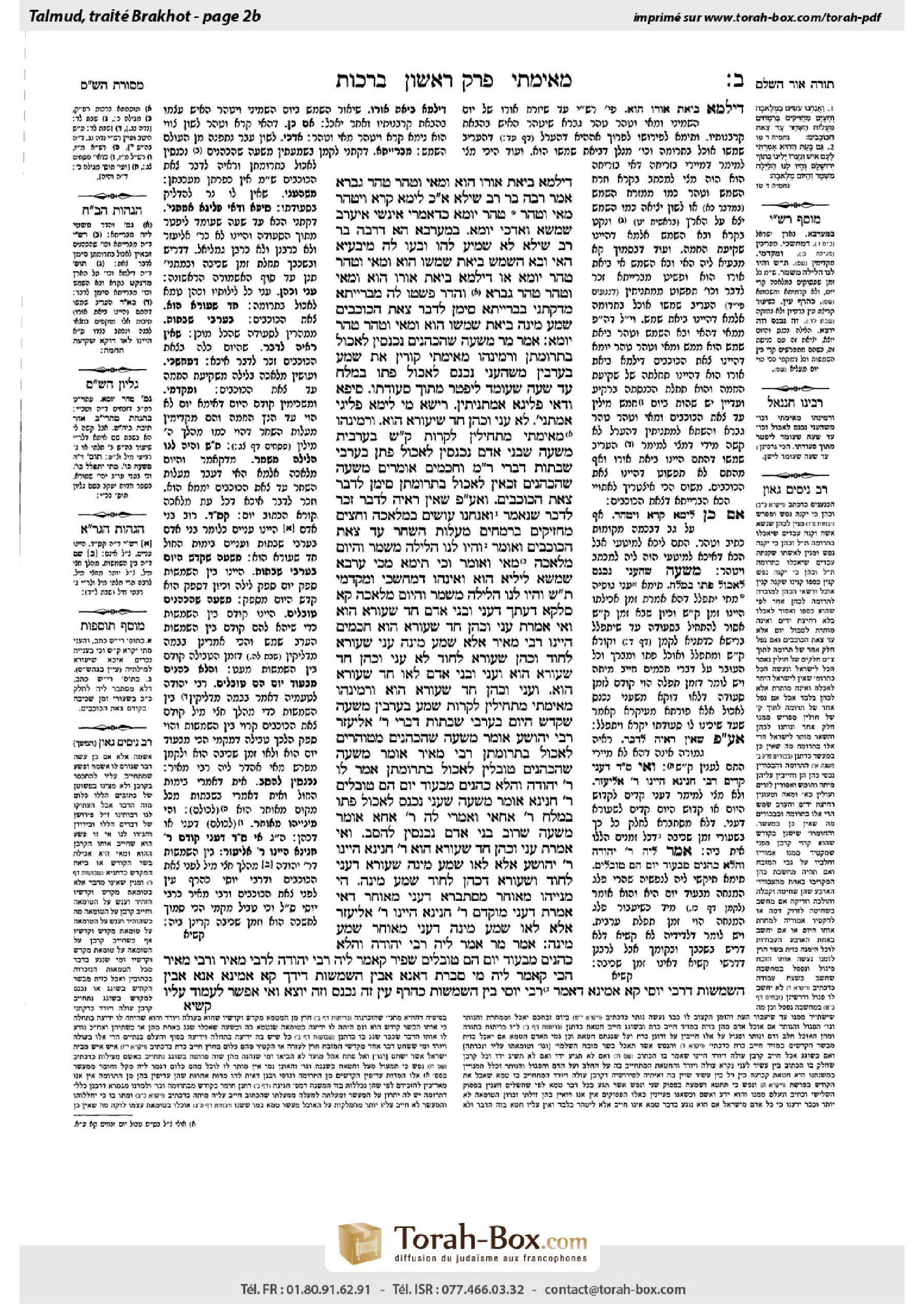
Berakhot 2b: Talmud study for Daf Yomi
Study the Talmud for Daf Yomi with scanned pages, Hebrew text, English translations from Sefaria and AI-generated French translations.
Passage selection and English or AI-generated French translation are available where the scan has annotations. Daf Study is independent of Torah-Box and Sefaria.
Browse Berakhot · ברכות · All tractatesBerakhot 2b text and translations
This page of Berakhot includes the Aramaic text, an English translation and an AI-generated French translation, alongside the scan above.
ברכות ב׳ ב · Aramaic and Hebrew text
דִּילְמָא בִּיאַת אוֹרוֹ הוּא, וּמַאי ״וְטָהֵר״ — טְהַר גַּבְרָא?!
אָמַר רַבָּהּ בַּר רַב שֵׁילָא: אִם כֵּן, לֵימָא קְרָא: ״וְיִטְהָר״, מַאי ״וְטָהֵר״ — טְהַר יוֹמָא, כִּדְאָמְרִי אִינָשֵׁי: ״אִיעֲרַב שִׁמְשָׁא וְאִדַּכִּי יוֹמָא״.
בְּמַעֲרָבָא, הָא דְּרַבָּהּ בַּר רַב שֵׁילָא לָא שְׁמִיעַ לְהוּ, וּבְעוֹ לַהּ מִיבַּעְיָא: הַאי ״וּבָא הַשֶּׁמֶשׁ״ בִּיאַת שִׁמְשׁוֹ הוּא, וּמַאי ״וְטָהֵר״ — טְהַר יוֹמָא, אוֹ דִילְמָא בִּיאַת אוֹרוֹ הוּא, וּמַאי ״וְטָהֵר״ — טְהַר גַּבְרָא.
וַהֲדַר פָּשְׁטוּ לַהּ מִבָּרַיְיתָא. מִדְּקָתָנֵי בְּבָרַיְיתָא, סִימָן לַדָּבָר — צֵאת הַכּוֹכָבִים. שְׁמַע מִינַּהּ — בִּיאַת שִׁמְשׁוֹ הוּא, וּמַאי ״וְטָהֵר״ — טְהַר יוֹמָא.
אָמַר מָר מִשָּׁעָה שֶׁהַכֹּהֲנִים נִכְנָסִין לֶאֱכוֹל בִּתְרוּמָתָן. וּרְמִינְהוּ: מֵאֵימָתַי קוֹרִין אֶת שְׁמַע בָּעֲרָבִין — מִשֶּׁהֶעָנִי נִכְנָס לֶאֱכוֹל פִּתּוֹ בְּמֶלַח, עַד שָׁעָה שֶׁעוֹמֵד לִיפָּטֵר מִתּוֹךְ סְעוּדָּתוֹ.
סֵיפָא, וַדַּאי פְּלִיגָא אַמַּתְנִיתִין. רֵישָׁא, מִי לֵימָא פְּלִיגִי אַמַּתְנִיתִין?
לָא, עָנִי וְכֹהֵן חַד שִׁיעוּרָא הוּא.
וּרְמִינְהוּ: מֵאֵימָתַי מַתְחִילִין לִקְרוֹת קְרִיאַת שְׁמַע בְּעַרְבִית — מִשָּׁעָה שֶׁבְּנֵי אָדָם נִכְנָסִין לֶאֱכוֹל פִּתָּן בְּעַרְבֵי שַׁבָּתוֹת, דִּבְרֵי רַבִּי מֵאִיר. וַחֲכָמִים אוֹמְרִים: מִשָּׁעָה שֶׁהַכֹּהֲנִים זַכָּאִין לֶאֱכוֹל בִּתְרוּמָתָן. סִימָן לַדָּבָר: צֵאת הַכּוֹכָבִים. וְאַף עַל פִּי שֶׁאֵין רְאָיָה לַדָּבָר, זֵכֶר לַדָּבָר, שֶׁנֶּאֱמַר: ״וַאֲנַחְנוּ עֹשִׂים בַּמְּלָאכָה וְחֶצְיָם מַחֲזִיקִים בָּרְמָחִים מֵעֲלוֹת הַשַּׁחַר עַד צֵאת הַכּוֹכָבִים״, וְאוֹמֵר: ״וְהָיוּ לָנוּ הַלַּיְלָה מִשְׁמָר וְהַיּוֹם מְלָאכָה״.
מַאי ״וְאוֹמֵר״?
וְכִי תֵּימָא מִכִּי עָרְבָא שִׁמְשָׁא, לֵילְיָא הוּא, וְאִינְהוּ דְּמַחְשְׁכִי וּמַקְדְּמִי, תָּא שְׁמַע ״וְהָיוּ לָנוּ הַלַּיְלָה מִשְׁמָר וְהַיּוֹם מְלָאכָה״.
קָא סָלְקָא דַּעְתָּךְ דְּעָנִי וּבְנֵי אָדָם חַד שִׁעוּרָא הוּא. וְאִי אָמְרַתְּ עָנִי וְכֹהֵן חַד שִׁעוּרָא הוּא, חֲכָמִים הַיְינוּ רַבִּי מֵאִיר?
אֶלָּא, שְׁמַע מִינַּהּ עָנִי שִׁעוּרָא לְחוּד וְכֹהֵן שִׁעוּרָא לְחוּד. לָא, עָנִי וְכֹהֵן חַד שִׁעוּרָא הוּא, וְעָנִי וּבְנֵי אָדָם לָאו חַד שִׁעוּרָא הוּא.
וְעָנִי וְכֹהֵן חַד שִׁעוּרָא הוּא? וּרְמִינְהוּ: מֵאֵימָתַי מַתְחִילִין לִקְרוֹת שְׁמַע בָּעֲרָבִין — מִשָּׁעָה שֶׁקָּדַשׁ הַיּוֹם בְּעַרְבֵי שַׁבָּתוֹת, דִּבְרֵי רַבִּי אֱלִיעֶזֶר. רַבִּי יְהוֹשֻׁעַ אוֹמֵר: מִשָּׁעָה שֶׁהַכֹּהֲנִים מְטוֹהָרִים לֶאֱכוֹל בִּתְרוּמָתָן. רַבִּי מֵאִיר אוֹמֵר, מִשָּׁעָה שֶׁהַכֹּהֲנִים טוֹבְלִין לֶאֱכוֹל בִּתְרוּמָתָן. אָמַר לוֹ רַבִּי יְהוּדָה: וַהֲלֹא כֹּהֲנִים מִבְּעוֹד יוֹם הֵם טוֹבְלִים? רַבִּי חֲנִינָא אוֹמֵר מִשָּׁעָה שֶׁעָנִי נִכְנָס לֶאֱכוֹל פִּתּוֹ בְּמֶלַח. רַבִּי אַחַאי וְאָמְרִי לַהּ רַבִּי אַחָא אוֹמֵר: מִשָּׁעָה שֶׁרוֹב בְּנֵי אָדָם נִכְנָסִין לְהָסֵב.
וְאִי אָמְרַתְּ עָנִי וְכֹהֵן חַד שִׁעוּרָא הוּא, רַבִּי חֲנִינָא הַיְינוּ רַבִּי יְהוֹשֻׁעַ!
אֶלָּא לָאו שְׁמַע מִינַּהּ שִׁעוּרָא דְּעָנִי לְחוּד וְשִׁעוּרָא דְּכֹהֵן לְחוּד, שְׁמַע מִינַּהּ.
הֵי מִינַּיְיהוּ מְאוּחָר? מִסְתַּבְּרָא דְּעָנִי מְאוּחָר דְּאִי אָמְרַתְּ דְּעָנִי מוּקְדָּם רַבִּי חֲנִינָא הַיְינוּ רַבִּי אֱלִיעֶזֶר. אֶלָּא לָאו שְׁמַע מִינַּהּ דְּעָנִי מְאוּחָר. שְׁמַע מִינַּהּ.
אָמַר מָר. אֲמַר לֵיהּ רַבִּי יְהוּדָה: וַהֲלֹא כֹּהֲנִים מִבְּעוֹד יוֹם הֵם טוֹבְלִים!
שַׁפִּיר קָאָמַר לֵיהּ רַבִּי יְהוּדָה לְרַבִּי מֵאִיר?
וְרַבִּי מֵאִיר הָכִי קָאָמַר לֵיהּ: מִי סָבְרַתְּ דַּאֲנָא אַבֵּין הַשְּׁמָשׁוֹת דִּידָךְ קָא אָמֵינָא? אֲנָא אַבֵּין הַשְּׁמָשׁוֹת דְּרַבִּי יוֹסֵי קָא אָמֵינָא, דְּאָמַר רַבִּי יוֹסֵי בֵּין הַשְּׁמָשׁוֹת כְּהֶרֶף עַיִן, זֶה — נִכְנָס, וְזֶה — יוֹצֵא, וְאִי אֶפְשָׁר לַעֲמוֹד עָלָיו.
Berakhot 2b · English translation
Perhaps the expression: “And the sun sets and it is purified” refers to the very beginning of sunset, the setting of the sun’s light. According to that explanation, what does the expression and it is purified mean? It means that the person will become purified. After immersing, he will wait until the beginning of sunset, and only then will he be able to eat of his teruma (Tosafot).
Rabba bar Rav Sheila said: If so, that: And it is purified, means that the priest goes and purifies himself, then let the verse say unambiguously: And he will become purified. Since the Torah does not employ that language, the conclusion is: What is the meaning of the expression: And it is purified? It means the day is pure, no residue of day remains, as people say colloquially: The sun has set and the day is purified.
In the West, Eretz Yisrael, they did not hear this explanation given by Rabba bar Rav Sheila. They raised the dilemma: Does the expression: And the sun sets, refer to the actual setting of the sun, and does: And it is purified, mean the day clears away? Or perhaps it refers to the setting of its light at sunset, in which case what is the meaning of: And it is purified? It refers to the purification of the person. In other words, in Eretz Yisrael, they attempted to clarify the halakha based on the biblical passage, but were unable to do so.
Ultimately they resolved this dilemma from a baraita. It was taught in a baraita that the time for the recitation of the evening Shema corresponds to the time when priests are permitted to eat of their teruma, a sign for which is the emergence of the stars. Therefore, derive from here that “and the sun sets” refers to the complete sunset, and the expression “and it is purified” means the day clears away, as the Sages in Babylonia concluded.
In our mishna, the Master said: The beginning of the time for the recitation of the evening Shema is: From the time when the priests enter to partake of their teruma. The Gemara raises a contradiction to this opinion from a baraita that states that the time for the recitation of the evening Shema is: From when a poor person enters to eat his bread with salt until he rises from his meal.
The Gemara begins its analysis by clarifying whether there is an actual contradiction here, or whether different expressions are being employed to describe the same time. The latter clause of the baraita, which established that the time for the recitation of the evening Shema ends when a poor person rises from his meal, certainly disagrees with our mishna. Since the poor person clearly does not continue eating until the end of the first watch, this baraita certainly contradicts our mishna. With regard to the first clause of the baraita, however, which establishes the beginning of the time for the recitation of the evening Shema, shall we say that it disagrees with our mishna?
The Gemara immediately rejects this idea: No, the time when the poor person eats and the time when the priest is purified and permitted to partake of his teruma are one and the same time.
The Gemara raises a contradiction from the Tosefta: From when does one begin to recite Shema in the evening? From the time when people enter to eat their bread on Shabbat eve. This is the statement of Rabbi Meir. As they do in our mishna, the Rabbis say: From the time when the priests are eligible to partake of their teruma, a sign for which is the emergence of the stars. And although there is no explicit proof that the emergence of the stars is when one may begin to recite the evening Shema, there is an allusion in the book of Nehemiah to the fact that the emergence of the stars is generally considered the beginning of the night. As it is stated with regard to the building of the walls of Jerusalem: “And we perform the work, and half of them grasp their spears from dawn until the emergence of the stars” (Nehemiah 4:15). And it says: “That in the night they may be a guard to us, and may labor in the day” (Nehemiah 4:16). From here we ascertain that the day ends with the emergence of the stars.
Even before analyzing these sources, the Gemara seeks to clarify a confusing element in the Tosefta. In their biblical proof, the Rabbis do not suffice with one verse, but rather they say: And it says…and they cite an additional verse. What is added by this use of: And it says? It seems superfluous, as the entire proof appears in the first verse.
The Gemara answers that the first verse was not sufficient. As, if you say that night begins when the sun sets, but the workers stayed late and arrived early; i.e., due to the importance of their task they worked even into the night. In anticipation of this objection, the second verse was cited to teach: Come and hear, as it is stated: “That in the night they may be a guard to us, and may labor in the day,” the time between dawn and the emergence of the stars is explicitly referred to as “day,” proving that night begins with the emergence of the stars.
In analyzing the three opinions regarding the beginning of the period for the recitation of the evening Shema, the Gemara begins with the supposition: It might enter your mind to say that the time when the poor person typically eats his meal and the time when ordinary people eat their Shabbat evening meal are one and the same time, since in both cases those eating would seek to begin their meals as early as possible, as, for different reasons, they are unable to kindle additional lights to illuminate their meal. And, if you say that the time of the poor person’s meal and the time when the priest is purified and permitted to partake of his teruma are one and the same time, then the opinion of the Rabbis is identical to that of Rabbi Meir. What is their disagreement?
Rather, what we said previously must be rejected, and instead learn from this that there is a separate time for the poor person and a separate time for the priest. However, this conclusion is based on the assumption that the time of the poor person and the time of people are the same. That too can be rejected with the assertion that, no, the time of the poor person and the priest are one and the same time, and the time of the poor person and people are not the same. Accordingly, the opinion expressed by the tanna in our baraita is identical to that of the other tanna’im, and only Rabbi Meir disagrees with them.
And is the time of the poor person and the priest the same? The Gemara raises a contradiction to this approach from another baraita, in which other opinions regarding the time for the recitation of the evening Shema are cited: From when does one begin to recite the evening Shema?
From the time when the day becomes sanctified on the eve of Shabbat, this is the statement of Rabbi Eliezer, who established an earlier time for Shema.
Rabbi Yehoshua, like our mishna, says: From the time when the priests are eligible to partake of their teruma.
Rabbi Meir says: The time for the recitation of Shema begins before the priests were purified, from when the priests immerse themselves in order to partake of their teruma.
Rabbi Yehuda said to Rabbi Meir: How is it possible that the time for the recitation of the evening Shema corresponds to the time of the priests’ immersion? Do the priests not immerse themselves during the day, so that with nightfall and the onset of a new day they will be purified? If so, how can that time be called night?
Rabbi Ḥanina says that the time for the recitation of the evening Shema begins when the poor person enters to eat his bread with salt.
But Rabbi Aḥai, and some say Rabbi Aḥa, says: From the time when most people enter to recline at their meal during the week.
The preceding was the text of the baraita. Returning to our question, if you say that the time of the poor person and the priest are one and the same time, then the opinion of Rabbi Ḥanina is identical to that of Rabbi Yehoshua. However, the fact that they are cited together indicates that they are not, in fact, the same.
Rather, must one not conclude from this the time for the poor person is separate and the time for the priest is separate? Since no objection is raised, the Gemara concedes: Indeed, conclude from this.
Having established that the time of the poor person and that of the priest are different, the Gemara seeks to determine: which one is later? The Gemara suggests that it is reasonable to conclude that the time of the poor person is later. As if you say that the poor person is earlier, it would be impossible to establish a time earlier than that established by Rabbi Yehoshua, unless we hold that night begins with sunset, in which case the opinion of Rabbi Ḥanina is identical to that of Rabbi Eliezer. Rather, must one not conclude from this that the poor person is later? The Gemara notes: Indeed, conclude from this.
We learned that the Master said in a baraita that the time for the recitation of the evening Shema according to Rabbi Meir begins with the time of the immersion of the priests. Regarding this, Rabbi Yehuda said to Rabbi Meir: Do the priests not immerse themselves during the day?
The Gemara notes: What Rabbi Yehuda said to Rabbi Meir seems correct, and how can Rabbi Meir respond? Rabbi Meir’s response is connected to the fundamental dispute over when night begins. After sunset, a period begins which is neither day nor night. The tanna’im disagree over the precise duration of this period known as twilight [bein hashemashot]. Rabbi Yehuda holds that twilight extends a full hour after sunset. Rabbi Neḥemya agrees in principle, though he disagrees over the specifics. Rabbi Yosei maintains that twilight is very brief, and occurs immediately before the emergence of the stars, which marks the beginning of the night. Regarding Rabbi Meir’s argument, Rabbi Yehuda asks that since the priests immerse themselves before twilight, they have a long wait until nightfall; clearly their immersion takes place while it is still day.
The Gemara answers that Rabbi Meir said to Rabbi Yehuda as follows: Do you maintain that I am speaking of your definition of twilight? I am speaking of Rabbi Yosei’s definition of twilight, as Rabbi Yosei said: Twilight is like the blink of an eye; night begins and day ends and the time between them is so brief, it is impossible to quantify. According to this opinion, the priests immerse themselves just before the emergence of the stars, when it is already considered night.
Berakhot 2b · Traduction française (IA)
Peut-être l'expression « Et le soleil se couche et il est purifié » fait référence au début du coucher du soleil, au moment où la lumière du soleil s'éteint. Selon cette interprétation, que signifie l'expression « et il est purifié » ? Cela signifie que la personne devient pure. Après l'immersion, il attend jusqu'au début du coucher du soleil, et seulement alors pourra-t-il manger de sa terouma (Tosafot).
Rabba bar Rav Sheila a dit : Si ainsi, que « et il est purifié » signifie que le prêtre va se purifier, alors la Torah devrait dire clairement : « et il devient purifié ». Puisque la Torah ne utilise pas ce langage, la conclusion est : Que signifie l'expression « et il est purifié » ? Cela signifie que la journée est pure, il ne reste plus de résidu de journée, comme les gens disent couramment : Le soleil est couché et la journée est purifiée.
Au West, en Eretz Yisrael, ils n'ont pas entendu cette explication donnée par Rabba bar Rav Sheila. Ils ont soulevé le dilemme : L'expression « Et le soleil se couche » fait-elle référence au coucher réel du soleil, et « et il est purifié » signifie-t-elle que la journée s'éclaire ? Ou peut-être fait-elle référence au coucher de sa lumière au coucher du soleil, dans ce cas, que signifie « et il est purifié » ? Cela fait référence à la purification de la personne. En d'autres termes, en Eretz Yisrael, ils ont tenté de clarifier la halakha à partir du passage biblique, mais n'ont pas réussi à le faire.
Finalement, ils ont résolu ce dilemme à partir d'une baraïta. Il a été enseigné dans une baraïta que le moment de la prière du soir correspond au moment où les prêtres sont autorisés à manger de leur terouma, un signe étant l'apparition des étoiles. Ainsi, on en déduit que « et le soleil se couche » fait référence au coucher complet du soleil, et l'expression « et il est purifié » signifie que la journée s'efface, comme les Sages en Babylonie l'ont conclu.
Dans notre mitsna, le Maître a dit : Le début du moment de la prière du soir est : À partir du moment où les prêtres entrent pour manger leur terouma. La Guemara soulève une contradiction avec cette opinion à partir d'une baraïta qui affirme que le moment de la prière du soir est : À partir du moment où un pauvre entre pour manger son pain avec du sel jusqu'à ce qu'il se lève de son repas.
La Guemara commence son analyse en clarifiant s'il y a une contradiction réelle ici, ou si des expressions différentes sont utilisées pour décrire le même moment. La clause finale de la baraïta, qui établit que le moment de la prière du soir se termine lorsque le pauvre se lève de son repas, ne correspond clairement pas à notre mitsna. Puisque le pauvre ne continue clairement pas à manger jusqu'à la fin de la première veille, cette baraïta contredit clairement notre mitsna. En ce qui concerne la clause initiale de la baraïta, qui établit le début du moment de la prière du soir, devons-nous dire qu'elle s'oppose à notre mitsna ?
La Guemara rejette immédiatement cette idée : Non, le moment où le pauvre mange et le moment où le prêtre est purifié et autorisé à manger sa terouma sont le même moment.
La Guemara soulève une contradiction à partir de la Tosefta : À partir de quel moment commence-t-on à réciter le Chéma en soirée ? À partir du moment où les gens entrent pour manger leur pain à la veille de la fête. C'est l'opinion de Rabbi Meir. Comme dans notre mitsva, les Rabbins disent : À partir du moment où les prêtres sont autorisés à manger leur terouma, un signe étant l'apparition des étoiles. Et bien qu'il n'y ait pas de preuve explicite que l'apparition des étoiles est le moment où l'on peut commencer à réciter le Chéma en soirée, il y a une allusion dans le livre de Néhémie à ce que l'apparition des étoiles est généralement considérée comme le début de la nuit. Il est dit concernant la construction des murs de Jérusalem : « Et nous faisons le travail, et la moitié d'entre eux saisissent leurs lances du lever du soleil jusqu'à l'apparition des étoiles » (Néhémie 4:15). Et il est dit : « Que dans la nuit ils soient notre garde, et qu'ils travaillent en jour » (Néhémie 4:16). De là, on déduit que la journée se termine avec l'apparition des étoiles.
Même avant d'analyser ces sources, la Guemara cherche à clarifier un point confus dans la Tosefta. Dans leur preuve biblique, les Rabbins ne se contentent pas d'un seul verset, mais ils disent : « Et il est dit… » et citent un autre verset. Que gagne-t-on à utiliser « et il est dit » ? Il semble superflu, puisque toute la preuve est dans le premier verset.
La Guemara répond que le premier verset n'était pas suffisant. En effet, si vous dites que la nuit commence lorsque le soleil se couche, mais les ouvriers sont restés tard et sont arrivés tôt ; c'est-à-dire, en raison de l'importance de leur tâche, ils ont travaillé même en plein nuit. Pour anticiper cette objection, le second verset a été cité pour enseigner : Viens écouter, car il est dit : « Que dans la nuit ils soient notre garde, et qu'ils travaillent en jour », le temps entre l'aube et l'apparition des étoiles est explicitement appelé « jour », prouvant que la nuit commence avec l'apparition des étoiles.
En analysant les trois opinions concernant le début de la période de la prière du soir, la Guemara commence par l'hypothèse : Il pourrait entrer en vous l'idée de dire que le moment où le pauvre mange son repas et le moment où les gens normaux mangent leur repas du soir sont le même moment, puisque dans les deux cas, ceux qui mangent veulent commencer leur repas aussi tôt que possible, car, pour des raisons différentes, ils ne peuvent pas allumer des lumières supplémentaires pour éclairer leur repas. Et, si vous dites que le moment du repas du pauvre et le moment où le prêtre est purifié et autorisé à manger sa terouma sont le même moment, alors l'opinion des Rabbins est identique à celle de Rabbi Meir. Quel est leur désaccord ?
Plutôt, ce que nous avons dit précédemment doit être rejeté, et au lieu de cela, apprendre de cela qu'il existe un moment particulier pour le pauvre et un moment particulier pour le prêtre. Cependant, cette conclusion repose sur l'hypothèse que le moment du pauvre et le moment des gens sont les mêmes. Cela aussi peut être rejeté avec l'affirmation que non, le moment du pauvre et celui du prêtre sont le même moment, et le moment du pauvre et celui des gens ne sont pas le même. Ainsi, l'opinion exprimée par le tanna dans notre baraïta est identique à celle des autres tannaïm, et seul Rabbi Meir s'y oppose.
Et le moment du pauvre et celui du prêtre sont-ils le même ? La Guemara soulève une contradiction avec cette approche à partir d'une autre baraïta, dans laquelle d'autres opinions concernant le moment de la prière du Chéma du soir sont citées : À partir de quel moment commence-t-on à réciter le Chéma du soir ? Dès le moment où la journée devient sanctifiée à la veille du Shabbat, dit Rabbi Eliezer, qui a établi un moment plus tôt pour la prière du Chéma. Rabbi Yéhoshua, comme notre mitsva, dit : Dès le moment où les prêtres sont éligibles à consommer leur terouma. Rabbi Meir dit : Le moment de la prière du Chéma commence avant que les prêtres ne soient purifiés, à partir du moment où les prêtres s'immergent afin de consommer leur terouma. Rabbi Yéhuda a dit à Rabbi Meir : Comment est-il possible que le moment de la prière du Chéma du soir corresponde au moment de l'immersion des prêtres ? Les prêtres ne s'immergent-ils pas pendant la journée, de sorte qu'avec la nuit et l'arrivée d'une nouvelle journée ils seront purifiés ? Si c'est le cas, comment peut-on appeler ce moment la nuit ? Rabbi Ḥanina dit que le moment de la prière du Chéma du soir commence lorsque le pauvre entre pour manger son pain avec du sel. Mais Rabbi Acha, et certains disent Rabbi Aḥa, dit : Dès le moment où la plupart des gens entrent pour se reposer lors de leur repas pendant la semaine.
Le texte précédent est celui de la baraïta. En revenant à notre question, si vous dites que le moment du pauvre et celui du prêtre sont le même moment, alors l'opinion de Rabbi Ḥanina est identique à celle de Rabbi Yéhoshua. Cependant, le fait qu'ils soient cités ensemble indique qu'ils ne sont pas, en réalité, les mêmes.
Plutôt, ne doit-on pas conclure de cela que le moment du pauvre est séparé et le moment du prêtre est séparé ? Puisque aucune objection n'est soulevée, la Guemara reconnaît : En effet, concluez de cela.
Ayant établi que le moment du pauvre et celui du prêtre sont différents, la Guemara cherche à déterminer : lequel est le plus tardif ? La Guemara suggère que il est raisonnable de conclure que le moment du pauvre est plus tardif. Comme si l'on disait que le pauvre est plus tôt, il serait impossible d'établir un moment plus tôt que celui établi par Rabbi Yéhoshua, à moins que l'on ne tienne compte que la nuit commence avec le coucher du soleil, dans ce cas l'opinion de Rabbi Ḥanina est identique à celle de Rabbi Eliezer. Plutôt, ne doit-on pas conclure de cela que le pauvre est plus tardif ? La Guemara note : En effet, concluez de cela.
Nous avons appris que le Maître a dit dans une baraïta que le moment de la prière du Chéma du soir selon Rabbi Meir commence avec le moment de l'immersion des prêtres. À ce sujet, Rabbi Yéhuda a dit à Rabbi Meir : Les prêtres ne s'immergent-ils pas pendant la journée ?
La Guemara note : Ce que Rabbi Yéhuda a dit à Rabbi Meir semble correct, et comment Rabbi Meir peut-il répondre ? La réponse de Rabbi Meir est liée au débat fondamental sur le moment où la nuit commence. Après le coucher du soleil, une période commence qui n'est ni jour ni nuit. Les tannaïm divergent sur la durée précise de cette période appelée bein hashemashot. Rabbi Yéhuda maintient que le crépuscule s'étend une heure après le coucher du soleil. Rabbi Néchemyah est d'accord en principe, bien qu'il diverge sur les détails. Rabbi Yosei maintient que le crépuscule est très bref et se produit immédiatement avant l'apparition des étoiles, qui marque le début de la nuit. À propos de l'argument de Rabbi Meir, Rabbi Yéhuda demande que puisque les prêtres s'immergent avant le crépuscule, ils ont une longue attente jusqu'au coucher du soleil ; évidemment leur immersion a lieu alors que c'est encore le jour.
La Guemara répond que Rabbi Meir a dit à Rabbi Yéhuda comme suit : Maintenez-vous que je parle de votre définition du crépuscule ? Je parle de la définition du crépuscule de Rabbi Yosei, car Rabbi Yosei a dit : Le crépuscule est comme un clignement d'œil ; la nuit commence et le jour finit, et le temps entre eux est si bref qu'il est impossible de le quantifier. Selon cette opinion, les prêtres s'immergent juste avant l'apparition des étoiles, lorsque c'est déjà considéré comme la nuit.
Traduction française générée par IA à partir de l’édition anglaise de Sefaria. Vérifie toujours un passage avec le texte source.
Text from Sefaria: William Davidson Edition - Vocalized Aramaic (CC BY NC); William Davidson Edition - English (CC BY NC).