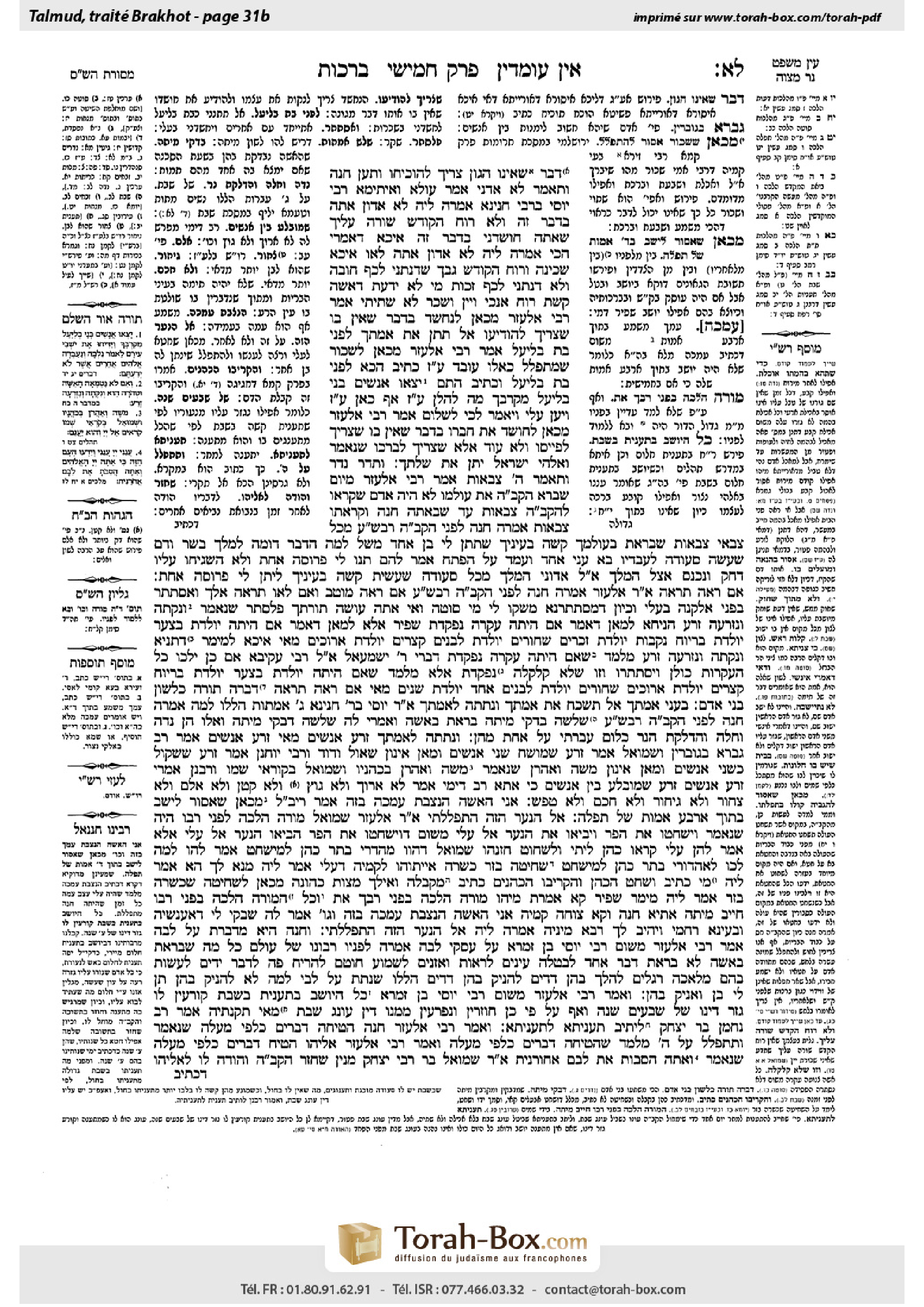
Berakhot 31b: Talmud study for Daf Yomi
Study the Talmud for Daf Yomi with scanned pages, Hebrew text, English translations from Sefaria and AI-generated French translations.
Passage selection and English or AI-generated French translation are available where the scan has annotations. Daf Study is independent of Torah-Box and Sefaria.
Browse Berakhot · ברכות · All tractatesBerakhot 31b text and translations
This page of Berakhot includes the Aramaic text, an English translation and an AI-generated French translation, alongside the scan above.
ברכות ל״א ב · Aramaic and Hebrew text
דָּבָר שֶׁאֵינוֹ הָגוּן, צָרִיךְ לְהוֹכִיחוֹ. ״וַתַּעַן חַנָּה וַתֹּאמֶר לֹא אֲדוֹנִי״. אָמַר עוּלָּא וְאִיתֵּימָא רַבִּי יוֹסֵי בְּרַבִּי חֲנִינָא: אֲמַרָה לֵיהּ: לֹא אָדוֹן אַתָּה בְּדָבָר זֶה, וְלֹא רוּחַ הַקּוֹדֶשׁ שׁוֹרָה עָלֶיךָ, שֶׁאַתָּה חוֹשְׁדֵנִי בְּדָבָר זֶה.
אִיכָּא דְאָמְרִי, הָכִי אֲמַרָה לֵיהּ: לֹא אָדוֹן אַתָּה? לָאו אִיכָּא שְׁכִינָה וְרוּחַ הַקּוֹדֶשׁ גַּבָּךְ, שֶׁדַּנְתַּנִי לְכַף חוֹבָה וְלֹא דַּנְתַּנִי לְכַף זְכוּת? מִי לָא יָדְעַתְּ דְּאִשָּׁה קְשַׁת רוּחַ אָנוֹכִי?!
״וְיַיִן וְשֵׁכָר לֹא שָׁתִיתִי״. אָמַר רַבִּי אֶלְעָזָר: מִכָּאן לַנֶּחְשָׁד בְּדָבָר שֶׁאֵין בּוֹ, שֶׁצָּרִיךְ לְהוֹדִיעוֹ.
״אַל תִּתֵּן אֶת אֲמָתְךָ לִפְנֵי בַּת בְּלִיָּעַל״. אָמַר רַבִּי אֶלְעָזָר: מִכָּאן לְשִׁכּוֹר שֶׁמִּתְפַּלֵּל, כְּאִילּוּ עוֹבֵד עֲבוֹדָה זָרָה. כְּתִיב הָכָא: ״לִפְנֵי בַּת בְּלִיַּעַל״, וּכְתִיב הָתָם: ״יָצְאוּ אֲנָשִׁים בְּנֵי בְלִיַּעַל מִקִּרְבֶּךָ״. מַה לְּהַלָּן עֲבוֹדָה זָרָה, אַף כָּאן עֲבוֹדָה זָרָה.
״וַיַּעַן עֵלִי וַיֹּאמֶר לְכִי לְשָׁלוֹם״, אָמַר רַבִּי אֶלְעָזָר: מִכָּאן לַחוֹשֵׁד אֶת חֲבֵרוֹ בְּדָבָר שֶׁאֵין בּוֹ, שֶׁצָּרִיךְ לְפַיְּיסוֹ. וְלֹא עוֹד, אֶלָּא שֶׁצָּרִיךְ לְבָרְכוֹ. שֶׁנֶּאֱמַר ״וֵאלֹהֵי יִשְׂרָאֵל יִתֵּן אֶת שֵׁלָתֵךְ״.
״וַתִּדֹּר נֶדֶר וַתֹּאמַר ה׳ צְבָאוֹת״, אָמַר רַבִּי אֶלְעָזָר: מִיּוֹם שֶׁבָּרָא הַקָּדוֹשׁ בָּרוּךְ הוּא אֶת עוֹלָמוֹ, לֹא הָיָה אָדָם שֶׁקְּרָאוֹ לְהַקָּדוֹשׁ בָּרוּךְ הוּא ״צְבָאוֹת״, עַד שֶׁבָּאתָה חַנָּה וּקְרָאַתּוּ ״צְבָאוֹת״.
אָמְרָה חַנָּה לִפְנֵי הַקָּדוֹשׁ בָּרוּךְ הוּא: רִבּוֹנוֹ שֶׁל עוֹלָם, מִכׇּל צִבְאֵי צְבָאוֹת שֶׁבָּרָאתָ בְּעוֹלָמְךָ קָשֶׁה בְּעֵינֶיךָ שֶׁתִּתֵּן לִי בֵּן אֶחָד?
מָשָׁל לַמָּה הַדָּבָר דּוֹמֶה — לְמֶלֶךְ בָּשָׂר וָדָם שֶׁעָשָׂה סְעוּדָה לַעֲבָדָיו. בָּא עָנִי אֶחָד וְעָמַד עַל הַפֶּתַח, אָמַר לָהֶם: תְּנוּ לִי פְּרוּסָה אַחַת! וְלֹא הִשְׁגִּיחוּ עָלָיו. דָּחַק וְנִכְנַס אֵצֶל הַמֶּלֶךְ. אָמַר לוֹ: אֲדוֹנִי הַמֶּלֶךְ, מִכׇּל סְעוּדָה שֶׁעָשִׂיתָ קָשֶׁה בְּעֵינֶיךָ לִיתֵּן לִי פְּרוּסָה אֶחָת?!
״אִם רָאֹה תִרְאֶה״, אָמַר רַבִּי אֶלְעָזָר: אָמְרָה חַנָּה לִפְנֵי הַקָּדוֹשׁ בָּרוּךְ הוּא: רִבּוֹנוֹ שֶׁל עוֹלָם, ״אִם רָאֹה״ — מוּטָב, וְאִם לָאו — ״תִּרְאֶה״.
אֵלֵךְ וְאֶסְתַּתֵּר בִּפְנֵי אֶלְקָנָה בַּעֲלִי, וְכֵיוָן דְּמִסְתַּתַּרְנָא מַשְׁקוּ לִי מֵי סוֹטָה, וְאִי אַתָּה עוֹשֶׂה תּוֹרָתְךָ פְּלַסְתֵּר, שֶׁנֶּאֱמַר ״וְנִקְּתָה וְנִזְרְעָה זָרַע״.
הָנִיחָא לְמַאן דְּאָמַר: אִם הָיְתָה עֲקָרָה — נִפְקֶדֶת, שַׁפִּיר, אֶלָּא לְמַאן דְּאָמַר, אִם הָיְתָה יוֹלֶדֶת בְּצַעַר יוֹלֶדֶת בְּרֶיוַח, נְקֵבוֹת יוֹלֶדֶת זְכָרִים שְׁחוֹרִים יוֹלֶדֶת לְבָנִים קְצָרִים יוֹלֶדֶת אֲרוּכִּים, מַאי אִיכָּא לְמֵימַר?
דְּתַנְיָא: ״וְנִקְּתָה וְנִזְרְעָה זָרַע״ — מְלַמֵּד שֶׁאִם הָיְתָה עֲקָרָה — נִפְקֶדֶת, דִּבְרֵי רַבִּי יִשְׁמָעֵאל. אָמַר לֵיהּ רַבִּי עֲקִיבָא: אִם כֵּן, יֵלְכוּ כׇּל הָעֲקָרוֹת כּוּלָּן וְיִסְתַּתְּרוּ, וְזוֹ שֶׁלֹּא קִלְקְלָה — נִפְקֶדֶת. אֶלָּא מְלַמֵּד שֶׁאִם הָיְתָה יוֹלֶדֶת בְּצַעַר — יוֹלֶדֶת בְּרֶיוַח, קְצָרִים — יוֹלֶדֶת אֲרוּכִּים, שְׁחוֹרִים — יוֹלֶדֶת לְבָנִים, אֶחָד — יוֹלֶדֶת שְׁנַיִם.
מַאי ״אִם רָאֹה תִרְאֶה״ — דִּבְּרָה תּוֹרָה כִּלְשׁוֹן בְּנֵי אָדָם.
״בָּעֳנִי אֲמָתֶךָ״. ״אַל תִשְׁכַּח אֶת אֲמָתֶךָ״. ״וְנָתַתָּה לַאֲמָתְךָ״.
אָמַר רַבִּי יוֹסֵי בְּרַבִּי חֲנִינָא: שָׁלֹשׁ אֲמָתוֹת הַלָּלוּ לָמָּה? — אָמְרָה חַנָּה לִפְנֵי הַקָּדוֹשׁ בָּרוּךְ הוּא: רִבּוֹנוֹ שֶׁל עוֹלָם, שְׁלֹשָׁה בִּדְקֵי מִיתָה בָּרָאתָ בָּאִשָּׁה, וְאָמְרִי לַהּ: שְׁלֹשָׁה דִּבְקֵי מִיתָה. וְאֵלּוּ הֵן: נִדָּה, וְחַלָּה וְהַדְלָקַת הַנֵּר. כְּלוּם עָבַרְתִּי עַל אַחַת מֵהֶן?! —
״וְנָתַתָּ לַאֲמָתְךָ זֶרַע אֲנָשִׁים״.
מַאי ״זֶרַע אֲנָשִׁים״? אָמַר רַב: גַּבְרָא בְּגוּבְרִין. וּשְׁמוּאֵל אָמַר: זֶרַע שֶׁמּוֹשֵׁחַ שְׁנֵי אֲנָשִׁים, וּמַאן אִינּוּן — שָׁאוּל וְדָוִד. וְרַבִּי יוֹחָנָן אָמַר: זֶרַע שֶׁשָּׁקוּל כִּשְׁנֵי אֲנָשִׁים, וּמַאן אִינּוּן — מֹשֶׁה וְאַהֲרֹן. שֶׁנֶּאֱמַר: ״מֹשֶׁה וְאַהֲרֹן בְּכֹהֲנָיו וּשְׁמוּאֵל בְּקוֹרְאֵי שְׁמוֹ״. וְרַבָּנַן אָמְרִי: ״זֶרַע אֲנָשִׁים״ — זֶרַע שֶׁמּוּבְלָע בֵּין אֲנָשִׁים.
כִּי אֲתָא רַב דִּימִי, אֲמַר לֹא אָרוֹךְ וְלֹא גּוּץ, וְלֹא קָטָן וְלֹא אַלָּם, וְלֹא צָחוֹר וְלֹא גִּיחוֹר, וְלֹא חָכָם וְלֹא טִפֵּשׁ.
״אֲנִי הָאִשָּׁה הַנִּצֶּבֶת עִמְּכָה בָּזֶה״, אָמַר רַבִּי יְהוֹשֻׁעַ בֶּן לֵוִי: מִכָּאן שֶׁאָסוּר לֵישֵׁב בְּתוֹךְ אַרְבַּע אַמּוֹת שֶׁל תְּפִלָּה.
״אֶל הַנַּעַר הַזֶּה הִתְפַּלָּלְתִּי״. אָמַר רַבִּי אֶלְעָזָר: שְׁמוּאֵל מוֹרֵה הֲלָכָה לִפְנֵי רַבּוֹ הָיָה. שֶׁנֶּאֱמַר: ״וַיִּשְׁחֲטוּ אֶת הַפָּר וַיָּבִיאוּ אֶת הַנַּעַר אֶל עֵלִי״. מִשּׁוּם דְּ״וַיִּשְׁחֲטוּ אֶת הַפָּר״ הֵבִיאוּ הַנַּעַר אֶל עֵלִי?
אֶלָּא, אָמַר לָהֶן עֵלִי: קִרְאוּ כֹּהֵן, לֵיתֵי וְלִשְׁחוֹט. חֲזַנְהוּ שְׁמוּאֵל דַּהֲווֹ מְהַדְּרִי בָּתַר כֹּהֵן לְמִישְׁחַט, אֲמַר לְהוּ: לְמָה לְכוּ לְאַהְדּוֹרֵי בָּתַר כֹּהֵן לְמִישְׁחַט? שְׁחִיטָה בְּזָר כְּשֵׁרָה! אַיְיתוּהוּ לְקַמֵּיהּ דְּעֵלִי. אֲמַר לֵיהּ: מְנָא לָךְ הָא? אֲמַר לֵיהּ: מִי כְּתִיב ״וְשָׁחַט הַכֹּהֵן״?! ״וְהִקְרִיבוּ הַכֹּהֲנִים״ כְּתִיב, מִקַּבָּלָה וְאֵילָךְ מִצְוַת כְּהוּנָּה, מִכָּאן לַשְּׁחִיטָה שֶׁכְּשֵׁרָה בְּזָר.
אֲמַר לֵיהּ: מֵימָר שַׁפִּיר קָא אָמְרַתְּ, מִיהוּ מוֹרֶה הֲלָכָה בִּפְנֵי רַבָּךְ אַתְּ, וְכׇל הַמּוֹרֶה הֲלָכָה בִּפְנֵי רַבּוֹ חַיָּיב מִיתָה. אָתְיָא חַנָּה וְקָא צָוְוחָה קַמֵּיהּ: ״אֲנִי הָאִשָּׁה הַנִּצֶּבֶת עִמְּכָה בָּזֶה וְגוֹ׳״. אֲמַר לַהּ: שִׁבְקִי לִי דְּאֶעֶנְשֵׁיהּ, וּבְעֵינָא רַחֲמֵי, וְיָהֵיב לָךְ רַבָּא מִינֵּיהּ. אֲמַרָה לֵיהּ: ״אֶל הַנַּעַר הַזֶּה הִתְפַּלָּלְתִּי״.
״וְחַנָּה הִיא מְדַבֶּרֶת עַל לִבָּהּ״. אָמַר רַבִּי אֶלְעָזָר מִשּׁוּם רַבִּי יוֹסֵי בֶּן זִמְרָא: עַל עִסְקֵי לִבָּהּ. אָמְרָה לְפָנָיו: רִבּוֹנוֹ שֶׁל עוֹלָם, כׇּל מַה שֶּׁבָּרָאתָ בָּאִשָּׁה, לֹא בָּרָאתָ דָּבָר אֶחָד לְבַטָּלָה: עֵינַיִם לִרְאוֹת, וְאׇזְנַיִם לִשְׁמוֹעַ, חוֹטֶם לְהָרִיחַ, פֶּה לְדַבֵּר, יָדַיִם לַעֲשׂוֹת בָּהֶם מְלָאכָה, רַגְלַיִם לְהַלֵּךְ בָּהֶן, דַּדִּים לְהָנִיק בָּהֶן. דַּדִּים הַלָּלוּ שֶׁנָּתַתָּ עַל לִבִּי לָמָּה? לֹא לְהָנִיק בָּהֶן?! תֵּן לִי בֵּן, וְאָנִיק בָּהֶן.
וְאָמַר רַבִּי אֶלְעָזָר מִשּׁוּם רַבִּי יוֹסֵי בֶּן זִמְרָא: כׇּל הַיּוֹשֵׁב בְּתַעֲנִית בְּשַׁבָּת קוֹרְעִים לוֹ גְּזַר דִּינוֹ שֶׁל שִׁבְעִים שָׁנָה. וְאַף עַל פִּי כֵן חוֹזְרִין וְנִפְרָעִין מִמֶּנּוּ דִּין עוֹנֶג שַׁבָּת.
מַאי תַּקַּנְתֵּיהּ? אָמַר רַב נַחְמָן בַּר יִצְחָק: לִיתֵּיב תַּעֲנִיתָא לְתַעֲנִיתָא.
וְאָמַר רַבִּי אֶלְעָזָר: חַנָּה הֵטִיחָה דְּבָרִים כְּלַפֵּי מַעְלָה. שֶׁנֶּאֱמַר ״וְתִתְפַּלֵּל עַל ה׳״, מְלַמֵּד שֶׁהֵטִיחָה דְּבָרִים כְּלַפֵּי מַעְלָה.
וְאָמַר רַבִּי אֶלְעָזָר: אֵלִיָּהוּ הֵטִיחַ דְּבָרִים כְּלַפֵּי מַעְלָה, שֶׁנֶּאֱמַר: ״וְאַתָּה הֲסִבֹּתָ אֶת לִבָּם אֲחֹרַנִּית״. אָמַר רַבִּי שְׁמוּאֵל בַּר רַבִּי יִצְחָק: מִנַּיִן שֶׁחָזַר הַקָּדוֹשׁ בָּרוּךְ הוּא וְהוֹדָה לוֹ לְאֵלִיָּהוּ,
Berakhot 31b · English translation
an unseemly matter, he must reprimand him, is derived. “And Hannah answered and she said no, my master, I am a woman of sorrowful spirit, and I have drunk neither wine nor liquor, but I pour out my soul before the Lord” (I Samuel 1:15). Regarding the words: “No, my master,” Ulla, and some say Rabbi Yosei, son of Rabbi Ḥanina, said that she said to him, in an allusion: With regard to this matter, you are not a master, and the Divine Spirit does not rest upon you, as you falsely suspect me of this.
Some say another version of her response. She said to him, questioning: Aren’t you a master? Aren’t the Divine Presence and Divine Spirit with you that you judged me to be guilty, and you did not judge me to be innocent? Didn’t you know that I am a woman of distressed spirit?
With regard to Hannah’s explanation that “I have drunk neither wine nor liquor,” Rabbi Elazar said: From here the halakha is derived that one who is suspected of something of which he is not guilty cannot suffice merely with the personal knowledge of his innocence, but must inform the one who suspects him that he is innocent and clear himself of suspicion.
“Do not take your maidservant as a wicked woman [bat beliya’al] for out of the abundance of my complaint and anger have I spoken until now” (I Samuel 1:16). Rabbi Elazar said: From here the halakha that when a drunk person prays it is as if he engaged in idol worship is derived as it is written here that Hannah, suspected of praying while drunk, defends herself and says: “Do not take your maidservant as a bat beliya’al”; and it is written there, with regard to a city that has been instigated to engage in idol worship: “Benei beliya’al have gone out from your midst and have lured the inhabitants of their city, saying let us go and serve other gods which we have not known” (Deuteronomy 13:14). By means of this verbal analogy it is derived: Just as there, in the case of the idolatrous city, the term beliya’al indicates idol worship, so too here, in the case of one who prays drunk, beliya’al indicates idol worship.
The verse continues: “And Eli answered and said: May you go in peace” (I Samuel 1:17). Rabbi Elazar said: From here the halakha is derived that one who suspects another of something that he has not done, he must appease him. Moreover, the one who suspected him must bless him, as Eli continued and offered Hannah a blessing, as it is stated: “And may the God of Israel grant your request that you have asked of Him” (I Samuel 1:17).
Incidental to this discussion of Hannah’s prayer, the Gemara explores related topics. In her prayer, Hannah said: “And she swore an oath and said, Lord of Hosts [Tzeva’ot] if You will indeed look upon the affliction of Your maidservant and remember me, and not forget Your maidservant and will give Your maidservant a male child, I will give him to the Lord all the days of his life, and there shall be no razor come upon his head” (I Samuel 1:11). Rabbi Elazar said: From the day that the Holy One, Blessed be He, created His world, there was no person who called the Holy One, Blessed be He, Lord of Hosts until Hannah came and called Him Lord of Hosts. This is the first time in the Bible that God is referred to by this name.
Rabbi Elazar explains that Hannah said before the Holy One, Blessed be He: Master of the Universe, are You not the Lord of the Hosts, and of all of the hosts and hosts of creations that You created in Your world, is it difficult in Your eyes to grant me one son?
The Gemara suggests a parable: To what is this similar? It is similar to a flesh and blood king who made a feast for his servants. A poor person came and stood at the door. He said to them: Give me one slice of bread! And they paid him no attention. He pushed and entered before the king. He said to him: My lord, the King, from this entire feast that you have prepared, is it so difficult in your eyes to give me a single slice of bread?
As for the double language in the verse, “if you will look upon [im ra’o tireh],” Rabbi Elazar said: Hannah said before the Holy One, Blessed be He: Master of the Universe, if You will look upon [ra’o] me now, fine, and if not, in any case You will see [tireh].
What was Hannah threatening? She said: I will go and seclude myself with another man before Elkana, my husband. Since I secluded myself, they will force me to drink the sota water to determine whether or not I have committed adultery. I will be found innocent, and since You will not make Your Torah false [pelaster], I will bear children. With regards to a woman who is falsely suspected of adultery and drank the sota water, the Torah says: “And if the woman was not defiled, but was pure, then she shall be acquitted and she shall conceive” (Numbers 5:28).
However, Rabbi Elazar’s opinion works out well according to the one who said that the verse means: If she were barren, she will be remembered by God and granted children. That works out well. But according to the one who said that the verse means that childbearing will be easier and more successful, i.e., if she had previously given birth with pain, she now gives birth with ease, or if she had previously given birth to daughters, she now gives birth to sons, or if she had previously given birth to black children, considered to be unattractive, she now gives birth to fair children, or if she had previously given birth to short, weak children, she gives birth to tall, strong children, what can be said?
As it was taught in a baraita that the tanna’im disputed the interpretation of the verse in Numbers: “Then she shall be acquitted and she shall conceive” teaches that if she was barren, she will be remembered by God and granted children; this is the statement of Rabbi Yishmael. Rabbi Akiva said to him: If so, all barren women will go and seclude themselves with men who are not their husbands, and any woman who did not commit the sin of adultery will be remembered by God and granted children. Rather, the verse teaches that this is merely a promise for greater ease in childbirth; if she has previously given birth with pain, she now gives birth with ease, if she has previously given birth to short children, she gives birth to tall children, if she has previously given birth to black children, she now gives birth to fair children, if she has previously given birth to one child, she now gives birth to two children.
According to Rabbi Akiva’s explanation, what is derived from the double language uttered by Hannah: Im ra’o tireh? The Torah spoke in the language of men, meaning that this double language is not extraordinary and nothing may be derived from it. It is common biblical vernacular.
In the oath/prayer uttered by Hannah, she refers to herself as “Your servant” [amatekha] three times: “The affliction of Your maidservant…and not forget Your maidservant and will give Your maidservant” (I Samuel 1:11).
Rabbi Yosei, son of Rabbi Ḥanina, said: Why are these three maidservants [amatot] cited in the verse? They are cited to teach that Hannah said before the Holy One, Blessed be He: Master of the Universe, You have created three crucibles potentially leading to death in a woman, where she is particularly vulnerable. Alternatively, some say: Master of the Universe, You have created three accelerants of death in a woman. They are mitzvot that, as a rule, pertain to women: Observing the halakhot of a menstruating woman, separating ḥalla from dough, and lighting Shabbat candles. Have I ever violated one of them? Hannah attests to her status as God’s maidservant [ama]. The reference to these three mitzvot is drawn from the etymological similarity between amatekha, your maidservant, and mita, death.
Later in her prayer, Hannah says: “And You will grant Your servant an offspring of men.”
The Gemara asks: What is the meaning of “an offspring of men”? Rav said: Hannah prayed for a man among men, a son who would be outstanding and exceptional. And Shmuel said: This expression means an offspring who will anoint two men to royalty. And who were they? Saul and David. And Rabbi Yoḥanan said: Hannah prayed that she would bear an offspring who would be the equivalent of two of the world’s greatest men. And who were they? Moses and Aaron. As it is stated: “Moses and Aaron among His priests, and Samuel among those who call His name” (Psalms 99:6). In this verse, Hannah’s son, Samuel, is equated to Moses and Aaron. And the Rabbis say: “An offspring of men”: Hannah prayed for an offspring who would be inconspicuous among men, that he would not stand out in any way.
The Gemara relates: When Rav Dimi came from Eretz Yisrael to Babylonia, he said in explanation: Hannah prayed that her son would not be conspicuous among men; neither too tall nor too short; neither too small nor too fat; neither too white nor too red; neither too smart nor too stupid.
When Hannah came to the Temple with her son Samuel, she told Eli: “My lord, as your soul lives, my lord, I am the woman who stood here with you to pray to the Lord” (I Samuel 1:26). Rabbi Yehoshua ben Levi said: From here the halakha that it is forbidden to sit within four cubits of one who is praying is derived. As the verse says: “Who stood here with you,” indicating that Eli stood alongside Hannah because she was praying.
Additionally, Hannah’s emphasis in speaking to Eli, “for this youth I prayed” (I Samuel 1:27), indicates that she came to protect him from danger. As Rabbi Elazar said: Samuel was one who taught halakha in the presence of his teacher. Hannah wanted to pray that he not be punished by death at the hand of Heaven for his transgression, as it is stated: “And they slaughtered the cow and they brought the youth to Eli” (I Samuel 1:25). This verse is puzzling. Because they slaughtered the cow, therefore, they brought the youth to Eli? What does one have to do with the next?
Rather, this is what happened: Eli said to those who brought the offering: Call a priest; he will come and slaughter the offering. Samuel saw them looking for a priest to slaughter the animal. He said to them: Why do you need to look for a priest to slaughter it? Slaughter of an offering performed by a non-priest is valid. They brought him before Eli to clarify his statement. Eli said to him: How do you know this? Samuel said to him: Is it written in the Torah: And the priest shall slaughter indicating that the offering may only be slaughtered by a priest? It is written: “And the priests shall offer,” only from the stage of receiving the blood in the bowls and onward is it a mitzva incumbent upon priests alone. From here the halakha that slaughter by a non-priest is acceptable is derived.
Eli said to Samuel: You have spoken well and your statement is correct, but nevertheless, you are one who issued a halakhic ruling in the presence of your teacher, and anyone who issues a halakhic ruling in the presence of his teacher, even if the particular halakha is correct, is liable for death at the hand of Heaven for showing contempt for his teacher. Hannah came and shouted before him: “I am the woman who stood here with you to pray to the Lord;” do not punish the child who was born of my prayers. He said to her: Let me punish him, and I will pray for mercy, that the Holy One, Blessed be He, will grant you a son who will be greater than this one. She said to him: “For this youth I prayed” and I want no other.
The Gemara continues to deal with Hannah’s prayer. It is said: “And Hannah spoke on her heart.” Several interpretations are offered to explain her use of the phrase “on her heart” instead of the common phrase to her heart (Maharsha). Rabbi Elazar said in the name of Rabbi Yosei ben Zimra: Hannah spoke to God concerning matters of her heart. She said before Him: Master of the Universe, of all the organs You created in a woman, You have not created one in vain. Every organ fulfills its purpose; eyes to see, ears to hear, a nose to smell, a mouth to speak, hands with which to perform labor, feet with which to walk, breasts with which to nurse. If so, these breasts that You placed upon my heart, to what purpose did You place them? Was it not in order to nurse with them? Grant me a son and I will nurse with them.
Tangentially, the Gemara also cites an additional statement that Rabbi Elazar said in the name of Rabbi Yosei ben Zimra: Anyone who sits in observance of a fast on Shabbat, his merit is great and they tear up and repeal his sentence of seventy years; because everyone is enjoying himself and a feast is prepared, it is more difficult to fast on Shabbat than on any other day. Nevertheless, they then hold him accountable for failing to fulfill the halakha of delight of Shabbat.
The Gemara asks: What is his remedy to atone and avoid punishment? Rav Naḥman bar Yitzḥak said: He must sit in observance of another fast on a weekday to atone for the fast on Shabbat.
After explaining the uncommon expression, on her heart, the Gemara cites an additional statement in the matter of Hannah. And Rabbi Elazar said: Hannah spoke impertinently toward God on High. As it is stated: “And she prayed onto the Lord,” as opposed to the common phrase: To the Lord. This teaches that she spoke impertinently toward on High.
And on a similar note, Rabbi Elazar said that Elijah spoke impertinently toward God on High as well in his prayer at Mount Carmel, as it is stated: “Answer me, Lord, answer me, that this people will know that You are the Lord, God, and You have turned their hearts backward” (I Kings 18:37), claiming that God caused Israel to sin. On this topic, Rabbi Shmuel bar Rabbi Yitzḥak said: From where do we know that the Holy One, Blessed be He, ultimately conceded to Elijah that he was correct?
Berakhot 31b · Traduction française (IA)
Une affaire indécente, il faut le réprimander, est dérivée. « Et Hannah répondit et elle dit non, mon maître, je suis une femme d'esprit triste, et je n'ai bu ni vin ni liqueur, mais je verse mon âme devant l'Éternel » (1 Samuel 1:15). Concernant les paroles : « Non, mon maître », Ulla, et certains disent Rabbi Yosei, fils de Rabbi Ḥanina, a dit qu'elle lui a dit, en allusion : En ce qui concerne cette affaire, vous n'êtes pas un maître, et l'Esprit divin ne repose pas sur vous, car vous soupçonnez faussement que je suis coupable de cela.
Certains disent une autre version de sa réponse. Elle lui a dit, en questionnant : N’es-tu pas un maître ? N’es-tu pas accompagné de la Présence divine et de l’Esprit divin que tu as jugé que j’étais coupable, et que tu n’as pas jugé que j’étais innocente ? N’étais-tu pas au courant que je suis une femme d’esprit tourmenté ?
Concernant l’explication de Hannah que « je n’ai bu ni vin ni liqueur », le Rabbi Elazar a dit : D’ici on dérive la halakha que celui qui est soupçonné d’une chose dont il n’est pas coupable ne peut se contenter de la connaissance personnelle de son innocence, mais doit informer celui qui le soupçonne qu’il est innocent et se décharger de ce soupçon.
« Ne prends pas ta servante pour une femme mauvaise [bat beliya’al], car c'est de l'abondance de ma plainte et de ma colère que j'ai parlé jusqu'à présent » (1 Samuel 1:16). Rabbi Elazar a dit : D'ici on dérive la halakha que lorsqu'une personne ivre prie, cela équivaut à un culte idolâtre. Il est écrit ici que Hannah, soupçonnée de prier en état d'ivresse, se défend et dit : « Ne prends pas ta servante pour une bat beliya’al » ; et il est écrit là, concernant une ville qui a été instigée à l'idolâtrie : « Les fils de beliya’al sont sortis de votre milieu et ont séduit les habitants de leur ville, disant : allons servir d'autres dieux que nous n'avons pas connus » (Deutéronome 13:14). Par analogie verbale, on dérive : tout comme là, dans le cas de la ville idolâtre, le terme beliya’al indique l'idolâtrie, ainsi ici, dans le cas d'une personne ivre qui prie, beliya’al indique l'idolâtrie.
Le verset continue : « Et Eli répondit et dit : Que tu ailles en paix » (1 Samuel 1:17). Rabbi Elazar a dit : D'ici on dérive la halakha que celui qui soupçonne un autre d'une chose qu'il n'a pas commise doit le rassurer. De plus, celui qui l'avait soupçonné doit le bénir, car Eli a continué et a offert à Hannah une bénédiction, comme il est dit : « Et que le Dieu d'Israël accorde à ta demande ce que tu as demandé à Lui » (1 Samuel 1:17).
En lien avec cette discussion sur la prière de Hannah, le Guemara explore des sujets connexes. Dans sa prière, Hannah dit : « Et elle jura un serment et dit, Seigneur des Armées [Tzeva’ot], si Tu regarderas effectivement la détresse de ta servante et Te souviendras de moi, et ne l'oublies pas, et Tu me donneras un fils, je lui donnerai à l'Éternel toute la vie, et il n'y aura pas de rasoir sur sa tête » (1 Samuel 1:11). Rabbi Elazar dit : Depuis le jour où l'Éternel, béni soit Son Nom, a créé Son monde, il n'y a pas eu de personne qui a appelé l'Éternel, béni soit Son Nom, Seigneur des Armées, jusqu'à Hannah qui est venue et l'a appelé ainsi. C'est la première fois dans la Bible que Dieu est désigné par ce nom.
Rabbi Elazar explique que Hannah a dit devant l'Éternel : Maître de l'Univers, ne suis-tu pas le Seigneur des Armées, et de toutes les armées de créations que Tu as créées dans ton monde, est-ce difficile à tes yeux de me donner un fils ?
Le Guemara suggère une parabole : À quoi cela ressemble-t-il ? Cela ressemble à un roi mortel qui a organisé un festin pour ses serviteurs. Un pauvre est venu et s'est tenu à la porte. Il a dit à ceux-ci : Donnez-moi une tranche de pain ! Et ils n'ont pas pris en compte. Il a poussé et est entré devant le roi. Il a dit à lui : Mon seigneur, le roi, de cette totalité de festin que tu as préparé, est-ce difficile à tes yeux de me donner une seule tranche de pain ?
Concernant la double expression dans la parole, « si Tu regarderas [im ra’o tireh] », Rabbi Elazar a dit : Hannah a dit devant le Saint, le Béni soit-Il : Maître de l'Univers, si Tu regarderas [ra’o] moi maintenant, c'est bon, et si non, en tout cas Tu verras [tireh].
Qu'était-ce que Hannah menaçait ? Elle a dit : Je vais me retirer avec un autre homme devant Elkana, mon mari. Depuis que j'ai été retenue, ils forceront à me faire boire l'eau de la sota pour déterminer si j'ai commis l'adultère. Je serai trouvée innocente, et puisque Tu ne fais pas faux ton Torah [pelaster], je donnerai des enfants. Concernant une femme qui est faussement soupçonnée d'adultère et qui a bu l'eau de la sota, la Torah dit : « Et si la femme n'était pas souillée, mais pure, alors elle sera acquittée et elle concevra » (Nombres 5:28).
Cependant, l'opinion de Rabbi Elazar s'aligne bien avec celui qui a dit que la parole signifie : Si elle était stérile, elle sera souvenue par Dieu et reçue des enfants. Cela s'aligne bien. Mais selon celui qui a dit que la parole signifie que la fécondité sera plus facile et plus réussie, c'est-à-dire si elle avait précédemment donné naissance avec douleur, elle donne naissance maintenant avec facilité, ou si elle avait précédemment donné naissance à des filles, elle donne naissance maintenant à des fils, ou si elle avait précédemment donné naissance à des enfants noirs, considérés comme peu attrayants, elle donne naissance maintenant à des enfants beaux, ou si elle avait précédemment donné naissance à des enfants courts et faibles, elle donne naissance maintenant à des enfants grands et forts, que peut-on dire ?
Comme il a été enseigné dans une baraïta, les tannaïm discutaient de l'interprétation de la parole du Lévitique : « Elle sera déclarée innocente et elle concevra » ; cela enseigne que si elle était stérile, elle sera souvenue par Dieu et lui sera donnée des enfants ; c'est la déclaration du Rabbi Yishmael. Le Rabbi Akiva lui répondit : Si c'est ainsi, toutes les femmes stériles iront se retirer avec des hommes qui ne sont pas leurs maris, et toute femme qui n'a pas commis le péché d'adultère sera souvenue par Dieu et lui sera donnée des enfants. En réalité, la parole enseigne que c'est simplement une promesse pour un accouchement plus facile ; si elle a déjà donné naissance avec douleur, elle accouche maintenant avec facilité, si elle a déjà donné naissance à des enfants petits, elle accouche maintenant d'enfants grands, si elle a déjà donné naissance à des enfants noirs, elle accouche maintenant d'enfants beaux, si elle a déjà donné naissance à un seul enfant, elle accouche maintenant de deux enfants.
Selon l'explication du Rabbi Akiva, qu'en déduit-on de la double expression utilisée par Hannah : « Im ra’o tireh » ? La Torah parle dans la langue des hommes, ce qui signifie que cette double expression n'est pas extraordinaire et qu'on ne peut en déduire rien. C'est un langage biblique courant.
Dans la prière prononcée par Hannah, elle se réfère à elle-même comme « Votre servante » [amatekha] trois fois : « La souffrance de Votre servante… et ne négligez pas Votre servante et donnez Votre servante » (I Samuel 1:11).
Le Rabbi Yosei, fils du Rabbi Ḥanina, dit : Pourquoi ces trois servantes [amatot] sont-elles citées dans la parole ? Elles sont citées pour enseigner que Hannah a dit devant le Saint, béni soit-Il : Seigneur du Monde, Tu as créé trois fours potentiels menant à la mort dans une femme, où elle est particulièrement vulnérable. D'autres disent : Seigneur du Monde, Tu as créé trois accélérateurs de mort dans une femme. Elles sont des commandements qui, en général, concernent les femmes : l'observation des halakhot d'une femme en période de ménstruation, la séparation de la ḥalla du pain, et l'allumage des bougies du Shabbat. Ai-je jamais violé l'un d'entre eux ? Hannah atteste de son statut de servante de Dieu [ama]. La référence à ces trois commandements provient de la similitude étymologique entre amatekha, ta servante, et mita, mort.
Plus tard dans sa prière, Hannah dit : « Et Tu donneras à Ta servante un descendant d'hommes. »
La Guemara demande : Quelle est la signification de « un descendant d'hommes » ? Rav dit : Hannah pria pour un homme parmi les hommes, un fils exceptionnel et remarquable. Et Shmuel dit : cette expression signifie un descendant qui accélérerait la royauté de deux hommes. Et qui étaient-ils ? Saul et David. Et le Rabbi Yoḥanan dit : Hannah pria pour un descendant qui serait équivalent à deux des plus grands hommes du monde. Et qui étaient-ils ? Moïse et Aaron. Comme il est dit : « Moïse et Aaron parmi Ses prêtres, et Samuel parmi ceux qui invoquent Son nom » (Psaumes 99:6). Dans cette parole, le fils de Hannah, Samuel, est équivalent à Moïse et Aaron. Et les Rabbins disent : « Un descendant d'hommes » : Hannah pria pour un descendant qui serait discret parmi les hommes, qui ne se distinguerait en aucun point.
La Guemara rapporte : Quand Rav Dimi est venu de la Terre d'Israël vers Babylone, il expliqua : Hannah pria afin que son fils ne se distingue pas parmi les hommes ; ni trop grand ni trop petit ; ni trop petit ni trop gros ; ni trop blanc ni trop roussâtre ; ni trop intelligent ni trop stupide.
Quand Hannah est venue au Temple avec son fils Samuel, elle a dit à Eli : « Mon seigneur, par ton âme, je suis la femme qui est venue ici avec toi prier le Seigneur » (I Samuel 1:26). Le Rabbi Yehoshua ben Levi dit : d'ici on déduit la halakha selon laquelle il est interdit de s'asseoir à quatre coudées d'une personne qui prie. Comme la parole dit : « Qui est venue ici avec toi », indiquant que Eli était debout à côté de Hannah parce qu'elle priait.
De plus, l'accent mis par Hannah dans sa parole à Eli, « pour ce jeune homme je priai » (I Samuel 1:27), indique qu'elle voulait le protéger contre les dangers. Comme le Rabbi Elazar dit : Samuel était celui qui enseignait la halakha en présence de son maître. Hannah voulait prier afin qu'il ne soit pas puni par la main du Ciel pour son péché, comme il est dit : « Et ils ont tué la vache et ils ont amené le jeune homme à Eli » (I Samuel 1:25). Cette parole est énigmatique. Parce qu'ils ont tué la vache, donc, ils ont amené le jeune homme à Eli ? Quel lien y a-t-il entre ces deux versets ?
En réalité, ceci s'est produit : Eli dit à ceux qui apportaient l'offrande : Appelle un prêtre ; il viendra et tuera l'offrande. Samuel vit qu'ils cherchaient un prêtre pour tuer l'animal. Il dit à eux : Pourquoi cherchez-vous un prêtre pour tuer cela ? La mise à mort d'une offrande par un non-prêtre est valide. Ils l'apportèrent devant Eli pour clarifier sa déclaration. Eli dit à lui : Comment sais-tu cela ? Samuel dit à lui : Est-il écrit dans la Torah : « Et le prêtre tuera », indiquant que l'offrande ne peut être tuée que par un prêtre ? Il est écrit : « Et les prêtres offriront », seulement à partir de la phase de réception du sang dans les coupes et ensuite c'est un commandement propre aux prêtres uniquement. D'ici on déduit la halakha que la mise à mort par un non-prêtre est acceptable.
Eli dit à Samuel : Tu as parlé bien et ta déclaration est correcte, mais néanmoins, tu es celui qui a émis une décision halakhique en présence de ton maître, et celui qui émet une décision halakhique en présence de son maître, même si la halakha est correcte, est puni par la main du Ciel pour montrer le mépris envers son maître. Hannah vint et cria devant lui : « Je suis la femme qui est venue ici avec toi prier le Seigneur » ; ne punis pas l'enfant né de mes prières. Il dit à elle : Laisse-moi le punir, et je prierai pour la miséricorde, que le Saint, béni soit-Il, accorde à toi un fils plus grand que celui-ci. Elle dit à lui : « Pour ce jeune homme je priai » et je veux un autre.
La Guemara continue à traiter de la prière de Hannah. On dit : « Et Hannah parla sur son cœur. » Plusieurs interprétations sont données pour expliquer son utilisation de la formule « sur son cœur » plutôt que la formule courante « à son cœur » (Maharsha). Rabbi Elazar, en nom de Rabbi Yosei ben Zimra, dit : Hannah parla à Dieu concernant les affaires de son cœur. Elle dit devant Lui : Seigneur de l'Univers, de tous les organes que Tu as créés chez la femme, Tu n'en as pas créé un en vain. Chaque organe remplit son office ; les yeux pour voir, les oreilles pour entendre, le nez pour sentir, la bouche pour parler, les mains pour accomplir le travail, les pieds pour marcher, les seins pour allaiter. Si tel est le cas, ces seins que Tu as placés sur mon cœur, à quel usage les as-Tu placés ? N'était-ce pas pour allaiter ? Accorde-moi un fils et je les utiliserai pour allaiter.
En guise de parenthèse, la Guemara cite également une autre déclaration que Rabbi Elazar a faite en nom de Rabbi Yosei ben Zimra : Celui qui jeûne le sabbat en observant la prière, sa mérite est grande et on annule et révoque sa sentence de soixante-dix ans ; car tout le monde s'amuse et un festin est préparé, il est plus difficile de jeûner le sabbat que n'importe quel autre jour. Cependant, on le tient alors responsable de n'avoir pas accompli la halakha de la joie du sabbat.
La Guemara demande : Quel est son remède pour expier et éviter la punition ? Rav Naḥman bar Yitzḥak dit : Il doit observer un autre jeûne un jour de semaine pour expier le jeûne du sabbat.
Après avoir expliqué l'expression inhabituelle « sur son cœur », la Guemara cite une autre déclaration concernant Hannah. Et Rabbi Elazar dit : Hannah a parlé impudemment à Dieu au-dessus de lui. Comme il est dit : « Et elle pria sur l'Éternel », contrairement à la formule courante : « à l'Éternel ». Cela enseigne qu'elle a parlé impudemment à l'au-dessus.
Et sur un sujet similaire, Rabbi Elazar dit que Elie a parlé impudemment à Dieu au-dessus de lui également dans sa prière sur la montagne de Carmel, comme il est dit : « Réponds-moi, Éternel, réponds-moi, afin que ce peuple sache que Tu es l'Éternel, le Dieu, et Tu as retourné leurs cœurs en arrière » (I Rois 18:37), affirmant que Dieu a causé à Israël le péché. À ce sujet, Rabbi Shmuel bar Rabbi Yitzḥak dit : D'où savons-nous que l'Éternel, béni soit Il, a finalement cédé à Elie qu'il avait raison ?
Traduction française générée par IA à partir de l’édition anglaise de Sefaria. Vérifie toujours un passage avec le texte source.
Text from Sefaria: William Davidson Edition - Vocalized Aramaic (CC BY NC); William Davidson Edition - English (CC BY NC).